
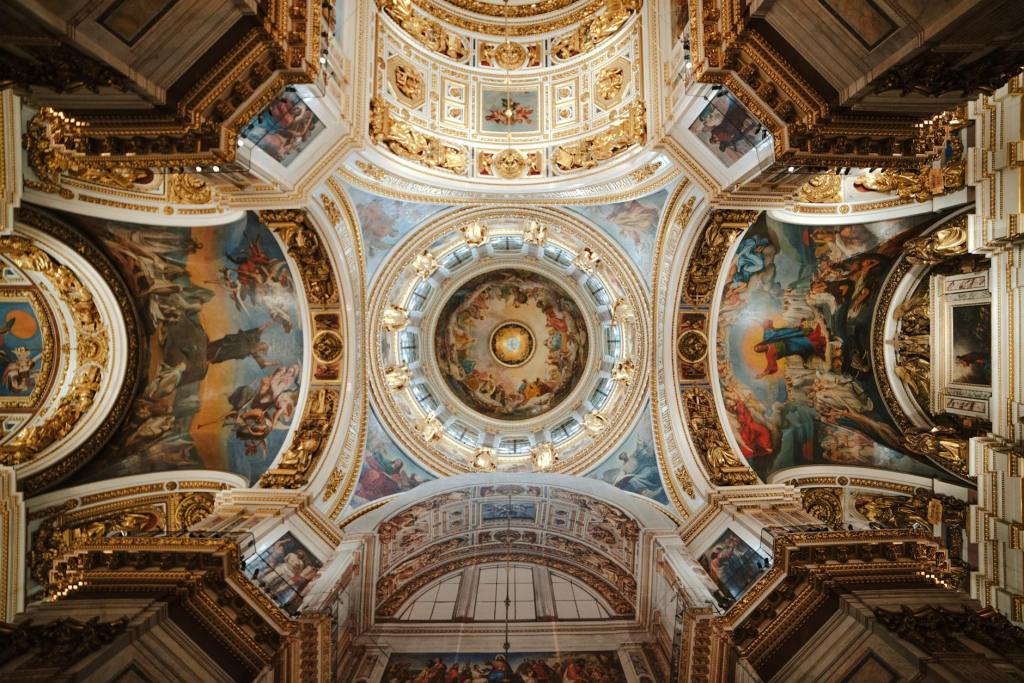
Have you ever noticed how different churches look?
Step into an Eastern Orthodox church and you are surrounded by icons, gold backgrounds, candles, and images of saints gazing down from every wall. Enter a Roman Catholic cathedral and you may find statues, stained glass, paintings, and the Stations of the Cross guiding you through the story of Christ’s suffering. Walk into many Protestant churches, however, and the experience is very different. The walls may be nearly bare. Perhaps there is only a cross, a pulpit, and rows of chairs facing forward.
The contrast can be striking. One tradition appears richly adorned, even overwhelming to the senses. Another feels almost intentionally minimalist. Somewhere between those two extremes lies a whole spectrum of approaches to sacred space.
For many years I assumed I knew the reason. Growing up in an evangelical context, I was taught to be suspicious of religious images. Icons, statues, and elaborate decorations were often presented as dangerous, things that could easily slip into idolatry. I remember a pastor or teacher (I honestly cannot recall which one) trying to be helpful by explaining that all those decorations in Catholic churches were essentially examples of idolatry. The message was simple: Protestants avoided these things because we wanted to stay faithful to the Bible.
It sounded convincing at the time. Over time I came to realize that explanation was not only overly simplistic, it was also uncharitable. As Christians we are warned not to bear false witness about our neighbors, and those kinds of remarks did not fairly represent what other Christians actually believe or practice. The Christians who filled those churches with icons and images were not attempting to replace God with statues. Something deeper was going on.
Perhaps you have wondered the same thing. Why do some churches surround worshippers with images while others avoid them almost entirely? Are icons and religious art inherently idolatrous? Do some Christians believe these objects carry supernatural power? Or is something else happening beneath the surface?
As it turns out, the answer lies in a long and fascinating history, one that stretches back more than a thousand years and touches on some of the deepest questions in Christian theology. But I suspect the real issue may not be exactly what either side in those debates thought it was. My growing conviction is that the argument has often been framed the wrong way often reduced to a choice between idolatry on one side and supernatural power on the other. I think there is another way to understand icons, sacred art, and even relics, one that many Christians across traditions might find surprisingly reasonable. Before we get there, though, it helps to understand the historical debate that shaped why our churches look so different today.
Historic Background
The Lord spoke to Moses. See, I have called by name Bezalel son of Uri son of Hur, of the tribe of Judah and I have filled him with divine spirit, with ability, intelligence, and knowledge in every kind of craft, to devise artistic designs, to work in gold, silver, and bronze, in cutting stones for setting, and in carving wood, in every kind of craft. – Ex 31:1–5 (NRSV)
To understand why churches today look so different, we need to step back more than a thousand years into one of the most significant theological debates in Christian history. The question that sparked the controversy was deceptively simple: Can Christians use images of Christ and the saints without committing idolatry? Beneath that question, however, were deeper concerns about the nature of Christ, the relationship between matter and the divine, and the difference between honoring something and worshiping it. Christians on all sides of this debate were trying to protect important truths about the faith, and their concerns deserve to be understood with charity.
Early Christian Art (1st–4th Centuries)
From the beginning, Christianity developed in a world where visual imagery was common. Literacy rates were low in the ancient world, so images often served as powerful teaching tools. Archaeology shows that early Christians did use visual symbols and artwork. Catacomb paintings in Rome and early mosaics found in places such as Megiddo depict biblical scenes and Christian symbols like the fish, the Good Shepherd, and the cross. These images were not treated as objects of worship but as reminders of the story of Christ and the truths of the gospel.
Augustine later described this kind of symbolism using the language of signs. In his theology, a sign (Latin: signum) is something that points beyond itself to the deeper reality it represents (res). A symbol is not the thing itself; rather, it directs our attention toward the thing. This distinction between a symbol and the reality it represents would become very important in later debates about religious images.
The Iconoclast Controversy (726–843)
The most intense debate about religious images occurred in the Byzantine Empire during the eighth and ninth centuries. Historians refer to this conflict as the Iconoclast Controversy. The word iconoclast literally means “image breaker.”
Byzantine Emperor Leo III took a public stand against icons in 726, and their use was officially prohibited by 730. Many Christians supported this decision because they believed icons had begun to be treated as sacred objects rather than as reminders of spiritual truths. Their concerns were rooted in the Second Commandment, which forbids the making of “graven images” (Exodus 20:4). They feared that ordinary believers might begin to treat images themselves as objects of worship.
Iconoclasts also raised serious Christological concerns. Christology is the theological study of the nature of Jesus Christ. Orthodox Christian teaching holds that Jesus is both fully God and fully human, a doctrine known as the hypostatic union (Latin: unio hypostatica). Iconoclasts asked an important question: if Christ possesses both a divine and human nature, what exactly is an icon depicting? If an image shows only Christ’s humanity, does it separate his human and divine natures? If it attempts to represent his divinity, is that even possible? For many iconoclasts, the safest approach was simply to avoid religious images altogether.
Opposing them were the iconodules, or defenders of icons. One of the most important voices on this side was John of Damascus (c. 675–749). His argument centered on the doctrine of the Incarnation (Latin: incarnatio), the Christian belief that God truly became human in Jesus Christ. If God took on visible, physical flesh, John reasoned, then depicting Christ’s human form could not be inherently wrong.
John also clarified an important distinction between two different kinds of honor:
- Latria (Greek: λατρεία) – worship that belongs to God alone
- Proskynesis (Greek: προσκύνησις) – veneration or honor shown to someone or something worthy of respect
According to the iconodules, icons were to receive veneration, not worship. A famous phrase emerged from this debate: “The honor given to the image passes to the prototype.” In other words, respect shown toward an icon is directed toward the person represented, not toward the object itself. Images were often defended in the West as aids for instruction, sometimes summarized by the phrase ‘books for the illiterate.’ They saw the icons as helping believers remember the stories and truths of the faith.
The debate reached a major turning point in 787 at the Second Council of Nicaea, the seventh ecumenical council of the church. The council ruled that icons could be used in churches and venerated, but not worshiped. This decision restored icons to the Byzantine church.
The controversy did not end immediately. A second period of iconoclasm occurred between 815 and 843, but in 843 icons were permanently restored in what the Eastern Church still celebrates as the Triumph of Orthodoxy. From that point forward, icons became a central feature of Eastern Orthodox worship. They were often described as “windows into heaven,” visual reminders of the spiritual realities they represent.
The Western Church
While the controversy unfolded in the Byzantine East, the Western church generally supported the use of images, although it framed the issue somewhat differently. In the West, images were often defended primarily as didactic tools, that is, aids for teaching the faith. Stained glass windows, statues, and paintings helped communicate the story of Scripture to people who could not read. Over time, Western Christianity developed an extraordinarily rich artistic tradition. Medieval cathedrals themselves became visual sermons in stone and glass, filled with imagery meant to teach and inspire.
The Protestant Reformation (16th Century)
Nearly seven centuries later, the debate resurfaced during the Protestant Reformation. Some reformers believed that the medieval church had allowed images and relics to take on too much spiritual significance. In certain places relics were believed to possess miraculous powers, and relic collecting had sometimes become entangled with questionable financial practices. Reformers worried that these developments had drifted into superstition.
Different reformers responded in different ways.
- Huldrych Zwingli (1484–1531) led reforms in Switzerland that removed religious images from churches entirely.
- John Calvin (1509–1564) argued that attempts to depict God inevitably distort the divine nature. His thinking contributed to what later became known as the Regulative Principle of Worship, the idea that Christian worship should include only practices explicitly authorized by Scripture.
- Martin Luther (1483–1546) took a more moderate position, allowing religious art as long as it was not worshiped and was used for teaching.
Because of these different theological instincts, Protestant churches developed very different visual traditions over time:
- Reformed traditions (Calvinist, Presbyterian, Puritan) tended to remove most religious imagery.
- Lutheran churches generally retained paintings, crucifixes, and stained glass.
- Anglican churches kept many traditional artistic elements while simplifying other aspects of worship.
- Many evangelical churches adopted a minimalist aesthetic, sometimes influenced by Reformed instincts about worship and imagery.
As a result, many Protestant churches came to emphasize preaching, Scripture reading, and congregational singing as the central elements of worship, and the physical spaces themselves often reflected that focus.
A Debate About Protecting the Faith
When we look back at this long history, it becomes clear that the debate was never merely about decorations. The deeper issue was how Christians should protect and express important truths about God.
Some Christians were primarily concerned with protecting God’s transcendence and avoiding anything that might lead to idolatry. Others were concerned with affirming the reality of the Incarnation and the goodness of the material world God created. Both concerns were sincere and rooted in important theological convictions.
And yet, as we will see, the way the debate has often been framed of being between idolatry on one side and supernatural power on the other, may have missed something important.
Biblical Theology of Imagery
Before the later historical debates about icons, relics, and church decoration, the Bible itself already provides an important framework for thinking about images. Scripture does not present a simple prohibition of all visual representation. Instead, it draws a careful distinction between idolatry and symbolic imagery. Understanding that distinction helps clarify why Christians across history have interpreted the role of images differently.
The Second Commandment
The concern most often raised in discussions about religious imagery comes from the Second Commandment. In Exodus 20, God commands Israel not to make carved images and not to bow down to them. The commandment warns against creating idols and worshiping them as if they were divine.
Some iconoclast and Reformed traditions interpret the Second Commandment more strictly, arguing that it prohibits not only the worship of images but also their use in religious devotion, particularly in representing God or Christ. They contend that even well-intended imagery can distort true worship or lead the human heart toward idolatry, and therefore should be excluded from the life of the church.
What is often overlooked, however, is that the commandment targets idolatry, not imagery itself. The prohibition is directed against making images for the purpose of worship, particularly images that claim to represent God or function as substitutes for Him. The issue is misplaced devotion. In other words, the biblical concern is not simply the presence of images, but the misdirection of worship.
Seen in this light, the disagreement is not about whether idolatry is dangerous, on that point there is broad agreement, but about how best to guard against it. Some choose to draw the boundary tightly, removing imagery altogether to prevent misuse. Others see room for a more nuanced approach, one that distinguishes between worship and symbol, between devotion and reminder. The question, then, is not simply whether images exist, but how they function in the life of the believer specifically whether they draw the heart toward God or subtly replace Him.
The commandment forces a question that goes beyond objects and into the heart: what do we ultimately trust, honor, and love? With that question in view, the issue shifts from the mere presence of imagery to the role it plays in shaping devotion, a theme that becomes clearer as we look at the broader witness of Scripture.
God Commands Religious Imagery
Shortly after giving the Ten Commandments, God instructed Israel to include artistic imagery within the very center of their worship space. In Exodus 25, God commands the construction of the Ark of the Covenant, which included two sculpted cherubim positioned above the mercy seat. These figures were placed inside the Holy of Holies, the most sacred location in Israel’s worship.
Similarly, Exodus 26 describes the design of the tabernacle curtains, which were embroidered with images of cherubim. These artistic designs were part of the sacred environment where Israel encountered God.
Later, when Solomon’s Temple was constructed, the use of imagery expanded even further. According to 1 Kings 6–7, the temple walls and furnishings included elaborate carvings and decorations. Among the images described in the temple were:
- Cherubim
- Palm trees
- Flowers and natural imagery
These artistic elements were not treated as objects of worship. Rather, they served as symbolic elements within the sacred space, reflecting themes of creation, heaven, and divine presence. Taken together, these passages demonstrate that the Bible itself distinguishes between two very different uses of images:
- Idolatry – forbidden worship of created images as divine.
- Symbolic imagery – permitted artistic representation used within worship and sacred space.
Symbolic Objects as Reminders
The Old Testament also contains examples of physical objects used as reminders of God’s actions in history. These objects functioned as memory markers, helping the community remember what God had done.
One example appears in Joshua 4, where the Israelites set up memorial stones after crossing the Jordan River. The stones served as a visible reminder of God’s deliverance. When future generations asked about the stones, they would hear the story of what God had done.
Another example is the bronze serpent described in Numbers 21. When the Israelites were suffering from venomous snake bites, God instructed Moses to place a bronze serpent on a pole. Those who looked at it in faith were healed. The object itself had no magical power; it functioned as a symbol directing attention toward God’s healing.
Interestingly, the bronze serpent later became an idol when people began burning incense to it. At that point, King Hezekiah destroyed it (2 Kings 18:4). This episode provides a clear biblical pattern: a symbolic object can be legitimate when it points toward God, but it must be removed if it becomes an object of misplaced devotion.
Visual Symbolism in Scripture
Beyond physical objects, the Bible itself frequently communicates through visual imagery. Much of Scripture invites the reader to imagine symbolic scenes and pictures. Examples include:
- Prophetic symbolism, such as the symbolic actions of the prophets.
- Parables, where Jesus teaches through vivid narrative images.
- Apocalyptic visions, such as the symbolic imagery found in the books of Daniel and Revelation.
These forms of communication engage what we might call the moral imagination, the human capacity to picture realities that shape belief and behavior. In this sense, the biblical narrative is already saturated with imagery and symbolic language.
Idols in the New Testament: Objects Without Divine Reality
The New Testament adds another important layer to this discussion. The Apostle Paul directly addresses the nature of idols and makes a striking claim: idols themselves have no real existence as divine beings. They are physical objects made from ordinary materials, not gods.
In 1 Corinthians 8:4, Paul writes:
“We know that an idol is nothing at all in the world and that there is no God but one.”
This is one of the clearest statements in Scripture about the nature of idols. The carved object itself has no divine reality behind it. It is simply matter shaped by human hands.
Paul makes a similar point in Galatians 4:8, reminding believers that before they knew God they were enslaved to beings that “by nature are not gods.” In other words, the objects of pagan worship do not possess true divinity. The same theme appears elsewhere in Scripture. Revelation 9:20 describes idols made of gold, silver, bronze, stone, and wood that “cannot see or hear or walk.” This echoes the Old Testament prophets, who often mocked idols as lifeless objects incapable of action or awareness.
Taken together, these passages emphasize an important biblical principle: the physical object itself is not the real issue. An idol made of stone or wood does not possess supernatural power. It is simply a material object. This observation becomes especially relevant when discussing religious imagery. If idols themselves are nothing more than carved material, then icons or religious art are also simply material objects. The real theological concern cannot be the physical object alone.
Paul’s Warning About Idolatry
Yet Paul immediately adds an important warning. Even though idols themselves are nothing, idolatry can still carry spiritual danger.
In 1 Corinthians 10:19–20, Paul asks rhetorically:
“Do I mean that food sacrificed to an idol is anything, or that an idol is anything? No.”
But he continues by explaining that pagan sacrifices are offered to demons rather than to God. The idol itself has no power, but the worship directed through it can lead people into false spiritual allegiances. This distinction is important. The danger does not lie in the wood, stone, or metal of the object. The danger lies in the human heart assigning divine significance to something that is not God.
This biblical perspective reinforces the central distinction that runs throughout Scripture: the problem is not the existence of images or objects themselves, but the misdirection of worship. When an object is treated as a god, it becomes an idol. When it functions merely as a reminder or symbol pointing beyond itself, it occupies a very different category.
This distinction will become important as we return to the historical debates about icons and sacred art.
Early Christian Art
The earliest Christians continued this pattern of visual symbolism. Archaeological discoveries reveal that early Christian communities used artistic imagery to communicate the faith.
Examples include:
- Catacomb paintings in Rome, depicting scenes such as the Good Shepherd, Jonah and the whale, and the resurrection.
- Early Christian mosaics, which decorated worship spaces with biblical themes.
- The Megiddo church mosaic in Israel, one of the earliest known church mosaics, which includes Christian inscriptions and symbolic imagery.
These images functioned as visual theology. They were not objects of worship but tools for teaching and remembering the story of Christ. In a world where many believers could not read, such imagery helped communicate the central truths of the gospel.
Seen in this light, the Christian tradition of sacred imagery did not arise in opposition to Scripture. Rather, it developed within a biblical pattern in which physical symbols and visual reminders helped direct the hearts and minds of believers toward the reality of God.
The Shared Assumption Behind the Historical Debates
When we step back and look at the long history of debates over icons, art, and relics, something interesting emerges. Although the different traditions disagreed sharply with one another, they often shared the same underlying assumption about what sacred objects are and how they function.
One common way these debates have been framed is around power and danger, even though the historical conversations were much richer, involving questions about Christ, the sacraments, and how people are formed in the faith. Within that simplified frame, sacred objects were often seen in one of two ways: either as participating in spiritual reality or as dangerously close to idolatry. The result was a tendency to reduce the issue to a sharp either–or.
- Some traditions associated with iconodule theology believed sacred images could mediate spiritual realities in a meaningful way. While careful distinctions were made between worship and veneration, icons were sometimes described as participating in the holy realities they represented.
- Other traditions associated with iconoclasm, particularly within certain streams of the Protestant Reformation, feared that any sacred image might encourage idolatry. Because human beings are prone to misdirect worship, removing such objects from worship spaces was seen as the safest course.
Despite their differences, both sides tended to frame the issue around the same central question:
Do sacred objects possess spiritual power?
If the answer was yes, then the objects could be used as part of Christian devotion. If the answer was no, then they were often seen as spiritually dangerous or misleading.
But what if that is the wrong question?
What if sacred objects were never meant to be understood as possessing metaphysical power in the first place? What if their true function lies somewhere else entirely?
In this respect, Augustine of Hippo may offer a more helpful framework. Augustine developed a sophisticated theory of symbols and meaning that can shed light on how religious imagery might function without requiring supernatural power.
Augustine distinguished between two related concepts:
- Sign (signum) – something that points beyond itself to another reality
- Thing signified (res) – the reality to which the sign points
A sign is not the reality itself. Its purpose is to direct attention toward something beyond itself. Words function this way. So do symbols. So do many of the physical reminders we encounter in daily life. A simple modern example appears every time we use a computer. The small icon on a desktop is not the application itself. It is a visual sign that points to the real program stored elsewhere in the system. When we click the icon, it directs us to the application. But if the program has been uninstalled, clicking the icon does nothing, because the icon itself has no power. It only functions as a pointer to the reality behind it. In much the same way, symbolic objects in religious life can function as signs that direct attention beyond themselves to the deeper realities they represent.
Applied to sacred imagery, Augustine’s insight suggests a different way of understanding religious art. Icons, paintings, and other symbolic objects can function as signs that point beyond themselves to theological truths. They remind believers of Christ, the saints, or the story of redemption. They do not contain divine power, nor do they replace God.
Idolatry occurs when the relationship between sign and reality is reversed. Instead of allowing the sign to direct attention toward the reality it represents, a person begins to treat the sign itself as the ultimate object of devotion. In Augustine’s framework, the problem is not the existence of the sign but confusing the sign with the reality.
If this is correct, then sacred art may occupy a legitimate place within Christian practice, not as an object of supernatural power, but as a form of symbolic mediation that directs the mind and heart toward God.
This raises an important question.
If images and symbols function primarily as signs, why do human beings seem so drawn to them in the first place?
Sacred Imagery as Pedagogy and Formation
My thesis is simple: icons, relics, and sacred art can play a legitimate role in Christian life when they function as signs that direct attention toward deeper spiritual realities rather than as objects of supernatural power. When understood properly, these objects can actually help believers grow in faith. They do this in at least two important ways. First, they serve as pedagogical tools, teaching theological truths visually. Second, they contribute to psychological and spiritual formation by shaping what we pay attention to and what we learn to desire.
Sacred Art as Learning Tools (Pedagogy)
For most of Christian history, literacy was not widespread. Many believers could not read Scripture for themselves, so churches developed visual ways of communicating the story of redemption. Sacred art often functioned as visual catechesis, a way of teaching the faith through images.
Church architecture and decoration were often intentionally designed to tell the biblical story. Examples include:
- Stained glass windows depicting scenes from the life of Christ or the saints
- Fresco cycles covering church walls with biblical narratives
- Icons representing key theological truths about Christ, Mary, and the saints
- The Stations of the Cross, which visually guide believers through the events of Christ’s passion
These visual forms of storytelling helped believers remember the gospel narrative and understand theological truths. In this sense, sacred art functioned much like a visual sermon. It communicated ideas that words alone might not convey as powerfully.
Psychological Formation and the Power of Images
There is also a second dimension that modern psychology helps us recognize more clearly. Images influence the human mind in powerful ways. They shape what we notice, what we dwell on, and over time, what we come to desire. In that sense, images are not neutral. They quietly participate in the formation of the imagination.
We see this in everyday life. The images we are surrounded by, in media, advertising, and digital spaces, are carefully crafted because they work. They capture attention and, through repetition, begin to shape how we see the world.
If that is true, it raises an important question. If images can shape us in one direction, could they also help shape us in another?
This is where sacred imagery may play a constructive role. For many believers, images of Christ or scenes from Scripture serve as reminders of deeper truths. I have found this to be true in my own life. The art, statues, and paintings around me bring my attention back, again and again, to the story of the gospel and the kind of life it calls me to live. In a world full of distractions, those reminders matter more than we might think.
Cultural Liturgies and the Formation of Desire
Philosopher James K. A. Smith offers an important insight that helps explain why imagery can have such influence. Smith argues that human beings are not primarily thinking creatures but desiring creatures. Our loves and desires often guide our actions long before our rational arguments do.
According to Smith, the environments we inhabit constantly shape our desires. He describes these influences as “cultural liturgies”—repeated patterns and experiences that train our hearts to love certain things. Examples of such formative environments include:
- Advertising
- Entertainment media
- Pornography
- Consumer culture
These environments shape the imagination through repeated exposure. Over time they train people to desire particular kinds of experiences or identities. If images and environments can shape desire in destructive ways, they can also shape desire in constructive ways. Sacred imagery can function as counter-liturgies that redirect attention and affection toward the things of God.
Spiritual Formation and the Transformation of Character
A similar idea appears in the work of Dallas Willard, whose writings on spiritual formation emphasize that the ultimate goal of the Christian life is transformation into Christlikeness. Christianity is not merely about believing correct doctrines; it is about becoming the kind of person who naturally reflects the character of Christ.
Willard argues that spiritual formation occurs through several key elements:
- Attention
- Habits
- Repeated practices
Human beings gradually become what they consistently focus on. Our character is shaped by what repeatedly occupies our attention. This insight raises a practical question: What do we regularly place before our eyes and minds?
Sacred imagery can reinforce virtues associated with the life of Christ. For example, imagine a statue or painting of Christ washing the disciples’ feet. The scene symbolizes several important virtues central to Christian life:
- Humility
- Servant leadership
- Agape love (self-giving love)
Repeated exposure to such imagery can reinforce these themes in the believer’s imagination. The image functions as a visual reminder of the kind of life Christ calls his followers to live.
The Real Issue: Human Attention and Formation
At this point the argument becomes clearer. The real issue is not whether images possess supernatural power. The Bible does not treat crafted religious objects as inherently divine or as possessing autonomous spiritual power. Any efficacy comes from God, not from the material object itself. Rather, the more important issue is how images influence human attention and formation.
Images shape how people see the world. They shape the imagination, desires, and behavior. The modern world demonstrates this constantly. Pornography, advertising, and entertainment all show how visual stimuli can reshape human desire and attention.
If images can deform the imagination, they can also help form it toward virtue. In that sense, sacred art can function as:
- Reminders of theological truths
- Pedagogical tools for teaching the faith
- Aids to moral and spiritual formation
Returning to Augustine’s Insight
This perspective also fits naturally with Augustine’s earlier distinction between sign (signum) and the reality signified (res). Sacred imagery can function legitimately when it operates as a sign, directing the mind toward divine realities. Idolatry occurs when that relationship is reversed. When the sign is treated as if it were the reality itself, devotion becomes misdirected.
In other words, the danger is not the existence of the symbol but loving the symbol for its own sake rather than for what it points to. Augustine warned that idolatry occurs when our loves become disordered, when we cling to created things instead of allowing them to direct us toward God. Seen in this light, sacred imagery can serve a legitimate role within Christian life when it functions as a sign pointing beyond itself. It becomes problematic only when the sign replaces the reality it was meant to reveal.
Imagery and the World We Live In
There is also a broader point that is easy to overlook in these debates. Imagery is not a marginal issue in human life. It is a central one. We live in a world saturated with images, and those images constantly shape how we think, feel, and act. Consider how much of modern life is mediated through visual experience. Every day we encounter a steady stream of images through:
- Movies and television
- Social media feeds
- Advertising and marketing
- Online videos and slide presentations
- Digital interfaces and screens
One simple example illustrates just how powerful images can be. Consider the cost of a Super Bowl commercial. A 30-second advertisement during the Super Bowl now costs several million dollars. For Super Bowl LX, reported prices were about $8 million on average, with some spots reaching $10 million. Companies are willing to pay that extraordinary amount of money for just a few seconds of visual storytelling. Why? Because they know images influence people. A carefully crafted sequence of images can shape perception, stir emotion, and influence purchasing behavior on a massive scale. No company would spend that kind of money if visual imagery did not affect the human mind. The modern advertising industry is built on the assumption that what we repeatedly see shapes what we think and what we desire.
In many ways we are continually programming our minds through what we repeatedly place before our eyes. Attention is not neutral. Whatever we attend to regularly begins to shape our imagination and our habits.
This visual saturation is largely a modern phenomenon. The world of the Protestant Reformers was very different. In the sixteenth century most people were not surrounded by constant streams of imagery. In that context, concerns about removing religious images from worship spaces may have seemed far less significant because visual stimuli were not dominating everyday life in the way they do today.
But that world is gone.
Today we are bombarded with images all day long, and those images are not neutral. They compete for our attention, shape our desires, and influence our moral imagination. If this is true, then the question is not whether images will shape us. They already do. The real question is which images will shape us.
This observation also raises a practical concern about what might be called the Protestant minimalism problem. Many Protestant traditions, especially those influenced by Reformed theology, have tended to focus almost exclusively on verbal forms of teaching. Worship services often center primarily on:
- Preaching
- Reading Scripture
- Spoken instruction
These practices are essential and deeply valuable. But they emphasize only one mode of human learning: verbal cognition. Human beings, however, learn and are formed in multiple ways. Our minds are shaped not only by words but also by:
- Visual experience
- Ritual practices
- Repetition
- Embodied participation
When imagery is removed entirely from the worship environment, the formative space can become narrower than it needs to be. The intention behind such minimalism was often admirable. Reformers like Calvin were attempting to guard against idolatry and superstition. Their concerns were understandable within their historical context.
Yet what began as a theological caution has sometimes hardened into a tradition of minimalism that may not serve the modern church particularly well. In a world overflowing with powerful visual influences, the absence of meaningful Christian imagery may unintentionally leave that formative space to be filled by other cultural forces.
If images inevitably shape the imagination, then perhaps the wiser question is not whether Christians should use imagery at all, but how we might intentionally use imagery to direct attention toward truth, virtue, and the life of Christ.
The Real Issue: Human Attention and Formation
At this point you can probably see where my thinking has been going. The real issue in the debate over sacred imagery is not whether physical objects possess supernatural power. The deeper issue is human attention and formation.
Images influence the mind. This is not merely a theological claim; it is something we can observe in ordinary life. Visual stimuli shape imagination, direct attention, and gradually influence behavior. What we repeatedly see begins to shape how we interpret the world and what we learn to desire.
A clear example of this dynamic can be seen in the modern discussion surrounding pornography. While clinical research on the subject is often mixed and does not always establish clear causal conclusions, it is broadly acknowledged that repeated exposure to sexualized imagery can influence attention, shape desire, and affect behavior. In other words, images have the ability to form the imagination over time.
If that is true in destructive directions, it raises an important implication. If images can deform the imagination, they can also form it toward virtue. Visual reminders of truth, goodness, and Christlike character can help shape the way believers think and live.
In that sense, sacred art can serve several constructive purposes within Christian life:
- Reminders of central truths about Christ and the gospel
- Pedagogical tools that communicate theological ideas visually
- Aids to moral and spiritual formation, reinforcing virtues such as humility, love, sacrifice, and faithfulness
The power here is not metaphysical but formational. Sacred imagery works on the level of attention and imagination, shaping what believers consistently place before their minds.
How This Connects to My Argument
This is really the heart of what I am trying to suggest. Sacred images can serve a legitimate role when they function as signs that direct the mind toward the deeper realities of the Christian faith. They become problematic only when they are treated as if they are the reality itself.
This idea echoes an insight from Augustine. In his writings he distinguishes between a sign (signum) and the thing signified (res). A sign is meant to point beyond itself. Its purpose is to direct attention to something greater.
The problem arises when that relationship gets reversed. Instead of allowing the sign to direct our attention toward the reality it represents, a person begins to treat the sign itself as the ultimate object of devotion.
Augustine would describe that as misdirected love. In his theology, sin often involves loving created things in the wrong way or in the wrong order. Idolatry happens when the heart becomes attached to the sign itself rather than to the reality the sign was meant to reveal.
When we think about sacred imagery this way, the issue becomes clearer. The question is not whether physical objects possess spiritual power. The real question is whether the object functions properly as a sign pointing toward God, or whether it becomes a substitute for God.
When symbols do what they are meant to do—when they quietly direct our attention beyond themselves—they can help guide the mind and heart toward Christ. But when the symbol itself becomes the focus of devotion, the sign has been mistaken for the reality it was meant to point to.
Memorials as Reminders
Before moving on, there is one related category worth mentioning that we often overlook because it feels so normal to us: memorials.
Memorials are usually statues, monuments, plaques, or other forms of artistic expression that exist for a very specific purpose—to remind people of something important that should not be forgotten. They are designed to capture attention, evoke memory, and shape how a community understands its history and values.
We see memorials everywhere. Cities build monuments to honor soldiers, commemorate tragedies, or remember important historical events. These objects are not believed to contain supernatural power. No one thinks the bronze statue itself possesses mystical energy. Yet we instinctively understand that memorials matter. They influence how people remember the past and how they interpret the present.
Memorials often function through visual symbolism. A statue of a soldier might represent sacrifice and courage. A monument to fallen heroes can remind a community of the cost of freedom. A plaque marking a historical moment invites reflection on what happened there and why it matters.
In this sense, memorials work on our psychology and moral imagination. They shape memory, reinforce shared values, and direct our attention toward truths that we do not want to lose. They remind us who we are and what we stand for.
The Bible itself contains examples of this kind of practice. As mentioned earlier, the memorial stones in Joshua 4 were placed so that future generations would ask why they were there. The stones were meant to spark conversation and keep the story of God’s deliverance alive in the community’s memory.
Jesus himself also established a memorial practice for his followers. During the Last Supper, drawing on the Passover meal, he told his disciples:
“Do this in remembrance of me.” (Luke 22:19)
The bread and the cup serve as physical reminders of Christ’s sacrifice and the new covenant. Whatever theological conclusions different traditions draw about the Lord’s Supper, the command itself clearly emphasizes remembrance. The act directs attention back to the saving work of Christ. It is a practice designed to keep a central truth of the gospel continually before the minds and hearts of believers.
Seen this way, memorials function very much like the signs Augustine described. They point beyond themselves to something greater than the object itself. Their purpose is not to draw attention to the material from which they are made but to the reality they represent.
For that reason, I find myself thinking about memorials in much the same way as sacred art. They are visual reminders that help direct our attention toward important truths. They shape memory and imagination. They reinforce the values a community wishes to preserve.
Certainly, much more could be said about memorials and their role in shaping collective memory and identity. For the purposes of this discussion, it is enough to recognize that they operate according to the same principle we have been exploring: symbols that direct attention beyond themselves can play a meaningful role in shaping how we think, remember, and live.
A Note on “Power”
This brings us back to the question that naturally arises in this discussion: Do sacred objects have power or not?
The answer depends on what we mean by the word power. If the question is whether sacred objects possess metaphysical power, some inherent supernatural ability residing within the object itself, the biblical and theological answer appears to be no. Scripture consistently treats objects made of wood, stone, metal, or cloth as ordinary material things. They do not contain divine energy or spiritual force.
However, images and objects clearly possess psychological and formative power. They influence attention, imagination, and desire. What we repeatedly place before our eyes shapes how we think and how we live. For that reason, visual symbols can be used constructively as tools for spiritual formation, reminders of theological truths, and aids to teaching.
At the same time, the same principle carries a warning. The content of what we place before our minds can also lead us in destructive directions. Images can elevate the soul toward virtue, or they can deform the imagination toward vice. The real question, then, is not whether images have power, but what kind of power they have and how we choose to use them.
A helpful biblical illustration appears in the story of the bronze serpent in Numbers 21. When the Israelites were suffering from snake bites, God instructed Moses to place a bronze serpent on a pole. Those who looked at it were healed. But the object itself did not contain healing power. God was the one who healed. The bronze serpent simply directed the people’s attention toward the act of God. Later, when the object itself began to be treated as sacred, it was destroyed (2 Kings 18:4).
Another important example is the Ark of the Covenant. Popular imagination, helped along by movies like Indiana Jones, often makes it seem as though the gold covered box itself possessed mysterious supernatural power. But the biblical description tells a different story. The Ark was significant not because of the wood and gold from which it was constructed, but because of God’s presence associated with it. The cover of the Ark was called the Mercy Seat כַּפֹּ֫רֶת (Hebrew: kapporet), the place where God symbolically met with His people. Exodus 25:18–22 describes the two cherubim on the Mercy Seat and says God will meet with Moses “from above the mercy seat.” In other words, the Ark functioned as a location of divine presence, not a container of magical energy. The power did not come from the object itself. It came from God.
In that sense, sacred images and relics are best understood not as containers of supernatural force, but as symbols and reminders that direct attention beyond themselves. When they serve that purpose, they can be helpful. When they replace the reality they are meant to point to, they become something very different.
Considering an Objection
At this point, someone might raise an understandable objection. In a conversation about this topic, one person suggested that my approach turns religion into psychology. If sacred images influence the mind and shape attention, then perhaps what I am describing is simply a method of reprogramming the brain. In that case, one might worry that God has been quietly removed from the picture.
I understand that concern. But that is not what I am suggesting.
I am not arguing that spiritual formation is only psychological, nor that the Christian life can be reduced to techniques for managing our mental patterns. In fact, I hold a view much closer to what Dallas Willard often described as robust metaphysical realism. Willard insisted that the spiritual world is real, that God is genuinely present and active, and that the Christian life involves an authentic relationship with the living God. I share that conviction.
Scripture itself speaks about the indwelling presence of God in believers. The New Testament repeatedly describes the Holy Spirit dwelling within the Christian, transforming the heart and gradually shaping the person into the likeness of Christ. That transformation is not merely psychological self-improvement. It is participation in a real spiritual life that comes from God.
At the same time, I do not see the relationship between spiritual reality and human psychology as an either-or situation. It may be better understood as both-and. God created human beings with minds, bodies, habits, and patterns of attention. It should not surprise us if God works through those very structures as part of spiritual formation. The same God who created the spiritual realm also created the human mind and the ways it learns and develops.
In other words, recognizing the psychological dimension of formation does not remove God from the equation. If anything, it does the opposite. It leaves God as the only true source of spiritual power, while acknowledging that God may work through the ordinary processes of human life.
This perspective also allows us to maintain the biblical realism that Paul describes regarding idols. As Paul states in 1 Corinthians 8:4, an idol itself is nothing. A carved object made of wood or stone does not possess divine power. I fully agree with that. The object itself is simply material.
However, Paul also warns that people can still stumble through idolatrous practices. In some cases, devotion directed toward false objects can open the door to harmful spiritual influences. Scripture does not deny the existence of spiritual agents. Just as God acts in the world, so too the Bible acknowledges the possibility of demonic influence in human affairs.
For that reason, the danger is not in the physical object itself. The danger lies in how the human heart relates to it. A stone idol is just a stone. But misplaced devotion can still lead people in spiritually destructive directions.
My point is not to eliminate the spiritual dimension of the Christian life. Quite the opposite. By recognizing that physical objects have no inherent supernatural power, we leave God—and God alone—as the true source of spiritual action, while also recognizing that the way we shape our attention and imagination can either cooperate with that work or resist it.
Toward a Balanced Understanding of Sacred Imagery
If we step back and look at everything we have explored, a clearer picture begins to emerge.
The long debates in Christian history about icons, images, and relics often revolved around the question of power. Some traditions worried that images might become idols. Others defended them as meaningful parts of Christian devotion. Both sides were trying to protect something important about the faith, and their concerns were understandable. But the discussion was often framed in a way that may have missed a deeper issue.
The real question is not whether sacred objects possess metaphysical power. Scripture consistently reminds us that physical objects made of wood, stone, or metal are simply material things. They do not contain divine energy or spiritual force. God alone is the source of spiritual power.
At the same time, the human mind and heart are not neutral. What we repeatedly place before our attention shapes how we think, what we value, and what we learn to love. Images influence imagination. Symbols guide memory. Practices reinforce habits. In that sense, visual reminders can participate in the formation of character.
When understood properly, sacred imagery can function in a healthy and constructive way. It can serve as:
- Symbolic reminders that direct attention toward divine truth
- Teaching tools that communicate theological ideas visually
- Aids to spiritual formation, reinforcing Christlike virtues
Such images do not replace Scripture. They do not guarantee spiritual effects. And they certainly do not possess intrinsic power. What they can do is help shape the imagination of the believer, keeping the truths of the gospel before the mind in a world filled with competing influences.
In the end, the deeper question is not about the object itself but about how symbols shape the formation of the believer. When images function as signs that point beyond themselves to God, they can quietly support the central aim of the Christian life: becoming the kind of person whose life reflects the character of Christ. Or to put it another way, the goal is not to admire the symbol, but to allow it to remind us of the One to whom it points.
I hope, as we come back to where we began, that you can now see a little more clearly why some churches are adorned the way they are. These spaces are not trying to compete with God, but to direct attention toward Him. And perhaps more personally, I hope you can see that images need not be feared. They can be received rightly, as simple reminders that help steady our attention and reorient our hearts. I have come to see them this way in my own life, not as objects of power, but as quiet aids in keeping my focus on the One who already dwells within.
Resources
- Augustine, A. (1995). Teaching Christianity (De doctrina christiana) (E. Hill, Trans.). New City Press. (Original work written c. 397–426).
- Barrett, J. L. (2012). Born believers: The science of children’s religious belief. Free Press.
- Besançon, A. (2000). The forbidden image: An intellectual history of iconoclasm. University of Chicago Press.
- Brubaker, L., & Haldon, J. (2011). Byzantium in the iconoclast era, c. 680–850: A history. Cambridge University Press.
- Calvin, J. (1960). Institutes of the Christian religion (J. T. McNeill, Ed.; F. L. Battles, Trans.). Westminster Press. (Original work published 1559).
- Cameron, E. (2012). The European Reformation (2nd ed.). Oxford University Press.
- Chazelle, Celia M. (1990) Pictures, books, and the illiterate: Pope Gregory I’s letters to Serenus of
- Marseilles, Word & Image: A Journal of Verbal/Visual Enquiry, 6:2, 138-153, DOI: 10.1080/02666286.1990.10435425 http://dx.doi.org/10.1080/02666286.1990.10435425
- Finegan, J. (1992). The archaeology of the New Testament: The life of Jesus and the beginning of the early church (Rev. ed.). Princeton University Press.
- Jackson, B Darrell, The Theory of Signs, The Theory of Signs in St. Augustine’s De doctrina christiana. https://www.brepolsonline.net/docserver/fulltext/rea/15/1-2/J.REA.5.104162.pdf
- John of Damascus. (2003). On the divine images (D. Anderson, Trans.). St. Vladimir’s Seminary Press.
- Kitzinger, E. (1977). Byzantine art in the making. Harvard University Press.
- MacCulloch, D. (2004). The Reformation: A history. Viking.
- McGilchrist, I. (2009). The master and his emissary. Yale University Press.
- Miller, H. (2026, January 29). *Super Bowl ad rates hit $10 million for 30-second spot, NBC says. Bloomberg. https://www.bloomberg.com/news/articles/2026-01-29/super-bowl-ad-rates-hit-10-million-for-30-second-spot-nbc-says
- Pathmendra, P., Raggatt, M., Lim, M. S. C., Marino, J. L., & Skinner, S. R. (2023). Exposure to pornography and adolescent sexual behavior: Systematic review. Journal of Medical Internet Research, 25, e43116. https://www.jmir.org/2023/1/e43116/
- Pelikan, J. (1974). The Christian tradition: A history of the development of doctrine. Vol. 2: The spirit of Eastern Christendom (600–1700). University of Chicago Press.
- Shelley, B. L. (2013). Church history in plain language (4th ed.). Thomas Nelson.
- Smith, J. K. A. (2009). Desiring the kingdom. Baker Academic.
- Smith, J. K. A. (2013). Imagining the kingdom. Baker Academic.
- Smith, J. K. A. (2016). You are what you love. Brazos Press.
- Ware, K. (1997). The Orthodox Church (New ed.). Penguin.
- Willard, D. (1998). The divine conspiracy. HarperOne.
- Willard, D. (2002). Renovation of the heart. NavPress.
Websites
- Britannica, Second Council of Nicaea, https://www.britannica.com/event/Second-Council-of-Nicaea-787
- Britannica, Early Christian art, https://www.britannica.com/art/Early-Christian-art
- Britannica, Iconoclastic Controversy, https://www.britannica.com/event/Iconoclastic-Controversy
- Britannica, Huldrych Zwingli, https://www.britannica.com/biography/Huldrych-Zwingli
Excerpt
Sacred images do not carry divine power, yet they shape how we see, remember, and love. When understood rightly, they point beyond themselves, forming the imagination toward truth. When misunderstood, they become substitutes. The question is not the image itself, but what it is doing to the soul.
Eikon, Not Idol


Leave a Reply