
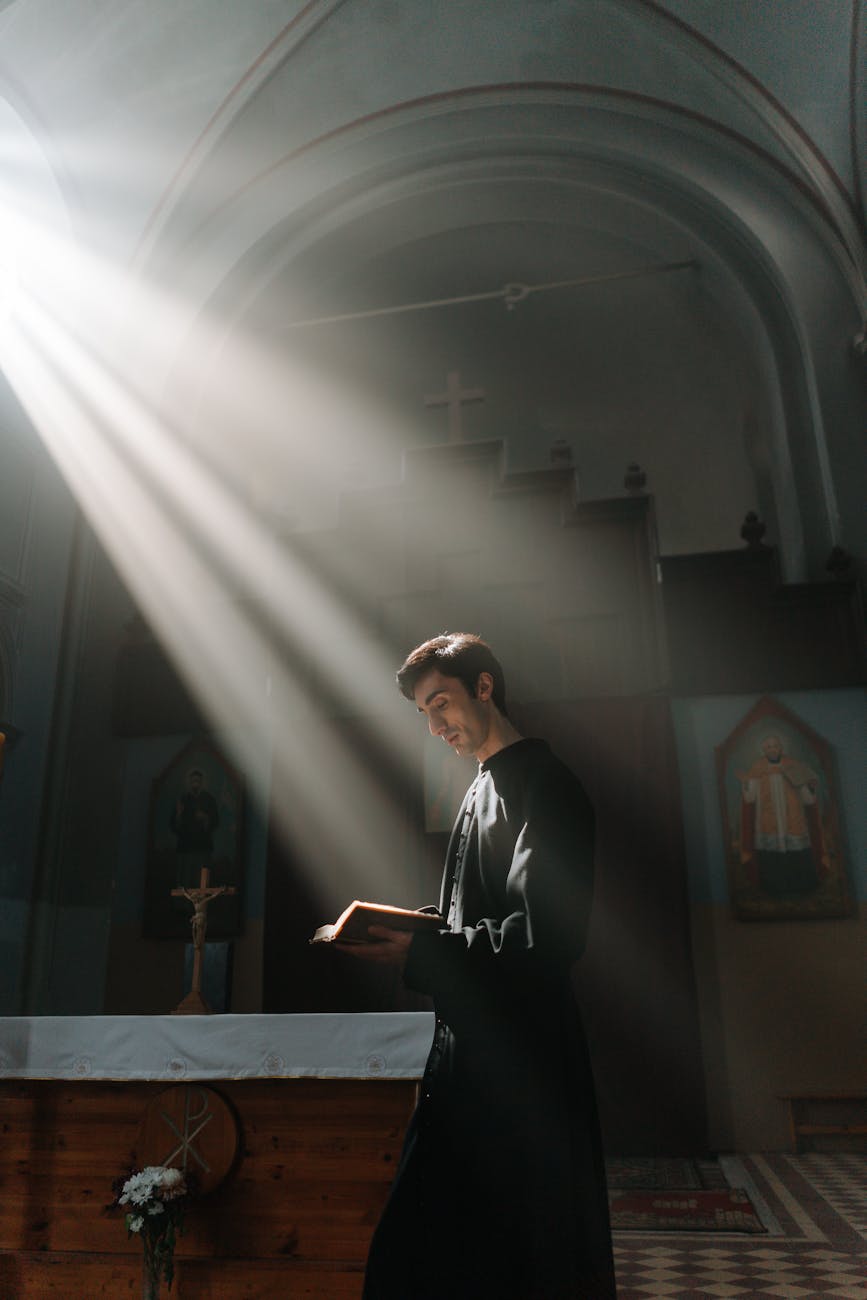
Entering the Gravity Well
I keep finding Christians from very different traditions orbiting the same mystery. They do not always use the same vocabulary. They do not always trust each other’s vocabulary. Yet again and again, they circle back to the same astonishing claim: the Christian life is not merely Christ for us, but Christ in us, and us in Christ.
I did not begin this journey by looking for another doctrine to study. I was not trying to add one more theological category to an already crowded shelf. At first, I simply kept noticing a pattern. A phrase here. A passage there. A book I had read years ago suddenly speaking with a new voice. A writer from one tradition saying something that sounded strangely familiar to a writer from another tradition. Union with Christ. Theosis. Participation. Indwelling. Abiding. Kingdom life. The exchanged life. Christ in you. You in Christ. The words were not identical, and they should not be flattened into sameness, but they seemed to be moving around the same center.
The longer I have sat with this, the more it has felt like entering a gravity well. At first, I thought I was studying scattered theological themes, each with its own history, vocabulary, and orbit. But over time, the scattered lights began to form a system. Mutual indwelling became the star at the center. Around it, different Christian traditions move like planets, each with its own path, atmosphere, and angle of vision. Some draw close to the heat of mystical participation. Some remain farther out, cautious, careful, and bounded. Some devotional writers pass through like comets, bright with spiritual insight, even if less precise in theological language. Yet all of them, in their own way, seem to be responding to the same radiant mystery.
That mystery is stated with startling simplicity in John 14:20: ὑμεῖς ἐν ἐμοί, κἀγὼ ἐν ὑμῖν, “you in me, and I in you.” It is hard to imagine a more compact statement of the Christian life. Jesus does not merely say that we will believe in him, follow him, admire him, or receive benefits from him. All of those may be true, but they do not reach the depth of what he says. He speaks of mutual indwelling. We are in him, and he is in us. This is not the language of distant admiration. It is not merely the language of legal standing. It is not even merely the language of moral imitation. It is the language of shared life.
That is why the common phrase “a personal relationship with Jesus,” while true as far as it goes, no longer feels large enough to carry the weight of the mystery. A personal relationship may describe nearness, affection, trust, and devotion. Those things matter deeply. Yet “you in me, and I in you” reaches further. It points toward communion, participation, and transformation. It suggests that salvation is not only something Christ does for us, but a life he shares with us. The Christian life is not merely a forgiven life, though it is certainly that. It is not merely an improved life, though it should become that. It is life drawn into the life of Christ through the Spirit, within the love of the Father.
I have realized, looking back, that I have been orbiting this mystery for a long time without fully recognizing it. Some of the authors who now seem so important to this journey were on my shelf twenty years ago. I read them then, and I gained something from them, but I did not yet see the path clearly. Now, rereading them with fresh eyes, I find that they were pointing toward a center I had not yet learned to name. They were not all saying the same thing in the same way. Some emphasized union. Some emphasized transformation. Some emphasized grace. Some emphasized participation. Some emphasized the indwelling Christ. Some emphasized life in the kingdom of God. But again and again, I find myself asking: Are these separate doctrines, or are they different orbital paths around the same sun?
That question matters because words matter. The question is not whether all these terms mean exactly the same thing. They do not. Union with Christ is not simply interchangeable with theosis. Theosis is not simply interchangeable with sanctification. Participation is not simply interchangeable with abiding. Each word carries its own history, its own strengths, and its own dangers. Each catches part of the light. Each can also bend the light if we are not careful. The danger is mistaking one orbit for the center, or mistaking one tradition’s vocabulary for the whole mystery.
So this post is part of my own journey of discovery. I am trying to think out loud, carefully and prayerfully, about what I have found so far. Many Christian traditions are circling the same radiant center: the believer’s real participation in the life of Christ through the Spirit, within the communion of the Triune God. Some call it union with Christ. Some call it theosis. Some call it participation, mystical union, abiding, indwelling, Christification, or the with God life. Each term helps. Each term also needs guardrails. The task is not simply to choose the most impressive word. The task is to find language faithful enough to name the mystery without distorting it, reducing it, or sending us into theological deep space.
At this point in the journey, I have begun to land in two places. For technical theological language, I am drawn to perichoretic salvation, because it speaks of real communion without absorption, mutual indwelling without confusion, and participation without erasing the difference between Creator and creature. For pastoral language, I am drawn to dancing with God, because it reminds me that this mystery is not only something to define. It is something to live. It is movement, response, surrender, attention, grace, and joy. It is Christ in us, and us in Christ. It is the life of God drawing us into the dance.
Before we move closer to the center, it may help to step back and survey the whole system. The traditions are not the reality itself. The planets are not the sun. Even the words we use, however beautiful or precise, are not the mystery they attempt to name. They are maps, lenses, instruments, and orbital paths. What holds the system together is the gravity of Christ’s own life shared with us, the light of mutual indwelling that keeps drawing us nearer. So let us take a slow journey around this theological solar system, not to confuse the planets for the star, but to see how each orbit catches the light from a different angle.
The Star at the Center: “You in Me, and I in You”
ὑμεῖς ἐν ἐμοί, κἀγὼ ἐν ὑμῖν.
There is something beautiful about those words even before we try to explain them. “You in me, and I in you.” They are simple enough for a child to hear, yet deep enough that the church has spent centuries trying to understand them. They do not sound like an abstract doctrine. They sound like an invitation into a mystery. Jesus is not merely saying, “Believe correct things about me.” He is not merely saying, “Follow my example from a safe distance.” He is not merely saying, “I will help you become a better person.” He is saying something far more intimate, far more astonishing, and perhaps far more unsettling. He is saying that the Christian life is mutual indwelling.
I have read these passages before. Many times. Yet I am finding that Scripture can become strangely new when a light comes on in another room. After wrestling with James Gifford’s way of describing this mystery, especially his idea of perichoretic salvation, I find myself returning to familiar verses with fresh eyes. It is not that the words have changed. It is that I am beginning to see the pattern. Passages that once seemed scattered now appear to belong to the same constellation. Or perhaps better, they are planets reflecting the light of the same star.
John 14:20 stands near the center of that star. Jesus tells His disciples, “On that day you will know that I am in my Father, and you in me, and I in you.” Notice the movement. Jesus speaks first of His own relationship with the Father. Then He draws His disciples into that pattern of communion. The Son is in the Father, and the disciples are in the Son, and the Son is in them. This is not a casual spiritual encouragement. It is not religious decoration. It is the grammar of salvation. The life of the Son, in communion with the Father, is opened to us through the Spirit.
Then we come to John 15, and the image changes from astronomy to agriculture, but the mystery remains the same. “Abide in me as I abide in you.” Jesus is the vine. We are the branches. A branch does not merely admire the vine. It does not merely agree with the vine. It does not merely try hard to behave like the vine. It lives because it shares in the life of the vine. Cut off from that life, it withers. Joined to that life, it bears fruit. This is one reason moral self-improvement cannot be the center of Christianity. Fruit is not produced by detached effort. Fruit comes from abiding life.
John 17 takes us still deeper. Jesus prays that His followers “may all be one,” and then He gives the pattern: “As you, Father, are in me and I am in you, may they also be in us.” That sentence should make us pause. Jesus does not pray merely that Christians would be organized, polite, efficient, or institutionally aligned. He prays that our unity would somehow participate in the communion of the Father and the Son. Of course, we must be careful here. We do not become God. We are not absorbed into the Trinity. We do not cross the line between Creator and creature. Yet Jesus Himself gives us language of participation. He prays that we may be drawn into divine communion without ceasing to be human.
Paul says the same mystery with different words. “I have been crucified with Christ,” he writes in Galatians 2:20, “and it is no longer I who live, but it is Christ who lives in me.” This is not self-annihilation. Paul does not disappear. He still speaks, writes, travels, suffers, prays, reasons, and loves. Yet his life is no longer closed in upon itself. His life has been taken up into the life of Christ. He lives, but not as an isolated self. He lives by participation. He lives by indwelling. He lives because Christ lives in him.
Colossians 1:27 gives the same center another name: “Christ in you, the hope of glory.” Not merely Christ above you. Not merely Christ before you. Not merely Christ beside you. Christ in you. And this indwelling Christ is not a minor devotional thought. Paul calls it the hope of glory. Glory is not merely a future reward handed to us from the outside. It is the full flowering of Christ’s life in us, the completion of what grace has already begun. The seed of glory is indwelling.
Romans 6 adds another view. We are baptized into Christ’s death. We are buried with Him. We are raised with Him. Again, Paul refuses to describe salvation as though it were only a transaction external to us. Something happens to us because we are joined to Christ. His death becomes the pattern of our dying to sin. His resurrection becomes the source of our new life. We do not save ourselves by moral effort, but neither are we left unchanged. Grace does not merely adjust our legal record. Grace brings us into the death and life of Jesus.
Romans 8 widens the view even further. Here the Spirit bears witness that we are children of God. We are heirs of God and joint heirs with Christ, sharing in His sufferings so that we may also share in His glory. The Spirit is not an accessory to the Christian life. The Spirit is the One who makes this participation real in us. The Spirit draws us into adoption, teaches us to cry “Abba,” helps us in weakness, conforms us to the image of the Son, and carries us toward glorification. The Christian life is therefore not merely Christlike behavior from the outside. It is Spirit formed participation in the Son’s relationship with the Father.
This is why 2 Peter 1:3 to 4 no longer feels as strange to me as it once did. Peter says that God’s divine power has given us everything needed for life and godliness, and that through His promises we may “become participants of the divine nature.” For a long time, language like that sounded difficult, perhaps even dangerous. Participants of the divine nature? What can that mean without going too far? But once the larger pattern comes into view, the passage becomes less foreign. It does not mean that we become divine by essence. It does not mean that we stop being creatures. It means that by grace we are brought into communion with God’s own life. We share what we could never possess by nature. We receive what we could never generate by ourselves.
Paul says something similarly striking in 1 Corinthians 6:17: “Anyone united to the Lord becomes one spirit with him.” Again, we should not rush past the words. United to the Lord. One spirit with Him. This is not casual association. It is not mere membership in a religious group. It is not only moral agreement. It is union that reaches into the deepest reality of the person, yet without erasing the person. The believer remains a creature, a self, a responsible moral agent. But that self is no longer sealed off from God. It has been opened, joined, inhabited, and made alive.
So what is the mystery at the center? I would describe it this way: the Christian life is Spirit mediated participation in the life of Christ, whereby believers are brought into communion with the Triune God while remaining creatures, persons, and morally responsible agents. That may sound technical, but each part matters. It is Spirit mediated because we do not climb into God by our own power. It is participation because salvation is not merely external benefit. It is in the life of Christ because Jesus is not only the giver of salvation, but the place where salvation happens. It is communion with the Triune God because the Son brings us to the Father in the Spirit. And it preserves our creaturely personhood because union with God is not absorption into God.
This is why I keep coming back to the star at the center. The words differ from passage to passage. Abide. Indwell. Live. Participate. Die with. Rise with. Be united. Share in glory. Become children. Become one spirit with the Lord. Each word catches a different ray of light. But the light itself is the life of Christ shared with us. The center is not a term. The center is not a tradition. The center is not even our experience of the mystery. The center is Christ Himself, who says with breathtaking simplicity, “You in me, and I in you.”
Why “Personal Relationship with Jesus” Is Too Small
I grew up with the language of having “a personal relationship with Jesus,” and I do not want to dismiss it. There is truth in it. There is comfort in it. There is something deeply beautiful about saying, “I have a friend in Jesus.” At times, that language has helped me pray, trust, repent, and remember that Christ is not an abstraction. He is not merely an idea, a doctrine, a moral teacher, or a figure locked safely in the past. He is living, present, personal, and near.
And yet, the more I sit with Jesus’ words in John 14:20, the more I feel that the phrase is too small by itself. A personal relationship may describe friendship, affection, nearness, and trust. But “you in me, and I in you” describes a mystery of shared life. It is not less than relationship. It is relationship transfigured into communion. Jesus is not merely a friend who visits when invited, leaves when ignored, and returns when remembered. He is not external to us in that ordinary way. He is not simply beside us. He is in us. And we are in Him.
That is both comforting and unsettling. Comforting, because it means we are never abandoned. Christ is not a distant companion we must somehow summon from far away. He is closer than breath, nearer than our own self-awareness, present in the hidden places we do not know how to name. Yet it is unsettling because there is nothing in us hidden from Him. We may hide from others. We may even hide from ourselves. We may bury memories, motives, fears, desires, and sins so deeply that we no longer know how to find them. But Christ sees clearly. More clearly than we do. His knowledge of us is not partial, distracted, or sentimental. It is intimate, piercing, truthful, and healing.
That kind of intimacy can be unnerving. Most of us would feel exposed if another person could hear our thoughts. There is a reason stories about telepathy often carry a sense of discomfort. Imagine someone standing in the room who not only hears what you say, but also hears the thought beneath the sentence, the motive behind the gesture, the fear behind the smile. I remember scenes where Captain Picard looked deeply uncomfortable because Lwaxana Troi could read what he had not chosen to speak. There is humor in that, but there is also something revealing. We want to be known, but not too known. We want intimacy, but we also want control over what is disclosed.
Now take that thought further. Christ does not merely know the thoughts we consciously form. He knows the hidden rooms of the soul, the tangled motives, the wounds we mistake for wisdom, the resentments we rename as discernment, the fears we baptize as prudence, and the desires we do not yet have the courage to confess. He sees not only what we think, but what our thoughts are made of. He sees the subconscious architecture of the heart. That is a terrifying mercy.
This is why mutual indwelling must be understood as more than religious comfort. If Christ is in us, then He is also the light within us. And light does not flatter darkness. It exposes it. It names it. It reveals what is false, not to shame us into despair, but to heal us into truth. The indwelling Christ is not a passive guest sitting quietly in a locked room of the soul. He is the holy presence of God within us, casting light into the places we would rather keep dim. He does not enter us to leave us unchanged. He enters to make us whole.
Yet even here, we must be careful. Christ’s knowledge of us is not the cold surveillance of an accuser. It is the searching knowledge of the Savior. He does not expose in order to destroy. He exposes in order to redeem. He does not bring light because He despises us, but because darkness is killing us. The One who knows us most completely is also the One who loves us most truthfully. That combination is hard for us to imagine because human beings often separate knowledge and love. We fear that if someone really knew us, they might not love us. But in Christ, perfect knowledge and perfect love are united.
So yes, I can still say that I have a personal relationship with Jesus. But I now need to say more. He is my friend, but He is not merely my friend. He is my life. He is my light. He is the One in whom I live, and the One who lives in me. He is not a companion at the edge of my existence, but the center of gravity within it. The mystery is not simply that Jesus walks with me, though He does. The deeper mystery is that He dwells in me, draws me into Himself, and patiently teaches me to live from His life rather than my own self enclosed striving.
Perhaps that is why the phrase feels too thin now. It is true, but incomplete. It points in the right direction, but it does not carry us all the way to the center. “Personal relationship” may bring us into orbit. “You in me, and I in you” pulls us toward the star.
The Orbits: Different Traditions Naming the Same Center
Once we begin to see mutual indwelling as the star at the center, it becomes easier to look at the different Christian traditions with a little more patience. They are not all saying exactly the same thing. That would be too simple, and probably not true. But neither are they always speaking about completely different realities. Often, they are approaching the same mystery from different angles, using different inherited vocabularies, shaped by different concerns, and guarded by different anxieties. Each tradition has its own orbit. Each catches the light differently. Each also casts its own shadow.
The Eastern Orthodox orbit is perhaps the most willing to speak directly of transformation and participation. Its great word is theosis, often translated as deification or divinization. For many Protestant ears, that word immediately raises alarm. Deification can sound as if human beings become God, as if salvation means crossing the line between Creator and creature. But that is not the careful Orthodox claim. The claim is not that we become God by essence, but that we participate in divine life by grace. Athanasius, Gregory of Nyssa, Gregory of Nazianzus, Maximus the Confessor, Gregory Palamas, Vladimir Lossky, and others help us see that salvation is not merely pardon from outside. It is healing, illumination, communion, and transformation. The strength of this orbit is that it refuses to shrink salvation into a legal category alone. Its necessary guardrail is that participation is never absorption. We are brought into communion with God, but we do not become God by nature.
The Catholic orbit also speaks deeply of participation, though often through the language of grace, sacrament, virtue, charity, communion, and the life of Christ formed in the soul. Augustine gives us the restless heart drawn toward God. Aquinas gives us participation in being, grace perfecting nature, and charity as the form of the Christian life. Teresa of Ávila gives us the interior castle, where the soul is drawn inward toward Christ, who dwells at the center, and where His light slowly heals and orders the rooms of the soul. John of the Cross gives us purgation and union, the painful healing of desire until love becomes rightly ordered. Hans Urs von Balthasar, Henri de Lubac, Jean Daniélou, Joseph Ratzinger, and others help us see that salvation is ecclesial, sacramental, personal, and cosmic. The strength of this orbit is that it refuses to separate participation from embodied practices, communal life, and the formation of love. Its risk, especially for Protestant readers, is that participation can be misheard as human effort earning divine favor. But rightly understood, grace remains grace. The life we live in God is received before it is practiced.
The Reformed orbit often prefers the language of union with Christ. This orbit is careful, and that carefulness is one of its gifts. Calvin, John Owen, John Murray, Sinclair Ferguson, Marcus Johnson, and other Reformed voices, along with broader Protestant scholars such as Thomas F. Torrance, Grant Macaskill, Constantine Campbell, and Kevin Vanhoozer, remind us that salvation is grounded in Christ, not in spiritual experience detached from Him. Union with Christ protects the gospel from becoming vague mysticism. It ties justification, sanctification, adoption, and glorification together in Christ. John Murray famously called union with Christ central to the whole doctrine of salvation, and that insight is key. The strength of this orbit is that it protects grace, justification, and the Creator creature distinction. Its risk, especially in some popular or overly schematic presentations, is that union can sometimes be treated too much like a status and not enough like shared life. If union becomes only a legal location, we may lose the warmth of indwelling, the living communion of Christ in us and us in Christ.
This orbit is not a single narrow confessional lane. Some of these voices stand squarely within the Reformed tradition, while others are better described as Reformed adjacent, evangelical, or broader Protestant scholars of union, participation, and Pauline theology. I am placing them near one another because they share a concern to recover the depth of salvation in Christ, not merely as benefits received from Him, but as life received in Him.
The Lutheran orbit has its own rich language of unio mystica, mystical union, Christ for us, Christ in us, and sacramental union. Luther’s theology keeps returning us to the astonishing nearness of Christ, not as an abstract principle, but as the crucified and risen Lord who gives Himself to us. Johann Gerhard, Abraham Calov, Timothy Schmeling, Tuomo Mannermaa, and others help show that Lutheran theology has deeper participatory currents than many outsiders realize, though Mannermaa’s reading of Luther is part of a debated stream of modern Luther scholarship and should not be treated as representative of all Lutheran theology. The strength of this orbit is that it refuses to divide Christ’s objective work for us from His living presence in us. Christ does not merely accomplish salvation at a distance. He gives Himself. The risk is that several kinds of union must be carefully distinguished. The personal union of Christ’s divine and human natures, Christ’s sacramental presence in the Lord’s Supper, and the believer’s mystical union with Christ are related, but they are not identical. Precision matters because mystery is not served by confusion.
Then there is the Pauline participation orbit, which tries to stay close to Paul’s own grammar of salvation. Here we find language such as participation in Christ, participatio Christi, being crucified with Christ, buried with Christ, raised with Christ, conformed to Christ, and sharing in His sufferings and glory. Michael Gorman’s language of cruciformity is especially helpful because it reminds us that participation in Christ is not merely an elevated spiritual experience. It is cross shaped. Ben Blackwell, Susan Eastman, Douglas Campbell, Morna Hooker, E. P. Sanders, N. T. Wright, Michael Thate, Constantine Campbell, Kevin Vanhoozer, Grant Macaskill, and others all help illuminate this orbit in different ways, even where they do not all approach Paul from the same angle. Its strength is that it keeps us close to Scripture’s own participatory language. Its risk is that some discussions can pit participation against justification, as if Paul must have only one center. But perhaps Paul’s gospel is larger than that kind of forced choice. Perhaps justification names one radiant aspect of union with Christ, while participation names the larger life into which justification welcomes us.
The pneumatological orbit reminds us not to speak of participation as though it were only Christological in a narrow sense. The Son brings us to the Father in and through the Spirit. The Spirit is not an afterthought. The Spirit is the One who makes the life of Christ present in us, who teaches us to cry “Abba,” who conforms us to the image of the Son, who bears fruit in us, who groans within us, and who draws us into communion with the Triune God. Gordon Fee, James D. G. Dunn, Jacob Chengwei Feng, Frank Macchia, Clark Pinnock, Amos Yong, and others help us keep this orbit in view. Feng’s recent language of theosis, Christosis, and pneumasis is especially suggestive, even if pneumasis remains a constructive proposal rather than settled theological vocabulary. It reminds us that participation is not flat. It is Trinitarian. We are not merely improved religious individuals. We are drawn by the Spirit into the Son’s communion with the Father. The strength of this orbit is that it keeps participation alive, dynamic, and pneumatological. Its risk is abstraction. If the Spirit becomes only a concept in our system, we have missed the living Breath of God.
The spiritual formation orbit is where this mystery begins to come down to the ground beneath our feet. Dallas Willard may be one of the most important guides here. He may not always use the most technical language, but his phrases “the with-God life,” “kingdom life,” and “eternal life now” describe the lived reality of participation. Richard Foster, James Bryan Smith, J. P. Moreland, Brother Lawrence, Teresa of Ávila, and Major Ian Thomas each help us see that union with Christ is not merely a doctrine to define. It is a life to inhabit. Moreland, especially, helps connect this lived formation to the renewal of the mind, the soul, and Christian anthropology. This orbit asks practical questions. How do we live from the life of Christ? How are our thoughts renovated? How are our habits healed? How do we practice the presence of God? How do we become the kind of people who naturally and joyfully do what Jesus taught? The strength of this orbit is that it refuses to leave participation in the clouds. Its risk is that formation can become practical without remaining deeply ontological. In other words, we can start talking about habits, disciplines, and practices without remembering that the point is not self-improvement. The point is Christ formed in us.
The Keswick, Higher Life, deeper life, grace life, exchanged-life, and Christ-life orbit presses this point even further. Writers such as Major W. Ian Thomas, Watchman Nee, Andrew Murray, Hudson Taylor, Bill Gillham, Bob George, Bob Christopher, Steve McVey, and others often speak of the exchanged life, identification with Christ, abiding life, or Christ living through the believer, even though they do not all belong to the Keswick tradition in the same narrow sense. At its best, this orbit beautifully resists the exhausting illusion that we can live the Christian life by willpower. It reminds us that Christ does not merely give commands. He shares His life. He is not only the model in front of us, but the source within us. The risk is quietism, or at least the appearance of quietism. If we are not careful, “Christ lives through me” can sound as if the believer becomes passive, as if human agency no longer matters. But the New Testament does not describe us as puppets. Grace does not erase our willing. It heals it. The dance requires surrender, but surrender is not the same as disappearance.
Finally, there is the literary and imaginative orbit, and I find myself increasingly grateful for it. Not all truth reaches us first as a definition. Sometimes an image carries us further than a formula. C. S. Lewis gives us the Great Dance. Charles Williams gives us coinherence. George MacDonald gives us a sanctified imagination, a way of seeing created things as windows into deeper reality. Tolkien, though less direct on this specific topic, gives us worlds where participation, fellowship, sacrifice, and hidden providence feel more real than mere explanation. This orbit gives us language we can inhabit. It helps us imagine communion, not merely analyze it. Its strength is wonder. Its risk is sentimentality. The image must remain tethered to Scripture, doctrine, and holiness. Still, I cannot escape the sense that “dancing with God” may be one of the most pastorally faithful ways to speak of this mystery. Dance has movement, response, nearness, distinction, rhythm, surrender, and joy. In a dance, two do not become one person, but they may move as one.
As I survey these orbits, I do not feel the need to collapse them into one vocabulary. That would flatten the beauty of the system. The Eastern Orthodox orbit helps me take transformation seriously. The Catholic orbit helps me see grace as embodied, sacramental, and formative. The Reformed orbit helps me protect the gospel from becoming untethered from Christ’s finished work. The Lutheran orbit reminds me that Christ for us and Christ in us belong together. The Pauline participation orbit keeps me close to the apostolic grammar of dying and rising with Christ. The Spirit orbit reminds me that all of this is mediated by the living presence of God. The spiritual formation orbit asks whether I am actually living this mystery. The deeper life orbit warns me against self-powered discipleship. The literary orbit gives me images that awaken longing.
Yet none of these orbits is the center. The terms are not the star. The traditions are not the star. The theologians are not the star. The center is still Christ Himself, saying, “You in me, and I in you.” All our words are attempts to look toward that light without going blind, to map the heavens without confusing the map for the sky. The best language will not replace the mystery. It will help us stay close enough to be warmed by it, humbled by it, and transformed by it.
A Map of Terms Orbiting the Mystery
One of the questions that keeps pressing on me is this: what belongs inside the box of historic Christianity, and what moves outside of it? That is not always an easy question. Sometimes the boundary is clear. If a claim erases the difference between God and creation, it has drifted too far. If a claim turns salvation into self-divinization, it has left the Christian orbit. If a claim makes us passive puppets rather than redeemed persons, it has misunderstood grace. Yet many of the disagreements I keep finding are not always about the center itself. They are often about the words used to describe the center.
That matters because language can either clarify or cloud the mystery. I am tracking different terms used for this mysterious union, and I am also trying to track the major works and voices that use them. What has surprised me is how often this concept transcends Protestant, Catholic, and Orthodox categories. Each tradition has its own vocabulary, its own anxieties, and its own theological instincts, but the same center keeps appearing. The believer is brought into real communion with Christ by the Spirit. Christ is in us, and we are in Christ. Salvation is not only pardon, not only moral reform, not only future hope, but participation in the life of God by grace.
This is also why debates in New Testament scholarship matter. There is a major unresolved discussion about whether participation or justification stands at the center of Paul’s theology. I am not sure the answer must be either one or the other. Perhaps justification and participation are not rival suns, but two ways the light of the same gospel reaches us. Justification tells us we are accepted in Christ. Participation tells us we are joined to Christ. The danger comes when we use one truth to eclipse the other. If justification is separated from participation, salvation can sound external and thin. If participation is separated from justification, salvation can become vague, unstable, or untethered from Christ’s finished work.
The terms also overlap in ways that require patience. Theosis, deification, divinization, mystical union, participation, union with Christ, and perichoretic salvation do not all mean the same thing in every writer. They are not interchangeable labels pasted onto the same box. Theosis as a modern theological term may not always function exactly the same way as theosis in historical Orthodox sources. Deification may be used carefully by one writer and carelessly by another. Mystical union may mean something precise in one tradition and something more devotional in another. This is why we must slow down before we react. We should not assume that because a word sounds dangerous, the doctrine behind it is necessarily outside the faith.
Timothy Schmeling gives a helpful example when he connects Eastern and Western language:
“Theosis (θέωσις) and mystical union (unio mystica) are Eastern and Western Christendom’s customary terms for essentially the same thing. . . . So what exactly is the relationship between theosis and the mystical union? Theosis is the verbal idea or action that takes place in the mystical union. Therefore the mystical union is the bond in which theosis occurs.”
That distinction helps me. It does not solve every question, but it gives us a way to see the relationship between terms rather than forcing them into competition. Mystical union names the bond. Theosis names the transforming action that takes place within that bond. Union is not merely a status. Transformation is not detached from union. The believer is joined to Christ, and because the believer is joined to Christ, the believer is changed.
Jacob Chengwei Feng gives another helpful expansion:
“Theosis, Christosis, and pneumasis, or deification, Christification, and pneumafication, work together to reflect, and do full justice to, Paul’s proto trinitarian thoughts on participation.”
That sentence opens another window. Participation is not merely an individual relationship with Jesus considered in isolation. It is a triune divine encounter. The Father is not absent. The Son is not detached from the Spirit. The Spirit is not merely an emotional atmosphere around the believer. The Spirit brings us into the life of the Son, and the Son brings us to the Father. That is why participation must be Trinitarian, or it becomes too small.
Much confusion comes from assuming we already know what someone means before we listen carefully. People get wrapped around terminology. They hear “deification” and assume it means becoming God by essence. They hear “union with Christ” and assume it means only a legal status. They hear “exchanged life” and assume the believer has no active role. They hear “sanctification” and assume moral effort without indwelling grace. Sometimes a whole tradition is judged by one flawed explanation of one term. Sometimes criticism is aimed not at the actual doctrine, but at a caricature of it.
I have seen this in criticisms of the Keswick tradition and deeper life language. There are real concerns worth discussing. Some expressions can sound passive. Some can sound as if the human will disappears. Some can sound as if growth in Christ should be effortless. Those concerns should not be dismissed. But if we do not listen carefully, we may miss the real insight. Many of these writers are trying to say that the Christian life cannot be lived by self-powered striving. They are trying to recover the truth that Christ is not merely our example, but our life. That is worth hearing, even if some of the language needs guardrails.
This is where the old image of the blind men and the elephant becomes useful. One person touches the trunk and describes one reality. Another touches the leg and describes another. Another touches the ear and gives still another account. Each may be describing something real, but none sees the whole. In this case, the mystery is greater than any one term. One orbit sees transformation. Another sees justification. Another sees sacramental communion. Another sees spiritual formation. Another sees indwelling life. Another sees the Spirit. Another sees the dance. If we put our minds together, perhaps we can see more of the mystery than any one orbit can show us alone.
From a technical theological perspective, I am increasingly drawn to Gifford’s language of perichoretic salvation and the idea of a third type of perichoretic relationship. I say that cautiously, because I have not read everyone on this subject, and I keep discovering more. I may adjust as I keep learning. But so far, that language seems to give the best theological structure for what I am seeing. It names real mutual indwelling without collapsing God and creation. It names communion without absorption. It gives me a way to speak of “you in me, and I in you” without reducing the mystery to either legal status or vague mysticism.
From the side of lived discipleship, however, I still find Dallas Willard hard to surpass. He was a master of words and definitions, a trained philosopher who cared about precision, but he also cared about ordinary disciples becoming the kind of people who naturally live in the kingdom of God. His language of the “with God life” and “kingdom life” may not satisfy every technical question, but it puts the mystery where the rubber meets the road. It asks whether I am actually learning to live with God, from God, and in God’s presence. It asks whether Christ’s indwelling life is becoming visible in my thoughts, habits, loves, and responses.
So what follows is not a list of synonyms. It is a map of overlapping orbits. Some words belong to Scripture. Some come from Greek and Latin theology. Some are doctrinal. Some are transformational. Some are devotional. Some are metaphorical. Some are safer in academic writing. Some are better for prayer. Some need careful definition. Some may need warning labels. But all of them, at their best, point toward the same radiant center.
Biblical terms
These are the words and images that should govern the whole system. They are the star charts given by Scripture itself.
- in Christ
- Christ in you
- abide
- remain
- dwell
- union
- communion
- fellowship
- partakers of the divine nature
- one spirit with the Lord
- children of God
- heirs with Christ
- conformed to the image of the Son
- temple of the Holy Spirit
- branches in the vine
- members of the body of Christ
- crucified with Christ
- buried with Christ
- raised with Christ
- seated with Christ
- new creation
- adopted as sons and daughters
- sharing in Christ’s sufferings
- sharing in Christ’s glory
Greek and Latin terms
These terms come from the long theological labor of the church. They often require definition, but they can carry great precision when used carefully.
- theosis
- deification
- divinization
- participatio Christi
- communio
- koinonia
- unio mystica
- conjunctio
- perichoresis
- coinherence
- methexis
- imitatio Christi
- communicatio idiomatum
- enhypostasia
- sanctificatio
- glorificatio
- pneuma
- energia
- gratia
- caritas
- inhabitatio Dei
Doctrinal terms
These are the terms that try to locate the mystery within the structure of Christian theology.
- union with Christ
- mystical union
- soteriological union
- perichoretic salvation
- third type of perichoretic relationship
- Trinitarian participation
- Spirit mediated union
- reciprocal immanence
- participation in divine life
- communion with the Triune God
- adoption
- sanctification
- glorification
- regeneration
- reconciliation
- incorporation into Christ
- covenantal union
- sacramental union
- communion of saints
- indwelling of the Spirit
- life in Christ
- life in the Spirit
Transformational terms
These terms emphasize that salvation changes us. The light does not merely shine on us. It shines in us.
- Christification
- Christosis
- pneumafication
- pneumasis
- deification
- sanctification
- glorification
- cruciformity
- resurrectional cruciformity
- conformity to Christ
- transformation
- renovation of the heart
- spiritual formation
- moral transformation
- participation in holiness
- dying to sin
- rising to new life
- putting on Christ
- being formed into Christlikeness
- becoming love
Devotional and pastoral terms
These are often the terms that help ordinary disciples pray, practice, repent, and live.
- abiding life
- exchanged life
- Christ life
- deeper life
- grace life
- with God life
- kingdom life
- eternal life now
- practicing the presence of God
- conversational relationship with God
- dancing with God
- Christ living through me
- resting in Christ
- surrender
- dependence
- life from above
- walking in the Spirit
- apprenticeship to Jesus
- friendship with God
- communion with Christ
Metaphorical terms
These images help us imagine the mystery, not as a replacement for doctrine, but as a way of inhabiting it.
- divine dance
- Great Dance
- gravity well
- orbit
- center of gravity
- indwelling
- engrafting
- vine and branches
- temple
- marriage union
- body of Christ
- adoption
- family resemblance
- light in the soul
- interior castle
- living water
- fire of love
- breath of God
- participation
- shared life
- homecoming
- being drawn into the life of God
Looking at the map this way helps me breathe a little. It reminds me that not every difference is a contradiction. Some differences are angles of vision. Some are safeguards. Some are historical accents. Some are attempts to protect a truth that another orbit is in danger of neglecting. The Eastern Christian wants to protect transformation. The Reformed Christian wants to protect grace and justification. The Catholic Christian wants to protect embodied communion and sacramental life. The spiritual formation writer wants to protect actual lived discipleship. The Pauline scholar wants to protect the apostolic grammar. The devotional writer wants to protect dependence on Christ’s indwelling life.
The center is larger than any single term, but the terms still matter. Bad language can send us into bad orbits. Careless language can blur the Creator creature distinction. Thin language can reduce salvation to paperwork in heaven. Sentimental language can turn communion into mood. Overly academic language can make the mystery feel like a specimen under glass. We need words that are clear enough to guard truth, rich enough to invite worship, and humble enough to admit that the reality exceeds the vocabulary.
For now, this is my map of the solar system. It is not complete. It may never be complete. I expect to keep finding more stars, more planets, more old paths, and more forgotten names. But the more I look, the more convinced I become that the heart of the Christian life is not merely that Christ did something for us, though He certainly did. It is that Christ gives Himself to us, dwells in us by the Spirit, draws us into His own communion with the Father, and teaches us to live from a life we could never create for ourselves. That is the mystery all these terms are trying to name.
What Each Term Sees Clearly, and What It Can Miss
At this point, I do not expect every tradition to change its vocabulary, nor do I think that would be wise. Words are not interchangeable parts that can simply be swapped out without loss. They carry histories, prayers, debates, wounds, safeguards, and inherited wisdom. An Orthodox Christian does not need to stop saying theosis. A Reformed Christian does not need to stop saying union with Christ. A spiritual formation writer does not need to stop speaking of the with God life. A devotional writer does not need to abandon abiding. My hope is more modest. I want to understand what each term helps us see, what each term can obscure, and how the different orbits can help us perceive the center more clearly.
Union with Christ sees something essential. It is deeply biblical, and in the Reformed tradition especially, it helps gather the benefits of salvation into Christ Himself. We are justified in Christ, sanctified in Christ, adopted in Christ, and glorified in Christ. The strength of the phrase is that it refuses to separate salvation from the Savior. Yet it can become too static if we are not careful. If union is heard only as a legal status or covenantal location, then “in Christ” can begin to sound like being listed on a roster rather than sharing in a life. Union with Christ is true, but it must remain living union, not merely positional union.
Theosis sees transformation and participation with remarkable clarity. It refuses to let salvation shrink into forgiveness alone. It insists that grace heals, illumines, renews, and draws us into communion with God. That is a great gift. Yet the word can alarm many Protestant readers, and not without reason if it is undefined. Deification sounds, at first hearing, as if the creature becomes God. Careful Orthodox theology does not mean that. It means participation by grace, not identity by essence. We do not become God. We are not absorbed into God. We remain creatures. But because the word carries ambiguity, it must be guarded carefully, especially when speaking across traditions.
Participation is a beautiful and necessary word because it captures active sharing in Christ’s death and life. We participate in His death. We participate in His resurrection. We participate in His sufferings. We participate in His glory. It helps us see that salvation is not merely something done outside us and then credited to us from a distance. We are drawn into Christ’s own story. Yet participation can also sound abstract. It can become a scholarly word that floats above the ordinary life of prayer, obedience, repentance, suffering, and love. It needs flesh and blood. It needs to become visible in the way we live.
Abiding brings us back to John’s Gospel, to the vine and the branches, to the simple and profound command of Jesus: abide in me. This word has warmth. It has intimacy. It sounds like staying, resting, remaining, and drawing life from Christ moment by moment. Its strength is that it keeps the mystery close to prayer. Yet abiding can become thin if it is reduced to devotional feeling. Without doctrinal depth, it may sound like a private spiritual mood rather than real union with Christ by the Spirit. Abiding is not merely peaceful nearness. It is shared life.
Mystical union sees the depth of communion. It tells us that this mystery is not merely legal, institutional, intellectual, or moral. There is a real joining of the believer to Christ. Yet the word mystical can be misunderstood. Some hear it and think of vagueness, emotionalism, esoteric spirituality, or anti rational experience. That is unfortunate, because the best Christian use of mystical does not mean irrational. It means a real communion with God that exceeds our ability to fully explain it. Still, because the word is easily misunderstood, it needs careful definition.
Perichoretic salvation is, for me, the most helpful technical phrase. It sees mutual indwelling. It sees communion without absorption. It sees unity without collapse. It gives theological shape to “you in me, and I in you.” It also keeps the mystery Trinitarian. We are not merely connected to Jesus as an isolated individual. We are brought by the Spirit into the Son’s communion with the Father. That is why I find Gifford’s language so helpful. His idea of a third type of perichoretic relationship gives me a way to say that believers truly participate in divine life without saying that we participate in the Trinity exactly as the divine persons participate in one another. The analogy is powerful, but it must remain an analogy.
The weakness of the phrase is obvious. Perichoretic salvation is not the language most people use at the kitchen table, in a hospital room, or during morning prayer. It is precise, but it is technical. It may help theologians name the mystery, but it may not help a wounded disciple pray. That does not make it wrong. It simply means it belongs in one orbit and not every orbit. It is a telescope, not the sun.
This is why, pastorally, I keep coming back to dancing with God. I do not mean that as a replacement for Scripture or doctrine. I mean it as an image that helps the heart understand what the mind is trying to name. Dancing captures movement, relationship, response, attention, surrender, freedom, rhythm, and joy. It suggests participation without possession. It suggests surrender without disappearance. It suggests that God is truly active, and we are truly active as well. We are not dragged across the floor. We are invited into motion.
That matters because some forms of deeper life language have been criticized for sounding passive, as if allowing Christ to live His life through us means that we no longer act. I understand the concern. If we speak carelessly, we can make the Christian life sound like spiritual autopilot. But Dallas Willard is very clear that God does not normally micromanage us or possess us like puppets. Grace does not erase our agency. It restores it. God wants sons and daughters, not marionettes. The with God life is a life of cooperation, apprenticeship, obedience, conversation, and growing maturity.
This is one reason the image of dance seems so fitting to me. In a dance, there is leading and following, but there is also responsiveness. There is structure, but also freedom. There is another will involved, but your own will is not destroyed. Sometimes you follow. Sometimes, in a mysterious way, you are invited to move, ask, respond, and even affect the movement. Willard’s point that Moses could intercede and that God could respond reminds us that life with God is not mechanical. It is personal, relational, and participatory. The living God is not less personal than we are. He is more personal than we are.
C. S. Lewis gives us a powerful imaginative doorway here with the Great Dance, and Gifford’s discussion of perichoretic relationship within the Trinity helps explain why the image carries theological weight. Dance is not merely pretty language. It helps us imagine unity without sameness, nearness without absorption, and movement without chaos. In a dance, two do not become one person, but they may move as one. That seems very close to what I am trying to say about the Christian life.
So here is where I am settling for now. From a technical or academic perspective, I am drawn to perichoretic salvation, or Gifford’s language of a third type of perichoretic relationship. It seems clearer than theosis for the point I am trying to make, because it more directly guards against the fear that we become God or are absorbed into God. Like the Trinity, the mystery involves unity and distinction, although not in the same way or at the same level. That distinction is crucial. We are drawn into communion with God, but we remain ourselves. We are united to Christ, but we are not confused with Christ. We participate in divine life, but we do not become divine by nature.
From a pastoral and lay perspective, I am drawn to dancing with God. I still appreciate “the with God life,” and I think Willard’s language is wonderfully clear. But dancing feels more participatory to me. It carries the movement I am trying to name. It reminds me that the Christian life is not merely standing near God, thinking about God, or receiving benefits from God. It is life with God, in Christ, by the Spirit. It is learning the rhythm of grace. It is being drawn nearer to the light without being consumed by it. It is Christ in us, and us in Christ, until our lives begin to move with His.
Where We Go Too Far
If this mystery is as rich as I am beginning to see, then it also needs careful boundaries. The answer to thin Christianity is not careless Christianity. We do not honor the mystery by exaggerating it past what Scripture and historic Christian faith can bear. A star gives light and warmth, but if we mistake ourselves for the star, we have misunderstood both the light and ourselves. Participation is real, but it is not absorption. Union is real, but it is not confusion. Communion is real, but it does not erase creaturehood.
The solar system metaphor helps here as well. There are many legitimate orbits within the Christian tradition, and they do not all move at the same distance from the center. Some come closer to the heat of mystical language. Some remain farther out with more cautious doctrinal boundaries. That is fine. A planet does not need another planet’s orbit to belong to the same system. But there is a difference between a distinct orbit and leaving the gravitational field altogether. When our language begins to erase the Creator creature distinction, dissolve the person into God, deny the need for grace, or detach participation from Christ, Scripture, and holiness, we are no longer simply using another Christian vocabulary. We are drifting beyond the bounds of Christian orthodoxy. At that point, the image is no longer a planet circling the sun, but an untethered world wandering into the deep darkness of space. The goal is not to make every orbit identical. The goal is to remain held by the gravity of Christ.
This is where I think we need to speak with both wonder and caution. We go too far when we say, or even imply, that believers become God by essence. That is not Christian salvation. We participate in divine life by grace, not by nature. We receive what God gives, but we do not become what God alone is. The Creator creature distinction is not a problem to overcome. It is part of the goodness of reality. God remains God. We remain creatures. The miracle is not that the distinction disappears, but that communion is possible without the distinction disappearing.
We also go too far when salvation is described as absorption into God. That may sound spiritual at first, but it is not the biblical picture. Scripture does not teach that God saves us by dissolving us. God does not redeem persons by erasing personhood. He heals persons. He restores persons. He makes us more truly ourselves in Christ, not less. If I am in Christ, I am not annihilated. If Christ is in me, I am not replaced. The self that was curved inward by sin is not destroyed as a creaturely self. It is opened, cleansed, reordered, and brought into communion.
This matters because some language about “Christ living in me” can be misunderstood. Paul can say, “It is no longer I who live, but Christ who lives in me,” and yet Paul still lives, thinks, chooses, suffers, writes, reasons, prays, and obeys. Christ living in us does not mean we become passive containers. It does not mean grace turns us into puppets. It does not mean God takes over while we disappear into the background. Grace does not eliminate agency. Grace heals agency. Grace does not make obedience unnecessary. Grace makes true obedience possible.
Here again, the dance image helps me. In a dance, surrender is not passivity. Following is not nonexistence. Movement with another does not mean one partner has ceased to be real. The beauty of the dance is precisely that distinction and communion remain together. If one person absorbs the other, the dance is gone. If each person moves in total isolation, the dance is gone. The mystery is in the shared movement.
We also go too far when participation is used to replace justification, or when justification is used to eliminate participation. These two truths should not be treated as rival planets competing for the same orbit. Justification tells us that we are accepted in Christ, not because we have achieved righteousness by our own strength, but because of Christ’s faithful work for us. Participation tells us that this acceptance is not sterile or external. The One who justifies also joins us to Himself. The courtroom and the vine are not enemies. The Judge who declares us righteous is also the Savior who gives us His life.
Likewise, spiritual formation goes too far when it becomes self-powered moral improvement. If spiritual formation is merely my effort to become a better version of myself, then it has drifted away from the center. Christian formation is not self-renovation with religious vocabulary. It is the renovation of the heart by grace, through the Spirit, in union with Christ. Yet we also go too far in the opposite direction when we speak as though grace makes practice irrelevant. Jesus still teaches. We still follow. We still train. We still repent. We still learn to obey. But we do so as branches in the vine, not as severed branches trying to produce fruit by determination alone.
Union with Christ also needs this same balance. We go too far when union is reduced to legal status only. That makes “in Christ” sound like a file location, a membership category, or a line in an account book. But the New Testament speaks of union as life, death, resurrection, Spirit, adoption, fruit, holiness, suffering, and glory. At the same time, we go too far if union becomes vague spiritual experience detached from Christ’s finished work, Scripture, the church, and holiness. Union with Christ is not a mist. It is not an emotional atmosphere. It is communion with the crucified and risen Lord.
Theosis needs guardrails as well. We go too far if theosis becomes spiritual elitism, secret knowledge, or a ladder for the spiritually impressive. That would betray the gospel. Participation in divine life is not a badge for the initiated. It is grace for the redeemed. It should make us humbler, not stranger in the wrong way. It should make us more loving, not more obscure. If our language of deification makes us proud, impatient, or dismissive of ordinary Christians, then we have probably misunderstood it.
Mystical union can also be mishandled. We go too far when mystical language excuses sloppy thinking. Mystery is not the same thing as confusion. Some realities exceed our full comprehension, but that does not give us permission to speak carelessly. Christian mystery invites reverence, not intellectual laziness. The fact that we cannot exhaust the truth does not mean we cannot say true things. It means we speak carefully, humbly, and worshipfully.
And perichoresis needs perhaps the clearest warning of all. We go too far if we apply perichoresis to believers in exactly the same way it applies to the Trinity. The Father, Son, and Spirit indwell one another as the one God. That divine communion is unique, eternal, uncreated, and proper to God alone. Our participation is not that. We are brought into communion by grace, through Christ, in the Spirit. The analogy is real and illuminating, but it remains an analogy. We are not added as a fourth member of the Trinity. We are adopted children, not divine persons.
This is where the instincts of Chalcedon help me, even though we are not talking about the hypostatic union in the same way. Chalcedon taught Christians to speak of true union without collapse.
“Without confusion, without change, without division, without separation.”
Those words were written about the union of divine and human natures in Christ, not directly about the believer’s union with Christ. So we must not apply them carelessly. But the instinct is profoundly helpful. Christian theology has long known that true union does not require confusion. Communion does not require absorption. Distinction does not require separation. Nearness does not require sameness.
That is the path I am trying to stay on. I want language large enough to honor the mystery, but careful enough to remain Christian. I want to say more than “Jesus helps me become better.” I want to say more than “Jesus forgives me and remains outside me.” I want to say what Scripture seems to say with breathtaking boldness: Christ is in us, and we are in Christ. But I also want to say it with the humility of a creature standing before the Creator, warmed by the light, drawn by the gravity, but never mistaking myself for the sun.
Why Perichoretic Salvation Is the Best Technical Term
Technically, I have landed on perichoretic salvation because it gives me a way to speak of real mutual indwelling without losing distinction, communion without absorption, participation without confusion, and transformation without pretending the creature becomes the Creator. It is not the simplest term. It is not the easiest term to explain. It is certainly not the phrase most people will use in ordinary conversation. But as a theological term, it gives me the most careful way to name the mystery I keep seeing in Scripture: “you in me, and I in you.”
Perichoresis is most often used to describe the mutual indwelling of the Father, Son, and Holy Spirit. The divine persons are not separate gods standing beside one another, nor are they blended into one indistinct person. The Father is not the Son. The Son is not the Spirit. The Spirit is not the Father. Yet God is one. There is communion without confusion, distinction without separation, unity without collapse. That is why the term is so powerful. It gives us language for a kind of nearness that does not erase difference.
Of course, we have to be very careful here. The believer does not participate in the Trinity in exactly the same way the divine persons indwell one another. We are not folded into the Godhead. We are not added to the Trinity. We do not become divine persons. That would send us outside the gravitational field of Christian orthodoxy. But Gifford’s language of a third type of perichoretic relationship helps because it gives us an analogical way to speak. It says there is a real, gracious, soteriological form of mutual indwelling grounded in Christ and mediated by the Spirit. In other words, salvation brings us into communion with God, but it does not make us God.
That is why I find this term clearer than theosis for what I am trying to describe. Theosis can be a beautiful and deeply Christian word when properly defined. It points to transformation, participation, and sharing in divine life by grace. But because the word is often translated as deification, it can easily alarm people, especially Protestants who hear it as a threat to the Creator creature distinction. Perichoretic salvation, at least for me, places the guardrails closer to the center. It tells me that the mystery is real participation, but not absorption. Real union, but not confusion. Real transformation, but not self-divinization.
It also seems to preserve the proper hierarchy of love. The life does not originate in us. The dance does not begin with us. Agape flows from the eternal communion of Father, Son, and Spirit. The Father loves the Son in the Spirit. The Son gives Himself in love to the Father. The Spirit pours divine love into our hearts. Then, as we abide in Christ, that love begins to move through us toward God, neighbor, enemy, and creation. We do not generate divine love as an independent source. We receive and participate in it. We become, by grace, conduits of a love that began before the foundation of the world.
This matters because it keeps salvation from becoming too small in either direction. If salvation is reduced to legal declaration alone, then it can sound as though God changes our status while leaving our life untouched. But Scripture speaks of more than acquittal. It speaks of indwelling, abiding, adoption, transformation, fruit, holiness, dying with Christ, rising with Christ, and sharing in glory. At the same time, if salvation is reduced to moral improvement alone, then it becomes a religious self-help project. But Scripture speaks of more than becoming better. It speaks of receiving life from Another. It speaks of Christ in us.
Perichoretic salvation helps hold these together. It does not deny justification. It gives justification a larger home. It does not deny sanctification. It roots sanctification in union and participation. It does not deny spiritual formation. It saves spiritual formation from becoming self-powered moral repair. It does not deny personal relationship with Jesus. It deepens that relationship into communion. It does not deny obedience. It makes obedience the fruit of shared life rather than the desperate labor of an isolated self.
This is also why “union with Christ,” though beautiful and biblical, sometimes feels incomplete if it is heard only as status. I do not want to abandon the phrase. I need it. The New Testament needs it. The church needs it. But when union is treated merely as a legal category, it cannot carry the full weight of John 14:20. “You in me, and I in you” sounds more intimate, more dynamic, more participatory, and more transformative than a change in position alone. Perichoretic salvation helps me say that union with Christ is living communion.
It also gives me a way to understand why this mystery keeps appearing across traditions. The Orthodox orbit speaks of theosis. The Catholic orbit speaks of participation, sanctifying grace, and communion. The Reformed orbit speaks of union with Christ. The Lutheran orbit speaks of mystical union. The spiritual formation orbit speaks of the with God life. The deeper life orbit speaks of Christ living through us. These are not identical orbits, but perichoretic salvation helps me see why they keep circling the same star. They are all trying, in different ways, to speak about the redeemed person being drawn into the life of God through Christ by the Spirit.
So for now, this is the technical phrase that gives me the most clarity. Perichoretic salvation names the relational, participatory, Trinitarian, and transformative reality at the heart of the Christian life. It gives conceptual room for mutual indwelling. It preserves distinction. It resists absorption. It honors the flow of agape from God to us and through us. It keeps us from reducing salvation to paperwork in heaven or self-improvement on earth. And most importantly, it gives me a theological home for the beautiful words of Jesus: “You in me, and I in you.”
Why “Dancing with God” Is the Best Pastoral Image
For the scholar, I may call it perichoretic salvation. For the disciple trying to live it, I may call it dancing with God.
I know that may sound poetic at first, perhaps even too poetic. But the more I sit with it, the more fitting it seems. Dancing with God avoids two opposite errors. On one side, it avoids the passivity that says, “God does everything while I do nothing.” On the other side, it avoids the anxious self-effort that says, “I must become Christlike by moral exertion alone.” A dance is not passive, but it is not solitary either. It is responsive. It has movement, rhythm, attention, surrender, agency, and joy. Sometimes one follows. Sometimes one responds. Sometimes one is carried. But one is never a puppet.
That matters deeply to me because participation requires agency. If I participate, then I am not merely acted upon. I have a voice. I have a response. I have a will that can be healed, trained, surrendered, and brought into harmony with God. Love requires this. If love is forced, it is no longer love. If obedience is programmed, it is not the obedience of a son or daughter. If I cannot say no, then my yes has lost its meaning. Much of the Christian life is about learning to love God and neighbor, and love cannot be reduced to a preprogrammed operating system. God is not looking for religious robots. He is forming persons who can freely share His life.
This is one reason the image of dance feels more faithful than some other images. It preserves the reality of grace and the reality of response. Christ is not standing at a distance, shouting instructions across the room while I try to copy His steps. Nor does He possess me so that I vanish and He simply moves my limbs. He draws me into communion. He teaches me the rhythm of His life. He leads, but He does not erase me. He corrects, but He does not coerce. He carries, but He also teaches me to stand, move, listen, and respond.
The dance also fits the unevenness of actual life. Life with God is not all one thing. It is not always triumph. It is not always clarity. It is not always stillness. There are seasons of joy, grief, obedience, confusion, repentance, delight, silence, and renewal. The dance has turns we did not expect. Sometimes the music feels bright. Sometimes it feels like we are learning in the dark. Sometimes we move easily. Sometimes we step on toes. Sometimes we resist the lead because we think we know the steps better than the One who made the music.
That image helps me understand what it means to be in God’s will. Being in God’s will is not merely standing in the correct location. It is harmonious movement with God. It is learning to move with His love, His wisdom, His timing, His holiness, and His purposes. When I am out of alignment with God’s will, it is like a bad dance. There is strain. There is collision. I move too quickly, or too slowly, or in the wrong direction. I pull against the lead. I mistake my impulse for guidance. I confuse motion with faithfulness. But when grace brings me back into rhythm, there is a kind of spiritual rightness. Not ease necessarily, but harmony.
This also helps me think about co-laboring with Christ. I am not extending the kingdom alone. I am not building something for God while He watches from the balcony. I am invited to work with Him. That little word with matters. With God. With Christ. With the Spirit. Dallas Willard’s language of the “with God life” is so helpful here because it reminds us that eternal life is not merely endless duration after death. It is interactive life with God now. Yet for me, dancing adds another layer. It gives motion to the with. It makes the relationship participatory, embodied, responsive, and beautiful.
C. S. Lewis’s image of the Great Dance also seems to hover in the background. It gives the imagination something doctrine alone may not give. Not because doctrine is insufficient, but because human beings need images as well as definitions. We need words that can be prayed, remembered, and lived. The divine life is not static. The communion of Father, Son, and Spirit is not lonely stillness. There is eternal love, eternal giving, eternal receiving, eternal delight. To speak of dancing with God is not to trivialize that mystery. It is to confess that salvation draws us into movement, relationship, rhythm, and joy.
Of course, the image needs theological grounding. Dancing with God must not become sentimental language for doing whatever feels spiritually meaningful. The dance is not self-expression detached from holiness. It is not improvising against the music of Scripture. It is not turning God into a partner we can control. The dance is grounded in Christ, formed by the Spirit, directed toward the Father, and shaped by love. It has freedom, but not lawlessness. It has movement, but not chaos. It has intimacy, but not absorption.
That is why the image serves the mystery so well. In a dance, two do not become one person, but they may move as one. There is distinction without separation. There is communion without confusion. There is surrender without disappearance. There is freedom without isolation. That is very close to what I am trying to name. Christ in me, and I in Christ. Not Christ instead of me. Not me without Christ. Not me becoming Christ. Not Christ remaining outside me. But shared life, responsive love, and Spirit enabled movement.
So, yes, for technical clarity I may call this perichoretic salvation. But when I am praying, repenting, discerning, serving, suffering, or trying to love someone difficult, I need more than a technical phrase. I need an image that reminds me how to live. I need to remember that Christ is not merely the doctrine I confess, the example I admire, or the Savior who stands far away. He is the life within me, the Lord before me, the companion beside me, and the music drawing me onward.
For the disciple, then, I call it dancing with God. Not because it explains everything, but because it invites me into the right posture. I am not alone. I am not passive. I am not self-powered. I am not absorbed. I am invited. I am led. I am loved. I am learning, slowly and often clumsily, to move with the One who is already moving in me.
Conclusion: Many Orbits, One Radiant Center
After surveying these orbits, I find myself less interested in winning a terminology contest and more interested in staying near the light. The words matter, but the words are not the sun. Traditions matter, but the traditions are not the sun. Theologians matter, but the theologians are not the sun. These are telescopes, maps, orbital paths, and instruments of navigation. They help us see, but they are not the reality itself. The center is Christ Himself, the Son who brings us to the Father through the Spirit.
That is why I do not want to flatten all the terms into one easy vocabulary. Union with Christ, theosis, participation, mystical union, abiding, indwelling, perichoretic salvation, the with God life, and dancing with God each catch something important. Each one reflects the light from a slightly different angle. Some terms protect grace. Some protect transformation. Some protect intimacy. Some protect distinction. Some protect lived discipleship. Some awaken wonder. We need more than one lens because the mystery is larger than any single lens can hold.
Yet we also need a center. Without a center, the terms drift. Without a center, one orbit can mistake itself for the whole system. Without a center, beautiful language can become vague, technical language can become cold, and devotional language can become sentimental. The center is not our favorite term. The center is not our preferred tradition. The center is the living Christ who says, with breathtaking simplicity, “You in me, and I in you.”
I am not trying to rename Christianity. I am trying to find language large enough for what Jesus actually said. That phrase, “you in me, and I in you,” is not a slogan. It is not merely a metaphor. It is the gravity well of salvation. It draws together justification, sanctification, adoption, glorification, spiritual formation, love, obedience, communion, and hope. It tells us that salvation is not merely Christ for us, though it is certainly that. It is Christ in us, and us in Christ.
For now, this is where I have landed. Technically, I call it perichoretic salvation, because that language helps me speak of real mutual indwelling without absorption, real communion without confusion, and real participation without erasing the Creator creature distinction. Pastorally, I call it dancing with God, because that image helps me remember that this mystery is not only something to define. It is something to live. It is movement with grace, response to love, and participation in the life of Christ through the Spirit.
And once you begin to see it, many of the scattered lights of Christian theology begin to look less like random stars and more like planets orbiting the same sun. The Christian life is deeper than belief alone, deeper than moral effort alone, deeper than legal declaration alone, deeper even than what many of us have meant by a personal relationship with Jesus. It is the astonishing invitation to share in the life of Christ, to be drawn by the Spirit into the Son’s communion with the Father, and to become, by grace, the kind of people who can live in the light without pretending we are the light.
So I will keep orbiting. I will keep reading. I will keep listening across traditions. I will keep testing the language against Scripture, doctrine, prayer, and lived holiness. But I hope I do not lose sight of the radiant center. The goal is not to master the mystery from a distance. The goal is to be drawn nearer, warmed by the light, held by the gravity, and transformed by the One who says, “You in me, and I in you.”
Excerpt
A reflective journey through the many Christian terms orbiting the mystery of mutual indwelling: union with Christ, theosis, participation, abiding, and perichoretic salvation. At the center is Jesus’ promise: “You in me, and I in you.”
Participation Without Confusion


Leave a comment