
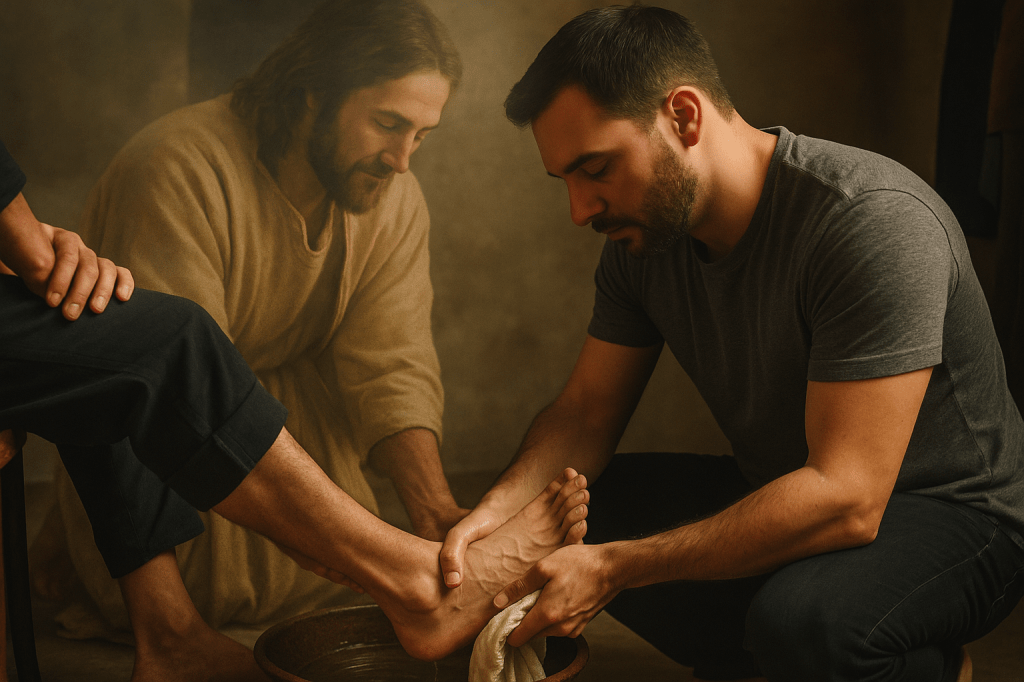
Lately I have been circling around a set of ideas that seem to converge from very different Christian teachers. Dallas Willard approaches the Christian life one way. Major Ian Thomas approaches it another. James Gifford Jr., when he talks about perichoretic salvation (περιχώρησις), uses language drawn from Trinitarian theology. Eastern Orthodox writers speak of theosis (θέωσις), sometimes translated as deification or participation in the divine life.
Different traditions. Different vocabulary. Yet when you listen carefully, it begins to sound like they are all pointing toward the same mysterious center.
What they seem to be describing is a kind of indwelling relationship between the believer and God. Scripture itself uses similar language. Christ in you. You in Christ. Participation in the life of God. Eternal life beginning now. Kingdom living. A Trinitarian life.
None of these phrases are identical, but they seem to be describing the same reality. A relationship in which God does not merely influence us externally but actually dwells within us (indwelling, inhabitatio Dei). A relationship in which we become participants in the life of God by grace rather than by nature. In Orthodox language this is theosis. In Gifford’s framework it is participation in the divine communion through what he calls perichoretic salvation.
inhabitatio Dei
- Eastern Orthodox theology connects inhabitatio Dei with theosis: God indwells the believer through His energies, drawing them into divine life.
- Roman Catholic theology uses the term especially in relation to the Holy Spirit’s indwelling and the infused virtues of faith, hope, and love.
- Reformed and Protestant theologians also use the term, often emphasizing union with Christ and the Spirit’s presence.
And this raises a question that I keep returning to. What does that actually look like in practice? How does the indwelling life of Christ work in the ordinary life of a believer?
As I have been reading more deeply, I also discovered that theologians sometimes make an important distinction that may help clarify what we are talking about here. They distinguish between moral imitation (imitatio Christi) and ontological participation (participatio Christi). Moral imitation means following the example of Jesus. We study His character, His teachings, and His actions, and then we attempt to model our lives after Him. This has been a central theme in Christian discipleship for centuries. But ontological participation points to something deeper. It suggests that the Christian life is not merely copying Christ from the outside but sharing in His life from the inside. In this view, transformation happens because we are united with Christ and participate in His life through the Spirit.
Dallas Willard offers one metaphor. Major Ian Thomas offers another. Both are helpful, but both leave me with questions.
Willard describes the relationship somewhat like power steering. When you drive a car, the steering wheel still moves because you turn it. Yet the system supplies a kind of power that makes the movement possible. Without it, you would still steer, but it would require far more strain. With it, the movement becomes fluid.
If I understand Willard correctly, the Christian life works something like that. We act. We choose. We live. Yet the power enabling that life is not merely our own. God empowers what we could not accomplish by ourselves.
This fits well with the language of cooperation that theologians sometimes call synergism (συνεργία), meaning a working together between God and the believer. The term comes from the Greek syn (“with”) and ergon (“work”), literally meaning “working together.” This idea is especially central in Eastern Orthodox and Roman Catholic theology and also appears in some Protestant traditions influenced by Arminianism. It stands in contrast to monergism, which teaches that God alone acts in salvation without human cooperation. It is important to clarify, however, that thinkers like Gifford, Thomas, and Willard are not suggesting that we cooperate with God in the initial act of justification. Rather, they are speaking about the ongoing life of sanctification, where the believer participates in the transforming life of Christ after salvation has begun.
But when you hear it framed this way, it can almost sound as if we remain fully in control and God simply supplies assistance when needed.
That is where Major Ian Thomas’s metaphor becomes interesting. Thomas famously described the relationship as a hand and glove. A glove lying on a table cannot do anything by itself. It has shape, but no life. It has form, but no agency.
When a hand enters the glove, suddenly the glove can do everything the hand can do. The glove can pick something up, write a letter, or grasp another hand. Yet the glove is not really the source of the action. The hand is. In Thomas’s metaphor, Christ is the hand and we are the glove. The Christian life, in this picture, is not primarily us trying to imitate Jesus. It is Christ Himself living His life through us. This resonates with Paul’s famous statement: “It is no longer I who live, but Christ lives in me” (Galatians 2:20).
At first glance, this seems closer to the language of Scripture about union with Christ (unio cum Christo). It emphasizes dependence and divine initiative much more strongly than the power steering analogy.
But if I am honest, this metaphor also raises questions. Because if we push the hand and glove analogy too far, it begins to sound almost like possession. And that makes me pause.
The New Testament describes something very different when it talks about demonic possession. In those cases the person’s will and agency appear to be overridden. The person becomes a vehicle for another will entirely. The demon controls speech, behavior, and even bodily movement.
If you described that situation metaphorically, you might also use something like a hand and glove. The possessing spirit acts and the person becomes the instrument. Clearly that cannot be the same thing as the indwelling of Christ.
So where is the difference?
The more I think about it, the distinction may lie in the nature of surrender. Both Willard and Thomas emphasize something important here. Christ does not coerce His way into the human heart. The New Testament repeatedly describes the Christian life as something entered voluntarily. We yield. We surrender. We present ourselves to God (Romans 12:1).
The indwelling of Christ is therefore not coercive possession but willing participation. Love does not override the will. It invites it. This is why the New Testament repeatedly speaks of abiding in Christ (μένω, menō). Abiding suggests relationship, communion, and ongoing trust. It is not mechanical control but relational participation.
In that sense the Christian life may not fit neatly into either metaphor perfectly. Perhaps there really is something of both. From one angle, it does resemble power steering. We still act. We still choose. Our personality and agency remain intact. God does not erase our humanity but restores it.
From another angle, it resembles the hand and glove. The life being expressed through us ultimately originates in Christ. The love, patience, and grace that flow outward are not simply products of human effort but manifestations of divine life.
Maybe this is why the early church often spoke of salvation not merely as forgiveness but as participation (participatio) in the life of God. This is the language of theosis. Not that we become God by nature. Christianity has never taught that. But that by grace we participate in the divine life through union with Christ and the indwelling of the Holy Spirit (pneumatology, πνεῦμα).
The more I explore these ideas, the more I realize how much mystery remains. I do not pretend to have this fully worked out. In fact, the opposite is true.
I feel like I am circling around something important but still searching for the right language to describe it. These metaphors help, but every metaphor eventually breaks down. The reality they point to is deeper than any single image can capture.
What seems increasingly clear to me, however, is that the Christian life cannot be reduced to moral effort alone. It is not merely imitation of Christ from a distance. It is participation in His life. Christ in us. Us in Him.
A living relationship in which the believer becomes, slowly and imperfectly, a vessel through which divine life begins to flow into the world. I suspect I will be pondering this for a long time. And perhaps that is exactly where the journey of spiritual formation begins.
Excerpt
Different Christian teachers describe the indwelling life of Christ in different ways. Is the Christian life moral imitation or participation in the divine life? Reflecting on Dallas Willard, Major Ian Thomas, and James Gifford Jr., I explore metaphors, theology, and the mystery of what it means for Christ to live through us.
Theosis Is Not a Metaphor


Leave a Reply