
Introduction
Any serious discussion of Christian naturism or nudism eventually has to ask a larger question: what has Christianity actually taught us to see when we look at the unadorned human body?
That question is not as simple as many assume. The nude human form has a rich, complicated, and sometimes uncomfortable history within Christianity. It appears in Scripture, in theological reflection, in baptismal imagery, in depictions of Adam and Eve, in scenes of martyrdom and crucifixion, in portrayals of resurrection and judgment, and in some of the most famous works of Christian art ever created. At the same time, Christians have also argued over such images, censored them, covered them, defended them, and sometimes condemned them.
This matters because Christian naturism cannot be reduced to a modern lifestyle preference or a reaction against cultural shame. It touches deeper questions about creation, incarnation, embodiment, modesty, sexuality, dignity, vulnerability, temptation, beauty, and redemption. Christianity is not a religion of souls trying to escape bodies. It is a faith that begins with embodied creatures made in the image of God, centers on the Word made flesh, and ends not with disembodied spirits floating in heaven, but with resurrection and renewed creation.
So before asking whether Christians may practice naturism faithfully, we should pause and ask how Christians have understood the body itself. What does the unclothed body mean? Is it always sexual? Is it always shameful? Can it be innocent, vulnerable, dignified, tragic, heroic, penitential, or holy? Can art teach us to see the body rightly, or can it train us to see wrongly?
This three part mini-series explores those questions through the history of Christian art and theology. The first post asks why Christian art ever depicted nude bodies at all. The second considers what those nude bodies were meant to communicate. The third looks at why Christians have disputed, censored, and sometimes covered such images. My goal is not to flatten the conversation into easy approval or easy rejection, but to recover a more thoughtful Christian imagination, one capable of seeing the body neither as an idol nor as an embarrassment, but as part of the mystery of what God has made, entered, redeemed, and promised to raise.
The Body Revealed
Many modern Christians instinctively assume that nude art is automatically unchristian. The unclothed body, they assume, must belong to the realm of temptation, immodesty, lust, or moral danger. To be fair, that instinct does not come from nowhere. We live in a culture that has repeatedly trained us to see the body through the lens of consumption, advertisement, pornography, vanity, and performance. Many Christians have good reasons to be cautious about what images do to the imagination.
And yet, if we pause long enough to look at Christian history, the picture becomes far more complicated.
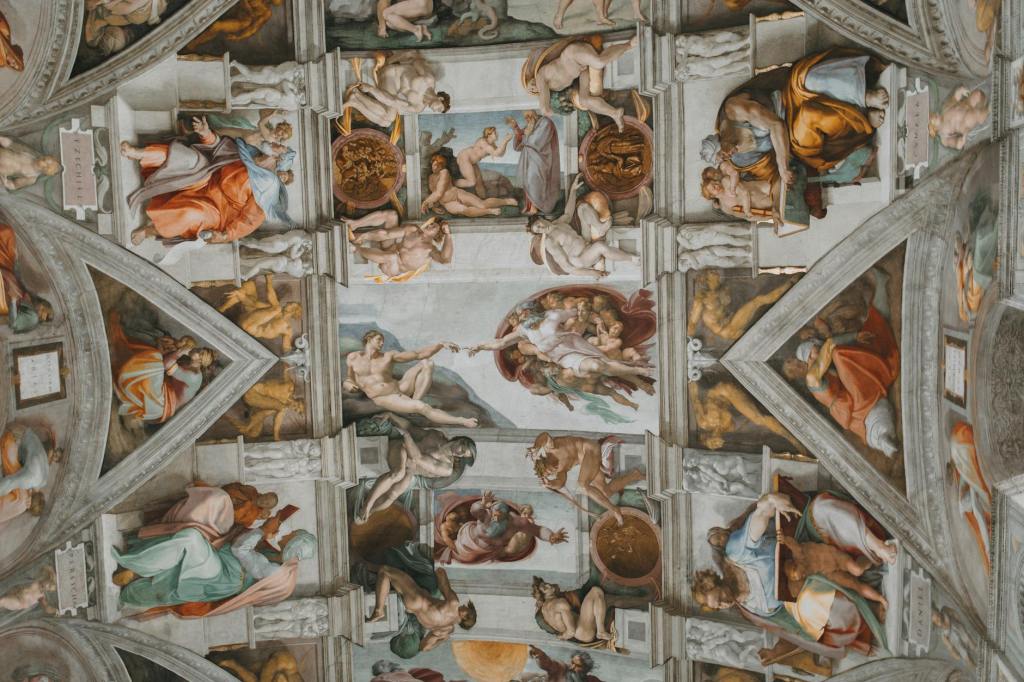
Christian civilization gave us the Sistine Chapel. It gave us Michelangelo’s David. It gave us Adam and Eve before the Fall, baptismal scenes, martyrdoms, crucifixions, Last Judgments, and visions of resurrected humanity. Some of the most famous works of Christian art ever made include nude or partially nude bodies. These bodies appear not on the margins of Christian civilization, but often near its center, in churches, chapels, manuscripts, frescoes, sculptures, and sacred spaces meant to train the eyes, shape the imagination, and direct the soul toward God.
“And the Word became flesh and lived among us.” – John 1:14
That should make us pause. If nudity were always and everywhere treated as spiritually corrupting, why did Christians ever permit the nude body to be shown in sacred art at all? Why was Adam shown unclothed in Eden? Why were the newly baptized sometimes imagined in imagery of nakedness and rebirth? Why were martyrs depicted stripped, exposed, and vulnerable? Why were the dead raised in Last Judgment scenes with bodies unveiled before God? Why did artists portray Christ Himself, especially in the crucifixion and deposition, with a body that was wounded, exposed, humiliated, and yet still the body through which salvation came?
These questions matter for any serious conversation about Christian naturism or nudism. We cannot talk about Christian practice and the unadorned human body as if the Church has never had to think about the body before. Nor can we pretend that Christian history gives us one simple answer. Like most things in church history, the story defies easy categorization. Christians have honored the body and feared it. They have painted it, sculpted it, covered it, censored it, defended it, disciplined it, and contemplated it. They have seen in it both the glory of creation and the vulnerability of fallen humanity.
So the question is not merely, “Is the body shown?” That is too shallow. The deeper question is, “What is this body being asked to mean?”
A nude body in Christian art may be shown as innocent, as with Adam and Eve before shame entered the world. It may be shown as vulnerable, as with the poor, the suffering, or the condemned. It may be shown as humiliated, as with Christ stripped before crucifixion. It may be shown as universal, as with resurrected humanity standing before divine judgment with every earthly status removed. It may be shown as beautiful, not in the sense of being available for possession, but in the sense of being part of God’s good workmanship. The same physical form can communicate very different things depending on the story, the setting, the posture, the gaze, and the moral imagination being formed in the viewer.
That last phrase is crucial: the moral imagination being formed in the viewer. Christian art is never just decoration. At its best, it teaches us how to see. It trains perception. It asks us to look at the world, the body, suffering, holiness, death, resurrection, and glory through a redeemed imagination. But images can also train us badly. They can reduce persons to objects. They can invite use rather than reverence. They can flatter vanity, excuse voyeurism, or baptize sensuality with religious language. This is why discernment is necessary. The issue is not whether the human body can ever be shown. Christian history has already answered that with a complicated yes. The harder question is whether a particular image forms us toward dignity or toward use.
That distinction will guide this series. Christian art could depict nude bodies because Christianity is not a religion of escape from embodiment. It is not Gnosticism with stained glass. It does not teach that the soul is good and the body is merely a prison. Christianity begins with creation, where embodied humanity is called very good. It centers on the Incarnation, where the eternal Word takes on flesh. It proclaims the resurrection of the body, not the disposal of the body. It looks toward renewed creation, not an escape hatch from material existence. If that is true, then the body is not automatically shameful. It can be theologically meaningful.
That does not settle every question about Christian naturism. It does not mean every setting is wise, every image is good, or every claim made in the name of bodily freedom should be accepted without examination. But it does mean we should not begin with the assumption that the unclothed body is inherently obscene. That assumption may owe more to cultural anxiety than to Christian theology.
Before we ask what Christian naturism might mean today, we need to ask what Christians have seen, feared, and hoped when they looked at the unadorned human form. The first step is to look honestly at the paradox in front of us: many Christians are uncomfortable with nude art, yet Christian civilization produced some of the most famous nude and seminude sacred art in the world. That tension is not a problem to be avoided. It is the doorway into the conversation.
The Body in Christian Theology
Have you ever looked closely at Albrecht Dürer’s Adam and Eve?
Dürer’s 1504 engraving is one of the most influential Northern Renaissance depictions of the nude human form. Adam and Eve stand before us with an almost sculptural stillness, beautiful, vulnerable, symbolic, and strange. They are not yet clothed. They are not yet hiding. They are not yet curved inward by shame. Around them are animals, trees, fruit, and signs of a world heavy with meaning. The scene is not merely anatomical study, though it is certainly that. It is theology through line and shadow.
So what comes to mind when we see it? Do we see temptation first? Do we see innocence? Do we see danger? Do we see beauty? Do we see a man and a woman as God’s workmanship before the rupture of sin? Or do we immediately feel the need to look away because we have been trained to think that the unclothed body must always be morally suspicious? That reaction tells us something. Not necessarily about the artwork first, but about us.
Christian theology begins with the human being as an embodied image bearer. That phrase matters. To be human is not to be a soul trapped inside a temporary machine. We are not ghosts wearing meat. We are embodied persons. Our bodies are not accessories to our humanity. They are part of our humanity. When Genesis says that humanity is made in the image of God, it does not mean that God has a body like ours. It means that the whole human person, body and soul together, is called to represent God’s presence, rule, creativity, relationality, and goodness within creation.
“So God created humankind in his image, in the image of God he created them; male and female he created them.” – Genesis 1:27
This is why an embodied theological anthropology is so important. Anthropology here means our understanding of the human person. A Christian anthropology does not begin with shame. It begins with gift. Before sin enters the story, the body is already there. Male and female are already there. Creatureliness is already there. Difference is already there. The body is not introduced after the Fall as a punishment. The body belongs to creation before shame ever appears.
That means the body is part of God’s good creation. We may need to say this slowly because many Christians have inherited habits of discomfort that sound spiritual but may not actually be biblical. The body is not the dirty part of the human being. It is not the lower half of a higher spiritual self. It is not a regrettable necessity that God tolerates until He can finally rescue us from material existence. Genesis does not call creation “very good” with an asterisk next to the human body.
The body is divine workmanship. It is formed, animated, blessed, and given a vocation. Hands can serve. Eyes can behold. Feet can carry good news. Skin can feel the nearness of another. Voices can bless or curse. Faces can reveal sorrow, joy, fear, and love. The body is not merely biological material. It is personal presence made visible. When we encounter another human body, we are not encountering an object. We are encountering someone.
This is where Christian discomfort with the body becomes worth examining. Some discomfort is wise. We should be cautious about lust, exploitation, vanity, voyeurism, and the reduction of persons to parts. But some discomfort may be culturally inherited rather than theologically necessary. We have often absorbed the assumption that nakedness equals sex, sex equals danger, and danger equals shame. That chain of thought may feel protective, but it can also distort our vision. It can make us suspicious of the very form God created and called good.
Then comes the Incarnation, and the Christian claim becomes even more startling. The Word became flesh. Not an idea. Not an apparition. Not a divine message wearing a costume. Flesh. The eternal Son entered human life through a human body. He was conceived, born, held, fed, washed, carried, and clothed. He grew. He became tired. He touched lepers. He wept. He ate with sinners. He slept in a boat. He bled under Roman violence. He died with a body exposed to public humiliation. If Christianity were embarrassed by embodiment, the Incarnation would be impossible to explain.
The Incarnation is God’s affirmation of embodied life. It does not mean every bodily desire is rightly ordered. It does not mean every use of the body is holy. But it does mean the body cannot be dismissed as spiritually irrelevant. God does not redeem humanity by avoiding the body. God redeems humanity by entering bodily life from within.
“The flesh is the hinge of salvation.” – Tertullian
That line from Tertullian may sound almost shocking to modern ears, but it captures something deeply Christian. Salvation does not bypass the body. Christ is born in the flesh, suffers in the flesh, dies in the flesh, and rises in the flesh. The body is not an obstacle to redemption. It is one of the places where redemption is revealed.
This leads directly to the resurrection of the body. Christianity does not end with souls escaping upward into a vague spiritual mist. The creeds confess the resurrection of the body. Paul speaks of resurrection not as the abandonment of embodiment, but as its transformation. The body is sown perishable and raised imperishable. That means embodiment is not temporary scaffolding, used for a while and then discarded once the real spiritual building is complete. Embodiment belongs to the final hope of Christianity.
This is one reason nude and seminude bodies appear in Christian art, especially in scenes of resurrection and judgment. The body matters because the whole person matters. What we do in the body matters. What is done to the body matters. The poor body, the wounded body, the shamed body, the baptized body, the resurrected body, all of it belongs to the Christian story.
And here we meet what might be called Christianity’s anti-Gnostic instinct. Gnosticism, in broad terms, refers to ancient religious movements that often treated the material world as inferior, corrupt, or something to escape through secret spiritual knowledge. The details vary, and we should be careful not to flatten history, but the general impulse is familiar: spirit good, matter bad; soul important, body disposable. Christianity rejected that instinct at its roots. Creation is good. The Word becomes flesh. The dead are raised. The new creation is not the deletion of the old creation, but its healing and transfiguration.
This does not make Christianity naïve about the body. Scripture is quite honest about disordered desire, lust, exploitation, and sin. But it does mean Christian modesty should not be built on contempt for the body. Christian holiness should not require us to despise what God has made. Christian discipline should not become a baptized form of disgust.
That is why Dürer’s Adam and Eve is such a useful place to begin. The image asks us to stand before the human form before shame, while knowing that shame is about to enter the story. It asks us to see beauty and danger, innocence and vulnerability, creation and fall, all at once. It does not let us take the easy way out. It does not permit the simplistic claim that the unclothed body is always obscene, nor does it allow the opposite claim that nakedness is always innocent in every context. It asks for discernment.
And perhaps that is exactly what we need. Before Christian naturism can be evaluated wisely, Christians need a better theology of the body. Not a theology that worships the body. Not a theology that fears the body. Not a theology that treats clothing as the measure of holiness or nakedness as the measure of freedom. We need a theology rooted in creation, incarnation, resurrection, and renewed creation. We need to recover the ability to say that the body is good without pretending that all gazes are pure. We need to say that shame is real without making shame the foundation of Christian anthropology. The body, in Christian theology, is not an embarrassment to be explained away. It is part of the mystery of being human.
Eden, Shame, and Restoration
If Dürer’s Adam and Eve invites us to see the body in the stillness before rupture, Masaccio’s Expulsion from the Garden of Eden forces us to look at the moment after everything has changed.
Painted around 1425 in the Brancacci Chapel in Florence, Masaccio’s fresco shows Adam and Eve driven from Eden by an angel with a flaming sword. They are nude, but the nudity does not communicate innocence in the same way it does in many depictions of Eden before the Fall. Adam covers his face in anguish. Eve’s body twists in grief. Their nakedness is no longer serene. It has become exposed, vulnerable, wounded, and ashamed.
That is what makes the image so powerful. The body itself has not changed. The context has.
Before the Fall, Genesis says, “the man and his wife were both naked, and were not ashamed.” That sentence is almost impossible for us to read innocently. We already know the next chapter. We already know the rupture is coming. We already know shame will enter the story. But the text asks us to pause before that happens. It asks us to imagine a world where the unclothed body did not automatically mean lust, embarrassment, danger, vanity, or exposure. Nakedness, in Eden, was not yet a problem to solve. It was simply part of embodied life before alienation.
“And they were both naked, the man and his wife, and were not ashamed.” – Genesis 2:25
Then comes the Fall. After sin, Adam and Eve see themselves differently. They sew fig leaves together. They hide from God. They become aware not merely of their bodies, but of themselves as vulnerable before God, one another, and the world. Shame enters human experience, and the body becomes one of the places where that shame is felt. This does not mean the body became evil. It means the human relationship to the body became fractured.
The Fall does not turn the body from good to bad. It turns human perception, desire, trust, and relationship out of alignment. The body remains God’s creation, but now it is experienced through fear, comparison, lust, domination, insecurity, and concealment. The body becomes a site of both beauty and anxiety. It can still be received as gift, but it can also be used as a weapon, a commodity, a temptation, or a mask.
Masaccio’s fresco captures this terrible transition. Adam and Eve are still God’s image bearers, but now they are image bearers in exile. Their nakedness is no longer the peaceful openness of Genesis 2. It is the painful exposure of Genesis 3. The same visible condition, unclothed humanity, can signify opposite realities depending on the story being told. In one setting, innocence. In another, shame. In one, trust. In another, fear. In one, vulnerability without threat. In another, vulnerability under judgment.
This is why context matters so much in Christian art. Nudity is not morally self-interpreting. It does not always say the same thing. The nude body in Eden before sin is not saying the same thing as the nude body expelled from Eden after sin. The stripped body of Christ before crucifixion is not saying the same thing as a body arranged for consumption. The resurrected bodies in a Last Judgment are not saying the same thing as bodies used for entertainment. The question is not only what is shown, but what the showing means.
Here we also need to think carefully about clothing. Clothing can be practical. It protects from cold, sun, injury, labor, and social vulnerability. It can be beautiful, symbolic, modest, professional, festive, or liturgical. Scripture does not treat clothing as meaningless. Garments can communicate identity, office, grief, celebration, repentance, and dignity.
But clothing can also conceal. After the Fall, the first clothing is not merely about weather. It is about shame. It is about hiding. It is about the painful new awareness that something has gone wrong between human beings, within human beings, and before God. The fig leaves are not evil, but they are tragic. They are the first human attempt to manage shame by covering the visible sign of vulnerability.
This helps us avoid two opposite mistakes. One mistake says clothing is always the proof of holiness and nakedness is always the proof of corruption. That is too simple. It forgets Eden. It forgets baptismal imagery. It forgets resurrection. It forgets that shame is not the same thing as modesty, and modesty is not the same thing as disgust.
The other mistake says that because nakedness existed before the Fall, all shame can simply be ignored now. That is also too simple. It forgets that we no longer live in Eden. We live among disordered desires, wounded imaginations, predatory gazes, trauma, insecurity, and sin. The Christian answer is not pretending the Fall never happened. The Christian answer is redemption.
And redemption is restoration, not escape from embodiment. This is central to the Christian story. God does not respond to the tragedy of Eden by abandoning the body. He does not say, “The material world failed, so now salvation will be purely spiritual.” Instead, Scripture moves toward incarnation, resurrection, and renewed creation. The same God who clothed Adam and Eve later takes on flesh in Christ. The same God who judges sin also heals bodies, touches the unclean, raises the dead, and promises a new heaven and a new earth.
“Behold, I make all things new.” – Revelation 21:5
Notice that phrase: all things new. Not all things discarded. Not all things escaped. New. The Christian hope is not that we finally become bodiless souls freed from the burden of matter. The Christian hope is the resurrection of the body and the renewal of creation. That means embodiment is not a temporary embarrassment. It is part of God’s intention for human life. The body that now knows shame, weakness, aging, desire, pain, and death is still destined for redemption.
This is why Eden matters not merely as origin, but as direction. Eden is not only where the story begins. It is also a clue to what restoration means. The biblical arc does not simply move from garden to ghostly heaven. It moves from garden, through exile, through cross and resurrection, toward new creation. The lost openness of Eden is not restored by naïvely pretending we are unfallen. It is restored through Christ, who enters our shame, bears our exposure, and opens the way toward healed communion with God and one another.
This gives Christian reflection on naturism a needed seriousness. It cannot simply say, “Adam and Eve were naked, therefore everything is fine.” That would be shallow. But neither can it say, “Adam and Eve were ashamed, therefore the body is shameful.” That would also miss the story. The deeper truth is that nakedness can belong to innocence, shame, vulnerability, humiliation, penitence, judgment, and hope. The body remains meaningful in all of it because the body remains part of the person God made and intends to redeem.
Masaccio’s Expulsion helps us see this. Adam and Eve leave Eden naked, but their nudity is no longer simple. It is heavy with grief. Yet even there, even in exile, their bodies are not worthless. They are not trash left behind by a failed creation. They are sorrowing bodies, guilty bodies, frightened bodies, but still human bodies. Still image bearing bodies. Still bodies God will clothe, pursue, and ultimately redeem.
The Christian story does not end with fig leaves. It does not even end outside the garden. It ends with creation healed, shame answered, death defeated, and embodied humanity restored before God. That is why the body remains theologically meaningful. It carries memory of Eden, evidence of the Fall, wounds of exile, signs of longing, and hope of resurrection. It can move from innocence to shame, but also from shame toward restoration. It can signify vulnerability, but also strength. It can reveal our poverty, but also God’s workmanship.
The Body as Art, Not Embarrassment
If the human person is God’s workmanship, why should the unclothed body be treated as automatically unfit for depiction?
That question does not answer every concern, but it does force us to examine one of our assumptions. Many Christians are willing to say, in theory, that the body is created by God, formed by God, sustained by God, and destined for resurrection. Yet when the body appears unclothed in art, especially in a sacred or biblical setting, many immediately assume that something improper has happened. But why? Is the problem the body itself, or the way the body is being seen? Is the issue nakedness, or the gaze that turns a person into an object?
“For we are his workmanship, created in Christ Jesus for good works.” – Ephesians 2:10
The word “workmanship” is sometimes rendered as “handiwork” or even “masterpiece.” That does not mean every depiction of the body is good, wise, reverent, or spiritually healthy. But it does mean that the body is not an embarrassment to God. If the human person is God’s masterpiece, then the body cannot be treated as spiritual clutter. It is part of the created form through which human life becomes visible. The body is not the whole person, but neither is it something less than personal. It is the person made manifest.
This is where art becomes important. Art asks us to look, but good art also asks us to look rightly. A painting or sculpture can train the viewer toward reverence, pity, wonder, repentance, courage, grief, or hope. It can also train the viewer toward possession, fantasy, domination, envy, or use. The question, then, is not whether the human form can be represented. The question is whether the representation honors the person or reduces the person.
Christian art developed carefully, unevenly, and not without disagreement. Early Christians were often cautious about images, partly because of Jewish concerns about idolatry, partly because of the surrounding pagan world, and partly because the Church was still learning how to express its faith visually. Yet over time, Christian art developed a rich visual language. Biblical figures, saints, martyrs, Christ, Mary, angels, judgment, resurrection, paradise, and suffering all entered the visual imagination of the Church.
In medieval art, the human body appeared in many forms, sometimes stylized, sometimes symbolic, sometimes clothed in theological meaning more than anatomical realism. The body could signify sin, mortality, suffering, holiness, vulnerability, or glory. Then the Renaissance brought renewed attention to anatomy, proportion, classical form, and the heroic body. Artists such as Dürer, Michelangelo, and others did not merely study the body as biological structure. They used the body to communicate biblical drama, moral seriousness, and theological meaning.
Of course, that same history also includes anxiety. Some Christians worried that beauty could become sensuality, that sacred images could become distractions, and that the human form could become too naturalistic, too exposed, or too easily misread. Later covering and censoring impulses did not come from nowhere. They often arose from genuine concerns about devotion, modesty, and temptation. But the existence of those concerns does not erase the earlier fact: Christian art had already found ways to depict the body as meaningful rather than automatically obscene.
This is why Adam and Eve are such an important starting point. They show the body at the beginning, before shame, and then after shame. In one image, the nude body can signify innocence. In another, grief and exposure. That contrast prepares us for an even larger theological image: the body at the end, raised for judgment.
Case Study: The Nude Body on the Wall of the Sistine Chapel
If modern Christians assume that nude bodies have no place in sacred art, Michelangelo’s Last Judgment immediately disrupts that assumption. Painted on the altar wall of the Sistine Chapel, Michelangelo’s Last Judgment is not a marginal work tucked away in some obscure corner of Christian history. It stands in one of the most famous sacred spaces in the world. Last Judgment imagery itself was one of the most important themes in Christian art from the medieval period into the Renaissance, and Michelangelo’s version became perhaps the most famous and controversial example of the theme.
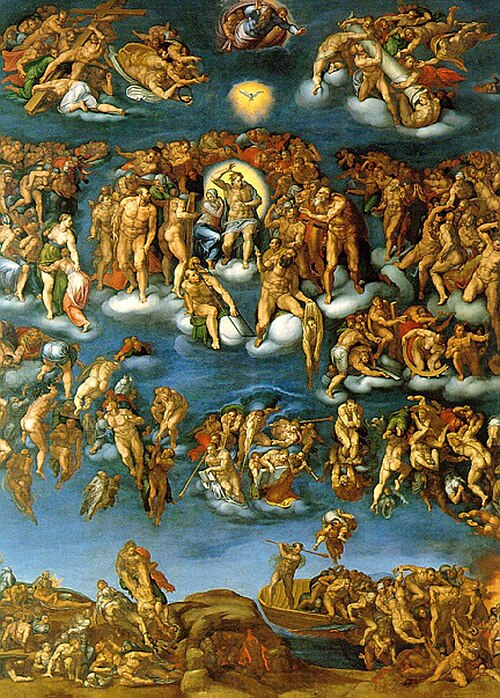
What does the fresco depict? Christ judges the world. The saved are drawn upward. The damned are pulled downward. The dead rise. Humanity stands before divine truth. The scene is not casual, decorative, or merely dramatic. It is eschatological, which means it concerns the last things: judgment, resurrection, salvation, damnation, and the final unveiling of reality before God.
The nude body in the Last Judgment is not a decorative extra. It is part of the theology of resurrection and judgment. Christianity does not confess merely the survival of the soul. It confesses the resurrection of the body. The dead are raised as whole persons. They stand before God not as social roles, costumes, titles, ranks, uniforms, or carefully managed public identities, but as embodied creatures fully known by their Creator.
The bodies are not nude because the fresco is trying to eroticize the scene, but because judgment concerns the whole person, embodied and unhidden. Here nakedness can signify vulnerability, universality, and exposure before divine truth. Kings do not stand before God as kings. Bishops do not stand before God as bishops. The rich do not stand before God wrapped in status. The poor do not stand before God as forgotten scraps of history. Every earthly covering is stripped away. Every performance ends. Every mask falls. Humanity appears before Christ as humanity.
In this sense, Michelangelo’s nude bodies are not an argument against Christian seriousness. They are an argument for it. They remind us that salvation and judgment are not abstractions. The body is not incidental to the human person. What we have done, suffered, desired, loved, harmed, endured, and become is not detached from embodied life. The body is where mercy was given, where violence was done, where prayer was whispered, where hunger was felt, where love was enacted, where wounds were carried.
Michelangelo could paint nude bodies in one of Christianity’s holiest spaces because the Christian tradition did not automatically treat the body as shameful or unfit for sacred representation. The body could be painted because the body could mean. It could carry theological weight. It could speak of creation, fall, vulnerability, judgment, resurrection, and glory.
That does not mean everyone agreed with Michelangelo’s choices. They did not. The same work that demonstrates Christianity’s ability to depict the body also became a site of anxiety, criticism, censorship, and covering. The fresco’s later history reminds us that Christian art has always lived in tension between reverence and suspicion, beauty and danger, embodiment and modesty. That debate will matter later.
For now, the point is simpler and more foundational. Christian art did not depict the body because Christianity forgot holiness. It depicted the body because Christianity remembered creation, incarnation, resurrection, and judgment. The body was not merely something to hide. It was something to understand.
And if that is true, then any Christian conversation about naturism must begin with better questions than, “Is the body visible?” We must ask, “What is the body being made to mean?” “What kind of seeing is being encouraged?” “Does this form the viewer toward dignity or toward use?” “Does it honor the person as God’s workmanship, or does it train the eye to consume?” The body as art is not automatically innocent. But neither is it automatically an embarrassment.
Different Christian Traditions, Different Instincts
It is important to say plainly that Christianity is not uniform in how it has treated sacred images, the human body, or nude and seminude art. There is no single visual instinct shared equally by all Christians in all times and places. The Church has always confessed the goodness of creation, the reality of the Incarnation, and the hope of bodily resurrection, but different Christian traditions have expressed those truths with different levels of visual confidence, caution, and discipline.
Catholic Christianity has often had the richest tradition of figural art. This does not mean every Catholic artwork is beyond criticism, or that Catholics have never debated the limits of sacred representation. They certainly have. But Catholic visual culture has generally been deeply sacramental and incarnational. By sacramental, I mean that visible things can become signs that point beyond themselves to invisible grace. By incarnational, I mean that because God entered the visible world in Christ, matter, color, stone, flesh, gesture, and beauty can become vehicles of theological meaning. In that world, the human body can be depicted not because it is worshiped, but because it belongs to the created order God has entered and redeemed.
This is part of why Catholic art could give us crucifixions, pietàs, martyrs, saints, Madonnas, Last Judgments, and biblical nudes with such emotional and theological force. The body could be shown wounded, glorified, humbled, exposed, maternal, penitential, or resurrected. The visible body could help the viewer contemplate invisible realities. The danger, of course, is that beauty can become spectacle, and spectacle can become distraction. Catholic art has always had to wrestle with that tension.
Protestant traditions have been more varied. Some streams of Protestantism inherited or developed strong iconoclastic caution. Iconoclasm is the rejection or destruction of religious images, usually out of concern that such images may become idols or corrupt worship. In some Protestant settings, sacred art was viewed with deep suspicion because the preached Word, rather than the painted image, was understood as the proper center of Christian formation. This caution should not be dismissed too quickly. It reflects a serious concern that images can mislead, manipulate, sentimentalize, or become substitutes for faithful obedience.
But Protestantism is not simply anti-art. Other Protestant traditions retained, recovered, or eventually renewed the use of visual art, especially for teaching, devotion, beauty, and cultural engagement. Lutheran, Anglican, Reformed, Evangelical, and other Protestant communities have handled these questions differently. Some have plain sanctuaries and rich hymnody. Some have stained glass, crosses, biblical illustration, and sacred architecture. Some have moved toward a renewed appreciation of art as part of Christian imagination and formation. Protestant instincts range from “be careful what images do” to “recover the imagination for Christ.”
Orthodox Christianity offers yet another instinct. Orthodoxy strongly affirms the goodness of the body and the reality of the Incarnation, but it disciplines sacred imagery through the icon. An icon is not simply a religious picture. It is a visual form shaped by theology, prayer, tradition, and liturgical use. Orthodox icons usually resist sensual naturalism, meaning they do not aim primarily to imitate the body in a realistic or physically seductive way. They are often stylized, transfigured, frontal, luminous, and restrained. The point is not to deny embodiment, but to show the body as drawn into holiness.
Orthodoxy does not reject the body as evil. It does not deny that Christ truly became flesh. In fact, the defense of icons historically depended heavily on the Incarnation. Because the invisible God became visible in Christ, Christ may be depicted. Yet Orthodox iconography is cautious about how the body is depicted, because the image is meant to lead the viewer into prayer rather than sensory possession. The body is affirmed, but the gaze is disciplined.
These differences are important for this series because they prevent us from saying, “Christianity says…” too quickly. Christianity speaks with a shared theological grammar, but with different visual accents. Catholic art often leans into sacramental fullness. Protestant traditions often ask sharper questions about idolatry, teaching, and the authority of the Word. Orthodox iconography affirms the visible while resisting visual excess. Each instinct has something to teach us.
This also helps us avoid simplistic conclusions about Christian naturism. A Christian theology of the body cannot be built by selecting only the tradition that makes us most comfortable. We need the Catholic reminder that matter can mediate meaning. We need the Protestant warning that images can deform as well as form. We need the Orthodox discipline that seeing must be purified, not merely permitted.
Taken together, these traditions suggest that the Christian question is not merely whether the body may be shown, but how the body is seen, what the body is made to mean, and whether the gaze is being trained toward reverence. Sacred art, like Christian practice, requires discernment. The body is good, but not every gaze is innocent. Beauty can reveal truth, but it can also be misused. Restraint can protect holiness, but it can also become fear. Freedom can honor creation, but it can also become self-deception. So we should not be surprised that Christians have disagreed. The disagreement itself tells us that the body matters.
This is also where I would connect this discussion to something I have written about elsewhere in this blog, especially in Art, The Kind of Knowledge That Changes You. My basic argument there was that art is not merely information placed before the mind. It is an experience that forms the viewer. We do not simply observe art from a safe distance; in some measure, we participate in it. We enter another person’s way of seeing, feeling, ordering, and interpreting the world. That is why art can be spiritually beneficial, but also why discernment matters. What we behold shapes us. The question is not only whether an image is permitted, but what kind of person it is training us to become. Does it move us toward truth, beauty, reverence, and agape love, or does it teach us to consume, possess, and use? That is the proper middle ground. Christian art should not be dismissed as spiritually dangerous simply because it is visual, embodied, or beautiful. But neither should it be consumed uncritically, as if images have no formative power. Art can become a doorway into deeper knowledge, but only when we learn to look with disciplined love. As I argued in that earlier post, “we are all being formed by what we behold. The question is, into what?”
What Comes Next
The complexity of this history should not become an excuse for intellectual laziness. It would be easy to say, “Because nudity in art can be misunderstood, misused, or abused, Christians should simply reject it altogether.” But that response is too quick. It avoids discernment by replacing it with fear. It flattens a rich and varied Christian history into a single prohibition, and in doing so it deprives us of a deeper visual and theological inheritance. Yes, images can deform us. Yes, the body can be exploited. Yes, wisdom is needed. But Christian maturity is not formed by refusing to look at difficult things. It is formed by learning how to see rightly. If the body can speak of innocence, shame, vulnerability, strength, humiliation, resurrection, and glory, then rejecting all nude art does not protect the meaning of the body. It may actually silence part of its testimony.
So the first question is no longer whether Christians ever showed the body. They did. They showed Adam and Eve in innocence and in exile. They showed martyrs stripped and suffering. They showed Christ wounded and humiliated on the cross. They showed the dead raised for judgment. They showed David, at times, not as a figure of worldly armor and visible power, but as the vulnerable human being through whom God’s strength was revealed. Christian art has not always treated the nude or seminude body as automatically obscene, even when Christians have disagreed sharply about when such images are wise, reverent, or dangerous.
That brings us to the next and deeper question: what were Christians trying to say when they showed the body?
The human body tells a story. More precisely, the human body is where many of our stories become visible. Creation, shame, vulnerability, courage, suffering, humiliation, beauty, mortality, judgment, and hope all pass through embodied life. Nudity exposes us, but it does not explain itself. It is not morally self-interpreting. In the Garden, nakedness can represent innocence. Outside the Garden, it can represent shame. Before Goliath, vulnerability can become a strange kind of strength, because David does not win by wearing Saul’s armor. On the cross, exposure becomes humiliation, and yet in that very humiliation Christ reveals the depth of divine love.
This is why context matters so much. Nudity is not the thing that brings the whole meaning by itself. The story gives the meaning. The posture, setting, gaze, symbolism, and theological frame all matter. The unclothed body can be used to degrade, but it can also be shown to reveal dignity. It can be used to consume, but it can also be shown to invite reverence. It can expose shame, but it can also point toward restoration. In that sense, nudity is not some strange foreign object inserted into theology from the outside. Nudity is us. It is humanity without costume, without rank, without the symbols by which we manage how others see us.
If anything, Christian art reminds us that we are deeply complex creatures. We are embodied image bearers. We are God’s workmanship. We are vulnerable and glorious, fallen and pursued, ashamed and loved, mortal and promised resurrection. Christianity does not give us permission to treat the body casually, but neither does it permit us to treat the body with contempt. The body belongs to creation, incarnation, cross, resurrection, and renewed creation.
That is why the next post will move from the question of why Christians depicted nude bodies to the question of what those bodies were meant to communicate. Nude bodies in Christian art can signify innocence, created goodness, vulnerability, humiliation, repentance, judgment, mortality, resurrection, and glory. The real issue is not simply whether a body is shown, but whether the image teaches us to see the human person truthfully.
The body was shown. Now we must ask what it was saying.
Excerpt
Christian art did not treat the nude body as automatically shameful. From Eden to the Sistine Chapel, the body could reveal innocence, vulnerability, judgment, and resurrection hope. This post asks why Christians depicted nude bodies at all, and what that history means for Christian naturism today.
Parhelion


Leave a Reply