
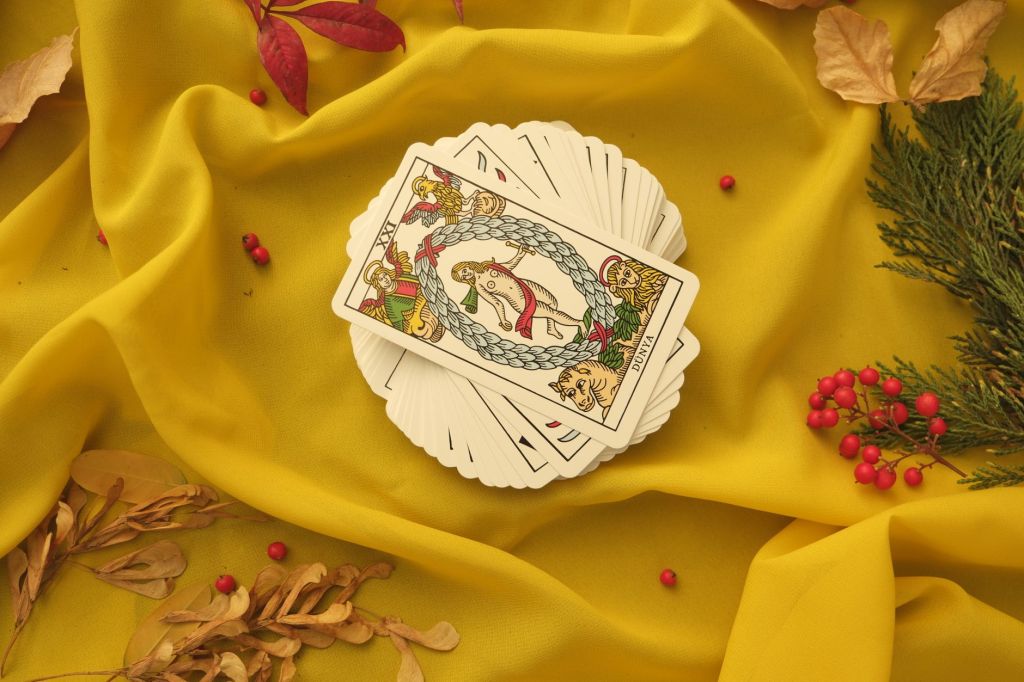
The Cards We Are Dealt
Imagine it is 500 years from now. Maybe you found a time machine. Maybe you were frozen as punishment for a crime and woke up in the year 2526, blinking under lights too clean, in a city too polite, surrounded by people who speak as if every rough edge of human life had been sanded smooth. The world is familiar enough to be recognizable and strange enough to feel like a joke you arrived too late to understand.
After dinner at a very fancy restaurant called Taco Bell, you wander through this spotless future city and come across a little shop tucked between sleek towers and frictionless conveniences. It looks different from everything else. Older. Stranger. Almost human.
A fortune teller. Of all the things in this utopia, it is the one place that feels familiar. It reminds you of your time in history. So you go in.
The room is dim. There is a small round table. A curtain shifts. A woman steps out dressed exactly as one might expect a fortune teller to dress, because apparently some stereotypes survive even the end of history. She sits across from you, holding a worn deck of cards.
“You are a wanderer,” she says. “Lost between worlds. Would you like some guidance?”
What the heck, you think. Lay it on me.
She shuffles the deck with practiced seriousness and begins placing the cards on the table. One card. Then another. Then another. And you freeze. You know these cards.
Not because they are ancient. Not because they carry the hidden wisdom of forgotten priests. Not because they were passed down from some mystical temple beneath the sands of Egypt. You recognize them because they look exactly like your old Pokémon cards.
No one in this future world plays the game anymore. No one remembers booster packs, playground trades, or arguments over whether a card was fair to use. The creatures, symbols, colors, and numbers have all survived, but the original game has faded from memory. Now the cards are used for fortune-telling. They are treated as mysterious, sacred, and ancient. You almost laugh. A children’s game became an oracle.
And that, in a very real sense, is what happened with tarot.
Tarot did not begin as an ancient Egyptian mystery system. It began as a game and novelty in the card-playing culture of late medieval and Renaissance Europe. Over time, people layered new meanings onto it. Symbols became secrets. Pictures became portals. A deck once used for play became, in the imagination of later centuries, a map of destiny, spirituality, psychology, and hidden wisdom.
Maybe, 500 years from now, it will not be Pokémon cards. Maybe the great spiritual seekers of the future will sit solemnly before a deck of Garbage Pail Kids cards, seeking guidance from Wrappin’ Ruth or Tommy Tomb. Stranger things have happened. Human beings have a remarkable habit of taking old images, forgetting where they came from, and then discovering new mysteries in them. And, for some reason, everyone eventually wants to point back to Egypt.
But perhaps that is part of the lesson. The question is not merely whether the cards are “really” ancient or “really” mystical. The deeper question is why human beings keep reaching for symbolic pictures when we are trying to understand ourselves, our choices, our fears, our hopes, and the road ahead.
Maybe they will use Garbage Pail kids instead of Pokémon cards in the future, unfortunately there is no Ancient Egyptian magic or mysteries to be found, or so they say. May on the cards Wrappin’ Ruth or Tommy Tomb Wink wink – It does seem like everyone always wants to point back to ancient Egyptian Mysteries don’t they?
That is the journey I want to trace in this post. Not because tarot needs to be feared, romanticized, or baptized into something it never was, but because its history is more interesting than the mythology surrounding it. Tarot began as a card game in late medieval Europe, moved through the hands of artists, nobles, gamblers, occultists, spiritual seekers, psychologists, and modern mystics, and gradually became something far larger than its original purpose. To understand tarot honestly, we need to begin before the crystal balls, before the fortune-telling booths, before the supposed Egyptian secrets, and before the modern spiritual marketplace. We need to start with the cards themselves: pictures on paper, made for play, later transformed by human imagination into symbols of destiny, archetype, and spiritual longing.
From Playing Cards to Portals: A Brief History of Tarot
Before tarot became associated with fortune-tellers, occult societies, New Age bookstores, psychological archetypes, or spiritual self-discovery, it was something much more ordinary.
It was a card game. That may feel anticlimactic, but it is also wonderfully human. We often imagine ancient wisdom arriving with thunder, incense, and secret priesthoods. Sometimes it arrives as a game played by nobles at court.
The earliest tarot cards emerged in northern Italy in the fifteenth century, probably sometime in the early-to-mid 1400s. At that time, they were not usually called “tarot” in the modern sense. They were known as carte da trionfi, or “triumph cards.” The word trionfi is important because it is connected to “trumps,” the special cards that outrank ordinary suit cards in trick-taking games. So when we speak of the “Major Arcana” today, we are looking at what began as a set of trump cards added to a more familiar four-suit deck.
The earliest written references to tarot cluster in the 1440s and 1450s in northern Italian cities such as Milan, Ferrara, Florence, Venice, and Urbino. One of the famous early references appears in the records of the Este court in Ferrara in 1442, where “triumph cards” are mentioned. There may be an even earlier Florentine reference from 1440, but the broader point is secure: tarot belongs to the world of fifteenth-century Italy, not ancient Egypt, Atlantis, or a lost temple buried beneath the sands.
The basic structure was already recognizable. The ordinary cards had four suits: Cups, Swords, Batons or Staves, and Coins. Each suit had numbered cards and court cards. Then came the added trump cards, which included figures such as the Fool, the Pope, the Emperor, Death, the Wheel of Fortune, Judgment, and the World. These images were not random. They came from the symbolic world of late medieval and Renaissance Europe: Christian imagery, courtly life, moral allegory, social hierarchy, death, virtue, fortune, judgment, and cosmic order.
But we should be careful. To say these images came from a Christian and Renaissance symbolic world is not the same as saying tarot began as a secret theological system. The cards carried familiar images from the culture around them, much like modern themed decks use familiar images from pop culture. A Renaissance noble could recognize the symbolic vocabulary without assuming he was holding an ancient book of hidden magic.
Some of the earliest surviving tarot cards are now preserved in museums and libraries. The most famous are the Visconti and Visconti-Sforza cards, associated with the powerful Visconti and Sforza families of Milan. These were not cheap paper cards tossed around in a tavern. They were luxury objects, hand-painted, gilded, and made for elite patrons. The Morgan Library & Museum in New York holds thirty-five cards from the Visconti-Sforza set. Other surviving cards from related sets are divided among institutions such as the Accademia Carrara in Bergamo, the Beinecke Rare Book & Manuscript Library at Yale, and the Pinacoteca di Brera in Milan.
This matters because the earliest surviving tarot cards are not spooky relics from an occult underground. They are Renaissance luxury objects. They belong to the world of courts, artists, family prestige, play, and social display. The cards are beautiful, but they were not originally fortune-telling tools.
For several centuries, tarot remained primarily a game. It spread from Italy into France, Switzerland, and other parts of Europe. The French form of the word, tarot, eventually became the term most English speakers recognize today. The Tarot de Marseille, a family of French tarot designs, became one of the most influential standard forms. Its images shaped later occult and esoteric interpretations, though it too grew out of the card-playing tradition.
The great turning point came in the late eighteenth century. In 1781, Antoine Court de Gébelin, a French Protestant pastor, Freemason, and scholar, published a theory that would change tarot’s reputation forever. In his massive work Le Monde primitif, he claimed that tarot preserved ancient Egyptian wisdom, specifically connected to the Book of Thoth. The problem is simple: he had no historical evidence for this claim. Egyptian hieroglyphs had not yet been deciphered, and the actual history of tarot pointed to Renaissance Europe, not ancient Egypt. But ideas do not have to be true to be influential. Don’t let truth get in the way of a good or lucrative story. We all know about Dan Brown and Joseph Smith.
At this point, I should probably confess that I too believe Garbage Pail Kids contain deep ancient Egyptian secrets. Of course, there is no evidence for this, but that has never stopped a good origin myth before. Maybe if I say it with enough confidence, write a few footnotes, add a mysterious diagram, and convince three people on the internet to repeat it, I can start a trend. Give it a century or two, and someone may solemnly claim that Wrappin’ Ruth and Tommy Tomb preserve fragments of lost temple wisdom. That is part of the warning here: sometimes “ancient mystery” is not discovered so much as invented, repeated, romanticized, and eventually mistaken for history.
As we know, Court de Gébelin’s Egyptian theory was wrong, but it was powerful. It gave tarot a new origin story. Instead of being a European card game with allegorical images, tarot could now be imagined as a hidden book of ancient wisdom disguised as playing cards. The cards became mysterious. The ordinary became arcane. A game became a cipher.
Soon after, Jean-Baptiste Alliette, better known by the name Etteilla, pushed tarot further into the world of divination. Etteilla was one of the first major figures to systematize tarot reading for fortune-telling. Around 1789, his Livre de Thot tarot deck appeared, explicitly designed for divinatory use. If Court de Gébelin gave tarot an ancient Egyptian myth, Etteilla helped turn tarot into a practical tool for reading fate. Once a snow ball starts rolling downhill it takes on a life of its own.
From there, tarot entered the bloodstream of Western esotericism. Nineteenth-century occult writers connected tarot with astrology, Kabbalah, alchemy, numerology, magic, and secret initiatory traditions. The deck became a kind of symbolic magnet. It attracted meanings from everywhere. Some of those meanings were creative and insightful. Some were historically dubious. Some were both at once.
Then came the deck that shaped the modern imagination more than any other: the Rider-Waite-Smith tarot. In 1909, Arthur Edward Waite commissioned Pamela Colman Smith to illustrate a new tarot deck, published by William Rider & Son in London. Waite was a poet, mystic, and member of the Hermetic Order of the Golden Dawn, an influential occult society that also attracted figures such as W. B. Yeats and you guessed it, Aleister Crowley. Pamela Colman Smith, sometimes called “Pixie,” was an artist, illustrator, theater designer, storyteller, and fellow Golden Dawn member. She had studied art, worked in literary and theatrical circles, and had a remarkable gift for creating images that felt simple at first glance but grew stranger and deeper the longer one looked at them.
Waite was not trying to recreate the medieval tarot as it originally existed. He was trying to produce what he considered a corrected or “rectified” symbolic deck. He rejected the claim that tarot came from ancient Egypt, but he still believed the cards carried profound esoteric meaning. His goal seems to have been to use tarot as a symbolic system for spiritual reflection, mystical insight, and divination under what he called the “veil” of symbolism.
Smith’s contribution cannot be overstated. Earlier decks often had simple pip cards in the numbered suits: three swords, seven cups, ten coins, and so forth. Smith illustrated the Minor Arcana with full narrative scenes. A person sits with arms crossed before four cups. A wounded figure stands with nine wands. A family gathers beneath ten cups. These scenes made the deck easier to read intuitively, but they also gave tarot a new visual grammar. The deck did not merely label meanings. It invited the reader into little symbolic dramas.
That is one reason the Rider-Waite-Smith deck became so influential. For many modern readers, it is tarot. Even when people have never held that specific deck, they have often seen its descendants. Countless modern tarot decks borrow its structure, visual cues, card meanings, and arrangements. It became the template from which much of modern tarot culture works.
Today, tarot has become endlessly adaptable. You can walk into a bookstore, metaphysical shop, game store, gift shop, or browse online and find tarot decks built around almost any theme imaginable. There are decks inspired by Supernatural, Alice in Wonderland, The Lord of the Rings, Disney Villains, cats, pasta, horror films, comic books, mythology, animals, plants, saints, witches, angels, and almost every aesthetic niche under the sun.
In one sense, this is new. In another sense, it is very old. Tarot has always been a mirror for the imagination of the culture using it. In fifteenth-century Italy, that meant courtly hierarchy, Christian imagery, and Renaissance allegory. In eighteenth-century France, it meant Egyptomania, occult speculation, and the search for ancient wisdom. In 1909 London, it meant Hermetic symbolism, mystical orders, and Pamela Colman Smith’s unforgettable visual storytelling. In our own time, it means fandoms, psychology, self-reflection, spiritual seeking, and pop culture.
The cards began as a game. They became a mystery. Then they became a mirror. That does not mean every claim made about tarot is historically true. It certainly does not mean tarot came from ancient Egypt. But it does mean tarot tells us something important about human beings. We are symbol-making creatures. We take pictures, stories, games, myths, and memories, and we use them to ask the questions we do not know how to ask directly.
That is where the history becomes more than history. It becomes anthropology, psychology, theology, and maybe even a little confession. Because whether one sees tarot as art, game, divination, archetype, temptation, curiosity, or conversation piece, its history reminds us that human beings are always searching for meaning in the cards we have been dealt. Pun intended.
Cards and Symbols
If the history of tarot did not make you reconsider what tarot cards are, or at least diminish some of the romanticism surrounding them, then this section might. That does not mean the cards are uninteresting. Quite the opposite. Tarot is fascinating precisely because its images are so visually powerful and psychologically suggestive. But we need to distinguish between the image on the card and the deeper pattern the image may evoke. The card image is symbolic. The deeper recurring pattern behind the image is archetypal. A crown, a child, a tower, a garden, a journey, a judgment, or a death scene may appear in one particular artistic form, but the reason such images affect us is that they touch themes human beings have wrestled with across cultures and centuries.
Archetypes: The Patterns Beneath the Pictures
An archetype is a recurring pattern of meaning that shows up across stories, dreams, religions, myths, art, and ordinary human experience. Think of the child, the mother, the father, the sage, the hero, the shadow, the journey, death and rebirth, exile and return, union, judgment, restoration, temptation, and transformation. These are not merely decorative ideas. They are patterns human beings recognize because they correspond to common features of life: birth, danger, love, guilt, wisdom, fear, loss, hope, homecoming, and the longing to become whole.
This is one reason tarot cards can feel more mysterious than they historically are. The cards may not come from ancient Egypt, but many of their images do draw from deep human patterns. When someone sees Death on a card, the image does not only mean physical death. It may evoke endings, loss, transition, fear, release, or transformation. When someone sees the Fool, the image may suggest innocence, risk, ignorance, trust, pilgrimage, foolishness, or beginning again. The image is particular; the pattern is larger.
In Jungian psychology, archetypes are associated with Carl Jung’s idea of the collective unconscious. Jung believed that beneath our personal unconscious there is a deeper layer of shared human psychic life, filled with what he called archetypes: universal primordial images and patterns. In that framework, stories and symbols repeat across cultures not merely because people copy one another, but because human beings share certain deep structures of imagination and experience.
That is where I want to put some distance between Jung’s framework and my own use of the term. There is no solid empirical evidence for a “collective unconscious” in Jung’s stronger sense, as though humanity shares one hidden psychic reservoir of images and meanings. But rejecting that claim does not mean rejecting the obvious fact that human beings keep returning to many of the same symbols and story patterns. Whether one sees divine design, evolutionary development, shared embodiment, common social experience, or some combination of these at work, human beings face many of the same realities: birth, death, danger, love, guilt, loss, hope, temptation, wisdom, exile, and return. For our purposes here, archetypes do not require a mystical shared unconscious. They only require the recognition that humanity repeatedly uses certain images and stories to make sense of common human experience.
So when I say tarot uses archetypes, I do not mean that every claim made by Jungian psychology has been scientifically proven. Jung’s ideas remain influential in psychology, religion, literature, art, and spiritual interpretation, but they are better treated as an interpretive framework than as settled biological fact. In other words, archetypes help us read patterns of meaning. They do not give us permission to pretend interpretation is the same thing as empirical proof.
The cards can be meaningful without being magical. They can be psychologically evocative without being historically ancient. They can mirror human experience without revealing hidden Egyptian secrets. A symbol does not need to be supernatural to be powerful. Sometimes an image moves us because it gives visible form to something we already know but have not yet named.
This is where tarot becomes worth studying even for those who do not accept divination. The cards gather images that people recognize: rulers and fools, mothers and magicians, lovers and judges, towers and worlds, deaths and renewals. These are the furniture of the human imagination. They show up in Scripture, mythology, fairy tales, dreams, novels, films, and the private theater of our own conscience.
The danger is not that symbols exist. The danger is forgetting what kind of thing a symbol is. A symbol points beyond itself, but it does not automatically prove the thing it points toward. A map may help us think about the journey, but the map is not the road. A card may help us reflect on fear, hope, guilt, or change, but the card is not an oracle simply because it stirs something inside us.
That is the power and the peril of archetypes. They can open doors of reflection, but they can also seduce us into reading too much into the image. The wise path is neither fear nor gullibility. It is discernment: learning to see the symbol, recognize the pattern, and still ask what is true.
The Problem with Interpreting Symbols
This is where we turn to the symbols themselves. Symbols are powerful, but they are also slippery. A word may have ambiguity, but most words still operate within a shared system of grammar, usage, and definition. Symbols are less precise. They suggest. They evoke. They gather associations. They point beyond themselves. That is part of their power, but it is also part of the problem.
A crown may represent authority, pride, responsibility, tyranny, holiness, inheritance, or divine calling. A garden may represent innocence, fertility, paradise, temptation, enclosure, restoration, or loss. A serpent may represent wisdom in one context and deception in another. The same symbol can carry different meanings across cultures, religions, artists, and historical periods.
So when we interpret symbols, we need something like a hermeneutic. Hermeneutics is the discipline of interpretation: the principles we use to understand a text, image, ritual, or symbol responsibly. Without some kind of interpretive discipline, symbols become completely subjective. We can make them mean whatever we want them to mean.
This is where I suppose Professor Langdon would enter the room, dramatically notice a detail everyone else missed, and announce that the whole secret was hidden in plain sight. And sometimes, yes, symbols do carry hidden layers of meaning. But not every detail is a code. Not every flower petal, hand gesture, color, shadow, or architectural line was placed there to unlock an ancient conspiracy. Sometimes a cup is just a cup.
Still, the question remains: how do we know what a symbol means? One answer is origin. Where did the symbol come from? Another is authorship. Who created it? Another is context. How was it used by the people who first saw it? Another is tradition. What meaning did later communities attach to it? And another is personal resonance. What does it stir in me?
The artist’s intended meaning has special weight. If Pamela Colman Smith painted a scene with a particular meaning in mind, that matters. If Arthur Edward Waite directed the symbolism of a card according to a specific occult framework, that matters too. The original context matters. The later tradition matters. The reader’s personal response matters. But these are different kinds of meaning, and we confuse ourselves when we treat them as interchangeable.
This is especially important when it comes to the tarot. The earliest tarot cards belong to a Renaissance Christian symbolic world. That does not mean every card was a sermon. It does not mean every image was orthodox theology. But it does mean we do a disservice to history if we immediately read the earliest cards as ancient Egyptian mysteries, Kabbalistic diagrams, or modern psychological tools. Their original imagery grew out of late medieval and Renaissance Europe: Christian art, courtly hierarchy, moral allegory, death, judgment, fortune, social order, and the drama of the human soul before God and society. That is the symbolic dictionary that the original creators used.
The Rider-Waite-Smith deck, the deck most people recognize today, is different. It is derivative of earlier tarot traditions, so some Renaissance and Christian symbolic themes remain. But we must also take into consideration it is also filtered through the esoteric world of Arthur Edward Waite, Pamela Colman Smith, and the Hermetic Order of the Golden Dawn.
The Golden Dawn was not simply preserving one pure ancient tradition. It was a highly syncretic Victorian occult order. Syncretic means it blended ideas, symbols, and practices from multiple religious and philosophical traditions into one system. In plain language, it was a real smorgasbord. The Golden Dawn created a structured occult curriculum by combining Rosicrucianism, Freemasonry, Hermeticism, Christian esoteric symbolism, Jewish, Christian, and Hermetic forms of Kabbalah, astrology, tarot, alchemy, geomancy, Egyptian imagery, and ceremonial magic into one initiatory system. It was a little bit of this and a little bit of that, all woven together into an elaborate framework of ritual, symbolism, and spiritual ascent. It was less like a group of archaeologists uncovering one ancient book of secrets and more like Victorian system-builders constructing a grand symbolic machine.
That symbolic machine had a major effect on modern tarot. In that system, tarot cards were connected to Hebrew letters, the Tree of Life, planets, zodiac signs, elements, divine names, angels, colors, alchemical ideas, and ritual practices. The result was a deck of cards that could be read not merely as pictures, but as part of an elaborate web of correspondences. This helps explain why modern tarot often feels like a mixture of Christianity, Judaism, Egypt, astrology, and occult philosophy. In the Golden Dawn tradition, it really is.
But here is the interpretive caution: when a symbol has multiple layers of meaning, not every layer has equal historical authority. A symbol may have an original meaning, a later occult meaning, a modern psychological meaning, and a personal meaning for the reader. Those meanings may overlap, but they are not the same. If we collapse them all together, we stop interpreting and start projecting.
That does not mean personal meaning is worthless. Far from it. A symbol may inspire me, challenge me, unsettle me, or help me name something in my own life. That personal resonance can be real and meaningful. But my response to a symbol is not automatically the symbol’s original meaning.
This is also why interpeting symbols require caution. Symbols are not mathematical formulas. They are not as precise as words, and even words can be ambiguous. But symbols are also not blank screens onto which we may project anything we like. Responsible interpretation asks: Who made this? When? For whom? In what tradition? With what intended meaning? How was it later received? And what am I bringing to it?
Think about tattoos. Someone may choose a symbol because it is beautiful, meaningful, or personally inspiring, only to discover later that the same symbol has been used by a group, movement, or ideology they would never want to be associated with. In that moment, the personal meaning does not simply disappear, but it may be overwhelmed by the public meaning. Others may see the symbol and make assumptions before ever hearing the person’s story. I do not say this to judge people for their tattoos. Tattoos are often deeply personal, tied to memory, grief, identity, survival, or hope. But it does illustrate the problem of symbols: meaning is not created by personal intention alone. Origin, history, common usage, and public interpretation also matter. Sometimes the meaning we intend is not the meaning others receive.
The recent controversy surrounding Graham Platner, a Democratic U.S. Senate candidate from Maine, is a sharp reminder that you should understand the full context of anything you permanently tattoo on your body. Platner came under fire for a skull‑and‑crossbones tattoo that critics said resembled the Nazi Totenkopf emblem. He said he didn’t know the symbol’s historical meaning when he got it, and after the backlash intensified, he had the tattoo removed. Whatever one thinks of the politics, the episode illustrates a simple truth: symbols carry histories, and if you don’t know what you’re wearing on your skin, the world will decide the meaning for you.
In other words, symbols require humility. Tarot cards are powerful images, but their power does not free us from careful interpretation. In reality we are probably reading way too much into tarot cards probably far more than ever intended.
Use: Meditation, Evangelism, and Fortune Telling
A well-meaning brother in Christ once asked me whether Christians could use tarot cards. My first response was not simply yes or no. It was, “How do you plan to use them?”
A knife can prepare a meal or commit a crime. A story can reveal truth or spread deception. A symbol can invite reflection or become an idol. The moral question is not only, “What is this object?” but also, “What am I doing with it? What posture am I taking toward it? What spiritual door am I opening?”
This is where tarot becomes complicated. On one hand, I can see why the cards affect people. The artwork, especially in the Rider-Waite-Smith deck, is simple and deep at the same time. It feels primal. A person standing before a cliff. A wounded traveler still holding his staff. A tower struck by lightning. A woman pouring water. A fool beginning a journey. These images are layered with meaning. They are not precise like a doctrinal statement, but they are suggestive, memorable, and emotionally powerful.
That is one reason a fortune-telling experience can feel so real. The cards are malleable enough to fit almost any situation, but structured enough to make the interpretation feel specific. The reader may offer a perspective you had not considered, or maybe one you already suspected but had not named. Either way, you respond to it. You supply meaning. You connect the image to your life. The card becomes a mirror, and mirrors can feel prophetic even when they are only reflective.
This does not mean tarot is harmless in every use. It means we need to be precise. There is a difference between meditation, evangelistic conversation, and fortune-telling.
Meditation, in the Christian sense, is not emptying the mind in order to surrender oneself to whatever appears. It is sustained attention upon what is true, good, holy, and life-giving. Scripture speaks positively of meditation when the object of meditation is the law of God, the works of God, the character of God, and the wisdom that leads us toward righteousness. So the question is not merely, “Can an image help me meditate?” Images have always helped Christians meditate. Icons, stained glass, illuminated manuscripts, crucifixes, paintings, and biblical art have served that purpose for centuries. The better question is, “What am I meditating on, and where is it leading me?”
If someone uses a card image simply as a prompt to reflect on biblical truth, moral formation, repentance, suffering, hope, humility, or the human condition, I can understand the argument. I know some Christian mystics and contemplatives use tarot-like imagery this way, not as prophecy, not as divination, and not as a way of contacting spirits, but as visual prompts for reflection. Used that way, the card is functioning more like art than oracle.
But even here, discernment is needed. Not every image is spiritually neutral in every context. If the use of tarot confuses your conscience, draws you toward occult practice, tempts you to seek hidden knowledge apart from God, or causes another believer to stumble, then wisdom says to leave it alone. Christian freedom is never merely the freedom to do what I can justify. It is the freedom to love God and neighbor well.
Evangelistic use is another category. Some Christians have studied tarot in order to understand the spiritual questions of those drawn to it. Ross Clifford and Philip Johnson, for example, have written about engaging New Age seekers and communicating Christ within today’s spiritual marketplace. Their point is not that Christians should become fortune tellers. Rather, the idea is that Christians should understand the symbols, longings, and questions that draw people into tarot in the first place. If someone is searching for destiny, guidance, healing, transformation, or meaning, those are not silly questions. They are deeply human questions. The Christian response should not be panic. It should be truth spoken with understanding.
This is also the approach found in Beyond Prediction: The Tarot and Your Spirituality. The book treats tarot through religious phenomenology, folklore, Jungian analysis, and literary archetypes. It argues that the Major Arcana can be read as a symbolic map of the human spiritual journey rather than merely as a fortune-telling device. I do not have to agree with every interpretive move in the book to appreciate the larger point: tarot’s attraction often reveals spiritual hunger. Christians should be able to recognize that hunger without baptizing every practice attached to it.
Then there is fortune-telling. That is where I draw a hard line. Scripture repeatedly warns against divination, sorcery, necromancy, and calling on spirits. (For good reason). The issue is not cardboard, ink, or artwork. The issue is seeking forbidden spiritual knowledge, attempting to control the future, or opening oneself to spiritual powers other than God. When tarot is used as divination, when someone asks the cards to reveal destiny, provide supernatural guidance, or mediate hidden knowledge, that is no longer meditation or art appreciation. That is spiritually dangerous territory.
At the same time, I do not think we need to become superstitious in the opposite direction. I do not believe there is an unlimited number of demons personally running every card reading like some infernal customer-service department. Nor do I believe demons indwell every inanimate object that has ever been used wrongly. A deck of cards does not have demonic power in itself. Objects do not become spiritually omnipotent because someone used them foolishly.
This is why I would not say tarot cards are demonic in and of themselves. The history does not support that claim. They began as cards, not as ancient portals of darkness. But almost anything can be misused spiritually. A person could use Uno cards and attempt to call upon spirits. I mean, have you played Uno No Mercy? That deck already feels like it was designed to destroy friendships. All kidding aside, I do not see anything inherently evil in paper, ink, and artwork. The moral and spiritual concern is not the mere existence of the cards. It is how they are used, what is sought through them, and whether they become a means of seeking guidance apart from God.
Demons may have power. People may invite spiritual deception. Objects may be used in occult practices. But the danger is not that paper and ink possess magic in themselves. The danger is what human beings do with them, what they seek through them, and whom they may be calling upon.
And this concern is not only for Christians. Suppose you are not a Christian and you do not believe in demons as Christians define them. I would still ask a basic question: if you are calling on spirits, how do you know who or what you are speaking with? How do you know they are benevolent? How do you know they have your best interests in mind? Is there any reliable way to authenticate the source? In ordinary life, we are cautious about strangers, scams, manipulation, and false identities; how much more cautious should we be if we believe we are communicating with unseen spiritual beings? For your own sake, I would advise avoiding that practice.
Of course, if you are an atheist or materialist, then you probably are not calling on spirits at all. You would likely see tarot as psychological projection, symbolic reflection, or imaginative play, not as a channel of supernatural knowledge. In that case, fortune telling should be far less interesting, because the cards would have no more power than the meaning we bring to them.
So my answer remains: how do you plan to use them?
If the goal is fortune telling, prophecy, contacting spirits, or seeking hidden guidance apart from God, then no. A Christian should not use tarot that way and I caution others as well.
If the goal is meditation on truth, careful symbolic reflection, or understanding the questions spiritual seekers are asking, then we are in a different conversation. Even then, wisdom, conscience, maturity, and context matter. Some Christians may be able to engage the imagery thoughtfully. Others should stay far away from it. Both may be acting faithfully, depending on their conscience and vulnerability. The point is to be discerning.
Tarot cards are not nothing. But they are also not everything their defenders or critics sometimes make them out to be. They are images, layered with history, symbolism, and later occult interpretation. They can be used as art, as psychological mirrors, as evangelistic bridges, or as tools of divination. Those uses are not morally equivalent. The cards do not determine the use. The user does.
Sidebar: When the Stories Give Us Pause
I want to be careful here. These stories do not prove that every tarot reading is demonic, nor do they prove that every tragic event connected to a reading was caused by spirits. Some of these accounts are historical legends. Some are occult folklore. Some are modern anecdotes. Skeptics will say “coincidence.” Believers may say “something spiritual happened.” Either way, prudence suggests we do not poke the bear.
One famous cluster of stories surrounds Madame Lenormand, the French cartomancer associated with the Napoleonic era. She became legendary for readings supposedly given to powerful figures, and later stories describe catastrophic predictions that allegedly contributed to despair, fear, and even suicide. Whether every detail is historically reliable is another question.
Another stream of lore gathers around the Hellfire Club and “the devil’s picture book,” an old phrase sometimes applied to playing cards. These stories often mix card games, occult ritual, blasphemous theater, spirit invocation, and sudden disaster. Some accounts describe mysterious deaths, destroyed cards, and rumors that “something” was unleashed. Again, this is more legend than clean history, but it is not exactly an advertisement for spiritual experimentation.
Then there is Papus, the occult name of Dr. Gérard Encausse, a French occultist connected to the Russian court. Stories about Papus and Tsar Nicholas II involve séances, prophecies, and promises of spiritual protection for the Romanovs. The dynasty did fall, Nicholas abdicated, and the royal family was later executed. I am not saying Papus caused the tragedy. That would be a leap far beyond the evidence. But it is sobering to see rulers in crisis turning to occult counsel while their world collapsed around them.
Modern tarot folklore adds its own cautionary tales: inherited “spirit-attached” decks, readers who say they invited spirits and then experienced dread or misfortune, and stories of ominous cards appearing before disaster. One modern anecdote describes a woman repeatedly drawing the Tower after invoking spirits, only for her house to burn down later. Coincidence? Maybe. Psychological projection? Possibly. Spiritual danger? Some would say yes. I do not know.
I would also be careful with claims like the “Visconti tarot curse.” The Visconti-Sforza cards are among the earliest surviving tarot cards, but historically they belong to the world of Renaissance luxury playing cards, not proven occult ritual. Later legends may attach themselves to old objects precisely because old objects feel mysterious. That is how folklore works.
So what should we do with stories like these? We should not build theology on legends. We should not pretend anecdotes are proof. But neither should we ignore the warning they suggest. When tarot is used for art, history, literary symbolism, or careful reflection, that is one kind of conversation. When it is used to call on spirits, seek hidden knowledge, or surrender decision-making to unseen powers, that is another matter entirely.
At that point, my advice is simple: do not poke the bear.
Now That You Know the Story, What Do the Cards Hold for You?
Now that we have walked through the history, symbols, archetypes, and possible uses of tarot, we can ask a more personal question: what do the cards hold for the people who use them? Not what supernatural power do they hold. Not what ancient Egyptian secret do they preserve. Not what hidden destiny do they reveal. Rather: why do they still appeal to so many people?
Tarot’s popularity is not only about prediction. Pew Research Center found in a fall 2024 survey that 30% of U.S. adults consult astrology, tarot cards, or fortune tellers at least once a year. Yet most say they do so “just for fun,” and relatively few say they make major life decisions based on them. That tells us something important. For many people, tarot is not hard-core divination. It functions as entertainment, reflection, identity exploration, spiritual curiosity, or symbolic self-examination.
In other words, many people are not asking the cards to run their lives. They are asking the cards to give them a picture, a prompt, a question, or a story. And human beings need stories.
We do not usually understand ourselves as spreadsheets. We understand ourselves through narrative: where we came from, what happened to us, what we fear, what we hope for, what we are becoming, and whether our suffering can be woven into something meaningful. Narrative identity research describes identity as an internalized and evolving life story that gives a person’s life unity, purpose, and coherence. Dan McAdams, one of the major scholars in this field, argues that storytelling gives people tools for constructing self-defining life narratives marked by meaning and moral purpose. This helps explain why tarot can feel insightful even when no supernatural claim is being made.
A card gives the mind something to work with: a road, a child, a storm, a tower, a cup, a sword, a garden, a beast, a star. The person then begins interpreting life through the image. The card becomes a symbolic surface on which hopes, anxieties, memories, and choices can appear. It is not necessarily revealing the future. It may be revealing what is already moving beneath the surface.
That is why the Major Arcana can be read as a kind of journey: innocence, encounter, formation, crisis, death, awakening, completion. The Fool begins the road. The Magician and High Priestess suggest power and hidden wisdom. The Lovers raise questions of union and choice. The Hermit seeks wisdom. The Wheel turns. Death comes. Judgment calls. The World completes the cycle. One does not have to believe in divination to recognize the narrative shape.
This is where Beyond Prediction makes an interesting point. It treats tarot not merely as a fortune-telling device, but through religious phenomenology, folklore, and literary archetypes. The authors argue that tarot resonates because it taps into the search for meaning, the struggle between good and evil, the longing for transformation, and the hope for redemption. Put more simply, we need stories and pictures to help us deal with our innermost beings. Tarot consists of fundamental archetypes that point to the universal search for spiritual meaning and healing.
That does not make tarot true in every claim made about it. It does help explain why it works on people. The images are personal but flexible. They are specific enough to provoke reflection, but open-ended enough to apply to many situations. That flexibility is part of the appeal. It is also part of the danger. A card can invite honest reflection: “What am I afraid of?” “What needs to end?” “Where am I resisting wisdom?” “What am I hoping will be restored?” Those can be useful questions.
But the same openness can also become projection, overinterpretation, manipulation, or self-deception. We may see what we want to see. We may accept vague statements as deeply personal. We may mistake emotional resonance for revelation.
This connects to what psychologists call the Barnum effect, also known as the Forer effect. It is the tendency to accept broad or general descriptions as if they were specifically true of us. A statement like “You have hidden strengths but also unresolved doubts” can feel personal because, in some way, it applies to almost everyone. Dutton’s work on cold reading explains how this can operate in settings like tarot, astrology, palmistry, and mediumship. A reading may feel accurate because it uses ambiguity, feedback, body language, emotional need, and generalized statements that the listener helps complete.
That does not mean every tarot reader is a fraud. It does mean we should be honest about how meaning can be manufactured. Tarot’s felt accuracy may come from several sources at once: genuine self-reflection, symbolic resonance, emotional need, reader skill, ambiguity, confirmation bias, and sometimes cold-reading techniques.
So what should a Christian do with all of this? A Christian analysis should begin with a simple distinction: archetypes can reveal real human longings, but they cannot redeem them.
Tarot images can touch deep human themes: innocence, temptation, wisdom, death, judgment, hope, union, exile, and restoration. These are not foreign to Christianity. They are part of the human condition. In fact, many of these themes appear throughout Scripture. The Bible is full of gardens, journeys, wilderness, towers, kings, fools, brides, beasts, stars, judgment, death, resurrection, and new creation.
Christians should avoid two errors:
The first error is historical carelessness. We should not say, “Tarot began as ancient demonic magic.” The history does not support that claim. Tarot began as a card game shaped by the symbolic world of late medieval and Renaissance Europe, and only later became layered with occult, esoteric, and divinatory meanings.
The second error is naïve fascination. We should not baptize tarot uncritically simply because some of its images overlap with Christian themes. When tarot becomes divination, when it is used to seek hidden knowledge, spiritual guidance, or control apart from God, it crosses a theological boundary. At that point, the issue is not art. It is allegiance.
This is the balance I am trying to hold. Tarot’s archetypal power comes from its ability to name human longing through images. But the Christian claim is that these longings are not finally answered by the cards. They are answered by Christ: the true image of God, the true wisdom of God, the true judge, the true bridegroom, the true light, and the true restoration of the world. The cards may help someone ask, “What story am I living in?” Christianity answers with a larger question: “What story is God telling, and how is He inviting me into it?”
How Would I Use Them, You May Ask?
So how would I use tarot cards? For me, honestly, not much.
That may sound strange after spending this much time thinking about them, but there is a difference between studying something and adopting it as a spiritual practice. I do use symbolism. I have written before about how symbols, art, icons, and images can remind us of eternal truths. Visual art has emotional and psychological power. It can bypass the purely analytical part of the mind and reach places that a paragraph sometimes cannot. A picture can hold together grief, hope, beauty, fear, longing, and truth in a way that simple explanation struggles to do.
Tarot cards can function that way too.
But the archetypes, virtues, and deep human patterns represented in tarot are not trapped inside tarot. They are everywhere. They show up in Scripture, iconography, literature, mythology, film, music, architecture, ritual, family stories, and the quiet symbols we attach to our own lives. So my advice would be: connect with the symbols that most faithfully and fruitfully direct your heart toward truth.
If I were to use them for meditation or reminders, I would likely try to align them with what Gifford calls Perichoretic Salvation, which connects closely with the older Christian idea of Theosis.
By Perichoretic Salvation, Gifford means salvation understood not merely as legal pardon or moral improvement, but as union with Christ and participation in the life of God. Perichoresis is a theological term often used to describe the mutual indwelling and relational life of the Trinity. Theosis means becoming united to God by grace, being transformed into Christlikeness, and sharing in divine life without becoming God by nature. Put more simply, it is the mystery of being drawn into communion with God. Or, as I have come to describe it more personally: dancing with God.
So I wondered whether that mystery could be found, even indirectly, in the symbolism of tarot. If the cards really do gather major archetypes of human longing and transformation, then one might expect some symbolic hint of this chief mystery: union with Christ, indwelling, communion, participation, the soul drawn into the divine dance.
After digging into the symbols and meanings, I do not find one card that directly aligns with Perichoretic Salvation in and of itself. The World card may come closest, because it symbolizes completion, integration, restoration, and all things brought back toward their proper order. It has that sense of fulfillment, harmony, and creation reaching its intended end. So if you see that card lying around the house, now you know why.
But even there, it is not exact. Gifford notes that Scripture uses adoption, marriage, and covenant as analogies for our relationship with God. These are not identical to Perichoretic Salvation, but they are lower-level analogies that point toward it. They help us glimpse communion from different angles.
If I were mapping those analogies loosely onto tarot imagery, I might see The Lovers as a symbol of marriage, The Sun as a symbol of adoption, and The Hierophant as a symbol of covenant. Again, I am not saying the cards were created to teach Christian theosis. I am saying the symbols are flexible enough to be used as reminders of deeper truths when read through a Christian imagination.
Another way I think about Perichoretic Salvation is through dancing. In that case, Temperance may be the closest image. The card often portrays movement, balance, flow, integration, and the joining of what seems divided. It does not fully capture the mystery of dancing with God, but it hints at harmony, participation, and the movement of life held together by grace.
So, would I use the cards? Maybe as symbolic prompts. Maybe as artistic reminders. Maybe as a way to think through how human beings search for meaning, union, transformation, and restoration. But I would not use them for divination. I would not ask them for hidden knowledge. I would not treat them as spiritual authorities. And I would not pretend they say more than they actually say.
At best, they are signs. They may point. They may suggest. They may remind. They may even help someone ask better questions. But they are not the dance. They are, at most, they could be a few painted footsteps that may remind us there is a dance to be found.
Conclusion: The Cards After the Mystery
Much of what I have written here is not entirely new. It is a gathering of summaries, books, historical research, psychological insights, and Christian reflection brought together in one place. My contribution, if there is one, is my particular way of looking at the material: curious, cautious, and trying not to take the easy way out.
I hope I have demystified tarot somewhat.
Maybe I have taken away some of the romanticism. Maybe I have deepened it. Who knows? Sometimes understanding the history of a thing makes it less enchanting. Other times, it makes it more interesting. Tarot did not come from ancient Egyptian temples. It did not begin as a secret demonic book. It began as cards, passed through culture, art, imagination, occult speculation, psychological interpretation, and spiritual longing. That story is not less fascinating because it is more human. In some ways, it is more fascinating because it is more human.
There is nothing here that requires panic. If someone in your life becomes interested in tarot, you now have a better way to talk with them. Not with fear. Not with mockery. Not with the assumption that curiosity equals rebellion. You can ask better questions. What draws you to the cards? Is it the art? The mystery? The sense of guidance? The archetypes? The story? The spiritual hunger underneath? Often, the mystery is the allure. When the mystery is gone, the allure may fade. Or perhaps the mystery simply changes shape.
That is why understanding tarot requires more than simply knowing whether someone “believes in it.” The attraction is often not so easily reduced to belief or unbelief. Many people are drawn to tarot because the cards give shape to feelings, questions, and inner conflicts they may not know how to express directly. Once we understand that, the conversation shifts. We are no longer merely asking, “Do these cards predict the future?” We are asking, “Why do these images feel meaningful in the first place?”
The archetypes help explain why tarot remains compelling even for people who do not fully believe in fortune-telling. The cards present recurring human patterns: the Fool beginning a journey, the Lovers facing union and choice, the Hermit seeking wisdom, the Tower collapsing, Death transforming, Judgment awakening, and the World restored. These images give people a visual language for inner experience. They help people tell a story about fear, desire, failure, hope, guilt, healing, and transformation.
That does not mean tarot possesses secret divine knowledge. It means symbols are powerful because human beings are meaning-making creatures.
Tarot’s popularity comes partly from this archetypal pull. It feels personal, ancient, spiritual, and psychologically revealing. It gives people images for things they may not yet know how to say. That is worth understanding. But understanding is not the same as surrendering discernment.
For Christians, the line remains important. We should not make historically careless claims about tarot. We should not say it began as ancient demonic magic when the history does not support that. But neither should we baptize it uncritically. When tarot becomes divination, when it becomes a way of seeking hidden knowledge, spiritual guidance, or control apart from God, it crosses a boundary Christians should not cross.
So perhaps the most balanced answer is this: tarot reveals longing, but it does not redeem longing. It may name the journey, but it is not the Way. It may picture wisdom, but it is not Wisdom Himself. It may show judgment, death, restoration, and the hope of completion, but it cannot accomplish any of them. The Christian claim is that our deepest longings are not finally answered by the cards. They are answered by Christ: the true image of God, the true wisdom of God, the true judge, the true bridegroom, the true light, and the true restoration of the world.
Resources
- Alper, B. A., Rotolo, C., Tevington, P., Nortey, J., & Kallo, A. (2023). Spirituality among Americans. Pew Research Center.
- Atkin, A. (2022). Peirce’s theory of signs. In E. N. Zalta & U. Nodelman (Eds.), The Stanford encyclopedia of philosophy. Metaphysics Research Lab, Stanford University.
- Betts, T. A. (1998). Tarot and the millennium: The story of who’s on the cards and why. New Perspective Media.
- Note: Internet Archive lists the publisher as New Perspective Media, Rancho Palos Verdes, CA.
- Clifford, R., & Johnson, P. (2001). Jesus and the gods of the New Age: Communicating Christ in today’s spiritual supermarket. Lion.
- Davies, O. (2023, October 31). The Hermetic Order of the Golden Dawn and the origins of Wicca. Yale University Press.
- Court de Gébelin, A. (1781). Monde primitif, analysé et comparé avec le monde moderne (Vol. 8).
- Drane, J. W., Clifford, R., & Johnson, P. (2001). Beyond prediction: The tarot and your spirituality. Lion.
- Dutton, D. L. (1988). The cold reading technique. Experientia, 44(4), 326–332. https://doi.org/10.1007/BF01961271
- The Editors of Encyclopaedia Britannica. (2026). Collective unconscious. Encyclopaedia Britannica.
- Explore Your Archive. (2024, March 8). The Hermetic Order of the Golden Dawn — secrets at the Museum of Freemasonry?
- Forer, B. R. (1949). The fallacy of personal validation: A classroom demonstration of gullibility. Journal of Abnormal and Social Psychology, 44(1), 118–123. https://doi.org/10.1037/h0059240
- Gadamer, H.-G. (2004). Truth and method (J. Weinsheimer & D. G. Marshall, Trans.; 2nd rev. ed.). Continuum. (Original work published 1960)
- Halford, M. (2009, September 15). Harvard: No symbology here. The New Yorker. https://www.newyorker.com/books/page-turner/harvard-no-symbology-here
- Jung, C. G. (1959). The archetypes and the collective unconscious (R. F. C. Hull, Trans.; 2nd ed.). Princeton University Press.
- Husband, T. (2016, September 29). Before fortune-telling: The history and structure of tarot cards. The Metropolitan Museum of Art. https://www.metmuseum.org/perspectives/tarot-2
- Mathers, S. L. M. (n.d.). Book T: The tarot. Hermetic Order of the Golden Dawn.
- McAdams, D. P. (2019). First we invented stories, then they changed us: The evolution of narrative identity. Evolutionary Studies in Imaginative Culture, 3(1), 1–18.
- Montgomery, J. W. (2017). Principalities and powers. New Reformation Publications.
- Montgomery, J. W. (Ed.). (1974). Myth, allegory, and gospel: An interpretation of J. R. R. Tolkien, C. S. Lewis, G. K. Chesterton, Charles Williams. Bethany Fellowship.
- Morgan Library & Museum. (n.d.). Visconti-Sforza tarot cards.
- Muller, B. (2022). The contemplative tarot: A Christian guide to the cards. St. Martin’s Essentials.
- Nichols, S. (2019). Tarot and the archetypal journey: The Jungian path from darkness to light (M. K. Greer, Foreword). Weiser Books.
- Nichols, S. (1980). Jung and tarot: An archetypal journey. Samuel Weiser.
- Ozaniec, N. (1999). The illustrated guide to tarot. Sterling Publishing.
- Panofsky, E. (1939). Studies in iconology: Humanistic themes in the art of the Renaissance. Oxford University Press.
- Peirce, C. S. (1931–1958). Collected papers of Charles Sanders Peirce (C. Hartshorne, P. Weiss, & A. W. Burks, Eds.; Vols. 1–8). Harvard University Press.
- Pew Research Center. (2025). Astrology, tarot cards or fortune tellers used by 30% of Americans.
- Pew Research Center. (2025, May 21). 3 in 10 Americans consult astrology, tarot cards or fortune tellers.
- Pico della Mirandola, G. (2008). In B. Copenhaver, Giovanni Pico della Mirandola. Stanford Encyclopedia of Philosophy.
- Public Domain Review. (2022). Etteilla’s Livre de Thot Tarot.
- Ricoeur, P. (1976). Interpretation theory: Discourse and the surplus of meaning. Texas Christian University Press.
- Sargent, C. (1988). Personality, divination, and the tarot. Destiny Books.
- Saussure, F. de. (1959). Course in general linguistics (W. Baskin, Trans.; C. Bally & A. Sechehaye, Eds.). Philosophical Library. (Original work published 1916)
- Tate. (n.d.). Iconography. Tate. Retrieved June 17, 2026, from https://www.tate.org.uk/art/art-terms/i/iconography
- Wagner, W. (2012). Tarot for Christians: Lessons from Christ’s Fool (2nd ed.). Mystic Ways Books.
- Warburg Institute. (2025). Tarot – Origins & Afterlives.
- Warburg Institute. (2025). Tarot – Origins & Afterlives: A conversation with director and co-curator Bill Sherman.
- White, E. D. (2026, April 24). Hermetic Order of the Golden Dawn. Encyclopaedia Britannica.
- White, E. D. (2026, June 2). Carl Jung. Encyclopaedia Britannica.
Excerpt
Tarot began as a card game, not an ancient mystery. Its power lies in symbols, archetypes, and human longing. This post explores tarot’s history, meaning, spiritual risks, and why Christians should approach it with both curiosity and discernment.
42 Is Not The Answer


Leave a Reply