
Generalizations, Straw Men, Cognitive Bias, and the Art of Disagreeing Fairly
The Problem with Generalizations
I have been thinking about a habit I see constantly in online discussions: the careless use of generalizations. They appear everywhere, often in memes, comments, political arguments, religious debates, and social media posts. Someone writes “Christians believe this,” “atheists do that,” “liberals always think this,” or “conservatives want that,” as though enormous and diverse groups of people can be reduced to a single position. Sometimes a broad statement may be justified, but very often the category is much wider than the evidence allows. And when that happens, the generalization does not make the argument stronger. It usually makes it weaker.
To be clear, a generalization is not automatically a fallacy. We could hardly think or communicate without forming categories and describing patterns among groups. The problem arises when the scope of our claim exceeds the evidence supporting it. “A majority of respondents in this survey said X” may be entirely defensible. Turning that into “these people believe X” may not be. The question is not whether we generalize, but whether our generalization is warranted.
Consider Christianity as a useful case study. I could make the same argument using political parties, religions, nationalities, or countless other social categories, but Christianity provides an especially useful example because of its enormous size and internal diversity. There are well over a billion professing Christians scattered across virtually every culture on Earth, divided among Catholicism, Eastern Orthodoxy, Oriental Orthodoxy, Protestantism, and thousands of denominations, movements, theological traditions, and independent churches. Even when Christians share foundational beliefs, they may disagree substantially about biblical interpretation, church authority, sacraments, salvation, eschatology, ethics, politics, and countless secondary theological questions.
Yet there is an extraordinarily simple solution. Instead of writing “Christians believe X,” write “some Christians believe X.” If the evidence supports something stronger, say “many Christians,” “most Christians,” “some evangelical Protestants,” or, better yet, identify the particular denomination, theologian, organization, or theological tradition you actually mean. A weak argument does not become strong merely because it is cleverly phrased, emotionally satisfying, or widely applauded. Precision does not weaken an argument. Precision strengthens it.
Our Choice of Words
That seemingly small choice between “Christians” and “some Christians” raises a deeper question: What does our choice of wording reveal about the way we are thinking about the people behind the label? When someone tells us they are a Christian, what assumptions immediately follow? Do we presume to know their politics, theology, biblical interpretation, moral positions, denomination, or views on science simply because they used the word Christian? And, more importantly, are those assumptions actually justified?
As noted before, “Christian” is an extraordinarily broad category. In most serious debates, the label by itself tells us remarkably little about what a particular person believes beyond some form of identification with Christianity. Even narrowing the category does not necessarily solve the problem. “Catholic” still encompasses enormous theological, cultural, political, and geographical diversity. “Protestant” may be even less useful as a predictive category because it contains traditions ranging from Anglicanism and Lutheranism to Methodism, Presbyterianism, Pentecostalism, Baptists, Anabaptists, and countless independent churches. Even “American Christian” leaves us with tens of millions of people representing very different traditions, cultures, interpretations, and convictions.
Of course, categories can still be useful. We could legitimately say, for example, that a particular denomination formally teaches something if its authoritative doctrinal documents actually say so. We might also describe a belief as common among a group if reliable evidence supports that conclusion. The problem comes when we quietly move from “this tradition officially teaches X” or “many members of this group believe X” to “Christians believe X.” We have moved from evidence to assumption.
And that should cause us to examine not merely the argument but ourselves. If seeing the label Christian, atheist, Muslim, liberal, conservative, or any other broad identity immediately causes us to populate that person’s mind with a collection of beliefs they have never expressed, we may be learning more about our own mental categories and biases than we are learning about them. Before debating the person standing in front of us, perhaps we should first make sure we are actually debating them, rather than the imaginary representative of a group we have constructed in our own minds.
Why Are Generalizations So Appealing?
Why, then, do we so often do the opposite? Part of the answer may be rhetorical convenience. Generalizations are easy. Nuance takes work. It is much easier to knock down “what Christians believe” than to investigate which Christians actually believe it, why they believe it, and what their strongest arguments are. But once we exaggerate or distort someone else’s position, we risk creating a straw man, a fallacy in which we substitute a weaker or distorted version of an argument for the real one and then refute the substitute.
The irony is that this does not make an argument stronger. It makes it weaker.
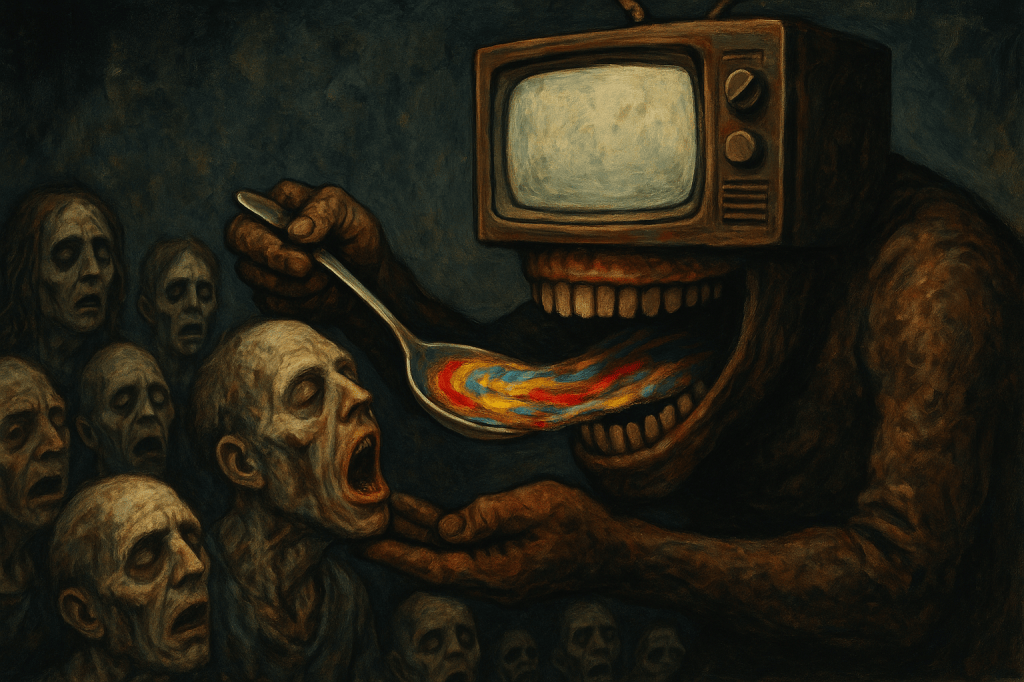
The people most likely to applaud such an argument may already agree with it. For them, the meme, post, or comment can become an exercise in confirmation bias, our tendency to notice, accept, and remember information that reinforces beliefs we already hold while giving less scrutiny to information that challenges them. The applause can therefore create an illusion of argumentative success. Lots of likes do not necessarily mean that a good argument has been made. Sometimes they merely mean that the argument successfully told an audience what it already wanted to hear.
Meanwhile, people who recognize the generalization may simply move on. Silence should not be confused with agreement. Someone may decide the argument is too weak to deserve a response. They may think the person posting it has already made up their mind. They may decide that correcting every questionable claim on social media is not a productive use of their afternoon. And then there are a few troublesome people like me who occasionally feel compelled to poke the argument with a stick and see whether it survives examination.
Bad reasoning rarely remains confined to abstract debate. Ideas shape beliefs, beliefs influence decisions, and decisions eventually become actions. C. S. Lewi’s warning in Learning in War-Time is apt here:
“Good philosophy must exist, if for no other reason, because bad philosophy needs to be answered.”
That principle reaches far beyond academic philosophy. Bad reasoning repeated often enough can become accepted wisdom. Generalizations become stereotypes. Stereotypes make it easier to stop seeing individuals. And once we stop seeing individuals, it becomes much easier to dismiss, marginalize, mistreat, or even dehumanize entire groups. Human history gives us more than enough examples of where that road can lead.
I sometimes think of bad reasoning as a kind of intellectual cancer. That does not mean every careless generalization leads to some social catastrophe. Most obviously do not. The point is that a small error may initially seem harmless, especially when it confirms what we already believe. But left unexamined, it can spread into other assumptions and conclusions. Catching the mistake early is far easier than dealing with the consequences after an entire worldview has been built around it.
Being Fair-Minded
There is also a moral dimension here, particularly for Christians. If I disagree with someone, I still have an obligation to represent that person’s position fairly. The command against bearing false witness should make Christians especially cautious about attributing beliefs to people that they do not actually hold. A straw man may be a logical fallacy, but when we knowingly misrepresent another person’s beliefs, it can become something more serious than faulty logic.
Perhaps a useful rule is simply this: before criticizing a group, make the category as narrow as the evidence requires. Before criticizing an argument, make sure it is an argument its proponents would actually recognize as their own.
So far, all of this has been fairly abstract. Let me turn to the particular example that prompted me to start thinking about this post.
Example
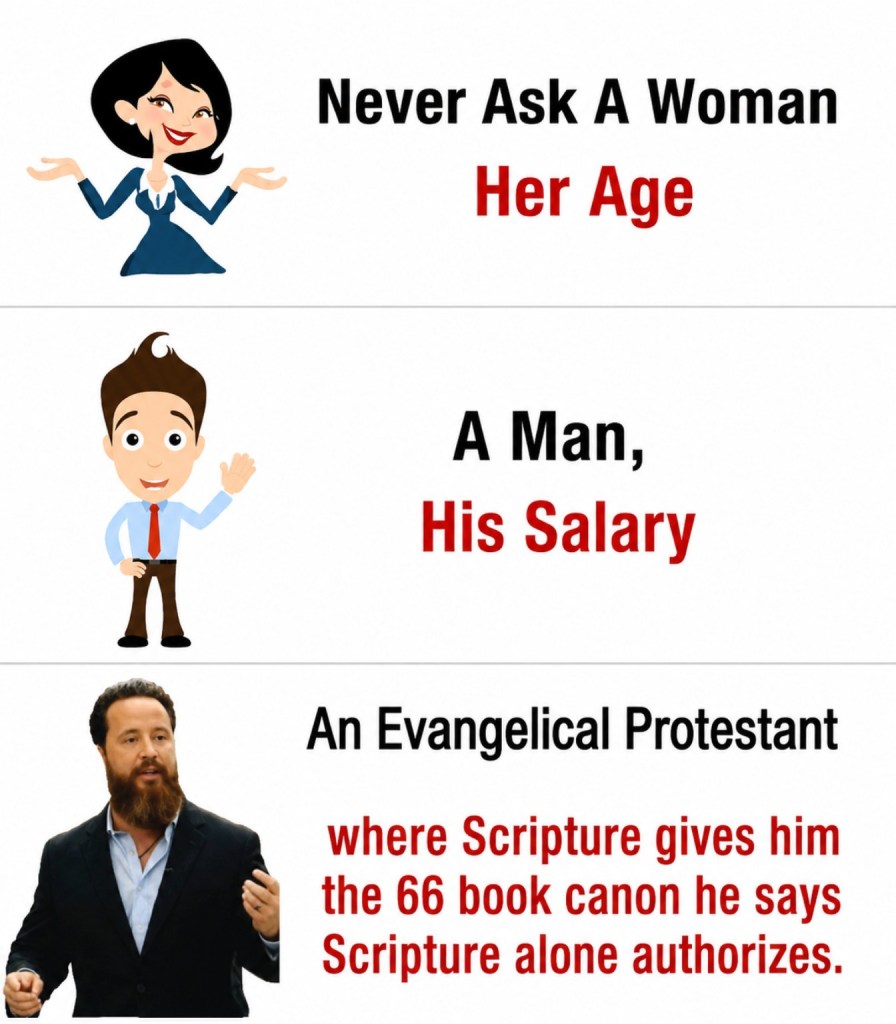
At least two informal fallacies are working together in this meme: a hasty generalization and a straw man. They are related, but they are not the same error. The hasty generalization creates an overly broad category and attributes a particular position to the people within it. The straw man then takes that supposed position, presents it in a weaker and somewhat ridiculous form, and knocks it down. In other words, the first fallacy tells us who supposedly believes something, while the second misrepresents what they supposedly believe. Let me explain.
The Generalization
The first problem is the category “Evangelical Protestant.” That is much broader and more diverse than the meme suggests. Evangelicalism is not a single denomination with one doctrine of Scripture, one ecclesiology, or one understanding of the canon. Even groups carrying the word Evangelical in their names can differ substantially. For example, the Evangelical Lutheran Church in America (ELCA) approaches Scripture quite differently from many conservative evangelical churches.
So before we even reach the meme’s argument about the biblical canon, there is a problem. Which evangelical Protestants are we talking about? A particular denomination? A theological tradition? Certain scholars? A survey showing what a majority of evangelicals believe? Without that qualification, an enormous and internally diverse category is being treated as though it speaks with one theological voice. That is precisely the kind of generalization I have been discussing throughout this post.
The Straw Man
The second problem is different. Even if we narrow the category to Protestants who affirm sola scriptura, does the meme accurately represent their argument?
The serious Protestant argument for the biblical canon is not simply, “The Bible tells us which books belong in the Bible.” If that were the entire argument, then yes, we would have a problem with circular reasoning. But that is not how evangelical scholars such as F. F. Bruce approached the subject. In The Canon of Scripture, Bruce examines the historical development and recognition of the canon, including apostolic origins, early Christian usage, disputed books, the testimony of the Church Fathers, and the differences among Protestant, Catholic, and Orthodox canons.
There is also an important distinction between sola scriptura and the historical process of identifying the canon. In its classical Protestant sense, sola scriptura is the claim that Scripture is the final or supreme normative authority for Christian doctrine. It does not mean that Scripture contains an inspired table of contents or that historical evidence cannot be used to investigate which writings the early Church recognized as Scripture. In a past post, I wrote about this topic more in-depth in The Misunderstood Doctrine of Sola Scriptura.
This is where the straw man becomes apparent. Instead of engaging that more sophisticated position, the meme substitutes a much simpler one: essentially, “We know which books belong in the Bible because the Bible tells us which books belong in the Bible.” That version is easy to make look circular and ridiculous. The problem is that knocking down the caricature does not knock down the actual argument.
This also illustrates another important distinction. What an average layperson within a tradition believes may be quite different from the position defended by that tradition’s scholars, theologians, philosophers, or authoritative documents. You can probably find a Christian, atheist, Catholic, Protestant, conservative, liberal, or member of almost any other group who gives a poorly reasoned explanation of what they believe. Refuting that person may be easy, but it tells us very little about whether the underlying position is actually sound.
Intellectual honesty requires us, whenever possible, to engage the strongest reasonable formulation of an opposing position rather than the weakest example we can find. This is related to the principle of charity: interpreting another person’s argument fairly and reasonably rather than looking for the least favorable interpretation. When we go further and deliberately construct a stronger version of an opponent’s argument before addressing it, we often call that steelmanning. If God, truth, reason, and the evidence really are on our side, we should have nothing to fear from giving the opposing argument its best hearing. And if our position can survive only by attacking the weakest version of the opposition, well, as the saying goes, “here’s your sign.”
The Better Question
There is, however, a legitimate and interesting question buried beneath the meme:
How does a Protestant account for the formation and recognition of the canon while maintaining sola scriptura?
Now that is a question worth discussing, and I would love to see a serious scholarly discussion of it. Notice what happened when we removed the generalization and the straw man. The underlying question actually became more interesting, not less. We no longer need the caricature because there is a genuine historical, epistemological, and theological question to investigate.
Reducing the Protestant position to a circular argument avoids engaging the much stronger historical and theological arguments actually made by scholars such as F. F. Bruce. Someone may ultimately conclude that Bruce and other Protestant scholars fail to solve the problem. Fair enough. But first we have to engage the argument they actually make. Refuting an argument someone never made proves very little.
And for Christians especially, there should be an additional caution here. If we knowingly misrepresent what another person or tradition actually believes in order to make it easier to ridicule, we are getting uncomfortably close to bearing false witness. At that point, our problem is no longer merely that we have committed an informal fallacy. We have a moral problem as well.
Conclusion: Slow Down Before You Share
The larger lesson here is not really about one meme, one theological disagreement, or even Christianity. It is about how we think and how fairly we represent people who disagree with us.
We live in an environment that rewards speed. Read the headline. See the meme. Feel the emotional response. Click “like.” Share. Move on. Critical thinking usually requires us to do almost exactly the opposite. Slow down. Ask questions. Check the claim. Define the terms. Look for missing context. Ask whether “some” has quietly become “all.” Most importantly, ask whether the people being criticized would actually recognize themselves or their beliefs in what we are saying about them.
That is why I think everyone would benefit from learning the basics of informal logical fallacies and cognitive biases. Learn to recognize straw men, hasty generalizations, false dilemmas, ad hominem arguments, appeals to ridicule, and cherry picking. Become familiar with confirmation bias, motivated reasoning, and the other mental shortcuts that can distort how we evaluate evidence. But remember that learning their names does not immunize us against them. There is a wonderful irony here: learning about cognitive bias can make us very good at finding bias in everyone except ourselves.
“The first principle is that you must not fool yourself—and you are the easiest person to fool.” – Richard Feynman
So read critically, but write critically as well. Before posting something, turn the analytical lens around. Am I generalizing beyond the evidence? Am I presenting the strongest reasonable version of the opposing position or the easiest one to knock down? Am I attributing motives or beliefs to people without evidence? Would the people I am criticizing recognize their position in what I have written?
If you do not have the time or background to perform that analysis yourself, we now have another useful tool. Ask AI to examine your post before you publish it. Ask specifically for informal fallacies, unsupported generalizations, cognitive biases, emotionally loaded language, factual claims that need verification, and possible straw men. Better yet, ask it to construct the strongest reasonable counterargument to what you have written. AI is fallible too, so it should never become another unquestioned authority, but it can be a useful intellectual sparring partner.
You may be surprised by what it finds. I hope occasionally you will also be humbled by what it finds. I know I am. Sometimes the devastating argument in our heads becomes considerably less devastating once its assumptions are exposed. Sometimes the evidence supports “some” when we wrote “all.” Sometimes the opposing position is more sophisticated than we gave it credit for. Sometimes, perhaps most importantly, we discover that the person who disagrees with us actually has a reasonable point.
That is not defeat. That is intellectual growth.
We do not become weaker thinkers by acknowledging that an opponent has a good argument. We become better thinkers. We do not lose credibility by correcting ourselves. We gain it. And perhaps recognizing the weaknesses in our own reasoning can make us a little more humble and a little more gracious toward people who see things differently.
The purpose of critical thinking, after all, should not merely be to become better at finding holes in everyone else’s arguments. It should make us better at finding the holes in our own. If discovering that our argument is weaker than we thought moves us closer to the truth, then we have gained something far more valuable than winning an argument.
Perhaps that is the habit we most need to recover: care more about getting closer to the truth than being proven right.
References
- Bruce, F. F. (1988). The canon of Scripture. InterVarsity Press.
- Kahneman, D. (2011). Thinking, fast and slow. Farrar, Straus and Giroux.
- Tversky, A., & Kahneman, D. (1974). Judgment under uncertainty: Heuristics and biases. Science, 185(4157), 1124–1131. https://doi.org/10.1126/science.185.4157.1124
- Walton, D. (2008). Informal logic: A pragmatic approach (2nd ed.). Cambridge University Press. https://doi.org/10.1017/CBO9780511808630
- References Meta-Frameworks of Influence and Control https://totef.org/2025/08/08/references-meta-frameworks-of-influence-and-control/
Excerpt
Generalizations can make arguments sound stronger while actually making them weaker. This post explores hasty generalizations, straw men, confirmation bias, and the need to represent others fairly, think critically, and value truth over winning.
The search for knowledge is hopeless and eternal.


Leave a Reply