
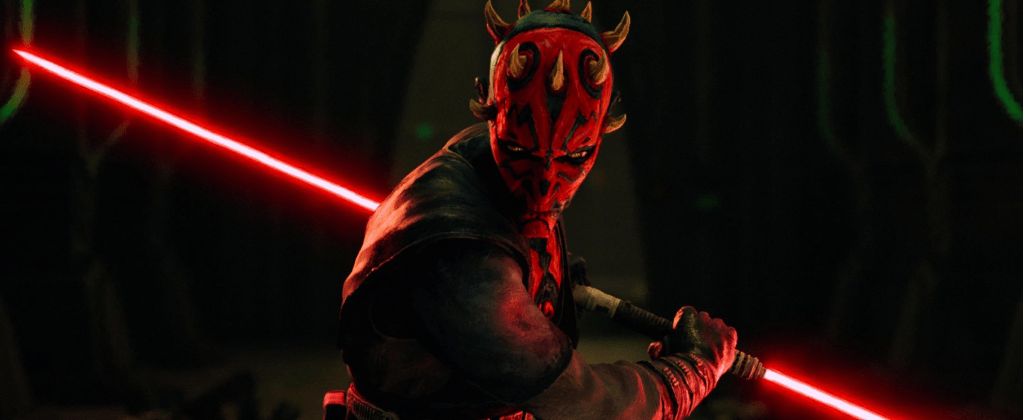
When I wrote about The Acolyte, I tried to approach it as more than just another entry in the endless cycle of Star Wars praise, backlash, hot takes, and counter-hot takes. What interested me most was not simply whether the show “worked,” but what it was trying to explore: mentorship, moral ambiguity, the failures of institutions, and the danger of flawed teachers shaping wounded students. Star Wars: Maul – Shadow Lord invites a similar kind of reflection, though from a much darker and more familiar corner of the galaxy. My earlier review of The Acolyte focused heavily on the master and apprentice dynamic, the moral complexity of the Jedi, and the way Star Wars stories can challenge us to think beyond a simple good-versus-evil framework.
You can watch Maul – Shadow Lord even if you are new to Star Wars, or at least new to the deeper corners of the Star Wars universe. Most people have some familiarity with the broad outlines: Jedi, Sith, lightsabers, the Force, Darth Vader, the Empire, and perhaps the ominous red and black figure who first appeared in The Phantom Menace. But Star Wars has become much larger than the films alone. Some of the most important development of Darth Maul’s story happens in animated series like The Clone Wars and Rebels, where he becomes far more than the silent assassin many viewers first encountered in 1999.
For that reason, I will include a viewing list for those who want the full Maul story. It is not required homework, but it will help. Maul’s arc stretches across The Phantom Menace, key episodes of The Clone Wars, Solo, Rebels, and now Shadow Lord, forming one of the more tragic and psychologically rich character studies in the Star Wars universe.
This review, however, will not be only about continuity, canon, or whether the series fits neatly into the larger timeline. I am more interested in the story beneath the story. What does Maul reveal about revenge, pain, manipulation, and the hunger to turn suffering into legacy? What do the characters around him reveal about impatience, grief, loyalty, caution, and the danger of taking one wrong step in a moment of emotional pressure?
I think this kind of review matters because stories shape us. They do not merely entertain us for a little while and then vanish when the credits roll. The stories we love train our imagination. They give us heroes to admire, villains to fear, warnings to remember, and moral patterns to either embrace or resist. They help us name things we may struggle to see directly in our own lives. A good story can make wisdom visible. A tragic story can show us where certain paths lead before we walk them ourselves.
That is why I want to look at Maul – Shadow Lord through a moral and ethical lens. Not because every story needs to be reduced to a lesson, but because every story is already forming us in some direction. As with much of the best Star Wars storytelling, the galaxy far, far away gives us enough distance to see ourselves more clearly.
So this will be a review, but not only a review. It will also be a reflection on character, moral formation, and the practical wisdom hidden inside a tragedy. Because sometimes the most dangerous villains are not the ones who only lie. Sometimes they are the ones who tell just enough truth to make revenge sound like justice.
The Definitive Watch List for Maul: Shadow Lord
Before getting into the review itself, I want to give what I think is the definitive watch list for Maul’s story. You do not have to watch all of this before watching Maul – Shadow Lord, especially if you are already familiar with Star Wars. The series can stand on its own well enough for new or casual viewers. But if you want the full emotional and narrative weight of Maul’s journey, I do recommend rewatching all of the major Maul episodes and appearances across the films and animated series.
The list below follows the preferred order for understanding Maul’s story, his fall, his survival, his rise, his obsessions, and the tragic path that eventually leads him into Rebels. It will also help make sense of why Shadow Lord matters, not just as another Star Wars story, but as another chapter in one of the franchise’s most wounded and dangerous lives.
- Star Wars: Episode I — The Phantom Menace (1999) https://www.imdb.com/title/tt0120915/
- Star Wars: The Clone Wars (2008) https://www.imdb.com/title/tt0458290/
- 3.14 Witches of the Mist
- 4.21 Brothers
- 4.22 Revenge
- 5.01 Revival
- 5.14 Eminence
- 5.15 Shades of Reason
- 5.16 The Lawless
- 7.08 Together Again
- 7.09 Old Friends not Forgotten
- 7.10 The Phantom Apprentice
- 7.11 Shattered
- 7.12 Victory and Death
- Star Wars: Maul – Shadow Lord (season 1) https://www.imdb.com/title/tt36594331/
- Star Wars: Maul – Shadow Lord (planned season 2)
- Solo: A Star Wars Story (2018) https://www.imdb.com/title/tt3778644/
- Star Wars Rebels (2014) https://www.imdb.com/title/tt2930604/
- Season 2, Episodes 21 and 22 – “Twilight of the Apprentice Parts 1 and 2”
- Season 3, Episode 3 – “Holocrons of Fate”
- Season 3, Episode 11 – “Visions and Voices”
- Season 3, Episode 20 – “Twin Suns”
Maul
The Mad Clarity of a Wounded Survivor
Maul is one of the more complex characters in Star Wars because he often sees the universe more clearly than the people around him, but he does not see it truly. He is not foolish. He is not merely a brute with a lightsaber. He understands power, betrayal, fear, weakness, and political hypocrisy. He can see that the Empire is evil. He can see that the Jedi failed. He can see that the Sith devour their own. He can see that the galaxy is not governed by clean slogans or comforting moral simplicity.
But his insight has been poisoned by pain.
That is what makes him so enticing and so frightening. Maul stands outside the major flows of the galaxy. He is not really aligned with the Jedi, the Sith, the Empire, or the Rebellion. He sees from an angle others often miss. In one sense, that gives him clarity. In another sense, it isolates him. He is outside the systems, but he is not free from them. He has rejected Sidious, but he is still shaped by Sidious. He hates being used, yet he uses others. He hates being discarded, yet he discards people when they no longer serve his purpose. He sees the cruelty of the Sith, but he still thinks like someone formed by the Sith.
Maul speaks truth, but always with a twist. Sometimes you do not know whether he is lying, telling the truth, or telling the truth in such a way that it becomes a lie. That is part of his danger. He uses truth the way another warrior uses a blade. He does not always need to invent falsehood. Sometimes all he has to do is take a real wound, press his thumb into it, and turn it toward rage.
This is where Maul becomes morally dangerous. He knows how to make anger sound like moral clarity. He knows how to make patience look like cowardice. He knows how to make restraint feel like weakness. He can look at someone who has suffered and say, in effect, “You are right to be angry. The others failed you. The old ways failed you. Now let me show you what strength really looks like.” That kind of temptation is powerful because it does not begin with an obvious lie. It begins with a partial truth.
That is why Devon is vulnerable to him. Maul does not have to convince her that goodness is fake. He only has to show her that goodness failed to protect the people she loved. He does not have to deny the Jedi way outright. He only has to make it feel too slow, too passive, too naïve, and too weak for the world she now inhabits. His genius is manipulation by half-truth. He does not merely corrupt by deception. He corrupts by interpretation.
I am careful about calling Maul insane in a simple sense. He is not incoherent. He is calculating, disciplined, perceptive, and patient when patience serves revenge. But there is a kind of madness in his singular focus. Revenge has become his organizing principle. It gives him strength, direction, endurance, and purpose. It also traps him. He can move forward only because he is chained to the past.
That may be the deepest tragedy of Maul. His desire for revenge gives him power, but it also blinds him. He can diagnose the disease of the galaxy, but every cure he offers is another form of poison. He sees corruption, hypocrisy, and weakness with frightening clarity, but because revenge governs his vision, clarity becomes madness. He is like a man staring directly at a fire and then insisting that everything else is darkness.
This also raises the question of what Maul really is by this point in the story. Is he still a Sith Lord? Is he a former Sith? Is he now a non-aligned dark side Force user trying to carve out his own place in the galaxy? He seems to stand somewhere between categories. He is no longer Sidious’s apprentice, but he has not escaped the logic of Sith formation. He may reject the title, but he does not reject the appetite. He still wants power. He still wants control. He still wants to bend others into instruments of his will.
That is why his desire for an apprentice matters so much. Why does Maul need one so desperately? Is it simply because the Sith tradition is built around the master and apprentice? Is it loneliness after the loss of Savage Opress, his brother? Is it strategy because he knows he cannot defeat Sidious, Vader, and the Empire alone? Does he want someone beside him so he can usurp the Emperor, or at least survive long enough to strike at him?
Or is it deeper than that?
Maybe Maul needs an apprentice because he needs his pain to become a legacy. If someone follows him, then his suffering was not meaningless. His hatred becomes a school. His revenge becomes a tradition. His wound becomes a doctrine. That is a terrible thing, but it is also deeply human. People who have been hurt often want their pain to mean something. The danger comes when we make others carry the meaning of our wounds.
This master and apprentice dynamic connects naturally to The Acolyte, though from a different angle. The Acolyte explored seduction, intimacy, secrecy, and the appeal of forbidden freedom. Maul – Shadow Lord explores trauma, anger, and the weaponization of grief. In both cases, the dark-side teacher does not usually begin by saying, “Become evil.” He begins by saying, “I understand what the others refuse to understand.” That is what makes the temptation believable.
We also know enough of Maul’s future to know that this path does not lead where he wants it to go. He does not end this part of the story with a stable apprentice beside him. Later, in Rebels, he tries to pull Ezra Bridger into his orbit. That future knowledge does not make Shadow Lord less interesting. It makes it more tragic. We are not watching to find out whether Maul will become healed. We are watching to see how many times he will reach toward connection and turn it into possession.
Savage, Devon, Ezra, and even Maul’s obsession with Kenobi all reveal the same wound. Maul does not know how to love without consuming. He does not know how to teach without controlling. He does not know how to seek justice without making it revenge. He wants freedom from Sidious, but he remains spiritually chained to what Sidious made him.
That is the tragic brilliance of Maul as a character. He sees more than most people see, but he sees through the lens of injury. He is perceptive enough to expose hypocrisy, but too wounded to offer healing. He is strong enough to survive what should have destroyed him, but not free enough to become whole. He stands outside the Jedi, outside the Sith, outside the Empire, and outside the Rebellion, but he is still orbiting the wound that made him.
Maul sees the galaxy’s hypocrisy with frightening clarity, but revenge turns clarity into madness. That is why he is both enticing and terrifying. He reminds us that insight alone does not make someone wise. A wounded person may tell the truth and still lead others into darkness. And sometimes the most dangerous teacher is not the one who lies about the world, but the one who tells the truth without love, without humility, and without any path toward redemption.
Devon Izara
Hunger, Compromise, and the Seduction of Anger
Devon Izara may be the character we should feel for most in Maul – Shadow Lord. In many ways, she is the center of the series. She is not introduced as evil. She is not presented as someone who simply wants power for power’s sake. She is hungry, afraid, frustrated, grieving, and disillusioned. She has been trained for a Jedi future that no longer exists. The Order is gone. The Republic is gone. The Empire is hunting people like her. Her master still holds to the Jedi way, but from Devon’s perspective, the Jedi way no longer seems to be working in the world they actually inhabit.
That is what makes her so vulnerable to Maul.
Devon already has a crack in her confidence before Maul begins working on her. She sees Master Daki’s restraint as passivity. She sees hiding as surrender. She sees survival as humiliation. Daki’s commitment to patience, concealment, and discipline may be morally principled, but to Devon it can feel practically useless when they are hungry, hunted, and powerless. She wants action. She wants movement. She wants something that feels like justice. And when people are desperate for justice, patience can begin to look like cowardice.
That is why the fruit matters. It seems small at first, but morally it is not small. Hunger creates the first compromise. Devon does not begin by trying to conquer the galaxy. She begins by trying to solve a real problem. That is often how compromise works. It does not arrive wearing a black cloak and announcing itself as darkness. It arrives as necessity. It says, “Just this once.” It says, “We have no other choice.” It says, “Surely a little step in the wrong direction will not harm us.”
But paths have direction.
Most of us understand Devon more than we might want to admit. We tell ourselves we can walk a little way down a dangerous road and still turn back whenever we want. We can use anger just enough. We can bend the rules just enough. We can feed resentment just enough. We can keep one thing hidden from the person who would challenge us, just this once, because they would not understand. But secrecy removes the counterweight. Once Devon keeps Maul’s influence from Daki, Maul’s words have more room to echo.
That is one of the strongest moral insights in her arc. Maul does not seduce Devon by sounding obviously evil. He says things that seem true. He notices what she notices. The Jedi failed. The Empire is cruel. Hiding is not enough. Powerlessness is unbearable. Action is necessary. All of that has some truth in it. But Maul takes true observations and bends them toward hatred. He does not have to invent her pain. He only has to interpret it for her.
So Devon’s fall is not a sudden turn. It is a slow reorientation. She begins zealously opposed to Maul, but over time she begins to think in his categories. She starts asking his questions. She starts feeling the force of his accusations. Then, after enough fear, secrecy, hunger, and loss, his path begins to feel not only tempting, but reasonable. That is the danger. Evil becomes most seductive when it looks like the only practical answer left.
Devon does not fall because she stops caring about goodness. She falls because Maul teaches her to believe that goodness without rage is powerless.
That is a sobering thought. Many people do not begin by wanting to become cruel. They begin by wanting to stop feeling helpless. They begin by wanting to protect someone. They begin by wanting to make sure what happened before never happens again. But if anger becomes the engine, and secrecy becomes the shelter, and resentment becomes the teacher, then even the desire to protect can become corrupted.
Her first compromise comes from hunger. Her final compromise comes from grief. In between, Maul teaches her to call compromise strength or maybe freedom.
This is why Devon’s story works. We can feel her disillusionment. We may not agree with her choices, but we can understand the emotional pressure behind them. She looks at her master’s commitment to the Jedi way and wonders whether it is wisdom or denial. She looks at Maul and sees danger, but also power. And in a broken world, power can look very much like hope if you have lost sight of anything better.
I also admit that part of me hopes Devon becomes some canon version of Darth Talon. Not necessarily in a one to one Legends copy, but in the sense that she disappears into the dark places of the galaxy, perhaps into the Unknown Regions or some forgotten Sith trail, searching for holocrons, secrets, and a name that Maul can give her. That would fit the tragedy. She begins as a displaced Padawan with no future, and Maul offers her a future shaped by rage.
Whether she literally becomes Darth Talon or simply fills that narrative role, the question is the same: can Devon ever come back from the story Maul has started telling her about herself?
That may be the real tragedy of Devon Izara. Maul does not merely offer her power. He offers her an identity. He tells her that her anger is clarity, that her disillusionment is wisdom, that her compromise is courage, and that her wound can become her destiny. And once someone begins to believe that, the fall has already begun.
Master Eeko-Dio Daki
Wisdom, Caution, and the Burden of Survival
If Devon represents hunger, impatience, and the seduction of anger, then Master Eeko-Dio Daki represents something far less exciting but far more difficult: endurance.
Daki is easy to misread. At first glance, he may look like a Jedi clinging too tightly to the past. The galaxy has changed. The Jedi Order has fallen. The Republic is gone. The Empire is rising. Vader is hunting down Jedi survivors. Maul is moving in the shadows. Devon is hungry, restless, and disillusioned. And through all of this, Daki keeps insisting on caution, patience, restraint, and survival.
So is he wise, or is he out of touch? I think the answer is that he is wise, but wisdom can look painfully inadequate when chaos is moving faster than patience can answer. Daki is not using Jedi language to hide cowardice. He is not simply refusing to read the room. He is trying to preserve a way of life that has been nearly extinguished. His immediate duty is not to defeat the Empire. It is to survive, protect Devon, and carry forward the Jedi way until there is some future in which it can be rebuilt. That is not weakness. That is stewardship.
But from Devon’s perspective, it can feel like weakness. She sees hunger. She sees injustice. She sees danger. She sees a master who keeps saying, “Not yet.” And when people are wounded by injustice, “not yet” can feel unbearable. The desire for justice can easily become impatience for justice, and impatience can rush in where wisdom and patience might have served better.
That is one of the painful moral tensions of the series. Daki’s caution is probably right, but it is emotionally unsatisfying. Maul’s way is morally corrupted, but it feels decisive. Daki teaches Devon to endure. Maul teaches her to strike. Daki asks her to carry the burden of patience. Maul offers her the intoxication of action. And that is a hard thing to resist when the world is burning.
This does not mean Daki is perfect. Perhaps he does hold on too long. Perhaps he does not fully read the tea leaves. Perhaps he underestimates the speed at which Devon is being drawn away from him. He knows of Maul, but he does not seem to grasp the specific kind of threat Maul represents. Maul is not merely another dangerous Force user. He is a manipulator of wounds. He does not just attack the body. He studies the fracture lines in the soul.
That may be Daki’s greatest failure. Not that he lacks integrity, but that his integrity does not reach Devon deeply enough before Maul reaches her pain. He is faithful to the Jedi way, but he cannot make that way feel persuasive to a wounded Padawan who is starving for action. He preserves the truth, but Maul makes corruption feel practical.
Daki teaches patience in a world that is burning. Maul teaches rage in a world that seems to reward it. Devon’s tragedy is that rage feels more practical. There is a real question here for all of us. Is it enough to be right if we cannot reach the person standing beside us? Is it enough to preserve a true way if that way is not embodied in a manner that speaks to the wounded, the angry, and the afraid? Daki is not wrong to preserve the Jedi way. But the series asks whether a true way can survive if it is only preserved and not persuasively embodied for the wounded person standing beside you.
That does not make Daki foolish. It makes him tragic. His death, or his likely fate, is something we can see coming because we already know the larger Star Wars story. Vader hunted down Jedi survivors. The scattered remnants of the Order were not safe simply because they were hidden. And when Vader enters a story like this, he does not feel like merely another villain. He feels like the new world taking physical form. He is the Empire’s judgment in armor. He is what Daki has been trying to survive.
That makes Daki’s role clearer. He is not naïve because he believes in the Jedi way. He is faithful because he keeps believing when the galaxy gives him every reason to stop. He is stoic, cautious, disciplined, and dutiful. He keeps cool when others might panic. He keeps walking when there is no obvious road left. His plan is to survive now, train Devon, preserve what remains, and perhaps one day help rebuild what was lost.
But that plan fails. Not because he lacks moral courage. Not because he lacks integrity. Not because the Jedi way is meaningless. It fails because Maul is chaos with a purpose, and Vader is death in armor. Daki is trying to raise a Padawan in the ruins of a murdered Order while predators circle from every side.
That is what makes him compelling. He is a true believer in the best sense. He has a sense of duty to continue the Order, not as nostalgia, but as fidelity. He keeps on keeping on because someone has to. Someone has to remember. Someone has to teach. Someone has to carry the flame through the dark, even when the flame is small and the night is full of hunters.
Daki’s failure is not that he lacked integrity. His failure is that integrity alone could not shield Devon from Maul’s manipulation or Vader’s violence.
And that is a sobering moral lesson. Integrity matters. Patience matters. Caution matters. But none of them guarantee success. Sometimes the wise person still dies. Sometimes the cautious plan still fails. Sometimes the one who kept faith is overtaken by the chaos he was trying to outlast.
Still, that does not make his faithfulness meaningless. In a galaxy where so many people surrender to fear, ambition, or revenge, Daki’s commitment to the Jedi way remains a witness. He may not be able to save Devon from every temptation. He may not be able to stop Maul. He may not be able to survive Vader. But he shows us that there is dignity in endurance, even when endurance does not win the day.
And that may be his quiet strength. Daki reminds us that wisdom is not always dramatic. Sometimes wisdom looks like restraint. Sometimes courage looks like hiding long enough to protect someone else. Sometimes faithfulness looks like refusing to become what the darkness demands, even when the darkness seems to be winning.
Marrok (First Brother)
Vader’s Hunting Dog and the Tangled Web of Dathomir
Before moving further into the main tragedy of Maul, Devon, and Daki, it is worth pausing over a few of the side characters. Everyone in this story has a story, even when the series only gives us a glimpse of it. Marrok is one of those characters. At first, he seems like a fairly straightforward Inquisitor, another Imperial hunter sent into the ruins of the Jedi Order. But the more you think about where his story eventually goes, the more interesting he becomes.
Marrok is not the dark philosopher of the story. He is not Maul, speaking in wounded half-truths and trying to turn someone else’s pain into a legacy. He is not Devon, struggling between fear, hunger, loyalty, and anger. He is not Daki, trying to preserve a way of life in a galaxy that has turned against it. Marrok is something colder and more direct. He is a hunter. A very good one.
In Maul – Shadow Lord, Marrok functions almost like Vader’s hunting dog. Vader is the nightmare at the end of the trail, but Marrok is the one who finds the trail. He flushes the prey out into the open. He searches the shadows, follows the scent, and forces hidden things to reveal themselves. Vader is the terror at the center of the Imperial machine, but Marrok is one of the tools by which that terror reaches into alleys, settlements, forgotten planets, and all the places where frightened survivors hope they have disappeared.
That makes him frightening in a different way from Maul. Maul wants power for himself. He wants revenge, an apprentice, a criminal empire, and a legacy. He wants to rule the shadows. Marrok knows how to hunt in them. He does not seem to want a kingdom. He does not seem burdened by grand philosophical speeches or personal ambition. He knows his place and appears content to remain in it.
That may be the most tragic thing about him. Maul taunts him as a slave of the Emperor, but even that may give Marrok too much status. He is not even directly at the top of that chain. He is more like the servant of the apprentice of the master. Vader belongs to Sidious, and Marrok belongs to Vader. He is chained to the hierarchy of darkness, but unlike Maul, he does not appear to rage against the chain. Maul hates being used even while he uses others. Marrok simply obeys.
There is something almost mechanical about that. He can feel less like a person with a moral center and more like an automaton, or even a kind of golem, animated by command rather than conscience. He does not seem to wrestle with the moral meaning of what he does. He does not seem to question whether obedience has made him less free. He is focused, disciplined, and deadly, but his focus is not wisdom. It is submission.
That creates an interesting contrast with Maul. Maul sees too much and is driven mad by revenge. Marrok may see too little and is hollowed out by obedience. Maul is consumed by his wound. Marrok is consumed by his role. One is chaotic ambition. The other is disciplined servitude. Neither is free.
His later story makes the web even more tangled. We eventually see Marrok in the New Republic era, serving Morgan Elsbeth and crossing paths with Ahsoka Tano. That future connection matters because Morgan is tied to the Nightsisters of Dathomir, and Dathomir is already central to Maul’s story. Maul came from that world. Savage Opress came from that world. Mother Talzin was part of that world. Sidious took Maul, and later the Nightsisters were slaughtered. So when Marrok later appears in proximity to Morgan Elsbeth, Grand Admiral Thrawn, and Nightsister power, the story loops back toward the same dark roots.
It is a tangled web. Maul is taken from Dathomir by Sidious. Savage is drawn into Maul’s orbit. Mother Talzin becomes one of the great shadow figures behind Maul’s tragedy. The Nightsisters are destroyed. Morgan Elsbeth survives and later serves Thrawn. Marrok, once one of Vader’s hunters, eventually serves Morgan. These stories do not simply run in straight lines. They circle back on themselves like old wounds that refuse to close.
His death in Ahsoka adds another layer of mystery. When Marrok is killed, the green smoke or energy that escapes from him strongly suggests some connection to Nightsister magic. I am careful to admit it has not been fully explained. Maybe he was resurrected. Maybe he was possessed. Maybe he was animated or sustained by Morgan’s magick in some way. The series leaves room for mystery. But the visual language clearly points us toward Dathomir, which makes his connection to Maul’s larger world feel even more significant.
There is also an interesting future echo with Ahsoka. Marrok and another Inquisitor connected to this wider Imperial hunting machine both cross paths with her later. That matters because Ahsoka is one of the great survivors of the Clone Wars, while Marrok is one of the predators sent into the ruins afterward. They are both products of the same catastrophe, but on opposite sides of its aftermath. Ahsoka survives Order 66 and keeps searching for a way beyond the old binaries. Marrok becomes part of the machinery that hunts the survivors.
That is why Marrok works as a side character. He does not need to carry the philosophical weight of the story. He does not need Maul’s tragic eloquence or Devon’s moral struggle. His meaning is in his function. He shows us what the Empire does with people. It turns them into instruments. It gives them a mask, a weapon, a target, and a place in the chain. It does not ask them to become wise. It asks them to obey. And that is its own kind of tragedy.
Marrok does not see the universe as Maul sees it. He is not standing outside the major currents of the galaxy trying to interpret them from above. He is not driven by some grand vision of revenge or liberation. He is focused on obedience, and obedience without conscience can become just as dangerous as rage without wisdom.
Maul wants to rule the shadows. Marrok knows how to hunt in them. But both reveal something dark about power. One shows us what happens when pain becomes ambition. The other shows us what happens when obedience replaces moral responsibility.
Two-Boots
The Moral Awakening of the Ordinary Galaxy
Two-Boots may seem at first like comic relief, and honestly, I am glad to see Richard Ayoade enter the Star Wars universe. I loved him in The IT Crowd, and his presence brings a strange, awkward charm that works surprisingly well here. But beneath the humor, Two-Boots carries one of the quieter moral arcs in the series.
At first, he seems almost fascinated by humanity. He wears boots, which a droid does not need, but he wears them anyway. He carries around a coffee cup, not because he requires coffee, but because that is what people do. It makes you wonder what is going on beneath the surface. Is he trying to be more relatable? Is he envious of human beings? Does he simply want to belong? Is there a little Pinocchio somewhere in his circuitry, longing to be treated not just as a machine, but as a real boy?
That is part of what makes him interesting. Two-Boots is funny because his imitation of humanity is unnecessary, but it is also touching because imitation often reveals desire. He wants to participate in the world of persons. He wants to be seen as more than a utility. He wants, in his own odd way, to be part of the ordinary life of the galaxy.
And that ordinary life is exactly what the Empire is corrupting.
Two-Boots begins with a very clear right and wrong approach. Follow the rules. Respect the law. Call in the proper authorities. Do the correct thing, regardless of the consequences. In a stable moral order, that instinct might be admirable. Rules matter. Law matters. Order matters. A society cannot survive if everyone simply does what is right in their own eyes.
But under the Empire, the question changes.
What happens when lawful authority itself becomes corrupt? What happens when the system no longer protects the innocent, but hunts them? What happens when doing the technically correct thing serves evil?
That is where Two-Boots becomes more than a funny droid in boots. He becomes a model of the ordinary galaxy beginning to wake up. He is not Maul, driven by revenge. He is not Devon, torn between Jedi discipline and dark side anger. He is not Daki, trying to preserve the old ways in hiding. Two-Boots represents the person, or even the institution, that still believes the system basically works. He assumes that rules will protect the innocent. Then he slowly begins to see that the Empire uses rules as a weapon.
His shift matters because it shows that moral clarity is not the same thing as simplistic certainty. At the beginning, Two-Boots sees things in black and white. But by the end, he is not less moral. He is more moral. He has learned that law and justice are not always the same thing. A person can obey the rules and still serve evil if the rules have been captured by a corrupt power.
That is a major Star Wars theme, but it is also a very practical moral lesson. Evil does not always ask ordinary people to become monsters. Sometimes it asks them to process the paperwork. Follow the procedure. Report the suspicious person. Trust the chain of command. Do not ask too many questions. Let the machine handle it.
Two-Boots shows us how the Empire wins ordinary people at first: not by asking them to love evil, but by convincing them that obedience, order, and procedure are enough.
That makes him a helpful contrast to Devon. Devon is pulled away from goodness into anger. Two-Boots is pulled away from naïve order into moral discernment. One character is being radicalized by pain. The other is being awakened by conscience. Devon begins to believe that hatred may be necessary. Two-Boots begins to understand that obedience is not always righteous.
Two-Boots begins with rules and learns justice. Devon begins with justice and is tempted toward rage. That contrast is one of the moral engines of the series.
In that sense, Two-Boots illustrates what much of the galaxy is starting to realize during this period. The Empire did not arrive everywhere at once as an obvious nightmare. It came through procedure, order, security, emergency authority, and promises of stability. For people like Two-Boots, the awakening comes when the Empire stops being an abstraction and starts threatening friends, neighbors, and the innocent. Two-Boots shows us how the Empire wins ordinary people at first: not by asking them to love evil, but by convincing them that obedience, order, and procedure are enough.
Two-Boots parallels the greater galaxy in this part of the Star Wars timeline. The galaxy is waking up to what the Empire actually means. At first, the Empire can look like order after chaos, security after war, structure after the collapse of the Republic. But slowly, planet by planet and person by person, the truth becomes harder to ignore. The Empire does not merely bring order. It demands submission. It does not merely enforce law. It bends law into domination. Two-Boots’ awakening is the galaxy’s awakening in miniature.
That is also why he works so well beside Marrok. Marrok obeys. Two-Boots disobeys. Marrok is a living being who acts almost like a machine, moving where he is sent, hunting whom he is told to hunt, and serving power without moral hesitation. Two-Boots is a machine who begins to act more human, not because he wears boots or carries a coffee cup, but because he develops moral discernment. The organic being becomes robotic in his obedience. The robot becomes humane in his disobedience.
That contrast may be one of the most quietly brilliant parts of the story. Marrok shows us obedience without conscience. Two-Boots shows us conscience awakening against obedience. One follows the chain of command into darkness. The other breaks from the chain because goodness requires it.
That makes him a helpful contrast to Devon as well. Devon is pulled away from goodness into anger. Two-Boots is pulled away from naïve order into moral discernment. One character is being radicalized by pain. The other is being awakened by conscience. Devon begins to believe that hatred may be necessary. Two-Boots begins to understand that obedience is not always righteous.
That is why his arc works. He begins as a rule follower, but he is not trapped there. Friendship changes him. Danger clarifies him. The Empire reveals itself to him. And once his friends are in danger, he starts to see the system for what it is. He does not abandon morality. He deepens it.
Two-Boots may be wearing boots he does not need and carrying a coffee cup he cannot use, but those little human gestures point toward something important. He wants to belong to a moral community. And when that community is threatened, he learns that being good requires more than compliance. It requires discernment, courage, and the willingness to stand with the vulnerable when the rules have been bent toward cruelty.
Darth Vadar
Death Personified
If Marrok is Vader’s hunting dog, then Vader is the thing at the end of the hunt. This is what many people wanted to see in Maul – Shadow Lord. Yes, the series is about Maul. Yes, Devon is really the emotional center of the story. Yes, Daki gives the story much of its moral weight. But there is no denying that when Darth Vader appears, the whole atmosphere changes. He does not merely enter the scene. He descends on it. Vader is death personified.
One of the most effective choices in the series is that Vader is presented less like a traditional villain and more like a horror monster. He does not need speeches, taunts, or grand declarations. He appears out of fog and shadow. He breathes. He stalks. He strikes. The silence makes him terrifying. In that moment, Vader is not the tragic father of Luke Skywalker. He is not yet the redeemed man beneath the mask. He is the nightmare of the early Empire, the thing Jedi survivors whisper about and criminals fear without fully understanding. And it works.
Part of what makes this portrayal so effective is that Vader does not speak. Maybe that choice was made partly because of the passing of James Earl Jones. Maybe it was made to heighten the fear. Maybe both are true. But whatever the reason, it works dramatically. His silence makes him feel less human, less reachable, and less predictable. He becomes almost elemental. You do not negotiate with him. You do not reason with him. You survive him, if you can.
This may be one of the strongest portrayals of Vader at this point in the timeline. We have always been told that people feared him. Here we begin to feel why. He is not merely powerful. He is inevitable. He does not need to rage like Maul. He does not need to prove himself like Maul. He has become something colder, more disciplined, and more terrible. Maul is hate with the wound still open. Vader is hate sealed inside armor and turned into a weapon.
That contrast matters for Maul’s story. Maul has always been one of the most physically impressive fighters in Star Wars. His duel in The Phantom Menace remains one of the best lightsaber fights in the cinematic Star Wars universe. Because of that, it has sometimes been hard to measure Vader against someone like Maul on screen. We know Vader is supposed to be one of the strongest beings in the Force, but seeing that power is different from being told about it.
Here, we start to see it. Vader is not flashy in the same way Maul is flashy. He is not acrobatic in the same way. He does not fight like a flame moving through the room. He fights like a closing door. Heavy. Certain. Final. Maul is dangerous because he is fast, clever, wounded, and unpredictable. Vader is dangerous because he feels inevitable. Once he enters the scene, the question is not whether someone can win. The question is whether anyone can escape.
That makes Vader the horror Maul never became. Maul is terrifying, but he is still visibly wounded. His rage has a human texture to it. He speaks. He tempts. He manipulates. He wants. He needs. He hungers for an apprentice, a legacy, a revenge that will somehow make his suffering mean something. Vader, at this point in the story, appears almost beyond that. He is not trying to persuade anyone. He is not trying to be understood. He is the Emperor’s will made physical.
That must be deeply unsettling for Maul. Maul has spent his life trying to become powerful enough that no one can use him again. But when Vader arrives, Maul is forced to face the thing he never became: the Emperor’s perfected instrument. Vader is what happens when power, pain, obedience, and evil are fused so completely that almost nothing human remains visible. In that sense, Vader is not only Maul’s enemy. He is Maul’s warning.
He also sharpens the tragedy of Devon. Vader creates the terror. Maul exploits the aftermath. Daki dies, Devon is shattered, and Maul is there to teach the wrong lesson. The lesson is not grief, patience, endurance, or moral courage. The lesson is rage. Vader shows Devon the cruelty of the Empire. Maul then offers her anger as the answer. That is the trap. The monster outside pushes her toward the monster within.
That may be the darkest moral movement in the series. Vader does not need to corrupt Devon directly. His violence creates the wound, and Maul steps in as the interpreter of that wound. Vader makes evil visible. Maul makes evil sound reasonable.
Vader makes us jump, but Maul makes us think. Vader is the horror in the room. Maul is the whisper afterward, telling Devon that her pain can become power.
And that is why Vader’s appearance does not steal the story from Maul. It clarifies it. Vader shows us the endpoint of a certain kind of darkness: obedience without mercy, strength without tenderness, power without conscience. Maul shows us another form of darkness: pain turned into manipulation, truth twisted into poison, and grief transformed into ambition.
One is the monster in armor. The other is the wounded survivor trying to make more monsters. Together, they make Maul – Shadow Lord feel heavier than a simple villain adventure. Vader reminds us why the galaxy is afraid. Maul reminds us how fear can be harvested. And Devon stands between them, wounded enough to listen.
Conclusion: The Tragedy of One Step in the Wrong Direction
Like I said at the beginning, stories form us. They train our moral imagination. They allow us to see choices, consequences, compromises, temptations, and failures from a safe distance. We are not Devon. We are not Daki. We are not Maul. We are not Two-Boots. But if the story is doing its work, we may recognize something of ourselves in each of them.
One of the haunting observations about Maul – Shadow Lord is that, in one sense, the whole tragedy could have been avoided. Not just once. Multiple times. In multiple ways.
If Devon had listened to Master Daki, if she had trusted his caution, if she had not taken that first step outside the path he laid before her, perhaps they escape. Perhaps they remain hidden. Perhaps Maul is left to face the Inquisitors without the leverage he finds in Devon. Perhaps Daki survives. Perhaps Devon does not begin sliding toward Maul’s way of seeing the world. Perhaps the story becomes much shorter, much less dramatic, and much less tragic.
But that is precisely the point. Tragedy often begins with something small. Devon does not begin by betraying the Jedi. She begins with hunger. She begins with frustration. She begins with the thought that Daki’s way is not practical enough for the world they are actually living in. She takes one step in the wrong direction, and then another. Each step can be explained. Each step can be justified. Each step seems manageable at the time. But paths have direction, and by the end of the season, a small compromise has grown into catastrophe.
The first step away from wisdom rarely feels like rebellion. It usually feels like necessity. This does not mean Devon alone killed Daki. That would be too simple, and too unfair. Maul manipulates her. Vader hunts them. The Inquisitors close in. The Empire has turned the galaxy into a place where survival itself feels morally compromised. But Devon’s choices still matter. She is not merely a victim of events. She helps create the opening through which those events rush in. How could she possibly have known what would happen? Sometimes obedience is the right direction, if she had followed her master, he may have avoided his tragic end. I am sure her tragic end too, but that is yet to be seen.
That is what makes the story morally painful. Daki’s death is not on Devon’s hands in the same way it is on Maul’s or Vader’s. But it is on her hands in the tragic sense that her choices helped bring him to that moment. She did not intend that end. She did not set out to destroy her master. But she stopped listening to the one person trying to guard her from the very path Maul wanted her to walk.
Devon does not choose Daki’s death, but she does choose the road that leads there. That is what makes the tragedy work. And that is how many falls happen. Not all at once. Not with a declaration. Not with a grand rejection of goodness. Just one compromise. One secret. One act of impatience. One moment where obedience feels too costly and anger feels more practical. Then the snowball begins.
That is why Daki’s caution matters. He is not exciting. He is not as compelling as Maul. He does not offer Devon the thrill of action. He offers survival, patience, restraint, and duty. Those virtues can feel passive in a burning world. But sometimes caution is not cowardice. Sometimes patience is the only thing standing between us and a tragedy we cannot yet see.
At the same time, Two-Boots complicates the lesson in a good way. If Two-Boots had simply obeyed, some consequences might have been avoided too. But his arc teaches us that blind obedience is not always righteousness. He has to learn that the law can be corrupted, that authority can serve evil, and that sometimes goodness requires disobedience. That is what makes the moral fabric of the series richer. Devon disobeys wisdom and moves toward tragedy. Two-Boots disobeys corrupt authority and moves toward moral courage.
So the question is not simply, “Should we obey?”
The better question is, “What are we obeying, and where is it leading us?”
Marrok obeys without conscience. Two-Boots disobeys because conscience wakes up. Devon disobeys because anger begins to govern her judgment. Daki obeys the Jedi way because he believes fidelity still matters, even in ruins. Maul refuses obedience to Sidious, but he remains obedient to revenge. Vader obeys the Emperor and becomes death in armor.
Everyone is following something. That may be the deepest moral question in Maul – Shadow Lord. What are we following when we make our choices? Wisdom or fear? Patience or rage? Conscience or procedure? Justice or revenge? Truth or a half-truth sharpened into a weapon?
The tragedy could have been avoided, but not by one magic solution. It could have been avoided by patience here, honesty there, discernment earlier, courage sooner, humility somewhere along the way. That is what makes it feel true. Most tragedies are not caused by one decision alone. They are woven from many small decisions, each one tugging the story a little closer to the edge.
And that is why this series works so well. It is not merely a dark Star Wars adventure. It is a story about moral formation. It shows us how people are shaped by hunger, grief, fear, obedience, rage, and pain. It shows us how a wounded teacher can pass on his wound as if it were wisdom. It shows us how a faithful teacher can be right and still fail to reach the person he loves. It shows us how an ordinary rule-follower can awaken to justice. It shows us how a hunter can become less human through obedience, while a droid can become more human through conscience.
There is much more to this story, and it is woven together beautifully. It gives us action, atmosphere, tragedy, and some of the most frightening Vader material we have seen in a long time. But the reason it lingers is not just the lightsabers or the lore. It lingers because it asks whether we are paying attention to the roads we are walking.
If Devon had obeyed, there might not have been much of a story. But tragedy is often the story of what happens when wisdom is ignored just long enough for chaos to enter.
That is the warning I take from Maul – Shadow Lord. One step matters. One compromise matters. One hidden conversation matters. One moment of anger matters. One refusal to listen matters. Not because every mistake destroys us immediately, but because every step forms us.
And stories like this help us ask, before the snowball begins, before the path narrows, before the wound becomes our teacher: where is this choice taking me?
Excerpt
Maul – Shadow Lord is more than a dark Star Wars story. It is a morally complex tragedy about revenge, obedience, conscience, manipulation, and the danger of one step in the wrong direction. Through Maul, Devon, Daki, Vader, Marrok, and Two-Boots, the series asks how stories shape us.
A cocktail of hemlock


Leave a Reply