

Introduction
Any serious discussion of Christian naturism or nudism has to ask what Christianity has taught us to see when we look at the unadorned human body. The first post in this mini-series asked why Christian art ever depicted nude bodies at all. The answer was not simple, but it was important: Christianity is not a religion of escape from embodiment. It is a faith of creation, incarnation, resurrection, and renewed creation. That means the body can be theologically meaningful rather than automatically shameful.
But now we need to ask the next question. When Christians showed nude or seminude bodies in sacred art, what were they trying to communicate? That question matters because nudity is not morally self-interpreting. The unclothed body can signify innocence in Eden, shame after the Fall, vulnerability in suffering, humiliation on the cross, courage before danger, exposure before judgment, or hope in resurrection. Context tells the story. The body is visible, but the meaning comes from the theological, artistic, and moral frame.
So this second post asks not merely whether Christians showed the body, but what they were saying when they did. My goal is not to make nude art easy, simplistic, or beyond critique. It is to recover a deeper Christian imagination, one capable of asking whether an image teaches us to see the human person with dignity, reverence, and truth, or whether it trains us to consume, possess, and use.
What Nude Bodies in Christian Art Were Meant to Mean
The first thing we need to say is simple, but it changes the whole conversation: in Christian art, the nude body is not the message by itself. That may sound obvious, but many modern viewers do not actually look at nude art that way. We tend to treat nudity as if it automatically carries one fixed meaning. If the body is unclothed, we assume the meaning must be sexual, immodest, shameful, or morally dangerous. But Christian art does not allow us to move that quickly. In sacred art, nudity can mean very different things depending on the story being told, the person being shown, the posture of the body, the setting, the gaze, and the theological frame around the image. The body is visible, but context tells the story.
A nude body in Christian art can signify innocence, as with Adam and Eve before the Fall. It can signify created goodness, as the human form is shown as part of God’s workmanship. It can signify heroism, as with David standing vulnerable before Goliath without the usual symbols of military strength. It can signify vulnerability, as with the poor, the suffering, or the exposed. It can signify humiliation, as with Christ stripped before crucifixion. It can signify repentance, as with penitents who have nothing left to hide. It can signify bodily truth, because the body reveals the human person not as an abstraction, but as an embodied creature. It can signify judgment, as in Last Judgment scenes where every earthly status is stripped away. It can signify mortality, reminding us that the body is beautiful but fragile, dignified but perishable. And it can signify resurrection hope, because Christianity does not end with the escape of the soul, but with the raising and transfiguration of the body.
That range of meanings should slow us down. Nudity in Christian art is not morally self-interpreting. It does not explain itself simply by being present. The same visible condition can carry opposite meanings depending on context. In Eden, nakedness can speak of innocence. Outside Eden, it can speak of shame. In martyrdom, exposure can reveal human cruelty and faithful endurance. On the cross, the exposed body of Christ reveals humiliation, violence, and divine love. In resurrection scenes, the uncovered body may speak not of erotic availability, but of humanity standing unveiled before God.
This is why the real question is not simply, “Is a body shown?” That question is too shallow. The better question is, “What is this image teaching me to see in the human person?” Does it teach reverence, or consumption? Does it reveal dignity, or does it invite possession? Does it call forth compassion, repentance, wonder, or hope? Or does it train the eye to divide the person into usable parts? The Christian concern cannot merely be the presence or absence of clothing. The deeper concern is whether the image honors the human person as an embodied image bearer of God.
That distinction gives us a more mature way to think about Christian art and, by extension, Christian naturism. If all nudity means the same thing, then discernment becomes unnecessary. We can simply approve or reject everything in one motion. But if nudity can signify innocence, shame, vulnerability, humiliation, repentance, judgment, mortality, glory, and resurrection, then we must learn to read the body within the story. We must ask what kind of gaze the image invites and what kind of person that gaze forms.
The body is not an embarrassment to Christian theology. But neither is it a blank canvas onto which we may project whatever we want. It is meaningful because the human person is meaningful. It is complex because we are complex. We are created good, fallen into shame, vulnerable to harm, capable of beauty, subject to death, and promised restoration in Christ.
So in this post, we are not asking whether Christian art ever showed nude bodies. We have already seen that it did. We are asking what those bodies were meant to communicate. That is the heart of the matter. The nude body in Christian art is not one symbol with one meaning. It is a visual language, and like any language, it must be interpreted with care.
Nudity as Innocence and Created Goodness
The first and most obvious meaning of nudity in Christian art is innocence. This begins, of course, with Adam and Eve before the Fall. Genesis gives us the foundational sentence: “And they were both naked, the man and his wife, and were not ashamed.” That single verse became one of the most important theological keys for Christian depictions of the unclothed body. Before sin, nakedness does not signify lust, exposure, humiliation, or danger. It signifies a world in right order. Humanity stands before God, before one another, and before creation without hiding.
In pre-Fall scenes, nudity can communicate purity, harmony with God, unselfconsciousness, and the body as God created it. Adam and Eve are not yet divided against themselves. They are not yet managing how they are seen. They are not yet using clothing as a shield against shame. Their bodies are visible because nothing has yet been broken in their relationship with God, with each other, or with themselves. The nude body here is not erotic by necessity. It is theological. It reveals created goodness.
This is why so many Christian artists returned to Adam and Eve. Dürer’s Adam and Eve, Michelangelo’s creation panels in the Sistine Chapel, Jan Gossaert’s Adam and Eve, and the many versions painted by Lucas Cranach the Elder all make the nude body part of the theological message. The point is not simply that the first humans had no clothing. The point is that the unclothed body can belong to innocence. The body, before shame, is not an embarrassment. It is God’s workmanship, visible and unhidden.
Christians sometimes act as though the body only becomes spiritually safe when it is hidden. But that is not the logic of Eden. In Eden, the body is not made safe by concealment. It is safe because desire is rightly ordered, love is uncorrupted, and the gaze is not yet predatory. The problem after the Fall is not that Adam and Eve suddenly have bodies. The problem is that their relationship to God, one another, and their own bodies has been wounded. Shame enters, not because the body is evil, but because innocence has been ruptured.
That distinction gives Christian art a richer visual vocabulary. A nude body is not automatically erotic. Sometimes it is meant to reveal created goodness. Sometimes it is meant to show creaturely dependence. Sometimes it reminds us that we are not self-made, not self-sufficient, and not armored by our own achievements. We come from God with nothing in our hands. We stand before God as embodied creatures, dependent on grace from beginning to end.
This is also why baptismal imagery is so important. In parts of early Christian practice, baptism was performed by full immersion, and there is historical evidence that candidates were baptized unclothed. That practice was not about exhibition. It was about rebirth. The old life was put off. The new life was received. The person entered the water as one being cleansed, recreated, and joined to Christ.
Baptismal art often carries this symbolism. Early Christian baptistery mosaics, including examples from Ravenna, show Christ in the Jordan nude. Medieval baptismal fonts and manuscript images sometimes show unclothed figures entering or rising from the waters. Eastern Orthodox icons of Christ’s baptism often present Him nearly nude, not to eroticize Him, but to reveal purity, humility, and the sanctification of the waters. The body in baptism becomes a sign of cleansing, new birth, and a kind of return toward Edenic innocence.
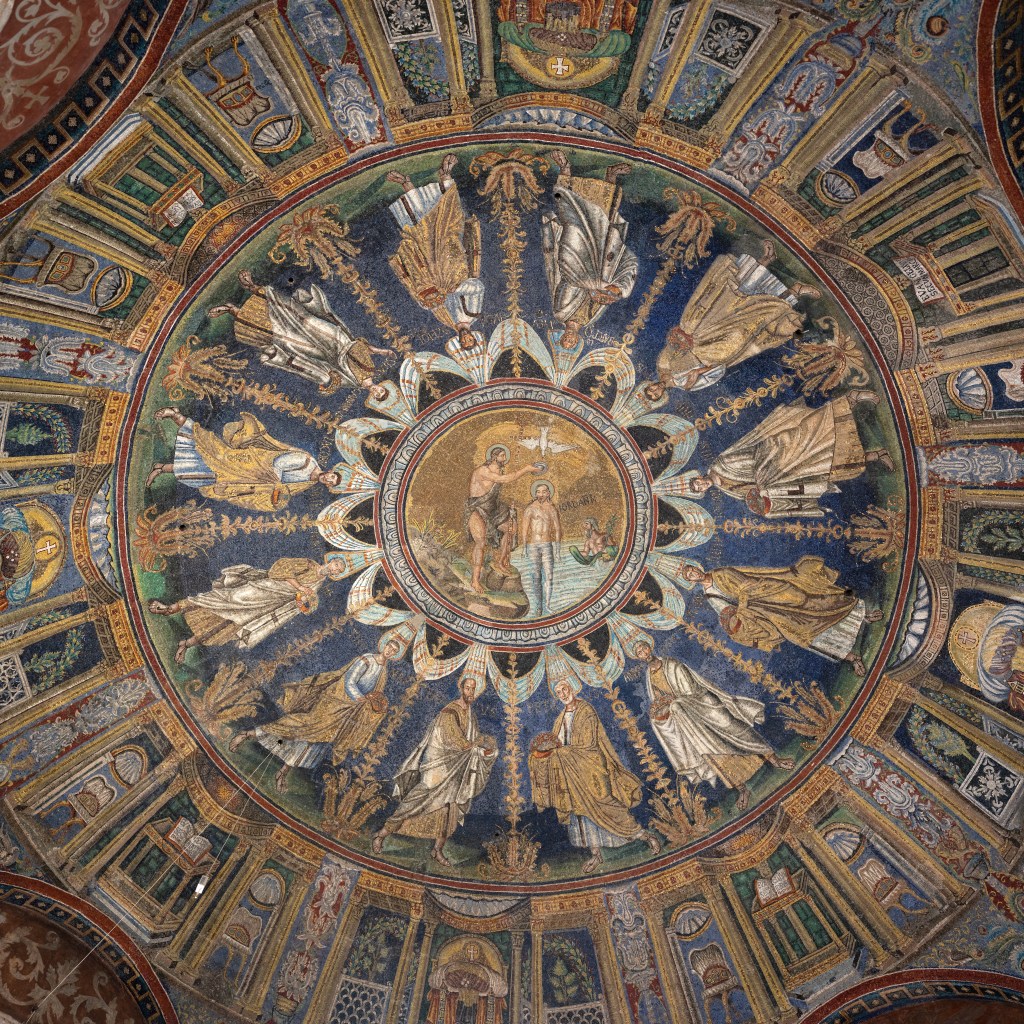
Here the connection between Eden and Christ becomes especially important. Christ is the New Adam. Where Adam falls into shame, Christ enters our shame to restore us. Where Adam hides, Christ is exposed. Where Adam grasps, Christ gives Himself. In Christian art, Christ’s nearly nude body can appear in the manger, on the cross, in the tomb, and in the arms of Mary. These images are not erotic. They are incarnational. They say that the Son of God truly took on flesh, truly became vulnerable, truly entered the condition of human beings.
The unclothed Christ child in Renaissance Nativity scenes often communicates purity and incarnation. The exposed torso of Christ in Michelangelo’s Pietà communicates death, innocence, and sacrificial love. Crucifixion scenes with a minimal loincloth often emphasize both humiliation and holiness. Christ is stripped by the world, but He is not made impure by being stripped. His innocence remains. His body becomes the place where violence, shame, love, and redemption meet.
The same pattern appears in depictions of saints and martyrs. St. Sebastian is often shown nearly nude, pierced by arrows, his body vulnerable but his fidelity intact. St. Agnes, in traditional accounts and images, may be stripped as part of her humiliation, yet her innocence is protected and honored. Other martyrdom scenes show exposed bodies not to invite possession, but to show what cruelty does and what holiness endures. The world may strip the saint, but it cannot strip away purity of heart.
This is a crucial point for Christian moral imagination. Nudity in such scenes does not always represent moral danger. Sometimes it exposes the moral danger of the viewer, the persecutor, or the fallen world. The saint’s body is vulnerable, but the saint is not reduced to vulnerability. The martyr may be physically exposed, yet spiritually clothed in faithfulness. The image asks the viewer not to consume the body, but to honor courage, pity suffering, and recognize innocence under trial.
Medieval allegory adds another layer. In manuscripts, psalters, and cathedral sculpture, naked souls sometimes appear at death, judgment, resurrection, or paradise. These small unclothed figures are not sexualized. They represent the soul or person without earthly covering, status, wealth, office, or disguise. The body or soul appears before God with nothing to hide. In that visual language, nakedness can signify truthfulness, dependence, and the stripping away of worldly illusion.
This does not mean every image succeeds. It does not mean every artist handled the body wisely. It does not mean viewers are incapable of misusing what they see. But it does mean Christian tradition had theological reasons for depicting the unclothed body as innocent, pure, vulnerable, or restored. Augustine, Chrysostom, Aquinas, and others all reflected in different ways on the meaning of Adam and Eve’s original nakedness. Before sin, shame did not govern the body. The pre Fall body was ordered, innocent, and free from lust. That theological conviction shaped centuries of Christian imagination.
David gives us another example, though we should handle it carefully. Michelangelo’s David is not simply a piece of biblical illustration. It also belongs to Renaissance humanism, civic symbolism, classical artistic recovery, and Florentine political imagination. Still, within a Christian reading of the biblical story, David’s body can be understood as vulnerability and dependence rather than mere heroic display. David stands before Goliath without Saul’s armor. His strength is not in worldly protection, but in trust. His courage is creaturely courage, the courage of one who knows that victory does not finally come from the visible armor of power.
Read this way, the nude or nearly nude biblical body can signify strength through vulnerability. It is not a denial of dependence, but a revelation of it. David is not powerful because he is armored. He is powerful because he is faithful. His apparent weakness becomes the place where divine strength is made visible. For me, this becomes a beautiful illustration of what I have elsewhere called perichoretic salvation, or more simply, dancing with God. David does not act alone, and God does not treat David as a puppet. There is a mysterious cooperation here, a human life caught up in divine purpose, God and David moving together in the unfolding work of God’s kingdom. Michelangelo may not have had that exact theological framework in mind, and we should be careful not to claim that he did. But perhaps the beauty of great art is that it can bear more meaning than even the artist consciously intended. Perhaps, in this case, God did.
So when Christian art shows the body in innocence or created goodness, it is not saying that nakedness is always innocent in every setting. That would be naïve. It is saying something more careful and more profound: the body is not automatically corrupt. The unclothed body can reveal the goodness of creation, the simplicity of Eden, the humility of baptism, the vulnerability of Christ, the purity of martyrs, and the dependence of the creature before God.
That is why this category matters so much for Christian naturism. If Christians begin with the assumption that the nude body is always erotic, always shameful, or always spiritually dangerous, we have already lost part of our own tradition. The question is not whether the body can be misused. Of course it can. The question is whether misuse defines the body’s meaning. Christian art says no. The body can be misread, exploited, and degraded, but it can also be seen truthfully.
In this visual theology, innocence is not ignorance. It is right relation. Created goodness is not naïve optimism. It is the confession that God made the body and called His creation good. And glory is not the denial of vulnerability. It is vulnerability transfigured by truth, love, and grace.
Case Study: Piero della Francesca’s The Baptism of Christ
Piero della Francesca’s The Baptism of Christ is a nearly perfect example for this part of the discussion because it is unmistakably Christian, originally made for a church setting, and places the seminude body of Christ at the center of a sacred moment. That alone should slow us down. If sacred art were required to avoid bodily exposure altogether, a painting like this would be difficult to explain. Yet here the exposed body is not a distraction from holiness. It is part of how the painting communicates holiness.
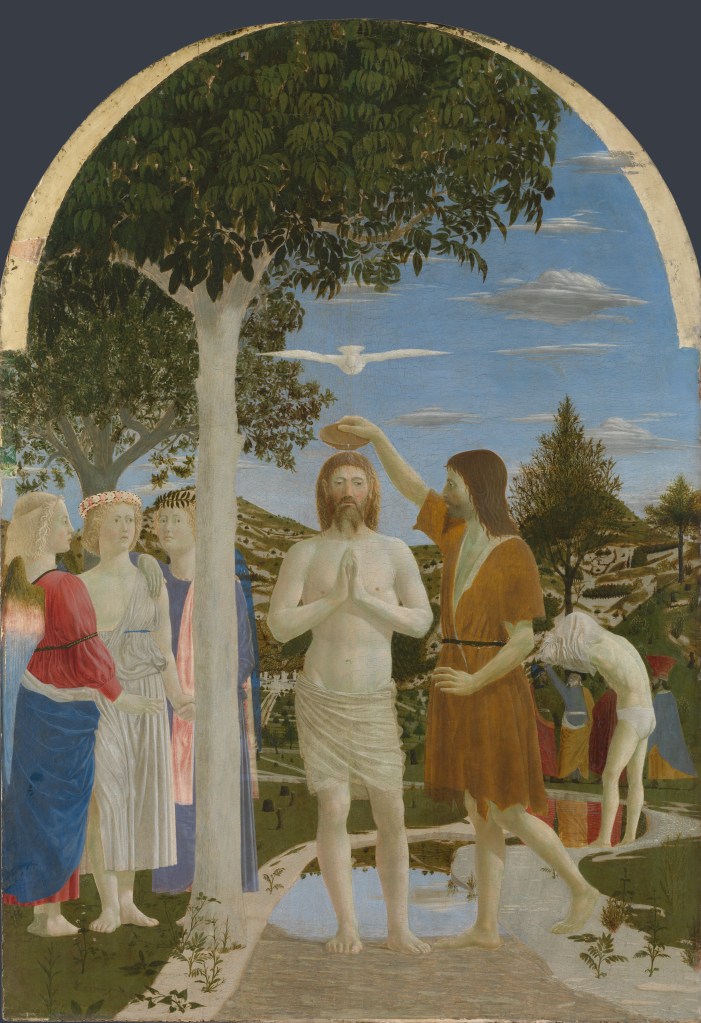
The scene is calm, ordered, and luminous. Christ stands in the Jordan while John the Baptist pours water over His head. Above Him, the Holy Spirit descends as a dove. Angels stand nearby as witnesses. In the background, another man removes his tunic in preparation for baptism. That detail matters. The painting does not only show Christ partially unclothed. It also shows bodily uncovering as part of baptismal preparation. The act is not presented as erotic display, but as a movement toward purification, surrender, and new life. In fact, if the scene were intended as strict historical realism, Christ Himself may well have been shown nude in the waters. Instead, the painting preserves modesty while still allowing the exposed body to carry sacramental meaning.
Here, the exposed body signifies humility, purification, embodiment, and the presentation of the person before God. Christ does not enter the waters as one needing cleansing from sin, but as the sinless one who identifies Himself with humanity. His body stands in the water because grace does not bypass embodied life. Baptism touches the body. Water runs over skin. The person does not come to God as a disembodied soul, but as a whole human being. Yet even here we can see the tension the Church has often carried around the nude body. Christ is partially covered, suggesting both the theological importance of bodily exposure and the pastoral instinct toward modesty. That tension between revealing and covering, between sacred meaning and moral caution, will become especially important in my next post.
This connects naturally to the older symbolism of Adamic innocence. In Eden, nakedness could signify openness before God without shame. In baptismal imagery, bodily simplicity can suggest a return toward that lost innocence, not by pretending the Fall never happened, but by receiving cleansing and renewal through grace. The old life is put off. The new life is received. The body is not treated as shameful, but as the site where grace is encountered.
That is the important theological point. In this painting, bodily exposure serves sacramental meaning, not sensual provocation. The seminude body of Christ is not there to invite possession, but contemplation. The baptismal candidate removing his garment is not being eroticized, but prepared. The image teaches the viewer to see the body as involved in repentance, cleansing, humility, and new creation.
This matters for Christian art because it shows that the body can appear in a sacred context without collapsing into lust or indecency. The problem is not visibility by itself. The problem is what kind of seeing is being formed. Piero’s painting invites a quiet, reverent gaze. It asks the viewer to see the body not as an object for consumption, but as the embodied person standing before God.
So if Christian art could place the partially unclothed body of Christ and the stripping of baptismal candidates inside a sacred image, then the issue cannot simply be “nude or not nude.” That question is too blunt for the richness of the tradition. The real question is what the image is teaching us to see.
Because Christian art can use the body this richly, the next question is not only what an image depicts, but what it trains the viewer to feel, and how it forms the Christian imagination.
Nudity as Suffering, Humiliation, and Vulnerability
Note, one reason some works of Christian art appear in more than one category is that good art often refuses to mean only one thing. A single image can stir grief, pity, reverence, discomfort, and hope all at once. The same exposed body may speak of innocence in one respect, suffering in another, and future restoration in yet another. That is not a weakness in the art. It is part of its depth. Human beings are not simple, and the body is often where that complexity becomes visible.
This is especially true when Christian art uses nudity or near nudity to depict suffering, humiliation, and vulnerability. This may be one of the most missed dimensions in the whole conversation. Many people assume that if a body is exposed, the image must be erotic or immodest. But Christian art often shows the exposed body for the opposite reason. It shows the body to tell the truth about suffering. It shows the body to reveal what violence, shame, poverty, and public humiliation do to a human being. It asks the viewer not to consume the body, but to mourn what has been done to it.
Christ Himself is the clearest and most important example. Historically, Roman crucifixion was not only execution. It was degradation. It was a public spectacle of state terror, designed to strip a person of dignity in the eyes of the crowd. The condemned were often crucified naked as part of the humiliation. Christian art frequently modifies this with a loincloth for modesty, but the theological reality remains. Christ is stripped. Christ is exposed. Christ is mocked. Christ is wounded. Christ is made vulnerable before the gaze of the world.
“He was despised and rejected by others; a man of suffering and acquainted with infirmity.” – Isaiah 53:3
This is not incidental to the Passion. The stripping of Christ is one of the ways the world tries to shame Him. The soldiers do not merely injure His body. They mock Him, dress Him in parody, remove His garments, cast lots for His clothing, and expose Him before others. The Son of God enters not only death, but humiliation. He enters the place where human beings are degraded, displayed, mocked, and treated as less than persons.
That is why the exposed body of Christ in crucifixion art must not be read as erotic. It is the suffering flesh of God. In Giotto’s crucifix, in Grünewald’s Isenheim Altarpiece, in countless medieval and Renaissance crucifixions, the body of Christ is shown wounded, stretched, pierced, thin, twisted, and vulnerable. Michelangelo’s wooden crucifix, made in 1492 for Santo Spirito in Florence, goes even further by depicting Christ fully nude. That work can unsettle modern viewers, but its meaning is not sensual display. It is total self-giving. Total exposure. Total vulnerability. The innocent one has nothing left to protect Him from the cruelty of the world.
This also helps us understand scenes of the Flagellation, the Mocking of Christ, and the Man of Sorrows. In works by artists such as Piero della Francesca, Caravaggio, Duccio, Rogier van der Weyden, Hans Memling, and Michelangelo, Christ is often shown stripped, half clothed, wounded, limp, or exposed. The visible body is not there to invite possession. It is there to awaken sorrow, reverence, and repentance. The viewer is meant to ask, “What have we done?” and perhaps even more painfully, “What do we still do to the vulnerable?”
This distinction is crucial: depicting humiliation is not the same thing as endorsing humiliation. An image can tell the truth about degradation without approving of degradation. We understand this in other contexts. A photograph of a starving child is not necessarily exploiting that child simply because it shows suffering. It may exploit, depending on the gaze, the framing, and the use. But it may also awaken mercy. It may force the comfortable viewer to face a reality they would rather ignore. The point of such an image, at its best, is not to revel in misery, but to call forth compassion and action.
Christian art often does something similar. It shows the exposed Christ, the stripped martyr, the anguished Adam and Eve, or the naked poor not so that we will enjoy their exposure, but so that we will see their humanity more truthfully. The image refuses to let suffering remain abstract. It gives pain a body. It gives humiliation a face. It makes the invisible wound visible.
This is also why martyrs were often depicted partially nude or nearly nude. St. Sebastian, bound and pierced by arrows, is one of the most recognizable examples. St. Agnes, according to tradition, was stripped before execution, yet her innocence was preserved and honored. St. Bartholomew, flayed alive, is often shown with terrible bodily vulnerability. These images are not saying that exposure is good in itself. They are saying that the world may strip the body, but it cannot strip away the soul’s fidelity to God.
The world can strip the body, but not the soul. The martyr’s body is vulnerable, but the martyr is not spiritually defeated. The persecutor may expose, wound, and destroy, but the image insists that dignity remains. In fact, the exposed body can become the very place where dignity is revealed. Not because suffering is good, but because holiness can endure suffering without being erased by it. The body bears the marks of cruelty, yet the person remains more than what cruelty has done.
Adam and Eve after the Fall belong in this category as well, even though they also belong in the earlier discussion of innocence and shame. In Masaccio’s Expulsion from the Garden of Eden, their nudity is no longer peaceful. It is anguished. Their bodies are still the bodies God made, but now their nakedness speaks of fear, exposure, and the loss of innocence. The image does not despise their bodies. It mourns what has happened to them. Their shame is visible, but so is their humanity.
Medieval and Renaissance allegories of human frailty add another layer. In the Dance of Death, in images of the Three Living and the Three Dead, and in manuscript depictions of the naked soul before God, the unclothed body often signifies mortality, weakness, and the stripping away of earthly illusion. We are not as powerful as we pretend. We are not protected by our status, wealth, clothing, office, or reputation forever. Death removes costumes. Judgment removes masks. The body reveals the truth we often try to hide.
This can be uncomfortable, but discomfort is not always a sign that something is wrong. Sometimes discomfort is the beginning of moral seriousness. The exposed body in Christian art can remind us that human beings are fragile. We can be wounded. We can be shamed. We can be reduced by others to spectacle, labor, object, or victim. But Christian art, at its best, refuses to let degradation have the final word. It can show humiliation without surrendering dignity. It can show suffering without making suffering meaningless. It can show vulnerability without treating vulnerability as weakness.
That matters deeply for a theology of the body. If we only think about nudity in terms of innocence or beauty, we miss the suffering body. If we only think about nudity in terms of temptation, we miss the humiliated body. If we only think about nudity in terms of personal freedom, we miss those whose bodies have been exposed by force, poverty, violence, sickness, or shame. Christian art compels us to see them too.
The crucified Christ stands at the center of this vision. His exposed body gathers up the bodies of the shamed, the stripped, the wounded, the poor, the tortured, the mocked, and the powerless. He does not redeem humanity from a safe distance. He enters the place where human dignity seems most threatened, and there, astonishingly, reveals divine love.
So yes, nudity can signify suffering, humiliation, and vulnerability. But in Christian art, that does not mean the body loses its dignity. It means the body becomes the place where dignity must be defended most fiercely. The exposed body may reveal what sin has done, but it can also reveal what grace refuses to abandon.
Nudity as Judgment and Exposure
Nudity in Christian art can also signify judgment. This is where the conversation becomes more difficult, because Last Judgment scenes, hell panels, cathedral carvings, and medieval manuscripts often show nude bodies in distress, punishment, shame, and exposure. Some of these images are powerful. Some are disturbing. Some may even become excessive or lurid, raising fair questions about whether the image still preserves human dignity or whether it has crossed into spectacle. But even here, we need to interpret carefully.
In Last Judgment imagery, the nude body is often not the sin itself. The nude body is the site where judgment is revealed. When the damned are shown naked, the point is usually not that nakedness is evil. Rather, nakedness signifies that nothing is hidden from God. Earthly status is gone. Clothing, rank, costume, wealth, social performance, and public reputation have all been stripped away. The soul stands exposed. The body stands exposed. The whole person stands before divine truth.
“All are naked and laid bare to the eyes of the one to whom we must render an account.” – Hebrews 4:13
This is why Last Judgment scenes often show both the saved and the damned nude or nearly nude. Michelangelo’s Last Judgment in the Sistine Chapel, Giotto’s judgment imagery in the Scrovegni Chapel, and Signorelli’s frescoes in Orvieto Cathedral all use the human body to communicate resurrection, exposure, judgment, and destiny. The saved are not nude because they are shameful. The damned are not nude merely because nakedness is sinful. Both are shown unveiled because judgment concerns the whole person.
The difference is what the unveiling reveals. For the blessed, exposure can become glory. The body is raised, healed, and drawn toward God. For the damned, exposure becomes shame, because what was hidden is now seen. Pride is uncovered. Greed is uncovered. Violence is uncovered. Lust is uncovered. Rebellion is uncovered. The body becomes the visible place where the consequences of disordered love are shown.
This is especially important when we look at medieval hell imagery. Some scenes include serpents, demons, distorted bodies, and punishments directed toward particular parts of the body. Snakes biting genitals, for example, appear in some Last Judgment frescoes, hell panels, cathedral sculptures, and manuscript imagery. To a modern viewer, this can feel shocking or even grotesque. But the symbolism was not meant to be erotic. It was meant to be moral and theological.
Snakes often represent demonic punishment, corruption, or the wound of sin. When serpents attack the genitals, the image is usually pointing to lust, sexual sin, or disordered desire. The message is not, “The body is evil.” The message is closer to, “Sin wounds the very part of the person through which it was embraced.” It is a visual sermon. What was misused becomes the place of torment. What was made for love, union, fruitfulness, and embodied communion becomes twisted by disorder and judgment.
That does not mean every such image is equally wise. Some hell art is visually overwhelming. Some images seem almost to revel in punishment. Some may risk turning judgment into horror entertainment, a kind of infernal spectacle. Christian art is not exempt from critique simply because it has religious content. The same questions still apply. Does the image awaken repentance, humility, and moral seriousness? Or does it invite fascination with degradation? Does it reveal the dignity of the person even under judgment? Or does it reduce the damned to grotesque objects for the viewer’s imagination?
This is where discernment becomes necessary again. Christian judgment imagery can tell the truth about sin without teaching contempt for the body. It can show shame without making shame the whole meaning of the human person. It can depict punishment without asking us to delight in suffering. At its best, hell art is not a celebration of damnation. It is a warning against the destruction caused by sin.
The nude body in these images is therefore deeply symbolic. It speaks of unhiddenness. It speaks of vulnerability before God. It speaks of the collapse of false identity. It says that no one can hide forever behind titles, costumes, reputations, wealth, beauty, power, or religious performance. The question before divine judgment is not how successfully we managed our image, but what we became.
This also helps correct a common misreading. Some viewers assume that because nude bodies appear in hell scenes, Christian art must be teaching that the nude body is itself shameful or sinful. But that is too simple. In many Last Judgment scenes, everyone is nude because everyone is raised, exposed, and known. The sin being judged is not nakedness as such. The sins are lust, violence, pride, greed, cruelty, rebellion, and the refusal of love. The body becomes the place where these realities are shown because human beings sin, suffer, love, repent, and resist God as embodied persons.
That is a serious theological claim. Christianity does not treat sin as an abstract idea floating above the body. Sin is enacted in bodies. Greed withholds bread from hungry bodies. Violence wounds bodies. Lust consumes bodies. Pride performs through bodies. Envy looks through eyes. Anger strikes with hands. The body is not the source of all sin, but it is often where sin becomes visible. Judgment imagery makes that visible too.
So yes, some nude scenes in Christian art are connected to lust and sexual sin. But even there, the nudity is usually not meant to arouse. It is meant to reveal disorder. It is meant to show that desire severed from love becomes destructive. It is meant to show that what we do with the body matters because the body belongs to the whole person before God.
The hard truth of judgment art is that exposure can reveal either shame or glory. It depends on what has been loved, what has been hidden, what has been healed, and what has been refused. In Eden, nakedness could be innocence. After the Fall, it could become shame. In baptism, it could signify cleansing. In martyrdom, it could reveal vulnerable fidelity. In judgment, it becomes the final unveiling.
The body, once again, is not meaningless. It is where the truth comes into view.
Case Study: Jan van Eyck’s The Crucifixion; The Last Judgment
Jan van Eyck’s paired panels, The Crucifixion; The Last Judgment, bring together two defining Christian scenes: Christ crucified and humanity judged. The Metropolitan Museum of Art dates the work to about 1436 to 1438 and describes Van Eyck as giving “palpable form to the horrors of the Last Judgment.” That phrase is helpful because it captures exactly why this work belongs in this discussion. This is not nudity for display. This is the body placed inside the largest Christian drama: sin, suffering, salvation, judgment, and the fate of the human person before God.
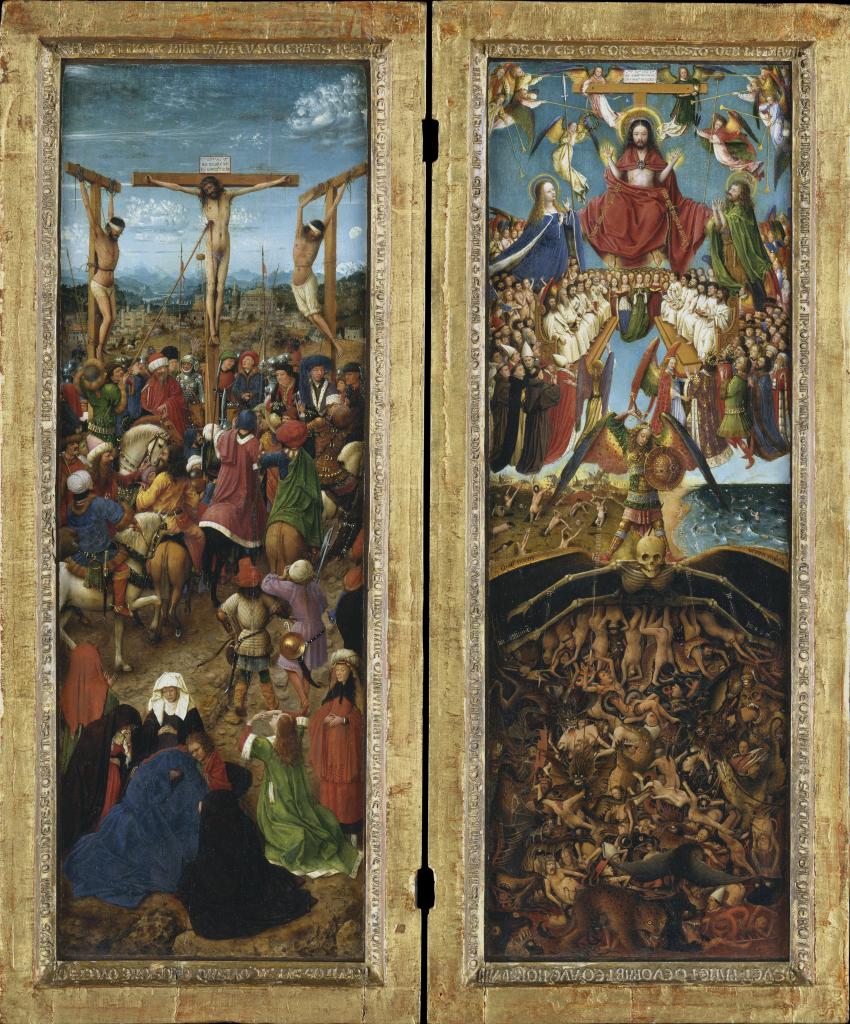
In the Crucifixion panel, the body is central because suffering is central. Christ is lifted up in public shame. His body is exposed to violence, mockery, exhaustion, and death. Even where artists add a loincloth for modesty, the theological reality remains: crucifixion was meant to humiliate. Roman execution did not merely kill the condemned. It displayed them. It made their vulnerability public. Van Eyck’s panel asks us to see the body of Christ not as an object of erotic attention, but as the innocent body handed over to violence.
That distinction is crucial. Christian art can reveal the body precisely to tell the truth about degradation without endorsing degradation. To show Christ’s suffering is not to celebrate cruelty. To show His exposed vulnerability is not to make exposure the point. The point is that the Son of God enters the place where human dignity is most visibly attacked. His body is humiliated, but not stripped of dignity. The world can mock, wound, and display Him, but it cannot make Him less than the beloved Son. We can even see this tension in modern visual art. The Passion of the Christ, as a moving picture and therefore a powerful form of art, portrays the humility, degradation, and sheer brutality of crucifixion with almost unbearable force. Yet it does not portray Christ nude, even though Roman crucifixion historically involved nakedness as part of the humiliation. So much for strict historical accuracy. It is striking that full nudity would likely have been considered far more scandalous, perhaps even changing how the film was received or rated, while the violence itself was presented with intense realism. Out of religious sensitivity, the exposed body is restrained, but the torn body is shown in detail. That contrast should make us think. Why are we often more unsettled by the truthful exposure of the body than by the graphic display of violence done to the body?
The Last Judgment panel intensifies the question. Here the human body appears before divine judgment. Resurrected bodies stand exposed, not because nakedness is the sin, but because nothing is hidden. Clothing, rank, wealth, office, beauty, and reputation no longer manage the meaning of the person. The human being stands revealed. In Christian judgment art, the nude body often signifies not erotic availability but total visibility before God.
This is the heart of the theological point. The body is not incidental to salvation or judgment. Human beings sin, suffer, repent, love, wound, forgive, and rebel as embodied persons. The body becomes the place where the consequences of sin are shown, but that does not make the body itself the object of condemnation. Lust, violence, pride, greed, cruelty, and rebellion are judged. Nakedness, in this context, is the stripping away of illusion. It is unhiddenness.
Van Eyck’s infernal imagery also raises the dignity question. Hell scenes often include demons, bodily torment, and punishments that appear grotesque or terrifying. These images were intended as warnings, visual sermons meant to awaken repentance and moral seriousness. But there is always a danger here. Warning imagery can become lurid. A viewer may be moved to repentance, but another may be fascinated by the spectacle. The intended purpose of an image and the actual response of the viewer are not always the same.
That is why Christian art still needs discernment, even when the subject is the Last Judgment. Does the image reveal the horror of sin, or does it invite us to revel in horror? Does it preserve the dignity of the human person, even under judgment, or does it reduce bodies to objects of fear and fascination? Does it awaken humility and repentance, or does it turn hell into spectacle? These are not modern questions forced onto old art from the outside. They belong to the moral seriousness of looking itself.
This diptych teaches us that the nude body in Christian art can carry several meanings at once. In the Crucifixion panel, the exposed body speaks of suffering, humiliation, and innocent vulnerability. In the Last Judgment panel, nude resurrected bodies speak of exposure, judgment, and the loss of worldly coverings. In the hell imagery, bodily torment speaks of the consequences of sin, while also forcing us to ask whether the image preserves or threatens human dignity.
This is why Van Eyck is so helpful for this series. One Christian artwork can show that the body may be central without making the body the sin. The nude or exposed body can reveal suffering without becoming erotic. It can reveal judgment without teaching contempt for embodiment. It can reveal horror without asking us to delight in horror. The body remains theologically serious because the human person remains theologically serious.
Nudity as Catechesis and Spiritual Formation
This leads to another question that is easy to miss. Christian art was not only asking, “What does the body mean?” It was also asking, “What is this image forming in the viewer?”
That is the catechetical question. Catechesis means instruction in the faith, but in Christian history that instruction has never been limited to words on a page. Sermons teach. Creeds teach. Hymns teach. Liturgy teaches. Architecture teaches. Stained glass teaches. Icons, frescoes, sculptures, altar pieces, manuscript illuminations, and church wall paintings all teach. They do not merely give information. They form imagination.
This matters because art does not simply say something to the mind. It does something to the whole person. It trains attention. It awakens emotion. It gives shape to memory. It teaches us what to fear, what to love, what to pity, what to honor, what to reject, and what to hope for. A painting of the Crucifixion does not merely communicate the fact that Christ died. It invites grief, gratitude, repentance, and reverence. A Last Judgment scene does not merely communicate a doctrine of final accountability. It can awaken holy fear, moral seriousness, and the recognition that nothing is hidden from God. A baptismal image does not merely communicate that baptism happened. It can teach the viewer to imagine cleansing, humility, rebirth, and embodied grace.
This is why it is too small to say that Christian art was merely “the Bible for the illiterate.” That phrase contains a partial truth, since many Christians in earlier centuries encountered biblical stories visually as well as orally. But art did more than illustrate information for those who could not read. It shaped how Christians felt the faith. It gave them a visual world in which holiness, sin, suffering, mercy, judgment, resurrection, and glory could be imagined. It helped them inhabit the story.
That formative power becomes especially important when the nude or seminude body appears in sacred art. The question is not only, “What does the image depict?” The deeper question is, “What is this image training the viewer to feel?” Is it training fear? Pity? Repentance? Reverence? Disgust? Mercy? Desire? Contempt? Gratitude? Wonder?
Those questions matter because the same visible body can be placed within very different moral worlds. The body of Christ in the Passion should train us toward sorrow, repentance, and love. The body of the martyr should train us toward courage and compassion. The body of Adam and Eve before the Fall should train us toward wonder at created goodness. The body of Adam and Eve after the Fall should train us toward grief over shame and exile. The body in baptismal art should train us toward humility and renewal. The body in Last Judgment imagery should train us toward moral seriousness before God.
But we must admit that images can also misform us. A work intended to provoke repentance can become a spectacle. A body meant to awaken pity can be consumed as an object. Hell imagery meant to warn can slip into fascination with torment. Beauty meant to reveal divine workmanship can become vanity or possession. This does not mean art should be rejected. It means art must be received with discernment. If experience forms us, then what we repeatedly behold matters.
I have argued elsewhere that art can give us a kind of knowledge that changes us. It is not merely information. It is encounter. We do not simply stand outside a work of art and extract facts from it. We enter, in some measure, the artist’s way of seeing. We participate in a vision of reality. That is why art can deepen spiritual formation, but also why careless looking can deform the imagination. We are being shaped by what we behold.
Christian art, then, sits in a middle place between rejection and naïve consumption. It should not be dismissed simply because it is visual, embodied, beautiful, or emotionally powerful. But neither should it be treated as harmless decoration. Images ask something of us. They summon a response. They train the heart.
This is especially true of church art. A fresco on a chapel wall is not like a random image glanced at while scrolling through a feed. It belongs to a setting of worship, prayer, confession, preaching, and sacramental life. The viewer does not encounter it as isolated content, but as part of a larger moral and theological environment. The image participates in the formation of the Christian imagination. It helps tell the worshiper where they are in the story of creation, fall, redemption, judgment, and restoration.
So when nude bodies appear in Christian art, we should not ask only whether they are present. We should ask what kind of seeing they cultivate. Do they teach us to see the body as God’s workmanship? Do they teach us to grieve over the body degraded by violence? Do they teach us to honor vulnerability? Do they teach us to long for resurrection? Or do they train us to reduce the person to an object of fear, disgust, or use?
That is the real test. Christian art is never only about depiction. It is about formation. The question is not only what the eye sees, but what the soul learns to love, remember, and contemplate. As I mentioned earlier, Michelangelo’s David is a case in point. Even beyond what Michelangelo may have consciously intended, the work can carry deep significance for the viewer. It can become a visual reminder of a spiritual truth: that faithful vulnerability may reveal a strength deeper than armor. In that sense, art can help us recall, meditate on, and imaginatively inhabit truths we might otherwise leave as abstract ideas. It does not merely show us something. It can train us to return to it.
The Ethics of Seeing
At this point, the question is not only what the artist intended. Intention matters, but it is not the whole story. When we use art as a means of communication, there is usually something the artist hopes to convey: a truth, a meaning, a feeling, a warning, a longing, or a vision of the world. But there is also the reception of that truth, meaning, or feeling by the viewer. Art is completed, in a sense, in the act of seeing. The viewer brings a gaze, a history, a set of desires, wounds, habits, assumptions, memories, and temptations. That means the moral question is not only, “What did the artist mean?” It is also, “What am I doing as I look?”
This also means I am not always bound by the artist’s conscious intention. A work of art can become meaningful to me in ways the artist may never have imagined. Michelangelo’s David is a good example. Michelangelo may not have intended the sculpture to communicate everything I now see in it, especially my own reflection on David as a figure of faithful vulnerability and dependence on God. Yet for me, the image can still become a visual reminder of a deeper spiritual truth. David stands without Saul’s armor, and in that vulnerability I can see something beautiful about dancing with God, about human courage moving with divine purpose. That meaning is not false simply because Michelangelo may not have written it in the margins. It is part of how the work is received, contemplated, and spiritually inhabited.
We do this with popular culture too. I can look at Spider-Man and see a symbol of the truth that with great power comes great responsibility. Stan Lee did intend many of his characters to carry moral meaning, so that reading is not far off. But the larger point remains. Art can carry intended meaning, received meaning, and personally discovered meaning. We are allowed to find resonance. We are allowed to let an image remind us of truth. But when we make meaning, we also bear responsibility for how we make it. If I receive an image with reverence, gratitude, courage, or repentance, that matters. If I receive it with lust, contempt, vanity, or use, that matters too.
This is where John Paul II’s reflections on the body and art become especially helpful. In his theology of the body, he repeatedly returns to the dignity of the human person and the danger of reducing a person to an object of use. That word, use, is crucial. A body can be seen as the visible presence of a person, or it can be reduced to material for appetite, fantasy, comparison, control, or possession. The same human form can be approached with reverence or consumption.
So we need an ethics of seeing.
When we look at a nude or seminude body in Christian art, we should ask what kind of gaze the image invites, and also what kind of gaze we are bringing to it. Does it invite contemplation, pity, holy fear, repentance, reverence, or gratitude for God’s workmanship? Does it help us remember suffering, innocence, vulnerability, judgment, or resurrection hope? Or does it invite use? And if the image itself does not invite use, am I nevertheless turning it into something for use within myself?
This is the deeper distinction between art and pornography. Pornography is not merely an image with less clothing. It is a way of seeing the person as an object for consumption. It trains the viewer to separate body from person, desire from love, pleasure from responsibility, and seeing from reverence. It does not ask, “Who is this person before God?” It asks, “How can this body serve me?”
Christian art, at its best, does the opposite. It refuses to detach the body from the person. The exposed body of Christ is not available for use. It calls us to repentance and worship. The body of the martyr is not available for use. It calls us to pity, courage, and moral seriousness. The body of Adam and Eve is not available for use. It calls us to remember innocence, shame, and the longing for restoration. The body raised in judgment is not available for use. It calls us to tremble before the truth that nothing is hidden from God.
But what if different viewers receive the same image differently? A painting may be intended for reverence, but a viewer may receive it with lust. A work may be meant to awaken pity, but a viewer may become fascinated with suffering. A Last Judgment scene may be meant to warn against sin, but someone may linger over the punishments in a distorted way. A sculpture meant to celebrate courage may become an object of vanity. This does not automatically mean the image itself is corrupt. Sometimes the problem is the viewer’s gaze.
That may be uncomfortable to admit, but Christian moral reflection requires it. We cannot blame the body for every disordered response within us. Sometimes the body is not the problem. Sometimes the image is not the problem. Sometimes the problem is that the viewer has been trained by a fallen culture, by pornography, by shame, by fear, by vanity, or by wounded desire to see wrongly. The fact that I can misuse an image does not prove the image has no proper use. It may prove that my gaze needs conversion.
Of course, that does not excuse artists, churches, or communities from responsibility. Some images really do invite use. Some images blur devotion and sensuality in unhealthy ways. Some images exploit suffering. Some images display bodies in ways that do not honor the person. The viewer’s gaze matters, but so does the image’s moral structure. We should not pretend that every religious image is automatically safe simply because it has a biblical subject.
This is why dignity must become the governing standard. Does the image honor the human person as an embodied image bearer of God? Does it preserve the unity of body and person? Does it train the viewer toward love, mercy, repentance, reverence, humility, courage, or hope? Or does it reduce the person to a thing to be consumed?
This standard helps us avoid two errors. The first error says that if an image contains nudity, it must be rejected. That is too crude. It ignores Christian history and the theological meaning of the body. The second error says that if an image is called art, it cannot be morally dangerous. That is also too crude. Art can form us, and not all formation is good.
The ethics of seeing asks for something harder than quick rejection or careless permission. It asks for discernment. It asks us to examine the image, the context, the purpose, the artist’s likely intent, and our own reception. It asks whether we are learning to see the body as God sees the person, or whether we are quietly learning to use what should be loved. It also asks whether an image might become for us a reminder of truth, a point of meditation, or a doorway into deeper spiritual reflection, even when that meaning goes beyond what the artist consciously intended.
That question reaches beyond art. It reaches into Christian naturism as well. If the unadorned body can be seen with reverence, humility, and dignity, then it should not be automatically condemned as obscene. But if the body is seen through lust, pride, performance, or use, then even an innocent setting can become morally distorted. The central issue is not simply visibility. It is vision.
The body matters. But how we see the body matters too.
The Controlling Question: Does the Image Honor the Dignity of the Human Being?
At the center of all of this is a question of dignity. Christian art is symbolic. It conveys meaning beyond words, sometimes with a depth that language can only circle around. A painting can make us feel sorrow before we can explain sorrow. It can awaken pity before we have constructed an argument for mercy. It can make judgment feel weighty, suffering feel personal, innocence feel fragile, and resurrection feel imaginable. That is part of art’s power. But it is also part of art’s difficulty. Because images are symbolic, they can be rich and layered, but also obscure. They leave more room for subjectivity, misreading, and mistaken desire than a carefully defined sentence might.
This is why nudity in Christian art requires discernment. As we have seen, the nude body can symbolize many things. It can signify innocence in Eden and shame outside the Garden. It can signify vulnerability in baptism and humiliation in the Passion. It can signify the stripped poverty of the martyr, the exposed truth of judgment, the fragility of mortality, or the hope of resurrection. Sometimes it can hold opposite meanings at once. The body can be vulnerable and strong. Exposed and dignified. Wounded and holy. Ashamed and still beloved.
That means the line between appropriate and inappropriate cannot be drawn simply by asking whether the body is clothed. A clothed body can be degraded. A nude body can be honored. That may be the clearest way to state the matter. Clothing does not automatically preserve dignity, and nudity does not automatically destroy it. A fully clothed person can be depicted in a way that reduces them to power, vanity, mockery, seduction, propaganda, or use. A nude or seminude person can be depicted in a way that preserves reverence, pity, courage, innocence, suffering, and theological seriousness. The decisive question is not fabric. The decisive question is whether the image preserves the human person as a bearer of immeasurable worth.
Of course, many Christians want to avoid nudity in art altogether because they fear temptation. That concern should not be mocked. Temptation is real. The human gaze can be disordered. We do not become holy by pretending we are immune to lust, vanity, voyeurism, or self-deception. There is wisdom in avoiding what we know will deform us.
But avoidance alone is not the same thing as mature vision. If we reject every difficult image because it might be misused, we never learn how to see rightly. We only learn how not to look. There is a place for guarding the eyes, but there is also a place for discipling the eyes. Christian formation should not merely ask, “How do I avoid seeing the body?” It should also ask, “How do I learn to see the body truthfully, reverently, and without possession?”
Jesus did not teach us to cultivate temptation, but He did show us that holiness is not fragile avoidance. He faced temptation without surrendering to it. By the Spirit, Christians are called not merely to flee what is clearly corrupting, but also to grow into people whose loves are rightly ordered. That includes learning that the body is not automatically erotic, not automatically shameful, and not automatically an object for use. Context matters. The gaze matters. Formation matters.
This is where the distinction between appreciation and appropriation becomes important. Appreciation receives the image with reverence. It asks what truth is being revealed. It honors the person depicted. It allows the image to teach pity, humility, repentance, gratitude, or hope. Appropriation takes the image for the self. It turns the person into an object. It uses beauty for appetite, suffering for spectacle, or vulnerability for control.
That is the dignity test. Does the image honor the whole person, or does it reduce the person to parts? Does it invite contemplation, or consumption? Does it deepen mercy, or numb it? Does it reveal the body as God’s workmanship, or does it train the viewer to possess what should be loved? Does it tell the truth about suffering without reveling in degradation? Does it show judgment without delighting in torment? Does it show beauty without idolizing the body? Does it show vulnerability without making vulnerability cheap?
This also helps us speak more carefully about body image and idealization. Some art may honor the body, but still present bodies in ways that create unrealistic ideals of strength, youth, beauty, symmetry, or perfection. That does not make such art worthless, but it does add another layer of discernment. Are we learning to see the human body as a gift in its real diversity, or are we learning to despise ordinary bodies because they do not match a heroic artistic ideal? Dignity must include the weak body, the aging body, the disabled body, the scarred body, the poor body, and the body that does not fit cultural standards of beauty.
So the governing standard is not nude versus clothed. It is dignity versus degradation. That distinction also helps clearly separate art from pornography. Pornography sees the body as a means to an end. It detaches the body from the person and presents the human form as something to be consumed, possessed, or used for gratification. Christian art, at its best, does the opposite. It refuses to let the body become merely an object. It keeps the person present. It asks us to see the human being as someone made in the image of God, someone with immeasurable worth, someone whose body is not a tool for appetite but part of the mystery of personhood. A nude body can be honored, and a clothed body can be degraded. The moral line is not drawn by fabric alone, but by whether the image preserves or violates the dignity of the human person.
Conclusion
Christian nude art is not a simple subject because the human body is not a simple subject. In the works we have considered, nudity can signify innocence, created goodness, baptismal humility, suffering, humiliation, martyrdom, judgment, mortality, and resurrection hope. The body is not the message by itself. Context gives it meaning, and the gaze determines whether we receive that meaning with reverence or distort it into use.
That is why the controlling question cannot be merely, “Is the body clothed or unclothed?” The better question is whether the image honors the dignity of the human person. A nude body can be depicted with reverence, and a clothed body can be degraded. Christian art, at its best, teaches us to see the body as part of God’s workmanship, not as an object for consumption, but as the visible presence of a person made for communion with God.
But Christians have not always agreed about where that line should be drawn. Some images have inspired devotion, while others have provoked concern. Some have been defended as sacred art, while others have been covered, censored, altered, or condemned. That brings us to the final post in this miniseries: Covering, Censorship, and Discernment. If the first question was why Christians depicted nude bodies, and the second was what those bodies were meant to communicate, the next question is how Christians have argued over them, and how we might practice wise discernment today.
Excerpt
Nudity in Christian art is not morally self-interpreting. It can signify innocence, suffering, humiliation, judgment, repentance, or resurrection hope. The deeper question is not whether the body is shown, but whether the image honors human dignity and teaches us to see truthfully.
More Sky, Less Armor


Leave a Reply