

Introduction
Here we are at the third and final post in this small sub-series on nudity in Christian art. I have not covered the subject exhaustively. Surely there is much more that could be said, more works of art that could be considered, more theological sources that could be brought into the conversation, and more historical controversies that could be explored. But for the purpose of this larger series on Christian naturism or nudism, I think we have covered enough of the highlights to have a more thoughtful conversation about nudity in Christian art and what it tells us about the human body. If there are other areas we should lay bare, let me know, and perhaps we can explore them in the future.
The first post asked why Christian art ever depicted nude bodies at all. The second asked what those nude bodies were meant to communicate. We saw that the nude or seminude body in Christian art is not morally self-interpreting. It can signify innocence, created goodness, vulnerability, suffering, humiliation, judgment, repentance, mortality, resurrection hope, and glory. The real question is not simply whether the body is shown, but what the image teaches us to see in the human person.
Now we come to the question that has followed Christian art for centuries: what happens when Christians disagree?
Church history is nothing if not a long record of controversy, prayer, argument, correction, failure, repentance, and sometimes hard-won wisdom. The Church has had to wrestle with difficult questions from the beginning. At its best, the Church does this collectively, humbly, and under the guidance of the Holy Spirit, trusting that the Spirit leads us into truth. The great councils remind us that hard questions are not always settled by pretending they are simple. They must often be wrestled with carefully, patiently, and with a willingness to submit our own judgment to something larger than ourselves.
Unfortunately, we have not always done that well. Too often, Christians divide before they discern. We draw lines before we listen. We turn disagreements into tribal tests, and then we congratulate ourselves for our certainty. That is a great sin against the Body of Christ. Truth matters, and doctrine matters, but charity matters too. If we cannot discuss the human body, modesty, beauty, temptation, art, and holiness without wounding one another, then perhaps the first thing being exposed is not the body, but our lack of love.
This post is probably the one where some readers will disagree. Some may have disagreed already. Some may even be offended by the topic itself. That is unfortunate, but not surprising. I have tried to write about Christian naturism and nudism as charitably, carefully, and dispassionately as I can. Still, to stand in the arena is to accept that someone may aim at the message, the messenger, or both. Like the martyrs of old, I cannot deny what I believe to be true simply because it is uncomfortable. At the same time, I am not so fixed in my position that I cannot learn, refine, or even change my view. Open dialogue is welcome. Honest correction is welcome. A sincere challenge is welcome. Just not a knife to the back.
That distinction matters because this final post is about discernment. Christians have never simply agreed about nude art. Some have seen it as capable of expressing theological truth, human dignity, and the mystery of embodied life. Others have feared indecency, lust, scandal, sensual naturalism, idolatry, or the misuse of beauty. Those concerns should not be dismissed. But neither should they automatically settle the matter.
The wisest Christian answer is not reflexive approval or reflexive condemnation. It is discernment ordered by dignity, truth, and spiritual effect. Does the image honor the human person, or does it degrade the person? Does it train the viewer toward reverence, repentance, mercy, and hope, or toward use, possession, and distortion? Does it reveal something true about creation, incarnation, suffering, judgment, and redemption, or does it merely excuse a gaze that should be converted?
That is where we now turn: covering, censorship, and discernment.
The Church Did Not Speak with One Voice
- Christians made the art.
- Christians censored the art.
- Christians defended the art.
- Christians condemned the art.
That tension is not an accident on the edge of Christian history. It is part of the history. The same broad Christian tradition that produced Adam and Eve before the Fall, the nude or nearly nude Christ in baptism and crucifixion, martyrs stripped before execution, resurrected bodies in Last Judgment scenes, and Michelangelo’s powerful bodies on the wall of the Sistine Chapel also produced coverings, corrections, condemnations, iconoclastic movements, and deep anxieties about modesty, temptation, idolatry, and scandal.
So if someone says, “Christianity has always rejected nude sacred art,” that is historically too simple. But if someone says, “Christianity has always embraced nude sacred art,” that is also too simple. The truth is more complicated, and more interesting. Christian history contains both the creation of nude and seminude sacred art and strong reactions against it. The disagreement itself tells us something important: Christians have long known that images matter, that bodies matter, and that the act of seeing can form or deform the soul.
This is why the subject cannot be settled by collecting a few examples on one side and pretending the other side does not exist. Michelangelo’s Last Judgment matters, but so do the later coverings added to it. Baptismal imagery matters, but so do Christian concerns about modesty. The theology of the Incarnation matters, but so do warnings against lust, idolatry, and the misuse of beauty. The Christian tradition is not a single flat note. It is a difficult harmony, and sometimes a dissonance, between embodiment and restraint, beauty and caution, revelation and covering.
That does not mean truth is impossible. It means discernment is necessary. We do not honor the tradition by flattening it into whatever answer we already prefer. We honor it by listening carefully to its tensions, asking why Christians created such art, why others feared it, and what those arguments reveal about the body, the gaze, and spiritual formation.
The Church did not speak with one voice on nude art. That may frustrate us, but it should not surprise us. The body has always stood at the crossroads of creation and fall, innocence and shame, beauty and temptation, vulnerability and dignity. Of course Christians wrestled with it. The question is whether we will wrestle honestly too.
Catholic Censorship and Decorum Debates
The Catholic tradition may be the best example of why this subject refuses to become simple. Catholic Christianity gave the world some of the richest figural art in Christian history, including some of the most famous nude and seminude sacred bodies ever painted or sculpted. Yet Catholic authorities also worried about indecency, scandal, sensuality, and the misuse of beauty. In other words, the Catholic tradition did not simply say yes or no. It struggled. It commissioned, admired, corrected, covered, restored, and reinterpreted. It moved back and forth in a long attempt to find the right fit, the proper demarcation between sacred beauty and indecorous display.
The Council of Trent is a key moment in that struggle. Trent did not reject sacred images. In fact, it defended their legitimate use, teaching that images of Christ, Mary, and the saints could be retained in churches because honor shown to images is referred to the realities they represent. It also described sacred images as a way the faithful are instructed, reminded of the mysteries of redemption, moved to give thanks, and encouraged to cultivate piety. But Trent also warned that abuses should be removed, especially images that could teach error, encourage superstition, or excite lust. Its concern was not art versus no art, but sacred image versus distorted image.
That is where the language of decorum becomes important. Decorum means fittingness, the sense that something is appropriate to its purpose, setting, and meaning. Sacred art was supposed to fit the holiness of the church, the dignity of the subject, and the spiritual formation of the viewer. Trent explicitly warned that “all lasciviousness be avoided” and that nothing profane or indecorous should be seen in the house of God. The question was not merely, “Is this beautiful?” The question was, “Is this beauty ordered toward worship, instruction, and holiness, or does it risk becoming a distraction, a temptation, or a scandal?”
Michelangelo’s Last Judgment became the great test case. The Vatican Museums describe the fresco as painted between 1536 and 1541, centered on Christ at the moment before the verdict of judgment, with the risen recovering their bodies on one side and the damned being pulled down toward hell on the other. In other words, this was not decorative nudity. It was resurrection, judgment, damnation, and glory painted in bodily form.
But not everyone saw it that way. The Vatican Museums note that the work caused strong reactions among Michelangelo’s contemporaries, including Biagio da Cesena, the papal Master of Ceremonies, who objected that so many nude figures were unfitting for the Pope’s chapel. The controversy continued, and in 1564 some figures judged “obscene” were ordered covered. Daniele da Volterra was given the task of painting draperies over them, earning the nickname Il Braghettone, the “breeches maker” or “pants maker.” Later coverings were added in following centuries.
That history is fascinating because it shows an argument inside Catholicism, not merely an attack from outside. The same Church that housed Michelangelo’s fresco also covered parts of it. The same tradition that saw the body as capable of bearing theological meaning also worried that bodily beauty could become spiritually dangerous. This is not hypocrisy so much as tension. Catholicism had to wrestle with the very question we are asking here: when does the unveiled body reveal theological truth, and when does it risk becoming lascivious, distracting, or indecorous?
The later Catholic retrieval of the body under John Paul II adds another turn in the story. John Paul II did not simply erase earlier concerns about modesty or lust. But he did recover, in a powerful way, the theological dignity of the human body and the spiritual vocation of artists. At the restoration of the Sistine Chapel frescoes, he spoke of Michelangelo’s vision as permeated by “the light and logic of the faith,” holding together glorified bodies and bodies subjected to damnation within the Christian confession of God as creator of all things visible and invisible.
In his Letter to Artists, John Paul II began from Genesis: “God saw all that he had made, and it was very good.” He described the artist as sharing, in a creaturely way, in God’s creative work, giving form and meaning to material reality. He even speaks of human life itself as something to be crafted into a “work of art, a masterpiece.” This is not a careless permission slip for every image, but it is a significant retrieval of beauty, embodiment, and artistic vocation as goods rooted in creation.
So the Catholic story is not a straight line from freedom to repression or repression to freedom. It is more like a long wrestling match over beauty, holiness, the body, and the gaze. The Church knew that images could teach. It also knew that images could mislead. It knew the body could reveal resurrection, judgment, incarnation, and glory. It also knew the body could be misread through lust, vanity, or spectacle.
That is why this history matters for Christian naturism. The Catholic tradition gives us neither a simplistic yes nor a simplistic no. It gives us a struggle over fittingness. The question is not whether the body can ever be shown. Catholic art already answered yes. The question is whether the body is shown in a way that honors dignity, teaches truth, and forms the viewer toward God.
Case Study: Michelangelo’s Last Judgment
One of the most famous works of Christian art in the world is also one of the most famous examples of Christians deciding that Christian art had gone too far.
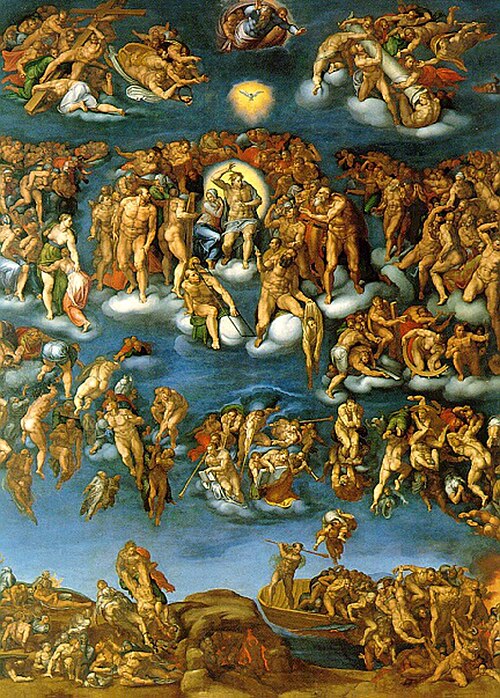
That is the paradox of Michelangelo’s Last Judgment. Christians commissioned it. Christians praised it. Christians attacked it. Christians censored it. Later Christians partially restored it, but still kept some of the censorship in place. If we want a single artwork that captures the Christian fight over nude sacred art, this is probably the clearest example.
Michelangelo painted The Last Judgment on the altar wall of the Sistine Chapel between 1536 and 1541. The Vatican Museums describe the fresco as centered on Christ at the moment before the verdict of judgment, with the resurrected recovering their bodies and the damned being drawn toward hell. This is not nudity placed in a sacred space as decoration or provocation. It is the body placed at the heart of Christian eschatology, the doctrine of the last things: resurrection, judgment, heaven, hell, glory, and damnation.
That is why Michelangelo used so many nude bodies. The Last Judgment is about bodily resurrection. Humanity stands before Christ without the costumes of worldly life. Rank, wealth, office, reputation, and social performance fall away. The body is not incidental to the scene. It is part of the theology. The dead are raised. The saved are drawn upward. The damned are pulled downward. The whole person, embodied and unhidden, stands before divine truth.
But the same theological power that made the fresco so striking also made it controversial. The Vatican Museums note that the work provoked strong reactions among Michelangelo’s contemporaries, including Biagio da Cesena, the papal Master of Ceremonies, who objected that so many nude figures were unfitting for the Pope’s chapel. His concern was not only nudity in the abstract. It was sacred decorum. A papal chapel, in his view, required a kind of visual fittingness that Michelangelo’s bodies violated.
The Council of Trent helps explain the later climate. Trent did not reject sacred images. It defended their proper use. But it also warned that abuses should be removed, that “all lasciviousness” should be avoided, and that figures should not be painted or adorned with a beauty that excites lust. It also said that nothing profane or indecorous should appear in sacred settings, because holiness befits the house of God.
Then came the coverings. In 1564, figures in the Last Judgment judged “obscene” were ordered covered. Daniele da Volterra was assigned to paint draperies over them, which earned him the nickname Il Braghettone, the “breeches maker.” The Vatican Museums note that Daniele’s additions were only the first, with more coverings added in later centuries. Some changes went beyond adding drapery. The figures of Saint Catherine and Saint Blaise were not merely given “breeches,” but substantially repainted, a point also noted by Casa Buonarroti in its discussion of copies after Michelangelo’s Last Judgment.
The controversy proves that the Christian tradition does not give us a simplistic answer to nude art. The same tradition that commissioned the fresco also censored it. The same Church that could see theological grandeur in the resurrected body could also fear that the visible body might become indecorous, distracting, or spiritually dangerous. The question was not simply whether the body could mean. The question was whether it was being received rightly in that place, by those viewers, within that sacred setting.
The later restoration adds one more layer. Some later additions were removed during modern restoration, but the earliest post-Tridentine changes were left in place. That decision itself becomes symbolic. The restored fresco is neither completely returned to Michelangelo’s original vision nor left entirely in its censored state. It bears the marks of both artistic daring and ecclesial caution. It is, quite literally, a wall where the Christian argument over the body remains visible.
So was the problem the body itself, or the fear that the body was being received in the wrong way? That question is the heart of discernment. Michelangelo’s Last Judgment does not allow us to say that nude sacred art is impossible. It exists on the altar wall of the Sistine Chapel. But its history also does not allow us to say that every use of the nude body in sacred art is beyond criticism. The fresco asks us to wrestle with beauty, judgment, resurrection, scandal, holiness, and the gaze. In that sense, the controversy is not a distraction from the meaning of the work. It has become part of the work’s meaning.
Protestant Concerns and Protestant Variety
Protestant Christianity complicates the story even further, because there is no single Protestant view of nude art. It is better to speak of Protestant instincts, Protestant anxieties, and Protestant recoveries. A Lutheran influenced by Cranach, a Reformed Christian shaped by Calvin, an Anglican formed by beauty and liturgy, an Evangelical shaped by revivalism, and a Puritan shaped by iconoclastic suspicion may all approach the body, art, and nudity very differently. The debate is not only about the body. It is also about images, worship, Scripture, modesty, temptation, and the moral power of beauty.
In that sense, Protestant concerns are more complex than a simple rejection of Catholic art. There is a tale of at least two views. One view begins with caution. It worries that images can distract from Scripture, become objects of devotion in unhealthy ways, stir lust, or pull the imagination away from the preached Word. John Calvin and much of the Reformed tradition expressed deep suspicion toward religious images, especially images used in worship. The concern was not merely aesthetic. It was theological. If God speaks through His Word, and if human beings are prone to idolatry, then images must be handled with great care.
Side Bar: Calvin is right to insist that God speaks through His Word. That is not a small point. Scripture must remain the plumb line, the measuring rod by which all other claims of divine communication are tested. But perhaps what Calvin missed, or at least what later Christians influenced by his caution have sometimes missed, is that God does not speak ‘only’ through the written Word. In Scripture itself, God speaks through creation, prophets, dreams, visions, angels, suffering, wisdom, beauty, silence, and ultimately through the Word made flesh. The written Word gives us the standard by which we discern these things, but it does not require us to deny that God can use visible, embodied, and artistic means to awaken truth, repentance, wonder, or worship. Art must be judged by Scripture, but that does not mean art cannot speak or that God does not use art to speak.
That concern intensified in Puritan settings. Puritans generally rejected religious imagery in churches, not merely nude imagery. Church interiors were stripped down, sometimes quite literally, into white walls, plain pulpits, and minimal ornamentation. There is almost a pun waiting there, but the historical reality is serious. For Puritans, sacred images could become idols, visual beauty could become a distraction, and the human body could become an occasion for lust. In that world, nude Adam and Eve, nude baptismal imagery, nude martyrs, Last Judgment frescoes, or a historically nude crucified Christ would have been almost unthinkable.
This is one of the reasons American Christians often inherit a stronger discomfort with nudity than some European Christians. The Puritan ethic shaped later American modesty instincts, not only in art but in ordinary life. Nudity, even in non-sexual contexts, was often treated as spiritually dangerous. The body was not necessarily denied as God’s creation, but in practice it was often approached as a constant temptation requiring strict regulation. That instinct still echoes in many churches today. Some Christians do not merely ask whether an image is dignified. They assume that bodily exposure itself is already the problem.
But Protestantism is not only Puritanism.
Lutheran Christianity gives a different example. Lucas Cranach the Elder, a close friend of Martin Luther, painted multiple images of Adam and Eve, including nude depictions of the first humans. These works did not disappear from Lutheran visual culture as if they were automatically indecent. A Lutheran theological instinct could affirm that pre Fall nudity signified innocence, that the body is God’s creation, and that shame comes from sin, not from skin. That is a very different anthropology from one that treats the unclothed body as inherently corrupting.
Lutherans also retained a strong visual focus on the real physical suffering of Christ. Lutheran altarpieces and Passion imagery often show Christ’s exposed torso, wounds, blood, weakness, and vulnerability. This was not seen as indecency, but as theology. The Incarnation means Christ took on real flesh. The Passion means that real flesh suffered. The Gospel is not served by making Christ’s body abstract, sanitized, or unreal. In this setting, the exposed body can teach the seriousness of sin and the depth of divine love.
Last Judgment imagery could also survive in Lutheran contexts. Nude resurrected bodies, exposed damned souls, demons, serpents, and bodily punishments might be understood not as erotic display, but as biblical and theological realism. Again, the body is not the sin. The body is the place where judgment, resurrection, and the consequences of sin are made visible. That does not remove the need for discernment, but it shows that Protestant art cannot be reduced to blanket hostility toward the nude form.
Later Protestants also retrieved art in more positive ways. Thinkers such as Francis Schaeffer, William Dyrness, Nicholas Wolterstorff, and others helped many Protestants recover a Christian theology of art, beauty, imagination, and cultural creation. They did not all say the same thing, and they did not erase older concerns about idolatry or misuse. But they helped show that art is not merely a distraction from truth. Art can be a way of perceiving, communicating, and inhabiting truth. It can train the imagination. It can teach us to see creation, fall, redemption, and glory with more than propositional clarity.
So Protestantism gives us both warning and permission. The warning is real: images can mislead, tempt, manipulate, sentimentalize, or distract. The permission is also real: the body is created good, Christ took on real flesh, art can teach the Gospel, and visual beauty can serve truth. Some Protestant traditions lean heavily into the warning. Others recover the permission. Many live in the tension.
That is why it would be unfair to say, “Protestants reject nude art.” Some did. Some did not. Some rejected sacred images altogether. Some retained biblical art. Some embraced the nude body as a sign of Edenic innocence, Christ’s suffering, human vulnerability, or resurrection judgment. Some later Protestants retrieved art as a form of spiritual and moral formation.
The deeper point is that Protestant disagreement often flows from deeper theological assumptions. What is the body? What did the Fall corrupt? Is the problem skin, or disordered desire? What is art for? Can images teach truth, or do they compete with Scripture? Can beauty serve devotion, or does it easily become temptation? Depending on how one answers those questions, nude art will appear either as a dangerous compromise or as a possible witness to creation, incarnation, and redemption.
And that brings us back to discernment. Protestant concerns should not be dismissed as mere prudishness. Some of them arise from serious theological commitments. But Protestant suspicion should also not become the final word, as if caution alone were wisdom. The Christian task is not simply to strip the walls bare or to fill them without restraint. The task is to ask whether what we place before the eyes forms the soul toward truth, reverence, dignity, repentance, mercy, and love.
Orthodox Concerns and the Discipline of the Icon
Orthodox Christianity gives us a different view of art altogether, one so important that disputes over images helped divide and define the Christian world. The iconoclastic controversy was not a minor argument about decoration. It was a major theological struggle over whether sacred images were faithful to Christian worship or a dangerous form of idolatry. The Orthodox answer, eventually affirmed at the Seventh Ecumenical Council, Nicaea II in 787, was rooted in the Incarnation. If the invisible God has become visible in Christ, then Christ can be depicted. The Word became flesh. Therefore, the visible flesh of Christ matters.
But Orthodoxy’s defense of icons should not be confused with a general approval of all religious art. Icons are not optional decorations in Orthodoxy. They are theology in color. They are windows into heaven, tools of spiritual formation, expressions of the Incarnation, and, in Orthodox understanding, participations in divine reality through the persons and mysteries they depict. Orthodox Christians do not merely “look at” icons the way one might look at a museum painting. They pray with them. They venerate them, not as idols, but as images whose honor passes to the prototype, the holy reality represented.
This is why Orthodox iconography is connected to theosis, the lifelong transformation of the believer into the likeness of Christ. Theosis does not mean becoming God by nature. It means participation in the life of God by grace. Icons belong to that whole spiritual ecosystem. They train the eyes to see holiness. They train the imagination toward virtue. They form humility and reverence. They draw the heart toward prayer. They remind the believer that the saints are not merely figures from the past, but living members of the communion of saints.
That means icons are meant to form the believer. They shape the imagination, the emotions, the moral sense, the understanding of Christ, the awareness of the saints, and the sense of sacred time. This is why Orthodox churches are often covered in icons. The worshiper enters a visual world ordered toward prayer. The building itself becomes a sacred environment that constantly teaches the eyes where they are and who surrounds them. The goal is not entertainment, self-expression, or artistic novelty. The goal is formation in holiness. I almost want to call them theological infographics.
This also explains why Orthodox icons are not realistic in the same way Renaissance art is realistic. Icons intentionally avoid sensuality, dramatic emotion, deep naturalistic perspective, heavy shadows, and excessive bodily realism. They are not trying to show earthly reality as the eye ordinarily sees it. They are trying to show transfigured reality, the world as seen in the light of the Kingdom of God. This is why the bodies in icons are often elongated, stylized, luminous, restrained, and prayerful. The body is affirmed, but the style is disciplined.
In that sense, Orthodoxy is not anti-body and not anti-image. It is resistant to sensual or overly naturalistic sacred art. The concern is not that the human body is evil. The concern is that the gaze can become distracted, possessive, or merely sensual. Iconography tries to protect the viewer from that kind of seeing. Adam and Eve may be shown in ways that emphasize lost glory or garments of light. Christ is not typically depicted nude. Martyrs are shown modestly even when their historical suffering involved stripping or bodily exposure. Judgment scenes tend to avoid the graphic bodily naturalism found in some Western medieval and Renaissance art. The point is not to deny the body, but to show the body as transfigured by holiness.
Orthodox iconographers often say they “write” an icon rather than simply paint one. That language is important. The icon is not primarily self-expression. It is obedience. It follows inherited patterns, canonical rules, prayer, fasting, and theological discipline. The iconographer does not stand above the tradition as a lone genius inventing a private vision. The iconographer submits to the Church’s visual language so that the image may communicate faithfully. In this sense, the icon is almost Scripture in color, not because it replaces Scripture, but because it visually bears witness to the same holy reality.
I do not claim to understand fully what happens spiritually when someone prays with icons or uses them in meditation. But I do know, and have argued elsewhere, that images affect us psychologically. They shape attention, memory, emotion, desire, and imagination. Paul speaks of the renewing of the mind, and it seems reasonable to say that part of spiritual formation involves psychological change ordered toward God. If what we behold shapes us, then a tradition that carefully limits sacred art to images meant to enlighten, purify, and direct the heart toward God has real wisdom in it.
At the same time, I wonder whether the Orthodox approach may sometimes limit artistic interpretation further than necessary. There is something beautiful about obedience, restraint, and continuity. There is also something beautiful about artistic exploration, emotional range, and the ability of art to surprise us with meanings we did not expect. Orthodoxy gives us a powerful warning against sensual naturalism and undisciplined religious art. But perhaps the wider Christian tradition also needs room for artworks that communicate truth through drama, vulnerability, suffering, and even bodily exposure, when that exposure honors dignity and forms the viewer rightly.
So the Orthodox contribution to this conversation is not a simple rejection of nude art. It is a disciplined theology of seeing. The body is good, but the gaze must be purified. Images are powerful, but that power must be ordered toward prayer. Art can form the soul, but not every artistic freedom serves holiness. The icon asks a question that every Christian tradition should take seriously: does this image lead the viewer toward communion with God, or does it leave the viewer at the level of surface appearance?
Pornography Versus Art
This is where the discussion finally has to name the obvious concern: pornography is not art simply because someone frames it, and nude art is not pornography simply because a body is visible. Discernment in this area can be easy in some cases and difficult in others. Sometimes, as Justice Potter Stewart famously said, “I know it when I see it.” We recognize immediately that an image is not inviting reverence, contemplation, pity, repentance, or wonder. It is inviting use. It presents the body as a means to an end.
That distinction matters. Pornography does not merely show the body. It reduces the person. It takes the visible body and detaches it from dignity, love, covenant, responsibility, and personhood. The body becomes material for consumption. The person disappears behind appetite. Christian art, at its best, does the opposite. It keeps the person present. It invites us to ask who this human being is before God. It asks us to see suffering, innocence, judgment, vulnerability, glory, or mortality. Pornography asks, “How can this body serve me?” Christian art asks, “What truth about the human person is being revealed here?”
Of course, the line is not always as obvious as we might like. American law has wrestled with this too. The Miller test asks, in part, whether a work lacks serious literary, artistic, political, or scientific value. That is not the same as Christian moral discernment, but it does recognize something important: context and meaning matter. A nude figure in a Last Judgment fresco, a medical textbook, a Renaissance sculpture, a baptismal image, or an exploitative advertisement should not be treated as if all are doing the same thing simply because the body is visible.
This is why both artist intention and viewer reception matter. An artist may intend reverence, but a viewer may receive the image with lust. An artist may intend moral seriousness, but a viewer may become fascinated by suffering or shame. On the other hand, an artist may intend provocation, use, or sensual stimulation, even while hiding behind the language of “art.” Discernment has to look in both directions. What is the image trying to do? And what is it doing in me?
This is also why the debate never fully ends. Images are not mathematical equations. They are symbolic, emotional, contextual, and received differently by different people. One viewer may look at Michelangelo’s David and see faithful vulnerability, courage, and dependence on God. Another may see only an idealized body. One viewer may look at a crucifixion scene and see divine love entering human humiliation. Another may be disturbed by the exposed suffering. A third may misuse the image entirely. The fact that an image can be misused does not prove that the image is corrupt. It may reveal that the gaze needs formation.
This is especially important in a culture saturated with pornography. Decades ago, people joked that adolescent boys could be stirred by lingerie pages in department store catalogs. Perhaps some were. Human desire is powerful, and youth can be easily awakened. But that does not mean every underwear advertisement was pornography in the same sense as what is now instantly available online. The internet has changed the scale, intensity, accessibility, and formative power of sexualized images. We should not be naïve about that. Pornography trains the gaze. It disciplines people into use. It makes it harder to see bodies innocently, reverently, or truthfully.
But that is precisely why Christians need deeper formation, not merely stricter avoidance. If pornography has trained the eye to consume, then Christian discipleship must retrain the eye to honor. We cannot blame everybody for the lust of the viewer. We cannot treat every image as guilty because some viewers have been wounded, tempted, or malformed by a pornographic culture. Sometimes the problem is not the body. Sometimes it is not even the artwork. Sometimes the problem is what we have been trained to do with what we see.
Still, this does not give art a free pass. Some images really do degrade the human person. Some images use religious language as a cover for sensual indulgence. Some images blur beauty and possession in ways that are spiritually dangerous. Some images make the body available rather than meaningful. In those cases, concern is not prudishness. It is moral clarity.
So again, the question is not simply nude versus clothed. It is dignity versus degradation. What does the image do to the dignity of the human body and person? What feelings does it raise in me? Does it move me toward lust, contempt, envy, or use? Or does it move me toward reverence, mercy, gratitude, repentance, courage, or wonder? Does it preserve the unity of body and person, or does it separate the two?
Pornography and Christian art are not separated merely by how much skin is visible. They are separated by what kind of seeing they cultivate. One trains the gaze to consume. The other, at its best, trains the gaze to behold.
Modern Oversexualization and the Fear of Nudity
Modern Christians are not approaching this subject from a neutral place. We live in a culture where the human body is often displayed, edited, sold, ranked, mocked, eroticized, and consumed. Advertising uses the body to sell products. Entertainment uses the body to hold attention. Social media turns the body into a performance. Pornography turns the body into a tool for gratification. So when many Christians feel immediate anxiety around nudity, we should not treat that concern as foolish. The concern comes from living in a world that has trained us badly.
But here is the counterintuitive point: when nudity appears almost exclusively in sexualized settings, people learn to sexualize nudity automatically.
That does not mean every person responds the same way. It does not mean innocent nudity magically fixes disordered desire. It does not mean everyone should seek out nude settings as some kind of spiritual exercise. But it does mean our cultural conditioning matters. If the only time a person sees an unclothed body is in pornography, sexualized advertising, or entertainment designed to provoke desire, then the mind begins to associate nudity with sexual availability. That association then feels natural, even though it has been trained.
In that sense, fear of nudity can sometimes intensify the very problem it claims to solve. If the body is always hidden except when it is sexualized, then nudity becomes charged with forbidden meaning. It becomes exotic, dangerous, and automatically erotic. The result is not necessarily greater purity. Sometimes the result is a more fragile imagination, one that cannot imagine the body except through the lens of lust, shame, or danger.
This is where nonsexual contexts matter. Seeing the body in ordinary, nonsexual, dignified settings can challenge the assumption that nakedness must always mean erotic availability. Medical settings do this in one way. Classical art can do this in another. Baptismal imagery, crucifixion art, martyrdom scenes, and resurrection imagery can do it theologically. Naturist settings, when healthy and rightly ordered, claim to do it socially by placing nudity in a context of ordinary human presence rather than performance or consumption. I will not develop that argument fully here, because others, including Philip Oak, have explored this more directly. For our purposes, the point is simply that context can train the gaze and we can see the human form rightly.
Research on pornography also reminds us that culture and access matter. The International Sex Survey, a large cross national study, found that risk estimates for problematic pornography use varied across 42 countries and differed by gender, sexual orientation, and the measurement tool used. That does not prove a simple cause and effect between cultural modesty and pornography problems, but it does show that pornography use and problematic use are shaped by broader social, cultural, and personal factors.
Other cross cultural work using Pornhub traffic data found that patterns of pornography use vary by age, gender, human development, gender inequality, attitudes toward sexual minorities, and internet access. It also warned that internet pornography may function as de facto sex education in many cultures, especially where healthier forms of education and formation are absent.
That last point is important. Pornography does not merely satisfy desire. It teaches. It trains expectations. It shapes what people think bodies are for, what sex is for, what power is for, and what other persons are for. In many places, the internet has become a secret catechist of the body, and it is a terrible one. It teaches use without love, exposure without dignity, pleasure without responsibility, and bodies without persons. Of course, what pornography teaches is not the Christian worldview or theology of the body.
So the Christian answer cannot be merely, “Avoid all nudity.” That may protect someone in the short term from certain temptations, and for some people that boundary may be wise or necessary. But as a larger theology of the body, it is incomplete. Avoidance does not necessarily heal the gaze. It may only leave the pornographic imagination unchallenged, waiting beneath the surface.
At the same time, the opposite mistake would be to say that nonsexual nudity automatically retrains everyone’s mind. It does not. People carry histories, wounds, habits, addictions, cultural conditioning, and personal vulnerabilities. Some people may not be able to see nude bodies without sexualizing them, at least not yet. Some settings are not healthy. Some communities are not safe. Some claims of “innocent nudity” are naïve or dishonest. Discernment remains necessary.
If Christians want to resist modern oversexualization, we need more than fear. We need a renewed theology of the body, a disciplined gaze, and forms of formation that teach us to see persons rather than objects. Christian art can help because it places the body inside larger meanings: creation, innocence, suffering, humiliation, baptism, judgment, resurrection, and glory. It reminds us that the body can mean more than sex.
That may be one of the reasons this whole discussion matters for Christian naturism. The question is not whether all Christians must become naturists. They need not. The question is whether Christians can recover a way of seeing the unadorned body that is not immediately ruled by lust, shame, fear, or disgust. If the answer is no, then pornography and oversexualization have already discipled our imagination more deeply than we want to admit.
But if the answer is yes, then perhaps part of Christian formation is learning, slowly and wisely, that the body is not a product, not a performance, not a trap, and not a toy. The body is the visible presence of a person. And the person is made for dignity, love, and God.
Idealization and Body Shame
Pornography is not the only modern problem in how we see the body. That may sound strange after spending so much time distinguishing art from pornography, but it is important. Lust is not the only way the body can be degraded. Sometimes the greater danger is shame. Sometimes the image does not train the viewer to desire another person wrongly, but to despise themselves quietly. A nude body in art can dignify the human person, but it can also establish an ideal that ordinary viewers begin to measure themselves against and fail.
This is not only a problem with nude art. It is everywhere in the modern visual world. Advertising, magazines, film, fitness culture, and social media repeatedly place idealized bodies before us: thin bodies, muscular bodies, young bodies, flawless bodies, edited bodies, airbrushed bodies, bodies shaped by lighting, filters, surgery, performance, and careful selection. Over time, these images can quietly redefine what “normal” looks like. The viewer begins to think the exception is the standard.
Modern psychology gives us reason to take this seriously. Research on body image consistently points to a pattern in which idealized images encourage social comparison, internalization of beauty standards, body dissatisfaction, and body shame. A 2022 review in Frontiers in Psychology discusses body shame, positive body image, and self-compassion as central issues in body image distress, while another 2022 review notes that repeated exposure to thin or muscular bodies in media can make those bodies seem like standards to aspire to.
That matters for Christian reflection because shame is not holiness. Shame may imitate conviction for a while, but it does not produce love. A person who looks at their own body with contempt has not necessarily become more spiritual. They may simply have internalized a false canon of beauty. They may have learned to see themselves through the eyes of comparison rather than through the eyes of God.
This is where the dignity test becomes even more important. We should ask not only whether an image provokes lust, but whether it provokes despair. Does this image help me see the human body as God’s workmanship, or does it teach me that only certain bodies are worthy of honor? Does it enlarge my capacity for reverence, or does it narrow beauty into one approved form? Does it make room for the ordinary body, the aging body, the scarred body, the disabled body, the larger body, the thin body, the weak body, and the body that does not fit cultural ideals?
Some classical and Renaissance art can raise this issue too. The heroic nude may communicate strength, courage, beauty, or theological grandeur. Michelangelo’s David can, for me, become a profound image of faithful vulnerability and participation in God’s work. But it is also an idealized body. That does not make the work bad. It simply means we must know how to read it. We should not confuse symbolic beauty with the standard every human body must meet. David can point us toward courage without becoming a measuring stick for our waistline, muscle tone, or youth.
The same is true in modern media, only the pressure is more constant and more personalized. Social media intensifies comparison because the images are not only distant works in a museum. They are in our pockets. They are repeated daily. They are filtered through algorithms. They arrive with likes, comments, metrics, and silent social judgment. Recent work continues to connect social appearance comparison and internalized appearance ideals with body dissatisfaction, especially in younger people.
The Church should have been leading here. A bold and unapologetic theology of the body should have taught us that human dignity is not earned by matching an aesthetic ideal. We are embodied image bearers before we are attractive, fit, fashionable, thin, muscular, young, or socially approved. The body is not valuable because it meets the standard of the age. It is valuable because the person is valuable.
At the same time, this cannot become another form of denial. Some bodily conditions do have real health implications. It is not loving to pretend otherwise. But neither is it loving to stigmatize people, mock bodies, or treat health as a moral ranking system. We need a difficult middle path: truth without contempt, compassion without denial, encouragement without shame, and dignity without pretending every condition is equally healthy. That is not easy. But Christian love is rarely the easy thing.
Advertisers and media companies have begun responding to body shame concerns by diversifying the kinds of bodies they show. That can be good, at least when it is not merely another marketing strategy. But the Church should go deeper than representation. The Church should teach people how to see. It should teach that everybody is not an idol to worship, a project to perfect, or a product to display. It should teach that the body is part of the person, and the person is made for communion with God.
So yes, nude art can be misused by lust. But nude or idealized art can also be misused by comparison. The worst danger in some images may not be erotic temptation, but the quiet formation of inadequacy. Why is that body the ideal? Who decided? What does repeated idealization do to ordinary viewers? What happens when beauty becomes so narrow that most people experience their own bodies as failures?
A complete theology of the body goes beyond nudity in art or naturist practice. It must also speak to shame, comparison, health, disability, aging, beauty, weakness, and the ordinary embodied life most of us actually live. The Christian answer cannot be pornography on one side and impossible perfection on the other. It must be dignity. It must be truth. It must be love.
The body is not a mistake because it is not ideal. The body is not worthless because it is not perfect. The body is the visible presence of a person God made, Christ entered, and grace intends to redeem.
Conclusion: The Final Christian Answer Is Discernment
So what is the final Christian answer to nude art? It depends.
That may feel unsatisfying at first, but I think it is the most honest answer. Nudity in art can serve wholesome, truthful, and spiritually formative purposes. It can reveal innocence, vulnerability, suffering, humility, judgment, repentance, mortality, and resurrection hope. It can help us contemplate the body as God’s workmanship, the Incarnation as God’s embrace of embodied life, and the resurrection as the promise that the body is not disposable. It can teach us to see the human person with reverence.
But nudity in art can also degrade, exploit, sensationalize, distort, or train the viewer toward use. Some art may claim to be serious while quietly inviting consumption. Some religious art may fail the dignity test. Some hell imagery may become spectacle. Some idealized bodies may stir less lust than shame, comparison, and inadequacy. Some viewers may bring a gaze so shaped by pornography, fear, vanity, or wounded desire that even a dignified image becomes distorted in reception.
That is why the answer cannot be reflexive approval or reflexive condemnation. The answer is discernment.
I hope this short sub-series has made clear why different Christians, different traditions, and even the same tradition at different times have answered these questions differently. Catholic debates over decorum and censorship, Protestant concerns over images and temptation, Orthodox discipline of the icon, modern anxieties over pornography, and current concerns over body shame all show that Christians have never dealt with the visible body in only one way. We have wrestled with it for nearly two millennia. We are still wrestling.
And perhaps that is not failure. Perhaps that is part of faithful life in a fallen world.
A Christian discernment grid for nude art might begin with questions like these:
- Does this image honor the dignity of the human person?
- What does the nudity mean in this context?
- What kind of gaze does the work invite?
- Does it tell the truth about the body, or distort it?
- Is the likely effect reverence, contemplation, pity, repentance, mercy, or degradation?
Those questions do not make every case easy, but they help us avoid lazy answers. They also help us remember that the issue is not merely whether the body is covered or uncovered. A clothed body can be degraded. A nude body can be honored. The decisive question is whether the person remains visible as a bearer of immeasurable worth before God.
“False brothers secretly brought in, who slipped in to spy out our freedom that we have in Christ Jesus, so that they might bring us into slavery.” – Galatians 2:4
Some will always be tempted to spy out another Christian’s freedom in Christ and demand conformity to their own version of piety. Some may insist they are more spiritual because they reject all nude art, refuse even to consider the question, or treat discomfort as proof of righteousness. But discomfort is not the same as discernment. Fear is not the same as holiness. And strictness is not always the same as wisdom.
At the same time, Christian freedom is not permission to be careless. Freedom must be ordered by love. If a work degrades the person, trains the viewer toward lust, exploits suffering, or damages the conscience, then we should have the courage to reject it. But if an image honors the human person, tells the truth about embodied life, and forms the viewer toward reverence, mercy, repentance, or hope, then we should not reject it merely because the body is visible.
So test all things by Scripture. Pray for discernment. Listen to the Holy Spirit. Pay attention to your own gaze. Be honest about your weaknesses. Be charitable toward Christians who draw the line differently. And do not make this a reason for division in the Church.
We may always wrestle with the body, beauty, modesty, and art.
Such is life east of Eden.
But if the Christian story is true, then the body is not merely a danger to be managed. It is part of creation, part of the Incarnation, part of the Passion, part of resurrection hope, and part of the mystery of what God intends to redeem.
Excerpt
Christians have never agreed simply about nude art. Some defended it, others censored it, and many wrestled with its risks. This post argues that the answer is not reflexive approval or condemnation, but discernment ordered by dignity, truth, spiritual formation, and love.
“Et tu, Brute?”

 Treasures of the Elysian Fields
Leave a comment