
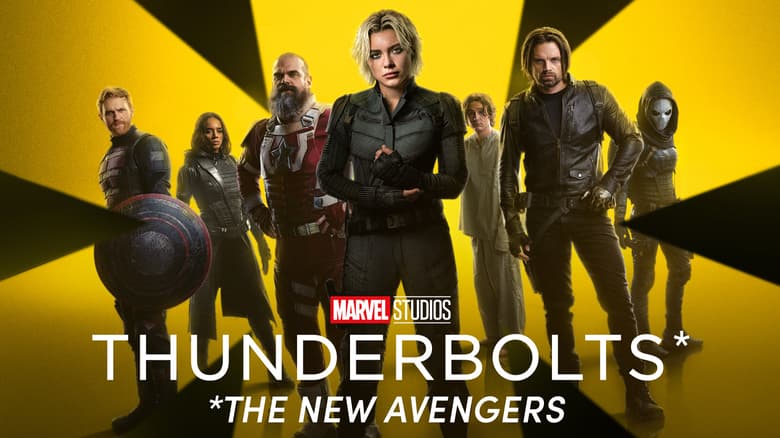
I wanted to write a few thoughts about Thunderbolts* and what stood out to me while watching it. Of course, I said something similar when I started writing about Moana. That draft began at about four paragraphs, and the more I thought about the movie, the more I found buried beneath the surface. We all know how that turned out.
So I am going to try to exercise some restraint here. There are really only two things I want to explore about Thunderbolts*: the psychology of the movie and what I think may be an even deeper spiritual dimension running alongside it. I am certainly not the first person to notice the movie’s psychological themes. In fact, after watching it and then looking at what the filmmakers and other reviewers have said, I discovered that much of what caught my attention was quite intentional.
The Psychology of the Void
The first thing that struck me was just how much Thunderbolts* is about psychology. Yes, it is a Marvel movie with assassins, super soldiers, explosions, impossible powers, and the usual collection of people who probably should not be trusted with heavy machinery. Underneath all of that, however, is a surprisingly serious story about loneliness, depression, shame, isolation, identity, and the loss of meaning and purpose.
Yelena establishes that theme almost immediately. At the beginning of the movie, she describes the emptiness she has been experiencing. She is still working. She is still functioning. She can still jump off absurdly tall buildings, which apparently is one way to start a Marvel movie, but something inside her has gone dim. She is going through the motions without really knowing why she is doing any of it.
Her father figure, Alexei, sees it too. In one of my favorite lines, he tells her, “Your light is dim, even by Eastern European standards.” Later, after she has begun working with the others, he tells her that whatever they are, “the light inside you is brighter.” The joke works because it sounds exactly like something Alexei would say, but underneath the humor is an important observation about Yelena’s psychological condition. Something has changed.
The change is not that Yelena suddenly has everything figured out. She has not completed a twelve step program for existential crises somewhere between action scenes. She has not discovered the complete meaning and purpose of her life. What has changed is much smaller, and perhaps much more realistic: she is no longer completely alone.
Yelena begins the movie operating almost entirely as an isolated individual. Then Valentina sends her into what is essentially a kill room, where the people inside are supposed to eliminate one another and ultimately be eliminated themselves. Instead, something unexpected happens. These discarded people begin cooperating. They survive precisely because they stop acting entirely as isolated individuals.
That movement from isolation toward relationship seems to be one of the organizing ideas of the film. Joanna Calo, one of the film’s writers, later told Marvel that the movie is fundamentally about connection among these characters. Speaking specifically about Yelena, Alexei, Bob, and the others, she summarized the idea rather succinctly: “connection is the way out.”
That makes Alexei’s second observation about Yelena’s light especially significant. She is not suddenly cheerful, healed, or transformed into a psychologically well-adjusted Avenger. Heaven forbid Marvel ever gives us one of those. Her light is simply brighter because something has begun changing in the way she relates to the people around her.
Then there is Bob.
Bob takes the same psychological themes and turns them into something visually concrete. The darkness that Yelena describes metaphorically becomes literal in him. Bob carries the Void, and eventually the internal darkness becomes external. His despair, shame, fear, trauma, and isolation are no longer merely psychological experiences. This is a superhero movie, after all, so naturally somebody’s depression eventually has to start swallowing Manhattan.
That interpretation is not something reviewers have simply projected onto the film. Director Jake Schreier has discussed depression as central to Bob’s story and explained that he drew upon the experiences of a close friend who struggles with it. Schreier was particularly concerned that the movie not suggest that depression can simply be defeated once and for all. His point was more modest and, I think, much wiser: the burden may remain, but we can learn to bear it with other people.
Other reviewers have noticed essentially the same thing. Variety described the film as an allegory about confronting personal trauma and working through mental illness together, while a Psychology Today analysis focused specifically on the connection between shame, isolation, trauma, and the team’s willingness to enter the Void together.
That brings us to what may be the most important psychological moment in the movie. Bob does not finally overcome the Void because someone finds an even larger laser, throws a harder punch, or discovers the Void’s conveniently placed thermal exhaust port. In fact, greater violence is not the answer at all. Yelena goes into the darkness after him. Then the others follow her. They enter Bob’s darkness rather than abandoning him inside it.
That is a remarkably different resolution for a superhero movie. The final confrontation is not ultimately about defeating another person. It is about reaching one. Bob needs someone willing to enter the place where he is trapped and remind him that he is not alone.
Even the movie’s little jabs about phones and doomscrolling fit into this larger picture. I laughed when the subject came up because normally I am not a fan of movies stopping everything to deliver a public service announcement about whatever social problem the writers have decided we need to contemplate. Thunderbolts* largely avoids that. The comments about staring at our phones are woven casually into Yelena’s larger description of what her life has become: working, remembering terrible things, staring at her phone, and continuing the cycle.
Compare that with the second season of Star Trek: Picard, when the story traveled back in time to Los Angeles. Oh my goodness, that season was so overtly preachy that at times the social commentary seemed to overwhelm the science fiction. The irony is that Star Trek, like most good science fiction, has always been social commentary. Science fiction gives us a laboratory in which we can examine racism, war, authoritarianism, technology, inequality, prejudice, and countless other human problems from a safe distance. The difference is in how you do it. When the message becomes so obvious that the audience feels as though the story has stopped and an influence campaign has begun, people can become defensive and tune it out. Thunderbolts* handles its message much better. It lets the themes emerge from the characters and the story rather than repeatedly reminding us what we are supposed to think.
In Thunderbolts* the phone is not really the problem the movie is describing. It is part of a pattern of isolation and rumination. Rumination is the psychological tendency to repeatedly dwell on distressing thoughts, failures, or experiences without moving toward a resolution. One psychological commentary on the film similarly connected Yelena’s phone use with the broader existential malaise depicted in her character.
The movie therefore does not need a separate sermon on doomscrolling. Loneliness, endless scrolling, shame, despair, loss of meaning, rumination, and isolation can reinforce one another. The point is made without beating us over the head with it, which is usually a good way to get me to actually listen to a point.
Seen this way, the “light,” the Void, Yelena’s loneliness, Bob’s despair, doomscrolling, and the gradual formation of this rather dysfunctional little community are not separate ideas. They are different parts of the same psychological story. Thunderbolts* asks what happens when people become trapped alone with the worst things they believe about themselves, and then asks what might begin to happen when they no longer have to face those things alone.
More Than Psychology: A Spiritual Dimension
That brings me to the second thing I saw in the movie, and this one probably says as much about what I have been reading and thinking about lately as it does about what Marvel consciously intended. I think Thunderbolts* works remarkably well as a modern parable with some deep spiritual connections. I am not suggesting that Marvel secretly slipped a Christian theology lesson into the MCU. I am saying that the questions raised by the story intersect with some very old Christian questions about identity, meaning, purpose, relationship, communion, and what it means to become the person we were created to be.
The timing was particularly interesting for me because my men’s group has been reading Jamie Winship’s Living Fearless. One of the ideas we have been discussing is the relationship between identity and the way we live. If I accept a false identity formed from fear, shame, trauma, failure, or other people’s judgments about me, that identity begins shaping my behavior. I begin living according to what I believe myself to be.
That is almost a description of the Thunderbolts themselves. Yelena could allow “assassin” to become the final definition of who she is. John Walker could allow his failures as Captain America to define him permanently. Alexei could disappear into the story of the hero he once believed himself to be. Bob could accept the belief that he is dangerous, broken, worthless, or perhaps even better off not existing. Their pasts contain real failures, and the movie does not need to pretend otherwise, but there is an important difference between acknowledging what I have done and deciding that what I have done is the total definition of who I am.
Interestingly, this connection to identity was also recognized by the actors themselves. Before the film was released, David Harbour described the story as dealing with mental illness and self-hatred, but he also said the characters must overcome these things in themselves in order to “unlock who they really are as people.” That comes remarkably close to the distinction I have been thinking about between a false identity and a true one.
This is where psychology starts touching spirituality for me. The question is no longer merely, “How do I feel better?” It becomes, “Who am I?” And closely connected to that comes another question: “What am I here for?” Identity, meaning, and purpose are intertwined. If I misunderstand who I am, it should not surprise me if I also struggle to understand what I am supposed to be doing.
This also connects with another theological idea I have been exploring for some time, something I have come to call “Dancing with God.” It draws on several closely related ways Christians have described our participation in the life of God, including the Eastern Orthodox doctrine of theosis, the Reformed emphasis on union with Christ, and James D. Gifford Jr.’s concept of perichoretic salvation. These traditions are not identical, but they considerably overlap in seeing salvation as more than forgiveness or merely a change in legal status. Salvation is also relational and participatory. We are drawn into communion with God, transformed through that relationship, and from there learn to live in rightly ordered relationships with others.
Christianity, seen through this lens, is not merely about knowing the correct propositions or following the correct rules, important as truth and obedience certainly are. It is about participation in the life of God. Paul’s words in Acts 17:28 come immediately to mind: “For in him we live and move and have our being.” Our identity and our purpose ultimately make sense in relationship to the One in whom we live, move, and have our being.
Perhaps that is why the ending of Thunderbolts* resonated with me so strongly. Bob does not escape the Void because he finally becomes powerful enough to destroy it. Yelena enters the darkness with him, and then the others enter as well. Psychologically, that is a powerful picture of support, connection, and refusing to abandon someone in despair. Spiritually, I think it points toward something even deeper about the relational nature of human beings.
We grow in relationship. We discover much of who we are in relationship. We find purpose through relationships in which we love, serve, create, protect, teach, encourage, and contribute to the lives of others. Christianity goes further still and says that our deepest identity is relational because we were created by God, for communion with God, and for communion with one another.
This does not mean other people can simply fix us. The movie itself is more intelligent than that, and Schreier has explicitly rejected the idea that Bob’s depression is simply cured at the end. Christian theology should resist that simplistic conclusion as well. Communion is not magic, and relationships do not erase trauma, depression, guilt, or the consequences of our actions. But isolation is fertile soil for lies about who we are, while healthy relationship gives those lies somewhere to be challenged.
“Walk with the wise and become wise, for a companion of fools suffers harm.” – Proverbs 13:20 (NIV)
The Void says, in effect, that you are alone, that your failures define you, that nothing will change, that you have nothing meaningful to contribute, and that no one can reach you. Relationship challenges those claims by entering the darkness and remaining there with you. Christian faith adds another dimension by insisting that our identity is not finally determined by our failures, our fears, our shame, our accomplishments, or even the judgments of other people. Our deepest identity begins in relationship with God.
That is where the movie’s psychological and spiritual dimensions finally come together for me. Psychologically, Thunderbolts* is about people discovering that isolation makes their darkness worse and that connection can help them begin moving out of it. Spiritually, it reminds me that human beings were never designed to exist as isolated selves in the first place. We were made for relationship, for participation, for service, for love, and ultimately for communion.
Maybe that is what Alexei sees when he notices that Yelena’s light is brighter. She has not solved herself, and she certainly has not solved the strange collection of damaged people now standing around her. But she has begun to belong to something beyond herself, and that has started changing her. The opposite of the Void, then, may not simply be happiness or even psychological health. Perhaps the deeper opposite of the Void is communion, because the darkness loses some of its power when we discover that we were never meant to face it alone.
References
- Brinen, A. (2025, May 4). Thunderbolts: Marvel’s allegory of recovery from trauma. Psychology Today. https://www.psychologytoday.com/us/blog/beyond-symptoms/202505/thunderbolts-marvels-allegory-of-recovery-from-trauma
- Bucksbaum, S. (2024, July 30). Florence Pugh teases “bizarre but pure” father-daughter relationship in Marvel’s Thunderbolts. Entertainment Weekly. https://ew.com/marvels-thunderbolts-florence-pugh-david-harbour-tease-father-daughter-relationship-exclusive-8685712
- Gifford, J. D., Jr. (2011). Perichoretic salvation: The believer’s union with Christ as a third type of perichoresis. Wipf and Stock.
- Gleiberman, O. (2025, April 29). Thunderbolts review: That mysterious asterisk masks the real reason to watch these six Marvel rejects. Variety. https://variety.com/2025/film/reviews/thunderbolts-review-marvel-the-new-avengers-1236381303/
- Marvel. (2025, June 2). Thunderbolts writer Joanna Calo talks Bucky’s congressional run: “People would vote for him!” https://www.marvel.com/articles/movies/marvel-studios-thunderbolts-joanna-calo-interview
- Next Level Psychology. (2025, May 27). The Thunderbolts and the gifts of imperfection. Substack. https://psychfox.substack.com/p/the-thunderbolts-and-the-gifts-of
- The Credits. (2025, May 2). Thunderbolts director Jake Schreier: From Beef’s parking lot rage to superhero trauma. Motion Picture Association. https://www.motionpictures.org/2025/05/thunderbolts-director-jake-schreier-from-beefs-parking-lot-rage-to-superhero-trauma/
- Winship, J. (2022). Living fearless: Exchanging the lies of the world for the liberating truth of God. Revell.
Excerpt
Thunderbolts* is more than a superhero movie. Beneath the action is a thoughtful exploration of loneliness, identity, depression, purpose, and relationship. Its psychological themes also open the door to deeper spiritual reflection on communion, true identity, and why we were never meant to face the darkness alone.
Veritas Lux Mea


Leave a Reply