
Intro
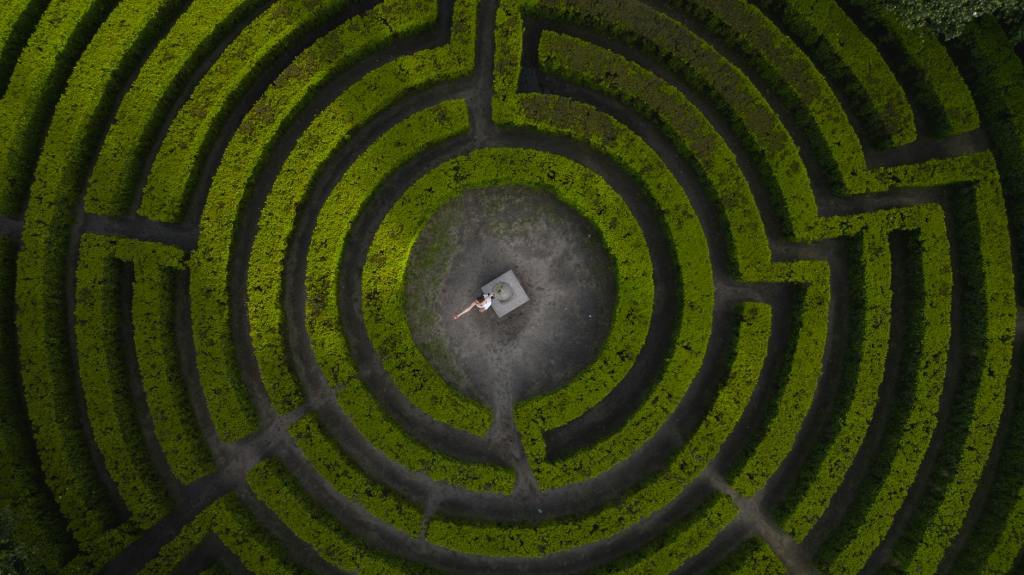
Every fall, when the corn mazes start appearing, I am drawn to the harder ones. The children’s mazes are fine for what they are. They are gentle, forgiving, and almost eager to let you win. Keep walking long enough and you will usually find your way out. The dead ends are short. The choices are not especially costly. You can often see the mistake before you have fully committed to it. But the real mazes, the ones meant for adults or at least for the stubborn, are something else entirely. Those are the ones I like best.
There is a peculiar pleasure in stepping into a maze that does not immediately yield itself. You see several paths at once. Some look broad and obvious. Some curve in a way that feels promising. Some even look worn enough that you think, surely this must be the way. Then you follow one for what feels like real progress, only to discover that it leads nowhere. So you turn around, retrace your steps, and try again. If you made the mistake of starting too close to closing time, you may discover that your confidence was more fragile than you thought. A good corn maze can keep you wandering for hours, and oddly enough, that is part of the charm.
What makes those harder mazes enjoyable is not the absence of frustration, but the right kind of frustration. The long corridors with branching choices are not there by accident. The dead ends are not signs of bad design. They are the design. They force you to remember where you have been. They make you test assumptions. They teach you that what looks like progress may only be distance, and that a path can feel right while being entirely wrong. Not every road leads to the prize. In fact, the road that seems most inviting may be the one that sends you deepest into the field and farthest from the exit.
That principle is not limited to mazes. Deception has long been part of strategy, whether in security, warfare, or games of mystery. Confusion can be used cruelly, of course, but it can also be used artfully. To mislead is not always to cheat. Sometimes it is to create the very conditions that make discovery satisfying. The point is not to leave a person in chaos forever. The point is to make them work, to make them observe, to make them correct themselves, and finally to make them earn their way through.
That is why a good mystery does not remove confusion. It disciplines confusion. It gives us false paths, dead ends, and red herrings, but it still provides enough structure, enough logic, and enough honest clues that the truth remains discoverable. Fair play means the designer may hide the answer, delay the answer, and disguise the answer, but must never make the answer arbitrary.
When Getting Lost Is Still Fair
Once you see that confusion can be part of good design, the next question is obvious. What makes that confusion fair rather than cheap? In mystery design, fair play means the player has a genuine chance to solve the puzzle with the information that has actually been provided. The clues may be subtle. They may be layered. They may require patience, memory, and a willingness to look twice. But they are there. The design may misdirect, but it does not lie.
That distinction matters more than it may seem at first. A fair play clue is one the player can really work with. It may not be easy, but it is visible, logical, and connected to the answer in a way that can be understood. A false lead is different. It looks meaningful and invites pursuit, but it does not ultimately carry the player to the solution. A red herring goes even further by deliberately pulling attention in the wrong direction. Misdirection is the broader art behind all of this. It is any design choice that draws the eye away from the true path without destroying the possibility of finding it. A blind alley is one of the simplest examples. It looks promising, perhaps even more promising than the right path, but it ends in a wall and forces a return.
I feel this difference very strongly in escape games. I do not mind difficulty. In fact, I usually want more of it. What I dislike is the moment when a game stops feeling difficult and starts feeling arbitrary. There are some puzzles where the next step depends on a leap no reasonable person could make. You are expected to scan a bar code on the box or do something so disconnected from the actual logic of the game that the solution feels less like discovery and more like the designer smirking from behind the curtain. Really? That is not satisfying. That is not mystery. That is a trap laid not for the mind but for the patience.
Now, to be fair, once you learn a particular designer’s habits, you may start catching those tricks more quickly. But even then, something has been lost. A good mystery should not depend on the player memorizing the private eccentricities of the author. It should create meaning inside its own world. And once you start relying too heavily on the same gimmicks, you weaken the very thing that made the mystery worth solving in the first place. A real mystery must do more than surprise. It must persuade.
This is why difficulty alone is not a virtue. We do not need a mystery to be childish in order for it to be enjoyable, but neither do we need it to be so esoteric that the only reward is exhaustion. The old cartoon version of mystery may be too simple at times, but pure obscurity is not an improvement. Difficulty must serve the prize. The greater the treasure, the more resistance we are willing to accept. But that resistance has to feel proportionate, meaningful, and earned. Otherwise the search becomes irritation instead of adventure.
So fair play is not the removal of challenge. It is the moral structure of challenge. It says the player may be delayed, misled, tested, and even thoroughly confused, but never mocked with randomness. The answer can be hidden in shadow, but it must still belong to the light.
The Honesty of a Dead End
The corn maze is such a useful example because it shows how misdirection can be honest. It misleads you, certainly, but it does not cheat you. The wrong paths are still real paths. They belong to the maze. They are not fake in the sense of being arbitrary or malicious. They are simply not the way through. That distinction is important. A maze does not promise that every corridor will reward your hopes. It promises only that the structure is real, that your choices matter, and that your mistakes still occur inside an intelligible design.
That is why a dead end, frustrating as it may be, is not deception in the worst sense. It is a hard answer, but it is still an answer. It tells you, not this way. It eliminates a possibility. It narrows the field. In its own strange way, it gives knowledge. You may arrive there annoyed, but you do not leave empty handed. You now know something you did not know before, and in a real maze that matters. A dead end helps define the shape of the whole by showing you where the whole is not.
The same is true of a false path more broadly. Even the corridor that leads nowhere still contributes to the experience and logic of the maze. It creates tension. It stretches the scale of the field. It makes memory necessary. It teaches humility. It keeps you from mistaking movement for progress. In that sense, the wrong path is not outside the design. It is one of the ways the design teaches you how to read it. The maze is not simply a place to arrive at the exit. It is a structure that trains the player through trial, correction, and repeated attention.
And yet the maze remains navigable. That is the crucial point. You are not being asked to wander in random despair forever. You are being asked to observe, to remember previous turns, to test possibilities, and to learn from failure. Perhaps one row of the maze tends to curve back on itself. Perhaps certain intersections repeat a pattern. Perhaps the long inviting corridor that looks most obvious has already betrayed you once, and now you know better than to trust mere appearances. The designer has not moved the exit while you were walking. He has not changed the rules halfway through. The maze is difficult, but it is stable.
That stability is what makes honest misdirection possible. Effort still has a relationship to progress, even when that progress comes by elimination rather than direct advance. A player can get lost, but not because the world has become incoherent. A player can fail, but not because the answer has been severed from reason. The maze allows confusion, even depends on it, but it never turns confusion into chaos. And that is exactly why it becomes such a powerful model for mystery design.
Lost Is Not the Same as Cheated
This is where the real distinction has to be made, because being lost and being cheated are not the same experience at all. A player can be confused, delayed, turned around, and even thoroughly frustrated, and still feel that the game has treated him honestly. In fact, many of the best mysteries depend on exactly that feeling. You are lost, yes, but you still believe the path is there. You believe the clues exist. You believe the structure is coherent even if you do not yet understand it. And because you believe that, you keep going.
That is very different from the moment when a mystery stops feeling difficult and starts feeling impossible. Star Trek gave us a famous example of that in the Kobayashi Maru, the unwinnable simulation designed to force cadets to confront the reality that some situations cannot be solved. As a thought experiment, or as a lesson about character, that is fascinating. As a treasure hunt, it would be intolerable. An unwinnable scenario may have a place in life, tragedy, or war, but it does not make for a satisfying game. No one wants to enter a maze, follow clues, and later discover that there was never any possible path to victory in the first place.
Real life, of course, is under no obligation to be satisfying. Oak Island may be the perfect example of that harder truth. In real life the island does not owe us a clean ending, a reveal, or a final chamber full of neatly preserved treasure. Perhaps it will never fully yield up its secrets. Perhaps it already has and no one realized it in time. Perhaps the treasure is gone. Perhaps the real story is not a solved puzzle but a centuries long entanglement of hope, engineering, obsession, and interpretation. Reality can do that. Reality can leave us with uncertainty. But what may be acceptable in real life is usually no fun at all in a designed mystery.
That is why the line matters. Being lost is fair when the clues exist, when the structure holds together, when mistakes can be corrected, when the player can learn from the environment, and when the answer, once found, makes sense in retrospect. In those cases confusion is not cruelty. It is part of the discipline of discovery. You may not know where you are yet, but you are still somewhere meaningful. The world has not become nonsense. It is simply not transparent.
Being cheated is something else entirely. That happens when the answer depends on information the player was never given, when the correct path is arbitrary, when the rules change in the middle, when a clue could mean almost anything at all, or when success depends not on insight but on blind luck. At that point the bond between effort and progress is broken. The player is no longer being tested. He is being toyed with. And once that happens, the whole pleasure of mystery begins to collapse.
This distinction is the beating heart of the matter because it reaches far beyond corn mazes. It applies to treasure hunts, escape rooms, detective fiction, old adventure games, and even the small puzzles I like to hide in my own writing. A good mystery may let us wander. It may even let us suffer a little. But it must never make the truth feel as though it belonged to another game entirely.
Why We Need the Wrong Path
We should probably admit something plainly. If the puzzle is too easy, it is usually not much fun. A mystery that gives up its answer immediately may be clear, but it is rarely memorable. It does not hold our attention because it does not ask enough of us. Part of what makes discovery satisfying is that it had to be reached. The path mattered because it was not automatic.
You see this in games all the time. A good game rarely gives you one giant challenge and nothing else. It gives you a chain of smaller obstacles, side puzzles, and moments of uncertainty that keep your mind engaged. I have felt this in games like Lego Star Wars and Ratchet and Clank. Neither game is built as a pure mystery, and yet both understand something important about mystery design. They scatter little puzzles along the way, each with its own level of difficulty, each asking you to pause, notice, experiment, and try again. Some are simple. Some make you stop longer than expected. Together they keep the world from feeling flat, and they make progress feel rewarding rather than merely mechanical.
That is why false leads are not just permissible. They are necessary. A mystery without them is often too thin to feel like a mystery at all. Blind alleys create tension because they make uncertainty real. They test attention because they force the player to distinguish what matters from what only appears to matter. They force commitment because choosing one path means not choosing another, at least for a time. They make the final path feel earned because the player knows what it cost to find it. And perhaps most importantly, they make the player remember. A wrong turn that teaches you something is often more memorable than an easy success that asks nothing of you.
Without the possibility of being wrong, discovery loses much of its weight. If every clue points in only one obvious direction, then there is no real search, only delayed confirmation. A maze with one gentle winding path is barely a maze at all. It may still be pleasant, but it is not doing the deeper work that mystery can do. It is not sharpening perception. It is not asking for judgment. It is not making the player feel the difference between assumption and understanding.
So the wrong path has a purpose. It is not there merely to waste time. It is there to thicken the experience. It gives mystery its texture. It teaches us that clarity often comes through contrast, that we know the right path more fully because we have seen what it is not. In that sense, false leads are not an unfortunate extra feature of mystery design. They are one of the things that make mystery worthy of the name.
The Difference Between Craft and Trickery
Once you start thinking this way, you can begin to name some simple rules for misleading fairly. These are less like rigid laws and more like marks of good craft. They help explain why some mysteries feel elegant even when they frustrate us, while others feel cheap no matter how clever they think they are.
First, the right path must actually exist. That sounds obvious, but it is astonishing how often bad design forgets it. The solution cannot depend on hidden rules the player could never infer or on a logic that belongs only to the designer’s private imagination. A good mystery may conceal the answer, but it cannot invent the answer only after the player gives up. There has to be a real thread running through the labyrinth.
Second, the wrong paths should still teach. A blind alley is not wasted if it eliminates possibilities, reveals part of the structure, or sharpens the player’s attention. In fact, one mark of strong design is that even failure yields knowledge. You may not find the treasure in that corridor, but you should come away understanding the map a little better than before. A wrong turn should cost something, but it should also give something.
Third, misdirection should arise naturally from the world of the mystery itself. The false lead should feel plausible within the design, not tacked on as an act of cruelty. If the setting is an old library, the distractions should feel like things that belong in a library. If the mystery lives in a ruined temple, the misleading paths should feel native to that world. Good misdirection does not feel stapled on. It feels as though it grew there.
Fourth, there should be breadcrumbs. Even if the player wanders, small confirmations ought to exist along the way. A pattern repeats. A symbol reappears. A detail that seemed decorative proves meaningful. These small signs matter because they reassure the player that the mystery is still coherent. They say, in effect, keep looking, the world still holds together. Without such breadcrumbs, wandering begins to feel less like searching and more like drifting.
Finally, the reveal should feel inevitable in hindsight. When the truth appears, the player should not merely be surprised. He should also feel that peculiar click of recognition. I could have seen it. That is one of the deepest pleasures a mystery can offer. The answer was hidden, but it was not alien. It belonged to everything that came before. The best reveals do not feel pasted onto the story. They feel like the quiet fulfillment of promises the story was making all along.
That, finally, is the difference between craft and trickery. Trickery wants to outsmart the player for its own sake. Craft wants to lead the player through confusion toward earned discovery. One leaves you irritated that you could never have known. The other leaves you delighted that the answer was there, waiting patiently for the right eyes.
A Deeper Turn in the Maze
There may be a deeper layer here, and perhaps it is a small treasure for those who have read this far. I am not saying life is a game, though I admit the phrase game of life still makes me smile. But life does sometimes feel like a maze in ways that are difficult to ignore. Some paths look promising and go nowhere. Some turns cost us years. Some corridors seem like delays until much later, when we realize they were teaching us discernment, patience, or humility. And some dead ends are not meaningless after all, because they clarify what is not the way.
That may be one of the hardest lessons to accept. We tend to think only the successful path has value. Only the open door counts. Only the discovered treasure matters. But often we are shaped as much by the roads that failed us as by the roads that carried us forward. A blind alley can save us from a greater error. A season of confusion can train the eye. A long wandering can strip us of false confidence and teach us to look more carefully at what is actually there.
If that is true, then the best mysteries are not merely entertaining. They echo something real about the structure of human experience. Not because life is playful in the same way a puzzle is playful, but because both involve search, uncertainty, and the discipline of attention. We are rarely handed the whole map. We move by fragments, by partial lights, by signs that only make full sense later. We test paths. We backtrack. We revise our assumptions. And sometimes what felt like failure turns out to have been instruction in disguise.
A well-made maze respects the seeker. It does not remove difficulty, because difficulty is part of the point. But neither does it mock honest effort. It allows confusion without turning confusion into contempt. I think that is part of why good mysteries feel strangely satisfying even beyond the moment of solution. They remind us that struggle and meaning are not always enemies. Sometimes the very effort required to find the way is part of what makes the finding worthwhile.
Earned Discovery
So we come back to the corn maze. A good maze is not just a field with random walls cut into it. It is a shaped confusion. It is a pattern that withholds its meaning for a time, but not forever. The wrong turns matter because the right turn matters. The blind alley matters because it teaches you something about the whole. The frustration is not a design flaw. It is part of the invitation.
The same is true of mystery more broadly. A good mystery is not a heap of disconnected tricks, arbitrary surprises, or clever nonsense. It is an ordered concealment. The answer may be delayed. It may be disguised. It may require patience, memory, and a fair amount of backtracking. But it must remain connected to reason. Fair play means the designer can hide the truth, force us to work for it, and even make us sweat a little, but never sever discovery from logic.
That is why the best mysteries do not merely confuse us. They honor us. They let us get lost, but not abandoned. They test attention without mocking it. They make us wander, but not pointlessly. And when the answer finally comes into view, it does not feel cheap or random. It feels earned.
Perhaps that is why we keep returning to mazes, quests, clues, and hidden things. We want more than surprise. We want the deeper satisfaction of discovery that has weight. We want a path that can be found, even if not easily. We want a mystery that resists us just enough to make the final moment matter. In the end, the goal is not confusion for its own sake. The goal is earned discovery, and the strange joy of realizing that even our wrong turns were part of the way.
Excerpt
A good mystery does not remove confusion. It disciplines it. Using corn mazes, escape rooms, and adventure stories, this post explores the difference between being lost and being cheated, and why the best mysteries mislead honestly so that discovery feels not random, but earned.
Born from Judgment, Ended by Theseus


Leave a Reply