
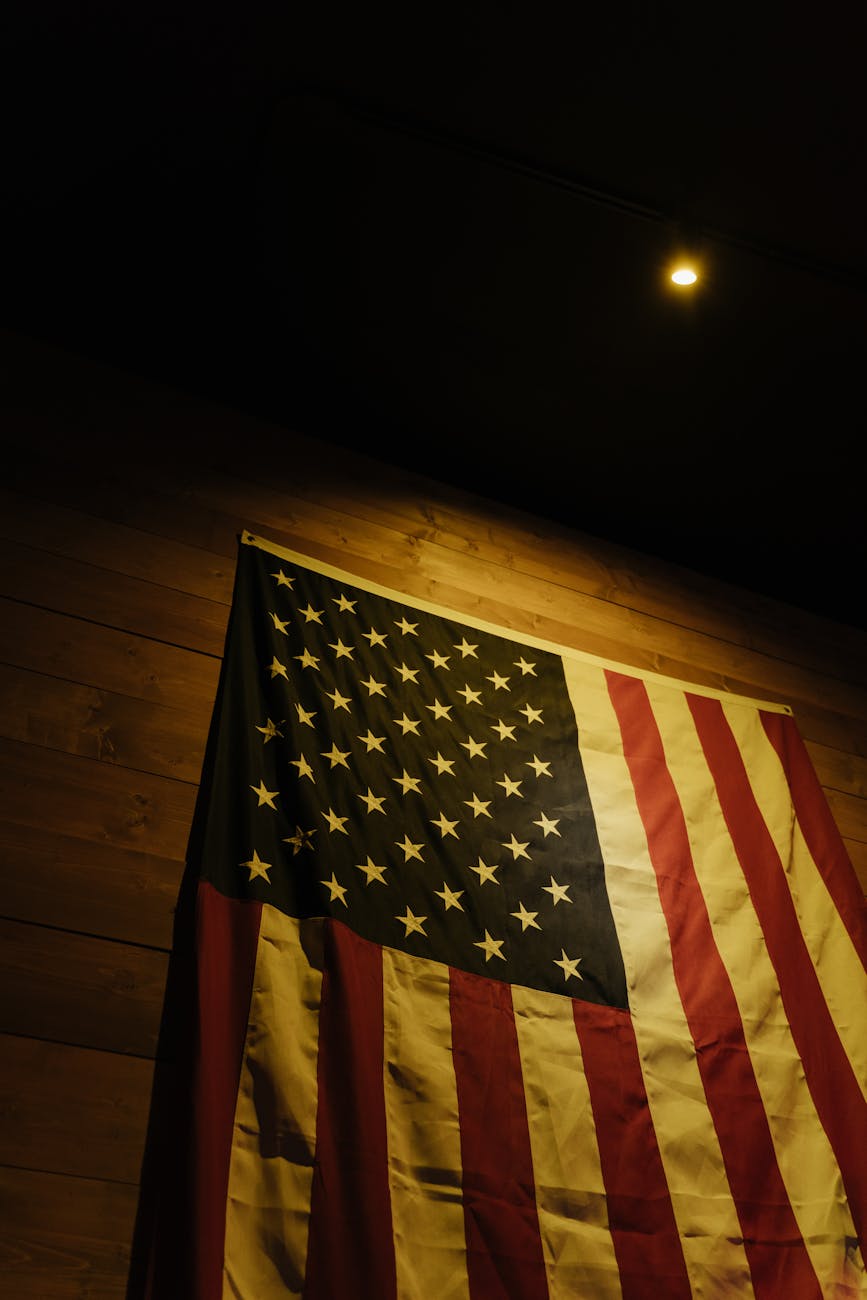
As we approach July 4, 2026, the 250th birthday of the United States, I have been thinking about a piece of cloth that somehow carries a weight far heavier than its fabric: the American flag.
I am not naive about it. I know people see it differently. For some, it is not a symbol of welcome but of warning, something that has been used against them, waved while they were excluded, ignored, or harmed. If that is your experience, I am not here to scold you into feeling what I feel. Symbols do not operate by force. They operate by memory. And memory can be tender or traumatic.
But I want to say plainly, as a veteran and as a citizen: I will not disrespect the flag. I stand for the National Anthem. I place my hand over my heart, sometimes I salute, when it is appropriate, because of what I see when I see it.
“We are not enemies, but friends.” – Abraham Lincoln
Why I Stand
Part of it is personal. I have watched the flag placed, carefully, reverently, on coffins. I have seen it folded into that precise triangle, and handed to families whose grief changes the oxygen in the room. I have walked past rows of graves where small flags stand like quiet sentries.
For me, the flag is tied to the cost of our freedoms, not as an abstraction, but as a receipt written in human lives. I am not saying every war was wise. I am not saying our country has always used its power justly. I am saying this: people really did die believing that freedom was worth defending, and that shared sacrifice deserves respect.
Why I Will Not Desecrate It
Let me say something clearly. I will not desecrate the flag. I will not let it touch the ground in contempt, and I will not burn it. Not because I believe this country has always lived up to its promises. It has not. Not because I believe our government is beyond criticism. It is not.
I refuse to desecrate it because the flag does not represent a particular administration, a party, or even the nation as it behaves at any given moment. It represents the ideals. It represents all of us collectively, you and me. It represents the promise that liberty, justice, and human dignity are grounded in principle, not granted by rulers.
When we desecrate the flag, we are not merely rejecting a government. We risk diminishing a shared symbol that has covered coffins, marked graves, and been saluted by those who believed those ideals were worth defending. I do not want to rob that symbol, or those who gave their lives in service to it, of dignity. And I do not want to rob you of dignity either, or distract from the lofty ideals the flag calls us toward.
I am not saying the flag represents this nation perfectly. It does not. It represents the ideals we sometimes fail to live up to. And that is precisely why we need it. Human beings require symbols. We measure ourselves against them. They remind us that there is something higher than our present dysfunction.
If we remember that, symbols like this can be powerful. They can call us upward. They can remind us who we are supposed to be.
What the Flag Does Not Belong To
I also stand because I refuse to let the flag be reduced.
- It does not belong to conservatism or liberalism.
- It does not belong to Democrats or Republicans.
- It does not belong to the Left or the Right.
- It does not belong to billionaires, corporations, or propaganda machines.
- It does not belong to racism, discrimination, or any ideology that treats Americans as less than.
If someone tries to use it that way, if they wave it like a threat, I do not conclude the flag is the threat. I conclude someone is committing a kind of theft: stealing the symbol and shrinking it to fit their tribe.
That theft is one reason I resonate with the message of WeAreTheFlag.org: the flag belongs to all of us, and it should be visible beside causes that express the best of American ideals, not only the loudest political branding. Their point is simple and, to me, deeply American: pair the flag with your vision of a more just country, and you reclaim what was never supposed to be surrendered.
What I See When I See It
When I look at the flag, I do not see a perfect nation. I see an aspiration.
I see a symbol for the American promise: that we can be wildly diverse, different histories, religions, cultures, politics, and backgrounds, and still choose to live together without tearing each other apart.
In the language of the Constitution, I see a commitment, however imperfectly lived out, to:
- Justice
- Domestic tranquility
- Common defense
- General welfare
- Liberty, not only for people like me, but for all Americans
That includes freedom of religion, and freedom from religion, as a civic principle. It includes the stubborn idea that your neighbor’s rights matter even when you disagree with their worldview. It includes the conviction that law should restrain power, not sanctify it.
This is why I keep coming back to the phrase unity in diversity. Not uniformity. Not hegemony. Not my tribe wins forever. A shared civic home big enough to hold disagreement without turning neighbors into enemies.
But America Has Blood On It
Yes. It does. Any honest American knows this. I don’t know a flag that doesn’t. That’s not an excuse. We have ugly chapters, slavery, segregation, injustices against Native peoples, exclusions baked into law, abuses of power at home and abroad. And even in the present tense, plenty of Americans feel the gap between promise and practice as something they carry in their bodies.
So here is my invitation: if you have ever felt anger when you see the flag, I am not asking you to pretend history did not happen. I am asking something harder.
What if the flag is not only a record of what has been done, but also a claim about what must still be fought for? That is why I find the reclaiming idea so compelling, not as a marketing slogan, but as a moral stance. If a symbol is being used to narrow the circle of belonging, one answer is to widen the circle again by refusing to surrender the symbol.
“Patriotism is supporting your country all the time, and your government when it deserves it.” – Mark Twain
A Word to My LGBTQ Neighbors
I want to speak carefully here, because I know this is tender.
I have seen, and heard, how many LGBTQ Americans experience the flag not as a shelter but as a signal: I am not safe here. That breaks my heart. No one should feel that the nation’s most visible symbol means they are unwelcome in their own home.
I also believe something else, at the same time that the flag should mean you belong. Not because the country has always treated you as if you do, it has not, but because the ideals underneath it, liberty, equal protection, due process, human dignity, are not the property of one moral tribe. They are the civic ground on which Americans argue, vote, persuade, organize, protest, and yes, sometimes repent.
If you are LGBTQ+ and the flag triggers fear or grief, I do not want to dismiss that. I want to understand it. And I want the kind of America where, someday, seeing a flag on a house does not translate emotionally or historically into I am not welcome.
If that means more people should fly the flag alongside the Pride flag, or fly it while advocating for civil rights, or fly it while pushing for equal protection under law, then good. Let the symbol be contested in the direction of inclusion, not surrendered to exclusion.
The Experiment Is Still Running
America is not perfect, far from it. But it remains a rare kind of civic experiment: a nation built around an idea, not a bloodline. A place where people keep coming, not because it is flawless, but because it still carries a kind of magnetic hope.
If you think there is a better civic model, I will not sneer at you. I will ask what you mean by better, and what tradeoffs you are willing to accept. Because every system has tradeoffs. The question is whether those tradeoffs protect human dignity, restrain power, and make room for pluralism, the fact of deep, persistent disagreement.
And if you are here, and you want to make the country better, then you are exactly the kind of American I want standing next to me under that flag.
My Small Act of Refusal
So this is my stance, in honor of 250 years:
- I stand for the anthem.
- I respect the flag.
- I refuse to let extremists claim it.
- I refuse to let cynicism hollow it out.
- And I refuse to abandon the symbol of a country that, however imperfectly, still dares to say: liberty and justice are for all.
You do not have to see it as I do. I cannot force that. I can only tell you what I see. When I see the flag, I see a promise worth insisting on, and a home still worth fighting to make worthy of everyone who lives beneath it.
Resources
We Are the Flag https://www.wearetheflag.org/
Excerpt
As America turns 250, I reflect on the flag not as a symbol of party or perfection, but of shared ideals. It represents liberty, justice, dignity, and unity in diversity. Imperfect though we are, I will stand for what it calls us to become, not merely what we have been.
The Land of Dreams and Madness


Leave a Reply