
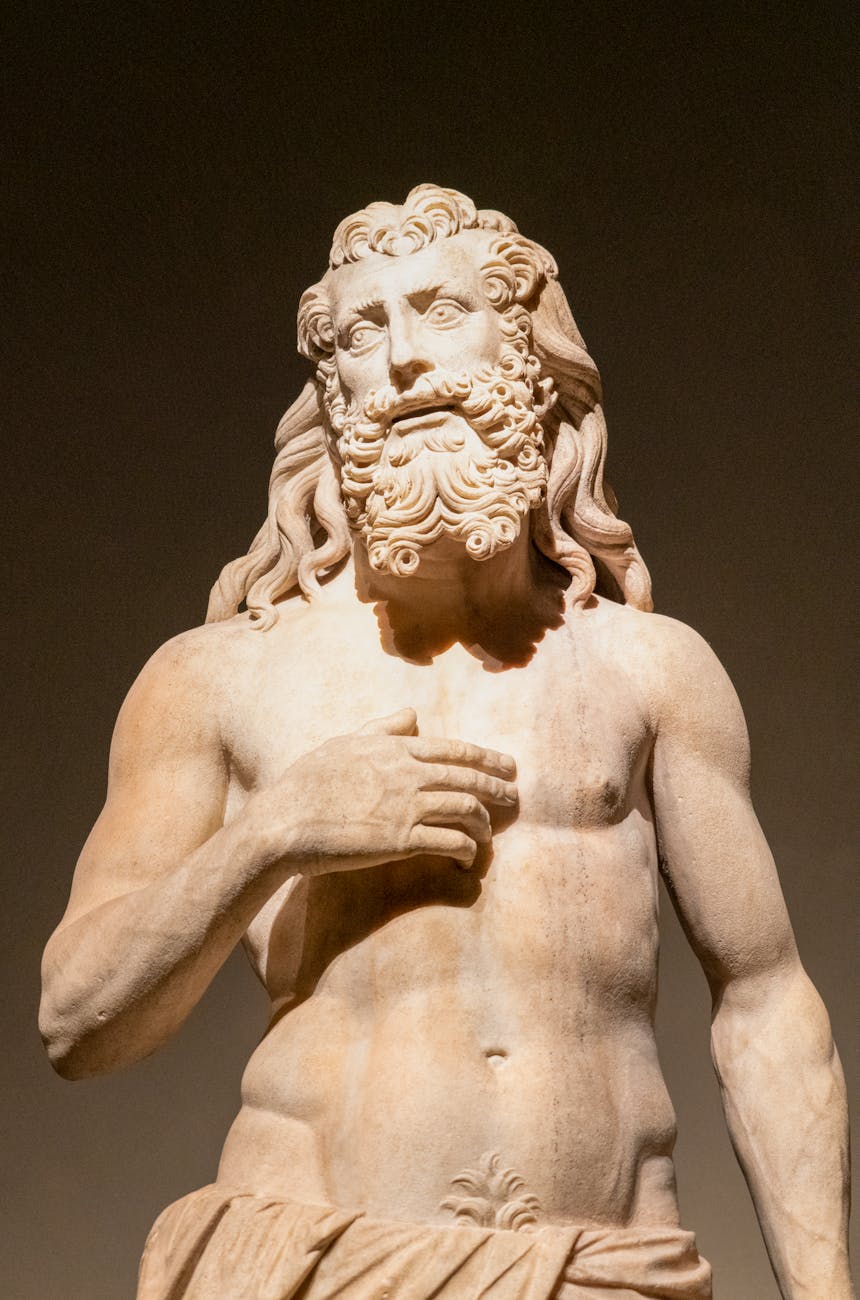
As we continue this slow journey through John 1, the path now brings us to John the Baptist, a wilderness voice standing like a guidepost along the road. Every true quest includes others who meet us along the way, some to encourage us, some to challenge us, some to point us beyond ourselves. John reminds us that the journey is not about making ourselves the hero of the story. It is about learning to recognize the signs, listen for God’s voice, and keep walking toward Christ, the true Light.
It Is Not About Me
As we keep walking through John 1, the road brings us to another figure standing beside the path. John the Baptist is not the destination. He is not the light. He is not the Word. He is not the Christ. He is the witness. He is the voice crying out in the wilderness, pointing weary travelers toward the One who was already coming toward them.
That is part of what makes John so striking. When the priests and Levites come from Jerusalem to question him, he does not inflate himself. He does not turn the moment into a platform for his own importance. He does not grasp for titles that do not belong to him. They ask who he is, and he is very clear about who he is not.
He is not the Christ. That alone is worth sitting with. There is something spiritually healthy in knowing what we are not. John the Baptist understands his role in right proportion. He is significant, but he is not central. He matters, but he is not the Messiah. He has a calling, but his calling is not to gather glory around himself. His calling is to point beyond himself.
In one sense, John is the voice while Jesus is the Word. The voice serves the Word. The voice carries the message, but the voice is not the message. That is not self-hatred. That is freedom. John does not have to be the center because he knows who the center is.
That presses on me. How often do I quietly make things about me? My plans. My concerns. My reputation. My pain. My ministry. My wounds. My preferences. My little kingdom. I may not say it out loud, but I can live as though the story bends around my needs and expectations. Even spiritual things can become self-centered if I am not careful. My insight. My growth. My calling. My usefulness. My failure. My guilt. My desire to be seen as faithful.
But John stands in the wilderness and reminds me that it is not about me. It is about Christ. That sounds simple until we let it search us. What would change if I considered more deeply that my life is about Christ and His kingdom, not me and mine? Where would I be spiritually if that truth moved from doctrine into reflex, from something I affirm into something I actually live?
I suspect there would be more freedom. Less need to manage appearances. Less need to win. Less need to be understood in every room. Less pressure to be the savior, the expert, the rescuer, or the one who must control the outcome. I suspect there would also be more honesty. If it is about Christ, I do not have to protect every illusion about myself. I can be corrected. I can be small. I can be unfinished. I can be a witness without pretending to be the light.
And I suspect there would be more love. Self-preoccupation shrinks the soul. Christ centeredness enlarges it. When I stop needing everything to orbit around me, I become more available to God and to others.
There is also another side to this passage that I do not want to miss. The priests and Levites are asking questions. They want to know who John is and by what authority he is baptizing. In one sense, that is not a bad thing. A man has appeared in the wilderness, calling Israel to repentance and baptizing people. Responsible leaders should ask questions. They should test what is happening. Discernment matters, it is important for followers of Christ.
It is good to test all things. But there is a difference between testing in order to receive truth and testing in order to protect ourselves from it. The problem is not careful questioning. The problem is stubborn questioning that refuses any answer it does not already want to hear. It is possible to ask the right questions with the wrong spirit. It is possible to investigate God’s work while quietly demanding that He fit inside our categories. It is possible to be very serious about truth and still not be open to it.
That may be especially dangerous for those of us who value careful thinking. We can mistake analysis for surrender. We can test all things, which is good, but secretly only accept what leaves us in charge. We can ask for clarity, but only welcome the kind of clarity that does not require repentance.
John the Baptist also reminds me that God often speaks through other people. That may sound obvious, but I am not sure we always live as though it is true. The religious leaders came to question John, but the deeper question is whether they were willing to hear what God might be saying through him. John was not the Light, but he bore witness to the Light. He was not the Word, but he was a voice. That means dismissing the messenger too quickly can become a way of avoiding the message.
This raises an uncomfortable question for me. Am I listening when God speaks through someone else, especially when that person does not fit my expectations? It is easy to say we want to hear from God. It is harder when His truth comes through a wilderness voice, a difficult conversation, a faithful correction, or someone we did not choose as our teacher. John shows us that humility is not only knowing it is not about me. Humility is also being willing to receive truth when God sends it through another.
So this scene gives us two invitations. The first is humility: it is not about me. The second is openness: am I willing to hear what God is saying, even when it is not what I wanted Him to say?
Those two belong together. The more self-centered I am, the harder it is to receive unwelcome truth. The more Christ centered I become, the more I can afford to be corrected. If Christ is the center, then I do not have to defend every old assumption as though my identity depends on it.
There is a line I have heard that captures this beautifully: do not shine so others can see you; shine so that through you, others can see Him. That is John the Baptist.
He does not disappear because he is worthless. He decreases because Christ is worthy. He becomes transparent to the Light. He stands on the road, not as the destination, but as a signpost. He does not call attention to himself as the answer. He points to the Lamb of God.
Maybe that is part of our journey too. We are not asked to be the light. We are asked to bear witness to the Light. We are not asked to be the Word. We are asked to become voices through whom the Word may be heard. We are not asked to build our own kingdoms. We are invited to live in Christ’s. And that is mercy.
Because if it is not about me, then I am free. Free to serve. Free to repent. Free to be corrected. Free to point beyond myself. Free to become smaller in the best possible way, not erased, not diminished, but rightly placed in the story God is telling.
Prayer
Lord, free me from needing it to be about me. Make me a faithful witness to Your light. And when You speak in ways I did not expect, keep me from resisting the truth simply because it does not leave me in control.
Reflection
- Where am I tempted to make the journey about me, my reputation, my control, my wounds, or my little kingdom, instead of Christ and His kingdom?
- Who has God placed along my road as a voice or witness, and am I truly listening, or only listening when the message confirms what I already wanted to hear?
- What would it look like for me to become more like John the Baptist, not trying to be the light, but faithfully pointing others toward the Light?
Excerpt
John the Baptist reminds us that every true journey includes voices along the road that point us beyond ourselves. He is not the Light, but a witness to the Light, teaching us humility, discernment, and the freedom of knowing the quest is about Christ, not us.
The Love of God is expressed through our hands.


Leave a Reply