
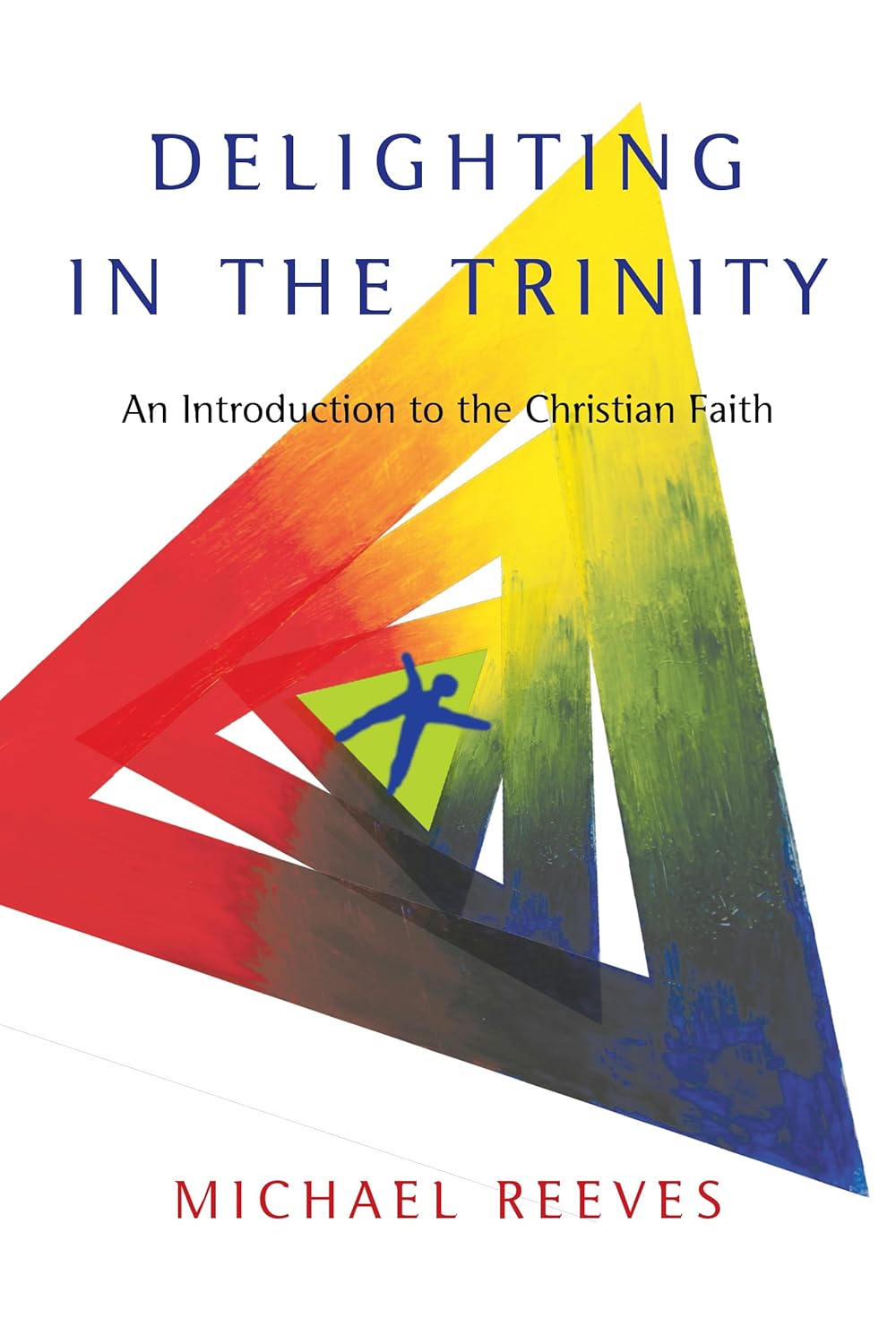
Participation and the Trinity: Where Reeves Stops Short, a Book Review
There is something deeply refreshing about reading Delighting in the Trinity: An Introduction to the Christian Faith by Michael Reeves. It is one of those rare works that recenters the Christian faith where it properly belongs, not on abstract doctrines or moral systems, but on the living reality of the Triune God. Reeves reminds us that what makes Christianity unique is not merely what it says about salvation, ethics, or even Scripture, but what it says about God Himself. A God who is Father, Son, and Spirit is not solitary, not static, but eternally relational, eternally loving, eternally giving.
I also deeply appreciate his treatment of alternative conceptions of God and how they fall short when compared to the Triune vision. He engages the Islamic understanding of God and various atheist caricatures with clarity and fairness, yet shows that without the Trinity, something essential is missing. A solitary monad cannot be eternally loving in itself. A distant, impersonal force cannot ground personal relationship. These views, when placed alongside the Triune God, begin to feel thin, as though they are describing something less than the fullness of reality. Reeves does not merely critique them. He lets the beauty of the Trinity expose their limitations.
That alone is no small contribution. And yet, as I read, I could not shake the sense that Reeves is standing on the edge of something far more profound than he ever fully articulates.
“God is not a lonely monad, but a communion of persons, a God of outgoing, self-giving love.”
That is exactly right. In fact, it is more than right. It is the doorway to something deeper. The question is what follows from that. Given that, what kind of relationship should we expect with our Creator?
Reeves repeatedly emphasizes union with Christ. He speaks of being “in Christ,” of sharing in His life, of receiving what is His. He describes salvation not merely as forgiveness but as participation in the Son’s relationship with the Father through the Spirit. This is not thin theology. This is rich, deeply biblical, and profoundly needed.
“All our life, our righteousness, our holiness is found in Him.”
Again, exactly right. But here is where a distinction begins to emerge, one that I think is often felt but rarely named clearly.
“If he did not enjoy eternal fellowship with his Son, one has to wonder if he would have any fellowship to share with us, or if he would even know what fellowship looks like.”
He comes close, however, there is a difference between status, participation, and what might be called perichoretic participation. Status is how many traditions implicitly frame union with Christ. To be “in Christ” is to belong to Him, to be counted as part of His people, to share in His benefits. It is real, it is true, but it can remain largely external. One might be in Christ in the same way one is in a family, or in a nation, or in a church. It is relational, but not necessarily transformative at the level of being.
“The psalm is referring to the ordination of Aaron as high priest, where the sacred anointing oil would be poured out on his head (Lev 8:12). Just so would Christ (“the Anointed One”) be anointed by the Spirit at his baptism. And as the oil ran down from Aaron’s head to his body, so the Spirit would run down from Christ our Head to his Body, the church. Thus we become “partakers of his anointing.”[3] The Spirit, through whom the Father had eternally loved his Son, would now anoint believers “that they may be one as we are one” (Jn 17:22). One with the Lord, one with each other.”
Participation goes further. Here we begin to speak of sharing in Christ’s life, not merely receiving what He has done. This is the language of Paul, of being crucified with Christ, of Christ living in us. Reeves clearly operates in this space. He speaks of sharing Christ’s joy, His holiness, His relationship with the Father. This is not merely legal. It is existential. It begins to reshape how we understand salvation itself.
But even here, something remains just out of reach. There is a third category, one that James D. Gifford Jr. attempts to articulate in Perichoretic Salvation. Drawing from the Trinitarian concept of perichoresis, the mutual indwelling of the Father, Son, and Spirit, Gifford proposes that the believer’s union with Christ is not merely status and not merely participation in a general sense, but a real, analogical sharing in that indwelling life. Not identity with God. Not absorption into God. But a genuine participation in the relational life of the Trinity itself.
This is precisely where Reeves comes very close. He even says, “In fact, the more trinitarian the salvation, the sweeter it is.” That statement feels like it is pointing directly toward this deeper reality, something just beneath the surface. The trajectory is there. The insight is there. And yet, he does not quite go as far as Gifford. It remains undeveloped, as though he is standing directly over the treasure and does not dig. So close, and yet still at a distance. It leaves me wondering how much sweeter it might have been if he had pressed further, allowing the full weight of the Trinity to shape not only our understanding of God, but our participation in Him.
He describes the flow of love from the Father, through the Son, in the Spirit, and into the believer. He shows that our cry of “Abba, Father” is not our own invention, but a sharing in the Son’s own relationship with the Father. He makes clear that salvation is not merely rescue, but inclusion in divine fellowship.
“The Spirit unites us to Christ, so that what is His becomes ours.” That sentence is doing more work than it appears to at first glance. What does it mean for what is His to become ours? Is this merely a transfer of benefits. Or is it a sharing in life itself.
Reeves often speaks of Christ sharing what is His rather than giving us His life in a more direct sense. That subtle wording suggests a framework that still leans toward status or mediated participation rather than a fully developed ontology of union. It is as if the reality is seen, described, even celebrated, but not fully named. At times, it feels like watching someone circle a profound insight from a high orbit, seeing its outline clearly, but never quite descending into it.
There is a moment that comes to mind, where the clues have all been gathered, the map is clear, and the mark is right beneath one’s feet. The realization is close enough to touch, and yet just out of reach. That is how this reads.
Now, in fairness, this is not a failure so much as a limitation of framework and context. Reeves is writing from within a Reformed tradition that has historically been cautious about language that sounds like deification. The word theosis, θέωσις, carries weight and baggage that many are hesitant to embrace. There is a concern to preserve the Creator creature distinction, to avoid any confusion that would blur that line. Those are good instincts. But what if the solution is not to avoid the language, but to clarify it.
This is where Gifford’s work is so helpful. He provides conceptual guardrails. He shows that one can speak of participation in the life of God without collapsing into pantheism or losing the distinction between Creator and creation. In fact, he strengthens that distinction by showing that participation is always derivative, always by grace, always through Christ, always in the Spirit.
Reeves, I suspect, would find those guardrails not threatening, but liberating. Because everything he is describing points in that direction. This becomes especially clear in his treatment of love.
He speaks of God’s love as outward flowing, self-giving, moving from the Father to the Son and through the Spirit to us. He captures something essential here. But I do find myself wishing he had been more explicit with the term agapē, ἀγάπη.
In English, love is an overloaded word. It stretches from preference to passion to sacrifice, often without clarity. Agapē, however, carries a specific meaning. It is self-giving love. It is love that is not rooted in need or deficiency, but in fullness. It is love that gives because it is already complete.
Only a triune God can be said to be agapē in His very being. And only by participation in that life can we begin to love in that way. That may sound like a bold claim. But consider it carefully. When we speak of self-sacrificial love, do we truly mean without any reference to ourselves? Without any return, any recognition, any internal satisfaction. Or are our best attempts still mixtures of giving and receiving?
If agapē is what Scripture describes, then it is not something we generate. It is something we share in.
And that brings us back to the central insight. Reeves has shown, beautifully and convincingly, that salvation is not merely about being declared righteous, but about being brought into relationship with the Triune God. He has shown that the Christian life is rooted in union with Christ and participation in His relationship with the Father through the Spirit.
What he does not fully explore is what that implies. What if union with Christ is not merely relational language? What if it is real participation? What if, by grace, we are brought into a real sharing in the life of the Triune God, not as equals, not as independent centers, but as participants in an already existing communion of love?
Different traditions have circled this reality. The Eastern tradition calls it theosis. Pauline scholars describe it as participation in Christ. Mystics speak of indwelling. Reformed theologians speak of union. James D. Gifford Jr. frames it as perichoretic participation. They are not identical, but they are not unrelated either. They are, perhaps, different ways of describing the same center of gravity. And Michael Reeves, whether he intended to or not, brings us right to its edge.
“Whereby are given unto us exceeding great and precious promises: that by these ye might be partakers of the divine nature, having escaped the corruption that is in the world through lust.” — 2 Peter 1:4 (KJV)
“That they all may be one; as thou, Father, art in me, and I in thee, that they also may be one in us…” — John 17:21–23
What do you do with passages like this? They must be rightly understood. Too many people read them and go off the reservation. What needs to be understood is what it means to be “partakers” (koinōnoi). It is not what I think most Protestants have taken it to mean. It is something that needs to be taught rightly. We do not become God. That is heresy. There remains a clear Creator and creation distinction. And Gifford’s model does this justice. Reeves is so close, but perhaps too cautious to see the X on the floor he is standing on.
The language may differ. The frameworks may vary. But the invitation remains. Not merely to belong. Not merely to receive. But to participate. To share, by grace, in the life of the One who is love.
Excerpt
Michael Reeves beautifully recovers the Trinity at the center of Christian faith, yet stops just short of its fullest implication. What if union with Christ is more than status or participation, but a real sharing in the life of the Triune God?
Langdon Is Lost


Leave a comment