
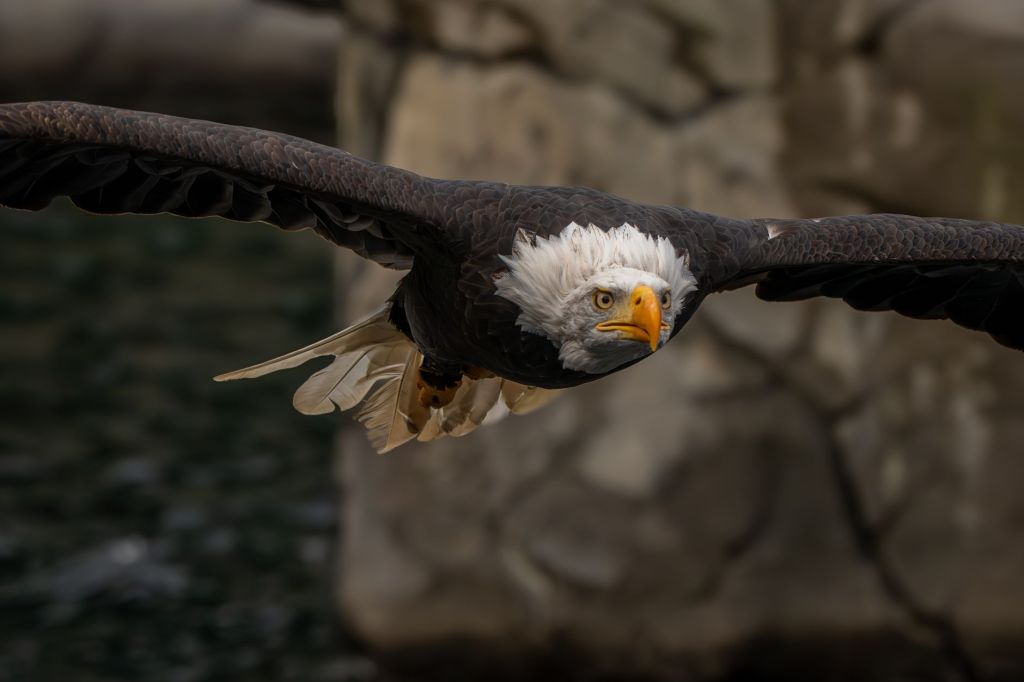
The Eagle, John’s Symbol
As we continue this slow journey through John, I want to pause beside something that is not directly in the text of the Gospel, but that came to me through a commentary. Perhaps this is another small example of what I reflected on earlier: that God can sometimes speak to us through others. Not in the same way Scripture speaks, and not as something I would want to turn into a private oracle, but as an occasion for reflection. Sometimes a line in a book, a symbol in a tradition, or a passing observation can become a signpost along the road.
The symbol traditionally associated with John’s Gospel is the eagle. That caught my attention. Is this a divine appointment, or merely a coincidence along the road? For those living in communion with God, nothing is merely a coincidence; even the unexpected can become an invitation to pay attention, listen more deeply, and walk more faithfully with Christ.
On one level, this is part of historic Christian symbolism. The four Gospels have often been associated with the four living creatures from Ezekiel and Revelation: the man, the lion, the ox, and the eagle. John is commonly represented by the eagle because his Gospel soars so high in its vision of Christ. John begins not with a manger, a genealogy, or the preaching of repentance, but with the eternal Word who was with God and was God. It is a Gospel that rises quickly into the heights.
Here is where the appointment begins. For me, the eagle is not merely an interesting symbol. It has personal resonance. The eagle has long been my favorite animal. John is my favorite Gospel. Eagle is also the name I took as my Native American name.
The eagle carries special meaning in many Native American traditions. It is often associated with sharp sight, spiritual awareness, prayer, sacred ceremony, and messages carried upward. I was told that the eagle can represent one who speaks with the Creator, or with the Great Spirit.
At the time, I thought that was simply “neat.” It seemed fitting because I often feel as though I am praying all the time, talking with God throughout the day. Yet it also felt strange in a meaningful way. Before I knew the meaning, the eagle was already my favorite animal, or perhaps the animal I most felt aligned with or drawn toward. However one wants to describe it, the connection was already there before I understood why it might matter.
My Native American name is Wohalidu, which is short for Wohali Uwadvdi Unelanv’i. ᏬᎭᎵᏛ (Wohalidu), which translates as “Eagle-Speaker,” or “Eagle who speaks”. Which is a short version of ᏬᎭᎵ ᎤᏩᏛᏗ ᎤᏁᎳᏅᎢ (Wohali Uwadvdi Unelanv’i), which translates as “Sacred Eagle who speaks with the Creator”.
As I understand it, a name like Wohalidu would suggest more than beauty or admiration for the eagle. It would point toward someone whose words matter, someone who carries truth, wisdom, warning, or insight. It suggests a person whose voice has weight, someone who is spiritually attentive, someone who listens and speaks with care.
I am not trying to claim more authority than I have, nor am I trying to turn a name into a badge of spiritual superiority. That would miss the whole point. If John the Baptist has taught us anything, it is that the witness is not the Light. The voice is not the Word. The messenger must not mistake himself for the message.
Still, I find the convergence meaningful. The eagle is tied to John. John is the Gospel that has been drawing me so deeply. The eagle has personal significance in my own life. And the idea of “one who speaks with God” feels strangely aligned with what I have been learning through this season of Lectio Divina, especially as I have been reflecting on perichoretic salvation, theosis, participation in Christ, and what I like to call dancing with God.
I do not want to rush to say, “God has definitely sent me a coded message.” That would be too easy, and maybe too flattering. But I also do not want to dismiss it as meaningless simply because it is personal. Not every meaningful convergence has to be turned into a supernatural announcement. Sometimes it is enough to say that something has become an occasion for holy attentiveness.
A symbol does not have to be a secret oracle to become spiritually significant. It may simply awaken desire, gratitude, humility, and deeper prayer.
And there is a fittingness here. John’s Gospel does soar like an eagle. It rises into the mystery of the eternal Word, divine glory, heavenly witness, and the Son who makes the Father known. But John does not stay in the sky. He also descends into flesh, water, wine, bread, tears, foot washing, wounds, and breakfast on the shore. John’s eagle does not escape the earth. It sees from above in order to reveal the meaning of what is below.
If the eagle speaks of height, John reminds me that spiritual vision is not escapism. The Word became flesh. The Light entered the world. The Son came near. True spiritual sight does not float above ordinary life as though the concrete world were beneath God’s attention. It helps us see ordinary life in the light of Christ.
This is where the connection to union with Christ becomes important for me. “One who speaks with God” should not be heard as a title of status, but as an invitation to communion. In John, the goal is not spiritual specialness. The goal is abiding. It is Christ in me and me in Christ. It is being drawn into the life of the Son, who lives in perfect communion with the Father and gives the Spirit to His people. That is what I mean by dancing with God.
As I have often noted elsewhere, Theosis, or participation in the divine life, does not mean that we become God by nature. It means that by grace we are drawn into communion with God, healed and transformed so that we become more truly human. Perichoretic salvation points toward this mutual indwelling: Christ in us, and us in Christ. The life of God is not merely observed from a distance. It is shared by grace.
So if there is any invitation in this eagle symbolism for me, it is not, “You are extraordinary.” It is more likely, “Pay attention. Stay near. Learn to listen. Let your life be turned Godward.”
And if the name means anything like “one who speaks with God,” then the first calling is not to speak for God, but to listen to God. To be spoken to. To be corrected. To be searched by the Light. To be shaped by the Word. To learn the difference between a true word and a self-flattering one.
It would be easy to build a story around myself. It would be easy to say, “See, this proves I am marked out.” Religious history gives us many warnings about what happens when personal experiences, visions, or symbols become the foundation for self-importance or for a message that departs from the Gospel of Christ. Joseph Smith and Muhammad are sobering examples of claims to special revelation that led away from historic Christian faith. But John the Baptist points us in a different direction. He reminds us that the right response to a meaningful sign is not inflation, but surrender. The real question is not, “Does this make me feel spiritually important?” but “Does this help me become more humble, more obedient, and more open to the agape love of Christ flowing through me?”
That becomes the test. Is this making me more like Christ? Is it making me more willing to listen? Is it producing humility, love, obedience, and a deeper hunger for communion with God? Or is it merely giving me a more interesting way to think about myself? That question is worth asking of myself. Maybe that is the better way to hold moments like this. Not as conclusions, but as prayers. That is part of Lectio Divina is meditating on it.
Lord, if there is an invitation here, purify it. Strip away vanity, projection, and self-deception. Keep only what draws me into deeper union with Christ, greater humility, and more faithful obedience.
As I sit with John’s eagle, I do feel invited to look higher, but not to escape the earth. I feel invited to listen more deeply, but not to become impressed with my own voice. I feel invited to speak, but only after I have first been willing to be spoken to. And perhaps that is a worthy question for any traveler on the road.
The eagle may soar, but in John’s Gospel, all true flight begins in abiding.
Prayer
Lord Jesus, teach me to be attentive to Your Spirit.
Quiet the noise in me that rushes past small things. Give me ears to hear, eyes to see, and a heart willing to receive. Help me notice the gentle invitations, the quiet promptings, the unexpected signposts, and the people You place along the road.
Keep me from turning every moment into a message about myself. Purify my attention so that what I notice draws me deeper into humility, obedience, love, and communion with You.
Teach me to listen before I speak, to discern before I conclude, and to follow where Your light leads.
Amen.
Reflection
- If I say I want to speak with God, am I also willing to listen when God speaks back?
- Am I willing to be corrected, searched, humbled, and sent?
- Am I willing to become not the Light, but a witness to the Light?
Excerpt
John’s eagle became more than a symbol for me; it became an invitation to pay attention. This reflection considers personal resonance, providence, humility, and the call to listen for God’s Spirit, even in the small signposts along the road.
Aquila Creatori Loquens


Leave a Reply