
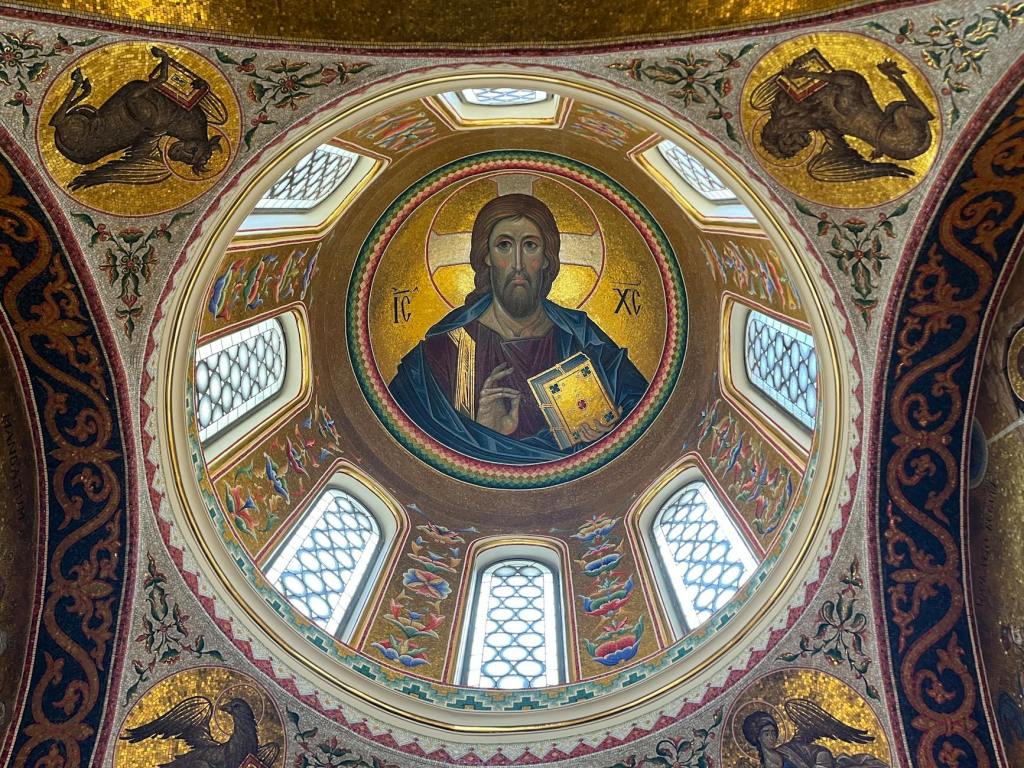
These reflections come from my own practice of Lectio Divina, as I have been slowly walking through John 1 and letting the passage linger rather than rushing past it. Think of this less as a formal commentary and more as an invitation to the road. I am not claiming to have mapped the whole journey. I am simply standing at the edge of the path, staff in hand, asking weary travelers to come along, sit for a while, and consider what John may be showing us in this new beginning.
New Genesis
Come sit with me for a while. Not in a hurry. Not as though we have to solve everything before we get up again. Let us sit like weary travelers beside a quiet fire, with the opening words of John’s Gospel before us, and listen for what may be deeper than our first reading.
“In the beginning.” John could have started somewhere else. He could have begun with Mary, Joseph, Bethlehem, shepherds, angels, or a genealogy. The other Gospels give us those roads into the story, and we need them. But John takes us further back. He takes us behind the manger, behind Israel, behind Abraham, behind Eden, and all the way back to the first words of Scripture.
“In the beginning.” N. T. Wright suggests that John is writing a new Genesis. I find that fascinating. I am still sitting with it. I am not sure I have fully grasped all that it means or how far it reaches, but I am drawn to it. Something in the idea feels true before I can explain it neatly. It is as though John is whispering, “Do not read this as merely another beginning. Read it as the beginning behind all beginnings.”
At the simplest level, I think Wright means that John wants Genesis in our ears from the first line. This is not accidental language. John is teaching us how to hear his Gospel. If we want to understand Jesus, we must see Him at the level of creation itself. The Word is there before all things. All things come into being through Him. Life appears. Light shines. Darkness is confronted. And then comes the great wonder, the great shock, the line that should stop us in our tracks.
“The Word became flesh.” If John is writing a new Genesis, then he is not only telling us who Jesus is. He is announcing that the Creator has entered creation to remake it.
That changes how we think about salvation. Salvation is not mainly an escape from creation, as though the world itself were the problem and the goal were simply to be extracted from it. John is showing us something richer and more beautiful. Creation is being rescued. Creation is being healed. Creation is being brought to its true goal in Christ.
And this is not only cosmic. It is personal. Jesus did not come merely to give us ideas, even true ideas. He came to begin new creation in actual human lives. The light shining in the darkness is not only a doctrine to affirm. It is the beginning of remaking. It is dawn breaking into the places we thought would remain dark forever.
Wright presses the phrase “the Word became flesh” very hard, and I think we should let it press on us too. In his reading, that line corresponds in some way to the climax of Genesis 1, where humanity is made in the image of God. If that is right, then Jesus is not only God coming near. He is also true humanity appearing at last.
That is worth lingering over.
When we look at Jesus in John’s Gospel, we are not only seeing divinity revealed. We are seeing humanity made right. We are seeing a human life fully open to God, fully surrendered to the Father, fully alive in the Spirit, fully expressive of what mankind was meant to be. Jesus is not less human because He is divine. He is the truly human One. He is the with God life embodied.
That matters for spiritual formation. It means Christ is not trying to make us less human, but more truly human. He is not trying to erase our creatureliness, but to heal it. He does not shine His light into us to destroy what He made, but to cleanse, reorder, restore, and renew what sin has bent out of shape.
This connects with something that has been stirring in me for a while. I do not want to keep Jesus as a magnificent idea. I do not want Him merely in the realm of concepts, doctrines, and theological language, as important as all of those are. I need Him in the concrete texture of life. In my habits. In my speech. In my relationships. In my reactions. In the hidden rooms I would rather not open.
If John is writing a new Genesis, then Jesus is not inviting me into abstraction. He is telling me that reality is starting over in Him. Not by erasing the old creation, but by renewing it from within.
That is a deeper truth than mere self-improvement. Some parts of us do not need a little correction. They need new creation. Some dark rooms do not need better decoration. They need light. Some wounds do not need slogans. They need the presence of the Word made flesh.
I think here of the image of the Interior Castle. The light enters the castle not to demolish it, but to cleanse it. To heal it. To make it radiant from within. The dirt, the shadows, the neglected chambers, the places we have avoided, all of them are brought into the light not because God hates the castle, but because He loves what it was meant to become.
And John gives us another layer. He does not only echo Genesis. He also tells us that the Word “dwelt” among us. The word carries the sense of tabernacling. God pitched His tent among His people. So this new Genesis also has the sound of Exodus in it. New creation is also new dwelling. The Creator enters creation, and the God who once dwelt with Israel in the tabernacle now dwells with humanity in the flesh of Jesus Christ.
That means God is not only making a better world somewhere out there. He is coming near. He is coming among us. And eventually, by the Spirit, He comes to dwell within His people.
New creation is not only repair. It is communion.
Perhaps that is why this idea draws me even though I do not yet feel that I have mastered it. Maybe it is not asking first to be mastered. Maybe it is asking to be received. Maybe it is asking for reorientation. If John is writing a new Genesis, then reading John is not merely learning information about Jesus. It is stepping into a world where the old order is being judged and a new one is beginning.
And that includes me. My habits. My fears. My loves. My speech. My anger. My hopes. My relationships. My hidden assumptions about God, others, and myself. The Gospel becomes less like a lecture and more like sunrise. So perhaps I do not need to force an immediate application. Perhaps the better practice is to let the phrase work on me.
The Word became flesh. The Creator entered creation. The light shines in the darkness. New creation has begun. And then, maybe, I can pray simply: Lord Jesus, if You are the beginning of new creation, begin again in me.
Prayer
Lord Jesus, eternal Word through whom all things were made,
shine Your light into the places where my life still waits for dawn.
If You are the beginning of new creation, begin again in me.
Renew what is weary, heal what is wounded, reorder what is bent,
and teach me to live as one made truly human in You.
Amen.
Reflection
- If John is inviting us to hear Genesis in the background of his Gospel, what does that change about how I understand Jesus, not merely as Savior, but as Creator entering creation?
- Where in my own life do I need new creation, not just improvement, correction, or better habits?
- When I hear that “the Word became flesh,” do I allow Christ into the concrete places of my life, my relationships, speech, wounds, fears, and hidden rooms, or do I keep Him safely in the realm of ideas?
Excerpt
John’s Gospel opens like a new Genesis, inviting us to see Jesus as the Creator entering creation to renew it from within. The Word becomes flesh, light enters darkness, and new creation begins not only in the world, but in us.
What to Do With the Time Given Us


Leave a Reply