
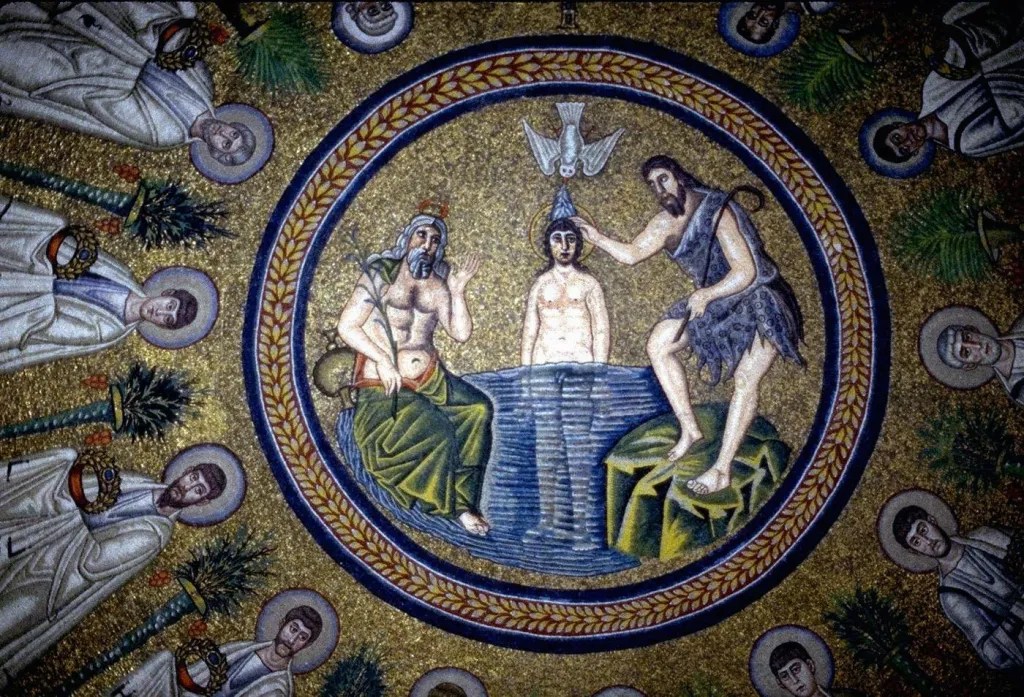
The Modern Christian Surprise
Most modern Christians would be startled by the phrase nude baptism. Some would probably assume it was strange, improper, fringe, or maybe even a modern invention trying to baptize contemporary naturism with ancient language. For many of us, baptism usually means a pastor, priest, or minister standing in a church baptistry, a robe, a towel, a change of clothes, and perhaps a few family members taking pictures. Even when baptism is practiced by full immersion, the body is usually covered, managed, and made as visually modest as possible.
But what if that modern picture is not the only Christian picture?
What if, in the early church, the stranger idea would have been to treat baptism as a merely mental or symbolic act detached from the body? What if baptism was understood not only as a public confession, not only as a sign of inward faith, but as a whole person event in which the body itself participated in the drama of death, washing, rebirth, anointing, and new life? What if what many Christians now find shocking once stood very near the center of Christian initiation?
Nude baptism was not a fringe oddity in early Christianity. It belonged to a broader ancient world of ritual immersion, purification, initiation, stripping, washing, anointing, and reclothing. In the early church, this embodied rite carried a rich theology. The old self was put off. The person entered the waters in participation with Christ. The baptized emerged into new life and was clothed again as a sign of renewal, righteousness, and resurrection hope. Nakedness was not the point for its own sake. It was part of the liturgical language of transformation.
What changed over the centuries? Why has the body, which Scripture presents as part of God’s good creation, so often become something Christians instinctively associate with shame? Why do we so often read the body through the lens of the expulsion from Eden rather than through the promise of redemption? If we are in Christ, indwelt by the Holy Spirit, and called into new creation life, why do we sometimes act as though the body remains permanently trapped in the fear and hiding of Genesis 3?
Of course, we do not live in Eden. We live in a fallen world where lust, abuse, objectification, and shame are real. Christian modesty is not meaningless. Boundaries are wise. But if our theology of the body begins and ends with fear, then something has gone wrong. Christianity does not teach that salvation rescues souls from bodies. It teaches creation, incarnation, baptism, resurrection, and renewed creation. The body is not an embarrassing leftover from the old life. It is part of the person God made, Christ entered, and grace intends to redeem.
That is why nude baptism matters for this larger series on Christian naturism. It reminds us that the early Church could speak about the body more boldly than many modern Christians do. One of the Church’s most sacred acts involved water touching skin, the old life being put off, and the whole person being presented before God. Many Christians today will find that shocking. But perhaps the shock reveals not only something about early Christianity. Perhaps it also reveals something about us.
What have we forgotten? What have we come to fear? And what might the early baptismal imagination teach us about the body, shame, and new life in Christ?
Before Christianity: Ritual Immersion in Jewish and Ancient Practice
Christian baptism did not appear in a vacuum. It emerged in a world where water, purity, initiation, washing, and bodily transition already carried deep symbolic force. That matters because baptism was not invented by Christians out of nothing. Christians received, transformed, and reinterpreted practices that already existed in the Jewish world and in the surrounding ancient world. If we want to understand why the early Church could practice baptism in such a deeply embodied way, we need to begin with the world in which baptism first made sense.
The closest background is Second Temple Judaism. Jewish life already included ritual washings and immersions connected with purity, repentance, and readiness before God. The mikveh, or ritual bath, was not a casual washing for ordinary hygiene. It was a serious bodily act. The person entered the water as a whole person. The body was not beside the point. Water touched the body because purity, uncleanness, restoration, and covenant life were not treated as merely mental ideas. They were enacted.
This is important for how we think about Christian baptism. When John the Baptist appeared in the wilderness baptizing people, he was not introducing water as a completely new religious symbol. He was drawing on a world where water already meant purification, repentance, and preparation. His baptism intensified that meaning around the coming kingdom of God. Christian baptism then took that world of meaning and centered it on Jesus Christ, His death, His resurrection, the gift of the Holy Spirit, and entrance into the people of God.
Living water was especially important. In Jewish ritual language, living water usually refers to naturally flowing water, such as a spring, stream, or river. That symbolism matters. Flowing water is not stagnant. It suggests cleansing, movement, life, and divine provision. So when early Christian sources prefer baptism in living water, they are not simply giving a practical instruction about where to perform the rite. They are working within an inherited symbolic world where water, life, purification, and bodily immersion already belonged together.
I am not saying we can prove that every Jewish immersion, or every early baptism, was nude in every place and in every circumstance. The evidence is not that tidy. What we can say is that ancient Jewish immersion was a full body ritual act, and that the surrounding evidence strongly suggests nude immersion in at least some Jewish conversion and purification contexts under the Roman Empire. Given the nature of full bodily immersion, the practical realities of clothing in water, and the later explicit Christian evidence for nude baptism, it is reasonable to assume that many, perhaps most, and possibly nearly all such immersions were performed nude. Still, that should be stated as a careful historical judgment, not as an absolute claim that no exception ever existed.
The broader ancient world also matters. Judaism is the nearest background for Christian baptism, but the Greco Roman world had its own initiatory and purification practices. In some mystery traditions and ritual settings, stripping, washing, anointing, initiation, and reclothing could symbolize a passage from one state of life to another. The person left one identity behind and entered another. Clothing and unclothing were not random details. They could communicate transition, vulnerability, cleansing, death to an old life, and entrance into a new one.
That does not mean Christian baptism was simply borrowed from pagan mystery religions. It was not. The meaning of Christian baptism is rooted in Israel’s Scriptures, the ministry of John the Baptist, the command of Christ, the death and resurrection of Jesus, and the life of the Church. But it does mean that Christians lived in an ancient world where bodies, water, initiation, and new identity were already connected in the religious imagination. A person entering water nude for a sacred rite was not an oddity. It was recognizable as a serious transition.
This helps us understand why nude baptism would not have seemed as strange to ancient Christians as it does to many modern Christians. In our world, nudity is usually interpreted through privacy, sexuality, shame, or exposure. In the ancient ritual world, nakedness could also symbolize stripping away, purification, vulnerability, and rebirth. The body was not merely a problem to cover. It was part of the symbolic grammar of religious transition.
So when the early Church adopted baptism as one of its central practices, it did not adopt a thin, abstract symbol. It adopted a bodily rite already resonant with meaning and then filled it with Christ. Water became the place where death and resurrection were enacted. Stripping became the sign of putting off the old self. Anointing became the sign of consecration and healing. Reclothing became the sign of new life. The body participated because salvation was never meant to be imagined as an escape from embodiment.
This background does not prove every later Christian practice in detail. It does, however, prepare us to understand why the early Church could develop baptism in such a rich, physical, and nude form. Christian baptism was not merely a lesson about grace. It was a drama of grace performed on and through the body. And that is exactly what the earliest Christian baptismal instructions begin to show us.
The Earliest Christian Baseline: The Didache
One of the earliest windows we have into Christian baptismal practice is the Didache, an early Christian teaching manual sometimes called *The Teaching of the Twelve Apostles*. It is not a full theological treatise, and it does not give us every detail we might like. But it does show that baptism was already treated as a structured bodily rite very early in Christian history.
The Didache prefers baptism in living water, meaning flowing water such as a river or stream. If living water is not available, it allows other water. If cold water is not available, warm water may be used. If there is not enough water for immersion, water may be poured three times on the head. It also instructs the one baptizing, the one being baptized, and others who are able to fast beforehand. This is not casual. It is ordered, prepared, and embodied.
The Didache does not explicitly mention nudity. That silence should not be forced to say more than it says. But neither should we assume that silence means the candidates were clothed. If full body ritual immersion was already familiar in the wider Jewish and ancient world, and if later Christian sources explicitly describe stripping as part of baptismal practice, then the Didache may simply not mention nudity because the bodily assumptions of immersion did not need to be explained. Ancient instructions often leave out what everyone already knows.
That said, the Didache gives us an important baseline. Very early Christians already understood baptism as more than a private thought, inward feeling, or disembodied symbol. It involved water, fasting, preparation, and bodily enactment. Before we get the fuller fourth century descriptions of stripping, anointing, immersion, and reclothing, we already see that baptism belonged to the physical, visible, communal life of the Church.
This is important for our larger question because it shows that Christian baptism was embodied from the beginning. The body was not an accidental participant. It entered the water. It was washed. It was presented before God. The fuller symbolism would become more explicit later, but the basic pattern was already there: Christian initiation was something done with the whole person, body and soul together.
The Early Church at Full Strength: Jerusalem and the Baptism of Catechumens
If the Didache gives us an early baseline, fourth-century Jerusalem gives us the fuller drama of baptism at almost full strength. Here we are no longer dealing only with brief instructions about water and fasting. We are looking at a mature pattern of Christian initiation, shaped by catechesis, fasting, renunciation, anointing, immersion, and reclothing. The body is not incidental. It is placed at the center of the rite.
The catechumens, those preparing for baptism, did not simply show up casually one morning and enter the water. They were formed over time. Egeria, a fourth-century pilgrim who visited Jerusalem and left us one of the most valuable travel accounts of early Christian worship, describes an intensive period of instruction leading up to baptism. Lent became a season of preparation, examination, teaching, prayer, and spiritual seriousness. Baptism was not treated as a light ceremony. It was entrance into a new life.
Then came the rite itself. In Jerusalem, as reflected in Cyril of Jerusalem’s Mystagogical Catecheses, the candidates stripped off their clothes. They were anointed with exorcistic oil. They renounced Satan. They professed faith. They entered the waters and were immersed three times. Then they emerged and were clothed in white garments. Every part of this sequence mattered. It was not religious theater in the shallow sense. It was liturgical theology enacted through the body.
Cyril explains the stripping with remarkable boldness. The candidates removed their clothing as a sign of putting off the old self. They stood naked in imitation of Christ, who was stripped and crucified. This is startling to many modern Christians, but it was not fringe theology. The nakedness of baptism was tied directly to union with Christ. The baptized person was not merely thinking about death and resurrection. The baptized person was entering the pattern bodily.
This is why nude baptism in the early Church cannot be reduced to embarrassment, practicality, or primitive custom. It was full of meaning. The old life was stripped away. The body was anointed as one being claimed by Christ. The person descended into the water as into death. The triple immersion echoed the Trinitarian faith and the pattern of burial and rising. The white robe after baptism signified new life, purity, and the dignity of the newly illumined Christian.
I first learned about this broader history while reading The Water That Divides, and it struck me because baptism itself has become one of the many things over which Christians divide. We divide over mode, meaning, timing, subjects, sacramental status, rebaptism, infant baptism, believer’s baptism, immersion, pouring, and almost everything else one can imagine. Unfortunately, even the sacrament or ordinance that marks our entrance into visible Christian life has become a point of separation among those who confess one Lord.
And yet, whatever Christians debate about baptism today, the historical evidence for this early practice is difficult to dismiss. The basic facts of fourth-century Jerusalem are not seriously in dispute. Catechumens underwent serious preparation. They stripped. They were anointed. They were immersed. They were clothed in white. What Christians may debate is how normative that practice should be for us now, or how we should interpret its meaning, but the historical practice itself is well attested.
This historical point it confronts our modern assumptions about nudity and religion. Many Christians today would be shocked by nude baptism. But the early Church appears to have seen in it a powerful sign of the Gospel. The body that had lived under the old life was stripped. The body that entered the water participated in Christ’s death. The body that emerged from the water was clothed as a sign of new creation. The baptized did not leave the body behind in order to become spiritual. They brought the body into the drama of salvation.
This is why Jerusalem is so important for this post. Here we see that baptism was not merely an inward decision symbolized outwardly. It was a whole person initiation into Christ. The body was washed, anointed, stripped, immersed, and clothed because salvation addresses the whole person. Nude baptism was nakedness as theology, and the early Church was not embarrassed to say so.
Why Was Baptism Done Nude?
Nude baptism was not nudity for its own sake. It was nakedness as liturgical theology. The early Church was not practicing nude baptism because the body was casual, because modesty did not matter, or because Christians had no moral concerns about lust. The rite was not a celebration of mere nakedness. It was a symbolic action in which the body participated in the Gospel. The candidate did not simply hear about putting off the old life. The candidate enacted it. The clothing was removed. The old self was stripped away. The body entered the water. The person emerged and was clothed again.
The first meaning, then, is putting off the old self. Paul uses this kind of language when he speaks of putting off the old humanity and putting on the new. In baptismal practice, that language became visible. The candidate removed the garments associated with ordinary life and stood before God without costume, status, role, or disguise. This was not shame for the sake of shame. It was exposure before grace. The old life was being renounced, not merely as an idea, but as an embodied reality.
Cyril of Jerusalem gives this symbolism particular force. For Cyril, the stripping of the candidate signified the putting off of the old man with his deeds. But he also connects the nakedness of baptism to Christ Himself. The baptized person imitates Christ, who was stripped and crucified. That is a remarkable theological claim. The candidate’s nakedness is not merely a return to Adam. It is participation in Christ. The body is drawn into the pattern of the cross.
This connection becomes even stronger when we remember that crucifixion was historically designed to strip the condemned of dignity as well as life. Christ was not only nailed to the cross. He was exposed. He entered the place of public shame, bodily vulnerability, and human humiliation. In that sense, the nakedness of baptism aligns the candidate with Christ in His own nakedness. We come to the water with nothing to hide behind, no costume of status, no old identity to preserve, and no illusion of self-salvation. Paul says that in baptism we are united with Christ in His death and resurrection. That union is not an abstraction. The early baptismal rite made it visible. As Christ was stripped, so the candidate was stripped. As Christ entered death, so the candidate entered the water. As Christ rose, so the candidate emerged into new life. Our nakedness in baptism was not merely human vulnerability. It was vulnerability joined to His, shame answered by His obedience, and the body drawn into the mystery of dying and rising with Christ.
This makes the baptismal rite profoundly Christocentric. Christ was stripped, exposed, crucified, buried, and raised. The baptized person is stripped, enters the water, and emerges into new life. The point is not that the candidate becomes innocent by pretending the Fall never happened. The point is that the candidate is united to Christ, who enters human shame and death in order to bring forth resurrection life. The nakedness of baptism is therefore not primarily about escape from the body. It is about the body being brought into the saving work of Christ.
This also helps explain the triple immersion. The candidate descends into the water and rises again in the name of the Father, and of the Son, and of the Holy Spirit. The body participates in the shape of Christian confession. The whole person is plunged into the name of the triune God. Baptism is not merely a statement about belief. It is a bodily entrance into the death and resurrection of Jesus.
Then comes reclothing. The newly baptized emerge from the water and are clothed in white. That action is just as important as the stripping. If the removal of clothing signified putting off the old life, the white garment signified new life, righteousness, purity, and resurrection hope. The baptized person is not left exposed. Grace does not merely uncover. Grace also clothes. The old garments are left behind, and the new garment becomes a sign of belonging to Christ.
There is likely an echo of Adamic innocence here as well. Nakedness before God naturally recalls Eden, where Adam and Eve were naked and not ashamed. Baptism can be seen as a movement toward restored innocence, not by erasing the Fall, but by passing through Christ. The baptized person does not simply go backward to Eden. The baptized person goes forward into Christ, the New Adam, in whom shame is answered, sin is forgiven, and embodied life is renewed.
This is why Susan Rode’s Christ centered reading of baptismal nudity is so helpful. A merely Adam focused interpretation could make nude baptism sound like an attempt to recover pre Fall innocence by stepping around the cross. But the early baptismal theology, especially in Cyril, does something richer. It moves through Christ. Nakedness is connected to His stripping. Immersion is connected to His death and burial. Rising from the water is connected to His resurrection. Reclothing is connected to new life in Him.
So why was baptism done nude? Because the body was speaking the language of the rite. The body put off the old. The body was anointed. The body entered the water. The body rose again. The body was clothed. The body did not replace faith, grace, or the work of the Holy Spirit. Rather, the body became the visible place where those realities were enacted.
That is hard for many modern Christians to grasp because we often treat symbols as if they are merely illustrations of ideas. The early Church often treated symbols more strongly than that. A symbol was not empty decoration. It was a meaningful action that carried the worshiper into the truth being proclaimed. Baptism did not merely point toward dying and rising with Christ. It enacted that truth through water, word, body, and Spirit.
This is why nude baptism should not be dismissed as a strange embarrassment from an earlier age. It was part of a serious Christian theology of salvation. The old self was stripped. The candidate stood vulnerable before God. The body was washed. The person participated in Christ’s death and resurrection. The newly baptized was clothed in white as a sign of new life. Nakedness, in that setting, was not the absence of meaning. It was meaning made visible.
Was This Normal Across the Early Church?
Jerusalem gives us one of the clearest and most detailed pictures of nude baptism in the early Church, but it would be a mistake to treat Jerusalem as if it were the only place where such a practice occurred. The evidence is strongest there because Cyril of Jerusalem and Egeria give us unusually rich descriptions of catechesis, stripping, anointing, immersion, and reclothing. Still, the broader pattern strongly suggests that nude baptism was not a strange local custom limited to one city.
We should not claim that every church in every region performed baptism in exactly the same way. Early Christianity was not liturgically uniform in the modern sense. Practices varied by region, language, bishop, architecture, local custom, theological emphasis, and pastoral circumstance. Some communities had large baptisteries. Others had limited access to water. Some baptized adults after long catechetical preparation. Others increasingly baptized infants. Some rites were elaborate. Others were simpler. Even when the same theological pattern was present, the exact form could differ.
Yet the basic evidence points in a clear direction. Nude baptism was part of early Christian initiation, not a marginal oddity. Ronald Hutton has described early Christian nude baptism as historically certain, while also placing it within a broader ancient context of ritual nakedness, initiation, stripping, washing, and reclothing. It helps us see that the early Christian practice was not bizarre within its own world. It was a Christian transformation of a symbolic language ancient people already understood.
Some modern readers may be tempted to say, “Well, perhaps that was just Jerusalem.” That is possible in the narrow sense that Jerusalem’s exact ceremony may have had local features. But the larger pattern of stripping, washing, anointing, immersion, and new clothing appears to belong to a broader early Christian baptismal imagination. The body was not an afterthought. The rite was not reduced to a few spoken words and a small amount of water. Baptism was understood as a whole person passage from old life to new life.
Even so, caution is necessary. Historical honesty requires us to distinguish between what is directly attested, what is strongly implied, and what is plausible but less certain. Jerusalem is directly attested with unusual clarity. Other early Christian communities are less fully documented. It is reasonable to conclude that nude baptism was widespread in early Christianity, especially where adult baptism by immersion and formal catechumenal preparation remained central. It is not responsible to claim that no exception existed, or that every Christian everywhere experienced the rite in precisely the same form.
We do not need to prove total uniformity in order to see the importance of the practice. A rite does not have to be universal in every detail to be historically significant. The question is not whether every baptism in every corner of the ancient Church was nude. The question is whether nude baptism was a recognized and meaningful part of early Christian initiation. The evidence says yes.
And if that is true, then modern Christians should be cautious before treating the idea as automatically scandalous. What shocks us may not have shocked them. What we instinctively associate with shame may have carried for them the language of putting off the old self, imitating the stripped Christ, entering the waters of death, and emerging clothed in new life. The practice may feel foreign to us, but it was not foreign to the embodied theology of the early Church.
So was nude baptism normal across the early Church? In the sense of being a well attested and theologically meaningful early Christian practice, yes. In the sense of every congregation everywhere doing it identically, we should not overstate the case. The better conclusion is that nude baptism belonged to the mainstream symbolic world of early Christian initiation, even as local practice varied.
That careful answer may be less dramatic than a sweeping claim, but it is more truthful. And for this discussion, truth matters more than shock value.
When Did Nude Baptism Largely Fade?
One of the frustrating things about this history is that nude baptism does not seem to disappear in one clear moment. We do not have a single council, decree, or dramatic turning point where the Church simply says, “From now on, baptism will no longer be nude.” Instead, the practice appears to fade gradually as the wider shape of Christian baptism changed. That makes the history harder to tell, but probably more honest.
Several transitions seem to matter. One of the most important was the movement from adult catechumenate to infant baptism as the dominant pattern. In the fourth century descriptions from Jerusalem, baptism was part of a long process of preparation. Adults were instructed, examined, exorcised, anointed, stripped, immersed, and reclothed. The rite carried the weight of a public passage from one life to another. As infant baptism became more common, the full drama of adult initiation naturally changed. The symbolism of stripping off the old life, professing faith, entering the water, and emerging clothed in new life did not disappear, but its bodily form became less visually dramatic.
The rites also became shorter and more controlled. As Christianity moved from a persecuted or minority movement into more established public life, baptismal practice developed across many regions. Churches learned how other cities performed the rite. Liturgical patterns were compared, adapted, abbreviated, and regularized. Local customs remained, but the movement toward more formal church structures also encouraged more uniform and manageable ceremonies. In that process, elements that had once been vivid and bodily could become more symbolic, more verbal, or more spiritually interpreted.
Changing modesty expectations likely played a role as well. As Christian communities grew, as baptisms became more public, and as the social setting of the Church changed, the older practice of stripping may have become pastorally awkward or culturally uncomfortable. This does not mean the early Church suddenly rejected the theology behind nude baptism. It may simply mean that the same theology began to be expressed through other signs. A white garment could still signify new life. Water could still signify cleansing and union with Christ. Words of renunciation and profession could still mark the putting off of the old self. The body no longer had to be fully naked for the symbolism to remain active.
There may also have been a shift toward understanding baptism more abstractly or spiritually. If baptism is treated primarily as a sacramental or symbolic act, then the physical nakedness of the candidate may seem less necessary. If the meaning is carried by the water, the words, the prayer, the anointing, and the garment, then the removal of all clothing may come to seem optional, unnecessary, or even distracting. Once the symbolism becomes detachable from the older bodily form, other symbols can carry the theological meaning.
This is not necessarily wrong. Christian worship has always developed. The Church has often translated meaning from one form into another. But it does mean something was lost. The early baptismal rite made the theology unmistakably visible. The old self was not only renounced. It was stripped away. The candidate did not merely hear about dying and rising with Christ. The body entered the water and emerged again. The white garment was not merely decorative. It completed the movement from naked vulnerability to clothed new life.
So why did nude baptism fade? The honest answer is that we do not know with precision. It likely faded through a combination of changing baptismal subjects, shorter rites, developing liturgical conventions, shifting modesty instincts, different architectural settings, and a gradual spiritualization of symbols. It was not simply rejected in one moment. It slowly became less necessary, less practical, less common, and perhaps eventually unimaginable.
That gradual disappearance is important for this larger series on Christian naturism. The fading of nude baptism does not prove that the early practice was shameful. It also does not prove that modern churches must restore it in order to be faithful. What it does show is that Christian attitudes toward the body changed over time. A practice that once embodied the Gospel with striking physical clarity slowly gave way to forms that were more clothed, more restrained, and perhaps more comfortable for later Christians.
The question is not whether every older practice must be recovered exactly as it was. The question is whether we have lost some of the theological imagination that made the practice meaningful in the first place. If early Christians could see nakedness in baptism as putting off the old self, union with Christ, death and resurrection, and reclothing in new life, then perhaps we should ask whether our own discomfort reveals wisdom, or whether it reveals forgetfulness.
Contemporary Revivals: Rare but Real
Nude baptism has not entirely disappeared. It is rare, and it is certainly not part of the ordinary life of most churches today, but it does still occur in small, private, intentional settings. Some Christian naturist groups and some Christian communities connected with naturist or nudist resorts have retained or revived the practice. The broader Church largely ignores them, and when it does notice, it often judges them quickly. That is unfortunate.
To be clear, I am not claiming that nude baptism is common today. It is not. I am also not calling for the whole Church to restore nude baptism universally, nor am I suggesting that it is the only faithful way to baptize. Christian baptism is valid and meaningful in many forms, depending on one’s tradition and theology. My point is more modest: nude baptism has deep roots in early Christian practice, and in the right context, with proper reverence, pastoral wisdom, and theological seriousness, it should not be treated as automatically sinful, indecent, or suspect.
If a typical church announced next Sunday that it was returning to nude baptism as the early Church practiced it, I imagine half the congregation might faint, the other half might call an emergency board meeting, and someone would almost certainly suggest the pastor had either lost his mind or needed an exorcism. That is obviously an exaggerated scene, but it illustrates the point: for most modern Christians, the practice would not be received as ancient, embodied, and theological. It would be received as scandalous.
However, among Christian naturists, there appears to be a growing interest in returning to the older baptismal imagination. In those settings, the unadorned body is not automatically viewed as shameful, erotic, or objectified. That makes a difference. If a community already understands nonsexual nudity as ordinary, dignified, and compatible with Christian discipleship, then nude baptism may be received very differently than it would be in a congregation where all nudity is immediately associated with lust, scandal, or exposure.
That raises an important question about culture. Some Christians might say, “Nude baptism may have been acceptable in the ancient world because their cultural context viewed nudity differently, but our culture does not.” There is some truth in that. Context matters. A practice that communicates reverence in one setting may communicate confusion or scandal in another. We should not ignore the moral and social meaning of actions within a given community.
But if the argument is cultural context, then we must be consistent. The Church has a long history of being countercultural when necessary. It does not simply accept the assumptions of the surrounding society as the final judge of Christian practice. More than that, if cultural context matters, then contemporary subcultures matter too. If there are Christian communities today in which nonsexual nudity is understood as dignified rather than shameful, then a case can be made that nude baptism may be appropriate within those communities, even if it would not be wise in others.
This is where discernment is needed. A nude baptism performed in a careless, performative, provocative, or exhibitionistic way would fail the test. But a nude baptism performed reverently and in the proper theological context, in a community where the body is not objectified, may recover something deeply ancient. It may embody the very meanings early Christians saw so clearly: putting off the old self, union with Christ in His death and resurrection, vulnerability before grace, and reclothing in new life.
Those who oppose nude baptism today should be careful before questioning the motives of those who practice it. Some may indeed misunderstand or misuse the practice, as people can misuse almost anything sacred. But many who are drawn to it are not trying to sexualize baptism. They are trying to take the body seriously. They are trying to recover a more embodied sacramental imagination. They are trying to remember that baptism was once a whole person rite in which the body visibly participated in the Gospel.
The modern Church may not be ready to receive that widely. Perhaps it never will be. But that does not mean the practice itself is outside the bounds of Christian faithfulness. At minimum, the history should make us slower to condemn and more willing to ask what early Christians saw that we may have forgotten.
A Short Excursus: Russian Epiphany Bathing
A related but distinct practice is Russian Epiphany bathing. This is not baptism itself. It is better described as baptism adjacent, a ritual remembrance or reenactment connected to the baptism of Christ. Around January, Russian Orthodox Christians and others enter icy water after priests bless it, often through holes cut into frozen rivers or lakes. The practice commemorates Christ’s baptism in the Jordan, but it is not the sacrament of baptism repeated.
The evidence I have seen supports the immersion custom much more strongly than any claim that nude participation is official Orthodox teaching or a normative requirement. Some participants may choose minimal clothing, and in some local or personal settings perhaps no clothing, but that appears to be custom, circumstance, or personal choice rather than formal church prescription. So we should not overstate the point. This is not a universal Orthodox command to bathe nude in freezing water.
Still, I find the practice intriguing because it shows that embodied religious remembrance has not entirely disappeared. Here again, the body participates. The person does not simply think about Christ’s baptism. The person steps into water. The cold is felt. The body trembles. The act becomes physical memory. It is not the same as baptism, but it is still a bodily way of remembering baptism.
For the purposes of this series, the most interesting point is that we can still find religious practices where bodily exposure, or at least minimal bodily covering, is not automatically treated as scandalous or shameful. In some contexts, the body can participate in religious devotion without being objectified. The meaning comes from the rite, the intention, the community, and the spiritual frame.
I would not object to this kind of practice in principle. The freezing water is another matter. I confess that if it were not ice covered water, I would be far more willing to participate in the nude. But that small personal reaction also illustrates the larger point. The issue is not whether the body can be part of religious practice. Clearly it can. The issue is whether the practice honors God, respects the body, and forms the participant toward reverence rather than spectacle.
Conclusion
Baptism began as a deeply embodied Christian act. However we understand baptism today within our own traditions, the early Church did not treat the body as an embarrassing add on to salvation. The body was the place where the drama of grace was enacted. The old life was stripped away. The person entered the water. The body was washed. The candidate participated in Christ’s death and resurrection. Then the newly baptized emerged and was clothed in white as a sign of new life.
That history should challenge us. Many modern Christians are shocked by the idea of nude baptism, but the early Church appears to have seen something profoundly theological in it. Nakedness was not being used for display. It was not being celebrated for its own sake. It was a sign of vulnerability before God, of putting off the old self, of union with the stripped and crucified Christ, and of emerging into a new identity in Him.
This does not mean every church today should restore nude baptism. It does not mean clothed baptism is deficient. It does not mean we ignore cultural context, modesty, pastoral wisdom, or the conscience of the community. But it does mean we should be slow to treat nude baptism as automatically indecent or unchristian. What many later Christians find scandalous once stood very near the center of Christian initiation.
The larger point is not merely historical curiosity. It is theological memory. Nude baptism reminds us that Christian faith once spoke more boldly about the body than many modern Christians do. The body was not a problem to be hidden from grace. It was the visible place where grace was received, enacted, and proclaimed. The early baptismal imagination did not move away from the body to become spiritual. It brought the body into the water because the whole person was being claimed by Christ.
Perhaps that is what we need to recover most. Not necessarily the exact practice in every setting, but the confidence behind it. Christianity is not a religion of escape from embodiment. It is a faith of creation, incarnation, cross, resurrection, and renewed creation. Baptism tells that story with water and flesh. It reminds us that salvation is not less than spiritual, but neither is it less than bodily.
So if nude baptism unsettles us, maybe we should ask why. Is it because the early Church was careless with the body, or because we have forgotten how deeply Christian the body can be? Is it because nakedness must always mean shame, or because we have been trained to see it that way? The early baptismal witness does not answer every modern question about Christian naturism, modesty, or practice. But it does open a door.
For the larger series, this should give us pause when we think about Christian naturism. Many Christians assume that nudity and Christianity simply cannot coexist. The categories are treated as mutually exclusive: if it is nude, it cannot be Christian, and if it is Christian, it must not be nude. But early baptism complicates that assumption. Here we find nudity not on the margins of Christian life, not as rebellion against Christian morality, but within one of the most sacred acts of Christian initiation. More than that, the nudity carried theological meaning. It spoke of putting off the old self, union with Christ, death, resurrection, vulnerability, and new life. That does not settle every question about Christian naturism today, but it does mean the conversation cannot begin with the claim that nudity and Christianity have never belonged together.
Excerpt
Nude baptism was not a fringe oddity in early Christianity. It was part of a deeply embodied rite of initiation, symbolizing the old self being stripped away, union with Christ’s death and resurrection, and new life clothed in grace.
In Ipso Vita Erat


Leave a Reply