
Introduction
Continuing my series on the symbolism of nudity in art, I recently came across Jean Cousin the Elder’s Eva Prima Pandora. It struck me as another useful example of something I have been trying to explore throughout this series: nudity in art is far more complicated than we often assume. Certainly, we cannot reduce the naked human body to a symbol of sex, lust, or sexual availability.
That distinction may be particularly important for people trying to understand the difference between pornography and “art”. Pornography can itself be considered a form of visual art in the broadest sense, which makes the distinction more complicated than simply saying “nudity equals pornography” and “clothing equals art.” We see something of this problem with automated content moderation on social media. An algorithm may recognize exposed skin quite easily, but understanding the context, symbolism, and purpose of an image is considerably harder. A classical nude, a medical photograph, a naturist photograph, and pornography may all contain nudity, while communicating very different things.
Pornography can also employ many of the same techniques found in other visual arts: composition, lighting, symbolism, narrative, beauty, and emotional response. The more useful question, then, is not simply Is there nudity? but What is this image trying to communicate, and what response is it intended to evoke? In pornography, sexual arousal is ordinarily the primary purpose. In other kinds of art, nudity may communicate innocence, vulnerability, shame, beauty, mortality, heroism, humanity, divine creation, or any number of other ideas. The naked body may look similar in each case, but what it means can be radically different.
Context helps us to discern what the nudity in the art is trying to convey. A naked figure cannot be interpreted correctly simply by noticing that the figure is naked. We have to ask what is happening around the figure, what symbols accompany it, what story the artist is telling, what the culture of the artist understood those symbols to mean, and what response the work seems designed to provoke. Images have always communicated through this kind of visual vocabulary. Religious art, for example, has used familiar symbols to communicate complex theological ideas, sometimes to people who could not read at all.
Even then, however, we should distinguish the artist’s intention from the viewer’s response. They are related, but they are not identical. An artist may intend one thing while a viewer, bringing an entirely different culture, history, or set of assumptions to the work, sees something else. Sometimes we can reconstruct the intended meaning fairly well because we know the artist, the culture, and the symbolic conventions being used. Sometimes we cannot. Like any language, a visual vocabulary uses familiar symbols to help convey an intended meaning. If we do not share a common lexicon, that meaning can be lost.
For example, think of Göbekli Tepe. Its carved animals and other figures were obviously meaningful to the people who created them, but much of that symbolic world has been lost to us. We can study the images, compare patterns, consider the archaeological context, and make educated arguments, but we no longer possess the cultural key that would allow us to read those carvings the way their creators did. We are, at least in part, guessing. We do not have the same lexicon for that visual vocabulary. We need a kind of visual Rosetta Stone to help match meaning to ancient symbols. But I am going down a path that probably deserves its own post.
That is a useful caution when looking at any work of art. The unadorned body is part of a visual language, and nudity can carry more than one meaning. To understand what it is saying, we have to look at the context surrounding the body and read the rest of the image. A single word is not a complete thought, and neither is a naked figure by itself. Context is king here, just as it is in any other form of communication.
Eva Prima Pandora gives us a particularly rich example because Jean Cousin is not merely painting a nude woman. He is bringing together two ancient stories, two traditions, and several symbols surrounding the human experience of temptation, mortality, suffering, and the loss of an original state. The nudity is important to the meaning but it is only one part of what the painting is saying.
The Painting
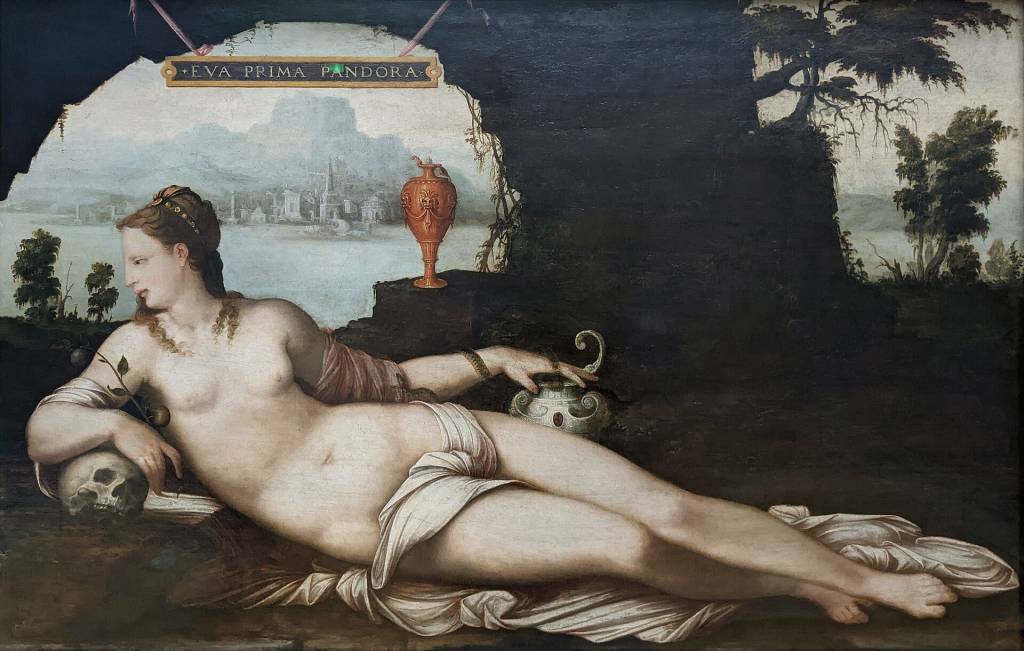
Before trying to interpret Eva Prima Pandora, it is worth simply looking at what Jean Cousin the Elder actually put on the panel. The painting was made in France sometime after 1549, probably around 1550, during the French Renaissance. Cousin, sometimes called Jean Cousin the Father or Jean Cousin the Elder, was associated with what became known as the School of Fontainebleau. The work is oil on oak and is surprisingly large, about three feet high and five feet wide. Today it is in the Musée du Louvre in Paris, where it is displayed in the Richelieu Wing, Room 823.
First, it helps to understand something about the world Jean Cousin was working in. He was part of the French Renaissance, a period when Christian thought and the rediscovery of the classical world often existed side by side. Biblical stories, Greek and Roman mythology, classical forms, and Christian symbolism could all become part of the same artistic vocabulary. That helps explain why Cousin could place Eve and Pandora together in a single image without treating the combination as strange or contradictory. To an educated sixteenth-century audience, those two stories could be read in conversation with one another and not necessarily in opposition.
There is also a more immediate connection. Cousin had participated in the elaborate decorations created for King Henri II’s royal entry into Paris in 1549. One of the displays at the Châtelet depicted Paris personified as “Lutetia nova Pandora,” or “Paris, the new Pandora.” The Louvre specifically connects Eva Prima Pandora, painted sometime after 1549, with that earlier royal decoration. This tells us that Pandora was not simply an ancient mythological figure floating somewhere in the background of Cousin’s education. She was part of the visual and symbolic language he was actively using.
This detail is especially useful because Pandora, like nudity, did not carry only one meaning. In the royal entry, she was not simply the woman associated with the release of evil into the world. She could also represent gifts and abundance from the gods. There was a duality to Pandora, and Cousin’s earlier work hints at it.
Within the painting itself, a nude woman dominates the scene, reclining across the foreground. She is stretched almost horizontally across the composition, her body occupying much of the available space. She does not appear startled or caught in motion. Instead, she seems remarkably calm, almost posed, with one arm supporting her head while the other reaches toward a large vessel beside her.
Around her are several details that are easy to overlook if our attention stops at the naked figure. Beneath or near her supporting arm is a human skull. A serpent winds around her other arm and toward the vessel. Nearby are a branch from an apple tree and fruit. Beside her sits the large jar or vessel. Above the figure is a cartouche bearing the Latin inscription “EVA PRIMA PANDORA.” The Louvre itself identifies the apple branch, apple, vessel, serpent, and inscription among the significant features of the painting.
The setting is also worth noticing. She is lying inside what appears at first glance, what looked to me to be some sort of ruined structure or cave. However, France’s Ministry of Culture describes it as a dark grotto opened by two arches onto a landscape. The distinction is interesting visually because the space seems to combine something natural and something architectural. Through the openings we can see a much brighter world outside: water, land, vegetation, buildings, and a distant city. The reclining woman occupies the darker foreground, while the landscape beyond her opens into the distance.
So before we begin interpreting the painting, we already have two layers of context in front of us. We know something about Cousin’s cultural world and the way Renaissance artists could bring Christian and classical traditions together. We also have a dense visual vocabulary within the painting itself: a reclining nude woman, a skull, a serpent, fruit and an apple branch, a vessel, a dark grotto, architectural openings, water, a distant city, and the words Eva Prima Pandora written above it all. Taken together, these details give us the context we need to begin asking what the painting is trying to say.
Interpretation
Let’s start with the obvious Latin words in the painting. Above the reclining woman Cousin gives us the inscription EVA PRIMA PANDORA which translates to “Eve, the first Pandora.” Before we have interpreted the skull, serpent, jar, fruit, or even the nudity, Cousin has already told us that we are supposed to bring two different stories together. One comes from the Old Testament creation narrative; the other comes from Greek mythology. The Louvre describes the painting explicitly as an assimilation of Eve and Pandora.
That is evocative by itself. What does Eve have to do with Pandora? Well, let’s see. Both are “first women,” and both stand near the beginning of stories attempting to explain something about the human condition. Eve participates in the Fall, after which Adam and Eve are expelled from Eden and mortality becomes part of the human story. In that sense, Eve’s actions are associated with the entrance of pain and suffering into human experience. Yet Eve is also called “the mother of all living” in Genesis 3:20. She is therefore associated not simply with the Fall, but with human life itself. Pandora likewise carries a certain duality. In Hesiod’s story, she becomes associated with the release of suffering into human existence. Yet, as we have already seen, Cousin’s own culture could also use Pandora as a symbol of gifts and abundance. Neither figure is quite as simple as “the woman who ruined everything.” It is far more complex.
There is another important connection with Eve that brings us directly back to nudity. Before the Fall, Genesis tells us that Adam and Eve “were both naked, and were not ashamed” (Genesis 2:25). Nakedness therefore belongs to the pre-Fall human condition. In that context, nudity can suggest innocence, openness, and humanity before shame entered the story. Cousin’s nude figure can reasonably call some of that visual vocabulary to mind. Notice also that the serpent is present, while the apples, or fruit, appear untouched. In that sense, the scene seems to place us before the Fall, or perhaps at the moment just before it. At least, that is how I think we are meant to interpret it.
But I would hesitate to say that her nudity means only “innocence.” This is not simply an illustration of Eve walking naked through Eden. It is an allegorical nude, a human figure being used to embody ideas larger than an individual person. That kind of symbolic use of the nude was very much at home in the Renaissance world in which Cousin was working, particularly around the School of Fontainebleau. Cousin seems to be showing us something closer to primordial or archetypal Woman: the human creature near the beginning of the story.
Seen that way, the unadorned body can also suggest beginning. Eve is presented in Genesis as the first woman and later called “the mother of all living.” She enters the story without clothing, just as each of us enters the world without clothing. The naked body can therefore evoke humanity as it was created, before culture, status, fashion, or social convention is layered onto it. In this painting, nudity may be doing more than showing innocence; it may also be helping Cousin represent humanity at its beginning and how we all enter the world
Moving on from the inscription, the symbols surrounding the woman reinforce the connection between Eve and Pandora. Although, without the inscription, I am not sure I would immediately have associated this figure with Pandora. The Eve imagery is much more obvious. The inscription gives us the key, and the surrounding symbols help confirm how Cousin wants us to read the figure.
The apple branch and fruit point toward Eve and the Fall, although it is worth remembering that Genesis never actually identifies the forbidden fruit as an apple. That association belongs to the later Western visual lexicon. The serpent makes the connection with Genesis even stronger.
The large vessel beside her points toward Pandora. Interestingly, the familiar expression “Pandora’s box” does not come from Hesiod’s original story. Hesiod describes a πίθος (pithos, large storage jar), not a box. The box entered the Western tradition during the Renaissance, apparently through Erasmus’s rendering of the story. By Cousin’s time, that version was already circulating, yet Cousin depicts a vessel rather than a box. That seems to keep his imagery closer to the older classical tradition.
Then there is the skull, resting beneath the arm of this beautiful and very much alive woman. It introduces mortality into the scene almost abruptly. Life and death are placed beside one another. The Louvre specifically identifies the apple branch, fruit, serpent, and vessel as elements that bring the stories of Eve and Pandora together.
Let’s do the symbolic math. Visually, we could almost reduce the painting to a formula:
Eve + fruit + serpent + skull (mortality)
combined with
Pandora + jar + the entrance of suffering
gives us
a Renaissance meditation on humanity’s loss of an original blessed condition and its entrance into suffering and mortality.
Two different cultural stories have been placed on top of one another. Cousin has turned Eve and Pandora into one symbolic woman, then surrounded her with enough visual clues for an educated Renaissance viewer to move back and forth between the two stories. The naked body becomes a symbol of the human condition itself: life, suffering, vulnerability, and mortality.
These are among the most universal experiences of being human. And yet we seem to carry within us a longing for something beyond them, for a condition in which suffering and death no longer have the final word. I have always found that interesting. Why do we protest so strongly against mortality if mortality is simply the way things are? How are we even able to imagine a world without suffering and death if nothing like it ever was, or ever could be? But now I am wandering into a question that probably deserves its own blog post.
There is, however, an uncomfortable dimension to all this that we should not ignore. Both Eve and Pandora have often been used in Western culture as explanations for how trouble entered the world, and that can easily become a sexist story about woman as the source of humanity’s problems. A modern person may understandably react against that.
We should notice it, but we should also be careful about presentism where we judging people of the past primarily through the assumptions and moral categories of our own time without first trying to understand theirs. Understanding historical context does not mean endorsing everything within it. Renaissance viewers inherited cultural assumptions about women, Eve, temptation, sexuality, and the Fall that may be uncomfortable to us today. Those assumptions were part of the cultural soup in which Cousin and his first viewers lived.
At the same time, I do not think the painting allows us simply to say, “Cousin is blaming women for everything.” That goes beyond what we can know about his intention. Genesis itself does not place responsibility upon Eve alone; Adam participates in the Fall as well. And Cousin’s own recent use of Pandora imagery shows that he knew Pandora could represent gifts as well as calamity. The better approach is to recognize the cultural associations available to his audience without pretending we can read Cousin’s mind. And there is a lot more happening here than blame anyway.
Look again at the woman herself. She is beautiful, idealized, naked, and remarkably tranquil. Yet beside and around that beautiful body are a skull, a serpent, forbidden fruit, and Pandora’s vessel. Beauty, innocence, temptation, knowledge, suffering, and death occupy the same space. The catastrophe of the human condition has been compressed into a handful of symbols surrounding an almost serene human figure.
Peel back the onion and there are layers upon layers. But then again, that is humanity. We are complex creatures, and the human condition is complex as well. Beauty and suffering, innocence and temptation, life and mortality are not neatly separated from one another. They overlap, sometimes uncomfortably, in the same human story.
That makes Eva Prima Pandora considerably more interesting to me than a simple “Eve caused the Fall” painting. It begins to look like a meditation on the paradox of being human. We are beautiful creatures capable of knowledge and choice, yet we live with temptation, suffering, mortality, and consequences. The same human being can carry innocence and danger, life and death, blessing and trouble. Perhaps that is why the tranquility of the woman seems almost unsettling. She rests calmly in the middle of everything that makes the human condition so complicated.
There may be still deeper layers, although here I think we need to become more cautious. For example, France’s official art-history portal suggests that the figure may also evoke Cleopatra. That interpretation is at least plausible. The serpent can recall the traditional account of Cleopatra’s suicide, her profile is presented in a Greek manner, and Cleopatra herself belonged to the Greek Ptolemaic dynasty of Egypt. The distant ancient city has also been interpreted as possibly suggesting Hellenistic Egypt. But notice the change in certainty: Eve and Pandora are literally named and supported by several obvious attributes; Cleopatra must be inferred. Although if it is Eve in the Garden, what then is the City in the background.
Even more of a stretch is the proposed connection with Mary Magdalene. The GrandPalaisRmn analysis points not primarily to the jar, as I initially wondered when I heard about the possibility of Mary, but to the grotto, the nudity, and especially the skull. In later Western Christian imagery, the penitent Magdalene could be depicted withdrawing into the wilderness or a grotto, sometimes nude or clothed only by her long hair. In that setting, the nudity could symbolize the stripping away of worldly possessions, status, adornment, and vanity or better, a human being reduced, in a sense, to herself before God. The skull reinforces that meditation on mortality and the passing nature of worldly things.
Interestingly, Cousin’s composition was adapted not long afterward into a relief representing Mary Magdalene at the church of Saint-Maurice in Sens. That tells us that at least some later viewers could see Magdalene imagery in Eva Prima Pandora. But we need to be careful with the direction of the evidence. It may tell us more about how Cousin’s painting was received and reinterpreted than about what Cousin himself intended. Eve and Pandora are explicit; Mary Magdalene remains a possible additional layer.
So I would treat Cleopatra and Mary Magdalene as possible echoes rather than the central message of the painting. Eve and Pandora are written into the work in capital letters. Cleopatra and Magdalene require us to listen for quieter notes in the background.
And perhaps that is the best way to approach Eva Prima Pandora. It is not a rebus in which every object has one fixed answer. Cousin seems to be working with overlapping symbols whose meanings accumulate as we recognize them. The nudity is part of that vocabulary, but it does not say “sex” or “lust” by itself. In this painting it participates in a much larger visual sentence about primordial humanity, innocence, beauty, temptation, suffering, mortality, and the strange mixture of blessing and trouble that accompanies being human.
Conclusion
I have found Eva Prima Pandora unusually evocative, mostly because of how densely layered it is. Cousin was clearly working with at least two women, Eve and Pandora, and possibly with echoes of Cleopatra and Mary Magdalene as well. The possibility of four women occupying the same symbolic figure is intriguing to me. I like to think Cousin may have intended all four, although I am not sure the evidence is strong enough to say that with confidence.
What does seem clear is that he was doing more than painting an individual woman. He was working with something closer to a primordial or archetypal woman, a figure capable of carrying several stories at once. Eve, Pandora, perhaps Cleopatra, perhaps Mary Magdalene. And once we begin thinking in those terms, the possibilities widen. Many women in history and mythology could, in some sense, be seen through this figure because the painting is dealing with themes larger than any one person: life, beauty, temptation, suffering, mortality, repentance, and the strange mixture of blessing and trouble that comes with being human.
That may be what I find most compelling about the painting. The longer I look at it, the less it seems to be about a naked woman and the more it seems to be about humanity itself. Cousin gives us a body, but then layers story upon story around it. The nudity is part of the visual vocabulary, but it does not finish the sentence. If anything, it invites us to keep reading.
References
- Buron, E. (2000). La nouvelle Pandore. L’invention d’Eva prima Pandora de Jean Cousin le père et les lectures de la fable de Pandore au moment de sa redécouverte en France. Journal de la Renaissance, 1, 275–304.
- Hesiod. (1914). Works and days (H. G. Evelyn-White, Trans.). In H. G. Evelyn-White, Hesiod, the Homeric hymns and Homerica. William Heinemann; The Macmillan Co. (Original work composed ca. 700 BCE). Perseus/Scaife ATLAS. Scaife ATLAS
- Musée du Louvre. (2026, July 3). Eva prima Pandora. Louvre Collections. . Louvre collection record
- Panofsky, D., & Panofsky, E. (1956). Pandora’s box: The changing aspects of a mythical symbol. Pantheon Books.
- Vaulet-Lagnier, M.-B. (2024, March 7). Eva prima Pandora. Panorama de l’art. Eva prima Pandora — Panorama de l’art
Excerpt
Jean Cousin the Elder’s Eva Prima Pandora brings together classical mythology and Christian theology, linking Pandora and Eve through themes of beauty, temptation, sin, and humanity’s fall. This Renaissance masterpiece invites us to explore how art reveals the evolving relationship between ancient mythology and Christian thought.
You have aroused my curiosity.


Leave a Reply