
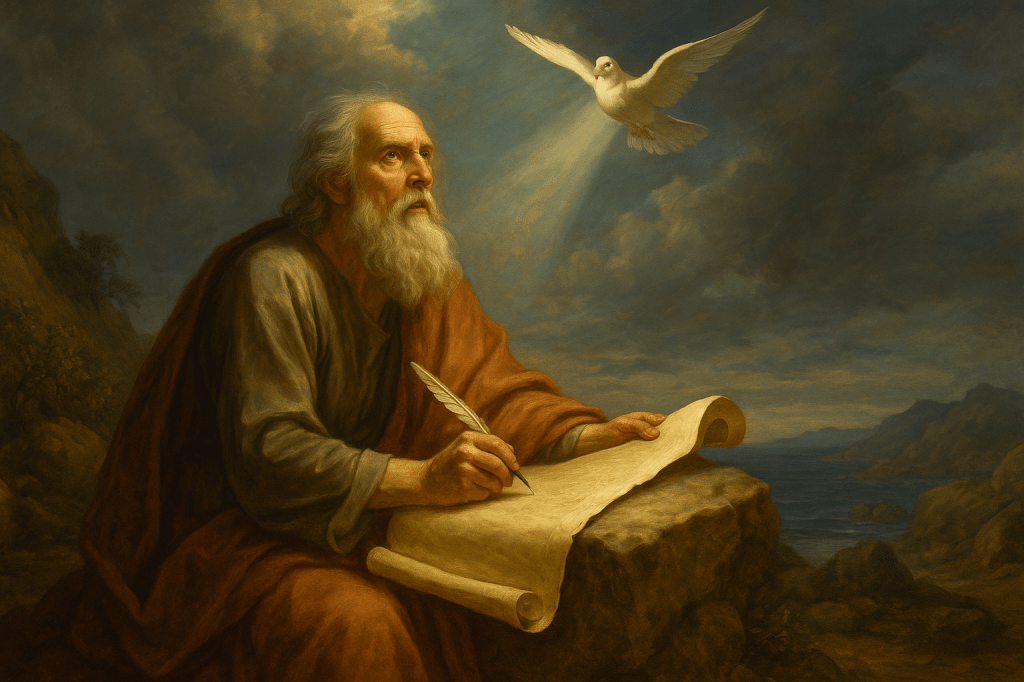
This reflection is part of a larger series of posts growing out of my Lectio Divina reading of John 1. I have been trying to sit with the chapter slowly, not rushing to master it, but allowing its words, images, titles, and details to work on me. John 1 is rich enough to reward careful study, but it also invites prayerful attention. Again and again, I find that the text does not merely give me ideas to analyze; it calls me back to Christ Himself, the Word made flesh, who invites us not only to understand, but to abide.
Hints of Authenticity
One thing I noticed while sitting with John 1 was what I would call hints of authenticity. John gives us concrete details. He names places. He locates events. He speaks of “Bethany across the Jordan.” He gives relative locations and small bits of local color. He also pauses to explain Hebrew or Aramaic terms for his readers, such as “Rabbi,” adding, “which means Teacher.” These are small details, but they matter. They hint at the authenticity of the Gospel.
By themselves, they do not prove everything. A detail is not the same thing as an argument. But taken together, these details give John’s Gospel the feel of remembered reality. They sound like someone writing about real places, real people, real conversations, and real encounters. A later writer far removed from the land, language, and culture of the Levant would not easily have had this kind of knowledge, especially in a world where information was not instantly searchable. So yes, these hints of authenticity can strengthen our historical confidence.
But then I have to ask a deeper question: does noticing these details draw me closer to God?
It can help strengthen my confidence in Scripture, and that is important. There are difficult passages in the Bible for sure. There are hard questions. There are places where readers wrestle with apparent tensions, challenges, and perceived contradictions. So it is worth noticing the concrete details that provide a kind of counterweight. They remind us that John is not writing in the mist of abstraction. He is writing about something that happened in the real world.
And yet, the Bible, properly understood, is not merely a historical record preserved for our curiosity. It is also, in a deep sense, a love letter from our Creator. The small facts matter, but if this is a love letter, then I have to ask whether I am focusing on the right thing. Or perhaps better, whether I am giving each thing the attention it deserves. A detail can be important without being the most important. We might say this is a matter of majoring on the majors and minoring on the minors. The details deserve attention, but they are meant to serve the larger picture.
Many things matter. Theology matters. Doctrine matters. Truth matters. Historical confidence matters. But we must not lose sight of the forest for the trees. There is a way of thinking about God that can remain safely above us, distant enough to admire, analyze, defend, and discuss, while never quite allowing Him to enter the actual rooms of our lives.
That may be one of the temptations in the spiritual life: to love the grand idea of God more than the concrete presence of Christ. John does not let us view God from a distance for very long.
John is masterful, yes, but not merely as a stylist. He is masterful as a spiritual guide. He teaches us that the eternal meaning of all things has a face, a voice, a body, relationships, meals, wounds, and acts of love. The Logos becomes σάρξ, (sarx, flesh).
ὁ λόγος σὰρξ ἐγένετο
The Infinite does not cancel the concrete world as we know it. He enters it.
This is one reason John can be so powerful for formation, and perhaps why I started with the Book of John for my series on lectio divina. He keeps calling us back from abstraction to encounter. He does not allow the Word, the Logos, to remain only an idea to contemplate. The Logos becomes someone to receive, follow, abide in, obey, and love.
There is also a quiet warning here. Sometimes “Logos” language can give us a place to hide. We can stay in the head because the heart and the body are harder places of surrender. Thought can become a sanctuary from obedience. Analysis can become a substitute for trust. Theological beauty can become something we admire from a distance rather than something that remakes us from within.
But John will not let the Word remain safely abstract. He takes us on a journey with the Logos. He brings us from “In the beginning” to the Word becoming flesh. Then he leads us onward: to water, to wine, to hunger, to tears, to friendship, to betrayal, to wounds, and finally to breakfast on the shore.
So perhaps one test of whether I am reading John well is not only whether I understand his theology, but whether the Word is becoming fleshly in me, in a secondary and creaturely sense, through embodied discipleship. Is the truth I confess becoming visible in my speech, my habits, my reactions, my relationships, and my love?
Where am I tempted to keep Jesus as a magnificent idea rather than welcome Him into my actual life?
That question has stayed with me because it touches something deep in my own journey. I have an advanced degree in theology and philosophy so I naturally lean toward technical clarity, careful definitions, philosophical distinctions, and the defense of truth. That is not a bad thing. In fact, I believe it is a gift. The Church needs people who can think clearly, speak carefully, and defend the faith faithfully.
But every gift casts a shadow when it is not continually surrendered to God. The shadow of the academic is the temptation to treat truth mainly as something to defend rather than Someone to receive, love, and obey. The shadow of philosophical theology is the temptation to admire coherence more than holiness. The shadow of technical language is the temptation to substitute accurate speech about union with Christ for actual yielding to Christ.
That is where this reflection surprised me. I began by noticing hints of authenticity in John’s Gospel: the concrete details, the narrative texture, the local color, the feel of remembered places and encounters. These things can strengthen historical confidence, and I think that matters. But the deeper gift was not only historical. It was spiritual.
I began to recognize that I can sometimes keep God at a safe distance. Perhaps many of us do. We turn Him into a subject to study rather than a Person to know, love, trust, and obey. The details matter. The place names matter. The historical texture matters. But they are not the main event. What good is it to notice the costumes of the actors and miss the play? What good is it to admire the scenery and never enter the story? John’s concrete details should not leave me standing outside the Gospel with a notebook in my hand. They should draw me further in, until I meet the living Christ who walks through those details and calls me to follow.
That realization brings me back to my ongoing journey of exploration with God, especially around perichoretic salvation, or what I have described as dancing with God. There is a real danger here too. We can become so fascinated by the architecture of the mystery that we remain standing outside it. We can study communion without consenting to communion. We can define participation, defend indwelling, trace the logic of union with Christ, and still keep Christ at a contemplative distance.
If “Christ in me and me in Christ” remains only a theological model, then it can become another fascinating object of study. But if it is truly participatory, then the doctrine itself presses us toward lived communion. The point is not only to say that salvation includes indwelling, participation, mutual abiding, and life in God by grace. The point is to ask whether I am actually opening myself to that life.
Life, after all, is a dance with God. We can sit on the sidelines and discuss the movements, analyze the steps, admire the harmony, and even describe the beauty of the dance with great precision. But we are not invited merely to observe. We are invited onto the dance floor. We are invited to dance with God and let Him teach us the movements from within the experience itself. He leads, and we learn to follow. He steadies what is awkward, corrects what is out of rhythm, and forms in us the grace to move in harmony with His life. The point is not only to understand the dance, but to enter it.
There is a danger in focused study: the danger of missing the main event. But there is grace even in noticing the danger. It is one thing to be tempted by abstraction. It is another thing to become aware that abstraction may be functioning as a buffer against intimacy. That awareness can become a turning point. Perhaps God is doing His work in me. He is not merely informing my Christology. He is drawing me from analysis toward relationship, from concept toward communion, from proving toward abiding. And that, my dear friends, is the point of Lectio Divina.
So the next movement is not to abandon careful thought. It is to subordinate it. Let theology become servant rather than master. Let apologetics clear obstacles, but not become the destination. Let philosophical precision help protect the mystery without replacing the mystery. Let doctrine lead to adoration. Let the concept lead to consent. Let the argument lead to surrender.
The Word became flesh. And now, by grace, the Word must become visible in us. Not as another incarnation. Not as though we become Christ by nature. But as those who are joined to Him, indwelt by Him, transformed by Him, and sent into the world to bear witness to His light. That is where the hints of authenticity become more than historical observations. They remind me that Jesus entered a real world of rivers, towns, names, bodies, questions, meals, friendships, and wounds. And therefore, He wants to enter mine.
This reminds me of Garth Brooks’ “Standing Outside the Fire.” There is something in that image that belongs here. We can stay at a safe distance from truth, close enough to admire its warmth, but far enough away that it never costs us anything. We can study love, define love, defend love, and still refuse to let love in. But the life Christ invites us into is not lived from the sidelines. It is not found by standing outside the fire, watching safely from a distance. At some point, love must be received. At some point, surrender must become more than an idea. We have to let divine love in, and then let it go through us into the world.
“Life is not tried, it is merely survived
If you’re standing outside the fire
There’s this love that is burning
Deep in my soul
Constantly yearning to get out of control
Wanting to fly higher and higher
I can’t abide
Standing outside the fire”
Prayer
Lord Jesus Christ, eternal Word made flesh, keep me from loving the idea of You more than Your living presence.
Thank You for the gift of thought, study, reason, and careful theology. Teach me to use those gifts faithfully, but never let them become a hiding place from surrender.
Draw me beyond abstraction into communion. Let what I believe become visible in how I live, speak, listen, love, forgive, and obey.
Teach me to abide in You, not merely to describe abiding. Teach me to participate in Your life, not merely to admire the idea of participation. Let my theology become prayer, my arguments become surrender, and my knowledge become love.
Holy Spirit, make me attentive to the concrete places where Christ is inviting me to yield. Let the Word become fleshly in my life through embodied discipleship, humble obedience, and holy agapē.
Amen.
Reflection
- Am I abiding?
- Am I letting Christ reorder my loves, speech, reactions, habits, and body?
- Am I allowing the dance to become more than vocabulary?
- When you think about union with Christ or perichoretic salvation, are you most energized by getting the formulation right, or by becoming more available to Christ?
- What concrete practice would show that your theology of indwelling is becoming an actual way of living with God rather than a beautiful description of it?
Excerpt
John’s concrete details can strengthen our confidence, but they also ask a deeper question: will we merely study the Gospel, or enter the life it reveals? The Word became flesh, inviting us from analysis into communion, from observation into surrender, and from concept into abiding love.
For Those With Eyes to See

 Treasures of the Elysian Fields
Leave a comment