
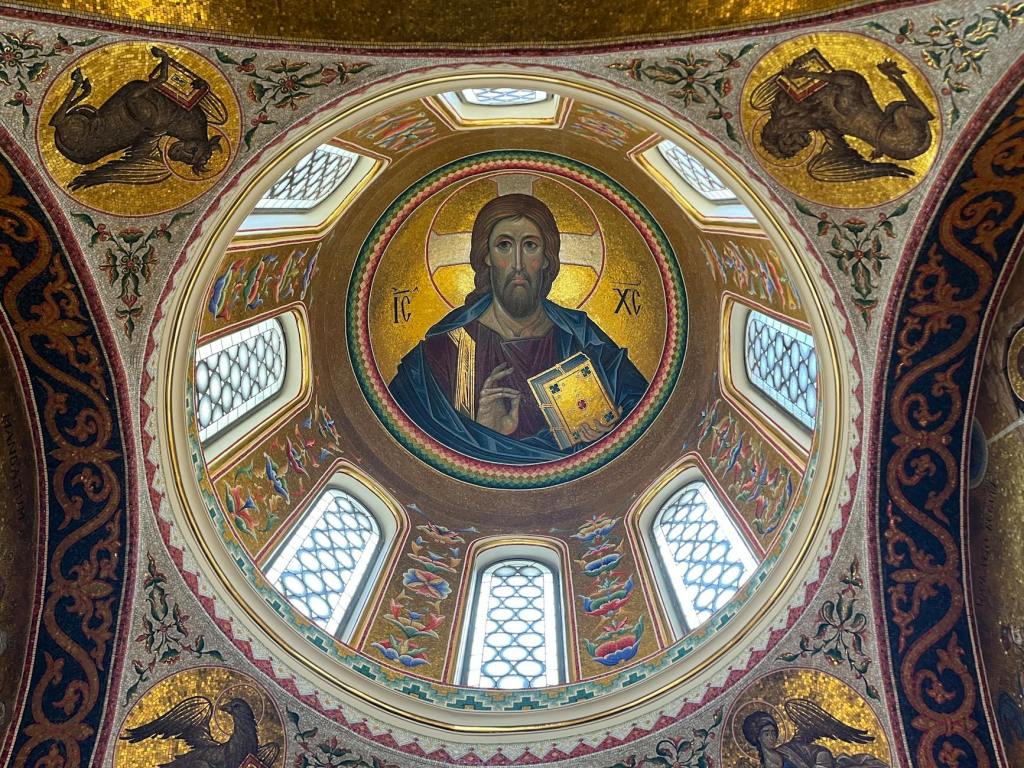
The church does not need a compromise between competing errors. It needs to be rightly ordered under Christ, who is its center, its focus, and its foundation.
Paul recognized this danger very early. The church at Corinth was already being pulled apart by misplaced loyalties. One person claimed Paul, another Apollos, as though the life of the church could be built on human names. Paul cuts through that confusion with remarkable clarity. Ministers are servants. Christ is the center, the focus, and the foundation of the church. He is the one to whom the church belongs and the one around whom everything else must be ordered. When a Christian community begins to gather itself around something other than Him, even something meaningful or worthwhile, things begin to slip out of order. The problem is not that leadership exists. The problem is that our loves become disordered and our loyalties begin to settle in places they were never meant to rest.
And if we are honest, this is still our problem. The names change, but the temptation remains. We still gather ourselves around teachers, movements, causes, styles, political instincts, and preferred emphases. We do it on the left and on the right. We do it with doctrine and with justice. We do it with aesthetics and with tone. Often these things matter, and sometimes they matter deeply. But when anything secondary begins to function as the center, the church begins to lose its balance. What should remain fixed on Christ as its true focus begins instead to orbit something smaller. When that happens, we are no longer building on the right foundation. That is when confusion begins to spread, and with it, the subtle unraveling of our witness. Beneath so many of our divisions is the same old Corinthian impulse: we keep losing sight of the One who must remain at the center.
“When one of you says, “I am a follower of Paul,” and another says, “I follow Apollos,” aren’t you acting just like people of the world? After all, who is Apollos? Who is Paul? We are only God’s servants through whom you believed the Good News. Each of us did the work the Lord gave us. I planted the seed in your hearts, and Apollos watered it, but it was God who made it grow. It’s not important who does the planting, or who does the watering. What’s important is that God makes the seed grow. The one who plants and the one who waters work together with the same purpose. And both will be rewarded for their own hard work. For we are both God’s workers. And you are God’s field. You are God’s building. Because of God’s grace to me, I have laid the foundation like an expert builder. Now others are building on it. But whoever is building on this foundation must be very careful. For no one can lay any foundation other than the one we already have—Jesus Christ.” 1 Co 3:4–11 (NLT)
That is why I do not believe the answer is some bland middle ground. There is no faithful compromise between truth and falsehood, holiness and sin, faithfulness and surrender. The church does not need a little less truth and a little more love, or a little less doctrine and a little more justice. It needs right alignment. When Christ is no longer the true center, focus, and foundation, even sincere convictions begin to drift out of order. What should have been held in orbit around Him begins to revolve around something smaller. Then truth can become a weapon, love can become sentimentality, action can become mere activism, politics can become captivity, and theology can harden into tribal identity. The church does not drift because Christians care too much about important things. It drifts because important things begin to function as ultimate things, even though they were never meant to bear that weight. I found myself pressed to write this after reading a recent post on “Third Way Christianity,” which argued that Christian allegiance must not be captured by the categories of left or right, but must remain with Christ alone. That resonated with other things God has been teaching me, because the issue is not moderation for its own sake. The issue is whether everything has remained rightly ordered under the One who alone can hold it together.
This is part of why I think Tim Keller’s “third way” language has resonated with so many Christians. At his best, Keller was not urging believers toward moderation for its own sake, as though faithfulness could be found simply by standing somewhere between two extremes. He was pointing to something deeper. The gospel does not sit comfortably inside the categories of left and right because neither side can bear the weight of being the church’s center or focus. Both offer visions that are too small, too thin, too reductionistic to hold what belongs to Christ alone. Keller saw that clearly. As Kathy Keller summarized his counsel, Christians must be pointed back to Christ, because their identity is in Him and not in a political party, and because the gospel must shape politics rather than politics shaping faith. That is not a call to bland centrism. It is a call to recover right order by returning the church to its true center.
N. T. Wright and Michael Bird press on this same wound, though from the vantage point of political theology and kingdom witness. In Jesus and the Powers, they describe parts of the church as holding tightly to things that are truly Christian, yet holding them apart from one another in ways that leave the whole misshapen. On one side is a cross-focused Christianity, steadfast in proclaiming sin, atonement, and justification, yet often uncertain what to do with Jesus’ kingdom ministry except treat it as a kind of prelude. On the other side is a kingdom-focused Christianity, alive to justice, mercy, healing, and embodied love, yet often uneasy with the cross as the decisive center of redemption. As Wright and Bird put it, both sides “latched on to something quite right,” yet they “pulled apart what belonged together.” That is the heart of their concern.
The cross without the kingdom can shrink into a privatized faith, as though salvation were only about personal forgiveness and not the reign of Christ over the whole of life. The kingdom without the cross can thin into activism without atonement, as though transformation could be proclaimed without reckoning with sin, repentance, and the need for redemption. So again, the answer is not to divide the difference between them, nor to let one church preach the cross while another performs mercy. It is to recover what was torn apart and return to Jesus Christ, in whom cross and kingdom belong together, as the church’s true center, proper focus, and only sure foundation.
“What is clearly not in mind is that preaching the cross to the ‘lost’ would happen in one church while acts of mercy for the poor would happen in another church.” – Wright/Bird
That same pattern also helps explain why Wright and Bird reject Christian nationalism. Their concern is not that public life is unimportant or that Christians should have nothing to say about politics. Their concern is that when allegiance to Christ becomes entangled with allegiance to a nation, something has gone badly out of order. The church is not the possession of any one people, party, or state. It is transnational, multi-ethnic, and oriented toward the kingdom of God. For that reason, Wright and Bird argue that a certain kind of secularity is better than Christian nationalism, because Christian nationalism tempts the church to confuse the rule of Christ with the interests of the nation. And when that fusion happens, the church’s witness does not become stronger. It becomes distorted. Politics still matters, but it becomes idolatrous whenever it asks to stand where Christ alone must stand, at the center, as the church’s true focus and foundation.
Dallas Willard reaches this same ground by a different path. In The Divine Conspiracy, he warns against what he calls “gospels of sin management.” On the theological right, the gospel is reduced to the forgiveness of individual sins. On the left, it is reduced to the removal of social and structural evils. Willard does not deny the importance of either one. He does not minimize forgiveness, nor does He dismiss the reality of social evil. His concern is that both right and left can take something real and necessary and make it carry more than it was meant to bear. When that happens, the gospel is reduced, and “transformation of life and character is no part of the redemptive message.” What is lost is a living framework for discipleship, the actual formation of persons who learn to live under the reign of God. That is what makes his criticism so piercing. He is not asking us to choose between personal salvation and the healing of the world. He is reminding us that both are too small when detached from the larger reality of life with Christ in the kingdom now. And then he asks the question that cuts straight through our evasions: how is it possible to trust Christ for the next life without trusting Him for this one?
That question becomes one of the clearest bridges between these voices. Keller keeps pointing the church back to Christ over party. Wright and Bird keep pointing the church back to kingdom over captivity. Willard keeps pointing the church back to discipleship and transformation over reduced gospels. They are not making identical arguments, and they are not using the same vocabulary, yet they are moving around the same center. Each, in his own way, is warning that Christians have a habit of taking something good, necessary, and secondary and asking it to sit in the place that belongs to Christ alone. And when that happens, we should not be surprised that faith begins to feel fragmented, that witness begins to feel compromised, and that people in the church can be full of passion while still being profoundly out of alignment.
That is where I think my earlier reflection on orthodoxy, orthopraxy, and orthopathy belongs in this conversation. I have come to believe that these are not rival emphases competing for space in the Christian life, but dimensions of wholeness before God. Orthodoxy guards truth. Orthopraxy embodies truth in action. Orthopathy loves what is true and good. Yet none of these can remain healthy if they are severed from the living Christ from whom they are meant to flow. Cut off from indwelling participation in Him, orthodoxy can harden into ideology, orthopraxy can slide into activism, and orthopathy can drift into sentimentality. That is not a minor adjustment in language. It means the church’s problem is not merely imbalance between competing emphases. It is something deeper. It is disconnection. It is loss of center, loss of focus, loss of foundation.
That same dynamic also helps explain both Christian nationalism and progressive Christianity. They are not the same thing. They arise from different instincts, speak in different vocabularies, and carry different dangers. But both can become examples of what happens when Christ is no longer the church’s living center. Christian nationalism can subordinate the church to nation, grievance, and the pursuit of power. Progressive Christianity can subordinate the church to therapeutic or political visions of inclusion detached from the living Christ. In one of my earlier reflections on Christian nationalism, I tried to put the matter plainly: things are not Christian; people are. I also argued that when church and state are fused, the state is not baptized so much as the church is hollowed out. And in that earlier reflection on orthodoxy, orthopraxy, and orthopathy, I came back to the same conclusion that keeps surfacing here as well: the deepest problem is not choosing between doctrine, action, and affection, but forgetting that what belongs together can only remain together in Christ.
That is why Paul’s rebuke to Corinth still speaks with such force. The personality cults of his day were only the early expression of a temptation that has never really left the church. One says, “I follow Paul,” and another, “I follow Apollos.” Later generations say, “I follow this party,” “I follow this movement,” “I follow this theological camp,” or “I follow this tribe.” The names change, but the disorder remains. And all the while, we may still speak fluent Christian language. We may still name Christ with our lips. But that alone is not the test. The real question is whether He remains central, whether He is still the church’s true focus and foundation. The issue is not whether doctrine matters, or justice matters, or public witness matters, or spiritual affections matter. Of course they do. The issue is whether these goods remain in their proper orbit around Christ, or whether Christ has been pushed toward the edges while one of those secondary goods quietly takes the throne.
This also helps explain why there is no true midpoint between truth and love. In Jesus, truth and love are not set against one another as though faithfulness required choosing which to preserve. They are one. As I wrote earlier, they are not balanced like opposing weights on a scale when we abide in Christ. They are united as facets of a single life. The more deeply we participate in Him, the less need we feel to choose between being truthful and being loving, because in Him the two are not enemies. If they begin to feel like competing values to be managed, that may already be a sign that we have drifted from the center and are trying to hold together, by our own effort, what can only remain whole in communion with Him.
So the way forward is not the creation of a new faction for people who are tired of factions. It is not a more sophisticated middle tribe for weary Christians trying to escape the noise. It is not a negotiated settlement between orthodoxy and orthopraxy, between cultural engagement and doctrinal seriousness, or between grace and truth. It is something deeper than all of that. It is union. It is abiding. It is Christ in us. In that earlier reflection, I wrote that the church does not need a new tribe but a deeper center, and I still believe that is true. What we need is communion, participation, indwelling union with the Triune God. Dallas Willard reaches for this same reality when he speaks of eternal life not as mere information about God, but as interactive relationship with Him, and when he grieves that Jesus’ present invitation into that life is so often ignored in favor of reduced messages. I feel the weight of that. Because once Christlikeness is treated as optional, impossible, or irrelevant, we have already settled for far too little.
“But what then are we to say about the multitudes, right and left along the theological spectrum, who today self-identify as Christians while having hardly a whiff of Christlikeness about them and no idea that it might even be possible—who perhaps even have a settled conviction that genuine Christlikeness is impossible? What is the gospel they have heard?” – Dallas Willard
If that is true, then many of our arguments in the church are not merely disagreements about emphasis. They are signs of a deeper loss of focus. We have tried to answer spiritual disintegration with better rhetoric, sharper institutions, stronger tribes, and more effective activism. But none of those can restore what has come apart at the center. Only Christ can hold together what belongs together. Only He can keep truth from becoming harsh, love from becoming vague, justice from becoming ideological, doctrine from becoming tribal, and politics from becoming idolatrous. So the answer is not less conviction. It is more Christ. The answer is not compromise. It is right order.
If this loss of center were only an internal church problem, it would still matter. But it is not staying inside the walls. The fragmentation is now showing up in the wider religious landscape as well. Pew’s 2023–24 Religious Landscape Study found that 35% of U.S. adults no longer identify with the religion in which they were raised. That includes movement between Christian traditions as well as movement out of Christianity altogether. PRRI’s 2024 reporting helps illuminate some of the reasons behind that churn. Among Americans who left a former religious tradition, many pointed to more than one cause: 56% said they stopped believing its teachings, 30% cited negative teachings about LGBTQ people, 27% pointed to scandals involving leaders, 18% referenced a traumatic personal event, and 17% said their church had become too focused on politics.
Some of that movement is plainly driven by pain, disillusionment, scandal, politicization, or outright loss of belief. Those departures should be approached with care, because leaving a church does not necessarily mean moving closer to Christ. In many cases, it may simply mean leaving one form of misalignment for another. But not every move is the same. Sometimes a change of tradition is not a departure from Christ, but an attempt to find Him more fully at the center, more clearly in focus, and more firmly as foundation.
It is grievous to see so many Christians grasping for something more when, in the deepest sense, what they most need is Christ Himself. Many of them seem to know something is wrong. They can feel the thinness, the fragmentation, the instability. They know the church they have known is not holding together what ought to remain whole. But knowing there is a problem is not the same as knowing where to turn. Hunger can drive a person toward bread, but it can also drive him toward substitutes.
Hank Hanegraaff may be a better example of that second kind of movement. In the public discussion surrounding his reception into Eastern Orthodoxy, what stands out is not a search for novelty or trendiness, nor merely a desire for a more comfortable tribe. What stands out instead is the appeal of a more sacramental, historic, and participatory vision of Christian life, one marked by reverence in worship, seriousness about the Eucharist, and a stronger sense of continuity with the early church. Reporting on broader Protestant movement toward Orthodoxy and Catholicism has also noted deep dissatisfaction with entrepreneurial, consumerist, and personality-driven forms of evangelical culture, alongside a longing for liturgy, doctrinal depth, and rootedness in the wider inheritance of the church.
If that is so, then Hanegraaff may represent more than mere religious churn. He may illustrate the very point I am trying to make. Sometimes what drives a change is the sense that Christ has been eclipsed by branding, personality, performance, or a reduced gospel. In such cases, the move is not necessarily away from the center, but a search for the center more fully recovered. That does not mean changing traditions is the answer for everyone. It does mean the deepest question is not denominational affiliation by itself. The deeper question is whether Christ is truly central. If He is not, then leaving one church for another may only change the style of the misalignment. If He is, then recovery remains possible, whether that recovery comes within one’s own tradition or through a move to another.
I am not suggesting that everyone should now go and become Eastern Orthodox. That would cut against the very point I am trying to make. No tradition is made faithful simply by its name, and no ecclesial move guarantees right order by itself. In every Christian tradition there are those who are learning to abide in Christ in a real and participatory way, those who are seeking not merely to talk about Him but to live in Him and from Him. That is where alignment is found and sustained. In that sense, I think the wiser path is closer to what C. S. Lewis called mere Christianity: not a flattening of real differences, and not an excuse for theological laziness, but a call to hold fast to Christ Jesus Himself as the center, the focus, and the foundation. Wherever we are, that is the heart of the matter.
Perhaps that is the common reality all of these voices are circling. Keller sees it in the church’s political captivity. Wright and Bird see it in the church’s tendency to tear apart cross and kingdom, and in its vulnerability to nationalism and ideological capture. Willard sees it in reduced gospels that leave ordinary life untouched by discipleship and transformation. I have tried to describe it in terms of orthodoxy, orthopraxy, and orthopathy, and the way each one begins to fragment when severed from participation in the life of God. The vocabularies differ. The angles of approach differ. But the center of gravity is the same. Christ. The church does not need a new tribe, a stronger faction, or a more sophisticated middle camp. It needs a recovered center. It needs Christ brought back into focus so that truth, love, practice, and worship can once again take their proper place in relation to Him.
And perhaps that is what Paul was pressing toward all along. Stop boasting in men. Stop building identity around servants. Stop mistaking partial loyalties for the whole. Christ is not divided, and His people were never meant to live as though He were. When He is brought back into focus, what is true, good, and beautiful begins, slowly but truly, to come back into order. Not all at once. Not without struggle. Not without repentance and sanctification. But truly. Because the church is no longer trying to navigate by lesser lights. It has turned again toward the right sun. Because the church will either be gathered by the voice of Christ, or it will be scattered by lesser voices.
“And I have other sheep that are not of this fold. I must bring them also, and they will listen to my voice. So there will be one flock, one shepherd.” – Jn 10:16 (ESV)
References
- Bird, M. F., & Wright, N. T. (2024). Jesus and the powers: Christian political witness in an age of totalitarian terror and dysfunctional democracies. Zondervan.
- Hanegraaff, H. (2017, May 17). Questions and answers about Orthodoxy. Christian Research Institute. https://www.equip.org/articles/questions-and-answers-about-orthodoxy/
- Keller, K., & Keller, T. (2024). Reflections on faith and politics. Gospel in Life. https://gospelinlife.com/article/reflections-on-faith-and-politics/
- Keller, T. (2020). Justice in the Bible. Gospel in Life Quarterly. https://quarterly.gospelinlife.com/justice-in-the-bible/
- Lirien N. (2024, June 25). Balancing love for country and devotion to God: A critical look at Christian nationalism. TOTEF. https://totef.org/2024/06/25/balancing-love-for-country-and-devotion-to-god-a-critical-look-at-christian-nationalism/
- Lirien N. (2025, December 19). Perichoretic salvation. TOTEF. https://totef.org/2025/12/19/perichoretic-salvation/
- Lirien N. (n.d.). Orthodoxy, orthopraxy, orthopathy: Love in union with Christ. TOTEF. Unpublished blog draft.
- Namee, M., Metrakos, N., Irwin, C., Morgan, N., & Hensersky, P. (2024, July). Converts to Orthodoxy: Statistics and trends from the past decade. Orthodox Studies Institute. https://www.orthodoxstudies.org/documents/2/ConvertstoOrthodoxy.pdf
- Pew Research Center. (2025, February 26). How Americans change, keep their religious identities over their lives. https://www.pewresearch.org/religion/2025/02/26/religious-switching/
- PRRI Staff. (2023, July 21). Unveiling the exodus: Americans’ reasons for leaving religious traditions. PRRI. https://prri.org/spotlight/unveiling-the-exodus-americans-reasons-for-leaving-religious-traditions/
- Willard, D. (1998). The Divine Conspiracy: Rediscovering our hidden life in God. HarperCollins.
- Zylstra, S. E. (2017, April 12). “Bible Answer Man” converts to Orthodoxy. Christianity Today. https://www.christianitytoday.com/2017/04/bible-answer-man-hank-hanegraaff-orthodoxy-cri-watchman-nee/
Excerpt
When Christ is displaced, good things become distorted. Doctrine hardens into ideology, action becomes activism, affection becomes sentimentality, and politics becomes captivity. Keller, Wright, Bird, Willard, and Paul all point, from different angles, to the same reality: the church does not need a new tribe, but Christ at the center.
ἀνακαινίζω


Leave a Reply