
Introduction
Early in my Christian life, I was introduced to a wide range of theological frameworks, often without realizing how they connected to one another. I was raised and confirmed in a conservative Evangelical Lutheran denomination. At the time, my experience of it felt deeply legalistic, an impression that, in hindsight, seems almost ironic given its roots in the reforming vision of Martin Luther.
As I grew in my faith, I found myself immersed in Christian talk radio and the popular Christian books of the day. Voices like David Jeremiah, D. James Kennedy, Chuck Swindoll, Hank Hanegraaff, J. Vernon McGee, Bob George, Max Lucado, Joyce Meyer, Steve Brown, R. C. Sproul, Steve Arterburn, Dr. Henry Cloud, and Dr. John Townsend filled my thinking. Looking back, it is almost nostalgic to remember how influential those voices were in shaping my early understanding of the Christian life. That season, in many ways, helped guide me toward a Baptist church context.
Among them, Bob George seemed to have a particularly strong impact on me at the time, largely because of his stark contrast to the legalism I had perceived. His emphasis led me to explore other authors he referenced or who were associated with similar themes. That journey introduced me to Major Ian Thomas, and from there to writers like David C. Needham, Bill Gillham, Bob Christopher, Steve McVey, and Andrew Murray. I collected their books, not all read at the time, and kept them together on a single shelf in my small library. Even then, I sensed there was some deeper thread connecting them, though I could not yet articulate what it was. Some of those books came through recommendations from others who, like me, were listening to Bob George on the radio. Only recently did I come to understand that these voices were drawing from what is known as the Keswick, or “Deeper Life,” tradition.
Revisiting this part of my journey has felt like a quiet walk through memory. There is something both humbling and illuminating about returning to ideas that once stirred something in you, but that you did not yet have the language to fully grasp. For a time, I remember feeling somewhat isolated, almost as if the kind of relational, lived experience of God being described was viewed with suspicion by others. And yet, as I have continued reading more recent authors like Gifford and Willard, I have come to see that this is not an isolated stream at all. Rather, it is one expression of a much broader current within Christian history. Across time and tradition, there have always been those who, in different ways and to varying degrees, have grasped something of what it means to truly participate in the life of God.
As part of my exploration of Gifford’s concept of perichoretic salvation, I found myself recalling Bob George and Major Ian Thomas, which led me back to their writings with fresh eyes. Tracing that thread more carefully, I now recognize it as part of the Keswick or Deeper Life tradition, a movement both richer and more diverse than I had previously understood. In this post, I want to explore that tradition more intentionally, looking at some of its key figures and its central theological themes.
The Theology of the Keswick and Deeper Life Tradition
Before getting into the history of the movement or the people most associated with it, it helps to say clearly what kind of theology this is and what kind of theology it is not.
Keswick theology is not, at least in its classic popular form, a tightly argued academic system. It is not known for careful metaphysical distinctions, technical doctrinal precision, or dense engagement with formal categories in systematic theology. It is much more devotional, pastoral, and experiential. It is trying to describe what the Christian life feels like, how it is lived, and why so many believers find themselves defeated when they are in fact already in Christ. That is part of both its strength and its weakness. Its strength is that it speaks directly to the lived experience of ordinary Christians. Its weakness is that it can sometimes say profound things in language loose enough to invite misunderstanding.
That matters because some criticisms of the tradition are not entirely wrong, but neither are they always fair. Sometimes the problem is not that Keswick writers are pointing to a false reality. The problem is that they are pointing to a real reality with language that is more sermonic than scholastic, more pastoral than technical, and more concerned with spiritual help than with doctrinal architecture. That means they are often best read with charity and with theological discernment.
It’s Central Burden
At the center of Keswick theology is a very simple claim. The Christian life is not lived by mere human effort, but by Christ living His life in and through the believer. This is why the tradition returns again and again to words like surrender, dependence, abiding, yieldedness, and victory. It is also why the language of the indwelling Christ becomes so central. The believer is not simply commanded to imitate Jesus from a distance. The believer is to live by His life, through the Spirit, from within union with Him.
This is the heart of what later came to be called the exchanged life. The phrase can sound startling at first, because it seems to suggest that the self is erased or replaced in some mechanical sense. But that is not really the best way to hear it. What Keswick writers are trying to say is that sanctification is not chiefly behavior management. It is not the mere improvement of the old life. It is the life of Christ expressed in the believer. Galatians 2:20 becomes the signature text here, not because Keswick owns it, but because Keswick feels its existential force. “I no longer live, but Christ lives in me” becomes less a slogan and more a description of Christian dependence.
This is why the tradition often resonates so strongly with those who have grown weary of legalism. It tells the exhausted Christian that the answer is not simply to try harder. It is to abide more deeply. It is to stop treating the Christian life as a self-improvement project carried out for Christ and begin to understand it as participation in Christ’s own life.
Not Academic Theology, Yet Not Theologically Empty
Because the tradition usually speaks in the language of devotion rather than in the language of doctrinal analysis, it rarely uses the more formal terms that theologians might use for similar realities. Keswick writers usually do not speak about theosis, perichoresis, or participatio Christi. They do not typically build their case through the language of Trinitarian metaphysics. They are not usually trying to explain sanctification by moving from Trinity to Christology to soteriology in a formal sequence. They are doing something more immediate. They are describing the Christian life from the inside.
And yet, for all that, Keswick is not theologically empty. In fact, one of the most important things to notice is that it seems to converge with deeper currents of Christian theology even when it does not use the same vocabulary. It emphasizes indwelling, dependence, and transformation. It treats holiness not merely as imitation but as life in union with Christ. It sees salvation, especially sanctification, as something mediated through union with Christ by the Holy Spirit. In that sense, it often functions as a Protestant experiential spirituality of union with Christ, even if it does not formally articulate itself that way.
That is why it can sound so close at points to themes I have found in broader participatory traditions. It is not formally the same as Eastern theosis. It is not explicitly perichoretic in the way a theologian like Gifford is. It does not ground its claims in the same ontological or Trinitarian categories. But it is often circling the same center of gravity. It is describing, in lived and pastoral language, the reality of Christ’s life shared with His people through the Spirit.
Experiential Rather Than Ontological
One of the clearest ways to describe the theology of Keswick is to say that it is experiential rather than ontological. That does not mean it is unreal or superficial. It means that it usually does not frame its claims in the language of metaphysical participation. It avoids stronger ontological language about participation in the divine nature and usually does not attempt to explain sanctification in terms of formal categories of being. Instead, it speaks of practical holiness, dependence, surrender, resting in Christ, and yielded obedience.
This is an important distinction. A theologian working in the language of theosis or perichoretic participation may ask what it means, at the level of doctrine, for believers to participate in divine life by grace. Keswick asks a different question. It asks what it means for a weary Christian to stop striving in the flesh and begin walking in conscious dependence on the indwelling Christ. The first question is more architectonic. The second is more pastoral. Both matter, but they are not doing the same kind of work.
This also helps explain why Keswick can sometimes be misread. If someone expects it to speak with Chalcedonian care, Augustinian density, or scholastic precision, they may find it wanting. And in some respects it is wanting. But if one listens for what it is trying to do, namely awaken believers to the reality of life in Christ, then its burden becomes easier to understand.
The Logic of Dependence
The inner logic of Keswick theology is the logic of dependence. The Christian life cannot be produced by autonomous effort. It cannot be manufactured by willpower alone. It is received, trusted, yielded to, and lived out through communion with Christ. This is why so much Keswick language turns around themes like abiding in Christ, resting in Him, and yielding to the Spirit. The point is not inactivity. The point is derivative activity. The believer still acts, obeys, chooses, fights sin, prays, serves, and suffers. But he does so as one drawing from another source of life.
That is a crucial distinction. Critics sometimes hear Keswick formulas and conclude that the tradition teaches passivity in the worst sense, as if the Christian becomes spiritually inert and Christ simply takes over in a way that erases agency. I do not think that is the fairest reading. It is true that certain phrases can sound overly passive when lifted out of context. “Let go and let God” can be heard as if sanctification means the collapse of human response. But at its best, the tradition is not teaching passivity as such. It is teaching dependence. It is not saying that the believer does nothing. It is saying that the believer can do nothing spiritually fruitful apart from Christ. That is a very different claim.
In this sense, Keswick is often trying to rescue sanctification from moralism. It wants to say that grace is not only for pardon but for power. Christ is not only the one who forgives the believer. He is also the one in whom the believer lives. That is why the language of victory appears so often. At its healthiest, “victory” does not mean sinless perfection or spiritual triumphalism. It means freedom from the illusion that holiness can be achieved by the independent self.
Where It Overlaps With Broader Christian Thought
One of the reasons this tradition is worth taking seriously is that it appears to represent one more example of Christianity rediscovering, in its own language, a recurring participatory reality. Different traditions use different conceptual vocabularies. Some speak of union with Christ. Some of participation. Some of theosis. Some of indwelling. Some of abiding. Those are not identical frameworks. They carry different emphases and different doctrinal entailments. But they are not unrelated either.
Keswick seems to belong to that family resemblance. It is not best understood as a full blown doctrine of theosis. It is not explicitly perichoretic. It is not built on intra-Trinitarian relations. But it does appear to function as a practical spirituality of participation in Christ. It is concerned with the indwelling Christ, Spirit-enabled transformation, and the believer’s lived dependence on divine life rather than self-effort. That places it in close conceptual proximity to traditions that are more formally participatory, even if the route taken is different.
Put differently, academic theology may explain the structure of union with Christ, while Keswick tries to explain how that union is lived. That is not a small difference, but neither is it a contradiction. It may simply be one more case of multiple theological streams converging on the same underlying reality from different directions.
The Problem of Precision
Still, some caution is needed. The lack of precision in many Keswick and Christ life writers is real. There are places where their formulations can be taken in ways they likely did not intend. Some readers may hear them as collapsing the distinction between Christ and the believer. Others may hear them as teaching a kind of spiritual quietism. Still others may think they are dividing Christians into ordinary believers and a second tier of victorious believers who have entered a higher state. Those concerns do not arise from nowhere. They arise because the language can be imprecise, especially when compressed into slogans.
At the same time, imprecision is not the same thing as falsehood. A casual reading of a writer like Bob George or Major Ian Thomas may leave the wrong impression if one does not take the whole corpus into account. The same writer may sound, in one paragraph, as if he is calling for total passivity, and in another make clear that the believer must actively respond to the Spirit’s guidance. That tension is often not a contradiction of substance so much as a limitation of expression. The tradition often knew more than it formally explained.
That is why this theology should be read neither gullibly nor dismissively. It should be read pastorally, carefully, and with enough theological maturity to distinguish between a slogan and a settled doctrine.
A Theology Ordered Toward Transformation
Perhaps one of the best ways to understand the Keswick and Deeper Life theological instinct is to say that it is theology ordered toward transformation rather than information. In that sense, it has an affinity with older Christian instincts that understood truth not merely as something to define but as something into which one is drawn. Augustine, for example, could speak of truth as ordered toward transformation rather than mere possession, and of knowledge as valuable insofar as it leads us toward the love of God.
That does not make Keswick Augustinian in any technical sense. But it does help explain why this theology keeps returning to the same pastoral question. Not simply, What is sanctification? But, How is the Christian actually changed? How does grace become lived reality? How does one move from merely knowing about Christ to living from Christ?
Keswick’s answer, in essence, is that sanctification is not the improvement of Adam but the expression of Christ. It is not bare moral exertion but dependent participation. It is not simply doing more for Jesus. It is learning, however imperfectly, to let the life already given in Him become manifest in us.
That answer may not satisfy every academic demand. It may leave important doctrinal questions still needing clarification. But it is not a shallow answer. It is trying to name something many Christians have experienced before they had the words to explain it. And perhaps that is part of why the tradition has endured. It is speaking, even with all its rough edges, to the difference between striving to appear Christian and actually living by the life of Christ.
The History of the Keswick Movement
The Keswick movement did not appear out of nowhere. It grew out of a wider nineteenth-century concern for holiness, sanctification, and the question of how the Christian life is actually lived. Many Protestants had a clear doctrine of conversion and justification, yet there remained a lingering pastoral problem. What was to be said to believers who were genuinely converted, yet still felt defeated, restless, inconsistent, or unable to live with any real sense of spiritual power or inward steadiness? The Keswick movement emerged as one answer to that question.
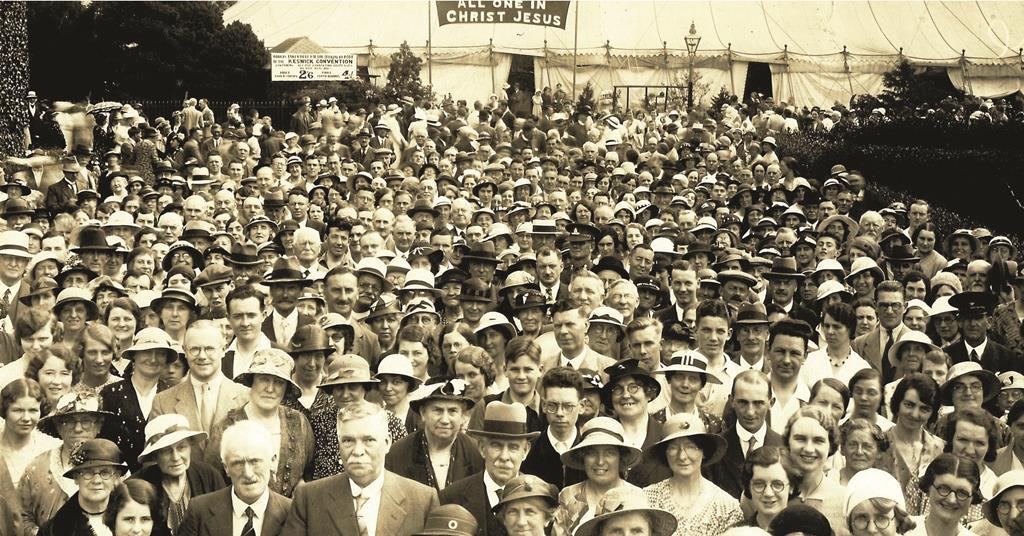
Its formal beginning is usually dated to 1875, with the first Keswick Convention in the Lake District town of Keswick in England. The Convention itself remains the central historical anchor of the movement. Keswick Ministries still traces its story back to that first gathering on the lawn of St John’s Church in 1875, and the annual convention continues into the present. What began as a relatively small gathering eventually became a sustained movement for spiritual renewal, Bible teaching, and mission, drawing Christians from across denominational lines and from around the world.
In its earliest form, Keswick developed within the broader Holiness world, especially in relation to currents influenced by Wesleyan concern for sanctification. Yet it gradually took on a distinct profile of its own. It was not simply identical with Wesleyan holiness teaching, nor was it comfortably at home within more conventional Reformed accounts of progressive sanctification. It occupied a kind of middle space. It shared the Holiness concern that the Christian life should be marked by real victory and practical holiness, but it tended to frame that victory less in terms of eradication of sin and more in terms of dependence on Christ and the Spirit in the midst of the ongoing struggle.
The early movement was shaped by figures such as Hannah Whitall Smith and Robert Pearsall Smith, and later by voices like F. B. Meyer and Andrew Murray. The names shift depending on whether one is speaking about direct founders, early organizers, major speakers, or later interpreters, but the important point is that Keswick was never merely a set of abstract ideas. It was a network of conferences, teachers, devotional literature, and pastoral exhortation. It was a lived movement before it was ever a neatly defined theological school.
What gave the movement its energy was not simply a doctrine, but a burden. Many believers knew they had been forgiven, but did not know how to think about daily Christian living except in terms of more effort, more discipline, and more failure. Keswick offered an alternative imagination. It called people to a deeper life, a higher life, or a victorious life. Those phrases were not always carefully defined, and that lack of precision later became part of the criticism. Still, historically speaking, they carried a powerful appeal because they named a hunger that many ordinary Christians already felt.
The annual conventions played a central role in this. Keswick was not first of all a classroom movement. It was a gathering movement. People came to hear Scripture preached, to seek spiritual renewal, to reflect on holiness, and to consider the claims of Christ on the whole of life. Over time the Convention also became closely associated with missionary concern. Keswick’s own history highlights its longstanding involvement with mission, noting that missionary meetings began in 1888 and that figures such as Hudson Taylor and Amy Carmichael were strongly connected to its missionary vision. That missionary emphasis was not accidental. If Christ was truly the source of the believer’s life, then holiness could never remain private. It had to overflow into service, sacrifice, and witness.
This is one of the reasons the movement spread so widely. Keswick spirituality traveled through conferences, sermons, missionary networks, devotional books, and personal influence. It was not confined to one denomination or one ecclesial structure. In that sense, its growth was less institutional than atmospheric. It entered evangelical consciousness through repeated themes, familiar books, and spiritual vocabulary that took root far beyond Keswick itself.
That wider influence is important, because not everyone shaped by Keswick belongs to the movement in any narrow formal sense. Some figures are directly tied to the conventions and leadership structures. Others are better understood as downstream voices. Hudson Taylor is often mentioned because of the deep resonance between Keswick spirituality and his emphasis on the exchanged life and dependence on the indwelling Christ. In a similar way, later figures such as Watchman Nee are not best described as official Keswick teachers, yet they clearly inhabit a spiritual world that had already been marked by many of the same emphases. In Nee’s case, modern scholarship tends to discuss his own spiritual theology in relation to the work of the Holy Spirit, inner guidance, and sanctification in ways that show family resemblance rather than simple organizational dependence. That is why I think it is more accurate to say that some later writers were influenced by the movement, directly or indirectly, rather than to flatten them into it.
So the historical development of Keswick is not just the story of one annual convention in England, though that remains its visible center. It is also the story of a vocabulary of spiritual life spreading across evangelicalism. It helped shape missionary spirituality, devotional culture, and practical teaching on sanctification in ways that reached well beyond its original setting. Even where the name Keswick faded, many of its instincts remained. The language of surrender, abiding, yieldedness, the indwelling Christ, and victory over self-effort continued to circulate in books, sermons, and discipleship movements across the twentieth century.
At the same time, the movement also evolved. Keswick’s own official history notes that there was early criticism from those suspicious of “higher life” teaching and that the language of “higher life” was later abandoned. That is historically significant. It suggests that the movement did not remain frozen in its earliest formulations. It adjusted its language over time, even while retaining its central concerns. The current ministry still presents itself in terms of hearing God’s Word, becoming like God’s Son, and serving God’s mission, which shows both continuity and development. The original concern for holiness remains, but it is expressed in a broader and perhaps more pastorally integrated way.
Historically, then, Keswick should be understood as a major stream within modern evangelical spirituality. It was one of Protestantism’s most influential attempts to address sanctification not merely as a doctrinal topic, but as a lived reality. It sought to answer the pastoral question of how Christians actually walk with Christ in daily life. Whether one ultimately embraces all of its formulations or not, it is hard to deny its historical significance. It gave language, shape, and momentum to a hunger for deeper life in Christ, and that influence spread far beyond the borders of Keswick itself.
Major Figures in the Deeper Life Tradition
What follows is not meant to be a complete catalog. It is simply a guided walk through the figures I am most aware of, arranged in roughly historical order, noting both direct Keswick connections and later downstream developments. Some of these men stood squarely within the Keswick world. Others were shaped by it indirectly, or carried its instincts into new settings and new vocabularies. What interests me most is not merely institutional lineage, but the recurring gravitational pull toward themes like surrender, indwelling, dependence, identity in Christ, and the saving life of Christ.
Andrew Murray
Andrew Murray stands near the headwaters of this stream, even though he cannot be reduced to Keswick alone. He was a South African Dutch Reformed leader, missionary advocate, devotional writer, and a speaker at both the Keswick and Northfield conventions in 1895. His importance lies partly in the way he bridged older Reformed theology with a deeply experiential spirituality of abiding, surrender, prayer, and the indwelling Spirit. He was also astonishingly prolific, with roughly 240 publications, and his devotional classics remain in print because they still speak to the inner life of ordinary believers.
If I were naming the books that matter most for this tradition, I would begin with Abide in Christ, The Spirit of Christ, Absolute Surrender, and With Christ in the School of Prayer. Abide in Christ revolves around John 15 and sustained dependence on the Son. The Spirit of Christ gives unusually strong attention to the Holy Spirit and the indwelling life. Absolute Surrender became one of the most recognizable expressions of the yielded life. Murray matters because he gave devotional form to realities that later writers would describe with the language of union, participation, and spiritual formation.
Hudson Taylor
Hudson Taylor was not a Keswick founder in the formal sense, but he belongs in any account of the deeper life tradition because his life and spirituality became one of its most compelling missionary expressions. Taylor served in China, founded the China Inland Mission in 1865, and became one of the great architects of faith missions. OMF, the organization that grew out of the China Inland Mission, still traces its story back to Taylor’s burden for inland China and his prayer for workers.
His enduring importance for this conversation is not simply his missionary strategy, but the spiritual secret that later came to be associated with his name. Hudson Taylor’s Spiritual Secret, compiled from his letters and journals, crystallized the theme of trust rather than striving, and Christ living through the believer rather than the believer trying to live for Christ by sheer effort. In that sense Taylor became one of the great missionary witnesses to the exchanged life, and his influence spread widely through missionary networks, devotional literature, and Keswick adjacent spirituality.
F. B. Meyer
F. B. Meyer was one of the most visible popularizers of Keswick and Higher Life spirituality in the English speaking world. He was a Baptist pastor, evangelist, prolific author, and frequent Keswick speaker. He also played a notable role in revival culture and urban reform, and his ministry reached well beyond one church or one conference circuit. He wrote extensively, traveled widely, and helped translate deeper life themes into a more accessible devotional form for ordinary Christians.
Books like The Secret of Guidance, The Secret of Christian Living, The Blessed Life, and Paul: A Servant of Jesus Christ make clear what his contribution was. Meyer was not a systematic theologian in the academic sense. He was a spiritual guide. He reinforced themes of surrender, yieldedness, God’s inner direction, and practical holiness. If Murray often feels like a bridge between Reformed devotion and participatory life, Meyer feels like one of Keswick’s most effective popular voices.
Watchman Nee
Watchman Nee is where the story becomes especially interesting for me, because he seems to stand both within this stream and beyond it. Nee became a Christian in 1920, began writing very early, and initiated what became the local churches movement in China in the 1920s. He was strongly influenced by imported Christian literature, missionary networks, Plymouth Brethren currents, and figures such as Jessie Penn-Lewis and T. Austin-Sparks. That means his relationship to Keswick is best described as indirect but real. He did not simply inherit Keswick institutionally, but he clearly absorbed and reworked many of its themes.
His best known book in English is The Normal Christian Life, based on talks delivered in 1938 and 1939 and centered heavily on Romans. That book has been one of the most influential twentieth century presentations of the Christian life as life in Christ, death with Christ, and resurrection life lived by another source. The Spiritual Man is also crucial, though it is broader and more demanding. Nee often sounds like a deepened and more biblically structured form of Keswick. The familiar themes are all there, but in him they move closer to a participatory center of gravity. The shift is subtle but important. The language is no longer just that Christ helps the believer. It is that Christ is the believer’s life.
This is why I do think Nee can be seen as a downstream development or offshoot of the deeper life tradition. He did not independently invent these themes, but neither did he merely repeat them. He translated them into a Chinese setting, grounded them strongly in Scripture, and pushed them toward a richer account of indwelling, the Body of Christ, and participation. That makes him one of the most important global developments of this entire stream.
Witness Lee
Witness Lee inherited Nee’s world and expanded it in ways that are both fascinating and, at times, cautionary. Lee was born in 1905, joined the Christian work in China after his conversion, and eventually became one of Nee’s closest coworkers. After moving west, he founded what became Living Stream Ministry, which continues to publish the works of both Watchman Nee and Witness Lee. Living Stream’s own statement of faith makes clear that this tradition strongly emphasizes the triune God, Christ’s full divinity and humanity, the Spirit’s equal deity, and the believer’s possession of God’s life and nature.
What Lee adds, however, is stronger language about union, participation, and what he famously described as the “mingling” of God and man. This is where I think caution is needed. Some of the difficulty may be linguistic and conceptual. Lee was working across Chinese categories, biblical language, and English theological vocabulary that do not map cleanly onto one another. Even so, his formulations often press closer to ontological participation than most classic Keswick writers were willing to go. I do not think he can simply be dismissed, because he is clearly trying to describe profound union without erasing distinction. But neither do I think the language is always guarded enough to satisfy classical theological instincts. In that sense, Lee feels like a post Keswick development that leans much more heavily into strong participatory language than most Western grace teachers would.
Major W. Ian Thomas
Major W. Ian Thomas is one of the clearest voices in this whole family of thought, and for many modern readers he may be the most direct entry point. After his wartime service, Thomas and his wife Joan opened their home and ministry to young Europeans, and that work eventually became Torchbearers, which began in 1947 and now exists globally through Bible schools, conferences, camps, and retreats. Torchbearers still describes its mission as proclaiming the transforming presence of Jesus Christ and teaching the saving, indwelling, and transforming life of Christ in the believer.
Thomas’s core claim is remarkably simple and remarkably powerful. The Christian life is not the believer’s life lived for Christ, but Christ’s life lived in the believer. That is the burden of The Saving Life of Christ, The Mystery of Godliness, and The Indwelling Life of Christ. Thomas matters because he takes the deeper life message and expresses it with unusual clarity, urgency, and pastoral force. He is not writing academic theology. He is describing how the Christian life is actually lived. For that reason I continue to see him as one of the most practical articulators of participatory soteriology in devotional form.
David C. Needham
David C. Needham occupies a slightly different place in this lineage. He is not as famous in popular Christian memory as Thomas or Taylor, but I think he is one of the better bridges between doctrine and discipleship. Birthright: Christian, Do You Know Who You Are? first appeared in 1979 and was later reissued by Multnomah. The book’s enduring burden is Christian identity. Needham asks not simply whether believers are forgiven, but whether they understand who they have become in Christ.
What makes Needham especially valuable is that he softens some of the sharper weaknesses that sometimes showed up in classic Keswick teaching. Rather than drawing an overly stark line between ordinary Christians and victorious Christians, Needham emphasizes that all believers already possess a new identity in Christ. The issue is not entry into a second level of Christian existence, but awakening to and living from what is already true in union with Christ. That makes him, in my judgment, one of the more theologically careful voices in this broader family.
Bill Gillham
Bill Gillham belongs squarely in the Christ life and identity in Christ stream that runs downstream from Keswick and Thomas. Harvest House describes him as a psychology professor, counselor, radio host, and speaker, and notes that Lifetime Guarantee grew out of his own crash and recovery after years of trying to live the Christian life in his own strength. His central insight was that only Jesus Christ can live like Christ, and that He desires to live His life through the believer.
That makes Gillham one of the clearest systematizers of exchanged life teaching for lay Christians. Lifetime Guarantee and What God Wishes Christians Knew About Christianity helped many readers reinterpret the Christian life not as behavior management but as Christ expressing His life in and through them. Like Thomas, Gillham is pastoral rather than academic. Unlike some popular teachers, however, he often works with a clearer framework of identity, self-reliance, and grace.
Bob George
Bob George stands in the same broad orbit, though with a somewhat different accent. He founded People to People Ministries in 1977 and became widely known as a teacher, author, pastor, and radio personality. His long running influence is tied especially to Classic Christianity, first released in 1989 and still central to his ministry. George’s emphasis falls strongly on the finished work of Christ, freedom from guilt-driven religion, and the fullness of the gospel as both forgiveness and life.
That means George overlaps with the deeper life tradition, but his tone often feels closer to evangelical grace teaching than to classic convention spirituality. He stresses that the believer’s problem is not only sin but death, and therefore the answer is not merely pardon but life. That is a profoundly important instinct, and it places him inside the same conceptual world of identity in Christ and indwelling life. He often cited Major Ian Thomas, and I think that connection helps explain why his message feels like a grace centered restatement of many older exchanged life themes.
Bob Christopher
Bob Christopher is best understood, in my view, as a continuation of the Bob George grace-centered stream rather than as an entirely separate branch. He is the CEO of Basic Gospel, host of the call in radio program Basic Gospel, and author of Simple Gospel, Simply Grace as well as Love Is. His burden is strikingly familiar. Christians fail when they try to live for God out of legalism, fear, and self-effort. The answer is not harder striving but receiving what has already been given by grace in Christ.
I recall being introduced to Bob Christopher as a guest on Bob George’s radio show. Conceptually Christopher belongs in the same family of finished work, identity in Christ, and grace-based discipleship teaching that shaped and was shaped by the Bob George world. He is not a formal theologian of participation, yet his message continues to function as a pastoral expression of the same broad intuition.
Steve McVey
Steve McVey is one of the most recognizable modern voices in the grace and Christ life world. He serves as president of Grace Walk Ministries, an international teaching and training ministry focused on the believer’s freedom and new life in Christ. His ministry explicitly says it exists to help Christians discover the freedom of their new life in Christ and the sufficiency of Jesus not only for salvation but for daily living.
His signature book is Grace Walk, first published in 1995. McVey’s language is often aimed at Christians exhausted by legalism and performance-based religion. In that sense, he feels like a modern popularizer of exchanged life teaching. The accent is on identity, rest, grace, and Christ living through the believer. The endorsement he gave to Bob George’s Classic Christianity also confirms that he moved in the same general stream. So while McVey is later and often more directly associated with the grace movement, I think he is best understood as a neo-Keswick or post-Keswick teacher rather than as something wholly different.
Jacob Chengwei Feng
Jacob Chengwei Feng represents a much later and more academic retrieval of themes that had long been circulating devotionally. Fuller Seminary now lists him as an affiliate assistant professor of theology and leadership, and Oxford Interfaith Forum lists him as a fellow there as well. His background is especially striking. He was raised in China as an atheist, studied engineering physics at Tsinghua, pursued graduate work in physics in the United States, became a Christian, later studied theology at Fuller, and has served in ministry in the Local Church tradition founded by Watchman Nee.
What makes Feng especially important for my larger project is that he represents a modern academic voice emerging from a Nee and Lee affiliated church context while engaging the wider scholarly discussions around theosis, participation, Christosis, and pneumatology. His 2023 article on pneumasis or pneumafication argues that the Holy Spirit is often undercredited in Pauline participation and that Romans 8 presents the Spirit as facilitating, enabling, empowering, and effectuating the mutual indwelling of Christ and believers. In that sense, Feng stands at an intriguing intersection. He belongs historically downstream from Nee, yet he also participates in contemporary academic theology in a way that can sharpen and correct devotional traditions that often lacked doctrinal precision.
A Closing Observation
When I step back from this list, what stands out is not uniformity but convergence. These figures do not all say the same thing in the same way. Some are more devotional, some more missionary, some more grace-centered, some more participatory, and some more theologically daring than others. But again and again I find the same deeper intuition resurfacing. The Christian life is not best understood as self-improvement for God. It is life in Christ, by Christ, through the Spirit, and for the Father’s glory. Keswick gave one language for that. Nee deepened it. Lee radicalized parts of it. Thomas popularized it with unusual force. George, Gillham, Christopher, and McVey translated it into late evangelical pastoral speech. Feng, in a different register, is helping recover it for academic theology. That does not erase the real differences, but it does suggest that many of these voices are circling the same center of gravity.
Conclusion
What I am seeing more clearly now is not a neat set of theological boxes, but a larger pattern slowly coming into view. I have never liked forcing people into rigid categories. That often flattens real differences, ignores important distinctions, and makes the landscape feel cleaner than it really is. Theology is rarely that tidy, and the lived Christian life certainly is not. What interests me more is overlap, resonance, and the way certain themes keep reappearing across traditions, vocabularies, and centuries.
For me, the Keswick tradition is speaking about perichoretic salvation, even if it does not do so directly or with formal theological precision. It is not using the technical language. It is not building a careful doctrinal structure from Trinitarian theology downward. It is saying the same reality more plainly, more devotionally, and more pastorally. It speaks of Christ living in the believer, of dependence instead of self-effort, of surrender, abiding, and the exchanged life. It is describing the lived reality that other theologians may describe with greater precision. That does not make the traditions identical, but it does suggest that they overlap in ways that matter.
I would not simply place Keswick teachers in the same group as James Gifford, Dallas Willard, or Brother Lawrence. They are not doing the same kind of work, and I do not want to erase those differences. Gifford is working with explicit theological architecture. Willard is thinking in terms of spiritual formation, kingdom life, and what he might call robust metaphysical realism. Brother Lawrence speaks from the texture of practiced presence and habitual love. Yet if I pay attention to the core reality each is touching, especially the relational and participatory reality of the indwelling Christ, I cannot help but notice that they seem to be looking toward the same center. They are not standing in the same place, but they are not staring at different suns either.
That is why I keep returning to the image of orbit. We may be moving in different orbital paths, with different languages, emphases, and concerns, yet still circling the same reality. One tradition may describe it devotionally. Another may describe it philosophically. Another may describe it through spiritual practice. Another through the language of sanctification, participation, or union. But beneath those differences, there appears to be a shared recognition that the Christian life is not merely imitation from a distance. It is participation in a relationship. It is life in Christ, with Christ, through Christ, and by the Spirit.
And perhaps that is part of what I am beginning to make sense of in my own life. As I look back, I do not just see random influences, disconnected authors, or isolated stages of Christian growth. I see, however imperfectly, the patient touch of God. I see Him placing books, teachers, ideas, and even frustrations in my path, not always so I would understand them immediately, but so that in time I might begin to recognize the larger pattern. What once felt fragmented now feels more like a trail of breadcrumbs. What once seemed like unrelated interests now feels more like a long education in the same mystery.
So I am continuing this adventure of discovery, trying to learn more about this strange and beautiful dance we have with God. I suspect there is still much I do not yet see, and perhaps some of what I think I see now will need refining later. But the picture is becoming clearer, and that clarity feels less like the end of a journey than the beginning of another stage in it.
More to come, I am sure. Stay tuned.
“On that day you will know that I am in my Father, and you in me, and I in you.” – John 14:20 (NRSV)
References
- Barabas, S. (1966). So great salvation: The history and message of the Keswick Convention. Marshall, Morgan & Scott.
- Basic Gospel. (n.d.). Simple Gospel, simply grace. https://www.basicgospel.net/simple-gospel-simply-grace
- Bebbington, D. W. (1989). Evangelicalism in modern Britain: A history from the 1730s to the 1980s. Routledge.
- Books.google.com. (n.d.). Simple Gospel, simply grace: How your Christian life is really supposed to work. https://books.google.com/books/about/Simple_Gospel_Simply_Grace.html
- Christian Classics Ethereal Library. (n.d.). Andrew Murray. https://ccel.org/ccel/murray
- Fuller Theological Seminary. (n.d.). Chengwei Feng. https://fuller.edu/adjunct/chengwei-feng/
- Fuller Theological Seminary. (n.d.). Student profile: Jacob Chengwei Feng. https://fuller.edu/posts/student-profile/jacob-chengwei-feng/
- Grace Walk Ministries. (n.d.). Our team. https://www.gracewalk.org/our-team/
- Harford, C. F. (Ed.). (1907). The Keswick Convention: Its message, its method and its men. Marshall Brothers.
- Harvest House Publishers. (n.d.). Lifetime guarantee. https://www.harvesthousepublishers.com/books/lifetime-guarantee-9780736947862
- Keswick Ministries. (n.d.). History. https://keswickministries.org/keswick-ministries-about/history/
- Living Stream Ministry. (n.d.). About us. https://www.livingstream.com/en/content/4-about-us
- Naselli, A. D. (2010). Let go and let God? A survey and analysis of Keswick theology. Lexham Press.
- Open Library. (n.d.). Abide in Christ. https://openlibrary.org/books/OL22877094M/Abide_in_Christ
- OMF International. (n.d.). Our story. https://omf.org/us/who-we-are/our-story/
- Pierson, A. T. (1897). Forward movements of the last half-century. Funk & Wagnalls.
- Torchbearers International. (n.d.). History. https://torchbearers.org/who-we-are/history/
- Torchbearers International. (n.d.). The Saving Life of Christ. https://torchbearers.org/media/shop/the-saving-life-of-christ/
- Torchbearers International. (n.d.). Who we are. https://torchbearers.org/who-we-are/
Excerpt
Tracing the Keswick tradition has helped me see a larger pattern in my own journey. Different writers and traditions may use different language, but many seem to orbit the same reality: the indwelling life of Christ, lived in dependence on God rather than through self-effort.
Perichoresis, Handle Carefully


Leave a Reply