
I have been spending more time lately looking at nude figures in art and asking a question that is both simpler and more complicated than it first appears: What is the nakedness doing in the painting? I do not mean what the naked person is doing. I mean what the artist accomplishes by depicting the person without clothing. Does the nakedness communicate sexuality? Innocence? Vulnerability? Humiliation? Peace? Equality? Mortality? Something else entirely?
This is a question I have explored before, particularly in my discussion of Lavinia Fontana’s Minerva Dressing. There I suggested that Minerva’s nakedness helps portray a moment between identities. She has laid aside the implements of war and has not yet fully assumed whatever comes next. Her body represents a kind of unarmed, transitional state beneath the social roles of warrior, goddess, protector, and caregiver. Whatever additional meanings Fontana intended, the painting reminded me that nakedness can communicate ideas beyond lust.
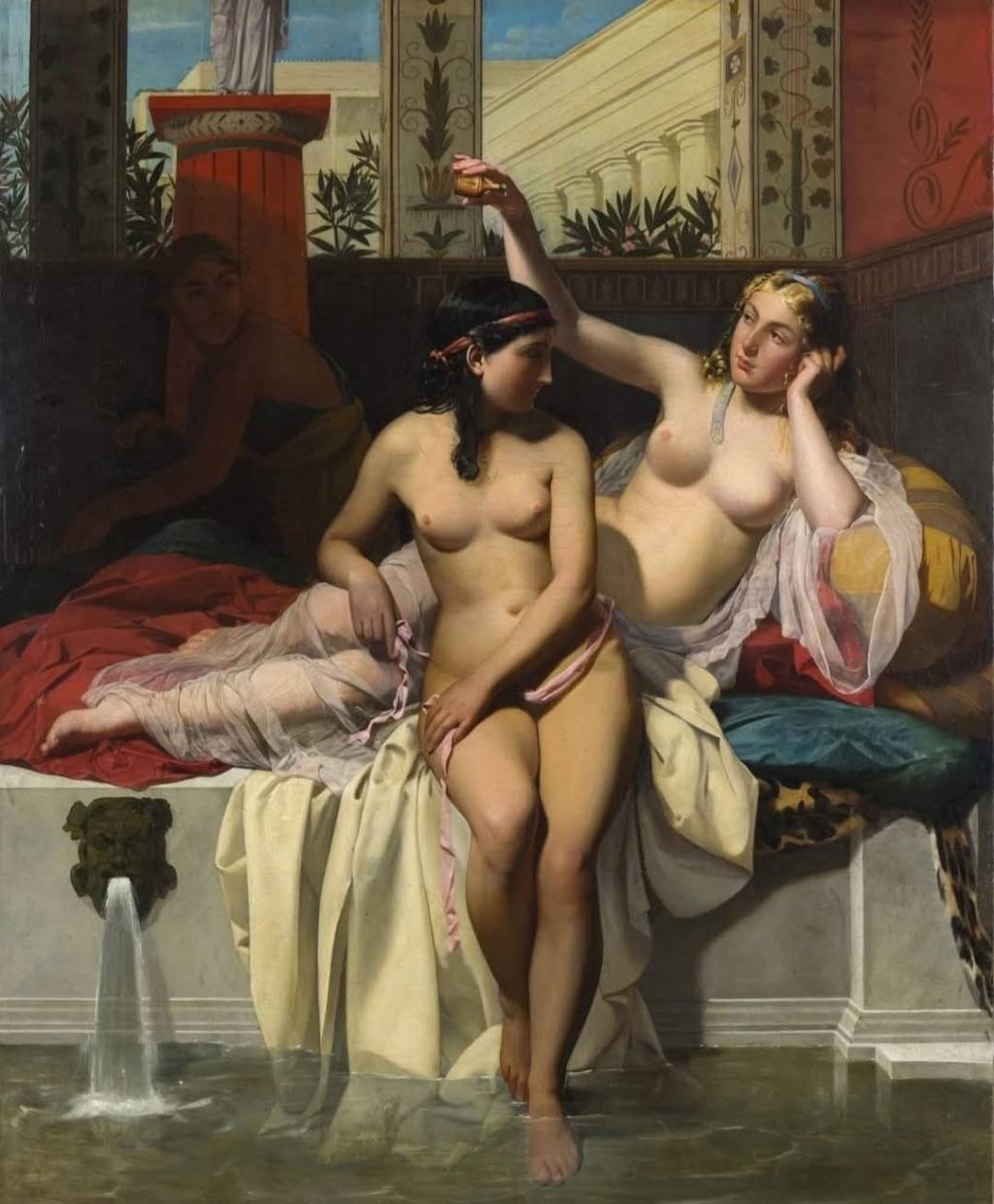
Maidens in a Pompeian Bath, a nineteenth-century painting attributed to Luigi Mussini, gives us another opportunity to ask the same question, but this time I think the nakedness may point us in a somewhat different direction than Minerva Dressing. Here the body does not seem to be between identities so much as simply unguarded. There is no armor to remove because no one thinks armor is necessary. There is no emergency, no struggle, and apparently no concern in the world. At least not the world inside the painting.
Note: The painting is generally attributed to Luigi Mussini, although the attribution is not considered absolutely certain. For the purposes of this discussion, I will treat it as his work, since that uncertainty does not materially affect the interpretation I am exploring.
Description of the Painting
Before going dig into this painting, it is probably worth simply looking at what is there. The painting shows two nude women in what appears to be an ancient Roman bath. One reclines comfortably on cushions while holding a small vessel above the head of the second woman, who sits at the edge of the bath with her feet in the water. A small stream of liquid seems to fall from the vessel onto or near the seated woman’s hair.
A third figure sits farther back in the shadows. I initially found that person difficult to identify with certainty, although the figure appears to be another woman, perhaps another bather or an attendant. The contrast is interesting in itself. The two foreground women are exposed to the light while the third person is clothed or draped and partially hidden in darkness. Her attention nevertheless seems directed toward what is happening in the foreground.
The seated woman also has what looks like a loose pink ribbon or sash passing around her body. Perhaps she has just removed or loosened it as she prepares to enter the bath. I don’t want to make too much of that detail, sometimes a ribbon is just a ribbon, and art interpretation can go off the rails rather quickly when every spoon, flower, cloud, and belt suddenly becomes the key to a secret code.
At the lower part of the scene is a face incorporated into what seems to be a waterspout. At first I wondered whether it might be something resembling a Green Man, but it looks more leonine, perhaps a lion or similar grotesque used as an architectural water feature. Beyond the room we see a courtyard, columns, statuary, blue sky, and clouds. Nothing about the outside world seems threatening. Peace and clam. And that may be the most important thing in the entire painting.
“The relation between what we see and what we know is never settled.” – John Berger, Ways of Seeing
The Painting’s History
The work is presently identified as Maidens in a Pompeian Bath, date unknown, attributed to Luigi Mussini (1813–1888). It is an oil on canvas presently listed in a private collection.
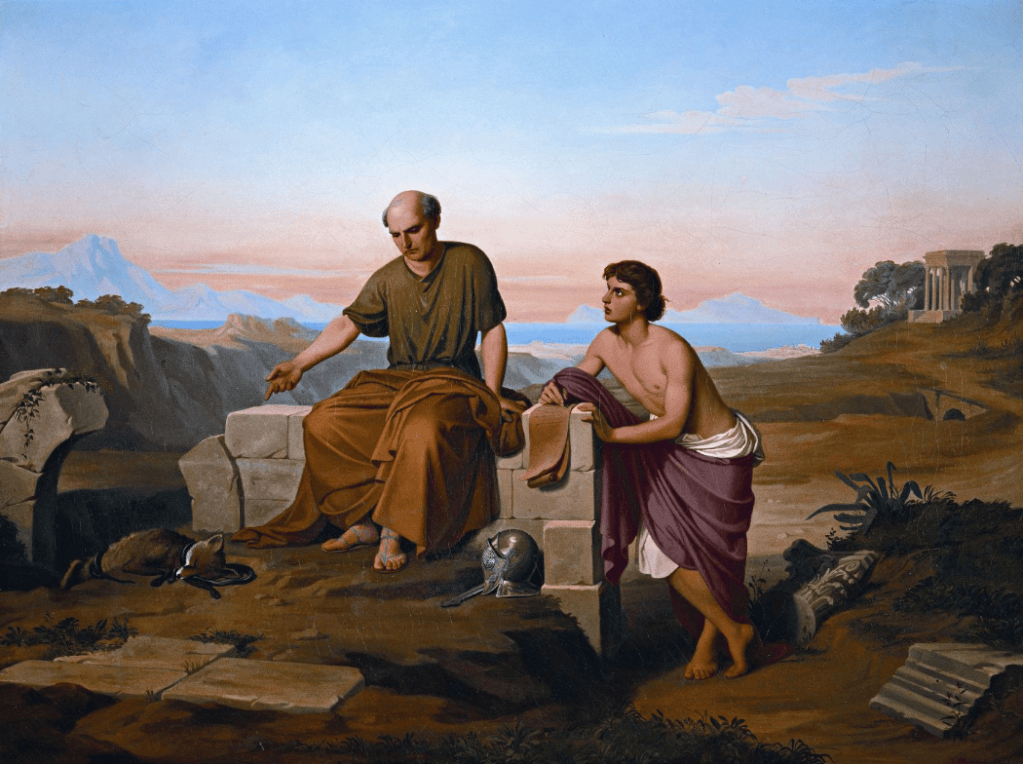
Mussini was part of a nineteenth-century artistic world fascinated by antiquity, and he certainly had an interest in the region and its history. In 1846, he painted I due Plinii, The Two Plinys, showing Pliny the Elder and Pliny the Younger against the landscape of the Bay of Naples, with Vesuvius visible in the distance. The connection to Vesuvius in both paintings is certainly intriguing. I would venture to guess that he had an interest in, or perhaps even a fascination with, Vesuvius. Of course, that is just my opinion, but it may give us some additional insight into this painting.
Pompeii itself had become a powerful subject for nineteenth-century artists. The excavations that began in the eighteenth century gave Europe something remarkable: not merely statues, temples, and the deeds of emperors, but kitchens, bedrooms, shops, graffiti, gardens, baths, and the clutter of normal human existence. It was a veritable time capsule from everyday life in ancient Rome. During the nineteenth century, some artists moved away from painting only heroic or catastrophic scenes from antiquity and began imagining what scholars sometimes call “everyday antiquity”: ordinary people eating, talking, resting, bathing, and going about their lives. And that appears to be what Mussini is going for here.
Pompeii belongs in a museum, certainly, but the nineteenth-century imagination was never content to leave it there. Artists repopulated the ruins. They put flesh back on the bones, food back on the tables, water back into the fountains, and people back into the baths. This painting gives us one such imagined moment of Roman daily life.
Nakedness Is Not Self-Interpreting
One of the themes I keep returning to in these posts is that nudity is not morally or symbolically self-interpreting. We bring assumptions to naked bodies, and those assumptions can prevent us from actually looking at what the image is doing.
A naked person in one painting may represent erotic desire. In another, nakedness may signify humiliation. In Christian art, it may evoke Eden, baptism, martyrdom, judgment, resurrection, vulnerability, or humanity stripped of status. Classical artists could use the nude to communicate ideal beauty or heroic strength. In Minerva Dressing, I suggested that nakedness could signify peace and transition because the warrior is temporarily without the tools and armor of war. The context determines the visual grammar.
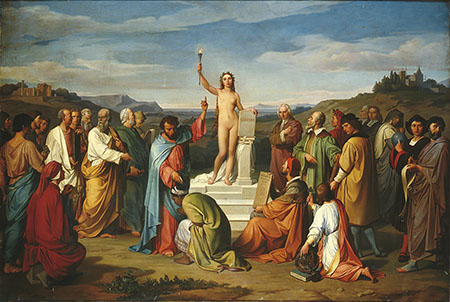
Interestingly, Mussini’s documented work gives us some evidence that a nonsexual symbolic nude would not have been foreign to his artistic vocabulary. In discussing Mussini’s Triumph of Truth, the Dizionario Biografico degli Italiani describes the central allegorical figure of Truth as a “chaste virginal nude.” She is naked not because the painting is about sex, but because the nude body serves an allegorical purpose. Mussini is drawing on a very old and well-established European iconographic tradition of Nuda Veritas, or “Naked Truth.” The basic idea is wonderfully straightforward: Truth is naked because Truth has nothing to hide. She is stripped of disguise, ornament, concealment, and deception. What you see is what is actually there.
Cesare Ripa’s enormously influential Iconologia, a handbook of allegorical imagery used by European artists, explicitly instructs artists to portray Truth as a beautiful nude woman:
“Ignuda si rappresenta, per dinotare, che la semplicità gli è naturale.” (She is represented naked to signify that simplicity is natural to her.) (Ripa, 1603).
That does not tell us what the bathers mean, but it does reinforce the larger point: a nude figure in nineteenth-century art cannot simply be translated as “sexual figure.” We have to read the rest of the sentence.
A Bath Is a Bath
Romans used oils as part of bathing and personal hygiene. Oil could be applied to the skin and then removed, along with dirt and sweat, using a curved scraping implement called a strigil. Oil bottles were common pieces of bathing equipment, and Roman examples survive in museum collections.
Oil was part of a broader bathing and grooming process. In this painting, because the liquid seems to be directed toward the seated woman’s hair rather than being rubbed across her body, it could just as easily represent scented oil, grooming, or some sort of hair treatment.
I also had the immediate thought that pouring oil over someone’s head looks like anointing, especially to those of us steeped in biblical imagery. Kings, priests, and others are anointed with oil in Scripture, so the visual association comes almost automatically. But that is a good example of why interpretation requires discipline. The association is real in my mind, but nothing else in the painting establishes that a sacred anointing is taking place. The bath provides a much simpler explanation.
That does not mean the visual resonance is meaningless. Art can trigger associations the artist did not consciously intend. It simply means we should distinguish between saying, “This reminds me of anointing,” and saying, “This woman is being ritually anointed.” Those are very different claims.
The Woman at the Center
Whatever the oil means, if anything, the seated woman is clearly the focus of the immediate action. The reclining woman’s raised arm leads our eyes toward the vessel. The liquid draws a line downward toward the seated woman. Even the figure in the shadows appears to be watching.
She is also the figure who seems closest to entering the water. The loose pink sash suggests preparation. She appears to be in the process of removing the remaining barriers between herself and the bath.
There is something strikingly ordinary about all of this. She is not Venus rising from the sea. She is not Minerva preparing for battle. She is not Eve hiding in the garden, Susanna threatened by the elders, or a martyr stripped before execution. She is apparently just a woman taking a bath.
The ordinariness of the scene brings us into the conversation surrounding naturism and nudism. Modern naturism is obviously not the same thing as Roman bathing, and I would not anachronistically call these women “naturists.” The connection I see is more basic. Naturists have long argued that nakedness does not have to be an event. It does not automatically have to be provocative, erotic, scandalous, rebellious, or dangerous. Sometimes people are simply naked because nakedness is appropriate to what they are doing. That seems to be exactly what is happening here.
Vulnerability Without Fear
But there is another layer that I see here. Clothing does more than protect us from the weather. Clothing communicates identity. Uniforms tell us occupations. Fine fabrics communicate wealth. Armor announces danger and power. Religious garments communicate office. Fashion can communicate tribe, profession, class, sexuality, rebellion, conformity, or aspiration.
Remove the clothing, and much of that visual information disappears. That is one reason nakedness can symbolize equality, humility, vulnerability, or openness. We encounter the human being beneath the costume. We do not necessarily know whether the seated woman is wealthy or poor, politically powerful or insignificant, married or unmarried. We primarily encounter her as a human being.
In Minerva Dressing, that stripping away of costume allowed me to think about the person beneath her roles. Here, it does something slightly different. These women are not merely unclothed. They are also unguarded. They do not believe they need protection. And that brings us back to Pompeii.
We Know Something They Do Not
If the title had simply been Women at the Bath, I am not sure I would think much about mortality at all. The philosophical weight enters largely through one word: Pompeian.
The painter does not give us Vesuvius erupting. There is no ash. No smoke. No earthquake. No terrified crowd. No red sky. No fleeing family desperately gathering children and possessions. There is water, oil, sunlight, architecture, and another ordinary day. But we know what eventually happens to Pompeii.
That creates what literary critics call dramatic irony, a situation in which the audience possesses important information that the characters within the story do not. We look at these women through the lens of history. Whether or not the painter consciously intended a memento mori, a reminder of death, it is difficult for us to see the word “Pompeii” without bringing Vesuvius into the room ourselves. These imagined women inhabit Pompeii before the catastrophe. They do not know they are living “before.” Only we do.
“For what is your life? It is even a vapour, that appeareth for a little time, and then vanisheth away.” – James 4:14, KJV
Is Their Security False?
My first instinct was to describe the scene as a false sense of security, but I am no longer sure that is quite fair. What exactly are they doing wrong? Are human beings supposed to spend every peaceful afternoon worrying about earthquakes, volcanoes, wars, pandemics, accidents, economic collapses, or whatever else may eventually happen? That would not be wisdom. It would be paralysis.
Their security is not exactly false. It is contingent. That is a useful philosophical word here. Something is contingent when it is real but could be otherwise. Their peace is real. The blue sky is real. The bath is real. Their friendship and conversation are real. The fact that those things will not last forever does not make them illusions.
And that may be one of the more uncomfortable truths the painting invites us to confront. Most of us live this way because we have to. We make appointments for next month. We buy groceries for next week. We plan vacations for next year. We save for retirement. We assume, provisionally and reasonably, that tomorrow will resemble today. Usually it does. Until it does not.
“All we have to decide is what to do with the time that is given us.” – J. R. R. Tolkien, The Fellowship of the Ring
We are seeing ordinary life in an ordinary bath, people going about their routine as if tomorrow were, in some sense, guaranteed. Memento mori, perhaps, but without any sense of dread within the scene itself. They are simply living their lives. If they could see the future, this painting would almost certainly look very different. Instead of bathing and grooming, perhaps we would see them fleeing the impending disaster.
Cleanliness Cannot Save Her
The seated woman also gives me one final image that I cannot quite shake. She is preparing to become clean. There is nothing wrong with that. Bathing is good. Grooming is good. Ordinary routines are good. The woman is doing exactly what a person ought reasonably to be doing in a bath. But she can wash every speck of dirt from her skin and still remain vulnerable to something entirely outside the room. The danger exists beyond the limits of the painting.
That may be the deepest meaning I personally take from the image. Not because I think the artist secretly encoded Vesuvius into the oil jar or hid a prophetic warning inside the lion-headed fountain, but because the painting accidentally recreates something fundamental about the human condition. We spend much of our lives attending to what is immediately in front of us while enormous realities remain outside our field of vision.
We cannot see around every corner. We cannot know everything outside the frame. And yet we still have to live.
I do not think there is necessarily a moral to the story here. In a sense, we are given a God’s-eye view: we know the future, and they do not. If there is any lesson here, perhaps it is simply that we should go about our business and recognize that the things we cannot foresee or prepare for are part of the human experience. Precisely because we are not like God, we cannot see the future.
Nakedness as Ordinary Humanity
This brings me back to naturism and to why I continue finding nude art philosophically interesting. The naked body is unusually effective at reminding us what human beings are beneath everything we construct around ourselves. These women have no armor. They have no uniforms. They have no visible rank.
They are not posing as warriors, politicians, saints, executives, soldiers, or philosophers. They are human beings doing something human beings have done for as long as there have been human beings: washing themselves, caring for their bodies, sharing space with one another, and assuming there will probably be another day.
Their nakedness therefore intensifies their vulnerability without necessarily making them afraid. They are exposed, but not ashamed. Vulnerable, but not threatened. Unprotected, but at peace.
That is an important distinction, particularly in a culture that so quickly interprets nakedness through sexuality or danger. Vulnerability does not always mean victimhood. Exposure does not always mean humiliation. Nakedness does not always mean eroticism. Sometimes nakedness can mean simply being human.
Outside the Frame
Art does not cease to speak simply because we cannot reconstruct every thought in the artist’s mind.
Perhaps that is why I enjoy taking the time to look at these paintings now. As a child, I probably would have seen two naked women in an old painting and moved along. Now I find myself wondering what the nakedness contributes to the story, what assumptions I am bringing with me, how the historical context changes what I see, and what questions the image raises about being human.
With Minerva Dressing, nakedness helped me see a person suspended between roles. With Maidens in a Pompeian Bath, it makes me think about ordinary humanity in a moment of complete unguardedness.
The women are bathing. The sky is blue. The water is flowing. Life is normal. Almost uninteresting.
Mussini, or whoever painted the work, does not need to put Vesuvius in the room. We bring Vesuvius into the room ourselves. And yet, in other works of his, he does include it. We cannot help ourselves. We have a kind of God’s-eye view of the scene, at least when it comes to what lies beyond the frame and what history tells us happened next.
And perhaps that is why the painting stays with me. We know something these women do not know about their future, but we occupy precisely the same position concerning our own. Somewhere beyond the frame are things we cannot see and cannot control. Our task is not to live terrified of them, but to live attentively, gratefully, and fully in the ordinary moments we have been given.
Maybe that is what their nakedness ultimately says to me. Beneath our clothes, titles, plans, defenses, and carefully constructed identities, we are all vulnerable creatures living beneath a blue sky, never entirely certain what tomorrow will bring. We can only live inside the frame. The proper response is probably neither fear nor denial, but humility: to care for the life in front of us, to appreciate the ordinary people beside us, and perhaps to remember occasionally that an ordinary day is more precious than it looks.
References
- Berger, J. (1972). Ways of seeing. Penguin Books. The quotation about the relationship between seeing and knowing appears at the beginning of the work. John Berger home
- Mussini, L. (attributed artist). (n.d.). Maidens in a Pompeian bath [Oil on canvas]. Private collection. Wikimedia Commons. The catalog record identifies the date as unknown and the work as attributed to Mussini. Wikimedia Commons catalog record and image
- Palazzo Sansedoni. (n.d.). Luigi Mussini (1813–1888), I due Plinii, 1846. Fondazione Monte dei Paschi di Siena. Palazzo Sansedoni catalog entry
- Pierini, M. (2012). Mussini, Luigi. In Dizionario biografico degli italiani (Vol. 77). Istituto della Enciclopedia Italiana. Treccani biography of Luigi Mussini
- Ripa, C. (1603). Iconologia, overo descrittione di diverse imagini cavate dall’antichità, & di propria inventione. Appresso Lepido Facij. (Iconologia, or Moral Emblems, Kindle.)
Excerpt
Maidens in a Pompeian Bath presents an ordinary moment of bathing, yet our knowledge of Pompeii changes how we see it. The women are unguarded, vulnerable, and simply living their lives, reminding us that nakedness in art can symbolize far more than sexuality.
Pneumonoultramicroscopicsilicovolcanoconiosis


Leave a Reply