
Minerva, Nudity, and the Meaning of Transition
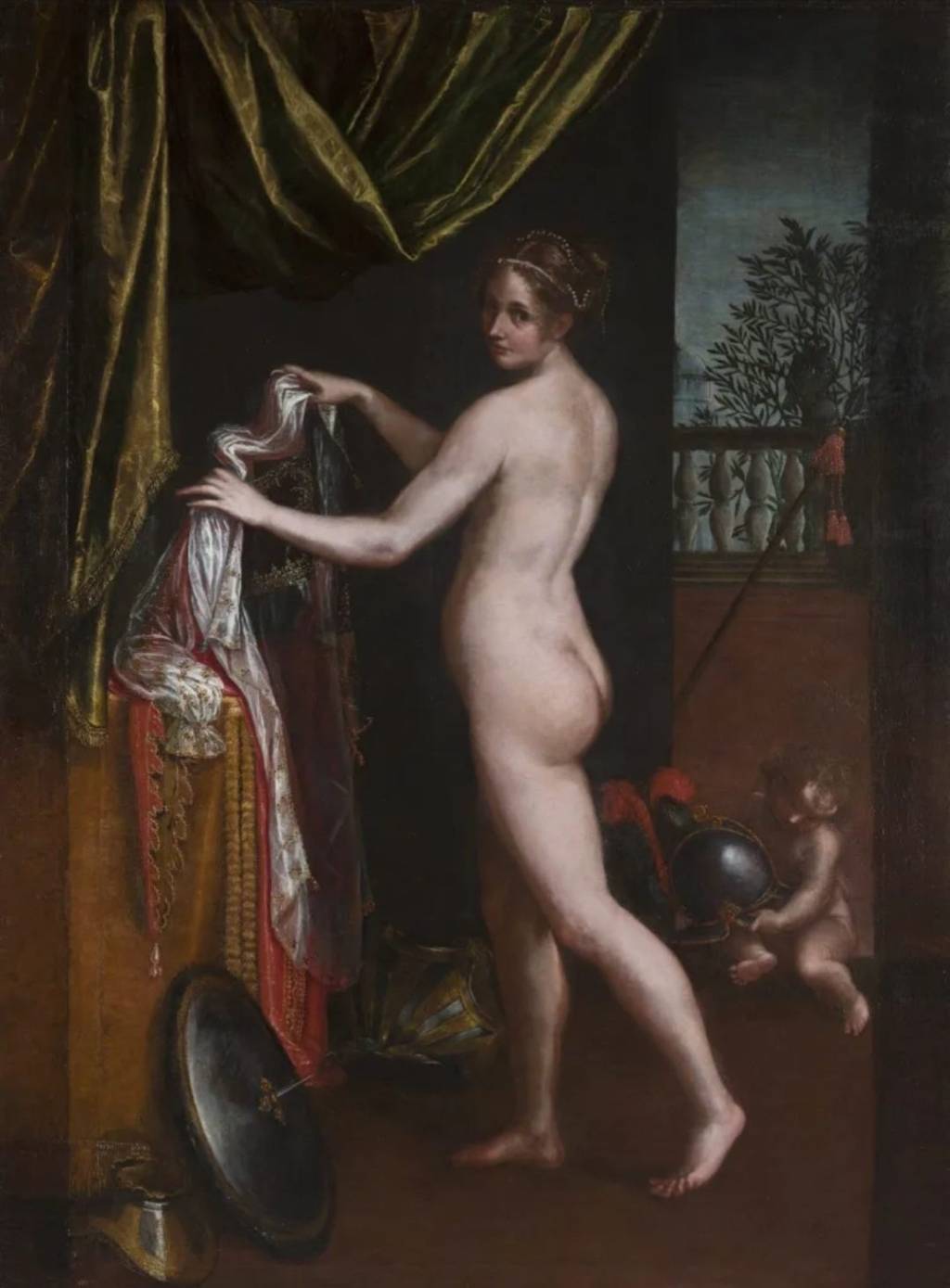
I was looking at a work of art online recently and, as often happens with me, I started wondering what exactly the artist was trying to communicate. The painting was Lavinia Fontana’s Minerva Dressing, completed in Rome in 1613. At first glance, there is an obvious feature that immediately draws our attention: Minerva is nude.
The more I looked at the painting and began investigating its background, the more it became another example of something I have been exploring throughout my writing on nudity and Christian art. Nudity is not necessarily the message of a work simply because nudity is present. Sometimes the nude body participates in a much larger symbolic vocabulary, and if we do not understand that vocabulary, we may completely misunderstand what the artist is doing. We see skin, stop looking, and miss the story.
Fontana herself makes this painting particularly interesting for a Christian discussion of art, even though the subject is obviously not Christian. Minerva is the Roman goddess of wisdom, strategy, craft, and disciplined warfare. Fontana, however, was not some artist working on the margins of Christian Europe. Born in Bologna in 1552, she became one of the most successful professional women painters of her era. She eventually moved to Rome, became associated with the court of Pope Paul V, painted portraits for important patrons, produced religious altarpieces and devotional works, and also painted mythological subjects such as this one.
That alone should give us a little historical pause. The Christian artistic culture of late Renaissance and early seventeenth century Italy was evidently capable of making distinctions that many people today sometimes flatten. A painter could create explicitly Christian devotional art and also paint classical mythology. A patron connected to the Church could commission religious works while also appreciating images drawn from Greece and Rome. And the appearance of a nude body did not automatically remove the work from the Christian cultural world in which it was produced.
It is also worth remembering that, in many of these works, the real subject was not the worship of Greek or Roman gods and goddesses. Classical mythology provided artists with a symbolic language for exploring ideals that Christians, pagans, and human beings more generally could recognize: wisdom, courage, justice, beauty, love, war, peace, temptation, sacrifice, and virtue. Minerva could therefore function as more than a character from an old religion. She could embody wisdom itself, or at least an archetype of the wise and disciplined person. In that sense, the attraction of classical mythology was often not really about mythology at all. It was about the transcendent dimensions of human experience and the recurring patterns of character and meaning that civilizations have tried to express in different ways. We still do something similar today with our own modern myths. Spider-Man, for example, is more than a fictional superhero; he embodies the moral idea that “with great power comes great responsibility.” We might call them ideals, personifications, or archetypes, but the basic impulse is familiar: sometimes an abstract truth becomes easier to see when we give it a face and a story.
Fontana died in Rome in 1614 and was buried in Santa Maria sopra Minerva, the Dominican church located near the Pantheon. Her Minerva Dressing was associated with Cardinal Scipione Borghese, one of the great patrons of art in early seventeenth century Rome. Perhaps most strikingly, the dome of St. Peter’s Basilica appears in the distant background of the painting. Here, then, is the pagan goddess Minerva standing nude within an unmistakably Christian Roman landscape. A detail I missed at first glance.
That is where things became even more interesting for me, because when I first studied the painting, I got the action almost exactly backwards.
My initial interpretation was that Minerva was preparing for war. The title, Minerva Dressing, led me to assume that I was watching her move from rest into action, dressing herself for battle. I saw the helmet, shield, armor, owl, and olive tree and read the composition almost like a sequence: wisdom behind her in the owl, peace behind her in the olive tree, and the instruments of war waiting nearby. I even noticed the fabric beside her, but I mistook it for some kind of undergarment or layer she would wear beneath the armor rather than the elaborate dress she was actually preparing to put on.
That interpretation seemed to make sense because Minerva is not Mars. She does not traditionally represent rage, bloodlust, or chaotic violence. She represents wisdom, discipline, strategy, and the intelligent use of force. So I thought I was looking at a symbolic moment when contemplation was becoming action, when wisdom and peace were giving way, reluctantly perhaps, to the necessity of conflict. In other words, I thought the painting showed Minerva putting on the role of the warrior.
But according to the Galleria Borghese, I had the movement of the painting exactly backwards. Minerva has already laid down her weapons. The armor remains nearby, while a small putto sits with or handles her helmet, and Minerva herself is preparing to put on an elaborate feminine garment. She is not dressing for battle. She is dressing after it.
The putto (child or cherub) caught my attention as well. I am not entirely sure what role the figure is meant to play symbolically. It is tempting to wonder whether the child might somehow suggest innocence, peace, or even those Minerva has protected, but I have not found evidence that Fontana intended any of those specific meanings. At the very least, the image reinforces the fact that the helmet is no longer on Minerva’s head. The instrument of war has been set aside and is now in the hands of a childlike figure while Minerva transitions toward another mode of life.
I rather like discoveries like this because they are a useful warning about how we interpret art. It is very easy to look at an image, notice a few symbols, and then become increasingly confident that our first impression must be what the artist intended. But interpretation should be constrained by context. We need to ask what the objects meant within the artist’s culture, what story is being depicted, what the title tells us, what the patron or intended audience may have understood, and, where possible, what the artist herself appears to have intended. Sometimes the details correct us. Sometimes history corrects us. Sometimes a better understanding of the artistic context reveals that we have been looking in the wrong direction.
That does not mean we cannot give an image or symbol a personal meaning. As I have discussed elsewhere, we do this all the time. A symbol may come to represent something deeply significant to us even if that meaning was never intended by the person who created it. There is nothing necessarily wrong with that, as long as we recognize what we are doing. At that point we are no longer explaining what the artwork means in its historical context; we are explaining what the artwork has come to mean to us. That personal meaning may be powerful, but unless we communicate it to others, it is largely private and cannot simply be projected backward onto the artist as though it were the original meaning of the work.
In this case, I think the correction actually makes the painting more interesting because it leaves room for two different levels of meaning. On a personal level, someone could still use the image as a symbol of preparing for war, of moving from rest into action, even though that does not appear to be what Fontana intended. But if we stay closer to the apparent meaning of the painting itself, Minerva stands in a moment of transition. She is no longer dressed for war, but neither has she yet dressed for ordinary social life. The armor has come off. The civilian clothing has not yet gone on. Between those two roles stands simply the human body.
That brings me back to the question that first interested me: what is the nudity doing in the painting? Does it symbolize innocence, vulnerability, peace, or perhaps something more basic? I am not sure we can confidently choose among those meanings, and perhaps we do not need to. The safer interpretation may simply be transition. Nudity visually marks the space between one identity and another, between what has been taken off and what has not yet been put on.
What I find especially interesting is that this symbolism could work in either direction. Whether we imagined Minerva moving from peace to war or, as the museum indicates, from war back to peace, the nude body would still occupy the vulnerable middle ground between the two. She is between roles, between states, between identities. That may be the most compelling way to understand the image: not necessarily as a symbol of innocence or peace by itself, but as a symbol of the exposed human being in the process of becoming something else.
We normally identify people through layers of symbols. Uniforms tell us who is a soldier, police officer, priest, judge, doctor, Marine, or firefighter. Suits may communicate professional status. Robes communicate judicial or ecclesiastical authority. Crowns announce royalty. Armor announces the warrior. Clothing does more than protect the body. It frequently tells the social world who we are, or at least what role we are occupying at that particular moment.
Remove the symbols and something more basic remains.
Minerva’s nudity therefore occupies a kind of visual middle ground. Armor represents one identity: the warrior. The elaborate clothing she is about to put on represents another identity: the civilized woman participating again in social life. Between the two is Minerva herself, temporarily stripped of the external markers that tell us what role she is playing.
Could Fontana intended Minerva’s nudity specifically as a symbol of innocence? As a philosophical reading of the composition, I think we can reasonably observe that the body appears between two assumed roles. The weapons are separate from Minerva. War is something she can put on and take off. Her body itself is not violent. Remember Minerva is not Mars. Her relationship with warfare is traditionally mediated through wisdom, reason, strategy, justice, and discipline. The owl reinforces her association with wisdom. The olive tree carries associations with peace. Even her martial character is therefore not simply about destruction. Her weapons are instruments to be taken up under some circumstances and set aside under others.
“A time to love and a time to hate, a time for war and a time for peace.” – Ecclesiastes 3:8
I am not suggesting that Fontana was illustrating Ecclesiastes. She was painting a Roman goddess, not creating a Christian allegory. Nevertheless, the philosophical resonance is difficult for me to miss. Wisdom involves more than knowing how to fight. It includes knowing when fighting is necessary and when the weapons should be put away.
We might imagine a soldier returning home after war. The uniform comes off. The medals are placed in a drawer. The weapon is secured. The person who spent months or years inhabiting a martial role must now rediscover how to inhabit another world. The warrior has not ceased to exist, but neither is the warrior the entirety of the person.
Minerva seems caught in precisely that kind of visual space.
What captures my attention most, however, is what happens if we approach the painting assuming that nudity must automatically mean sexuality. If we make that assumption, we miss nearly everything else happening in the image. We overlook the armor. We overlook the abandoned helmet. We overlook the owl. We overlook the olive tree. We overlook the transition from conflict to peace. We overlook St. Peter’s in the background. We may even overlook Minerva herself because we have reduced the human figure to a single characteristic: she is naked.
This is one of the reasons I continue to resist the idea that nudity in art is morally or symbolically erotic. Certainly, nudity can be erotic. Artists have used the nude body to communicate sexual desire, seduction, fertility, and erotic beauty for thousands of years. Pretending otherwise would simply be naive. But the opposite mistake is equally naive: assuming that because nudity can be sexual, nudity must be sexual.
Human beings use the body to symbolize all sorts of things. Nudity can communicate vulnerability because clothing offers protection. It can communicate poverty because clothing signals possessions and status. It can communicate equality because rank disappears when uniforms disappear. It can communicate humiliation when someone is forcibly stripped. It can communicate innocence, birth, death, judgment, mortality, beauty, rebirth, authenticity, or humanity stripped of its social disguises. Context determines meaning.
“And the man and his wife were both naked and were not ashamed.” – Genesis 2:25
That verse alone should at least complicate the claim that Scripture presents nakedness as inherently immoral. Whatever theological conclusions someone ultimately reaches about public or social nudity, the biblical story itself begins with a naked human body that is neither sinful nor shameful. The problem that enters Genesis is not the existence of the body.
The history of Christian art complicates matters further. Fontana was deeply embedded in the Christian artistic culture of Counter Reformation Italy. She painted religious altarpieces and devotional subjects and worked within circles of ecclesiastical patronage. Yet she could also paint the nude human body within mythological compositions. That does not prove that every nude artwork is morally unobjectionable, of course. It demonstrates something more modest but still important: historically, Christians have not always assumed that nakedness and immorality are interchangeable categories.
That historical complexity is one reason I find sweeping claims about “the Christian view of nudity” difficult to accept. Which Christians? In what century? In what country? Under what artistic conventions? Discussing which kind of nudity? An unclothed Christ in a Renaissance painting, Adam and Eve before the Fall, a martyr stripped before execution, a classical goddess, an anatomical study, and an erotic painting may all contain naked bodies while communicating very different things.
The body alone cannot tell us the whole story. This is also why learning how to look at art matters. We should ask what the body is doing within the composition. Where is the figure looking? What objects surround the figure? What story would the original audience have recognized? What symbols did the culture understand? What relationship exists between the body and the rest of the image? Those questions slow us down. And perhaps slowing down is exactly what we need.
When we encounter an image that challenges our assumptions, we can react immediately, or we can become curious. Curiosity does not require approving of everything we see. It simply means postponing judgment long enough to understand what we are judging.
In Minerva Dressing, that little delay and some research, changed my interpretation completely. I initially thought I was watching wisdom prepare for war. Instead, I discovered that I was watching wisdom put war away. Minerva stands momentarily without either armor or formal clothing. She has stepped out of one role and has not yet stepped into another. Her weapons remain beside her rather than becoming part of her. The warrior exists, but the warrior is not all that she is. Beneath the armor is the person.
Perhaps that is why the image stays with me. We live in a culture that loves labels and uniforms, whether literal or metaphorical. Conservative. Progressive. Veteran. Academic. Christian. Atheist. Republican. Democrat. Pastor. Activist. Warrior. Victim. Hero. Villain. We become accustomed to reading the clothing, the symbols, and the social markers, and then making assumptions about the person underneath them.
What becomes intriguing about Fontana’s Minerva is that, for this brief moment, many of those external markers are gone. Without the armor, without the elaborate dress, without the uniform of either war or ordinary social life, we are left with the person herself. Clothing often tells us something about occupation, wealth, rank, status, affiliation, or identity. Remove it, and many of those immediate clues disappear. We can no longer rely as easily on appearance to tell us who someone is. We have to know the person before we can confidently say what role, status, or identity belongs to them.
This is one reason many naturists speak of nudity as having an egalitarian quality. When clothing and many of the status symbols attached to it are removed, some of the visual hierarchy disappears with them. The executive, the laborer, the veteran, the professor, the wealthy, and the poor all become more difficult to sort at a glance. Of course, nudity does not erase every difference between people, nor does it magically eliminate social inequality, but it can strip away some of the external signals we habitually use to categorize one another.
Seen that way, Minerva’s nudity becomes even more interesting. For a moment, she is neither visibly warrior nor noblewoman. The armor is beside her, the dress is waiting, and the social identities they represent are temporarily suspended. What remains is simply Minerva herself, before we clothe her again with our assumptions.
That is why I think Minerva Dressing belongs in this continuing conversation about nudity and Christian art. The important question is not merely, “Is the person naked?” The better question is, “What is the nakedness doing?” Does it exploit the person? Does it invite lust? Does it communicate vulnerability? Innocence? Shame? Mortality? Equality? Beauty? Transition? Something else entirely?
Those are harder questions, but they are also better questions. In this particular painting, I think the nude body helps communicate a moment between identities: the warrior has laid aside the instruments of war and has not yet clothed herself for what comes next. Whatever additional meanings Fontana intended, the image gives us another useful reminder that nakedness can communicate ideas having very little to do with sex. We see the true Minerva, who can go from warrior to caregiver to warrior. He true self is capable of either. A sort of Schrodinger’s box where potential is in suspense and we don’t know what that potential will become.
I must admit that as a child it did not care much about the art but you can really dig into some of these masterpieces. Some, like this one are rich in symbolism. Others a much more simpler in composition and make it harder to piece together a narrative. I am glad I took the time to really look into this one. And not from a Dan Brown conspiratorial vantage point.
Those are harder questions, but they are also better questions. In this particular painting, I think the nude body helps communicate a moment between identities. The warrior has laid aside the instruments of war and has not yet clothed herself for whatever comes next. For that brief interval, we are not seeing Minerva primarily as warrior, noblewoman, strategist, or civic figure. We are seeing the person who is capable of inhabiting any of those roles.
That makes the moment almost like a kind of Schrödinger’s box, not in any literal quantum mechanical sense, of course, but as a metaphor for suspended potential. Minerva stands between states. The armor is off. The dress is not yet on. The next role has not yet been visually resolved for us. Her potential is still open. She can become the warrior again if circumstances demand it, or she can return to peace, wisdom, civic life, protection, or some other expression of who she is. The interesting point is that none of those roles exhausts her identity. They are things she can put on and take off. The nude figure stands, at least for a moment, beneath all of them.
Whatever additional meanings Fontana intended, the painting gives us another useful reminder that nakedness can communicate ideas having very little to do with sex. Here it can suggest transition, possibility, vulnerability, equality, and the person beneath the social role. That, to me, is a much richer way of seeing the image than simply noticing that Minerva is nude.
I have to admit that, as a child, I did not care much about art. A painting was a painting. You looked at it, perhaps decided whether you liked it, and moved on. But I have come to appreciate how much can be hiding in plain sight in some of these masterpieces. Some works, like this one, are dense with symbolism, cultural references, visual clues, and narrative possibilities. Others are much simpler in composition and give us far less material from which to reconstruct a story. Either way, slowing down and really looking can change the experience completely.
I am glad I took the time to investigate this one. Not from some Dan Brown style conspiratorial vantage point, looking for secret codes and hidden societies behind every brushstroke, but simply by asking better questions: What am I looking at? What did these symbols mean? What story is being told? What assumptions am I bringing to the image? And perhaps most importantly, what did I miss the first time I looked?
In the end, Minerva Dressing reminds me that art rewards patience. What first looked like a simple nude figure turned out to be a meditation on transition, identity, wisdom, peace, and the roles we put on and take off. The nudity is not the whole message, but it helps make the message visible.
Perhaps that is the larger lesson. We should be careful about assuming that the first thing we notice is the most important thing we are meant to see. Whether we are looking at a painting, a person, or even ourselves, sometimes understanding begins when we look past the obvious and ask what lies beneath the surface.
My Initial Comment on a Social Post of The Picture
In Lavinia Fontana’s Minerva Dressing (1613), the goddess stands in a rare moment of transition. Her nudity isn’t meant to be sensual; it represents the state of peace, innocence, and unarmed clarity she embodies before taking up her martial role. It’s Minerva as she is in her natural form; untouched, unarmored, and aligned with wisdom.
Outside the window, the owl of wisdom and the olive tree of peace remain in their rightful place, calm and undisturbed. Inside, Minerva prepares herself for action: a cherub prepares to hand her the helmet of war while her armor awaits, and she turns away from the serene world toward duty.
Unlike Mars who is always at war and raising chaos. Minerva is reserved. Her natural state is not war but peace, guided by the wisdom that war is sometimes necessary.
This is Minerva in motion, stepping from strategy and contemplation into action, from peace into protection. As Solomon wrote, there is a time for peace and a time for war. Fontana captures the exact moment the goddess decides which time it must be.
And once you understand that symbolism (and why Rome venerated Minerva as the embodiment of wise, justified action), the entire artwork comes alive with meaning.
References
- Galleria Borghese. (n.d.). Minerva dressing: Fontana Lavinia. https://www.collezionegalleriaborghese.it/en/opere/minerva-dressing
- Los Angeles County Museum of Art. (n.d.). The Holy Family with Saint Catherine of Alexandria, 1581: Lavinia Fontana. https://collections.lacma.org/object/157849
- National Museum of Women in the Arts. (n.d.). Lavinia Fontana. https://nmwa.org/art/artists/lavinia-fontana/
- L’Osservatore Romano. (2024, January 5). Martha and Mary by Lavinia Fontana. https://www.osservatoreromano.va/en/news/2024-01/dcm-001/martha-and-mary-by-lavinia-fontana.html
Excerpt
Lavinia Fontana’s Minerva Dressing invites us to look beyond the obvious. What first appears to be simply a nude figure becomes a meditation on transition, identity, wisdom, peace, and the person beneath the roles we put on and take off.
The Road to Peridea


Leave a Reply