
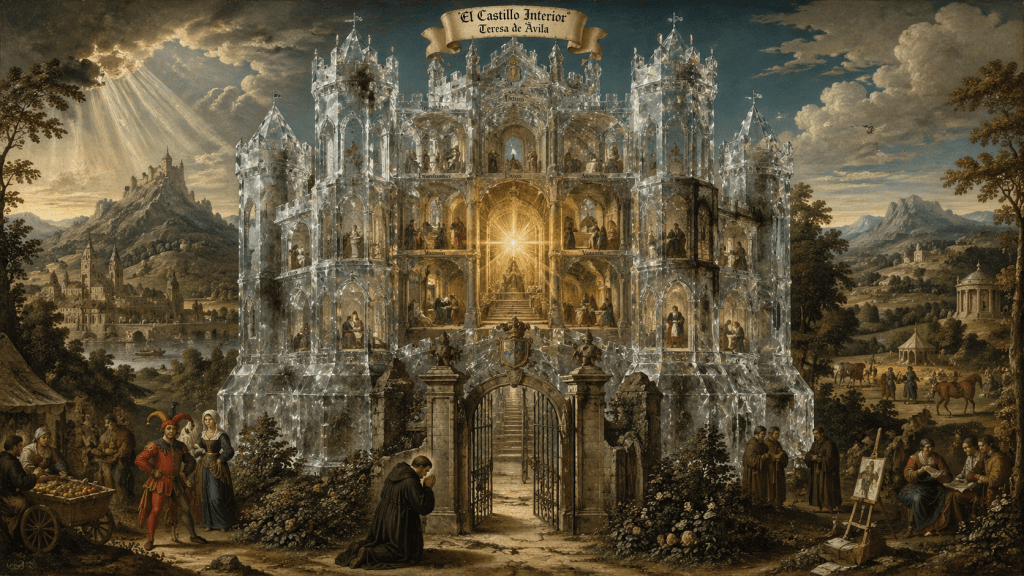
There are certain books that seem to follow you long before you ever open them. The Interior Castle has been one of those for me. I have heard it referenced again and again in conversations about spiritual formation, in discussions of prayer, and in the quiet recommendations of people I trust. Most recently, Dallas Willard mentioned it, and that was enough to move it from “someday” to “now.”
And yet, I know there is a hesitation that often arises, especially among Protestants and Evangelicals. The instinct is almost reflexive: This is Catholic spirituality… is this for me? That question is understandable, but perhaps it is also too small. If God is truly at work among His people, then we should expect glimpses of truth, wisdom, and lived experience of Him across traditions. Not uncritically, not without discernment, but also not with closed hands. Teresa, whatever else may be said, is one of His children, and it would be unwise to assume we have nothing to learn.
“All truth is God’s truth.” — attributed to Augustine
This reading, then, is not about adopting everything wholesale. It is about listening. It is about testing, discerning, and receiving what is good. It is about recognizing that the Spirit is not confined to our preferred lanes, even if we must still navigate carefully.
My goal is simple. I want to read this work slowly, one chapter at a time, and reflect on what I encounter. No rushing ahead. No spoilers. Just a deliberate walk through the text, pausing after each chapter to consider what it reveals about the inner life with God. This is not merely an intellectual exercise. It is an act of spiritual formation, an attempt to pay attention—to the text, to my own interior life, and, ultimately, to God.
“You are a little universe, and you carry heaven and earth within you.” — Hildegard of Bingen
I am only at the beginning—chapter one—and already it is stirring something. There is a sense that this is not just a book to be read, but a place to be explored. A map, perhaps. Or maybe more like an invitation. The kind where you do not yet know what lies beyond the door, only that it would be a mistake not to open it.
So I invite you to walk through it with me. Slowly. Thoughtfully. One room at a time.
There are certain images that do not merely explain an idea. They open a door. That is how Teresa of Ávila begins The Interior Castle. She asks us to imagine the soul as a castle made of diamond or very clear crystal, beautiful beyond our ability to fully understand, filled with many rooms, and created to be the dwelling place of God. The image is stunning because it begins with dignity before it begins with defect. The soul is not first presented as trash to be discarded, but as treasure to be recovered.
That matters.
Many of us begin the spiritual life by thinking mostly about what is wrong with us. Sin is real. Brokenness is real. The rooms of the castle do need cleaning. Teresa does not deny that. In fact, she later speaks of the soul being so cluttered with distractions and “vermine” that we cannot see the beauty of the castle clearly. But before she speaks of the mess, she shows us the worth. The soul is precious because it bears the image of God and because God Himself desires to dwell there.
This is where her metaphor has already begun to work on me. If the soul is like crystal, then it is made to receive and transmit light. If Christ dwells at the center, then spiritual formation is not merely about trying harder to behave better. It is about becoming clean, clear, and whole enough for His life to shine through us. Prayer, then, is not an escape from reality. It is the gate into reality. Teresa says the way into the castle is “prayer and consideration,” meaning attentive, reflective, interior prayer, not merely words moving across the lips while the heart remains elsewhere.
That makes the image both beautiful and frightening. Beautiful, because it tells me the soul has immeasurable worth. Frightening, because it means there are rooms I have not entered, corners I have not cleaned, and dark places I may prefer not to see. Yet the point is not shame. The point is invitation. God is already at the center of the castle, and the journey inward is a journey toward Him.
So I am reading The Interior Castle slowly, one chapter at a time. No spoilers. No rushing ahead. I want to sit with each room as I encounter it, reflect on what Teresa is teaching, and ask what God may be showing me about prayer, self-knowledge, repentance, and the life of the soul.
Reflection 1
If the soul is like a crystal, as Teresa of Ávila suggests, then something beautiful follows. Crystal does not generate light. It receives light. It transmits light. It refracts light. Its beauty is not self-originating, but participatory.
That immediately raises a question for me. If God is at the center of the soul, and if He is the source of life, then what would it mean for His light to shine through us? Scripture repeatedly describes Christ as light. Not merely as one who brings light, but as light itself. So the metaphor begins to stretch in a direction that feels almost too fitting. The clearer the crystal, the more fully the light passes through. The more obstructed it is, the dimmer and more distorted the light appears.
Am I taking Teresa’s metaphor too far? Maybe. I am not entirely sure this is precisely what she intended. But even if I am extending it, the extension does not feel foreign to the broader Christian vision. In fact, it seems to resonate deeply with it.
If this is true, then spiritual formation is not primarily about manufacturing goodness. It is about removing what obstructs the light. That reframes everything. We often speak about love as something we must produce, as though agape (ἀγάπη), that self-giving and sacrificial love, originates within us. But the deeper Christian claim is far more radical. We are not the source of agape love. The Trinity is. Love exists eternally within the life of God, Father, Son, and Holy Spirit, and what we are invited into is participation, not production.
This is where the metaphor begins to connect with what James D. Gifford Jr. describes as a kind of perichoretic participation. Perichoresis (περιχώρησις) refers to the mutual indwelling of the persons of the Trinity, a dynamic and living communion where each person fully indwells the others without confusion or loss of distinction. Gifford extends this idea to our relationship with God. Not that we become divine in essence, but that we are invited into a participatory union, a life in Christ and Christ in us.
If that is even partially true, then the crystal metaphor deepens. The soul is not just a structure to be cleaned. It is a dwelling place. And not a passive one, but a participatory one. The light does not merely shine on us. It shines through us. Or perhaps better said, the life of God dwells within us and expresses itself outwardly through us.
Which brings me back to the uncomfortable part. If the light is dim, distorted, or barely visible, the problem is not the light. It is the clarity of the crystal. And that is where Teresa’s emphasis on cleaning the rooms begins to make more sense. Not as moralism. Not as earning anything. But as the slow, often painful work of removing what keeps the life of God from being seen clearly in us.
So maybe the question is not whether I am taking her metaphor too far. Maybe the better question is this: what would it look like for the light to pass through me more clearly today?
Reflection 2
Teresa says the gate into the castle is prayer, but that raises an interesting question. How do we enter a castle that we already are? Perhaps the point is not that we are outside our own soul, but that we often live on the outer edges of it. We dwell near the walls. We move through life reacting, performing, managing, and surviving, but we rarely enter deeply enough to see what is actually within us. Prayer becomes the doorway into that deeper exploration.
When I began practicing Lectio Divina, I started using the Life With God Bible, and one of its reflections on John’s Gospel immediately drew me back to this image. “The light shines in the darkness.” Then came the question: what darknesses in our lives hide God’s light? That question is both beautiful and terrifying. Beautiful, because it assumes the light is real. Terrifying, because it asks me to let that light go places I might prefer to keep closed.
The idea of God illuminating the dark rooms of my life is not comforting at first. Who knows what is lurking there? Nothing good, I suspect. Old wounds. Sinful habits. Disordered loves. Resentments I have baptized as wisdom. Fears I have mistaken for prudence. The rooms of the castle may be crystal by design, but some of them have not been cleaned in a very long time.
Yet this is also where hope enters. If Christ is seated at the center of the castle, then His light is not coming to expose me for destruction, but to heal me for communion. The light does not reveal the dust because God delights in shame. It reveals the dust because the room was made to shine.
This connects again with the participatory life I have been exploring. Christ in me, and me in Christ. Not a vague religious slogan, but a real communion, a kind of holy dance. The life of God is not merely beside me or above me. He dwells within, calling me inward, room by room, not so I can obsess over my darkness, but so His light can pass through more clearly.
And yet, I feel the resistance. I want the light, but I fear what it will reveal. I want freedom, but I cling to familiar chains. Why is it so hard to let go of sin, even when we know it darkens the soul? Perhaps because sin is rarely experienced only as rebellion. Often, it has become shelter, habit, anesthesia, or identity. To surrender it can feel like losing part of ourselves, even when that part is slowly killing us.
Still, I am drawn to the light. That may be grace already at work. The desire to be healed is itself a gift. The willingness to open even one door, to let Christ illuminate even one neglected room, may be the beginning of prayer doing its quiet work. The castle is not cleaned all at once. But perhaps today, one curtain can be pulled back. One window can be opened. One room can begin to remember what it was made for.
Reflection 3
When Teresa speaks of entering the castle through “prayer and consideration,” I find myself wondering what she has in view. The phrase feels broader than what we often call prayer. It seems less like reciting words and more like a posture of attention. Perhaps what she is pointing toward is something closer to contemplative prayer, even if that language came later. Figures like Dallas Willard and J. P. Moreland have described contemplative prayer as a key part of spiritual formation, a way of being present to God rather than merely speaking to Him. That seems to fit what Teresa is getting at, a kind of interior attentiveness that allows us to actually enter the deeper rooms of the soul.
This also challenges the way I often approach reading. There is a subtle temptation to treat books like achievements, to move quickly, to finish, to check the box, as if the goal is completion rather than transformation. It becomes a kind of quiet gamification. How many pages did I read? How quickly did I get through it? But Teresa’s approach, and perhaps the nature of spiritual reading itself, pushes in the opposite direction. The goal is not speed. The goal is absorption. It is to linger long enough for meaning to settle, for truth to take root, and for God to bring to the surface what He would have me see.
I have found that happening already. I have spent nearly a month with the first chapter alone, not because it is difficult to understand, but because it continues to echo in unexpected places. It surfaced again as I began reading the Gospel of John, especially around the imagery of light and darkness. It appeared in moments of quiet reflection, in questions I had not planned to ask, in small convictions that seemed to come from somewhere deeper than my own thoughts. It is as though sitting with the text has allowed it to move from something I read into something that begins to read me.
There is something slow and almost hidden about this process. It does not feel efficient, but it does feel real. Taking time seems to saturate the mind with what might be called eternal truth, not in a way that overwhelms, but in a way that seeps in. The words remain, the images linger, and over time they begin to shape how I see both myself and God. Perhaps this is what Teresa meant all along. Not just prayer as speaking, and not just consideration as thinking, but a kind of attentive abiding where the soul learns to remain long enough for the light to be noticed.
Questions for Reflection
- If your soul is a castle, where do you tend to live most of the time? Are you near the outer walls, or have you ventured inward toward the center where Christ dwells?
- What “rooms” in your life feel closed off or unexamined? What emotions arise when you consider inviting God’s light into those spaces?
- When you think about God’s light exposing darkness in your life, do you experience that more as a threat or as an invitation? Why might that be?
- In what ways might you be trying to produce goodness or love on your own, rather than allowing the life of God to flow through you?
- How would your approach to prayer and Scripture change if the goal were not completion, but attentiveness? What might it look like to linger until something deeper begins to surface?
- Where have you already experienced God’s light breaking into your darkness in the past? What did that process feel like, and what did it produce in you?
- What is one small step you could take to “open a room” in your life this week and allow God to begin His quiet work there?
References
- Dubay, T. (1989). Fire Within: St. Teresa of Avila, St. John of the Cross, and the Gospel on Prayer. Ignatius Press.
- Kavanaugh, K., & Rodriguez, O. (Trans.). (1980). The Collected Works of St. Teresa of Avila. ICS Publications.
- Merton, T. (1961). The Inner Experience: Notes on Contemplation. Harper & Row.
- Moreland, J. P. (2019). Finding quiet: My story of overcoming anxiety and the practices that brought peace. Zondervan.
- Teresa of Ávila. (1577/2007). The Interior Castle. Dover Publications.
- Teresa of Ávila, S., & Dalton, J. (1852). The Interior Castle (pp. 1–6). T. Jones.
- Willard, D. (2021). Hearing God: Developing a conversational relationship with God (J. B. Smith, Foreword). IVP.
Excerpt
A slow reflection on Teresa of Ávila’s Interior Castle, the soul as crystal, prayer as entrance, and the frightening but beautiful work of letting Christ’s light shine through the hidden rooms within us.
oración y consideración


Leave a Reply