
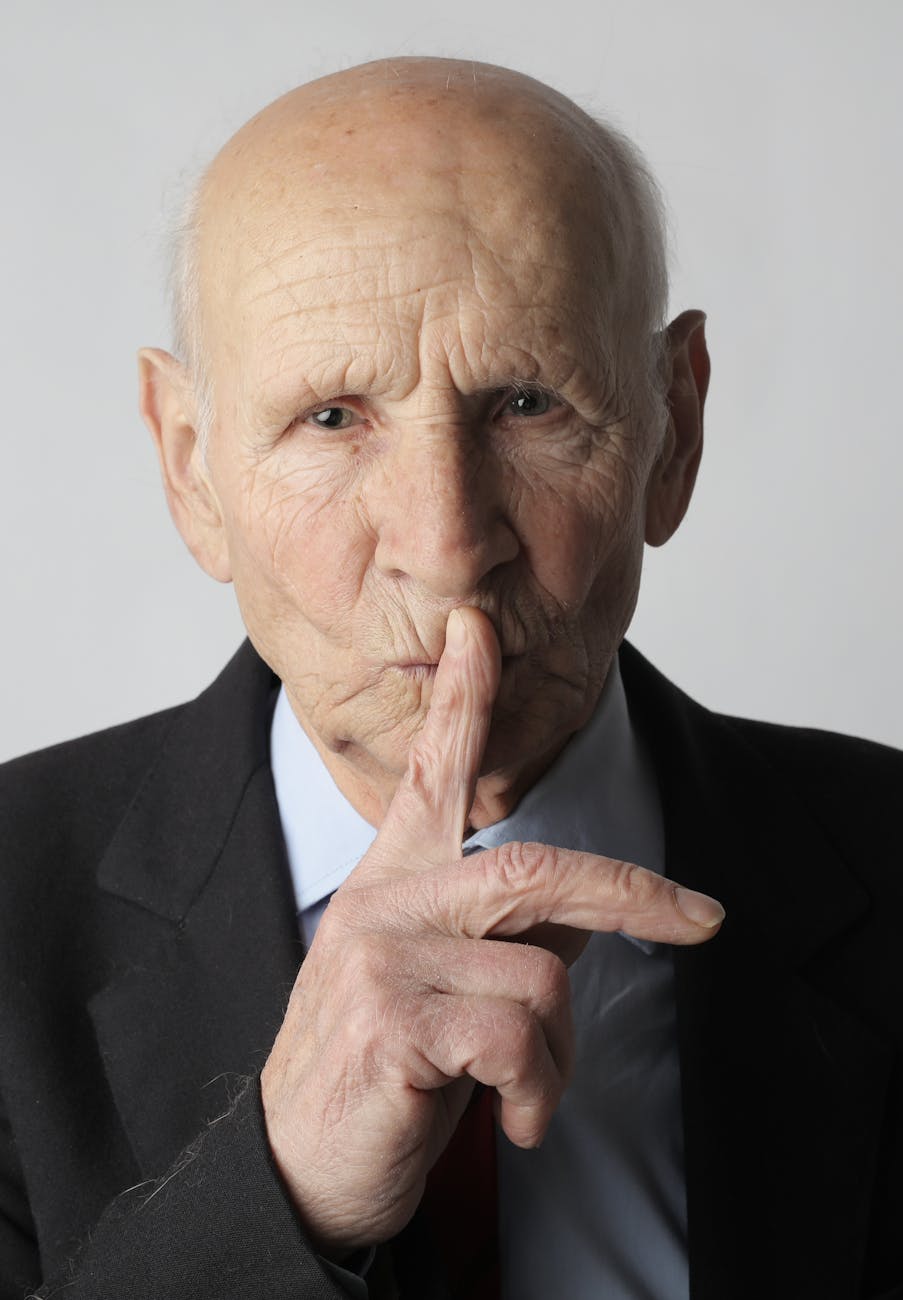
“Tell me not to look, and suddenly I cannot look away.”
This isn’t just a quirk of psychology—it’s the human condition. It’s also why so many of our religious, moral, and social structures surrounding sex seem simultaneously rigid and strangely permeable. We build walls around the subject of sexuality, and then we’re surprised when people start drilling holes through them, whispering across the gaps, or ignoring them altogether.
In this opening post of the series “Sex, Sense, and the Sacred: Unpacking Human Sexuality in a Confused Age,” I want to begin with the silence. Not the contemplative kind, but the awkward, suppressive, don’t-you-dare-bring-that-up kind. The kind that dominates both sacred spaces and secular conversations.
Let’s ask an honest question: Why don’t we talk about sex?
In many religious communities, especially conservative Christian ones, sexuality is either sterilized into theological abstraction or shrouded in silence altogether. I remember a Promise Keepers group in my church that was shut down—not because it was provocative, but because it dared to talk plainly about sex. Not in crude ways. Just honestly. About the reality of male desire, temptation, and the emotional burdens tied to performance and identity. But even that, it seems, was too much.
The rationale? “Men should not be discussing the mechanics of sex.”
As if the act itself can only be referenced in code, or reserved for obscure doctrinal footnotes. Yet this very silence breeds misunderstanding, shame, and bizarre forms of repression. The refusal to talk doesn’t sanctify the subject—it weaponizes it.
Especially for men, silence around sexuality can be a source of deep emotional distress. There’s a pervasive cultural script: to be a man is to be sexually confident, ever-desiring, and always ready to perform. If you’re not, you’re broken. If you talk about it, you’re weak.
But what if we flipped that? What if it were more manly to be honest than to pretend? Imagine the relief of hearing another man say, “Yeah, I struggle too,” or “I worry about that,” or “I don’t always know what I’m doing either.” That kind of vulnerability doesn’t diminish masculinity—it deepens it. And yet, most men live in emotional vacuums, unsure if anyone else has the same questions.
You might say, “But talking about sex could lead people astray.”
To that I reply: not talking about it already has. We’ve seen the fruit of secrecy—it’s confusion, isolation, and in many cases, hypocrisy.
When sex is boxed in too tightly by religious doctrine, people don’t always become more virtuous. Sometimes, they just become more inventive. Take for example the practice among some Mormon youth called “docking”—where penetration without movement is seen as avoiding “actual” sex. Or bacha bazi in some Afghan communities, where older men keep young boys as sexual companions but deny any connection to homosexuality—because the behavior is framed as “play,” not identity.
These are not merely fringe phenomena. They’re logical outcomes of theological silence combined with cultural repression. When you remove clarity but retain strict moral boundaries, people will find a way to rationalize what they want to do. And often, those rationalizations are ethically and theologically incoherent. It’s the same impulse that led the Goonies to believe they could outsmart every trap—except in this case, the trap is our own moral architecture.
There are many reasons for the silence:
- Cultural Taboos: Generations have been taught to treat sex as shameful or dirty.
- Fear of Judgment: Few want to be misunderstood—or worse, accused of perversion.
- Personal Privacy: Sex is deeply intimate, and many feel it doesn’t belong in public conversation.
- Political Weaponization: In today’s climate, even discussing non-reproductive sex is seen as taking a side in the culture war.
- Lack of Language: Without education or vocabulary, many simply don’t know how to begin the conversation.
There’s a strange irony here. In a society saturated with sexual imagery, actual dialogue about sexuality is still treated as off-limits, especially in religious circles. We’ve made sex simultaneously hyper-visible and utterly unspeakable.
Let’s not forget a basic truth of human psychology: Prohibition enhances allure. Paul, in Romans 7:7, said it plainly: “I would not have known what coveting really was if the law had not said, ‘You shall not covet.’” The command not to desire awakens desire.
Modern psychology agrees. Studies show that when something is made taboo, people are more likely to obsess over it. It’s not surprising, then, that religious communities with the strictest moral boundaries around sex often struggle most with secret transgressions.
If we could talk about sex openly, maybe it wouldn’t be quite so seductive. Maybe we could start seeing it not as a minefield, but as a meaningful—though complex—part of human existence.
So here I am—playing devil’s advocate, asking the questions that don’t get asked in polite company or from pulpits. What is sex really for? What happens when you can’t procreate anymore—does sex lose its value? What about people whose experiences don’t fit into theological checklists? Can we talk about those things without condemnation? Can we even ask without being accused of rebellion?
We must. Because if theology is to shape the whole of life, it must be brave enough to face the whole of life—including our sexuality.
In the end, I’m not looking for sensationalism or rebellion. I’m looking for truth. That sacred, uncomfortable, sometimes elusive truth that emerges not from certainty, but from honest exploration. We may not all agree on the answers. But if we can’t even ask the questions, what kind of faith are we practicing?
It’s time to stop whispering.
It’s time to speak—with wisdom, with humility, and yes, with courage.
Next in the series: “Missionary Only? Reconsidering the Theology of Sex” — exploring whether procreation is the sole purpose of sex, and what that implies for intimacy, identity, and spiritual formation.
Resources
- An Afghan Tragedy: The Pashtun practice of having sex with young boys, Afghanistan’s subculture of paedophilia is one of the country’s untold shames by Chris Mondloch, 29 October 2013, https://www.independent.co.uk/voices/comment/an-afghan-tragedy-the-pashtun-practice-of-having-sex-with-young-boys-8911529.html
- For Christian conservatives, it’s all about sex . . . and it’s been that way for a long time https://religionnews.com/2017/12/14/for-christian-conservatives-its-all-about-sex-and-its-been-that-way-for-a-long-time/
- Overcoming Religious Sexual Shame: An epidemic of sexual shame is crippling people taught to be “pure.” Posted August 23, 2017 by David J. Ley, Psychology Today https://www.psychologytoday.com/us/blog/women-who-stray/201708/overcoming-religious-sexual-shame
- Let’s (Not) Talk About Sex: Breaking Down the Stigma in Church, January 21, 2020, by Drs. Melissa and Scott Symington, Pepperdine University https://boonecenter.pepperdine.edu/blog/posts/lets-not-talk-about-sex.htm
- Half of U.S. Christians say casual sex between consenting adults is sometimes or always acceptable, August 31, 2020, Pew Research Center https://www.pewresearch.org/short-reads/2020/08/31/half-of-u-s-christians-say-casual-sex-between-consenting-adults-is-sometimes-or-always-acceptable/
- Researchers Confirm That Conservative Christian Women Are Having Horrible Sex “Seeing sex as a female obligation and a male entitlement leads to horrible sex, frankly.” by Noor Al-Sibai, 11.8.24 https://futurism.com/neoscope/conservative-christian-women-terrible-sex
Excerpt
Why is sex so hard to talk about—especially in church? In this post, we explore the silence around sexuality in sacred spaces, the emotional toll it takes, and the absurd logic that thrives in its absence. It’s time to ask the forbidden questions—and rediscover truth through honest conversation.
Keep Calm and Avoid the Sackville-Bagginses


Leave a Reply