
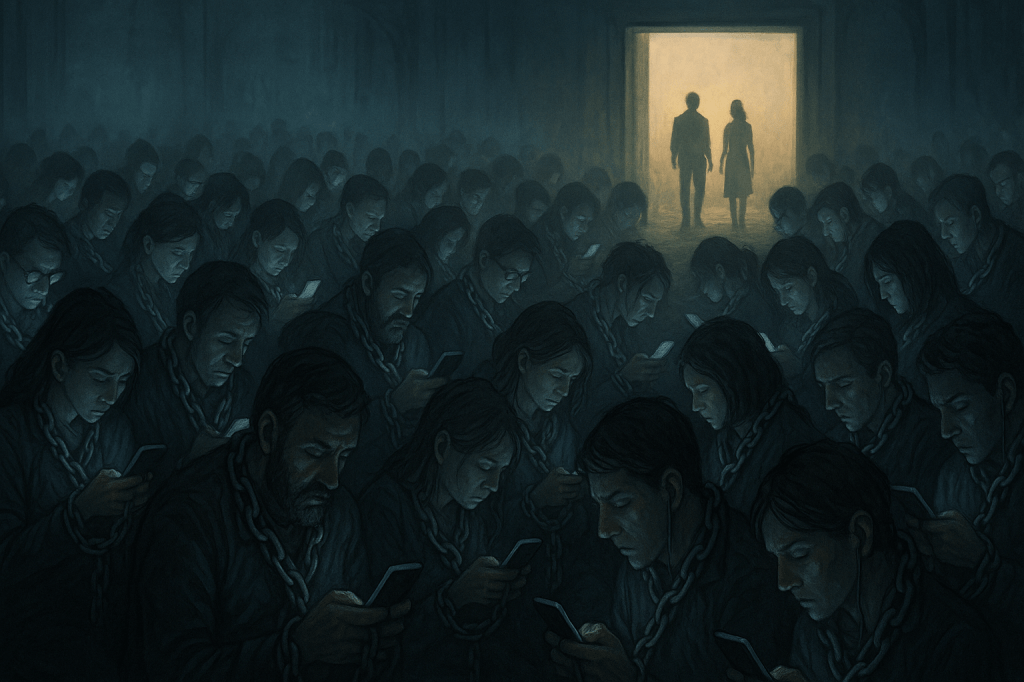
Why This Quote Won’t Let Me Go
I stumbled across a line the other day—one I had not seen before, and it felt less like a clever observation and more like someone tapping me on the shoulder across the decades:
“People will come to love their oppression, to adore the technologies that undo their capacities to think.”—Aldous Huxley
There are quotes that make you nod. Then there are quotes that make you stop, breathe, and wonder why they suddenly feel more like a mirror than a prophecy. Huxley’s words did that to me. They lodged themselves somewhere between my sternum and my conscience and started whispering.
It wasn’t even the drama of the word “oppression” that struck me—it was the quiet accuracy of “come to love.” As if he knew that the human struggle would not be against outward tyrants, but against the soft, glowing tools we cradle willingly. The ones we invite into our pockets, our homes, our attention, our minds.
The moment I read it again, a thread of thoughts began to unspool. Memories of late-night scrolling. Observations about how easily a perfectly ordinary mind becomes reactive, tribal, addicted. Reflections on how fast our tools evolve and how slowly our wisdom adapts. I felt the old tension rising: technology as promise and peril, liberation and leash, fire we claim to control even as it burns our fingers.
I couldn’t shake the feeling that Huxley was not warning us about governments or ideologies—not primarily. He was warning us about ourselves. About the way we respond to tools of our own making. About our uncanny ability to forge chains out of conveniences and call them freedoms.
This blog post is the continuation of that thought-trail—one that started with a single sentence but opened a door to much deeper concerns about how our tools shape our minds, our relationships, and even our sense of agency.
And perhaps the most unsettling question is not whether technology can undo our capacity to think…but how easily we let it.
Technology as Our Mirror: A Tool That Magnifies Who We Already Are
The strange irony of our age is that technology has never really deceived us. It has only amplified us. Every innovation, from the printing press to the smartphone, begins as a tool—neutral, inert, waiting for human intention to animate it. But tools have a way of revealing the intentions we didn’t realize we carried. They become mirrors before they become machines.
We like to imagine technology as an external force, something acting upon us. But more often, it reflects something already present: our impatience, our craving for novelty, our fear of missing out, our hunger for validation, our tribal instincts lurking just beneath the surface. Give us a platform to communicate, and we reveal how seldom we actually listen. Give us the ability to connect with anyone in the world, and we often choose to shout across digital barricades instead.
This is the Law of Unintended Consequences in slow motion. The very tools designed to liberate us—speed, convenience, global connection—quietly smuggle in their own liabilities. Platforms promising connection end up producing isolation. Technologies built to democratize information end up flooding the world with misinformation. Innovations meant to empower individuals are engineered to hold their attention captive instead.
Even public leaders are beginning to say it openly. Utah Governor Spencer Cox recently described social media not as a moral panic but as a spreading “cancer,” a force that “is taking all of our worst impulses and putting them on steroids… driving us to division… driving us to hate.” His description of algorithms as “wolves” that attack once they know your leanings may be the most accurate metaphor for the digital battlefield we now inhabit. It’s not that the wolves came looking for us. We let them in, fed them our preferences, and taught them to hunt.
And this is hardly a new story. I wrote recently about Forbidden Planet, that haunting mid-century parable where the legendary Krell built machines of unimaginable power—tools so advanced they could obey the subtlest whisper of thought. But in perfect Huxleyan fashion, the Krell were not destroyed by an external foe. They were undone by their own unexamined impulses, their monsters from the Id amplified and unleashed by technology that reflected them too faithfully. It is a cautionary tale of a civilization that mastered its tools only to be devoured by them, not because the machines turned evil, but because the creators underestimated themselves.
Our technologies may differ in form, but not in principle. They magnify what we bring to them. And in a culture that prizes efficiency over wisdom, the magnification tends to reveal our fractures before it reveals our strengths.
We didn’t inherit tools capable of shaping billions of minds at once. We invented them. And now we are discovering—often too late—that they shape us right back.
The Dopamine Cage: When the Machine Learns What Makes Us Twitch
If Huxley feared that pleasure would become the mechanism of control, he could not have imagined how precisely modern technology would operationalize that insight. We now live inside systems that don’t just entertain us—they study us. They watch how long our eyes linger, how fast we scroll, which emotions make our thumbs hesitate, which stories spike our heartbeat. And then they feed it all back to us, optimized.
We used to think addiction belonged to substances—alcohol, nicotine, opioids. Things you had to physically ingest. Today the drug is delivered through glowing rectangles, in hits measured not in milligrams but in notifications, outrage, and perfectly tailored provocation. The human nervous system simply was not built for infinite stimulation.
Decades ago, behavioral psychologists ran infamous experiments where rats would press a lever to stimulate the pleasure centers of their brains. Given the chance, many would neglect food and water until they died. We like to believe we’re more sophisticated than rodents, but the difference is only one of design. Rats pressed levers; we press screens. They had electrodes; we have algorithms. They were trapped by the novelty of sensation; we are trapped by the illusion of information.
This is why Tristan Harris, one of the early architects of persuasive technology, later confessed that we’ve built “tools that downgrade humanity.” It’s why Sam Altman warns that AI is now capable of generating “deeply persuasive individualized content.” And it’s why Yuval Noah Harari argues that AI does not need to hate us or rebel against us; it simply needs to hack the vulnerabilities in our cognitive firmware—the shortcuts, biases, and emotional instincts that have guided our species for millennia.
We built machines to learn from us. Then the machines learned what makes us twitch. And now they serve it back to us, in exactly the quantities needed to keep us pressing the lever.
What makes this cage so insidious is that it doesn’t feel like a cage. It feels like information, like relevance, like participation. It feels like agency even as it erodes agency. It feels like empowerment even as it quietly conditions our attention, our affect, and eventually our beliefs.
The Krell, in Forbidden Planet, were undone by a machine that could manifest their subconscious desires. Today, we carry smaller versions of that machine in our pockets—devices that manifest our impulses and train them into compulsions.
The tragedy is not that technology manipulates us. The tragedy is how willingly we cooperate.
From Entertainment to Entrapment: The Soft Authoritarianism of Convenience
George Orwell warned us about a future where tyranny would come with boots and batons. Aldous Huxley warned us about a future where tyranny would come with comfort. Between the two, it is Huxley who seems to have read our mail.
- Orwell feared the State would ban books.
- Huxley feared we would be so distracted we’d stop reading them.
- Orwell feared pain would control us.
- Huxley feared pleasure would.
We keep assuming oppression will look like force—someone taking something from us. But most modern forms of control involve giving us exactly what we want. Or at least what our impulses want. A never-ending stream of novelty. Outrage tailor-fit to our tribe. Entertainment that demands no thought. Comfort disguised as connection. The slow erosion of agency disguised as customization.
The Romans understood this logic long before we had algorithms. Their strategy was brutally simple: panem et circenses—bread and circuses. Keep the population fed and entertained, and they will surrender their political voice. Distraction becomes the currency of control, and comfort becomes the anesthetic of a declining republic.
Technology has perfected that formula.
What was once a political tactic has become a business model. The digital world supplies “bread” in the form of convenience—everything delivered, everything on-demand—and “circuses” in the form of endless entertainment, conflict, and curated outrage. Nero had amphitheaters; we have steaming services and social media. The effect is the same: a populace lulled into passivity by stimulation.
This is the genius—and the horror—of today’s digital ecosystem. It does not command obedience; it coaxes cooperation. It does not impose silence; it overwhelms discernment. It does not break the will; it bypasses it.
And the consequences are not merely psychological. They’re political. Cultural. Spiritual.
- When our attention is captured, our judgment follows.
- When our emotions are manipulated, our convictions drift.
- When our feeds become our lenses, our world shrinks to the size of our biases.
Huxley anticipated a culture where entertainment would become a narcotic, where distraction would serve as a political anesthetic. A world where people wouldn’t need to be silenced; they would simply stop caring. And in that world, the greatest dangers would not be imposed from without but welcomed from within.
Today, we live in that world. Not because a tyrant demanded it, but because a platform designed it. This is not the tyranny of a dictator. It is the tyranny of design—a soft authoritarianism of convenience.
We imagine that surrendering our agency would require force. But most of the time, it requires nothing more than a swipe and a tap. And like every mythic warning embedded in the stories we tell, the lesson remains: if we do not shape our tools with wisdom, our tools will shape us with indifference.
The Digital Fall: Why We Master Tools Only After They Damage Us
Humanity has a long history of inventing things we are not yet wise enough to wield. Fire, the wheel, gunpowder, industrial machinery, nuclear fission—each breakthrough arrived carrying both promise and peril in the same package. Every leap forward created extraordinary potential, and every leap was followed by a period of harm, misuse, or catastrophe before we learned how to govern the new power responsibly.
We master our tools only after they injure us.
This pattern is so consistent it feels almost mythic:
- Prometheus brings fire, and the gods fear what humans might do with it.
- The alchemists discover explosives, and within a generation they reshape warfare.
- Atomic energy is unlocked, and within a few years the world stands on the brink of annihilation.
But for most of human history, the cycle had margins. When a tool harmed us, it harmed a city, a region, a battlefield. Today, the margins are gone. Our technologies now scale globally before we understand their consequences. They outpace our laws, our ethics, and our cultural immune system.
Social media was unleashed on the world long before we understood how it weaponized tribal identity, rewired adolescent brains, and destabilized democracies. Artificial intelligence is accelerating the same trajectory—not maliciously, but indifferently. It does not need intention to cause harm; it simply needs speed.
This is the tragedy: the rate at which we gain wisdom is too slow for the exponential curve of our inventions.
When knowledge expands faster than meaning, mistrust is inevitable. People lose their grip on what is true, who can be trusted, and how to navigate a world of competing claims. Technology amplifies every cognitive vulnerability—confirmation bias, motivated reasoning, emotional contagion—until they become structural features of public life.
We keep imagining that technological harm will look like science fiction: killer robots, rogue AIs, mechanical uprisings. But more often, the danger is subtle. It is the gradual erosion of attention. The polarization of communities. The collapse of a shared reality. The slow drift from thoughtful citizens into reactive consumers.
This is why Huxley’s insight matters so much. He understood that the real threat is not technological rebellion, but human capitulation. We don’t fall because machines overpower us. We fall because our unexamined impulses—fear, anger, vanity, distraction—find new ways to express themselves through tools whose scale we cannot yet fathom.
We fear that AI might someday enslave humanity. The more sobering reality is that we may enslave ourselves long before that.
Unless we learn faster than our machines evolve, unless we develop the disciplines—moral, intellectual, spiritual—to govern the tools we create, we will repeat the pattern of the Krell: undone not by the malice of our inventions, but by the blindness of our own ungoverned minds.
A Personal Note — To the Few Who Made It This Far
If you’re still here—if your eyes are resting on these words after all the paragraphs above—then you are already different. Most people will never read a post like this. My blog doesn’t get much traffic, and it never will. The posts are too long for our age. Too reflective. Too demanding of attention in a world that’s traded contemplation for scrollable comforts.
And maybe that’s the point.
The fact that you are still here means you’re one of the few—one of the people who can still resist the trance. One of those rare souls who has not entirely ceded their mind to the algorithms that pander, provoke, and pacify. You see the game for what it is, even if none of us fully escape it. You know, deep down, that something is wrong—that something precious is being eroded in us, day by day, swipe by swipe.
And like me, you probably feel the frustration of watching a culture slide quietly into illusion. You might have tried to warn people. You might have said something, posted something, shared something. Only to discover what I’ve discovered:
No matter how loudly we shout the truth, most won’t look up from their glowing screens long enough to hear it.
Huxley anticipated this too. Not a world of tyranny enforced from above, but a world of sedation embraced from below. A world where people willingly trade their capacity for thought in exchange for the next hit of novelty or outrage. A world where truth becomes background noise against the constant hum of stimulation.
And yet—you’re here.
Still reading.
Still thinking.
That gives me hope. Not the loud kind of hope that makes headlines or sparks revolutions, but the quiet kind that keeps a candle burning in the dark. The kind of hope that remembers that change often comes from the few, not the many. From people willing to think when thinking is no longer fashionable.
So thank you.
For reading this far.
For caring enough to follow the thread.
For refusing to surrender your agency so easily.
Perhaps most people won’t look up from their little screens. Perhaps most won’t see the danger until it is too late. But if you and I can keep our eyes open—even just a little—then the darkness is not complete.
And maybe, in the end, that is enough.
| Related Posts for Influence & Control Meta-Framework |
| Explore my series exploring the psychological tools, logical distortions, and social mechanisms that shape how influence and undue control operate. |
| Posts | References |
Excerpt
A reflection on Huxley’s warning that we might come to love the very tools that undo us. From algorithms to AI, our technologies amplify our weaknesses and seduce us into quiet surrender—yet a few still resist the trance and keep their eyes open.

 Treasures of the Elysian Fields
Leave a comment