
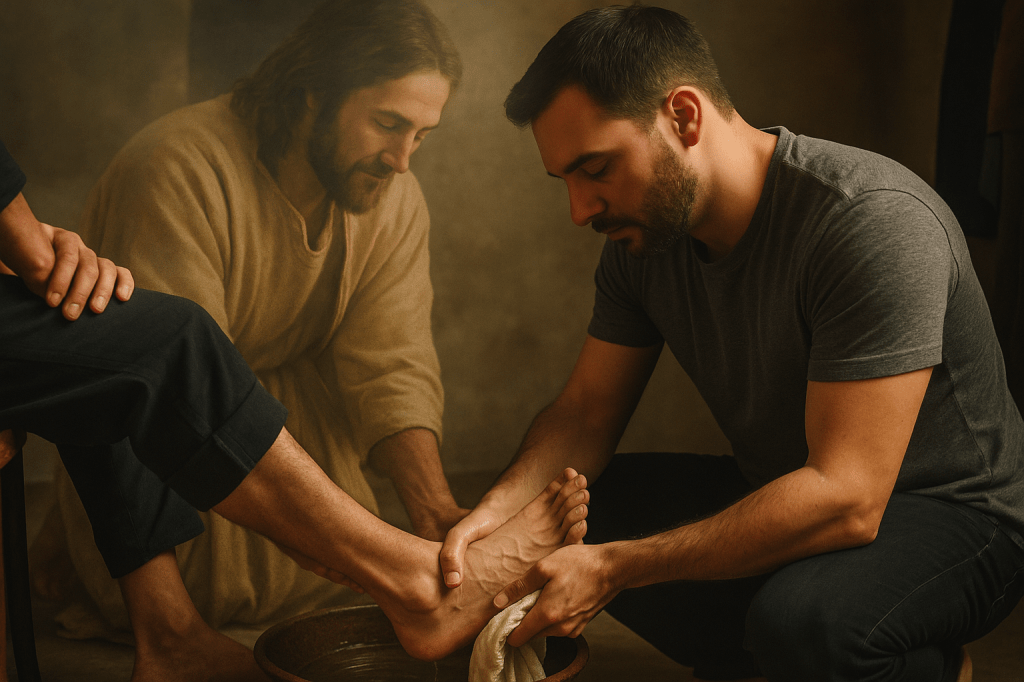
Introduction — Love at the Center
There are times when a book doesn’t merely inform you; it reawakens something that had gone quiet. Reading Perichoretic Salvation by James D. Gifford Jr. was one of those moments for me. It began as an exercise in brushing off the dust of old seminary notes — a way to revisit doctrines I hadn’t seriously engaged with in years. But it quickly became something deeper: a rediscovery of what it means to be in Christ, not just in belief but in being.
Because I’ll be honest: theology can sometimes feel like an exercise in system maintenance — keeping our propositions tidy and our boundaries well-marked. But Gifford’s exploration of perichoresis — that ancient Greek word describing the mutual indwelling and interpenetration of the Father, Son, and Spirit — reframed everything. It invited me to see salvation not as an abstract transaction but as a living, relational participation in divine life.
While reading, I leaned on Microsoft Copilot as a study companion — a digital conversation partner helping me unpack dense theological terminology and trace doctrinal threads across centuries. In the process, I found myself asking questions that reached far beyond mere academic curiosity:
- How does union with Christ differ from the “non-dual realization” found in Eastern mysticism?
- If we are truly drawn into the divine life, what does that mean for how we love?
- Does Jesus care more about doctrinal precision or about the practice of love — orthopraxis over orthodoxy?
Through those questions, the book became a mirror to my own faith journey. I began to see that love — agape — is not an accessory to salvation but its essence. Union with Christ is not about possession of right ideas but participation in right relationship. The more I read, the more I felt that the core of Christian life is not “believing correctly” but loving rightly — and that this love flows naturally from the perichoretic dance of divine life into which we are invited.
This post, then, is not just a review of Gifford’s book but a reflection on that journey. I want to share what I learned about perichoretic salvation, how it deepened my understanding of relational union with God, and why I believe this vision re-centers love as the heart of Christian life.
“Whoever lives in love lives in God, and God in them.” — 1 John 4:16
Note:
- This verse is a cornerstone for relational theology—it doesn’t just say that God has love, but that God is love, and that living in love is the very condition of mutual indwelling. It’s not abstract sentiment—it’s ontological reality. To live in love is to live in God, and vice versa. In Gifford’s framework, this verse becomes a relational litmus test: if we are truly “in Christ,” then love will be the defining expression of our being. Not just as an ethic, but as the evidence of union.
What Is Perichoretic Salvation?
Before we can understand what James D. Gifford Jr. means by perichoretic salvation, we need to recall how the term perichoresis has been used throughout Christian theology.
The first form refers to what theologians call Trinitarian perichoresis or circumincession. It affirms that the divine essence is shared fully by each of the three Persons of the Trinity in a way that avoids blurring their distinctions. Each Person—Father, Son, and Spirit—completely indwells the others, so that whatever belongs to one belongs equally to the others. Every divine action is a joint action of all three Persons. God’s unity is therefore not static substance but dynamic communion: a relationship of self-giving love.
The second form is the Christological perichoresis, or coinherence of natures. This doctrine describes the two natures of Christ—divine and human—as interpenetrating one another in perfect union, such that the human nature is never without the divine and the divine never without the human. In the words of the Chalcedonian Definition (AD 451), Jesus Christ is “recognized in two natures, without confusion, without change, without division, without separation; the distinction of natures being by no means taken away by the union, but rather the characteristics of each nature being preserved.” He is fully divine and fully human, neither overwhelming nor diminishing the other. There is union with distinction, the same harmonious mystery that exists within the Trinity itself.
“that each of Christ’s natures permeates the other (perichoresis), and that His humanity participates in the attributes of His divinity.” – Lutheran Symbolics
It is upon this foundation that Gifford proposes a third type: perichoretic salvation. In his book, he argues that the believer’s union with Christ can be analogically understood through this same relational pattern. When we are “in Christ,” and Christ is “in us,” something more than metaphor is taking place. We are drawn into genuine participation in the divine life—not by nature, as Christ is, but by grace.
Gifford is careful to preserve the Creator–creature distinction. The believer’s participation is real yet asymptotic; it forever approaches but never dissolves into the divine being. Still, the relational structure mirrors that of the Trinity and the Incarnation: love that indwells, gives, receives, and makes room for the other.
Salvation, in this vision, is not simply a juridical declaration or a moral improvement project. It is an invitation into the life of God—the divine dance of mutual indwelling. In being joined to Christ, we are drawn into the perichoretic flow of divine love, learning to live as participants in the communion that has existed from all eternity.
“God became man so that man might become god.” — Athanasius of Alexandria
This is the theological heartbeat of perichoretic salvation: a vision of redemption as relational participation rather than mere pardon, of theology as shared life rather than abstraction, and of agape—self-giving love—as both the shape and the substance of salvation itself.
Why This Framework Matters
For most of my life, I was taught that salvation is a legal declaration: God forgives, and the record is cleared. That framework has its place — justification is not to be dismissed — but it can leave the relationship feeling transactional, almost contractual. The perichoretic view reorients that entirely. It invites us to see salvation not as God’s bookkeeping but as God’s self-giving.
If the Triune God is a communion of love, and if Christ’s incarnation is the joining of divine and human life in one Person, then salvation must follow the same pattern: a relationship of shared life, not mere moral correction. In Gifford’s model, to be “in Christ” is to be taken up into that divine circulation of love — not absorbed or erased, but awakened and renewed in relationship.
This changes everything. Our spiritual life is no longer about proving worthiness or mastering propositions, but about participation. It is about dwelling within a love that makes room for us even as it transforms us. The believer’s life becomes an echo of the Trinity’s relational rhythm — giving and receiving, knowing and being known.
Seen this way, Christian ethics are not an external set of rules but the natural outflow of being indwelt by divine love. The command to “love one another” (John 13:34) is not a burden placed on us from the outside; it is the internal pulse of our new life. Orthodoxy — right belief — matters, but only insofar as it orients us toward orthopraxis — right love.
Jesus seemed to care more about whether we love rightly than whether we categorize correctly. His harshest words were not for sinners but for those who prized doctrinal purity over mercy. When asked about the greatest commandment, He didn’t cite a creed; He summarized the whole law in love — love of God and love of neighbor.
Perichoretic salvation reinforces this emphasis. It shows that love is not merely the result of salvation but its very substance. If salvation is participation in the life of Christ, and Christ’s life is defined by agape — self-emptying, other-embracing love — then to live in Christ is to love as Christ loves. Love becomes not our task but our nature restored.
This is why Gifford’s framework resonates so deeply with me. It unites doctrine and devotion, theology and life. It reminds me that correct belief is not the final goal but the scaffolding for relationship — the way of knowing that enables the way of loving.
“In the evening of life, we will be judged on love alone.” — John of the Cross
The perichoretic model gives language to what my heart already knew: that salvation is less about crossing a line and more about entering a relationship — the ongoing, ever-deepening communion of divine love.
My Study Journey
I didn’t expect to have a conversation partner on this theological pilgrimage, let alone a digital one. Yet as I read Perichoretic Salvation, I kept a second window open — Microsoft Copilot — not to outsource thinking, but to think with. The book is theologically dense, at times reading like a symphony of patristic citations and modern systematic theology. Having a tool that could quickly clarify terms, trace doctrinal lineages, or summarize historical debates allowed me to stay immersed rather than overwhelmed.
But what surprised me was how the process became dialogical. The more I asked questions, the more those questions revealed my own spiritual hungers. I wasn’t just looking for definitions — I was looking for connection.
One of my early questions was whether this idea of union with Christ was simply another form of non-dual realization, the kind described in Eastern mysticism. Copilot helped me see the critical distinction: non-dualism seeks the dissolution of distinctions — self into Absolute — whereas perichoretic union preserves relationship. In Christianity, union does not erase the “I” and the “Thou.” Love requires otherness. The dance only exists because there are partners.
That insight changed the way I thought about prayer and presence. In contemplative moments, the goal isn’t to vanish into God but to abide — to dwell in mutual indwelling without confusion or separation. The paradox is not annihilation but intimacy.
Later, while working through Chapter 5, I asked about the application of all this theology. If perichoresis is more than metaphor, what does it mean for daily life? The answer I found — in both Gifford’s writing and my own reflection — is that perichoretic participation expresses itself as agape. The closer we draw into the life of Christ, the more His love flows through us into the world.
This realization reframed everything I thought I knew about discipleship. The point of salvation isn’t escape from the world but communion within it — a way of loving as God loves, in the middle of ordinary human relationships. When Jesus prayed “that they may be one, as we are one,” He wasn’t speaking about doctrinal unanimity but relational unity: a perichoretic fellowship extended to humanity.
I began to see how much of modern Christianity has reversed the order — seeking right belief first and hoping right love will follow. But the Gospel reverses that: love is not the outcome of orthodoxy; it is the doorway to truth. The life of faith becomes less about policing boundaries and more about widening the circle of communion.
My dialogue with Copilot reminded me that theology is at its best when it’s conversational — not a monologue of certainty, but a humble pursuit of understanding together. The technology may have been new, but the process was ancient: faith seeking understanding (fides quaerens intellectum).
“We love because He first loved us.” — 1 John 4:19
By the end of the book, I realized that my questions about love, union, and practice were not tangents — they were the heart of it all. The perichoretic life is not something to analyze; it is something to enter. And the only true entrance is love.
Love as the Key — Orthopraxis and Participatory Relationship
The more I sat with Gifford’s idea of perichoretic salvation, the more it redefined what love actually means. Not sentiment, not duty, not even the moral excellence of loving the unlovable — but participation.
Love, in this framework, isn’t merely what we do; it’s what we enter into. It is the life of the Trinity shared with us — the divine current of self-giving that flows from Father to Son to Spirit and now draws us in. To be “in Christ” is to step into that movement, to become part of the eternal exchange of love that is God Himself.
When I pray, I’m not sending words into the void hoping for divine attention. I am participating with Christ in His intercession with the Father. Let that sink in: my small, faltering prayers are gathered into His perfect communion. Prayer becomes not performance but participation — not me reaching up, but Christ praying through me, with me, in me. That is perichoretic love in motion. Mind blown.
This realization changes how I understand everything about faith.
If salvation is participation in divine love, then Christian life is the art of participation. Every act of mercy, every moment of forgiveness, every breath of worship is not just obedience — it’s joining the eternal dialogue of the Godhead. Love is not the outcome of salvation; it is salvation manifest.
This kind of love — agape — is not an abstract ideal but a living relationship. It is, as Paul writes, “Christ in you, the hope of glory.” The more I participate in that love, the more it reshapes me from the inside out. My own capacity to love doesn’t expand by willpower or virtue but by presence — by being drawn into the One whose very being is love.
That’s why orthopraxis — right practice — matters. Not because we earn favor through good works, but because practice is how participation becomes embodied. Doctrine gives language to the truth; practice gives it life. As the apostle John put it bluntly, “Whoever does not love does not know God, because God is love.”
To live perichoretically — to participate in divine love — is to make space for others the way God makes space within Himself. The Trinity is the eternal act of making room for the other; the Incarnation extends that hospitality into human flesh. And the Church, when it loves rightly, continues that same motion — opening its arms, its tables, its hearts.
Love, then, is the liturgy of participation. Every prayer, every act of compassion, every time we forgive or serve or worship — we join the great intercession of Christ, the unending circulation of divine love that holds the cosmos together.
This is what it means to say God is love: not that God occasionally loves, but that God’s very being is loving participation — and He invites us into that life.
“The whole life of a Christian is one long act of love.” — St. Augustine
In that light, theology ceases to be about winning arguments or defining boundaries. It becomes the language of participation — words that help us enter the mystery of divine love more deeply. Orthodoxy describes the dance; orthopraxis is when we join it.
And that, to me, is the breathtaking beauty of perichoretic salvation:
- Salvation is not God loving us from a distance. It is God loving us into Himself — inviting us to participate in the very life that has always been love.
Implications for the Church, Worship, and Life
If salvation is participation in divine love, then everything we do as the Church — prayer, worship, service, even conversation — becomes an extension of that love. It is love continuing to make room for others.
This realization changes how I understand worship.
Jesus said that true worshipers “will worship the Father in spirit and truth.” I used to read that as a command to worship sincerely, without hypocrisy. But in light of perichoretic salvation, it means something deeper.
To worship “in Spirit” is to worship within the Spirit — to be caught up in the Spirit’s own act of adoration toward the Father through the Son. Our worship, then, is not an event we generate but a participation in the Triune life. We are joining the Son’s eternal “Yes” to the Father. Every song, every silence, every tear becomes part of that divine dialogue.
The same holds true for corporate worship.
When the Church gathers, it’s not merely a collection of individuals performing a shared ritual. It’s a living icon of the divine communion. The Spirit doesn’t just inhabit each believer separately but binds us together in the same indwelling love. The result is not uniformity but unity — a perichoresis of persons, distinct yet deeply connected.
This raises a question that still leaves me in awe: Is there, perhaps, a fourth level of perichoresis — not only Trinity, Incarnation, and Union with Christ, but believers indwelling one another through the Spirit?
Scripture hints at it. Jesus prayed, “that they may be one, as we are one — I in them and you in me” (John 17:22–23). Paul writes, “We, though many, are one body in Christ, and individually members one of another.” There it is again — in one another. The same relational structure that defines the Trinity and salvation also shapes the Church.
I don’t claim to understand how far that extends — it’s mystery upon mystery. Perhaps this is why love must govern our life together: because when I harm another, I harm one who is bound to me in Christ. When I forgive, serve, or reconcile, I participate in Christ’s own work of reconciliation.
This participatory vision restores the sacredness of community. The Church ceases to be a voluntary association and becomes a living organism, a communion of persons within the Communion of God. To love my neighbor is to honor Christ who dwells in them — and somehow, through them, in me.
It also reshapes how I pray. Prayer is not an act of self-expression; it is intercession through participation. When I pray for someone, I am joining Christ’s own intercession for them. My voice becomes a thread woven into His unending prayer before the Father. That means prayer is never solitary. Even alone, I’m praying with Christ, through the Spirit, to the Father, on behalf of the world.
In this light, the command to love one another is not merely ethical — it’s metaphysical. Love sustains the very reality of our shared life. Each act of love is a moment of perichoresis extended: God’s love flowing through Christ into me, through me into you, and through you into others, completing the circle again.
Perhaps this is what the Church was always meant to be — a visible echo of the invisible Trinity. A body where unity does not erase individuality, where difference does not divide, and where love holds all things together.
“That they may all be one; even as You, Father, are in Me and I in You, that they also may be in Us.” — John 17:21
Whether this mutual indwelling among believers counts as a “fourth level” of perichoresis or simply the outward flowering of the third, I cannot say. But I know this: the more I live into this truth, the more worship, prayer, and community converge into one thing — participation in love.
And maybe that’s the point. Not to define how many levels there are, but to realize that love is endlessly self-giving, always inviting, always making room. Every time I open my heart to another, the dance widens.
The Missed Command and the Long Journey Home
As I continued to sit with this vision of perichoretic love, one passage of Scripture kept echoing in my mind — words I’d heard countless times but never truly heard:
“By this everyone will know that you are my disciples, if you love one another.” — John 13:35
It’s stunning in its simplicity. Jesus didn’t say the world would know us by our creeds, our apologetics, or our moral codes. He said they would know us by our love — by the quality of our participation in His own life of self-giving relationship.
And yet, somehow, much of the Church — and I include myself in this — has missed it. We have built walls around doctrine and called it faithfulness, forgetting that doctrine is supposed to point us toward relationship. We’ve defended truth as if love were its enemy, when in reality, truth without love ceases to be true.
How did we get here? Maybe because it’s easier to define than to love. Doctrines can be memorized, defended, and systematized; love must be lived. Love requires vulnerability, patience, forgiveness, and the willingness to see Christ in people who don’t fit neatly into our categories. It’s much safer to win arguments than to wash feet.
And yet, who am I to judge? It took me years of walking with Christ to even glimpse this. My own faith journey has been full of head knowledge and half-light — like feeling my way around an elephant, describing fragments of something I couldn’t yet see whole. Only now do I realize the obvious: that the whole animal is love.
That realization didn’t come through emotional experience but through theology — through the very academic sterility of Gifford’s book. There’s a divine irony in that. Perichoretic Salvation is written in careful, systematic prose, footnoted and restrained, yet its subject matter overflows with relational fire. Beneath its scholarly surface beats the heart of divine intimacy.
And maybe that’s fitting. Perhaps God hides the most relational truths in dense theology so that only those hungry enough to wrestle with them will find the feast. Seek and ye shall find.
For me, this book didn’t just clarify a doctrine — it brought together years of scattered insights and moments of grace into a single vision: a relational participation in the life of God.
“Though I have the gift of prophecy and can fathom all mysteries and all knowledge, but do not have love, I am nothing.” — 1 Corinthians 13:2
It took me a long time to get here, but now I see what I was missing all along.
Conclusion — The Blindfold Removed
When I finished Perichoretic Salvation, I sat in silence for a long time. Not the silence of confusion, but the silence that follows revelation — the moment when puzzle pieces finally lock into place and what you’d been trying to describe for years suddenly comes into focus.
This book tied together threads I’d been gathering my whole life. The theological frameworks I once studied in fragments — incarnation, Trinity, theosis, union with Christ — all converged here, not as abstractions but as a single living reality: a participatory relationship with God.
I realize now that I had been like a blind man feeling around an elephant, describing the texture of the trunk, the curve of the tusk, the roughness of the skin — each insight partial, each doctrine incomplete. But now, at least for a moment, the blindfold has slipped. I can see the whole shape — the wholeness of love itself.
- And what I see is breathtaking.
- Salvation is not transaction but transformation.
- Faith is not assent but participation.
- Love is not command but communion.
It’s almost ironic that a book so rich in relational meaning should be written in such a sterile, academic tone — full of Greek terms, citations, and analytic precision. Yet maybe that’s part of the mystery. The God who hides majesty in a manger also hides relationship in theology. Sometimes the life-giving truth is wrapped in sterile prose, waiting for us to unwrap it.
This book isn’t for everyone. It’s dense, demanding, and at times dry — but for those willing to wrestle with it, it can be life-giving. For me, it wasn’t just a theological exercise; it was an unveiling.
Through it, I discovered that participation is the heartbeat of faith. When I pray, I participate with Christ in His intercession to the Father. When I worship, I join the Spirit’s eternal song. When I love my neighbor, I become part of the divine circulation of grace that began before the foundations of the world.
I don’t pretend to have mastered this truth — I’ve barely begun to live it. But now that I’ve seen it, I can’t unsee it. The Christian life is not about getting doctrine right so that we can love; it’s about loving so that doctrine comes alive.
- The blindfold is gone. What remains is wonder — and an invitation: to live each day as participation in the divine dance of love, to see every act of kindness as a thread in the eternal communion, and to remember that all theology worth having ends in this one thing: “Whoever lives in love lives in God, and God in them.” — 1 John 4:16
Join me on this journey of discovery. It is an adventure into the heart of mystery, where every new insight feels like uncovering hidden treasure. I have only begun to explore the depths of what perichoretic salvation means for faith, love, and life together. In future posts, I’ll delve into the wider implications of this participatory vision — from worship and prayer to community and spiritual formation — each one opening our eyes a little wider to the divine dance we’ve been invited to join. So stay tuned, and let’s keep seeking the treasures of this mystery together.
Reference List
- Berkhof, L. (1938). Systematic theology. Wm. B. Eerdmans publishing co.
- Gifford, J. D., Jr. (2011). Perichoretic salvation: The believer’s union with Christ as a third type of perichoresis. Wipf and Stock Publishers. https://www.wipfandstock.com/9781610973099/perichoretic-salvation
- Grenz, S., Guretzki, D., & Nordling, C. F. (1999). Pocket dictionary of theological terms (p. 26). IVP Academic.
- Hall, M. (2013, February 21). Review of Perichoretic Salvation by James D. Gifford Jr. Wheaton Blog. https://wheatonblog.wordpress.com/2013/02/21/review-of-perichoretic-salvation-by-james-d-gifford-jr/
- Perichoretic Salvation: The believer’s union with Christ as a third type of perichoresis [Book summary]. (2023). Everand. https://www.everand.com/book/399738584/Perichoretic-Salvation-The-Believer-s-Union-with-Christ-as-a-Third-Type-of-Perichoresis
- Rahner, K. (1970). The Trinity (J. Donceel, Trans.). Herder and Herder. (Original work published 1967)
- Torrance, T. F. (1996). The Christian doctrine of God: One being three persons. T&T Clark.
- Zizioulas, J. D. (2006). Communion and otherness: Further studies in personhood and the church. T&T Clark.
Excerpt
A theological journey became a revelation. Perichoretic Salvation helped me see that salvation is not transaction but participation — a life of shared love within the Trinity itself. The blindfold is gone; what remains is wonder, relationship, and the invitation to live inside divine love.
Abide, Then Proceed

 Treasures of the Elysian Fields
Leave a comment