
The Authority of Images
In 1917, two young girls in Cottingley, England — Elsie Wright and Frances Griffiths — staged a series of photographs showing themselves playing with delicate, winged fairies. By today’s standards, the images look almost laughably crude: cardboard cutouts held in place with hatpins. Yet at the time, they convinced not only the girls’ parents but even serious thinkers like Sir Arthur Conan Doyle, who cited them as proof of the spiritual world.
Why did these photographs persuade? Because they appeared to show what people longed to believe. Britain had just endured the trauma of World War I, with its mass death and industrial slaughter. A photograph of enchantment, innocence, and hidden worlds spoke more powerfully than any rational argument for or against. The images bypassed skepticism and gave people hope that reality contained more magic than mud and graves.
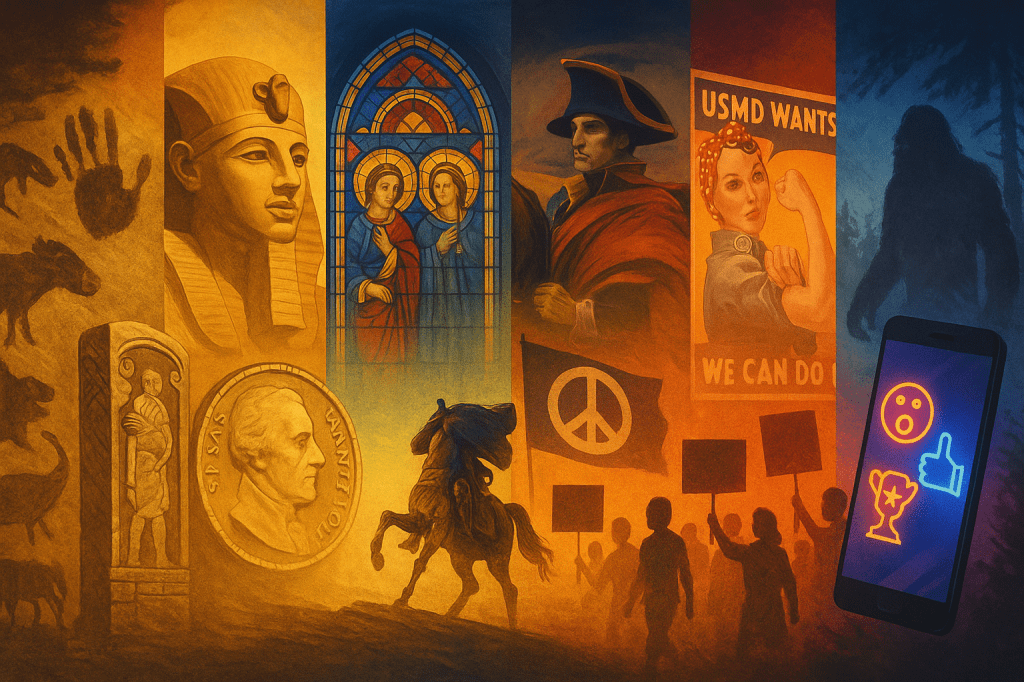
The Cottingley Fairies remind us of a sobering truth: humans have always trusted images, often more than words. We want to believe what we see. And for that very reason, images have been wielded throughout history as tools of influence and control. From ancient empires to modern states, from religious devotion to consumer advertising, images have been used to legitimize power, convey belief, and mobilize loyalty.
“He who controls the past controls the future. He who controls the present controls the past.” – George Orwell, 1984
This essay explores that long arc of image-based persuasion — from Pharaohs and Roman coins to medieval cathedrals, propaganda posters, awareness campaigns, and memes. The methods change, but the mechanism remains: images reach us where argument cannot.
Ancient Foundations – Divine Authority in Stone and Gold
Long before Pharaohs raised statues or emperors stamped their faces into coins, humans were already experimenting with the power of images. The earliest known cave paintings — from Chauvet, Lascaux, and Altamira — depict animals in motion, hunts in progress, mysterious handprints on stone. At Göbekli Tepe, the world’s oldest known temple complex (dating back to 9,000 BCE), massive T-shaped pillars are carved with animals, abstract symbols, and human figures.
We don’t know exactly why these images were created — ritual, storytelling, teaching, or a mixture of all three — but one truth seems clear: even in humanity’s earliest societies, images carried meaning beyond decoration. They communicated across time and space, shaping collective imagination. They were the first visual arguments: that the hunt mattered, that the spirits were near, that the tribe shared a story.
By the time Egyptian Pharaohs emerged millennia later, this instinct had matured into deliberate statecraft. Pharaohs were not merely kings — they were gods incarnate. Their colossal statues, carved in unchanging style for centuries, were not portraits in the modern sense but symbols of divine order. The immensity of a Pharaoh’s image was meant to humble: when you stood before a stone colossus towering forty feet high, the message was clear — this was no ordinary man. Scale itself was persuasion.
The Romans, pragmatic and political, perfected another form of visual influence: the coin. Tiny, portable, and mass-produced, Roman coins bore the emperor’s face and titles, circulating his image to every corner of the empire. For many subjects, this small piece of metal was the only direct “encounter” with their ruler. The coin carried propaganda in your pocket: not just currency, but an emblem of authority, loyalty, and empire.
But coins were only one piece of Rome’s visual arsenal. Excavations at Pompeii reveal campaign graffiti and slogans painted on walls, urging citizens to vote for local candidates. Some were blunt endorsements: “I ask you to elect Marcus Holconius Priscus duumvir, a good man.” Others leaned on humor or peer pressure: “The neighbors all support Lucius Popidius; you should too.” Painted in bright colors where people gathered, these slogans combined words with visual placement — a kind of ancient billboard. The message was unmistakable: political persuasion is most effective when it’s seen everywhere, not just heard once.
Images like these were more than art — they were arguments, silently declaring: this ruler is eternal, this power is divine, this system is unshakable. In societies where literacy was rare, the image was the message. You didn’t need to read a decree if you could see Caesar’s face stamped into the very money you used to buy bread, or pass campaign walls shouting the same names day after day.
“The measure of a man is what he does with power.” – Plato
From cave walls to temple pillars, from statues to coins and graffiti, the logic of visual persuasion has remained consistent: images shape how people see the world — and who rules it. Pompeii’s slogans may be two thousand years old, but their spirit lives on every time you drive past a yard full of election signs or scroll a feed flooded with hashtags. The walls have simply gone digital.
Religious Iconography – The Eye of Faith
If ancient empires used images to proclaim political power, the medieval world turned them into tools of faith. In Christian Europe, where literacy was rare, stained glass windows, illuminated manuscripts, and cathedral frescoes became the “Bible of the poor.” A single panel of stained glass could preach the gospel more vividly than a sermon — Christ enthroned, saints with golden halos, sinners writhing in painted hellfire. The message was unmistakable: this is the story of salvation, and you are part of it.
But Christianity was hardly alone in this. Buddhist temples across Asia are adorned with statues of the Buddha, serene in meditation, or vast mandalas designed to symbolize the cosmic order. In Shinto shrines in Japan, images of kami are rare, but symbolic objects — torii gates, ropes, and mirrors — act as visual anchors of spiritual presence. Islamic tradition, often avoiding figural art, instead embraced the power of calligraphy and geometric pattern. The very words of the Qur’an, inscribed in dazzling mosaics, became a visual testament to divine beauty and truth. Judaism, similarly cautious with figural images, used symbolic forms like the menorah, the Star of David, and Torah ornamentation to anchor communal identity.
And in Hinduism, the divine was — and is — vividly embodied in murti statues and temple carvings. Deities like Vishnu, Shiva, and Durga appear in countless forms, each with symbolic gestures, postures, and attributes. These images are not merely representations but believed to be living presences when consecrated, allowing worshippers to engage in darshan — the act of seeing and being seen by the deity. Color, adornment, and multiplicity reinforce theology: that the divine is vast, manifold, and intimately present.
The thread across all these traditions is the same: images and symbols do what words cannot — they bypass the rational and imprint belief directly on the imagination. To walk into Chartres Cathedral and see sunlight pouring through radiant glass was to feel the story of God’s kingdom. To spin a Tibetan prayer wheel or gaze on a mandala was to inhabit cosmic order. To trace Qur’anic calligraphy across a mosque wall was to sense divine beauty inscribed into the very structure of the world. To behold a murti of Krishna or Durga was to encounter divinity face-to-face.
Even in modern times, the same strategy endures. Jehovah’s Witnesses are famous for their colorful illustrations — books and pamphlets filled with cartoonlike visions of paradise: families picnicking with lions, children smiling in meadows, resurrected loved ones greeting each other in a garden-like earth. These images aren’t simply decoration; they are persuasion. They reinforce belief, providing a visual rehearsal of the world Witnesses are taught to expect. In many ways, these pictures function like medieval stained glass: they bypass argument and preach directly to the heart.
“The eye is the lamp of the body. If your eyes are healthy, your whole body will be full of light.” – Matthew 6:22
Across Christianity, Buddhism, Shinto, Islam, Judaism, Hinduism, and even modern religious movements, the principle is the same: to see is to believe. Visual persuasion gives theology a form the heart can grasp even before the mind considers it.
Empires of Propaganda
If religion baptized images with divine authority, empires and modern states weaponized them for war and politics. The image became not just a window to the sacred, but a banner under which millions marched.
Take Napoleon Bonaparte, who carefully curated his visual legacy. In paintings by Jacques-Louis David, Napoleon appears not as a mere general but as a near-mythic figure: calm amid chaos, robes flowing, hand tucked into his vest like a Roman statesman. These portraits were not neutral depictions; they were arguments. They declared Napoleon to be destiny incarnate, the embodiment of order rising from revolution.
A century later, propaganda reached industrial scale during World War I and II. Posters became the most persuasive weapons that never fired a bullet.
- In Britain, Lord Kitchener’s stern finger pointed out from recruitment posters: “Your Country Needs YOU.”
- In America, Uncle Sam mirrored the gesture, etching his gaze into the national imagination.
- In Nazi Germany, idealized Aryan figures — blond, muscular, resolute — filled posters, reinforcing a racial myth that demanded conformity and sacrifice.
- In the Soviet Union, bold red and black imagery elevated workers and soldiers into icons of collective struggle.
The images were simple, repeatable, emotional — perfect for bypassing deliberation and stirring loyalty. As historian David Welch once noted, propaganda posters work best when they “reduce complex issues to a stark choice and reinforce it with a striking visual.”
But the advent of photography and film changed everything. No longer were images limited to stylized portraits or posters carefully composed by the state. Now reality itself — or at least fragments of it — could be frozen and circulated. Governments were quick to seize on this power, creating official newsreels and photojournalism designed to build morale. Yet photography also gave protesters and dissenters a weapon every bit as powerful.
During the Vietnam War, several photographs became cultural turning points:
- Nick Ut’s 1972 photograph of nine-year-old Phan Thi Kim Phuc — “the napalm girl” — running naked and screaming from an airstrike.
- Eddie Adams’ 1968 photograph of a South Vietnamese police chief executing a Viet Cong prisoner in the street.
- Malcolm Browne’s 1963 photograph of Buddhist monk Thích Quảng Đức setting himself on fire in Saigon.
These images didn’t just illustrate the war; they redefined it. Beamed into living rooms via newspapers and television, they bypassed official narratives and stirred public outrage. Historians argue that these photographs helped fuel the anti-war movement, galvanizing dissent in ways no speech or editorial could. As one protester later put it, “We couldn’t ignore the war once we had seen those pictures.”
The lesson of Vietnam was clear: the camera could no longer be controlled by governments alone. Images could mobilize loyalty, but they could also erode it. What had been a one-way weapon of empire became a contested battleground where power itself was at stake.
“Propaganda is to democracy what violence is to dictatorship.” – Noam Chomsky
The 20th century made this dynamic unmistakable: rulers may use images to shape allegiance, but in the age of photographs and television, dissenters can fight back with images just as forceful. A poster can demand obedience; a photograph can shatter consent. Both rely on the same principle: the eye persuades faster than the ear.
Modern Icons – Secular Religions and Satire
If ancient statues and medieval stained glass shaped empires of belief, the modern world has developed its own visual pantheon. Today, we live amid secular religions of imagery — awareness campaigns, advertising mascots, protest symbols, and satirical counter-icons. Some inspire solidarity for good causes; others manipulate through fear or mock belief systems altogether. All are designed to persuade by repetition and ritual display.
Consider the icons of public awareness. The pink ribbon for breast cancer, the red ribbon for HIV, the rainbow flag for LGBTQ+ pride — each uses color and simplicity to create instant recognition. Their persuasive strength lies not in argument but in visibility. By saturating culture — pinned to lapels, waved at parades, filling profile pictures — they normalize belonging and solidarity. They are visual mantras: “You are not alone; this matters.”
Governments, too, have long understood this strategy. Smokey Bear, with his ranger’s hat and shovel, delivered a simple message: “Only YOU can prevent forest fires.” The DARE program of the 1980s made children chant slogans and stare at its bold logo. The infamous anti-drug PSA, “This is your brain on drugs,” with its sizzling fried egg, imprinted itself into an entire generation’s memory. These icons worked not by data but by image — a bear with a hat, a frying egg, a word repeated until it felt like common sense.
Yet every icon invites counter-icons. The Christian fish symbol, long used to mark faith, has been parodied by atheists as the Darwin fish — complete with legs, proclaiming evolution. The “Flying Spaghetti Monster,” first drawn in satirical protest against teaching creationism in schools, has since become a full-blown parody religion. Such counter-icons remind us that persuasion is contested: symbols can be subverted, mocked, and remixed.
Protest movements also harness iconic images. The lone figure of “Tank Man” in Tiananmen Square in 1989 — standing before a column of Chinese tanks — remains one of the most famous photographs of defiance in history. In recent years, sprawling Black Lives Matter murals painted across city streets turned protest into public art, embedding dissent into the urban landscape itself. These images bypass speeches and statistics; they persuade by courage and presence.
But not every powerful image tells the truth. In 1934, a blurry photo known as the “Surgeon’s Photograph” appeared to show the Loch Ness Monster rising from the Scottish lake. For decades it was treated as proof of the myth, fueling tourism and folklore. Only in the 1990s was it revealed to be a hoax: a toy submarine with a sculpted head. Yet the photo’s influence lingered long after it was debunked, showing once again how the eye persuades more than the ear.
“Humor is a weapon of unarmed people: it helps them to fight against the powerful and the oppressors.” – Václav Havel
The modern world proves that icons need not be religious or imperial to move masses. Whether they call for solidarity, warn of danger, mock belief, or defy tyranny, their persuasive power lies in what they all share with ancient murals and medieval glass: visibility, repetition, and ritual. The more often we see them, the more natural they feel.
Continuity – Murals, Memes, and Mass Influence
From the walls of caves to the walls of cities, images have always relied on one simple truth: what we see often enough, we come to accept. Repetition is normalization. This is why ancient empires lined their streets with statues of kings, why medieval churches filled every stained-glass panel with saints, and why modern states plastered walls with propaganda posters. Images that are everywhere feel inevitable.
Today, memes and mass media carry on that same work. A meme may seem trivial — a recycled joke, a viral image macro — but its persuasive power lies in its ubiquity. Like Roman graffiti in Pompeii or “Uncle Sam Wants You,” memes shape collective imagination by being everywhere at once. They reduce complex issues to symbols and slogans, then spread them until they feel like common sense.
The same is true of ritualized campaigns. Think of awareness months, when ribbons, logos, and hashtags flood the cultural landscape. Or consider political seasons, when yard signs and bumper stickers line entire neighborhoods. These campaigns aren’t arguments so much as visual occupations of space. By sheer visibility, they embed themselves into the rhythms of daily life.
Protest art fits this continuity as well. The great street murals of recent years — from “Black Lives Matter” painted across Washington, D.C.’s 16th Street to climate activists’ banners draped over bridges — function exactly like ancient murals. They transform public space into symbolic space. The city itself becomes a message.
And, of course, digital platforms accelerate the cycle. Where ancient murals might last for centuries, memes live fast and die young — but in their brief lifespan, they can reach millions. Their ritual is not carved stone but endless scrolling, each “like” reinforcing the shadow-play on our modern cave wall.
“History doesn’t repeat itself, but it often rhymes.” – Mark Twain
The logic has not changed. Ancient murals and modern memes both depend on the same triad: repetition, recognizability, and ritual display. Once those elements are in place, persuasion follows — not by force of argument, but by the quiet tyranny of the familiar.
Pop Culture Reflections – Shadows and Empires
The empire of images is not just a relic of history or the province of propaganda posters. It surrounds us every day in the media we consume, the platforms we scroll, and the pop culture we trust more than we realize. Social influence no longer marches under banners; it slides across our screens in memes, headlines, and viral clips.
The press plays a central role here. Chuck Missler once remarked that the media shifted from trying to inform to trying to influence. Yet perhaps the harder truth is that it was always about influence. There was never a golden age of neutrality. From Hearst’s “yellow journalism” to modern cable news, the press has always been a battlefield of persuasion. What’s changed is not the motive but the business model. In the digital economy, truth is less valuable than clicks. Outrage and fear sell because they keep us scrolling. When revenue depends on attention, headlines are designed not to inform but to provoke. And we mistake that provocation for reality.
The danger is obvious: when information is filtered through the logic of clicks, the shadows on Plato’s cave wall multiply and flicker faster than ever. We are not seeing reality; we are seeing what maximizes engagement. The line between news and propaganda blurs, not because there is a single puppet master, but because the system itself rewards manipulation.
Pop culture has long warned us about this dynamic. Orwell’s 1984 gave us the most enduring image of surveillance propaganda: the stern face of Big Brother gazing down with the words, “Big Brother is Watching You.” In Star Wars, Imperial banners and stormtrooper regalia create a visual shorthand of fear and conformity — icons that declare the inevitability of the Empire. More recently, franchises like The Hunger Games dramatize the same point, showing how carefully staged broadcasts keep citizens loyal and fearful at once.
In real life, the aesthetic hasn’t changed. The bold fonts, simplified slogans, and striking visuals used in authoritarian posters of the 20th century live on in clickbait thumbnails, campaign graphics, and viral tweets. The shadows are updated, but the cave remains the same.
“Symbols are given power by people. A symbol, in and of itself, is meaningless.” – V, V for Vendetta
The modern challenge is not just to recognize propaganda when it’s draped on a banner, but to see it when it flashes past as a notification. Influence has always been the point — whether in marble statues or headlines built for outrage. What we need now is not nostalgia for a mythical golden age of neutrality, but vigilance to recognize the empire of images we inhabit.
Vigilance Through History
From cave paintings to TikTok, from Pharaoh statues to protest murals, images have always been more than decoration. They are tools of persuasion — shaping what we believe, who we follow, and where our loyalties lie. Empires, religions, protest movements, and corporations alike have known that the eye persuades faster than the ear.
But persuasion by image carries a peculiar danger: even when we know better, the picture still holds us. The Bigfoot photograph of 1967 — grainy film of a shaggy creature striding through the woods — has been debunked countless times. Costumes, confessions, and forensic analysis all tell us it was a hoax. And yet the image remains lodged in our imagination. Why? Because seeing is believing, even when reason tells us not to. We want to believe, and images are ready accomplices to that longing.
This is why vigilance matters. The most powerful icons are not always the ones that are true, but the ones we see most often, the ones that feel inevitable through repetition. That is how propaganda posters mobilized nations, how stained glass preached to peasants, how memes shape online culture, and how hoaxes linger in the public imagination.
The point is not to reject images — we cannot live without them. The point is to remember that images are shadows. They may show us something real, but never the whole truth. If we forget that, we risk becoming prisoners in a cave of curated symbols, reacting to shadows instead of grasping reality.
So I leave you with this challenge:
- What images shape your loyalties today? Which icons, banners, or memes do you accept without question because they are everywhere?
- How do you check whether an image informs or manipulates? Do you pause long enough to let reason catch up with instinct?
- Why do you still want to believe some images, even when you know they’re false?
History gives us perspective, but vigilance gives us freedom. The cave walls may glow brighter now, but the task remains the same: to turn, to question, to step into the light.
“You become what you behold.” – William Blake
| Related Posts for Influence & Control Meta-Framework |
| Explore my series exploring the psychological tools, logical distortions, and social mechanisms that shape how influence and undue control operate. |
| Posts | References |
Excerpt
From Pharaoh statues to medieval stained glass, from WWII posters to modern memes, images have always shaped power and belief. This essay explores the history of visual persuasion — how icons legitimize authority, mobilize nations, and linger in our imagination, even when debunked like the Bigfoot photograph.

 Treasures of the Elysian Fields
Leave a comment