
The Power of an Image
We like to say, “seeing is believing.” But is it? Our eyes may be the window to the soul, yet they are also the gateway through which some of the most powerful manipulations slip unnoticed. An image doesn’t politely ask us to reflect. It lands, it imprints, and it moves us — often before our rational mind has a chance to weigh in.
Think about it: how much are companies willing to pay for a 30-second Super Bowl ad? The current going rate hovers around $7 million for half a minute of airtime. Would anyone in their right mind spend that much if the images, colors, and sounds on that screen weren’t effective at shaping behavior? The sheer scale of investment proves the point: images influence us in ways that reason alone rarely can.
And this isn’t just about billion-dollar brands. It’s about the courtroom juror swayed by a defendant’s posture, the voter persuaded by a campaign poster, or the teenager scrolling past Instagram photos that shape her sense of beauty and worth. We are creatures who live by images — and, all too often, we are captured by them.
The irony, of course, is that we trust images precisely because they feel immediate. “Seeing is believing,” we say, but images are never neutral. They may show us something real, yes — but never the whole truth. That tension — between reality and representation, truth and illusion — is the terrain of visual persuasion.
The Fast Track – Kahneman’s System 1 vs. System 2
The psychologist Daniel Kahneman gave us one of the most useful maps of the mind in his book Thinking, Fast and Slow. He divides human thought into two systems:
- System 1 — fast, instinctive, emotional, operating automatically.
- System 2 — slow, deliberate, rational, requiring conscious effort.
System 1 is the first responder of the mind. It keeps us alive when danger strikes, letting us react without hesitation. But it is also gullible, prone to shortcuts and illusions. System 2 is the careful analyst, weighing evidence and running scenarios. Yet it is also lazy; it rarely intervenes unless prompted, and often it arrives too late to undo System 1’s snap judgments.
Images overwhelmingly work on System 1. They don’t ask for deliberation; they demand reaction. A photograph of a starving child, an Instagram-perfect dinner, a campaign poster plastered with bright colors — these visuals bypass slow analysis and lodge directly in the emotional core. By the time System 2 gets around to asking, “Is this true? Is this representative? Is this fair?” System 1 has already drawn its conclusion.
We saw this dynamic in a recent image from Gaza: a woman lying in a cart, apparently either asleep or dead. Mr. Aguilar, a whistleblower witness, claimed she had been struck in the head by a smoke grenade and died instantly. Yet the photo itself raised questions. There was no blood visible — and head wounds typically bleed profusely. A single picture cannot tell whether someone is asleep or dead; you cannot check vital signs through an image. And who, one wonders, was standing so close at just the right moment to take the shot? Yet none of those questions mattered in the moment of viewing. The image hit System 1 first, triggering grief and outrage before System 2 had any chance to analyze. People know this, and they exploit it — weaponizing our instinctive trust in what we see.
This explains why images feel so persuasive: they exploit the brain’s fast track. We are not designed to carefully scrutinize every visual cue that comes our way. We are designed to survive — and survival depends on speed. In the modern world, where images saturate every waking moment, this ancient adaptation becomes an open door for persuasion.
Cognitive Biases in Visual Persuasion
“We scroll past poison dressed as humor—and call it harmless.”
Kahneman’s framework helps us see why images hijack the fast track, but the story doesn’t end there. The brain has a whole set of shortcuts — cognitive biases — that make us even more susceptible to visual persuasion. These aren’t minor quirks; they are structural features of human cognition, the very mechanisms that advertisers, propagandists, cult leaders, and meme-makers exploit.
Confirmation Bias
We tend to see what we already believe. When an image aligns with our worldview, we accept it instantly as “proof.” When it contradicts us, we dismiss it. Online, this bias is magnified by algorithms that feed us reinforcing visuals. Tyson Gill, in Pandemic of Delusion, describes this as a kind of intellectual “pandemic” — falsehoods spread because they are contagious to our confirmation-seeking brains, not because they are true.
The Halo and Horn Effects
As Edward Thorndike first noted, one strong impression — positive or negative — colors our entire judgment. In group dynamics, this often shows up as the insider/outsider divide. Members of the “in-group” are assumed to be more moral, trustworthy, and intelligent (the halo). Outsiders are branded as suspect, dangerous, or ignorant (the horns).
This mechanism is one reason cults, movements, and political factions rely so heavily on visual identity — uniforms, badges, colors, or symbols that instantly separate “us” from “them.” Amanda Montell shows in Cultish how such symbols do not merely mark difference, they moralize it.
The Availability Heuristic
We mistake vividness for frequency. Images of burning buildings or dead children lead us to believe these events are more common than they are. Kahneman himself warned that our risk perception is driven less by probability and more by mental pictures. A single photo from Gaza or a disaster scene doesn’t tell us how widespread the event is — but it seizes our imagination and convinces us the threat is everywhere.
The Illusion of Truth Effect
The more often we see an image or slogan, the truer it feels. Amanda Montell, in Cultish, shows how mantras and repetition create a sense of inevitability — what she calls “the language of fanaticism.” Memes exploit this perfectly. A joke, repeated across thousands of accounts, becomes a “truthy” cultural anchor, even when its factual content is dubious.
Social Proof
Humans are herd animals; we look to others for cues about what to believe or do. A viral meme or protest photo says, “Look, everyone agrees.” Steven Hassan notes in Combating Cult Mind Control that cult leaders use carefully staged group images — people smiling, clapping, loving — to reassure the recruit that the movement must be safe and right. The crowd itself becomes the argument.
Snap Judgments: Visual Cues in the Courtroom
Some visual biases are subtler but no less powerful. I once sat in a courtroom and instantly thought, that guy looks guilty. The defense lawyer wore a ponytail and a cheap suit; the defendant sat in an ill-fitting short-sleeved shirt, slacks, and loafers, his body language uncertain, his posture defeated. To me, the cues screamed “unprofessional” and “guilty.” I caught myself — I knew this was bias — but did everyone else in the room?
This is the power of nonverbal visual persuasion. Posture, attire, grooming, and facial expression can sway judgment before a word is spoken. And unlike obvious propaganda posters, we don’t recognize these as persuasion techniques. They feel like neutral “first impressions,” when in fact they are System 1 shortcuts that can decide outcomes as serious as a jury verdict.
The Neuroscience of Fear & Urgency
Why do images persuade us so effectively? The answer lies in the architecture of the brain. Visual input is processed almost instantaneously, often bypassing the slower reasoning centers that weigh evidence. Neurologically, images move through the amygdala — the brain’s emotional alarm system — faster than they reach the prefrontal cortex, where rational analysis lives. The result is a powerful sequence: see → feel → react.
Kahneman’s System 1 is deeply tied to this process. It responds in milliseconds, delivering fear, disgust, or desire before System 2 has time to evaluate. This explains why a single photo of a crying child can spark outrage, donations, or even policy shifts — while a statistical report on child mortality rates barely makes a dent. Emotion leads; reason follows.
Courts understand this all too well. That’s why they are often wary of admitting photographs as evidence. It is not that photographs have no truth to them, but that they have too much persuasive power. They can overwhelm rational deliberation. Judges cite several reasons:
- Lack of context: a snapshot shows one moment, not the whole story.
- Manipulability: photos can be cropped, staged, or doctored.
- Prejudicial effect: gruesome or emotive images can bias a jury far more than they inform.
- Ambiguity: a picture can’t speak to cause, intent, or sequence.
“Seeing is believing” bias: jurors may assume photos are neutral mirrors, when in fact they are curated representations. In other words, courts recognize that images hack System 1. They don’t wait for slow, rational System 2 to catch up.
A striking illustration came with recent images out of Gaza: a woman photographed lying in a cart, described by some as dead from a head injury caused by a smoke grenade. Yet the photo itself contained no clear indicators: no blood, no medical confirmation, nothing but a body lying still. Could she have been asleep? Could the moment have been staged? Who stood so close, camera ready, as the injury supposedly occurred? These are System 2 questions, but for most viewers they never arise. The image hit System 1 first — grief, anger, outrage — and that was enough.
This is why photographs are both indispensable and dangerous. They may show us something real, but they rarely show us the whole truth. And because our brains are built to respond to images emotionally before analytically, pictures can become weapons — capable of shaping verdicts, headlines, and public opinion with a single frame.
“How could they see anything but the shadows if they were never allowed to move their heads?” – Plato, Republic
Plato’s Cave and the Shadow World
Plato’s allegory of the cave is one of the most enduring metaphors in philosophy. Prisoners sit chained, able only to look forward at a wall. Behind them, unseen, puppeteers cast shadows with firelight. For the prisoners, those shadows are reality. They know nothing else. Only the philosopher, breaking free, discovers that the shadows are illusions — projections of a deeper truth.
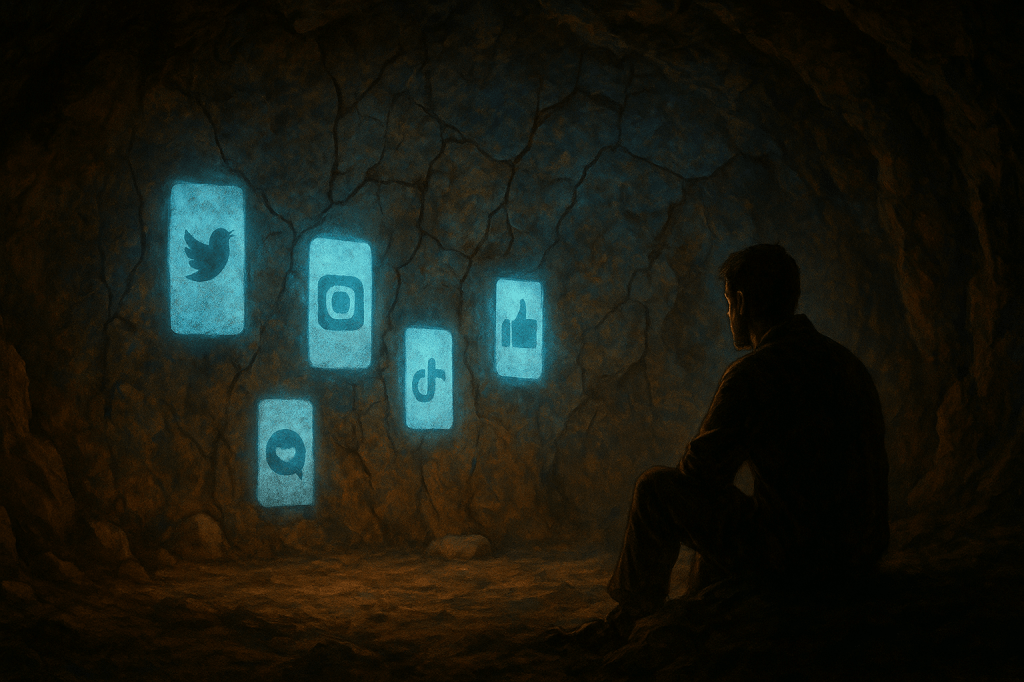
In many ways, our relationship to images hasn’t changed much since Plato’s day. Photographs, videos, memes, and viral clips are the shadows on our modern cave wall. They may show us something real — but never the whole of it. An image of a child in distress, a politician shaking hands, or a protester hurling a stone may capture a sliver of truth, but they are still fragments, framed by whoever holds the camera. The context — what came before, what came after, what lies outside the frame — is hidden. Yet we treat these fragments as reality itself.
This is the danger of visual persuasion: it trades in shadows, not substance. Like the prisoners in Plato’s cave, we are moved emotionally by what appears before us, even though we cannot see the full picture. The bias toward “seeing is believing” is not a modern weakness but an ancient condition of the human mind.
And just as the prisoners once resisted the one who tried to free them, today many resist those who question images. To doubt the photograph is often seen as heartless or conspiratorial. But skepticism is not denial. It is the recognition that shadows, while real in one sense, are not reality itself.
“What is real? How do you define ‘real’? If you’re talking about what you can feel, what you can smell, what you can taste and see, then ‘real’ is simply electrical signals interpreted by your brain.” – Morpheus, The Matrix
The Matrix reimagines Plato’s cave for the digital age. Neo discovers that the world he trusted is a simulation, a projection designed to keep him docile. The choice between the red pill and the blue pill is the choice between shadows and truth, comfort and reality. Like the prisoners in the cave, most people prefer the shadows because they are easier, safer, familiar.
The challenge for us is not to reject images, but to recognize their limits. They are shadows that can inform us, inspire us, even warn us — but they can also be wielded to deceive, manipulate, and control. Our task is to remember that what we see is never the whole of what is.
Algorithms: The New Puppeteers
“The most powerful propaganda today wears pixels and punchlines.”
If Plato imagined prisoners chained in a cave, staring at shadows on the wall, today those shadows are curated by something even less visible: algorithms. Social platforms do not simply show us the world; they show us what they calculate will keep us watching, scrolling, clicking. The more we “like,” the more the algorithm feeds us. The cycle tightens until our digital cave feels like the whole of reality.
This is not accidental. The platforms are designed for profit, not truth. Every click, every scroll, every pause of the thumb is tracked and monetized. The more emotional the content, the more likely we are to engage. Outrage and fear travel faster than nuance, so the algorithm dutifully serves up outrage and fear — because that keeps us on the platform. As Daniel Levitin observed in Weaponized Lies, our attention has become the most valuable commodity in the world, and algorithms are engineered to harvest it.
There’s an irony here that few want to face. Many who rail against billionaires are themselves tethered to the very platforms that made those billionaires rich. Every outraged post, every doomscroll session, is another coin in the pocket of the tech giants. If you really want to fight the billionaires, it won’t happen with hashtags — it will happen by setting the phone down, walking outside, and starving the system of your attention.
Otherwise, you’re not fighting the system; you’re feeding it. The algorithm doesn’t care if you love or hate the content, so long as you engage. If you think you’re shaping the platform, think again. The platform is shaping you. Each of us risks becoming what Plato might have called a digital zombie: alive, but not awake, mistaking algorithmic shadows for reality.
The question is not whether algorithms can be improved or made more ethical — though that matters too. The deeper question is whether we have the willpower to resist being trained by them. To break free of the cave today is not to smash the projector, but to put the phone down and step into the light.
And if we don’t? Well, then we’re just another shambling horde, doomscrolling in circles, looking less like citizens and more like extras on The Walking Dead.
“If you think you’re shaping the platform, think again. The platform is shaping you.”
Conclusion – Seeing Isn’t Believing
Images persuade not because they are false, but because they are powerful. They hit our brains faster than reason, stir emotions deeper than data, and shape our judgments more than we care to admit. Courts understand this, which is why they tread carefully with photographs. Plato understood this, which is why he warned us about shadows on the cave wall. And tech giants understand this, which is why they built billion-dollar machines to feed us pictures, videos, and memes on an endless loop.
Seeing isn’t believing. Seeing is reacting — unless we pause, unless we question, unless we choose to look beyond the frame. Images may show us something real, but they will never show us the whole truth. If we forget that, we risk becoming prisoners in the cave or worse — digital zombies shambling from one emotional reaction to the next.
The antidote is not to abandon images, but to meet them with vigilance. To learn our biases. To pause before we share. To remember that what looks obvious may not be true. To step out of the cave and into the harder light of reflection.
Reflection
We cannot stop images from flowing through our lives, but we can stop them from controlling us. The challenge is not out there, but in here — in how we respond.
So I leave you with these questions:
- How will you slow down System 1? What habits can you build to give System 2 the time it needs — whether that’s pausing before reacting, fact-checking before sharing, or simply breathing before judging?
- How will you break free from the algorithmic cave? Will you set down your phone more often, limit your scrolling, or reclaim your attention from platforms designed to monetize your emotions?
- What does freedom from the shadows look like in your own life?
Plato’s cave is not just a parable. It is our everyday reality. The question is whether we will stay chained to the wall, or whether we will rise, turn, and walk toward the light.
“You have power over your mind — not outside events. Realize this, and you will find strength.” – Marcus Aurelius, Meditations
| Related Posts for Influence & Control Meta-Framework |
| Explore my series exploring the psychological tools, logical distortions, and social mechanisms that shape how influence and undue control operate. |
| Posts | References |
Excerpt
Images bypass reason and hijack our instincts, shaping judgment before we can think. From Plato’s cave to social media algorithms, visual persuasion turns shadows into “truth.” Learn how System 1 vs. System 2, cognitive biases, and algorithmic feeds manipulate perception—and how to reclaim your freedom of thought.

 Treasures of the Elysian Fields
Leave a comment