

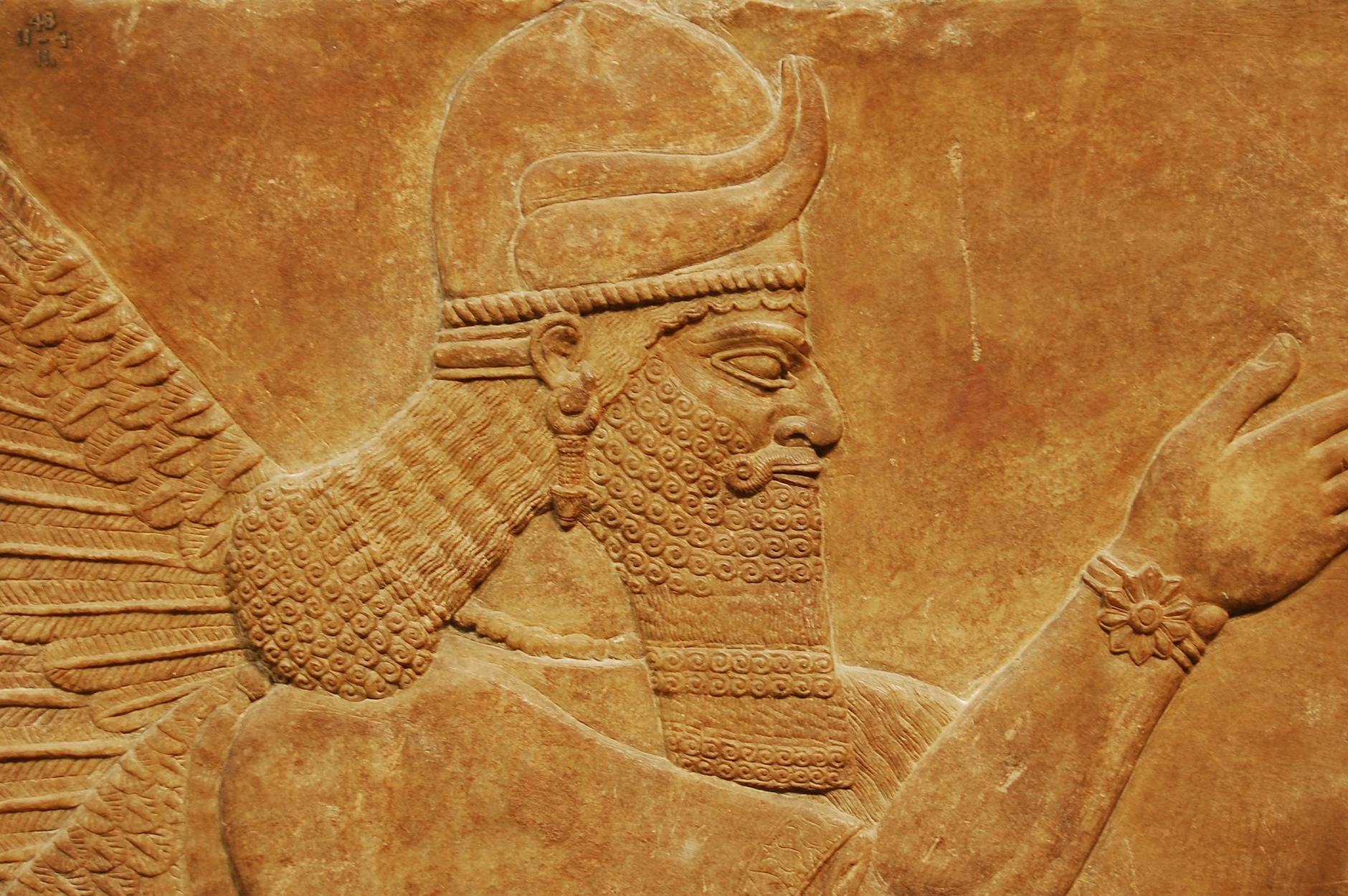
Imagine a world writhing in primordial chaos. From its depths arises a being who does not merely conquer the monstrous but does so through vision, speech, and order. This is the mythic world of Marduk, the Babylonian deity who defeats the chaos-dragon Tiamat and becomes king of the gods. But Marduk does not rule in isolation. His influence reaches Earth, where Babylonian kings claim legitimacy through him, aligning their governance with cosmic harmony. He is not just a god of war, but of creation, judgment, and the moral architecture of civilization.
In Episode 481 of Jordan Peterson’s podcast, Marduk’s role is briefly discussed not just as a mythological footnote but as a symbolic archetype: the leader as order-bringer, the visionary who sees through the swirling tempest and names the world into structure.
This echoes another grand narrative: the Mandate of Heaven in ancient China. There, the emperor’s legitimacy hinged on moral rectitude and just governance. Should a ruler descend into tyranny, natural disasters and civil unrest would be seen as divine withdrawal—a cosmic no-confidence vote.
Both systems—Marduk and the Mandate—suggest that leadership is contingent, conditional, and cosmic. Power is not merely seized; it is stewarded. The legitimacy of rulers is validated not by force alone but by their ability to maintain order while preserving justice.
Führer vs. Líder: Two Languages, Two Paths
One of the challenges I keep circling back to is the limitation of language itself, particularly in English. The word leader is so vast, so all-encompassing, that it often fails to capture the nuances of what kind of leadership we’re talking about. A tyrant, a mentor, a visionary, and a bureaucrat can all be labeled “leaders” in English, even though their styles, ethics, and impacts couldn’t be more different. Other languages—like German with Führung or Spanish with Liderazgo—offer shades of meaning that gesture toward the manner of leading, not just the fact of it. English tends to flatten that terrain, leaving us without a vocabulary that does justice to the spectrum from servant-leader to strongman. It’s as if we’re trying to describe the complexity of weather using only the word “climate.” Maybe what we need is not just more leadership—but more words for leadership.
My proposed dichotomy—Führung (authoritarian leadership) vs. Liderazgo (libertarian leadership)—has philosophical teeth. “Führung” carries connotations of rigidity and control, of structure imposed from above. Think of Darth Vader, whose grip on order is so tight it chokes the life out of his empire—both literally and figuratively. Or the Tyrell Corporation in Blade Runner, where control is omnipresent but soulless.
In contrast, “Liderazgo” inspires images of guidance, of leaders who lift rather than suppress. Consider Jean-Luc Picard of Star Trek: The Next Generation—a man who leads through principle, wisdom, and inspiration, not through fear or micromanagement. His bridge is a forum, not a command bunker.
Yet, you may wisely ask: Is the dichotomy too simple? Can authoritarianism ever be caring? Can libertarian leadership ever become passive?
Let’s suppose you’re a general during wartime. In such a scenario, non-negotiable decisions must be made swiftly, and command is less collaborative. But even here, as seen in Call Sign Chaos by James Mattis, leadership grounded in mutual respect and the well-being of subordinates proves more effective than tyranny. A great leader knows when to command and when to consult—when to be Marduk with the sword and when to be the wise judge.
The contrast between General James Mattis and Saddam Hussein illustrates the profound difference between earned leadership and enforced control. Mattis, a commander known for his intellect, discipline, and genuine concern for the well-being of his troops, embodied a style of leadership that inspired loyalty, not through fear, but through trust and competence. His troops followed him not just because of his rank, but because they believed in his judgment and character.
On the other hand, Saddam Hussein ruled Iraq through coercion, brutality, and paranoia. His leadership was built on a foundation of fear, surveillance, and suppression. When coalition forces entered Iraq, many Iraqi soldiers surrendered almost immediately, not out of cowardice, but because they had no real loyalty to a leader who had ruled them through terror. Fear may maintain obedience, but it rarely earns allegiance. (Interestingly, maybe English doesn’t lack a rich vocabulary for nuanced leadership styles, we do have words like tyrant, dictator, or despot, which at least capture the darker variants. I just might not think of them in the same category as leaders.) The surrender of Iraqi forces revealed a truth often overlooked: a leader can command armies, yet remain unloved and unsupported. True leadership, as exemplified by Mattis, builds something deeper—something that doesn’t dissolve the moment the threat disappears.
The Invisible Mandate
The deeper thread running through all of this is the idea of a higher accountability. Marduk watches. Heaven watches. History watches. The ancient world operated with the haunting sense that no action goes unwitnessed. Leaders are not only beholden to people but to something transcendent—call it God, the Tao, or history’s verdict.
We see this in pop culture’s echo chambers: The Lord of the Rings’ Aragorn reclaims the throne not through conquest but by proving himself worthy; The Matrix‘s Neo doesn’t command but embodies a higher truth; even Buffy the Vampire Slayer, who holds back apocalypse after apocalypse, leads not by force but by self-sacrifice and camaraderie.
And when that sacred duty is corrupted? The consequences are catastrophic. Consider Mao Zedong, whose pursuit of imposed order resulted in human suffering on a scale that dwarfed any cosmic chaos Marduk might have slain. Order imposed without justice is not order—it is disguised chaos.
Monsters in Disguise
This brings us to an uncomfortable truth: bullies are not leaders. They wear the mask of authority but create “unseen chaos,” corroding morale, fragmenting communities, and dragging society down into a negative spiral. Like the villain in Scooby-Doo—often a respected figure masquerading as a ghost to terrify others—they depend on illusion and fear, not integrity.
In Cherokee tradition, leadership emphasizes harmony, courage, and the well-being of the whole. It is a far cry from the boardroom tyrant or the despotic king. A real leader doesn’t seek followers—they create more leaders.
The Cosmic Scorecard
So where does this leave us?
With the haunting notion that all rulers are being watched, not just by historians or their people but by the moral structure of the universe. Leadership is a sacred trust. To break it is to risk everything—legitimacy, legacy, and even soul.
In the end, the best leaders are those who can stare into the eyes of chaos—not with arrogance, but with courage and humility. Who understand that order and freedom are not mutually exclusive but must be held in tension. Who grasp that true power is not about control, but about serving a purpose greater than themselves.
To quote the deleted octopus scene from The Goonies (yes, really): sometimes the monster isn’t defeated by force, but by music—by creativity, by an unexpected act of inspiration. That’s the kind of leadership we need more of today.
After all, Marduk didn’t just conquer the monster. He built the world.

The Pinnacle of Leadership: The Model of Jesus
If Marduk represents the mythic conqueror of chaos, and Confucian emperors embody moral mandate, then Jesus of Nazareth stands as the paradoxical pinnacle of leadership—not through domination, but through self-giving love.
Let’s suppose you were designing the perfect leader. You might combine wisdom with courage, empathy with justice, vision with humility. And yet the historical Jesus defies even this blueprint. He washed the feet of his followers. He wept with the grieving. He rebuked the powerful not with violence, but with truth. And ultimately, he sacrificed himself—not to secure a throne, but to open a path for others.
Jesus never held political office, never commanded an army, and never wrote a book. Yet his influence endures across millennia. Why? Because his leadership was rooted in service, integrity, and the transformation of hearts. He led not by coercion, but by compelling vision. Not by fear, but by invitation.
You might say, “But that’s unrealistic in the real world of power struggles and politics.” And yet—even in that world—we see that the leaders who echo Jesus’ approach tend to leave lasting legacies. Think of Martin Luther King Jr., who walked the path of nonviolent resistance, inspired directly by Jesus’ Sermon on the Mount. Or Nelson Mandela, who emerged from decades of imprisonment not seeking revenge, but reconciliation.
In the Lord of the Rings, Aragorn must become king—but only after proving his willingness to sacrifice and serve. He doesn’t seize the crown; he earns it through humility and valor. Similarly, in Star Wars, Luke Skywalker becomes a true Jedi not through mastery of the Force alone, but through refusing to strike down Vader in hate.
Jesus offers the clearest vision of Liderazgo in its highest form. He models a leadership of paradoxes: strength through meekness, influence through compassion, glory through the cross.
This is not just a spiritual example—it’s a strategic archetype. As Simon Sinek writes in The Infinite Game, the best leaders are those who play not to win, but to serve a cause bigger than themselves. That cause, for Jesus, was the reconciliation of all things.
Conclusion: Leadership as Cosmic Stewardship
When we compare Marduk’s conquest, the Mandate of Heaven, and Jesus’ self-emptying leadership, a fascinating thread emerges: legitimacy comes not from power, but from purpose.
Yes, chaos must be tamed. Yes, order must be established. But the greatest leaders go further. They create space for others to flourish. They recognize that people are not pawns to manage but souls to shepherd. They understand that justice is not merely the absence of disorder, but the presence of right relationship.
Ultimately, the best leaders are those who live as if they are being watched—not out of paranoia, but out of reverence. Reverence for their people, for truth, and for the higher power who holds all authority accountable.
Even if they have to face down a red octopus of chaos with nothing but a Walkman and a spark of creativity.
Reflection
- What kind of leadership do you most naturally respond to—one rooted in authority, or one grounded in inspiration and trust?
- Can a leader who imposes order without compassion ever be truly legitimate—or merely feared?
- Where is the line between necessary authority and tyranny?
Excerpt
What makes a leader worth following? From Marduk to Mattis, from tyrants to servant-kings, this post explores how power, legitimacy, and moral leadership intertwine. When leaders rule by fear, loyalty vanishes with their power. But those who serve a higher good earn something far stronger—trust, honor, and lasting influence.

 Treasures of the Elysian Fields
Leave a comment