
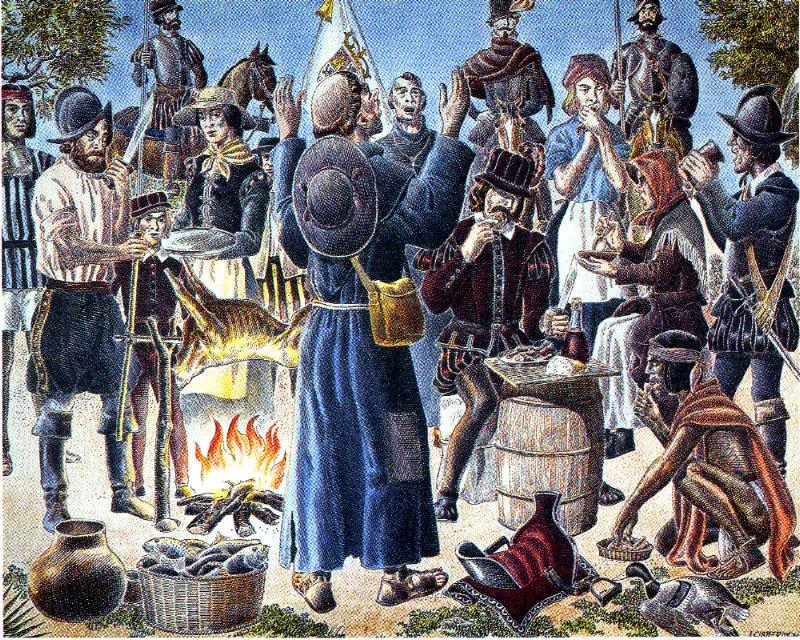
Above: A painting by Jose Cisneros depicting what some say was the first Thanksgiving celebration in North America, when Spanish colonists broke bread with the Mansos, a tribe native to the present-day El Paso area.
Exploring Proto-Thanksgivings in the Americas
In this next chapter of my journey to better understand the Thanksgiving tradition in the United States, I’ve uncovered some fascinating historical moments that I’d call “Proto-Thanksgivings.” These early celebrations by Europeans in the Americas, marked by meals and expressions of gratitude, provide a glimpse into the Christian worldview that shaped many of these events. While these moments didn’t directly influence the Thanksgiving we celebrate today, they underscore the enduring human impulse to give thanks, even in the face of incredible challenges.
It’s easy to overlook the sheer resilience of the Pilgrims, explorers, and settlers who endured arduous voyages to an unknown land. With no lifelines other than their own ingenuity and the relationships they forged with Indigenous peoples, these early adventurers embarked on a journey of survival and faith. This post will explore some of these early acts of thanksgiving in the Americas, reflecting on what they reveal about the spirit of gratitude in a time of hardship and uncertainty.
Before 1621: Europeans in the Americas
The tradition of Thanksgiving as a time for gratitude and communal celebration in the Americas predates the 1621 feast at Plymouth. Earlier events, such as Coronado’s gathering with the Teya in Texas in 1541 and Frobisher’s ceremony in Canada in 1578, offer glimpses into diverse expressions of thanksgiving shaped by the cultural, religious, and situational contexts of those who participated. Let’s take a closer look at these earlier moments of giving thanks.
1598: Juan de Oñate’s Thanksgiving in Texas
Many believe that the first Thanksgiving in what is now the United States occurred in 1598, more than two decades before the Pilgrims’ famous feast in Plymouth. On April 30, 1598, Spanish explorer Juan de Oñate and his expedition paused at San Elizario, Texas, to give thanks after surviving a perilous journey through the harsh terrain of the American Southwest. This moment, celebrated with a religious ceremony and communal meal, has been recognized as an early act of thanksgiving in the Americas.
The Difficult Journey and Expression of Gratitude
Juan de Oñate led his expedition northward from Mexico to colonize New Mexico. The journey across the Chihuahuan Desert was grueling, marked by extreme heat, scarce water, and exhaustion for both the travelers and their animals. The conditions were vividly described by Capt. Gaspar Pérez de Villagrá, a member of the expedition:
“The gaunt horses approached the rolling stream and plunged headlong into it. Two of them drank so much that they burst their sides and died. Two others, blinded by their raving thirst, plunged so far into the stream that they were caught in its swift current and drowned. Our men … threw themselves into the water and drank as though the entire river did not carry enough to quench their terrible thirst. Then satisfied, they threw themselves upon the cool sands, like foul wretches stretched upon some tavern floor in a drunken orgy, deformed and swollen and more like toads than men.”
After enduring this desperate ordeal, the expedition finally reached the Rio Grande, where they found water and rest. In gratitude for their survival and the resources provided by the land, Oñate organized a Thanksgiving Mass and feast, marking their relief and renewed hope.
The Thanksgiving observance at San Elizario consisted of a Catholic Mass, led by the priests traveling with the expedition, followed by a communal meal. This gathering, though modest, reflected the explorers’ profound gratitude for their survival. While detailed accounts of the meal are scarce, the event symbolized both spiritual and physical relief, as well as a moment of unity for the weary travelers.
A Misconception of “First”
While Oñate’s 1598 celebration is a significant moment in American history, it was not the first thanksgiving-like event in the Americas. The 1541 feast at Palo Duro Canyon, hosted by Coronado and the Teya Indians, predates Oñate’s observance by over half a century. We might speculate that even earlier moments of gratitude may have occurred, such as among the Vikings at L’Anse aux Meadows in Newfoundland, if so, it is lost to history.
Oñate’s Thanksgiving, however, remains notable for its context—a reflection of faith and resilience in the face of extraordinary hardship. Like Coronado’s earlier gathering, it highlights the centrality of gratitude as a unifying theme across diverse traditions, even in the most challenging circumstances.
1541: Coronado and the Teya Indians in Palo Duro Canyon
One of the earliest recorded thanksgiving-like gatherings in the Americas occurred on May 23, 1541, when Francisco Vásquez de Coronado and his expedition paused their journey to give thanks alongside the Teya Indians in what is now Palo Duro Canyon, Texas. Though vastly different from the modern Thanksgiving we know, this moment reflected themes of gratitude, survival, and cultural exchange that resonate with the spirit of the holiday.
Francisco Vásquez de Coronado, a Spanish explorer, led an ambitious expedition in search of the Seven Cities of Gold (Cibola). By 1541, his journey had brought him to the Great Plains, where he encountered the Teya people. Coronado’s expedition, consisting of approximately 1,500 individuals, including soldiers, Indigenous allies, servants, and animals, had endured months of hardship and disappointment as the mythical cities continued to elude them.
The journey through the plains had been especially grueling. Weary and disillusioned, Coronado’s company found themselves in dire need of sustenance and support. The Teya Indians provided the critical aid the Spaniards required, sharing food and offering guidance. Much like the Pilgrims decades later, Coronado’s group had much to be thankful for upon receiving this assistance.
Grateful for the help they received from the Teya, Coronado and his expedition paused their search to share a communal feast. Historical accounts, though limited, suggest that this gathering was a moment of hospitality and mutual exchange. The Teya offered food and sustenance to the Spaniards, who, in turn, shared aspects of their own culture.
A significant component of this gathering was the Thanksgiving Mass performed by Father Fray Juan de Padillo, a Catholic priest traveling with Coronado’s expedition. The Mass, held during the Feast of the Ascension on May 29, 1541, is often considered America’s first formal Thanksgiving celebration. Witnessed by members of the Teya community, the Mass symbolized the Spaniards’ gratitude to God for their survival and the provision they had received. Reports suggest the Teya observed the religious ceremony with curiosity and quiet amazement.
Father Padillo’s presence also highlights the broader spiritual dimensions of the event. Later martyred in 1544, he is remembered as the first Christian martyr in the United States and Texas, further emphasizing the religious significance of this moment.
Significance
Though it lacked the agricultural context of later Thanksgiving celebrations, the 1541 gathering in Palo Duro Canyon reflected deep gratitude for survival and the critical role of Indigenous support. The event underscored the importance of cross-cultural exchanges in early exploration, where collaboration between Europeans and Native Americans was often a matter of life and death.
As one of the earliest recorded acts of thanksgiving in the Americas, Coronado’s feast with the Teya Indians offers a unique perspective on how gratitude transcends cultural and historical boundaries. It highlights how moments of shared humanity and appreciation can emerge, even in the midst of exploration and adversity. This proto-Thanksgiving, though largely forgotten in popular narratives, remains a powerful testament to the enduring spirit of thanksgiving in the face of challenges.
1578: Martin Frobisher’s Thanksgiving in Newfoundland
Another contender for the title of the “first Thanksgiving” in the Americas occurred on Baffin Island, Newfoundland, in 1578, when English explorer Martin Frobisher and his crew paused to give thanks during an arduous expedition. Although vastly different from the Thanksgiving traditions celebrated today, this moment was a powerful act of gratitude rooted in survival and faith.
Martin Frobisher, an English navigator and explorer, was leading an expedition in search of the elusive Northwest Passage to Asia. His 1578 journey, fraught with peril, was marked by harsh weather, the loss of ships, and the constant threat of failure. At least one ship was lost at sea, while another was forced to turn back to England. Despite these hardships, Frobisher and a portion of his fleet reached land in what is now Frobisher Bay, Newfoundland and Labrador.
Surviving the treacherous crossing of the North Atlantic, Frobisher and his crew gave thanks for their safe arrival. For these explorers, survival was not guaranteed, and their gratitude reflected both a relief from danger and an acknowledgment of divine providence.
Upon reaching land, Frobisher and his crew marked their survival with a religious ceremony of thanksgiving, led by the ship’s chaplain, Robert Wolfall. The ceremony, held in Newfoundland, consisted of a Christian service where prayers and hymns expressed gratitude for deliverance from peril.
Unlike later Thanksgivings tied to harvests, this celebration was solely about spiritual and physical survival. The crew shared a modest meal of salt beef, biscuits, and mushy peas, reflecting the limited rations available on their journey. While the food was far from the celebratory feasts we associate with Thanksgiving today, the simplicity of the meal underscored the focus on gratitude rather than abundance.
Significance
Frobisher’s Thanksgiving in 1578 is widely regarded as the first recorded Thanksgiving in what is now Canada. Though unconnected to the modern Canadian Thanksgiving, which incorporates harvest themes, this event laid an important historical foundation for the practice of giving thanks in Canadian history.
The ceremony highlighted the enduring theme of gratitude in response to survival, a common thread in early Thanksgiving observances across the Americas. It also demonstrated the central role of faith in shaping expressions of thankfulness during the era of exploration. For Frobisher and his crew, the act of pausing to acknowledge their safe passage was both a spiritual and communal act, reflecting their dependence on divine providence during a time of immense uncertainty.
While Frobisher’s Thanksgiving differs from later celebrations tied to harvests and community gatherings, it remains a significant milestone in the history of giving thanks in North America. It serves as a reminder that the impulse to express gratitude in the face of hardship is a universal and timeless human experience, one that transcends time and geography.
1606: Samuel de Champlain’s Thanksgiving in Port-Royal
While not a contender for the “first Thanksgiving” in the Americas, the feast held by Samuel de Champlain on November 14, 1606, in Port-Royal, Nova Scotia, holds historical and cultural significance. This event, part of Champlain’s initiative known as the Order of Good Cheer (l’Ordre de Bon-Temps), reflects the spirit of Thanksgiving as a time of gratitude, community, and cultural exchange. Notably, it predates the 1621 Plymouth celebration and included both European settlers and the local Mi’kmaq people.
Port-Royal, the capital of Acadia, was an early settlement of New France in what is now Nova Scotia. Founded by French explorers, including Samuel de Champlain, the colony faced the harsh realities of North American winters. Malnutrition and diseases such as scurvy had devastated the settlement during previous winters, prompting Champlain to take measures to protect the settlers’ health and morale.
To address these challenges, Champlain established the Order of Good Cheer, a unique initiative that organized regular feasts to ensure a steady supply of nutritious food and to foster a sense of camaraderie among the settlers. These feasts served both a practical purpose—preventing scurvy by incorporating nutrient-rich foods like cranberries, known as “petites pommes rouges”—and a psychological one, boosting the morale of the colonists.
The Thanksgiving Feast
On November 14, 1606, Champlain and the settlers of Port-Royal held a significant feast, inviting the local Mi’kmaq people to join them. This gathering was not just about survival but also about fostering relationships and creating a sense of community between the French settlers and the Indigenous population.
- Location: The feast took place in Port-Royal, in the heart of Acadia.
- Participants: French settlers and Mi’kmaq people, reflecting a spirit of cross-cultural cooperation.
- Menu: The meal featured a variety of local game and seafood, highlighting the resources of the region. Cranberries, introduced to the French by the Mi’kmaq, played a crucial role in preventing scurvy due to their high vitamin C content.
Significance
The 1606 Thanksgiving in Port-Royal holds a unique place in the history of thanksgiving traditions:
- Cultural Exchange: The event was as much about fostering mutual respect and cooperation as it was about nourishment. The French settlers and the Mi’kmaq shared not only food but also traditions, creating a bond that helped sustain the colony.
- Historical Importance: This feast is one of the earliest recorded Thanksgiving celebrations in North America, predating the more famous Plymouth celebration by 15 years. While it was primarily aimed at survival, it embodied the communal spirit and gratitude that define Thanksgiving today.
- Morale and Well-being: Champlain’s understanding of the settlers’ psychological needs highlights the broader purpose of thanksgiving celebrations—not only as an expression of gratitude but also as a means of bringing people together and lifting spirits in difficult times.
A Thanksgiving of Resilience and Community
Champlain’s Thanksgiving in 1606 demonstrates the enduring human instinct to express gratitude and foster community, even in the face of hardship. While it may not have directly influenced the Thanksgiving traditions we recognize today, it represents an important step in the evolution of thanksgiving in Canada. By blending survival with cultural exchange, the Port-Royal feast captures the essence of Thanksgiving as a celebration of both resilience and unity.
Comparing Proto-Thanksgivings and the 1621 Plymouth Thanksgiving
Across centuries and cultures, moments of giving thanks have emerged in the Americas, reflecting diverse nationalities, religions, and reasons for celebration. These early “Proto-Thanksgivings” in 1541, 1578, 1598, and 1606 share themes of gratitude, resilience, and community, paralleling the more widely recognized 1621 Plymouth Thanksgiving. Together, these events highlight the universal human impulse to give thanks, transcending national, religious, and cultural boundaries.
Event Comparisons
| Event | Location | Year | Participants | Reason for Celebration |
| Coronado and Teya Feast | Palo Duro Canyon, TX | 1541 | Spanish explorers and Teya people | Gratitude for survival during an expedition in search of the Seven Cities of Gold; Teya assistance provided food, water, and sustenance. |
| Avilés Feast | St. Augustine, Florida | 1565 | Spanish explorers and Timucua people | Catholic Mass to give thanks for their safe Atlantic journey. |
| Frobisher Thanksgiving | Frobisher Bay, Canada | 1578 | English explorers | Thanks for survival and safe passage after a perilous expedition seeking the Northwest Passage. |
| Oñate’s Thanksgiving | San Elizario, TX | 1598 | Spanish explorers and settlers | Celebration of safe arrival after a harrowing trek across the Chihuahuan Desert to colonize New Mexico. |
| Champlain’s Feast | Port-Royal, Canada | 1606 | French settlers and Mi’kmaq people | A feast to prevent scurvy, boost morale, and give thanks for survival, organized by the Order of Good Cheer. |
| Plymouth Thanksgiving | Plymouth, MA | 1621 | English Pilgrims and Wampanoag people | A harvest celebration, giving thanks for the first successful harvest after a brutal winter, supported by the Wampanoag’s agricultural knowledge and alliance. |
Key Themes Across Events
Across the Americas, the spirit of thanksgiving emerged in diverse places and under varying circumstances, from the deserts of Texas to the icy waters of Newfoundland, the forests of Nova Scotia, and the shores of Massachusetts. These early celebrations reveal the universal appeal of gratitude, transcending geography, culture, and even religion. Each event reflected the unique challenges faced by explorers and settlers, whether it was Coronado’s quest for gold, Frobisher’s treacherous search for the Northwest Passage, or the Pilgrims’ pursuit of religious freedom.
Despite the varied settings, these gatherings were defined by the people who came together. The Spanish, represented by Coronado in 1541 and Oñate in 1598, turned to Catholic Mass to give thanks, often alongside Indigenous peoples like the Teya, who provided vital assistance. Similarly, the French settlers led by Champlain in 1606 included the Mi’kmaq people in their celebrations, blending Catholic rituals with Indigenous customs to create a unique sense of unity. On the other hand, the English—both Frobisher in 1578 and the Plymouth settlers in 1621—expressed their gratitude through Protestant services. These interactions, spanning nationalities and faiths, illustrate how thanksgiving brought together diverse groups in shared expressions of gratitude.
At the heart of these gatherings lay a common theme: survival. For Frobisher and Oñate, thanksgiving marked deliverance from perilous journeys and the challenges of crossing vast and often hostile environments. For Coronado and Champlain, it was gratitude for the help and sustenance provided by Indigenous allies, whose knowledge and resources were crucial to their survival. The Plymouth settlers echoed these sentiments, celebrating their first successful harvest—a testament to the agricultural techniques shared by the Wampanoag people. In every instance, these thanksgivings also carried a profound sense of hope: the promise of new beginnings in unfamiliar lands.
Each celebration was deeply rooted in the spiritual traditions of its participants. For the Spanish, thanksgiving often revolved around Catholic Mass, led by priests who offered prayers of gratitude for survival and divine providence. Similarly, Frobisher’s and Plymouth’s Protestant services reflected the settlers’ reliance on their faith to navigate challenges and express their thanks. Champlain’s gatherings under the Order of Good Cheer, while more practical in focus, incorporated Catholic elements and underscored the role of faith in boosting morale and fostering unity.
Together, these events reveal a timeless truth: thanksgiving transcends boundaries of nationality, religion, and culture. Whether Catholic or Protestant, Spanish or English or French, European or Indigenous, these early celebrations were unified by a shared impulse to pause, reflect, and give thanks. In these moments of gratitude, humanity’s enduring spirit of resilience and community shines brightly—a legacy that continues to define Thanksgiving today.
Conclusion
The 1621 Plymouth Thanksgiving may be the most celebrated, but it was not an isolated occurrence. It fits within a larger pattern of gratitude expressed by explorers and settlers across centuries and cultures. These proto-thanksgivings reveal a universal human response to survival, community, and hope—values that remain central to the Thanksgiving tradition today.
In exploring these early celebrations, I hope you, like me, have discovered that Thanksgiving has deeper and more diverse roots than commonly recognized. As I noted in a previous post, the Christian influence on Western culture played a significant role in shaping these expressions of gratitude, but these events also show that thanksgiving was not uniquely Pilgrim or even English. The Spanish, French, and English, along with Indigenous peoples, each contributed to a rich tradition of giving thanks, united by faith, resilience, and the shared need for connection and sustenance.
While history may never pinpoint the very first Thanksgiving in the Americas—given the lack of written records from the Vikings at L’Anse aux Meadows or other yet-unknown events—it’s clear these earlier gatherings laid the groundwork for the modern holiday. That said, it’s important to acknowledge that the Europeans’ celebrations represent only part of the story. Native Americans had long held diverse and deeply rooted ceremonies of gratitude, often tied to the cycles of nature and the land. If there were a “first Thanksgiving” in the Americas, it rightfully belongs to them.
By examining these earlier moments of thanksgiving, we gain a richer perspective on how the themes of gratitude, survival, and community have always been central to the human experience. These themes transcend specific cultural or historical contexts, reminding us that Thanksgiving is not only a time to celebrate our shared heritage but also an opportunity to reflect on the enduring power of gratitude in our own lives.
Update 30 November 2024
1565: Pedro Menéndez de Avilés Thanksgiving
During the week after writing this blog, I came across another claimed event to be the “first” Thanksgiving in North America. There seems to be no shortage of “first” Thanksgivings, each reflecting the unique circumstances of its time. I wanted to update this blog post with this newly discovered event, as it serves as yet another example of early or proto-Thanksgiving celebrations. These moments in history, while distinct from the modern holiday, further illustrate the deep human impulse to express gratitude and share in communal meals, transcending cultures and centuries.
One of the earliest recorded thanksgiving feasts in what is now the United States took place in 1565 in St. Augustine, Florida. This event, led by Spanish settlers under Pedro Menéndez de Avilés, highlights the diverse and rich history of gratitude celebrations across different cultures, faiths, and eras. On September 8, 1565, upon landing in Florida, Menéndez and his crew held a Catholic Mass to give thanks for their safe Atlantic journey, reflecting a common Spanish tradition. Following the Mass, the Spanish settlers shared a communal meal with the local Timucua people. The feast likely included Spanish staples such as salted pork, garbanzo beans, ship’s biscuits, and red wine, alongside local contributions like maize and fresh fish.
This event, marked by themes of gratitude and survival, represents one of the first recorded communal meals between Europeans and Native Americans. It also underscores early cross-cultural exchanges, where vastly different peoples shared food and customs despite their differences. The 1565 St. Augustine feast adds to the growing narrative of proto-Thanksgiving celebrations, including Coronado’s 1541 feast with the Teya Indians in Texas, Frobisher’s 1578 thanksgiving in Canada, and Oñate’s 1598 celebration in New Mexico. Each of these events reflects the universal human impulse to give thanks for survival, blessings, and moments of peace in uncertain times.
The inclusion of the St. Augustine feast broadens the Thanksgiving narrative, showing how gratitude has been expressed in diverse ways by different cultures across the Americas. While these early thanksgivings are not directly tied to the modern holiday, they remind us that the values of gratitude and community are timeless, transcending nationality and tradition to shape the human experience.
Reflecting on the Roots of Thanksgiving
As you consider the rich history of Thanksgiving explored in this post, I invite you to reflect on its deeper meaning. How do the stories of survival, gratitude, and community resonate with your own experiences? What lessons can we draw from these early moments of thanksgiving that still apply today?
Take a moment to think about how gratitude shapes your own life. Whether inspired by shared meals, personal triumphs, or acts of kindness, these moments of thanksgiving remind us of the resilience and connections that sustain us. How might you carry the spirit of thanksgiving beyond the holiday and into your everyday life?
Excerpt
Discover the rich history of Thanksgiving through early celebrations by explorers and settlers, including Coronado, Frobisher, Oñate, and Champlain. These proto-thanksgivings reveal universal themes of gratitude, survival, and community, transcending nationality and culture. Explore how these moments shaped the spirit of Thanksgiving we cherish today.
Resources
- America’s first Thanksgiving celebrated in Palo Duro Canyon in 1541 By Doug McDonough, MyPlainview, https://www.myplainview.com/news/article/America-s-first-Thanksgiving-celebrated-in-Palo-8419493.php
- Did Texas host the first Thanksgiving? By Andrew Weber https://www.kut.org/austin/2016-11-23/did-texas-host-the-first-thanksgiving
- Historia De La Nueva Mexico, by Gasper Perez De Villagra, https://nationalhumanitiescenter.org/pds/amerbegin/exploration/text1/villagra.pdf
- The First Thanksgiving? https://www.texasalmanac.com/articles/the-first-thanksgiving
- The First Thanksgiving in North America by Laura Neilson Bonikowsky https://www.thecanadianencyclopedia.ca/en/article/the-first-thanksgiving-in-north-america-feature
- The History of Thanksgiving in Canada https://www.canadashistory.ca/explore/arts-culture-society/the-history-of-thanksgiving-in-canada
- A Brief History of Canadian Thanksgiving https://www.thehistoryhound.ca/a-brief-history-of-canadian-thanksgiving/
- The Seven Sacred Ceremonies of the Cherokee https://fractalenlightenment.com/40555/culture/seven-sacred-ceremonies-cherokee

 Treasures of the Elysian Fields
Leave a reply to Thanksgiving a Time for Gratitude – Treasures of the Elysian Fields Cancel reply