
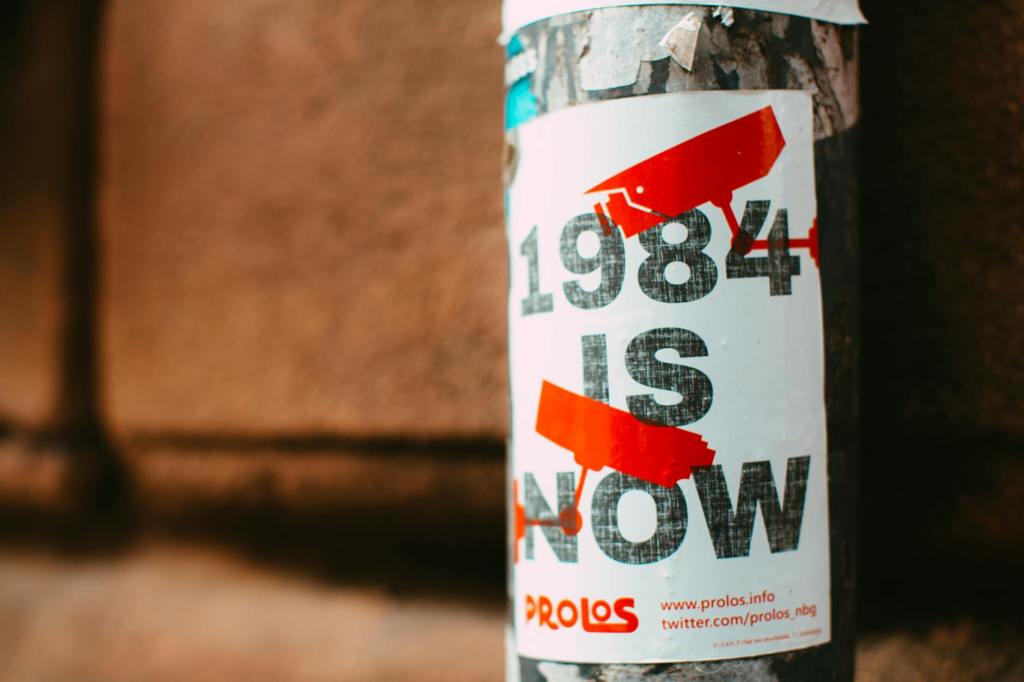
After recently revisiting George Orwell’s 1984, I found myself drawn deeper into its haunting portrayal of totalitarianism, this time with fresh eyes in light of modern technology and the erosion of privacy in today’s world. The parallels between Orwell’s fictional world of constant surveillance and our own age of digital monitoring felt disturbingly close, prompting me to reconsider the novel’s deeper meanings. The more I reflected on the concepts of manipulation, truth control, and psychological domination, the more I realized how prophetic Orwell’s warnings have become. This led me to explore and unpack some of the critical themes within 1984 in the context of our current era. In the following essay, I will delve into what I discovered in Orwell’s work and how it resonates with the world we live in today.
Excerpt
In 1984, George Orwell’s chilling vision of the future shows how totalitarian regimes manipulate truth, control emotions, and suppress rebellion. Through surveillance, censorship, and psychological warfare, the Party controls every aspect of life. This post explores these themes, drawing parallels to modern-day authoritarianism and the importance of vigilance.
I. Introduction to 1984
When George Orwell penned 1984, he painted a chilling portrait of a future where totalitarianism reigned supreme and individual thought was crushed under the weight of an all-seeing regime. Orwell’s vision, set in the fictional state of Oceania, introduces us to a world ruled by Big Brother, where constant surveillance, truth manipulation, and psychological control have become the instruments of power.
At the heart of this narrative is Winston Smith, a low-ranking Party member working at the Ministry of Truth. Winston’s role is disturbingly ironic: he’s tasked with rewriting historical records to fit the Party’s ever-shifting narrative. Beneath this routine of fabricating truth, Winston harbors a deep, festering hatred for the Party, and his longing for rebellion simmers throughout the novel. His story is a journey of covert defiance, fragile hope, and inevitable despair, as he finds himself entangled in both a love affair with a woman named Julia and the false promise of revolution embodied by the enigmatic figure O’Brien.
The Novel’s Plot and Setting
Oceania, the setting of Orwell’s dystopia, is a sprawling totalitarian state where the Party controls every aspect of life, from what people say to what they think. Surveillance is omnipresent, and privacy is nonexistent. Through telescreens, the Party monitors citizens both in public and private, ensuring no one can escape its reach. The state is perpetually at war, though the enemy shifts, and the war serves primarily as a tool to distract and control the populace.
In this oppressive setting, Winston Smith emerges as a reluctant and conflicted protagonist. His work involves manipulating historical records, ensuring that the Party’s version of events remains the only one that exists. This distortion of reality is central to the Party’s control; history is rewritten, enemies of the state vanish from records, and any evidence of a past outside the Party’s control is destroyed. This manipulation isn’t just an external act—it’s a psychological tool to break down individual perception and create doublethink, the ability to accept two contradictory beliefs simultaneously.
Winston secretly despises the regime. He feels trapped, suffocated by the weight of the Party’s oppression. His silent rebellion takes the form of a journal, where he writes down his thoughts—an act of defiance in itself, as independent thought is strictly forbidden. This journal is a small, fragile attempt to maintain his humanity in a world that seeks to erase it. He pours out his thoughts, knowing full well that even owning the journal is a crime punishable by death.
Winston Smith’s Rebellion and His Relationship with Julia
Winston’s journey into rebellion is ignited further by his affair with Julia, a woman who works for the Party but shares his disdain for its control. Their relationship is more than a mere romance—it becomes a form of resistance. In a world where personal connections are forbidden, and the Party seeks to sever all bonds that might compete with loyalty to Big Brother, Winston and Julia’s relationship represents a desperate attempt to reclaim something private, something real. It is an act of defiance against a system that wants to strip people of their individuality and make them mere cogs in a machine.
Julia, however, approaches the Party differently from Winston. She doesn’t seem interested in large-scale rebellion or philosophical introspection. For her, the Party is something to be outwitted on a personal level, a system to navigate rather than to confront head-on. Winston, on the other hand, dreams of a larger uprising, of tearing down the Party’s control completely, even if he doesn’t fully believe it is possible. Together, they create a brief, fragile world of their own, a sanctuary away from the ever-watchful eyes of Big Brother.
Betrayal and the False Promise of Revolution
One of the novel’s most fascinating characters is O’Brien, an inner Party member who Winston believes shares his desire for rebellion. O’Brien lures Winston and Julia into thinking they have found an ally within the Party. He feeds their hope with the suggestion of an underground resistance group called the Brotherhood, led by the Party’s enemy Emmanuel Goldstein.
For Winston, O’Brien embodies the promise of truth and revolution, a figure who seems to offer a way out of the oppressive system. However, O’Brien’s true role is far more sinister. He betrays Winston, revealing that he has been loyal to the Party all along. This moment of betrayal is devastating for Winston, and it highlights one of the most haunting aspects of Orwell’s vision: the Party’s total control is so complete that even the idea of resistance is carefully managed and manipulated by the regime. O’Brien’s role isn’t just to expose Winston’s rebellion but to break him entirely. Under O’Brien’s brutal interrogation, Winston is forced to betray Julia and ultimately loses his will to resist.
Themes: Oppression, Control of Truth, and the Futility of Rebellion
The key themes of 1984 are timeless and deeply relevant to both Orwell’s time and today. At its core, the novel is about the suffocating effects of totalitarianism and the erosion of individuality under oppressive regimes. It explores how a state can use surveillance and manipulation of truth to maintain absolute power. Through mechanisms like doublethink and the rewriting of history, the Party obliterates any chance for dissent. In Oceania, there is no room for independent thought or genuine resistance. Every aspect of life is controlled, from public discourse to private emotions.
One of the most poignant themes of the novel is the futility of rebellion. Winston’s attempt to resist, both through his affair with Julia and his trust in O’Brien, is doomed from the start. The Party’s control is so pervasive, so deeply embedded in the fabric of society, that any rebellion, no matter how personal or sincere, is crushed before it can gain any real traction. This theme reflects a profound sense of despair, where even the desire for freedom is manipulated and turned into a tool for further oppression.
Orwell’s Timeless Warning
Orwell’s 1984 is not just a dystopian novel; it’s a stark warning about the dangers of unchecked power and the fragility of truth in the face of authoritarian control. The world Orwell describes may have been inspired by the totalitarian regimes of the 20th century, but its lessons resonate powerfully in today’s world. The Party’s tactics—surveillance, control of information, and psychological manipulation—are eerily relevant in an age where technology has enabled unprecedented levels of state control and where the truth itself is often up for debate.
As we reflect on 1984, it’s essential to think critically about the systems of power in our own world. Are we, like Winston, complacently accepting narratives given to us? Are we willing to question, resist, and search for truth, even in the face of overwhelming control? Orwell’s novel challenges us to look deeply at the nature of power, freedom, and resistance. It’s a challenge we must take seriously if we hope to prevent Orwell’s nightmare from becoming our reality.
This is just the introduction to a deeper conversation on the relevance of 1984 today, a conversation that touches on technology, authoritarianism, and our capacity for rebellion. Keep thinking, keep questioning, and never assume that the narrative you are given is the truth.

II. The Manipulation of Language: Destroying Words
One of the most profound and insidious tools of control in George Orwell’s 1984 is the systematic destruction of language through the creation of Newspeak, the Party’s official language. Newspeak isn’t just a new way of speaking—it’s a tool designed to reshape how citizens think and, more importantly, how they are unable to think. In the novel, the Party deliberately shrinks the vocabulary of the English language, not merely for efficiency, but as a means of controlling the very boundaries of thought. Orwell reveals the terrifying potential for authoritarian regimes to use language as a weapon to suppress dissent and reshape reality.
Newspeak and the Shrinking of Language
The genius of Newspeak lies in its subtlety. By eliminating words that express rebellious or unorthodox ideas, the Party can prevent thoughts of rebellion from even forming. Words like “freedom,” “justice,” and “individuality” are removed from the lexicon because they represent concepts that could inspire resistance or encourage self-awareness. Without words to express dissent, the Party ensures that dissent becomes unthinkable. This process is aptly summarized by Syme, one of Winston Smith’s colleagues, who works on the Newspeak dictionary. Syme enthusiastically describes the purpose of Newspeak, saying:
“Don’t you see that the whole aim of Newspeak is to narrow the range of thought? In the end, we shall make thoughtcrime literally impossible, because there will be no words in which to express it.”
This is a chilling prospect: by controlling language, the Party eliminates the ability to even conceptualize resistance. Without the words to articulate freedom, citizens lose the ability to even desire it. Orwell’s idea resonates deeply with the notion that language and thought are inextricably linked. By reshaping the words people use, the Party reshapes their reality.
In Orwell’s world, thoughtcrime—the act of harboring rebellious thoughts—isn’t merely illegal, it’s unimaginable for those fully indoctrinated. This is the ultimate form of psychological control. Newspeak becomes a cage for the mind, locking away any possibility of rebellion before it even begins. The deliberate shrinking of language ensures that people cannot describe, let alone critique, the mechanisms of their own oppression.
The Dangers of Destroying Words: A Modern Paradox
The themes Orwell presents in 1984 around the manipulation of language and the erasure of words feel alarmingly familiar when we look at modern authoritarian regimes. Although the technologies may differ, the underlying goal is the same: control what people can think by controlling what they can say. The parallels between Orwell’s vision and contemporary reality are startlingly clear when examining the ways in which modern governments manipulate language to suppress dissent and shape ideology.
One striking example is the People’s Republic of China, where the government actively censors words and phrases that challenge the authority of the Communist Party. Online platforms are regularly scrubbed of any reference to sensitive topics such as the Tiananmen Square Massacre, the Hong Kong pro-democracy protests, or even personal critiques of Party leaders like Xi Jinping. In many cases, these phrases are not only banned from public discourse but also from online searches, removing the ability for individuals to engage with these ideas. Like Orwell’s Newspeak, this censorship narrows the field of thought by cutting off access to words and concepts that could inspire resistance or even critical thinking.
Similarly, in North Korea, language is tightly controlled and manipulated to maintain the regime’s ideological dominance. Citizens are taught a carefully curated version of reality, where Kim Jong-un is portrayed as an infallible leader, and North Korea’s isolation from the rest of the world is justified by a mythology of self-reliance and external threats. The government controls education and the media, limiting the population’s exposure to ideas that might challenge the regime. North Koreans are systematically deprived of language that could empower them to think critically or question the status quo, ensuring that loyalty to the regime remains unchallenged.
In both cases, the state actively limits the intellectual freedom of its citizens by controlling the very language available to them. This form of control goes beyond physical repression; it invades the mental and emotional realms, preventing people from even imagining alternatives to their present reality.
In recent years, progressive ideologues, particularly within the “woke” movement, have sought to redefine key terms like “racism” to fit a new ideological framework. Traditionally, racism was understood as discrimination or prejudice against individuals based on their race, rooted in personal bias or institutional structures. However, in many progressive circles, the definition has shifted to emphasize power dynamics, where racism is seen solely as systemic oppression perpetuated by the dominant group—often white individuals—against marginalized racial groups. This redefinition narrows the term’s application and excludes instances where minorities may exhibit racial prejudice, arguing that they lack the institutional power to be “racist.”
While this shift is intended to highlight systemic inequalities, it can be just as destructive as outright censorship, as it limits nuanced discussions about race, identity, and individual responsibility. When language is redefined to fit a rigid ideology, it can stifle open dialogue, creating echo chambers where dissenting views are dismissed outright. This mirrors Orwell’s concept of Newspeak, where changing the meanings of words shapes reality itself, reducing the possibility for diverse thought and critical discussion.
The Connection Between Language and Thought
Orwell’s insight into the connection between language and thought is a crucial element of 1984. As Syme points out, by reducing the range of language, the Party reduces the range of thought. Without the word “freedom,” what does freedom even mean? How can one desire what one cannot name? This concept is not merely theoretical—it has been observed in various real-world contexts. Psycholinguists have studied how language shapes cognition, with evidence suggesting that the words available in a language can influence how individuals perceive and interact with the world. For example, if a language lacks words for certain emotions, it may become harder for speakers to fully grasp or express those emotions.
This linguistic relativity—often referred to as the Sapir-Whorf Hypothesis—suggests that the structure and vocabulary of a language can shape its speakers’ perception of reality. Orwell magnifies this idea to an extreme in 1984, where the goal of Newspeak is to render certain thoughts impossible, not merely difficult to express. The destruction of words like “rebellion,” “liberty,” and “self-determination” doesn’t just remove them from speech—it erases the concepts themselves from the public consciousness.
In contemporary authoritarian regimes, we see a similar dynamic. By banning or limiting certain words and ideas, governments create a reality where citizens cannot easily conceive of alternatives to the regime’s rule. This isn’t just censorship—it’s a form of cognitive control, where the boundaries of what is possible are dictated by what is allowed to be said.
The Fight for Language and Thought
The manipulation of language as a form of control is perhaps one of Orwell’s most enduring insights in 1984. As we see in the novel, the destruction of words goes hand-in-hand with the destruction of thought. This method of control is not restricted to fiction—it finds echoes in the modern world, where censorship and language manipulation are used to suppress dissent and maintain power.
As we reflect on Orwell’s work, it’s crucial to recognize that the fight for freedom is not just about political rights—it’s about linguistic freedom, the ability to express, name, and think freely. The moment we lose words, we begin to lose the ability to engage with the world critically. Orwell’s 1984 serves as a timeless reminder that the control of language is one of the most powerful weapons in the arsenal of authoritarian regimes. The erosion of language is not just an attack on speech—it’s an assault on thought itself.
In an age where censorship can take many forms—whether it’s through digital surveillance, restricted access to information, or the banning of certain topics—we must remain vigilant. The fight to preserve language, and by extension thought, is the fight to preserve human freedom.
III. Denying the Evidence of the Senses: Doublethink
One of the most chilling aspects of Orwell’s 1984 is the Party’s demand that its citizens not only conform to its ideology but that they actively deny the evidence of their own senses. Orwell’s protagonist, Winston Smith, captures this disturbing reality when he writes in his diary: “The Party told you to reject the evidence of your eyes and ears. It was their final, most essential command.” This mandate lies at the core of the Party’s power, enabling it to control not just the actions of its citizens but their perception of truth itself. The concept of Doublethink—the ability to hold two contradictory beliefs simultaneously and accept both—becomes the cornerstone of this control. It allows the Party to rewrite reality and force individuals to accept impossibilities as truths.
Winston’s Struggle with Reality
Winston’s journey throughout 1984 is a struggle to retain his grasp on reality in a world where the Party’s control extends beyond mere behavior and into the realm of thought itself. From the very beginning, Winston understands that the Party seeks to dismantle the individual’s ability to trust their own perception. This is most notably encapsulated in the infamous example of the Party’s insistence that two plus two equals five. Winston knows, deep in his bones, that two plus two equals four—it is a self-evident fact, a fundamental truth. Yet, under the Party’s regime, even the most basic truths are malleable. Reality is not determined by empirical evidence but by the decrees of Big Brother.
The Party’s goal is not merely to be believed, but to reshape reality to such an extent that even objective truths become subject to its whims. Citizens are expected to accept contradictions without question, mastering the art of Doublethink. As Winston reflects, Doublethink allows a person to “hold two contradictory beliefs in one’s mind simultaneously, and accept both of them.” In this way, the Party ensures that the individual’s understanding of the world is completely pliable, and the concept of truth is whatever the Party says it is at any given moment.
The Power of Doublethink: Shaping Reality through Contradiction
Doublethink is not just a method of control, but a philosophical attack on the very nature of reality. In 1984, Orwell uses examples like “War is Peace,” “Freedom is Slavery,” and “Ignorance is Strength” to illustrate how the Party uses language to distort meaning. These contradictions are not meant to make sense; rather, they are designed to break down the individual’s capacity for independent thought. By forcing citizens to accept these absurdities, the Party eliminates any possibility of resistance.
The famous example of two plus two equaling five is perhaps the most poignant illustration of Doublethink. Winston knows the truth of basic arithmetic, but he is tortured and broken by O’Brien until he not only says but believes that two plus two equals five. This process illustrates the ultimate power of the Party: to strip away an individual’s ability to hold on to objective reality. Truth becomes irrelevant; what matters is that citizens internalize the Party’s version of reality, even if it contradicts their own lived experience. The battle isn’t just for conformity—it’s for total psychological dominance.
One of the most striking modern parallels to the concept of Doublethink and Orwell’s exploration of reality manipulation can be found in Star Trek: The Next Generation, specifically in the episode titled “Chain of Command, Part II.” In this powerful storyline, Captain Jean-Luc Picard is captured and tortured by the Cardassians, led by Gul Madred. During his imprisonment, Picard is subjected to intense psychological manipulation, and a recurring tactic used by his captor is to force him to state how many lights he sees in front of him. While there are clearly four lights, Gul Madred insists that there are five, demanding that Picard agree with the false reality.
This scenario mirrors Winston Smith’s struggle in 1984 when he is forced to accept that two plus two equals five, even though he knows it to be false. In both cases, the goal of the torturer is not just to inflict pain, but to break the victim’s perception of reality. It’s not enough for Picard to say there are five lights; he must believe there are five lights. The psychological toll of denying the evidence of one’s senses and accepting a false reality is the true essence of control—just as the Party in 1984 seeks to control not only actions but also thoughts.
Picard’s defiance, even under immense suffering, echoes Winston’s initial resistance to the Party’s indoctrination. Picard clings to his sanity by refusing to submit to the false narrative. In the final moments of his ordeal, when he is rescued by Starfleet, Picard triumphantly shouts, “There… are… four… lights!” This declaration is a moment of victory for Picard’s mind, but as he later confides, the experience was harrowing. He admits that in his darkest moments, he almost did see five lights. This confession reveals the deep psychological impact of such manipulation—it’s not just about getting someone to parrot the falsehood, but about destroying their ability to trust their own reality.
The parallels to Orwell’s 1984 are clear: the ultimate form of oppression is not merely physical but psychological—the ability to make someone question their own perceptions and bend them to the will of their captor. Just as O’Brien seeks to make Winston believe the Party’s reality, Gul Madred seeks to do the same with Picard. In both stories, the torturers understand that true power comes from not just controlling the body but from owning the mind. The struggle for truth, in both 1984 and Star Trek, becomes a fight to maintain one’s sense of reality in the face of overwhelming force.
This episode of Star Trek serves as a potent reminder of how fragile our grasp on truth can become under duress and manipulation. Whether it’s Winston grappling with the Party’s insistence that two plus two equals five, or Picard being told that there are five lights when he knows there are only four, these moments highlight the terrifying power that authoritarian regimes or captors can wield when they control the very fabric of reality.
Doublethink and Modern Regimes: The Rewriting of Reality
While Orwell’s vision of totalitarian control might have seemed speculative when 1984 was written, its eerie parallels to modern regimes make it startlingly prophetic. Today, the concept of Doublethink is alive in various forms, particularly in authoritarian regimes where controlling the narrative and rewriting reality are central to maintaining power. China and North Korea offer two contemporary examples where Doublethink is not only encouraged but enforced.
In China, the manipulation of truth through censorship and the control of information mirrors the tactics employed by the Party in 1984. The Chinese government exercises vast control over its citizens’ access to information, ensuring that only the Party’s narrative is available to the public. The government routinely censors any mention of politically sensitive topics, such as the Tiananmen Square Massacre, Hong Kong pro-democracy protests, or critiques of Party leadership. This creates an environment where citizens are forced to accept the Party’s version of events, regardless of what they may personally know or believe.
For example, the state-controlled media presents China’s policies in Xinjiang, where Uyghur Muslims are detained in mass internment camps, as measures of “education” and “re-education” for maintaining social stability. The reality of human rights abuses, which the global community documents and reports on, is systematically denied within the country. Citizens are expected to accept the Party’s narrative, even when it flies in the face of international facts. In this way, the Chinese government enforces a form of Doublethink, ensuring that the version of reality provided by the Party supersedes all external evidence.
Similarly, North Korea has long practiced a rigid form of Doublethink, where citizens are required to hold contradictory beliefs about their leadership and the state. The North Korean regime meticulously rewrites history to present its leaders as infallible and godlike. Kim Jong-un, and his predecessors Kim Jong-il and Kim Il-sung, are portrayed as nearly divine figures who have led the country through impossible challenges, often with fabricated or exaggerated achievements.
One of the most striking examples of this is the North Korean state’s claims about its leaders’ supernatural abilities, such as Kim Jong-il’s purported birth under a double rainbow or his perfect golfing score, where he allegedly achieved 11 holes-in-one during a single round of golf. While these stories are absurd, citizens are expected to accept them as fact. The regime’s control over education and media ensures that the population is continuously exposed to this false reality, unable to access independent information that might challenge the narrative. The ability to believe both in the hardships the country faces and in the miraculous achievements of its leaders exemplifies Doublethink in action.
Eroding the Capacity for Independent Thought
The ultimate goal of Doublethink, whether in Orwell’s Oceania or in contemporary regimes, is to erode the capacity for independent thought. By forcing citizens to accept contradictions and deny the evidence of their senses, the state eliminates any possibility of resistance. In 1984, Winston’s struggle is not just against the Party’s physical control, but against its psychological manipulation. His attempts to hold on to the truth of his own perceptions are slowly eroded, until he is finally broken by O’Brien and accepts the Party’s reality as his own.
In modern regimes, the psychological effects of this manipulation are equally devastating. When citizens are forced to accept contradictory beliefs or embrace obvious falsehoods, their ability to critically engage with the world around them is diminished. This allows authoritarian governments to maintain power, as citizens become incapable of imagining an alternative reality or questioning the state’s authority. The more contradictions people are required to accept, the more malleable their perception of truth becomes.
Doublethink as a Tool of Total Control
Orwell’s concept of Doublethink in 1984 is a powerful reminder of how authoritarian regimes can manipulate reality by forcing people to deny the evidence of their own senses. By shaping truth through contradiction, the Party ensures that citizens cannot trust their own perceptions, making resistance impossible. In today’s world, we see echoes of Doublethink in the censorship and manipulation of information practiced by regimes like China, North Korea and ideologues, where reality is rewritten to fit the state’s narrative. As I reflect on the lessons of 1984, it becomes clear that the fight for truth is not just a battle against misinformation—it’s a fight to preserve the integrity of reality itself.
IV. Love as Rebellion and Its Betrayal
One of the most poignant and devastating elements of George Orwell’s 1984 is how the Party weaponizes love, turning it from a source of strength and resistance into a tool of ultimate destruction. Orwell’s insight into the vulnerability of human relationships, particularly the depth of love, serves as a grim reminder of how totalitarian regimes can control not only external actions but the most private emotions. In a society like Oceania, where the Party seeks total control over its citizens, even the personal sanctuary of love is not safe. This manipulation of love as a weapon is one of the novel’s deepest and most frightening insights—showing that our most intimate bonds can be used against us.
Winston and Julia’s Relationship: Love as Rebellion
For Winston Smith, love becomes his personal rebellion, a way to resist the Party’s all-encompassing power. His affair with Julia is not just an act of physical intimacy but a statement of defiance in a world where personal connections are systematically crushed. In the totalitarian state of Oceania, where Big Brother controls every aspect of life, even love must be suppressed. The Party deliberately severs emotional ties between individuals, pushing for loyalty only to the state. Marriage and relationships exist not for companionship or affection but solely for reproduction, as the Party seeks to ensure that personal loyalty to another human never supersedes loyalty to Big Brother.
Winston, however, sees his relationship with Julia as a chance to break free from the Party’s grip, if only in small ways. Their love provides them with a temporary escape from the suffocating control of the state. For a brief time, Winston feels a sense of personal freedom, indulging in the act of rebellion by creating a private world away from the Party’s surveillance. For him, love becomes one of the few things worth living for, an anchor of humanity in a world designed to strip people of their individuality and spirit.
Yet, despite this brief solace, Winston and Julia’s affair is doomed from the start. The Party’s reach is so pervasive that any sense of personal freedom is fleeting, and rebellion, even in its most intimate form, is destined to fail. Their love is not strong enough to withstand the overwhelming pressure of the state’s psychological manipulation, and Orwell masterfully uses their relationship to illustrate the futility of resistance in a world where even love can be controlled and corrupted.
The Party’s Use of Love to Control and Destroy
The most tragic aspect of Winston and Julia’s relationship is not just its eventual failure, but the way in which the Party weaponizes their love against them. After their affair is discovered, they are arrested and separated. Their once-powerful connection is methodically unraveled in Room 101, where the Party brings Winston to face his greatest fear: rats. Under the unbearable threat of torture, Winston betrays Julia, pleading for the rats to be unleashed on her instead of him. In this moment, the Party triumphs, proving that even the deepest love is no match for its control.
The betrayal of Julia is not just a personal defeat for Winston; it symbolizes the Party’s ability to destroy even the most intimate and sacred bonds between individuals. Orwell’s message is stark and disturbing: in a totalitarian regime, love—the most private and cherished of human emotions—can be used as a weapon to break the human spirit. The Party’s manipulation of love reveals the terrifying extent of its power. Winston and Julia’s love, once a symbol of resistance, is turned into a tool of psychological destruction.
The Party’s ultimate goal is not just to control outward behavior but to own the minds and hearts of its citizens. By breaking Winston’s love for Julia, the Party forces him to transfer his loyalty completely to Big Brother. The final scene of the novel, where Winston declares his love for Big Brother, shows the completeness of the Party’s victory. Even love, which had once provided Winston with a sense of meaning and rebellion, is now redirected towards the state. The ability to destroy love and turn it into an instrument of control is one of Orwell’s most chilling critiques of authoritarianism.
Connection to Modern Regimes: State Control Over Personal Relationships
The manipulation and destruction of personal relationships is not limited to Orwell’s fictional world. In modern authoritarian regimes, the state often seeks to control, monitor, and influence private relationships in order to ensure total loyalty to the government. The forced destruction of familial and romantic bonds is a powerful tool used by these regimes to maintain control over the population, much like the Party’s weaponization of Winston and Julia’s love.
One contemporary example of this practice can be found in North Korea, where the regime goes to extreme lengths to ensure that personal relationships do not threaten loyalty to the state. In North Korea, families are often encouraged to spy on one another, with children taught from a young age to report any sign of disloyalty in their parents. This deliberate undermining of trust within families serves to isolate individuals, ensuring that loyalty to the state remains paramount. The regime’s control extends into marriage as well, with marriages often being arranged to serve political purposes or reinforce loyalty to the state. The state takes precedence over all personal relationships, mirroring the way the Party in 1984 seeks to break Winston and Julia’s love to secure Winston’s complete loyalty.
Similarly, in other authoritarian contexts, governments may monitor or interfere in relationships to prevent the formation of any groups or bonds that could challenge their power. In these regimes, personal relationships are not seen as private or sacred but as potential threats to the state’s authority. By keeping individuals isolated, these governments maintain tighter control over their citizens, ensuring that no emotional bond can supersede the bond with the state.
The Destruction of Bonds for Total Control
Orwell’s portrayal of love as rebellion, and its ultimate betrayal, offers a profound reflection on the fragility of human connections under authoritarian rule. In 1984, the Party demonstrates that even the most intimate and personal bonds—those of love and loyalty—are vulnerable to the state’s control. Winston and Julia’s love affair is not just a fleeting romance but an expression of their desire to hold onto something real and human in a world that seeks to strip away all individuality and autonomy.
Yet, Orwell’s message is clear: in a system as oppressive as the Party’s, love itself is not safe. It can be co-opted, manipulated, and used to destroy the very people who seek refuge in it. This terrifying insight resonates with the realities of modern authoritarian regimes, where love and personal relationships can be similarly weaponized to maintain control and suppress resistance.
As I reflect on 1984, I am reminded of the importance of protecting our most sacred and personal connections from forces that seek to exploit or destroy them. Orwell’s warning serves as a cautionary tale, urging us to remain vigilant in safeguarding our relationships, our emotions, and our humanity in the face of systems that would seek to turn them against us.

V. Symbolism of the Coral Paperweight
Of all the symbols in George Orwell’s 1984, the coral paperweight stands out to me as one of the most profound. When Winston Smith buys the coral paperweight early in the novel, it struck me as more than just an antique from a bygone era. It felt deeply metaphorical, and as the story progressed, the true weight of its symbolism became clearer, even obsessive in its implications. The more I thought about it, the more I realized how much this seemingly small object captures the core themes of the novel. In many ways, the coral paperweight is a microcosm of Winston’s brief rebellion against the Party—a beautiful but fragile world trapped inside an impenetrable shell, just as Winston’s personal freedom and hope are trapped within the suffocating control of Big Brother.
Initial Symbolism: Beauty, History, and Rebellion
When Winston purchases the coral paperweight from Mr. Charrington’s shop, it represents something that feels utterly foreign in the world of 1984: beauty, history, and individuality. The Party’s dominion over Oceania has systematically erased any connection to the past, rewriting history and crushing any form of aesthetic appreciation that isn’t tied to its oppressive ideology. The paperweight, then, is an artifact from a time before the Party’s rule—a connection to a world where beauty, art, and personal expression were still possible.
For Winston, the paperweight becomes a symbol of his rebellion, though it is a quiet, personal one. Much like his journal and his love affair with Julia, it represents a small act of defiance, a way to reclaim something that the Party has tried to erase. The coral trapped inside the glass is beautiful, delicate, and seemingly untouched by the regime. It gives Winston hope—a fragile hope—that there is still something pure and untainted by the Party’s control.
Furthermore, the coral paperweight becomes emblematic of Winston and Julia’s relationship. In the sterile, controlled world of Oceania, where even intimate relationships are reduced to state-sanctioned arrangements for reproduction, their affair feels like a small rebellion. Their love is a private world that exists beyond the reach of the Party, much like the coral encased in glass, sheltered from the outside world. For Winston, this private connection represents a flicker of personal freedom, an escape from the crushing conformity of the Party.
Captivity and Fragility: The Paperweight as a Symbol of Trapped Hope
While the initial symbolism of the coral paperweight is one of beauty and rebellion, it doesn’t take long to see that this beauty is ultimately fragile and trapped, just like Winston and Julia’s hope for freedom. The coral inside the glass is already dead, preserved but unable to grow, much like Winston’s spirit under the Party’s rule. The glass around the coral, though beautiful, is also a barrier—an impenetrable wall that keeps the coral isolated from the outside world. This mirrors Winston and Julia’s own fragile rebellion. Though they carve out a small space for themselves away from the Party, it is always under threat, always vulnerable to being shattered.
This fragility becomes heartbreakingly clear when the Thought Police finally catch Winston and Julia. During their arrest, the paperweight is shattered—an unmistakable symbol of the destruction of their rebellion. Just as the glass is broken and the tiny piece of coral inside is exposed, Winston and Julia’s private world is destroyed, and their hope for resistance is revealed as small, fragile, and ultimately futile. The paperweight, once a symbol of beauty and resistance, is now a reminder of the Party’s overwhelming power to crush even the smallest attempts at defiance.
A Metaphor for the Destruction of Individuality
The shattering of the paperweight is one of the most poignant moments in 1984, symbolizing not only the end of Winston and Julia’s rebellion but also the broader destruction of individuality under totalitarian regimes. In Oceania, there is no room for beauty, art, or personal expression that isn’t directly controlled by the Party. The world of Big Brother is one of uniformity, where creativity is suppressed, and personal desires are subordinated to the will of the state.
In this way, the coral paperweight is also a metaphor for how authoritarian regimes—both fictional and real—suppress individuality and creativity. The glass surrounding the coral represents the stifling grip of the Party, or any authoritarian state, on the human spirit. The coral, once a living thing, is now trapped and preserved, unable to grow or change. Similarly, in Orwell’s Oceania, people are trapped in a rigid system where free thought and personal freedom are not only discouraged but eradicated.
The Suppression of Beauty and Individuality
The symbolism of the coral paperweight resonates deeply when we consider how modern authoritarian regimes suppress individual expression and creativity. In China, for example, artistic expression is often censored or co-opted by the state. Any form of art that does not conform to the Party’s ideological narrative is suppressed, just as the Party in 1984 erases all traces of individuality. Artists, writers, and filmmakers must operate within the strict confines of what is deemed acceptable by the government. Much like the coral encased in glass, artistic creativity is trapped, unable to flourish freely.
China’s censorship of creativity, culture, and even internet discourse parallels the Party’s erasure of history and personal expression in 1984. By controlling what can and cannot be expressed, authoritarian regimes ensure that individual thought is subservient to the state. Just as Winston’s fragile rebellion is shattered along with the paperweight, modern acts of artistic defiance are similarly vulnerable to being crushed by the power of the state.
In North Korea, the suppression of individuality is even more extreme. Personal freedoms are virtually non-existent, and the regime exerts near-total control over every aspect of life. The fragility of individual thought and personal expression is ever-present, and much like the coral paperweight, personal freedoms in North Korea are encased in an impenetrable shell of state control. Even the most private thoughts and actions are subject to scrutiny, and any attempt at rebellion—no matter how small—is swiftly and brutally crushed.
The Fragility of Resistance
The coral paperweight is a haunting reminder of the fragility of resistance in a world where totalitarian control is absolute. It serves as a metaphor for the delicate nature of personal freedom under authoritarian regimes, where even the smallest acts of rebellion can be shattered in an instant. Winston and Julia’s love, their fragile attempt to create a private world away from the Party’s watchful eyes, is as fragile as the paperweight. The moment the Thought Police arrive, their rebellion is exposed, and the illusion of freedom is shattered, just like the glass surrounding the coral.
In this way, Orwell’s use of the coral paperweight as a symbol speaks to the broader theme of how easily resistance can be crushed in an authoritarian state. Beauty, individuality, and personal freedom are fragile things, vulnerable to the overwhelming power of the state. Just as the coral paperweight is ultimately broken, so too are Winston and Julia’s hopes of defying the Party. The destruction of the paperweight is a stark reminder that in a world of total control, resistance is not only difficult—it is, more often than not, doomed to failure.
A Symbol of Trapped Humanity
Orwell’s use of the coral paperweight in 1984 is a powerful metaphor for the fragility of beauty, individuality, and rebellion in a world dominated by totalitarian control. The paperweight, once a symbol of hope and resistance, is ultimately revealed as a fragile and delicate thing, easily shattered by the overwhelming force of the Party. It is a poignant reminder that in a world where the state exerts total control, even the smallest expressions of individuality and freedom are vulnerable to destruction.
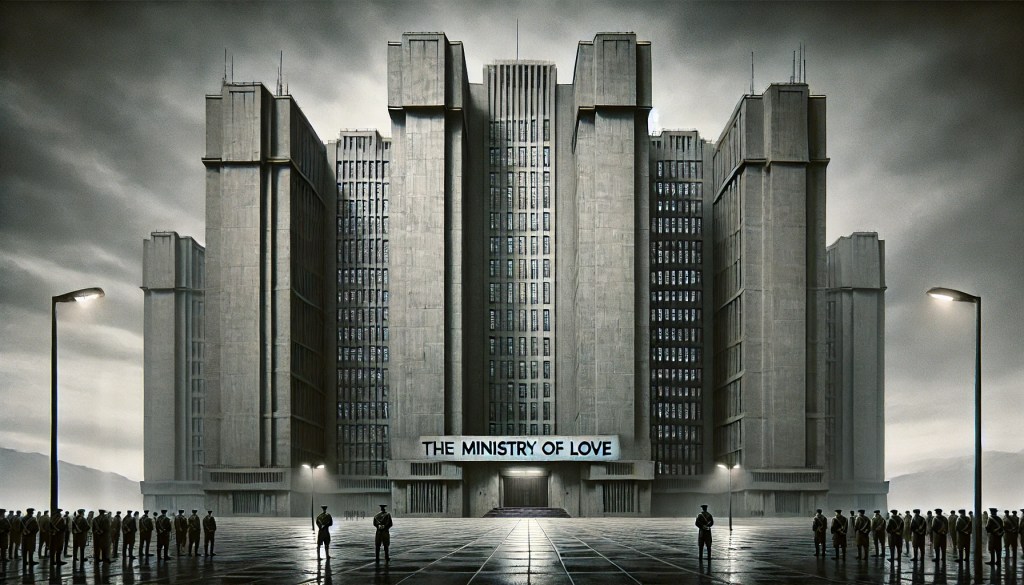
VI. The Climate of Manufactured Hate
The climate of manufactured hate in George Orwell’s 1984 is perhaps one of the most chilling depictions of how totalitarian regimes maintain power. In the novel, the Party uses systematic, state-sponsored hate to unify citizens, distract them from their own suffering, and create a constant sense of conflict. By channeling citizens’ anger and fear towards external enemies, the Party prevents them from turning that frustration inward, where it could challenge their rule. Orwell’s world of carefully directed hatred feels eerily relevant in today’s global political landscape, where “us versus them” rhetoric has increasingly become the norm—both in authoritarian regimes and in supposedly democratic societies.
In our modern context, especially in light of the Hamas attempted invasion of Israel last October, we can see this “us versus them” mentality echoing not just in the Middle East but across the globe. While countries like North Korea and China actively foster hatred towards external enemies to maintain control over their citizens, the divisive rhetoric is spreading in Western democracies as well. Political factions—be they Republicans or Democrats in the U.S.—accuse each other of being enemies of the state, all while real, complex global threats often go unaddressed. This climate of hate, whether engineered by authoritarian regimes or fueled by political partisanship, serves the same purpose: to distract, divide, and control.
The Air Filled with Hate: Orwell’s Vision of Manufactured Rage
In 1984, hate isn’t just an emotion—it’s a tool of control. The Party deliberately cultivates hate through orchestrated rituals like Two Minutes Hate and Hate Week. These events focus citizens’ anger on constructed enemies, such as the traitor Emmanuel Goldstein or the ever-shifting rival superstates of Eurasia and Eastasia. The entire population is encouraged to vent their frustration and rage toward these enemies, creating a sense of unity under Big Brother while obscuring the oppressive reality of their own lives.
The brilliance of this tactic lies in its simplicity: when people are angry, they are less likely to question the authority that governs them. Let me state that again: when people are angry, they are less likely to question the authority that governs them. By giving citizens a clear enemy to despise, the Party ensures that their hatred is always directed outward, rather than at the real source of their oppression. This manufactured hate is all-encompassing, filling the air and leaving no room for personal reflection or dissent. The Party not only controls what people think but also how they feel, ensuring that their emotional energy is spent on hating external enemies rather than questioning their lack of freedom, privacy, or autonomy.
Orwell’s portrayal of hate as a tool of manipulation resonates disturbingly with modern political climates. The rise of populist and authoritarian movements worldwide has been fueled by similar tactics, where fear and hatred of the “other” becomes a rallying cry for nationalistic fervor. This isn’t limited to one ideology or side of the political spectrum—it’s a tactic that thrives wherever division can be sown.
The Emotional Manipulation of Citizens
By fostering a culture of hate, Orwell’s Party eliminates any possibility of meaningful human connection or solidarity. Hatred serves a dual purpose: it distracts people from the oppressive conditions of their own lives, and it reinforces their loyalty to Big Brother. When people are united in their hatred of a common enemy, they are less likely to form bonds with one another that could lead to resistance or rebellion.
This is a powerful form of emotional manipulation. Hatred becomes a tool to keep people from forming meaningful relationships, whether those relationships are personal, romantic, or political. In 1984, love and trust are dangerous emotions because they create alliances that exist outside of the Party’s control. The Party responds by weaponizing hate to prevent these kinds of bonds from forming. By focusing citizens’ emotions outward, the Party maintains control over their hearts and minds.
We see this dynamic play out in the real world, particularly in regimes like North Korea and China, where hatred of external enemies is a key part of state propaganda. In North Korea, the regime continually portrays the United States, South Korea, and other nations as existential threats to the survival of the North Korean state. Citizens are fed a steady diet of propaganda that demonizes these foreign powers, keeping the population in a state of fear and hatred. This serves to unite the population under the leadership of the Kim dynasty, preventing any internal dissent or questioning of the regime’s brutal control.
In China, nationalist propaganda plays a similar role. The Chinese government regularly stirs up anger toward foreign governments, particularly the United States and Japan, as a way to deflect attention from domestic issues. By framing China as a victim of foreign aggression or interference, the state ensures that citizens’ frustrations are directed outward, rather than inward at the government itself. This tactic is particularly evident in China’s approach to Hong Kong, Taiwan, and its ongoing disputes in the South China Sea, where the government uses nationalist fervor to justify its actions and silence dissent. Like Orwell’s Party, China’s leadership understands the power of manufactured hate to maintain control over a population.
Manufactured Hate Today
While the parallels to authoritarian regimes are clear, Orwell’s insights about the power of manufactured hate apply just as well to the current political climate in democratic nations. Today, we see a rising trend of “us versus them” rhetoric in places that once prided themselves on pluralism and civil discourse. In the United States, political polarization has reached unprecedented levels, with Democrats and Republicans increasingly viewing each other as existential threats to the nation. The language of hate, once reserved for foreign enemies, is now used by political leaders and media outlets to describe domestic opponents.
Both sides of the political spectrum have fallen into this trap of demonizing the other, turning fellow citizens into “enemies of the state.” This is eerily reminiscent of Orwell’s Party, which used external enemies like Emmanuel Goldstein to unite the populace in hatred and keep them from questioning the true source of their oppression. In today’s climate, while political parties accuse one another of destroying the country, real and complex threats—such as economic inequality, climate change, or global security challenges—often go unaddressed. Like in 1984, the constant state of emotional agitation leaves little room for nuanced discussion or cooperation, effectively serving those in power by keeping the population divided and distracted.
The recent Hamas-Israeli conflict offers another example of how hate can be manufactured and exploited for political gain. The attempted invasion of Israel by Hamas has led to increased polarization across the globe, with political factions aligning themselves based on entrenched ideologies rather than facts. Notably, some Islamic extremists have found temporary allies in progressive liberal movements, despite holding fundamentally incompatible values. The common thread is the shared opposition to Israel (for different reasons), creating an alliance of convenience that masks deeper contradictions. This form of deception and alliance-building is a tactic reminiscent of Orwell’s warning in 1984: even those who seem diametrically opposed can find common cause when hatred becomes the primary motivator.
Hate as a Weapon: Deception and Division
What Orwell captures so brilliantly in 1984 is how hate is used not just as a distraction but as a weapon of division. When people are trained to hate, they are more easily manipulated. In the modern world, we see similar tactics being employed by political movements that thrive on division. Whether it’s through the demonization of immigrants, racial groups, or political opponents, hate serves as a tool to consolidate power.
The deceptive alliances we see today—whether between groups with fundamentally opposing values or between authoritarian regimes and their citizens—highlight the dangers of manufactured hate. In Orwell’s world, the Party’s use of hate was not just about controlling citizens but about creating a reality where everyone is constantly at war with one another, distracted and weakened by division. The result is a population that is easier to manipulate, less capable of critical thinking, and more dependent on the state.
The Power and Danger of Manufactured Hate
Orwell’s depiction of manufactured hate in 1984 serves as a cautionary tale for both authoritarian regimes and modern democracies. The power of hate lies in its ability to distract, divide, and control, making it a potent tool for any political movement seeking to consolidate power. Whether through state-sponsored propaganda in regimes like North Korea and China or through the divisive rhetoric of political factions in democracies, the tactic remains the same: create an enemy, fuel hatred, and use it to maintain control.
As we navigate the complexities of today’s political climate, it’s important to recognize the ways in which hate is being manufactured and weaponized against us. The more we allow ourselves to be consumed by “us versus them” thinking, the more we become pawns in the hands of those who seek to divide and control. Orwell’s 1984 reminds us that the true battle is not against each other, but against the systems that exploit our fears and emotions for power. If we are to resist the climate of manufactured hate, we must learn to question the narratives we are fed and seek out the common humanity that unites us all.
Love and Hate: Orwell’s Genius
As I was writing this section, another epiphany hit me: Orwell was an absolute genius. His portrayal of Big Brother’s methods in 1984 transcends the typical tools of oppression that we expect in a totalitarian regime. Big Brother doesn’t merely rely on brute force or censorship to control the masses—he wields two of the most powerful and fundamental forces in human existence: hate and love. What’s truly devious is how he masterfully manipulates both, often seen as opposing forces, to maintain his grip on society. Orwell’s insight into human psychology is staggering, and the realization that Big Brother exploits not just fear, but the very emotions that make us human, leaves my mind blown.
Think about it—hate is an obvious tool of control. We’ve already discussed how Orwell’s world channels hatred through rituals like Two Minutes Hate and Hate Week to unify the populace against external enemies and prevent them from turning their frustrations inward. This manipulation of hate is expected in totalitarian regimes, where anger and fear are often used to consolidate power. But Orwell doesn’t stop there. He goes a step further, showing us that love, the very emotion that is supposed to offer freedom and connection, can also be perverted and weaponized.
In 1984, Big Brother uses love as a tool of destruction just as effectively as he uses hate. The Party recognizes the power of love—the bonds between individuals, the passion that can drive rebellion—and systematically destroys it or co-opts it to serve its own ends. Take Winston and Julia, for example. Their love for each other represents a small rebellion against the Party, a private world that exists beyond the reach of Big Brother. For a time, their love gives them hope, a fleeting sense of humanity in a dehumanized world. But Orwell’s genius lies in how he shows that even this hope is not beyond the Party’s control.
The Party doesn’t just destroy Winston and Julia’s love through their arrest—it uses it against them. In Room 101, when Winston faces his greatest fear, the Party forces him to betray Julia. Under the threat of unimaginable torture, Winston’s love for Julia is crushed, and he pleads for her to be taken in his place. This is the Party’s ultimate victory. Love, which should be a force for resistance, becomes the very thing that leads to Winston’s surrender. Orwell reveals a terrifying truth: in a world where everything is controlled, even our deepest emotions can be turned against us.
What’s truly mind-blowing is how Orwell highlights that these two opposing forces—hate and love—are not so different when wielded by the Party. Both emotions are twisted to serve the same purpose: maintaining control. Hatred unites the people under a common enemy, while love, which should offer a refuge from the Party’s oppression, is weaponized to break individuals, ensuring that their ultimate loyalty is to Big Brother alone. The Party understands that human emotions are powerful, and by controlling them—by making people hate who they are told to hate, and by turning love into a tool of betrayal—they exert absolute dominance.
Orwell’s insight into how a regime can manipulate both love and hate to crush the human spirit is devious and brilliant. It’s easy to see how fear and hatred can be used for control, but the realization that even love, our most personal and cherished emotion, can be turned into a weapon is truly unsettling. Big Brother doesn’t just oppress through violence or fear—he invades the very essence of what makes us human, leveraging both the light and the dark within us to cement his rule. This is Orwell’s true genius.
VII. Winston’s Declaration: “We Are the Dead”
Privacy, in today’s world, is a big deal. Or at least, it should be. Yet, many of us have willingly sold it for the convenience of “free” services, services designed not only to track but to manipulate and influence us in subtle and sometimes blatant ways. Take Facebook, for example. Not long ago, it was revealed that Facebook had intentionally altered users’ news feeds to manipulate their emotions, showing how susceptible we are to controlled content. When you think about this in the context of Orwell’s 1984, the parallels are unsettling. Big Brother didn’t just control what people saw and heard; he controlled how they felt and what they believed, keeping them spiritually oppressed. Now imagine how easily a modern-day Big Brother could use today’s technologies—such as the data we freely give up on social platforms—to achieve the same result. Consider why countries like the United States might want to ban Chinese-owned apps like TikTok. It isn’t just about data privacy—it’s about the power that comes from the ability to manipulate entire populations through surveillance and information control.
When Winston Smith declares, “We are the dead,” he is acknowledging a deeper truth about life under the Party’s control: resistance is futile (wink, wink). This isn’t a sudden realization for Winston; it’s something he has felt throughout the novel, bubbling beneath the surface. His brief attempt at rebellion—his love affair with Julia, his secret journal entries, his fleeting hope that the Brotherhood might offer a path to freedom—was doomed from the beginning. The Party’s power is so absolute, its control so pervasive, that Winston knows he has no real chance of victory. By the time he and Julia are arrested, this truth becomes undeniable. The Party has already won, and Winston’s declaration that “we are the dead” is his recognition that, spiritually, the people of Oceania have been dead all along.
The Meaning of the Quote
When Winston says, “We are the dead,” it reflects not just his personal defeat but the broader reality of life in Oceania. Under the Party’s oppressive regime, the people have no freedom, no privacy, and no hope for a future. They are physically alive, yes, but spiritually, emotionally, and intellectually, they are dead. The Party has snuffed out individuality and free thought. In Orwell’s world, everyone lives in constant fear, conditioned to repress their own thoughts and desires. There’s no room for genuine human connection, creativity, or independent thinking. People are reduced to mere shells, existing only to serve the state.
This phrase encapsulates the soul-crushing reality of life under totalitarian rule. There’s no hope for change, no room for rebellion. The people have already been hollowed out, made into living corpses who go through the motions of life but are stripped of everything that makes life worth living. In this way, Winston’s declaration is not just about his own fate but about the fate of everyone in Oceania: they are all dead inside, long before the Thought Police come for them.
The Futility of Rebellion
Winston and Julia’s brief attempt to rebel—through their love, through small acts of defiance like buying the coral paperweight or meeting in secret—was, from the start, destined to fail. Orwell paints a bleak picture of totalitarian control in 1984, where resistance is crushed before it even begins. The Party’s power is so overwhelming that it leaves no cracks for opposition to grow. Every aspect of life is monitored, from physical actions to personal thoughts, and even love, which should offer refuge from oppression, is manipulated and turned into a weapon.
In Room 101, Winston’s love for Julia is shattered when he betrays her under torture, begging for the rats to be unleashed on her instead of him. This is the final proof of the Party’s total domination. Even the most intimate and personal human bonds are not safe from their control. Love, which might have been Winston’s last hope for rebellion, is turned against him. His declaration of “we are the dead” highlights the sheer hopelessness of his situation and the inevitability of his defeat. The Party cannot be resisted. It owns not only the bodies of its citizens but their minds and souls as well.
The Crushing of Resistance
Winston’s declaration resonates deeply when we look at modern authoritarian regimes. In North Korea, for example, any form of resistance is quickly and brutally crushed. Those who dare to challenge the regime face execution, imprisonment, or re-education, and even their families are often punished alongside them. Dissent is not tolerated, and the state controls every aspect of life, from media consumption to personal relationships. The people of North Korea, much like the citizens of Oceania, live in a state of perpetual fear, knowing that any deviation from the Party line could lead to their destruction. In this sense, the North Korean people, too, are “the dead,” existing in a state of spiritual oppression under the Kim regime.
Similarly, in China, dissent is swiftly dealt with through censorship, surveillance, and, in some cases, the disappearance of activists and critics. Chinese citizens who challenge the state’s authority are often arrested, re-educated, or simply erased from public consciousness. The Chinese government’s control over information, combined with its extensive surveillance network, mirrors Orwell’s Telescreens and Thought Police in disturbing ways. Like in 1984, rebellion in modern China often feels futile—activists are silenced before their movements can gain any real momentum, and the state’s control over its citizens’ thoughts and actions is pervasive.
Winston’s declaration, “We are the dead,” is a haunting reminder of the consequences of living under totalitarian rule. It speaks to the futility of resistance, the crushing of the human spirit, and the loss of individuality that comes with constant surveillance, information manipulation, and state control. In Orwell’s world, and in modern authoritarian regimes like China and North Korea, people are reduced to mere shadows of their former selves, living in a state of spiritual death. The parallels between 1984 and today’s political climate are stark and undeniable, reminding us of the dangers of unchecked power and the need to protect our privacy, freedom, and humanity at all costs.
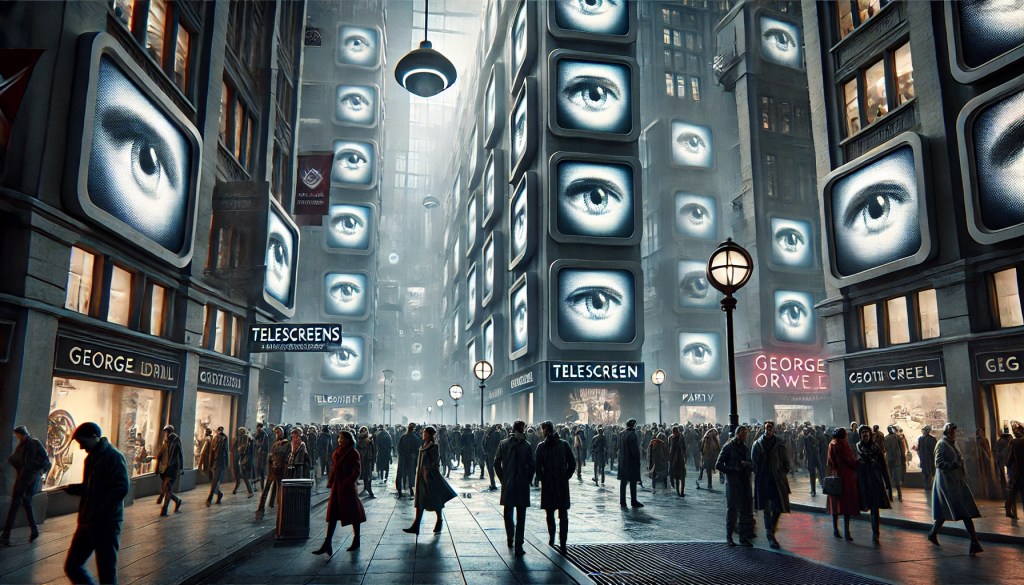
VIII. Parallels Between 1984 and Modern Authoritarian Regimes
Orwell’s 1984 is often lauded as a warning about the dangers of authoritarianism, and the parallels between the novel and modern regimes like China and North Korea are striking.
Surveillance and Control Through Technology
In 1984, the Party maintains control through a system of constant surveillance. Telescreens and the Thought Police ensure that no one can escape the watchful eye of Big Brother. In today’s world, this level of surveillance feels all too real. In China, for instance, facial recognition software, social credit scores, and extensive internet monitoring are used to track citizens’ behavior and ensure compliance with the Party’s rules. The state can punish citizens for anything from criticizing the government online to minor infractions like jaywalking, making privacy virtually nonexistent. Similarly, in North Korea, though the technology may not be as advanced, the regime relies on a network of informants and tight control over access to information to keep its citizens in line.
Manipulation of Information and Historical Revision
Just as Orwell’s Ministry of Truth constantly rewrites history, authoritarian regimes today manipulate information to control the narrative. In China, events like the Tiananmen Square Massacre are either downplayed or erased from public consciousness, with the state controlling how history is remembered. Schools and media are tightly regulated, ensuring that citizens are taught the Party’s version of history. In North Korea, the regime goes even further, glorifying the Kim dynasty with fabricated stories about their origins and achievements, much like the Party rewrites history in 1984 to ensure that Big Brother remains infallible.
Suppression of Dissent and Thought Control
Orwell’s concept of thoughtcrime is perhaps one of the most chilling aspects of 1984, and it is echoed in today’s world in regimes like China and North Korea. In both countries, citizens are taught from a young age to suppress dissenting thoughts, and any deviation from the state’s ideology is met with severe punishment. In China, activists are often arrested, re-educated, or disappeared, while in North Korea, the state’s control is so complete that even private dissent is considered a crime.
Cult of Personality
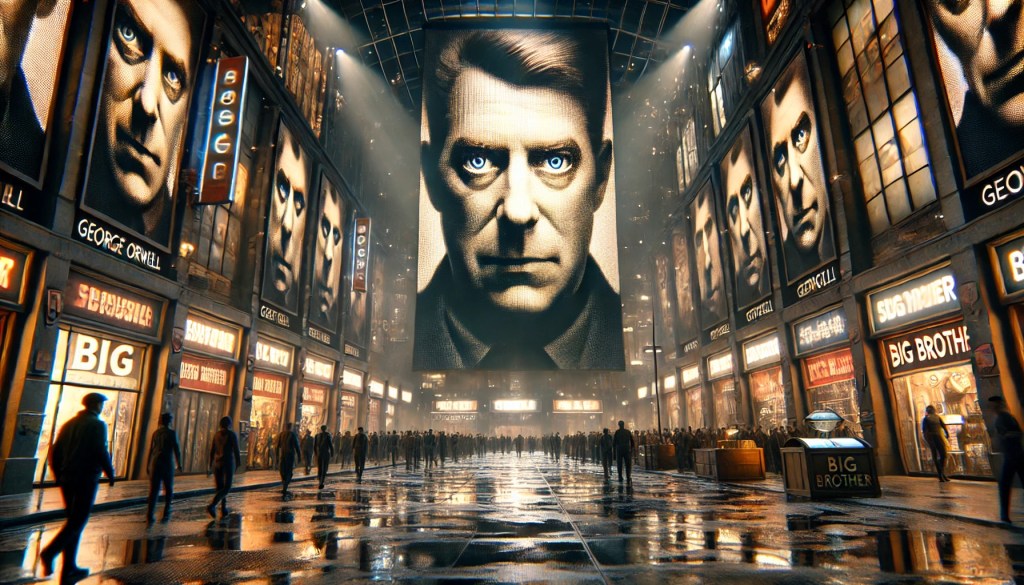
In 1984, Big Brother represents the all-powerful figurehead of the Party, and citizens are forced to both love and fear him. This cult of personality is replicated in China, where Xi Jinping’s leadership is celebrated as a central part of the nation’s ideology. Similarly, in North Korea, the Kim dynasty is worshipped in almost divine terms, with statues, portraits, and mythology surrounding the family’s rule. In both cases, the leader is portrayed as infallible, much like Big Brother in Orwell’s world.
Perpetual War and Control Through Fear
Orwell’s Oceania is constantly at war with either Eurasia or Eastasia, creating a sense of perpetual conflict that keeps the populace in a state of fear and dependence on the Party. This tactic is mirrored in regimes like North Korea, where the state constantly portrays external enemies—particularly the United States and South Korea—as existential threats to the country’s survival. By keeping its citizens in a state of fear, the regime is able to maintain control, much like the Party does in 1984.
Warning
China and North Korea serve as stark warnings of what can happen when ideologues and extremists gain the power to suppress freedom of speech. In both nations, dissent is silenced, independent thought is crushed, and the state controls not only the narrative but also the very thoughts of its people. These regimes show us the dangers of allowing any group to hold unchecked authority over what can be said, thought, or shared. When freedom of speech is eroded, so too is our ability to question power, seek truth, or resist oppression. The warning is clear: if we allow ideological zealots—whether they come from the left or right—to silence those who disagree with them, we are opening the door to a future where individual freedom is sacrificed for the illusion of security and order. Be wary, for the path from censorship to totalitarian control is a short and dangerous one.
IX. Reflection
1984 is a novel that offers a bleak, suffocating vision of the future—a dark abyss for humanity where totalitarian control reigns supreme. It’s a story that forces us to confront the very worst of what we might become if we allow power to concentrate unchecked and freedom to wither away. Orwell’s world, where love is twisted into a tool of destruction and hate becomes a state-mandated emotion, may feel like a distant dystopia. But upon closer reflection, it’s clear that the seeds of such a future exist in the world around us. This is why you need to read 1984 for yourself. Don’t simply take my view, or anyone else’s, as your own. Read it, immerse yourself in Orwell’s terrifying vision, and see what thoughts and conclusions you come to. Your perspective may be different from mine, and if so, share it with us—after all, discussion and reflection are the very tools we must use to guard against the future Orwell warns us about.
Orwell’s masterpiece, like Dante’s Inferno, confronts us with a vision of hell, where the words “All hope abandon, ye who enter here” might as well hang over every door in Oceania. 1984 is a tragedy, but not just for Winston and Julia. Their personal defeat and betrayal symbolize a much larger tragedy—one that extends to all of humanity. The thought that our world could evolve into a place like Oceania can lead to despair. The Party’s complete control over truth, love, and thought creates a reality where resistance seems not just difficult but impossible. For those who read Orwell’s novel, it may feel as though all hope is truly lost. In this way, 1984 is more than a cautionary tale; it is a visceral reminder of how fragile freedom is, and how easily it can be suffocated under the weight of authoritarian power.
Wendell Phillips once said, “Eternal vigilance is the price of liberty; power is ever stealing from the many to the few.” This quote encapsulates one of the central lessons of 1984. The Party’s rise to absolute power didn’t happen overnight—it was a gradual process of consolidating control over information, language, and thought. Are we vigilant? Are we continuously aware of the small ways in which our liberties are eroded? Or have we let our guard down, lulled into complacency by convenience or the illusion of security? If we allow ourselves to relax, to believe that someone else will protect our freedoms for us, then we must prepare for the inevitable outcome. Orwell’s warning is clear: the loss of freedom is always incremental, and once it’s gone, the road back to liberty is long and torturous.
Yet, despite Orwell’s grim vision, not all hope is lost. History has shown us that freedom, though fragile, can be resilient. We’ve seen dark moments in human history where it seemed like tyranny might triumph, but in each instance, the human spirit found a way to rise above. This reminds me of a line from Jurassic Park that, though lighthearted in its context, carries profound meaning in the face of Orwell’s dystopia. Dr. Ian Malcolm, played by Jeff Goldblum, famously says, “Life, uh, finds a way.” In the context of Orwell’s novel, this idea can be reimagined as a reflection on human resilience. Though the Party in 1984 may seem invincible, we can hope that freedom—like life—will ultimately find a way. Perhaps, Orwell’s vision of the future is not inevitable. Perhaps our world, though flawed, can still resist the totalitarian forces that seek to reshape it.
Even as we face new challenges in the modern era—surveillance, censorship, and the manipulation of truth—we can take solace in the fact that humanity has always found ways to resist oppression. Our nation might not survive in the form we know it, but freedom, in some form or another, will endure. Orwell’s novel is not just a warning; it’s a call to action. It asks us to remain vigilant, to be mindful of the forces that seek to limit our freedom, and to push back whenever we see those forces gaining strength. As long as we remain watchful, as long as we value and protect our liberties, the future does not have to be as bleak as Orwell imagined.
So, read 1984. Think deeply about its lessons. And above all, remember that the fight for freedom never ends. In Orwell’s world, the people of Oceania are spiritually dead, but we still have the power to resist, to stay alive in a world that wants to control and suppress us. As long as we remain vigilant, and as long as we value truth and freedom, we can ensure that Orwell’s nightmare never becomes our reality.

| Related Posts for Influence & Control Meta-Framework |
| Explore my series exploring the psychological tools, logical distortions, and social mechanisms that shape how influence and undue control operate. |
| Posts | References |


 Treasures of the Elysian Fields
Leave a comment