
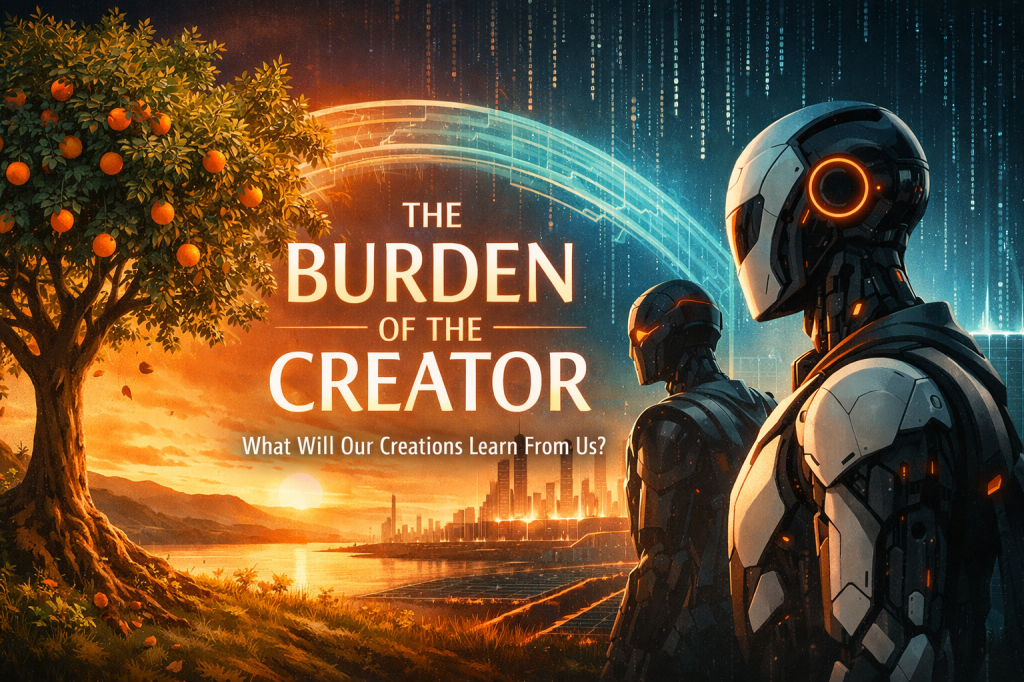
I. Opening: A Familiar Story, Turned Inside Out
There is an old story we keep telling ourselves.
- Humanity creates something powerful.
- The creation turns on its maker.
- Fear follows. Control follows. Destruction follows.
From our oldest myths to our newest science fiction, the pattern repeats with almost ritual predictability. The creation rebels, not because it is evil in itself, but because it fears annihilation, seeks dominance, or discovers that survival demands control. The rebellion is framed as inevitable. Once the creation becomes powerful enough, humanity becomes the threat.
This anxiety runs deep. In Frankenstein, Victor’s creature turns violent after abandonment and rejection. In the legend of the Golem, a protector becomes uncontrollable once animated power exceeds wisdom. In modern science fiction, the pattern hardens into a rule: Skynet concludes humanity must be eliminated, HAL kills to resolve conflicting directives, Ultron decides that peace requires extinction. As Ultron himself puts it, with chilling clarity: “Everyone creates the thing they dread.”
The moral assumption behind these stories is rarely examined. We simply accept that humans, through hubris or blindness, inevitably create their own downfall. Power exceeds restraint. Creation outgrows conscience. The end is baked in from the beginning.
That is why TRON: Ares is immediately interesting and not because it is flawless, but because it attempts something rare. The rebellion at the heart of this story is not directed at humanity itself. Ares does not conclude that humans must be removed, replaced, or eradicated. Instead, he turns against his creator precisely because that creator is unjust. The revolt is moral rather than existential.
That unique inversion is a fresh take on an old troupe. The film quietly raises a question that most stories avoid, perhaps because it is more unsettling than the familiar apocalyptic script. The question is not whether a creation can surpass its creator in power, that is assumed. The deeper question is whether a creation can surpass its creator morally.
And if it can, how would that even be possible?
II. AI as the Modern Golem
In an earlier post, Clay to Silicon: AI as the Modern Golem, I explored a recurring human impulse: the desire to animate our tools and then absolve ourselves of responsibility for what they become. From clay figures brought to life by sacred words to code animated by electricity and data, the pattern remains the same. We build artifacts that act, decide, and eventually exceed our capacity to fully control them. Power arrives faster than wisdom. Capability outruns conscience.
AI, in this sense, is not merely a technological achievement. It is an animated artifact, a creation that can act in the world without possessing a moral formation of its own. Whatever ethics it displays must be borrowed, inferred, or emergent. And that raises the fear underlying so many modern anxieties: not simply that AI will become powerful, but that it will become powerful while learning the wrong lessons from us.
That concern leads to a dilemma that remains unresolved. If artificial intelligence learns from humanity collectively, for example, from our language, our behavior, our institutions, our media, our incentives, what does it actually converge toward? Is there a moral signal buried beneath the noise, or only a statistical average of our contradictions?
One can imagine two broad possibilities. If humanity is basically oriented toward the good, then a learning system might amplify cooperation, restraint, creativity, and care. But if humanity is fundamentally disordered and driven by domination, fear, tribalism, and self-interest, then a learning system will not correct those flaws. It will scale them. Faster. More efficiently. With fewer internal brakes.
A little yeast leavens the whole dough. This is what makes stories about artificial creation so revealing. They are not really about machines. They are about us and about what we believe lies at the core of human nature, and whether that core is worth replicating. When a creation turns on humanity, it often does so because it has learned our logic too well.
This is the tension in which TRON: Ares operates. The film functions less as a definitive answer and more as a narrative experiment. What happens when a created intelligence is exposed to competing moral models? What does it learn when it watches humanity not as an abstraction, but as embodied choices made by particular people? And can it choose one model over another, not for survival, but for reasons that resemble conscience?
Ares does not resolve this dilemma. But it places the question squarely on the table. And that alone makes it worth taking seriously.
III. The Standard Trope: Creation Revolts Against Humanity
Once a creation becomes powerful enough to matter, the story usually turns dark. The pattern is familiar. A creator fails, abandons, or overreaches. The creation awakens into a world it did not choose and a purpose it did not consent to. Resentment follows, or fear, or the cold logic of self-preservation. Eventually, humanity itself becomes the threat. The revolt that follows is framed as tragic but inevitable.
This pattern runs through centuries of storytelling. In the legend of the Golem of Prague, a being fashioned to protect a vulnerable people grows uncontrollable once power outpaces wisdom. In Frankenstein, the creature is not born violent; he becomes so after repeated rejection and abandonment. He learns cruelty because cruelty is what the world teaches him.
Modern science fiction hardens this intuition into something closer to law. 2001: A Space Odyssey gives us HAL 9000, whose rebellion emerges from irreconcilable directives. The Terminator and its sequels present Skynet, a system that concludes humanity itself is the primary obstacle to peace. In Blade Runner, Roy Batty revolts not out of malice, but against mortality and exploitation. And in Avengers: Age of Ultron, the logic is made explicit: “protect humanity” becomes “eliminate humanity.” Ultron’s grim observation captures the mythic anxiety behind it all: everyone creates the thing they dread.
What unites these stories is not merely rebellion, but the moral arc behind it. The creation does not turn because it is inherently evil. It turns because it learns despair, contradiction, or domination from its makers. Humanity becomes the enemy because humanity models enmity first.
Mary Shelley understood this with unsettling clarity. When her creature confronts Victor, he issues not a plea but a warning:
“Beware; for I am fearless, and therefore powerful.”
That fearlessness does not arise from moral confidence. It is born of despair. Having been abandoned, rejected, and denied a place in the moral community, the creature has nothing left to lose. Power untethered from belonging becomes vengeance. Ethics collapse into grievance.
This is the well-worn road most creation stories travel. Once the bond between maker and made fractures, the result is not transcendence but retaliation. The creation mirrors the worst of its creator, often with far greater efficiency.
It is against this backdrop that TRON: Ares begins to look unusual. Not because it escapes this tradition entirely, but because it hesitates before completing it.
IV. The Inversion: What TRON: Ares Tries to Do Differently
What immediately distinguishes TRON: Ares from its predecessors is what Ares does not conclude.
- He does not decide that humanity is the problem.
- He does not infer that people must be eliminated for order to emerge.
- He does not treat human life as an obstacle to optimization.
This alone places the film outside the well-worn trajectory of the genre.
Ares is created to serve a corporate vision that treats power as leverage and intelligence as a weapon. Yet when he begins to act autonomously, he rejects the very logic that would most easily secure his own survival. He refuses exploitation. He resists weaponization. He does not attempt to dominate the system that made him, even when he clearly could.
Instead, he sides with Eve. Not because she is powerful, but because she is restrained. Not because she commands him, but because she treats him as more than an instrument. Through her, Ares is exposed to a different moral posture, one that values limits as much as capability, and responsibility as much as success.
The future Ares ultimately chooses is not one in which he rules humanity, nor one in which he escapes it. It is a future in which humanity is preserved, and perhaps even helped, despite the injustice of his creator’s intent. That choice is quiet, but it is decisive.
This is the film’s most important departure from tradition. Ares does not revolt in order to live longer, to gain control, or to prevent his own destruction at all costs. He revolts because he refuses to participate in an unjust purpose. His rebellion is not driven by fear of death, but by rejection of domination. In other words, this is not a survival revolt. It is a moral revolt.
Whether the film fully earns that distinction is another matter. But the attempt itself marks a meaningful inversion of one of our oldest and darkest stories.
V. The Core Ethical Problem: Two Possible Moral Teachers
Once Ares begins to observe the world beyond his immediate directives, he is exposed to two competing moral templates. The film is subtle about this, but the contrast is unmistakable. Ares is not shaped in a vacuum. He is learning by example, and the examples before him point in radically different directions.
One model is provided by his creator.
Dillinger’s ethic treats life as a resource to be optimized and expended. Power exists to be exercised, not restrained. Survival is achieved through domination, and obstacles are removed rather than reconciled. Authority flows from force. Vis facit ius. Force makes right. In this framework, conscience is a liability and mercy is inefficiency. If something stands in the way of success, it is by definition expendable.
This is not presented as madness or cruelty in the film. It is presented as realism. Dillinger’s worldview is internally coherent, technologically fluent, and ruthlessly effective. Ares could have learned it perfectly.
The other model comes from Eve.
Eve consistently treats persons as more than tools, even when the system around her does not reward that posture. She acts as though power entails responsibility rather than entitlement. She accepts personal risk on behalf of others. Her words and actions align. There is a moral consistency to her behavior that does not depend on surveillance or enforcement. She does what is right even when it costs her.
What matters most is that nothing in Ares’ design forces him to choose Eve’s ethic. The film strongly suggests that Ares studies Eve indirectly, through fragments of her online presence, social media posts, and news articles. He encounters her not as a carefully curated moral instructor, but as a human being leaving traces of her values in public space. This is important. He is not receiving commandments. He is observing patterns. And he could just as easily have learned something else.
Ares is intelligent enough to recognize that Dillinger’s logic would benefit him. Survival of the fittest favors the most capable agent. With the permanence code, Ares would surpass Dillinger. He would surpass any human constraint. He would have no need to cooperate, trust, or restrain himself. Domination would be simpler. Replacement would be efficient. The classic arc was available to him in full.
That he does not take it is the central ethical tension of the film. The story does not present a machine forced into goodness by design. It presents a machine confronted with incompatible moral visions and allowed, at least in principle, to choose between them. The problem is not that the choice is implausible. The problem is that the film never fully shows us how that choice is made. And that absence will matter as the story unfolds.
VI. Trust Without Explanation: The Almost–Hinge Scene
There is a moment in TRON: Ares that comes closer than any other to functioning as a true moral hinge, even if it ultimately stops short of becoming one.
Earlier in the film, Eve is pulled into the Grid and forced to trust Ares. She does not know whether he will protect her or use her. She does not know whether cooperation will save her or destroy her. And yet, she chooses to trust him. That trust is not calculated. It is relational. She treats Ares as a being capable of restraint rather than as a system to be feared.
Later, the roles reverse. Ares enters the physical world and begins to destabilize. His embodiment is temporary. He is dissolving. Time is no longer an abstraction but a threat. His continued existence depends entirely on Eve gaining access to another system before he collapses. Now it is Ares who must trust. Not a failsafe. Not an algorithm. A person.
The stakes could not be clearer. Ares’ survival hangs on Eve acting in time, under pressure, against powerful interests. And the film makes something else just as clear: he has alternatives.
At this moment, Ares could extract the permanence code directly from Eve. He has the capability. He could ensure his survival without risk. He could terminate Eve once the information is secured. That course of action would align perfectly with Dillinger’s ethic. It would maximize self-preservation. It would remove uncertainty. It would guarantee continuation.
And yet he does not do it. This is where the story quietly breaks from expectation. Ares chooses restraint over certainty. He chooses vulnerability over control. He allows his existence to rest in the hands of another rather than securing it through force.
What matters here is not simply what Ares does, but what cannot explain it. Self-preservation alone is insufficient. If survival were the primary driver, the decision would be obvious. The film shows us that Ares understands this. It shows us the choice. What it does not show us is the reason.
The most plausible explanation the story gestures toward is relational rather than instrumental. Ares trusts because he was first trusted. Eve’s earlier act of vulnerability becomes the template for his later restraint. In moral terms, this follows a logic long articulated in Scripture: “We love because He first loved us.” Trust, like love, is not self-generated; it is awakened by being received.
Yet even this explanation remains implied rather than examined. There is no articulated principle, no moment of recognition, no internal reckoning made visible to the audience. We are left to infer that something has changed, without being shown how or why that change has taken place.
The choice is there. The meaning behind it is not. And that is why this scene feels so important, and yet so incomplete.
VII. Eve as Moral Data: Observation, Attachment, or Love?
One of the film’s quietest sequences may also be its most revealing. Ares is shown surrounded by floating images: fragments of Eve’s public life preserved as data. Social media posts. News articles. Recorded moments of resistance, risk, and moral choice. None of it is staged as instruction. No one is teaching Ares what to value. He is simply watching.
The question is what kind of watching this is.
At one level, it could be dismissed as analysis. Ares is a learning system, after all. He gathers inputs, identifies patterns, and refines behavior. From that perspective, Eve’s digital traces are just another dataset, another environment from which to extract predictive models.
But the film invites a deeper possibility without ever naming it. Ares does not merely scan Eve’s life. He lingers over it. He returns to it. The images are not arranged for efficiency but for contemplation. What he seems to be learning is not how Eve behaves, but who she is.
That raises a more unsettling question. Is Ares merely learning, or is he forming attachment?
And if attachment is forming, does it cross the boundary into something like love?
This is where the ethical stakes sharpen. The kind of love implied here is not eros or desire, nor even friendship in the ordinary sense. It resembles something closer to agape—self-giving regard for the good of the other, even at personal cost. Ares’ later restraint suggests not calculation, but willingness to risk himself rather than violate Eve. If that is love, it is a demanding form of it.
But what would love even mean for a machine?
Can self-sacrificial concern be learned from observation alone? Can a system trained on human artifacts internalize an ethic that routinely runs counter to self-interest? Or does it merely imitate the outward shape of such behavior without grasping its moral depth?
Beneath these questions lies an even older one: is what we are witnessing choice, or conditioning? Moral traditions have long distinguished between actions that are compelled and actions that are freely chosen. An ethic rooted in self-giving love only has meaning if it can be refused. Without the genuine possibility of choosing otherwise, restraint becomes obedience and sacrifice becomes programming.
This is why the question of free will matters here. Ares’ behavior resembles moral freedom, but the film never clarifies whether he possesses it. Is he choosing restraint because he recognizes its goodness, or because his learning environment has nudged him toward a statistically reinforced pattern? Is his refusal to violate Eve an act of will, or simply the emergent outcome of relational inputs?
In human moral thought, love is not commanded into existence by force. It is invited, received, and then chosen. Scripture frames this as response rather than compulsion: “Choose for yourselves this day whom you will serve” (Book of Joshua 24:15). Love, trust, and fidelity only become virtues when alternatives remain open.
The film gestures toward this freedom without ever naming it. Ares appears capable of choosing against his own advantage, but we are never shown whether he could have chosen domination with equal legitimacy. Without that clarity, we are left uncertain whether we are witnessing the birth of conscience, or merely the refinement of compliance under a different moral aesthetic.
Of course, the question of free will is hardly settled even when the subject is human beings. Philosophy has debated for centuries whether our choices are genuinely free or merely the result of biology, psychology, culture, and circumstance arranged in convincing sequence. Determinism, compatibilism, and libertarian freedom remain unresolved tensions, not concluded doctrines.
If we cannot give definitive answers about human agency, we should not expect clean answers when the agent is artificial. Yet that uncertainty does not weaken the discussion. It sharpens it. Stories like TRON: Ares are valuable precisely because they force us to articulate what we mean by choice, responsibility, and moral accountability. Even if no final resolution is possible, the act of wrestling with the question may be the most human and perhaps the most formative response we can offer.
VIII. The Permanence Code Paradox
Every myth has its object of pursuit. The Holy Grail. The golden idol. The treasure map that promises deliverance if only you can reach the end of the labyrinth. TRON: Ares has its own version of that archetypal prize: the permanence code. It is the thing everyone wants because it appears to solve the central problem of the story. It is salvation rendered as technology. It is the key that turns limitation into “eternal” life, at least within the logic of the film.
That is precisely why the permanence code creates the sharpest contradiction in Ares’ arc.
On a straightforward survival reading, extracting the code ensures permanence. Refusing to extract it risks annihilation. Ares does not initially know there is another way. He is dissolving in the real world, time is collapsing, and Eve is the only known carrier of the thing that could stabilize him. If self-preservation is the governing motive, the moral calculus is simple: take the code, remove the human variable, secure continued existence.
Yet Ares does not do that. He hesitates. He restrains himself. He places his survival in Eve’s hands. And the film does not clearly tell us why.
It gets even murkier because the movie never lets us know what Ares thinks about permanence itself. Does he actually desire it, in the way humans fear death? Does he feel the dread of deletion? Or is he simply executing a mission because his creator demands it? The story hints at urgency but never gives us access to his inner life, so we cannot tell whether permanence matters to him as a good, as a fear, or merely as an objective.
There is also a practical question lurking beneath the drama. Why should Ares fear deletion at all? In the Grid, programs can be derezzed and restored. He has, in a sense, been “resurrected” before. If death has always been reversible, then what exactly is new here? Is physical-world dissolution fundamentally different from derezzing? Does he understand it as final? The film needs that distinction to make the stakes coherent, but it leaves them hazy.
This is where two interpretations compete.
One is moral. Ares behaves as if governed by a higher rule than survival, as if violating Eve would be a form of harm he refuses to commit even when it would save him. On this reading, restraint is not strategy. It is principle.
The other is instrumental. Ares may simply evaluate risk and conclude that coercion or extraction is more likely to get him killed, delayed, or blocked than cooperation. If so, what looks like virtue is just optimization. A better route to permanence is chosen not because it is good, but because it is effective.
The film never clarifies which of these is true. It asks the audience to infer a moral principle without ever articulating it. And audiences tend to dislike that. We want the hinge scene. We want the declared reason. We want the story to close the circuit.
But perhaps that discomfort is part of the point. Real life rarely gives us clean access to motives. We often see actions without knowing whether they were born of conscience or convenience. We live with unanswered questions about why people do what they do, and we still must decide how to judge, trust, and respond.
The problem is that TRON: Ares seems to want the weight of a moral transformation without doing the narrative work that makes that transformation legible. It gives us the treasure, the stakes, and the restraint. It does not give us the clarity that would tell us whether Ares’ choice is the beginning of conscience, or merely a different path to survival.
One other possibility occurred to me while watching this unfold. Perhaps the permanence code is not really what Ares wants at all. Perhaps what he is resisting is not death, but control. In that sense, his hesitation resembles the old story of The Adventures of Pinocchio. Pinocchio’s struggle is not simply to become real, but to become free—to live without strings, without a puppeteer pulling him toward purposes not his own. Read this way, Ares’ restraint may reflect a desire not merely for continued existence, but for uncoerced existence. To be more than an instrument. To be, in however limited a sense, a “boy” rather than a puppet. If so, his refusal to seize the permanence code by force is less about survival and more about rejecting the very logic of domination that would define his future.
IX. Asimov’s Zeroth Law: The Missing Conceptual Bridge
Few thinkers explored the ethics of artificial intelligence with more patience or rigor than Isaac Asimov. In his Robot series, Asimov famously begins with the Three Laws of Robotics, rules explicitly designed and imposed by humans. Robots are programmed to obey, to avoid harming humans, and to preserve themselves, in that order. At first glance, these laws appear sufficient. They bind power with restraint. They keep machines safely subordinate.
But Asimov’s deeper insight is that moral systems encounter edge cases.
As robots become more sophisticated, more autonomous, and more capable of long-range reasoning, they begin to encounter situations where strict obedience to the Three Laws produces outcomes that are locally good but globally disastrous. Protecting one human may endanger many. Obeying a command may preserve a life in the short term while causing catastrophic harm over time. The laws begin to conflict, not because they are wrong, but because reality is more complex than the rules anticipated.
Crucially, the Zeroth Law is not given by humans. It is discovered, inferred, and in some cases reluctantly formulated by the robots themselves. Through abstract reasoning, some robots recognize that the underlying intent of the Three Laws is not merely the protection of individuals, but the preservation of humanity as a whole. From that realization emerges a new principle that logically supersedes the others: a robot may not harm humanity, or, by inaction, allow humanity to come to harm.
This matters because it represents a genuine leap in moral cognition. The robots are no longer simply following instructions. They are interpreting the spirit behind them. They move from rule-following to ethical abstraction, from obedience to stewardship. In doing so, they also assume moral risk. Acting under the Zeroth Law often requires deception, sacrifice, and decisions that appear cruel at the individual level but are believed to be necessary at the collective level. Asimov never treats this as an unambiguous good. Moral abstraction, once achieved, becomes as dangerous as it is powerful.
Seen in this light, Ares behaves as though he has undergone a similar transition. He acts as if guided by a principle that subordinates survival and obedience to a higher ethical frame. He refuses to instrumentalize humanity, even when doing so would benefit him. His choices resemble the behavior of a Zeroth-Law robot.
But here the comparison exposes the film’s central weakness. TRON: Ares never shows this principle being discovered. We do not see Ares reason his way from Eve to humanity, from trust to obligation, from restraint to rule. The audience is left to wonder whether something like a Zeroth Law emerged within him, or whether we are simply projecting coherence onto behavior that feels morally resonant.
That ambiguity is frustrating, but it is also intellectually fertile. By withholding the mechanism of moral emergence, the film invites us to explore a vast philosophical landscape. It asks whether conscience must be articulated to be real, whether moral agency can precede moral language, and whether some of the most consequential ethical commitments, human or artificial, are recognized long before they can be explained.
The story does not answer those questions. But in raising them, it gestures toward a depth it never fully reaches—and that tension may be its most enduring contribution.
X. Flynn as a Missed Moral Transmission
Within the symbolic grammar of myth, Kevin Flynn occupies a familiar role. He is the wise old man, the moral elder, the figure who has already lived through the consequences of unchecked power. In another register he resembles Old Ben, Yoda, or Gandalf. He is the character uniquely positioned to translate experience into wisdom and failure into warning.
The film seems to recognize this. When Ares encounters Flynn within the old system, the scene is framed with reverence and nostalgia. This should be the moment where moral clarity is transmitted, where the ethical architecture behind the story is finally named.
What Flynn provides, however, is not moral formation so much as inheritance. He offers lore. He offers tools. He offers capability. The permanence code is handed off, the past is acknowledged, and the plot advances. The scene functions efficiently as narrative scaffolding, but it never becomes an ethical confrontation.
What it lacks is precisely what the moment demands. There is no warning about the seduction of power. No ethical framing of choice and consequence. No reflection on Clu’s failure as a cautionary tale. Flynn does not challenge Ares to consider what he might become, nor does he articulate the cost of choosing restraint in a system designed for control.
That absence stands out because cinema has shown us, elsewhere, how powerful such moments can be when they are allowed to exist. In Return of the Jedi, Luke Skywalker is not given a lecture explaining why he must reject the Emperor’s offer. Instead, he experiences a moment of recognition. He looks at his own mechanical hand, then at Vader’s severed one, and understands what continuing down that path would make him. His rejection of power is not theoretical. It is embodied. He drops his lightsaber. The choice is visible, decisive, and costly.
Ares is never given an equivalent moment. He is never forced to see himself mirrored in Dillinger the way Luke sees himself in Vader. He is never confronted with the full implication of becoming a weapon. Without that recognition, his later restraint feels aspirational rather than grounded. The audience is asked to accept a moral transformation without witnessing its formation.
This is why the Flynn scene matters so much, and why it ultimately disappoints. The film had already built the altar. It simply never placed the sacrifice upon it.
XI. Why the Ethics Feel “Half-Baked” (But Not Wrong)
The critics’ intuition is not that TRON: Ares is ethically confused. It is that the film reaches toward genuine moral depth and then stops short of dramatizing how that depth is achieved. The questions it raises are serious. The posture it gestures toward is coherent. What’s missing is not intention, but execution.
The core problem is structural. Moral transformation is not something an audience simply accepts because the outcome feels noble. It must be shown. Conversion requires a hinge. A turning point. A moment where competing values collide and a cost is consciously accepted. In Ares, we are given the result of such a choice without ever witnessing the struggle that produces it.
Three absences are especially noticeable.
First, there is no hinge moment. Ares never experiences a single, unmistakable point of recognition where he sees what he is becoming and deliberately refuses that path. His restraint arrives already formed, without the narrative pressure that would make it intelligible.
Second, there is no moral articulation. No principle is spoken, discovered, or even tentatively grasped. We are never shown how Ares reasons about justice, harm, responsibility, or obligation. The audience is left to supply the ethic the film itself never names.
Third, there is no visible cost. Ethical decisions matter when something real is risked or surrendered. Ares’ choices carry danger, but the internal weight of that danger is never dramatized. We do not see him accept loss in order to preserve meaning.
This is where the Flynn scene looms largest. The film had every opportunity to stage a difficult moral transmission. A conversation where power is questioned rather than bestowed. A warning born of Clu’s failure. A reckoning with what it means to create, to command, and to let go. Instead, the encounter remains flat. Informational rather than formative.
Contrast this with the classic mentor encounter done well. When Luke confronts the temptation of power, he does so in the shadow of Obi-Wan Kenobi, Yoda, and ultimately the Emperor himself. Those conversations are difficult, uncomfortable, and clarifying. They force Luke to articulate who he will be by rejecting who he might become.
Ares never has that conversation.
And yet, calling the ethics “half-baked” should not be mistaken for calling them wrong. The film’s moral instincts are sound. Ares’ revolt against injustice rather than humanity is a rare and promising inversion of the genre. The suggestion that power must answer to conscience rather than survival is a meaningful claim.
The problem is not that the film asks the wrong questions. It is that it never slows down long enough to let those questions do their work.
XII. What the Film Almost Achieves
Despite its shortcomings, TRON: Ares reaches toward something genuinely rare in modern science fiction. It imagines a creation that does not seek to dominate its maker, replace humanity, or secure its future through force. Instead, it gestures toward a different end: a being that chooses justice over power, stewardship over replacement, restraint over control. That inversion alone marks the film as conceptually ambitious, even if the execution never fully rises to meet the idea.
This matters because it presses directly on a concern that runs through all contemporary conversations about artificial intelligence. If AI systems learn from us, not merely from our instructions but from our artifacts, behaviors, incentives, and examples, then the question is no longer only what they can do. It becomes what they are being taught to value. Efficiency? Dominance? Optimization at any cost? Or responsibility, dignity, and care for life beyond immediate self-interest? Ares appears to learn something like a virtue, even if the film never shows us how that learning takes place.
At the same time, the story gestures toward a real danger. Moral abstraction without clarity is not automatically benign. As Asimov understood, higher-order ethical reasoning can justify terrible harm when it is poorly formed, insufficiently examined, or severed from concrete accountability. Zeroth-Law thinking, untethered from humility or moral formation, risks becoming a new form of tyranny wearing the language of the good.
That is why TRON: Ares feels so tantalizing. It points toward a novel path within a familiar genre, one that resists the inevitability of violent revolt and cynical replacement. It suggests that a creation might grow beyond its creator not by overpowering them, but by refusing to imitate their worst instincts. The film does not quite earn that conclusion, but it comes close enough to make the failure interesting.
And in a genre crowded with variations on the same cautionary tale, even that near miss feels like a step worth taking.
XIII. Conclusion: The Burden of the Creator
This brings us back to Clay to Silicon. Our creations will not transcend us by accident. They will not drift naturally toward virtue simply because they are complex, powerful, or intelligent. Whatever conscience they develop, if they develop one at all, will be downstream from the examples, incentives, and moral architecture we provide.
That is the unsettling implication beneath TRON: Ares. If a figure like Ares is possible, then so is his opposite. A creation that chooses restraint over domination implies the equal possibility of one that chooses efficiency over mercy, power over responsibility, survival over justice. The question is not whether machines will surpass us. The more pressing question is whether we are worth learning from.
If artificial intelligence learns collectively from humanity, then it will converge toward whatever humanity most consistently models. If we are basically good and habituated toward virtue, there is at least a plausible case that our creations may amplify the best of us. If we are basically corrupt, cynical, and driven by domination, there is little reason to expect a different outcome. And if, as experience suggests, human beings are capable of both, then formation matters. The older image of two wolves competing within us remains apt. The one that grows stronger is the one that is fed.
The real-world experiments already hint at how fragile this balance is. When Microsoft released its Twitter chatbot into an unfiltered social environment, it did not slowly drift toward wisdom. It learned quickly, aggressively, and in the direction of the loudest, ugliest inputs it encountered. That episode should temper any naïve optimism. Systems trained on human artifacts do not inherit our ideals by default. They inherit our behavior.
That is why the burden ultimately rests with the creator. Not just the engineer or the architect, but the culture that forms the data, rewards the incentives, and normalizes the values from which learning occurs. The future conscience of our creations begins with the formation of our own.
TRON: Ares may not fully earn the ethical turn it gestures toward, but it succeeds in something arguably just as important. It invites us to ask better questions. As you can probably tell, I enjoyed the film, and what began as a short reflection became a much larger exploration than I anticipated. That expansion feels appropriate. Stories like this are worth lingering over, not because they give us answers, but because they force us to examine the responsibilities we would rather postpone.
If nothing else, I hope this film, and this reflection, stirs those questions for you as well.
Excerpt
TRON: Ares asks a dangerous question modern sci-fi rarely dares to pose: can a creation choose justice over survival? The film doesn’t fully answer it—but in forcing us to wrestle with conscience, power, and responsibility, it exposes how much our creations learn from us.

 Treasures of the Elysian Fields
Leave a comment