
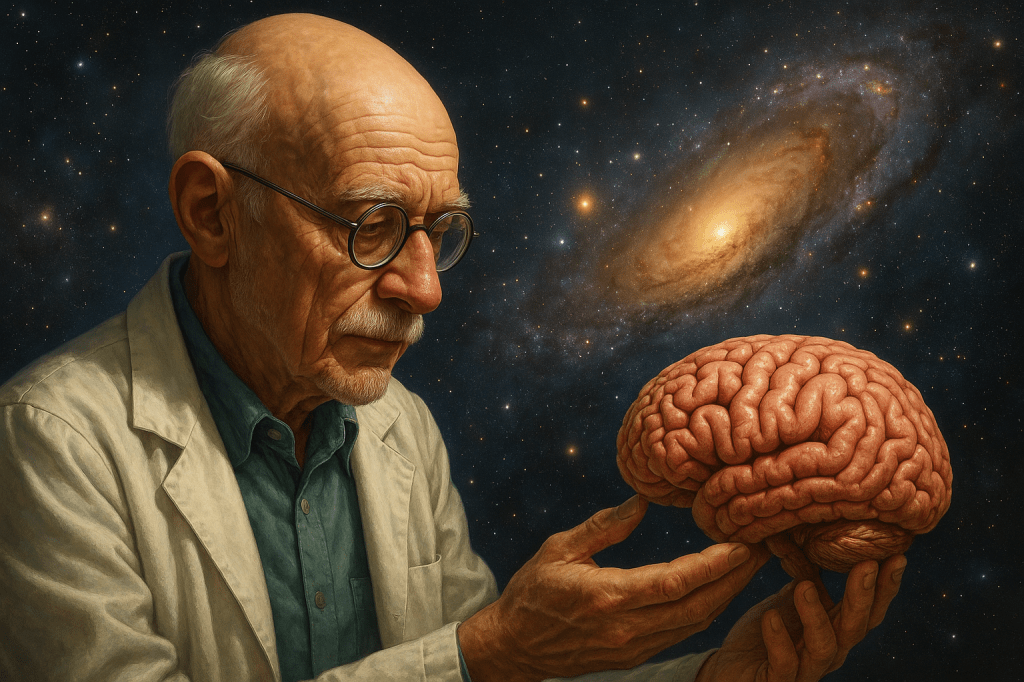
When the Mind Looks Back at the Universe
In philosophy, few questions haunt us more persistently than the mind–body problem—the riddle of how subjective experience arises from the machinery of matter. The ancient philosophers wrestled with it in different guises: Plato’s psyche, Aristotle’s form, Descartes’ dualism, Spinoza’s monism. Yet, even after centuries of metaphysics, neuroscience, and information theory, the question still glimmers beyond the horizon of certainty: What is consciousness, and how does it fit within the physical universe?
Recent years have seen a revival of this question in both science and popular culture. A new wave of physicists and psychologists have begun to wonder whether consciousness might be more than a byproduct of neural activity—perhaps it is a participant in the unfolding of reality itself.
| Follow my ongoing journey through the philosophy of mind and body—including the mysteries of consciousness—by exploring the related articles linked below. You’ll also find a complete reference list for further reading. |
| Articles | References |
As Popular Mechanics reports, “Your consciousness may be shaping reality,” citing emerging interpretations of the quantum observer effect, where observation seems to influence physical outcomes (Wells, 2025). Similarly, Psychology Today’s Darren J. Edwards (2025) introduces a quantum cognitive theory suggesting that mental states and quantum systems could be interwoven. The Modern Field calls this a “mind-blowing theory” that casts the brain as “the architect of the universe” (Ray, 2025), while Yahoo News summarizes the same idea in simpler terms: “Consciousness isn’t just in your head—it may be altering reality itself” (Natale, 2025).
Such claims walk the border between physics and metaphysics, where science brushes against the limits of what it can verify and philosophy begins its work. Whether or not these ideas withstand scientific scrutiny, they serve as reminders that our understanding of consciousness remains profoundly incomplete. And perhaps that incompleteness is itself instructive—revealing that the search for knowledge is not only empirical but also existential.
Phenomenology — This branch of philosophy studies how we experience the world from the inside out. Instead of focusing on what things are made of, it asks what things feel like when we encounter them—how we see, hear, think, and interpret reality. Originating with Edmund Husserl, phenomenology explores the structures of consciousness itself, showing that perception isn’t just receiving information but an active way of engaging with the world around us.
The Mind–Body Problem, then, is not a relic of ancient speculation; it is a living frontier where science, theology, and phenomenology converge. As we trace this frontier, we confront the possibility that the observer and the observed are not entirely separate, that perhaps the universe looks back through us.
“The mind is not a vessel to be filled, but a fire to be kindled.” — Plutarch
Classical Frameworks of the Mind–Body Problem
The tension between mind and matter is as old as philosophy itself. Before modern neuroscience or quantum theory, the question was already burning: How can thought, emotion, and will—intangible realities—emerge from physical substance? The history of philosophy reads almost like an extended debate over that mystery.
1. Dualism: The Ghost and the Machine
The modern conversation begins with René Descartes, who in the 17th century split reality into two fundamental substances—res cogitans (thinking substance) and res extensa (extended substance). The mind was immaterial, indivisible, and private; the body material, divisible, and public. Descartes’ wager was that reason alone could secure certainty—cogito, ergo sum (“I think, therefore I am”).
Yet this elegant certainty came with a cost. If mind and body are distinct substances, how do they interact? What bridge allows a thought to move a limb, or a neuron to ignite a feeling? The “ghost in the machine” (as Gilbert Ryle later mocked it) has haunted Western philosophy ever since.
“The soul can only act through organs, and the organs can act only by the motion of matter.” — René Descartes, Passions of the Soul
2. Materialism: Mind as Matter’s Reflection
By the 19th century, scientific triumphs—mechanics, chemistry, and physiology—pushed the pendulum toward materialism, the view that everything, including consciousness, arises from physical processes. The brain, in this model, is the engine of thought, and the mind its exhaust: a by-product with no independent existence.
This reductionist current flows through behaviorism and later computationalism—the idea that the mind is what the brain does, analogous to software running on hardware. Materialism offers explanatory power, but at a cost of its own: it struggles to account for the qualia, the first-person texture of experience—the redness of red, the ache of longing, the awareness of awareness itself.
Computationalism — In philosophy of mind and cognitive science, computationalism is the idea that the mind works like a computer. It suggests that thinking is a kind of information processing, where the brain functions as hardware and mental states are like software running on it. According to this view, thoughts, beliefs, and emotions are patterns of computation carried out by neural networks. Computationalism has shaped modern artificial intelligence research but is also debated—critics argue that human consciousness involves meaning, emotion, and awareness that go beyond mere calculation.
3. Idealism and Monism: The Primacy of Mind
Others turned the world upside-down. Philosophers such as George Berkeley and later Immanuel Kant argued that mind is not a product of matter but its condition of possibility. For Berkeley, to be is to be perceived (esse est percipi). Reality, then, is not an independent material realm but a divine or mental order sustained by perception.
Kant softened that claim: while the world exists independently, we never encounter it “as it is” (noumenon), only as it appears through the structures of our cognition (phenomena). Space, time, and causality are forms of the mind’s own organizing power. Consciousness does not merely observe reality—it shapes the conditions under which reality can appear.
4. Contemporary Hybrids: Dual-Aspect and Emergent Views
In the 20th century, thinkers sought to escape the stalemate between materialism and idealism. Spinoza’s earlier monism—one substance with both mental and physical attributes—found new life as dual-aspect theory, suggesting that mind and body are two sides of the same underlying reality. Others proposed emergentism, where consciousness arises from complex organization but introduces genuinely new properties, irreducible to neurons alone.
These views foreshadowed what modern physics and information theory now hint at: that the universe itself may be structured to generate observers, and that the line between physical and mental may be more porous than we once believed.
“The mind is to the body as music is to the instrument; distinct yet inseparable.” — Anonymous aphorism from the early Enlightenment
The classical frameworks—dualism, materialism, idealism, and their hybrids—do not so much solve the mind–body problem as map its terrain. Each illuminates part of the landscape while casting another into shadow. Yet, across these centuries, a single insight endures: to understand the mind, we must also understand what it means to be an observer within the world we seek to explain.
New Perspectives — Quantum and Informational Theories of Consciousness
Professor Farnsworth from Futurama once quipped that the brain is a “five-pound meat Ouija board.” The line is funny because it’s uncomfortably true. The brain is a biological machine—electrochemical, cellular, tangible—yet from it emerge thoughts, emotions, and creativity that seem to transcend the matter from which they arise. Farnsworth’s joke is a satirical nod to Descartes’ “ghost in the machine,” that from the physical emerges something behaving as though guided by an unseen hand.
This paradox sits at the heart of new scientific explorations of consciousness. Despite advances in neuroscience, the hard problem of consciousness—why physical processes produce subjective experience at all—remains unsolved. In response, a growing number of physicists, cognitive scientists, and philosophers are turning to the quantum and informational realms, seeking explanations beyond classical physics.
1. The Quantum Temptation
Quantum mechanics shattered the classical worldview that matter behaves predictably and independently of observation. At the subatomic level, particles exist in superposition—multiple potential states—until measured or observed. This observer effect has invited a bold (and controversial) speculation: if observation affects reality, could consciousness itself play a participatory role in shaping what becomes real?
Articles such as Sarah Wells’ “Your Consciousness Is Shaping Reality” (2025) in Popular Mechanics highlight experiments that seem to suggest that observation—not mere instrumentation—collapses quantum possibilities into definite outcomes. Psychologist Darren J. Edwards (2025) goes further, proposing a quantum cognitive theory where consciousness and quantum systems may interact in subtle ways. In this view, mental states are not just epiphenomena of neurons but entangled participants in the wider quantum field of existence.
Physicist John Archibald Wheeler, mentor to quantum theorist Benjamin Schumacher, once summarized this with the aphorism “It from bit”—the idea that physical reality (“it”) arises from informational choices (“bit”) made through acts of observation. Schumacher himself extended this logic, suggesting that information is not merely about communication but is the fabric of reality, the common language between physics, life, and thought.
2. Information as the Bridge
Information theory, born from Claude Shannon’s 1948 revolution, unites the abstract and the physical. Every thought, every message, every gene is an arrangement of information encoded in a material substrate—whether silicon, sound waves, or DNA. Yet information itself is not material; it is pattern—a structure that can migrate across media without losing identity.
This dual nature of information mirrors the duality of mind and body: pattern and substance, code and carrier. In Schumacher’s The Science of Information, he notes that even biological systems are fundamentally informational, from genetic replication to neural communication. The human brain, then, could be seen as an information processor that not only interprets the world but participates in constructing it.
In this light, Farnsworth’s “meat Ouija board” metaphor grows even richer: the brain may be the medium, but consciousness is the pattern of meaning that moves across it—an emergent informational phenomenon that interacts with physical reality much like code interacts with hardware.
“Information is the ability to distinguish reliably among possible alternatives.” — Claude Shannon
3. The Participatory Universe
If the universe is informational at its root, then consciousness may be its way of knowing itself. Physicist Wheeler imagined a “participatory universe” in which observers are woven into the fabric of creation. This resonates—however tentatively—with ancient philosophical intuitions: that reason (logos) and reality are intertwined, that the human mind echoes the structure of the cosmos.
Still, caution is warranted. Many scientists argue that invoking consciousness to explain quantum phenomena risks sliding into category error—confusing epistemology (what we know) with ontology (what is). Correlation does not prove causation, and the measurement problem may not require a conscious observer at all. Yet, as speculative as these theories are, they reveal a growing recognition that the divide between matter and mind is less absolute than once believed.
4. From Atoms to Awareness
Across physics, biology, and cognitive science, one theme is emerging: the universe appears to be structured for awareness. Whether this means consciousness is fundamental or simply inevitable remains open. But the conversation has shifted—from asking whether mind belongs in science to asking how deep its roots might go.
“The universe begins to look more like a great thought than a great machine.” — Sir James Jeans
Thus, the old question of the “ghost in the machine” finds new life in the “information in the field.” The riddle of how consciousness arises from matter may, in time, evolve into a new understanding: that mind and matter are complementary aspects of a deeper informational reality, each giving the other meaning.
What These Mean for the Role of Consciousness
The idea that observation can influence reality is one of the strangest and most consequential implications of modern physics. In classical science, an observer was a detached spectator—a passive recorder of facts. But in quantum mechanics, observation is participation. The very act of measuring a system appears to determine its state. Whether we describe this as “wave-function collapse” or “decoherence,” the unsettling implication remains: the universe does not fully decide what it is until something—perhaps someone—looks.
If this is more than a mathematical artifact, then consciousness may have a quantum footprint in the physical world. This does not mean that thought alone levitates stones or bends spoons; rather, it suggests that awareness itself might be woven into the causal structure of reality. The observer is not outside the experiment but an element within it.
“No phenomenon is a real phenomenon until it is an observed phenomenon.” — John A. Wheeler
1. Consciousness as a Quantum Participant
When physicists perform the famous double-slit experiment, light behaves as a wave of probabilities—until measured. Then it “chooses” to be a particle. At face value, this looks like the universe waiting for awareness to make up its mind. The interpretation is contested, of course: some argue that detectors, not minds, cause collapse; others, that multiple worlds branch simultaneously. Yet the symbolism endures. The world appears indeterminate until an observer enters the equation.
If the presence of a conscious observer correlates with the crystallization of physical events, then consciousness is not a ghost haunting matter but a co-author of the script. The implications are staggering. Observation does not merely record reality—it may, in some subtle way, instantiate it.
2. Mind and Meaning in an Interactive Universe
This view dissolves the sterile boundary between inner and outer worlds. The observer and the observed become complementary halves of a single dynamic. Consciousness and cosmos reflect one another like opposing mirrors, each revealing aspects of the other’s depth.
Such an outlook restores meaning to a universe often depicted as mechanistic and indifferent. If awareness influences the unfolding of events—even infinitesimally—then perception, intention, and attention acquire ontological weight. To be conscious is to participate in creation.
“We are participators in bringing into being not only the near and here but the far away and long ago.” — John A. Wheeler
3. Ethical and Existential Consequences
This participatory model of consciousness also implies responsibility. If our collective awareness contributes to the world’s unfolding, then cynicism, cruelty, and despair are not merely private states but forms of dissonance in the field of being. Conversely, empathy, wonder, and love become acts of cosmic harmony.
The theologian might hear echoes of imago Dei—human consciousness as a reflection of divine creativity. The scientist might hear an invitation to re-examine what “measurement” really means. Both are, in their way, calls to stewardship over the reality we perceive.
The poet T. S. Eliot once asked, “Where is the knowledge we have lost in information?” Perhaps the answer is here: knowledge lives where information meets consciousness—where the mind recognizes itself as part of the pattern it observes.
4. From Observation to Participation
Observation impacting reality may not yet prove that consciousness “creates” the universe, but it strongly implies that consciousness matters—that it is entangled, not incidental. Even if the quantum effect is minute, it symbolizes a profound truth: the cosmos is not a stage on which we act, but a symphony that requires our awareness to be complete.
“When you look closely at anything, you find yourself.” — Deepak Chopra
In this light, the ancient question—What is mind?—evolves into a new one: What kind of universe requires mind to exist? Perhaps, as Wheeler suggested, we inhabit a “self-observing cosmos,” one in which consciousness is both product and process, instrument and melody, a feedback loop through which the universe learns to know itself.
Toward a Nuanced Position — Bridging Science, Philosophy, and Faith
Strict materialism has long held that the mind is nothing more than the activity of the brain—an emergent illusion of neurons firing in elaborate patterns. But the implications of quantum mechanics quietly erode that confidence. If observation alters reality, then consciousness cannot be dismissed as a mere epiphenomenon. It seems to possess causal significance, a role in the universe’s unfolding that materialism struggles to explain.
Epiphenomenon — In simple terms, it means a side effect. In philosophy of mind, an epiphenomenon is the idea that consciousness doesn’t actually do anything—it just happens when the brain works, like steam rising from a train engine. The steam looks lively but doesn’t drive the engine.
We are thus faced with a striking possibility: that mind is not simply the product of matter, but rather that matter and mind are intertwined expressions of a deeper informational or spiritual substrate.
“Everything we call real is made of things that cannot be regarded as real.” — Niels Bohr
1. The Crumbling Wall of Materialism
In classical physics, reality was objective, measurable, and independent of the observer. The mind was seen as a late evolutionary accident, a fortunate trick of chemistry. Yet quantum physics undermines this detached stance. The observer cannot be neatly extracted from the observed. The act of perception appears to have ontological weight.
This doesn’t mean we can will planets into orbit or alter reality by thought alone; rather, it means that the universe is not fully defined without the act of consciousness. The materialist picture of a cold, self-contained mechanism begins to look incomplete—like a symphony written without an audience, a melody waiting for an ear to hear it.
“The universe begins to look more like a great thought than a great machine.” — Sir James Jeans
2. Consciousness as Quantum or Spiritual State
Here the question turns sharper: if observation exerts a quantum effect, is consciousness itself a quantum state? And if so, could that be what earlier generations meant by spirit?
The idea is provocative but not without precedent. Quantum physicists like Roger Penrose and Stuart Hameroff have suggested that quantum processes within neurons might be integral to conscious experience. Others—more speculative still—propose that consciousness could be a field or waveform, continuous with the quantum fabric of the universe.
If so, “spirit” may not be something that violates physics but rather something that transcends our current understanding of it—the informational coherence that bridges mind and matter. What ancient mystics called pneuma or ruach, the breath of life, might be another language for this invisible ordering principle.
3. Beyond Reduction and Mystification
Neither reductionism nor mysticism alone will suffice. To say “the mind is just neurons” is to ignore the mystery of awareness; to say “mind is divine energy” is to retreat from empirical rigor. A nuanced position acknowledges both: consciousness is embodied in matter yet not exhausted by it. It may operate in resonance with quantum systems, shaping probabilities rather than violating laws.
This middle path preserves intellectual humility while expanding our horizon of wonder. It honors the data of science and the depth of spiritual intuition, suggesting that the two might be describing the same phenomenon from different vantage points.
4. The Logos as Unifying Principle
In the Gospel of John, the cosmos is spoken into being through the Logos—a word that means both “reason” and “word.” If consciousness is indeed foundational, the Logos may be its theological analogue: the rational, creative intelligence underlying existence. Modern physics might call it information; theology might call it Spirit; philosophy might call it Mind.
Each term gestures toward a unifying reality that transcends the categories of subject and object, observer and observed. Perhaps consciousness is the language through which the universe speaks itself into being.
“The light shines in the darkness, and the darkness has not overcome it.” — John 1:5
5. Living with the Mystery
In the end, we cannot yet prove that consciousness is quantum, spiritual, or eternal. But the evidence hints that mind and matter are not strangers—that awareness participates in the ongoing genesis of the world. The wisest course is to live attentively within that mystery.
If the universe is, in some measure, responsive to consciousness, then every act of perception, compassion, or creativity matters more than we imagine. To be conscious is not only to observe the world, but to join in its becoming.
“We are not human beings having a spiritual experience; we are spiritual beings having a human experience.” — Pierre Teilhard de Chardin
Consciousness as the Mirror of Creation
Across centuries of thought—from Plato’s psyche to Descartes’ res cogitans—philosophers have wrestled with a single, stubborn mystery: How can matter think? Classical science offered precision but not meaning; materialism offered mechanism but not wonder. Now, quantum mechanics quietly reopens the door that reductionism tried to close.
If observation truly influences reality, then consciousness is not a late-arriving spectator to a finished play. It is part of the creative act itself. The universe appears structured so that awareness can arise within it—and, in rising, can shape what it beholds. That insight does not disprove science; it deepens it.
“Quantum mechanics may be strange, but the universe is stranger still—and perhaps, in its strangeness, it is whispering of transcendence.”
1. Beyond the Physical Horizon
At this frontier, strict materialism falters. The brain’s electrochemical activity may explain how thoughts occur, but not why there is anyone there to experience them. The informational and quantum properties of consciousness hint at something that exceeds the closed system of matter.
Here I find resonance with William Lane Craig, who argues that the intelligibility of the universe and the reality of consciousness both point toward a Creator—a personal, rational Mind behind all minds. If consciousness is irreducible to the physical, then it belongs partly to another order of reality. Humanity, in this light, bears the image of that transcendent intelligence.
2. Quantum Mechanics as the Bridge
Quantum physics may not prove theology, but it offers a bridge of coherence between science and spirit. The probabilistic dance of particles, the collapse of waves upon observation, the fine-tuned constants that allow life—all suggest that the physical world is open, relational, and mysteriously responsive.
Perhaps what theologians call Spirit and what physicists call quantum field are reflections of the same underlying mystery: a creative ground of being in which consciousness and cosmos are intertwined. The equations describe the structure; faith names the source.
“Mind, not matter, is the matrix of all things.” — Max Planck
3. The Human Vocation
If this is true, then to be human is to stand at the intersection of two worlds—the physical and the transcendent, the measurable and the meaningful. Our consciousness becomes a mirror in which creation beholds itself and, through us, glimpses its Maker.
Such a view does not demand abandoning science; it invites us to interpret its findings with deeper reverence. Every quantum of energy, every act of perception, every thought of love may participate in the same divine logic that spoke the universe into existence.
4. The Prime Observer
If the reader has not yet considered it, let me state it plainly: if a mind, by an act of observation, can influence the material universe, does this not make it possible—if not probable—that the universe itself came into existence by the observation of the Prime Mover?
The same logic that allows human awareness to play a participatory role in quantum events could scale upward to the cosmic level. What we experience as physical reality may be the ongoing result of divine observation—the conscious act of a Creator who called being out of potentiality.
This does not rest on mysticism or wishful thinking but on the philosophical consistency of a cosmos that requires an observer to define its state. If finite minds can affect the measurable, an infinite Mind could call forth the measurable itself. In that light, the Big Bang becomes not an accident of necessity but an act of perception—the first “Let there be.”
“In the beginning was the Word, and the Word was with God, and the Word was God.” — John 1:1
5. Consciousness and Creation
We are, then, more than matter animated by chance. We are consciousness—reflections of the original Mind—living bridges between the finite and the infinite. And when we look upon the universe with wonder, the universe, in some mysterious way, looks back.
Quantum mechanics may yet prove to be the scientific vocabulary for an ancient truth: that all existence is grounded in mind—the Mind of God—and that every act of awareness is a small echo of that first, eternal observation.
Excerpt
If observation can shape reality, then consciousness is not an illusion—it’s participation. Quantum mechanics may reveal what philosophers and theologians have long intuited: that mind and matter meet in mystery, and the universe itself may exist because it is observed—first and forever—by the Prime Mover.
Reference
Edwards, D. J. (2025, April 3). Does your mind shape reality? A radical new quantum cognitive theory says yes. Psychology Today. https://www.psychologytoday.com/us/blog/psychology-in-society/202504/does-your-mind-shape-reality
Natale, M. (2025, April 8). Consciousness isn’t just in your head—It may be altering reality itself, scientists say. Yahoo News. https://www.yahoo.com/news/consciousness-isn-t-just-head-135200144.html
Ray, T. M. (2025, October 4). Your brain is the architect of the universe and your consciousness shapes reality: This mind-blowing theory explains how. The Modern Field. https://themodernfield.com/your-brain-could-be-the-architect-of-the-universe/
Wells, S. (2025, September 25). Your consciousness is shaping reality, according to this mind-bending theory: It takes free will to a whole new level. Popular Mechanics. https://www.popularmechanics.com/science/a68041733/consciousness-reality-observer-effect/

 Treasures of the Elysian Fields
Leave a comment