
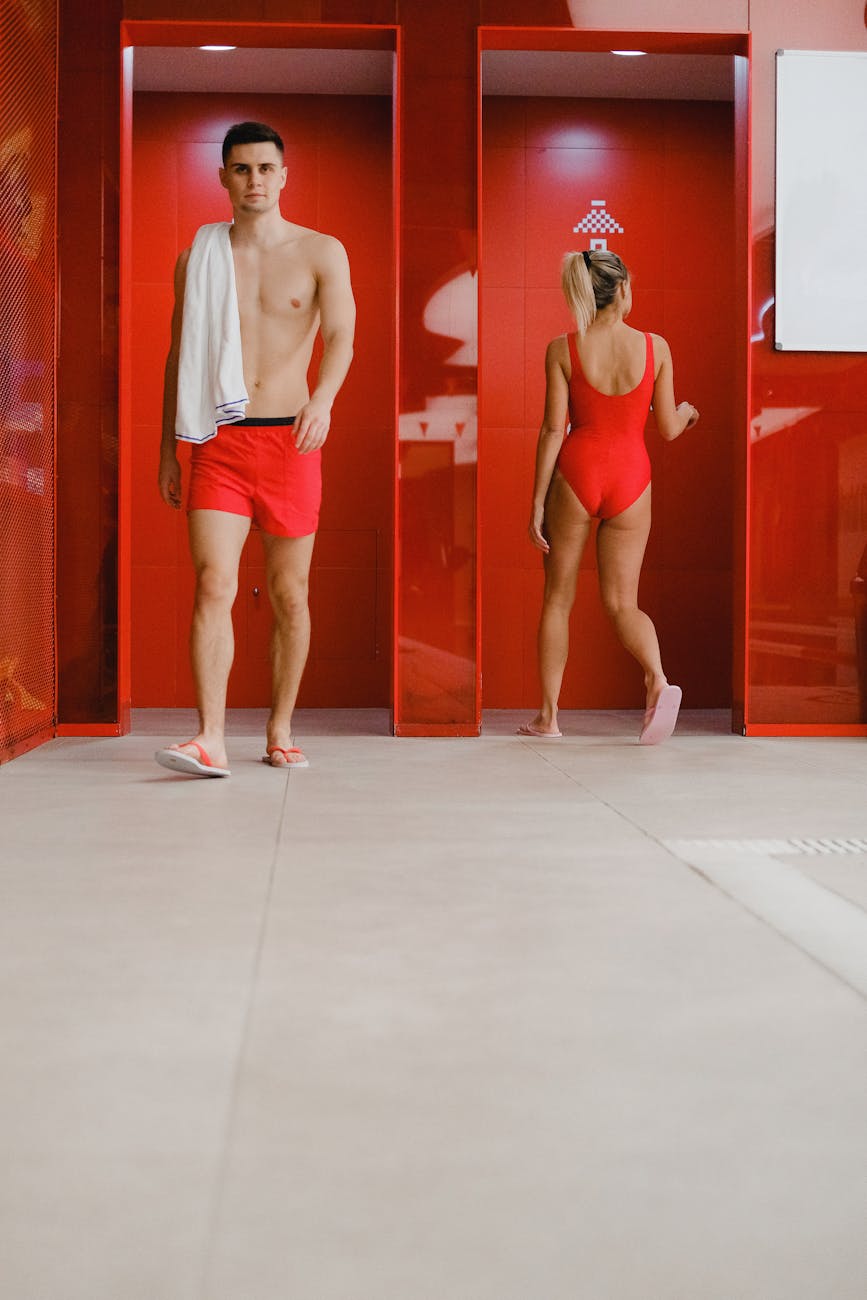
I recently came across a striking article in The Atlantic titled “The End of Naked Locker Rooms”, and it stopped me in my tracks. The piece describes the quiet disappearance of public and communal nudity in the United States—locker rooms redesigned around privacy stalls, schools removing open showers, gyms eliminating any space where bodies are casually visible. At first glance, these changes look like progress: more inclusion, more comfort, more safety. But as I read, I realized the loss is deeper than we think. When a culture removes every context where ordinary, nonsexual bodies can be seen, it risks forgetting something essential about embodiment—and about ourselves. This post is my attempt to reflect on that loss, and on what it will mean for our society moving forward.
For more reflections like this, check out my Naturism category, where I explore culture, body acceptance, and the philosophy of nudism in greater depth.
1. When the Locker Room Stopped Being a Locker Room
Jacob Beckert begins his article with a scene that should feel ordinary: two colleagues finishing a game of racquetball and heading into the locker room to change. Yet what unfolds is strangely emblematic of the new American relationship with the body. When he begins to remove his shirt, his friend stops him: “You can’t do that here.”
In a space historically designed for undressing, undressing is no longer permitted. Privacy stalls line the room like voting booths. The logic is familiar by now—“universal” design, gender inclusion, liability concerns, the omnipresent anxiety of cameras—but the effect is unmistakable: a quiet cultural transformation wrapped in the language of progress.
The locker room, once an unremarkable site of routine, nonsexual nudity, has become a place where modesty is expected and exposure is suspect. What was once casual is now coded. What was once normal is now negotiated.
This decline of shared, desexualized spaces is not isolated to one gym in Seattle. It is a national pattern. New construction rarely includes communal showers. Schools remove open changing areas. Community centers transition to single-user rooms. Even public pools—long a safe haven for ordinary, asexual bodies—now funnel people through privatized cubicles that limit the body’s visibility to the self alone.
“The exquisite realization of health; O I say these are not the parts and poems of the body only, but of the soul.” — Walt Whitman, “I Sing the Body Electric”
And so an odd reversal has taken place: Americans who grow up today may never see an unclothed, unposed, unfiltered human body unless it is a partner’s or one mediated through pornography or advertising. The naked body—once a simple fact of gym class, swimming, and shared space—has become something we encounter only through channels that are curated, eroticized, or commercialized.
This is not a small shift. It signals a deeper cultural anxiety about the body itself—one that shapes how we see ourselves, how we imagine one another, and ultimately, how we understand what it means to inhabit a human form at all.
2. The Disappearing Body
Beckert’s article shows something we don’t talk about enough: the quiet erasure of ordinary, unsexualized nudity from American life. Locker rooms, school showers, public pools, YMCAs—places that once exposed us to the unspectacular truth of human bodies—have slowly redesigned themselves to remove the body from view.
This shift is often framed as progress. Architectural journals celebrate “universal design,” administrators cite safety, school districts cite liability, and gyms point to camera bans they can’t reliably enforce. Privacy, comfort, inclusion—these are the stated goals. And in many ways, these motivations are good and necessary.
Yet beneath these changes lies a new reality: Americans now grow up with almost no exposure to real human bodies in nonsexual contexts.
We no longer learn that bodies come with:
- scars
- wrinkles
- asymmetries
- cellulite
- surgical marks
- age
- softness
- difference
Instead, our only points of comparison are polished: pornography, advertising, influencer culture, and algorithmic imagery. The result is predictable: ordinary bodies begin to look like failures, while unrealistic bodies become the norm.
Garcia’s 2020 study on communal nudity and body image confirms what many intuitively know: exposure to ordinary bodies improves self-esteem; lack of exposure erodes it. When we lose settings that normalize bodily variety, we lose social mechanisms that once helped people develop healthier self-understanding.
At the same time, the absence of communal nudity rewires cultural signals. In the past, the presence of naked bodies in a locker room communicated exactly one thing: people are changing clothes. Today, with the disappearance of these spaces, a naked body is more likely to be coded as inherently erotic—or inherently inappropriate.
This is where the change becomes truly consequential. When the only nudity we encounter is sexualized nudity, the body itself becomes sexual by default. This doesn’t just reshape our aesthetics. It reshapes our psychology, our social norms, and our most basic assumptions about embodiment.
3. How We Got Here: A Brief History of Vanishing Bodies
The decline of casual nudity in America isn’t sudden—it’s part of a long cultural trajectory shaped by modesty laws, moral panics, public-health campaigns, and religious inheritance. Beckert’s historical overview reminds us that the United States once had a much more open relationship with the unclothed body, at least in single-sex contexts.
In the late 18th and 19th centuries, young men bathed nude in rivers and lakes, often to the alarm of moral reformers who viewed visible skin as a threat to public order. Cities responded by enforcing rules: Boston banned Sunday bathing as “profaning the Lord’s day,” and New York prohibited daytime nude swimming to protect women from the sight of men’s bodies. From the very beginning, American nudity was managed through a blend of law and moral pressure.
Then came the Progressive Era—a strange moment of contradiction in which nudity was both stigmatized and required. Public bathhouses, communal showers, and nude swimming for boys were justified by hygiene, public health, and civic virtue. Reformers believed that cleanliness was next to godliness—but also that nudity could be morally neutral, even socially beneficial, when tightly regulated.
By the mid-20th century, however, the cultural fabric shifted again. Mixed-gender pools became the norm, racial integration altered the politics of public space, and bathing suits became both a technological improvement and a moral buffer. Nude swimming persisted in YMCAs and schools for decades, but the tide eventually turned: privacy, propriety, and the fear of misconduct took precedence.
- Then came the cameras.
- Then came the lawsuits.
- Then came the smartphone.
- And with them, an architectural revolution.
Today, privacy is not merely suggested; it is built into the walls.
This is where America diverges sharply from places like Denmark, Germany, and Finland, where communal nudity in saunas, spas, and swimming facilities remains ordinary and unremarkable. Denmark in particular stands out: recent studies show Danes to be among the most accepting of naturism in principle and practice. The body is not a battleground there—it is simply a fact of life.
Why the difference?
The American story is haunted by the long shadow of Puritan modesty, Protestant suspicion of the flesh, and the moralistic assumption that the exposed body is inherently problematic—or inherently sexual. These cultural anxieties never entirely disappeared; they simply modernized.
European countries inherited different legacies:
- Nordic sauna culture
- German Freikörperkultur
- Mediterranean topless traditions
- Danish social liberalism
Each reinforces a radically different conclusion: a naked body is not inherently a threat.
In the United States, by contrast, the body is presumed to be disruptive unless proven otherwise. That presumption shapes everything—from locker-room design to naturist culture to the quiet shame most Americans carry without realizing it.
4. When Bodies Disappear: A Cautious Comparison
As I read Beckert’s article, I couldn’t shake an image from a very different part of the world: photographs of Iran in the 1970s. Women wearing sundresses, jeans, loose hair in the wind—images of public freedom that now feel almost unreal. After the revolution, those expressions of embodiment were abruptly confined, regulated, restricted. Today, in many parts of Iran, only a woman’s eyes may be visible in public, if even that.
Let me be clear: the political realities are incomparable.
- One is enforced by state law, the other by design trends, institutional caution, and decentralized cultural anxiety.
- One is coercive, the other largely voluntary.
- One is tied to authoritarian control, the other to a complex negotiation of privacy, inclusion, and liability.
But the outcome—the narrowing of permitted bodily visibility—can have surprisingly similar psychological consequences.
Shared Effect: Narrowing exposure reshapes meaning
When a society reduces the places where ordinary, nonsexual bodies can be seen, the bodies that do remain visible shift toward the erotic, the curated, and the idealized. Everyday flesh becomes taboo. Imperfect bodies become invisible. And visibility itself becomes charged with anxiety.
Shared Effect: The body becomes politicized
Whether through religious mandates or progressive design principles, the more we hide ourselves, the more symbolic the body becomes. It stops being human and starts being ideological. It becomes a site of potential offense, liability, or risk.
Shared Effect: The loss of communal norms
In both contexts, the disappearance of casual nudity erodes the quiet social knowledge that comes from encountering bodies different from our own—older bodies, larger bodies, scarred bodies, the full spectrum of human variation.
Shared Effect: Rise in sexualization
When nearly every unclothed body you encounter is mediated through pornography, advertising, or romantic intimacy, the brain learns to associate nudity only with sexuality. The neutral body disappears. What remains is stimulus and spectacle.
Key Difference: Cause and remedy
- The causes differ dramatically—and so do the paths to change.
- In Iran, modesty is enforced by the state.
- In the U.S., it is enforced by fear—of cameras, lawsuits, misinterpretations, reputational risk.
- One requires political revolution; the other requires cultural reflection.
- The analogy is not about comparing regimes; it’s about comparing outcomes.
In both cases, the vanishing of ordinary, unremarkable nudity reshapes how people understand their own humanity. It narrows the range of what is considered normal, and it impoverishes the cultural imagination.
When a society hides the body—whether out of fear, modesty, or misguided protection—it risks forgetting that the body itself is not the problem.
5. What Happens When We Stop Seeing Each Other’s Bodies
When casual nudity disappears from public life, a strange thing happens: we don’t stop looking at bodies—we just stop looking at real ones.
Garcia’s 2020 study on communal nudity found a simple but profound truth: exposure to ordinary, unposed, nonsexual bodies improves self-esteem and reduces body shame.
The opposite is also true: the less we see normal human bodies, the harsher we become toward our own.
This lines up exactly with Beckert’s argument.
If our only exposure to nudity comes through the highly curated channels of pornography, advertising, and influencer culture, then our internal benchmark becomes impossibly narrow. The digitally perfected body becomes the standard; the ordinary human body becomes the embarrassment.
The Disappearance of the Asexual Body
In the past, spaces like locker rooms, bathhouses, or swimming pools subtly reinforced a powerful truth:
- nudity is not inherently sexual.
- It can be practical, hygienic, social, even mundane.
- The collapse of these spaces removes that cultural counterweight.
Without a neutral context for nudity, the meaning of the unclothed body collapses into a single category: sex.
And when nudity = sex by default, several consequences follow:
- Objectification intensifies.
- Bodies are judged more harshly, compared more aggressively, sexualized more quickly.
- Body shame increases.
- Without real-world comparison, people assume their natural variations are flaws.
- Fear replaces familiarity.
- If you only encounter naked bodies in sexual contexts, the mind begins to associate nudity itself with risk or impropriety.
- Diversity disappears from view.
- Aging bodies, fat bodies, disabled bodies, trans bodies—all become invisible, pushed out of public imagination.
The Feedback Loop of Shame
- As nonsexual nudity becomes taboo, shame increases.
- As shame increases, people avoid public nudity.
- As people avoid public nudity, communal spaces disappear.
- As communal spaces disappear, the taboo strengthens.
It is a self-reinforcing cycle, one that echoes sexual scripts rather than social health.
A Culture Without a Commons
A society that hides its bodies is a society that forgets:
- what normal variation looks like
- what aging looks like
- what unposed humanity looks like
- what equality looks like
We lose a basic literacy: the ability to understand bodies as bodies, not as objects.
In this sense, the decline of communal nudity is not merely an aesthetic or architectural change—it is a cultural impoverishment, a narrowing of the human vocabulary. And this narrowing falls hardest on the people who already feel invisible or judged: women, queer and trans people, fat people, disabled people, older adults. The less we see embodied diversity, the more fragile our sense of belonging becomes.
6. Why This Matters for Naturism — And Why the Road Is Harder in the U.S.
All of this—the vanishing locker rooms, the privatized showers, the smartphone fears, the moral panics—lands with particular force on naturism. If a society no longer has any ordinary, unsexualized context where people see the human body, naturism becomes not simply unusual, but almost unintelligible.
In Denmark, Germany, Finland, Croatia—places where communal nudity persists—naturism fits neatly into an existing cultural grammar. The body is not shocking; it is simply present. Being nude is not always erotic; it is often just ordinary. Because people grow up seeing real bodies in real settings, naturism does not violate the cultural script.
But in the United States, we are burdened with a double inheritance.
- First, the lingering Puritan suspicion of the flesh, a belief that the uncovered body is morally charged.
- Second, the modern privacy-safety-liability complex, which treats all nudity as a potential risk to be managed or eliminated.
And when these forces combine, naturism becomes doubly stigmatized. It is seen not only as unusual, but as unsafe or suspect.
The Safety Narrative—and Its Hidden Cost
Time after time, naturist clubs describe their policies as being about “safety.” And to be fair, some of these concerns are real. Cameras, misconduct, and boundary violations happen. But too often, “safety” becomes a euphemism for something else: mistrust, exclusion, and a presumption that nudity is inherently sexual.
I’ve experienced this firsthand. The last club I visited said I could come once on my own, but that in the future I could only return if my wife attended as well—as if her presence were a moral chaperone validating my intentions. My wife isn’t a naturist, and with her very fair skin she has no interest in prolonged sun exposure. Which means I’m effectively excluded. I’m sure the club believes it’s protecting people.
But the result is the opposite:
- it creates a stigma, treating single men not as participants in a nonsexual community, but as potential threats by default.
- This is how exclusion hides under the language of “safety.”
- It’s the same reflex that redesigns locker rooms so that no one changes in public.
- It’s the same reflex that replaces shared showers with stalls.
- It’s the same reflex that treats every naked body as sexual until proven otherwise.
- And it is killing the future of naturism in the U.S.
The Harder Road Ahead
Because Americans grow up seeing only sexualized nudity, naturism requires people to unlearn an entire cultural script. You cannot embrace naturism in the U.S. without first confronting and disentangling:
- inherited Puritan shame,
- the reflexive sexualization of the body,
- modern fears about safety and liability,
- a design culture that erases casual nudity,
- and a naturist community that, at times, reinforces stigma instead of challenging it.
In other words:
Naturism in the U.S. demands more cultural work because the culture itself does not support a desexualized understanding of the body.
Europe begins forty steps ahead.
Denmark in particular stands out: surveys show Danes to be far more accepting of naturism both in principle and in practice. They grew up with sauna culture and swimming pond norms; Americans grew up with privacy stalls and warning signs.
Naturism cannot grow in a society that never sees ordinary bodies. And naturism cannot thrive in a community that assumes nudity is dangerous unless carefully policed. If we want naturism to have a future here, we have to change not just the rules of clubs—but the story Americans tell about the body itself.
7. Reimagining Shared Spaces: Designing for Dignity, Safety, and Ordinary Bodies
If the disappearance of casual nudity has harmed our relationship with the body, the solution is not to return blindly to the past. Few people want the old high-school locker rooms back, complete with bullying, humiliation, and the silence that allowed predators to hide.
But neither can we pretend that the shift toward total privacy has no cost. Every design choice teaches a lesson. Every architectural decision becomes a cultural statement. When gyms, schools, and pools eliminate all communal nudity, they aren’t just changing tiles and partitions—they are reshaping the public imagination of what a body is and what a body means.
The challenge now is to move beyond nostalgia or reaction and instead reimagine shared spaces that preserve both safety and the desexualizing power of ordinary bodies.
1. Preserve optional communal spaces
We don’t need to force communal nudity on anyone, nor should we.
But we can build spaces where it remains an option—same-sex areas, time-blocked access, or consent-based zones where those who prefer normal communal changing still have it available.
- Let privacy be a choice, not a mandate.
- Let modesty be an option, not an imposition.
2. Enforce strong camera bans, visibly and simply
Cameras are the real catalyst of fear.
But instead of redesigning locker rooms around the worst-case scenario, we can counter cameras with:
- bold “no device” signage,
- monitored entrances,
- staff training,
- quick reporting procedures,
- lockers or cubbies specifically for phones.
Stopping the technology is easier than redesigning the social world around it.
3. Design for inclusion without erasing embodiment
Gender inclusion and bodily privacy are essential. But we do not need to choose between inclusion and desexualization—we can have both.
Architects and administrators can implement:
- universal changing rooms for those who prefer them,
- same-sex communal areas for those who prefer that,
- private stalls interspersed rather than mandated,
- clear expectations and behavior norms to protect all users.
Inclusion is strengthened, not threatened, when people have multiple dignified options.
4. Teach why nonsexual nudity matters
Most people aren’t opposed to communal nudity because they understand it—they’re opposed because they’ve never experienced it.
Educational materials—brief, non-intrusive, and optional—could explain:
- how casual nudity supports body acceptance,
- how communal norms reduce sexualization,
- how ordinary bodies vary across the lifespan,
- why shared spaces once played a role in civic life.
We shouldn’t assume that generations raised on smartphones will intuitively grasp these truths. They won’t.
5. Rethink naturism itself
If naturism is going to survive in the U.S., it must become a teacher, not a refuge.
Naturist communities must lead the cultural conversation, not hide from it. That means:
- revising “safety rules” that stigmatize single people,
- creating transparent consent norms,
- welcoming diverse body types and family structures,
- explaining clearly that nonsexual nudity reduces, not increases, harm.
- Naturism should model the very thing America has forgotten:
- that the naked body can simply be human.
- A society that hides its bodies hides part of its humanity.
The goal is not to resurrect the past, but to design a future where bodies are neither spectacle nor scandal—where nudity can sometimes just be nudity, and where the ordinary human form can once again appear in public life without fear, shame, or suspicion.
8. Rediscovering the Ordinary Body
The Atlantic article is about more than locker rooms. It’s about what happens to a culture when it loses the ability to see the human body as ordinary. When the unclothed form becomes something that exists only in private, in sexual contexts, or on a screen, we begin to forget what we once knew intuitively: that the body is not a threat to be managed but a reality to be lived.
And when a society forgets that, the consequences reach far beyond architecture or gym policies.
- We become more anxious, more ashamed, more alienated from one another.
- We become easy prey for industries that profit from insecurity and fantasies of physical perfection.
- We drift further from embodied wisdom—what it means to age, to heal, to scar, to grow, to simply be.
Naturism has always challenged this forgetfulness, insisting that the body need not be sexual, scandalous, or dangerous. But in the United States, that challenge now requires swimming against the current of both old Puritan fears and new privatized norms that make the body invisible except under erotic lighting or algorithmic polish. The work is harder here, but that only makes it more necessary.
- We do not need to return to the past.
- We do not need to force nudity into spaces where people feel unsafe or unseen.
But we do need to reclaim something we have lost: the knowledge that a human body—unadorned, imperfect, extraordinarily ordinary—is not a problem to be solved.
Whitman was right:
“These are not the parts and poems of the body only, but of the soul.”
If anything is sacred, it is not the fear that hides us, but the recognition that embodiment itself is a gift. Our task now is to ensure that the cultural spaces we build—literal and metaphorical—allow us to remember that.
Resources
- American Facility Design Journal. (2023). Trends in locker-room privacy and inclusive design. https://www.afdj.org/report/locker-room-trends
- Beckert, J. (2025, November 13). The end of naked locker rooms: What we lose when casual nudity disappears. The Atlantic. https://www.theatlantic.com/family/2025/11/naked-locker-room-end/684907/
- Garcia, M. L. (2020). Normalizing bodies: communal nudity and body-image outcomes. Journal of Body Studies, 12(3), 45–62.
- Smith, J. (2022, October 10). School removes communal showers amid privacy concerns. The Seattle Times. https://www.seattletimes.com/education/showers
- Westside Community Gym. (2024, June 2). Renovation: universal changing rooms and private stalls. https://www.westsidegym.org/renovation
Excerpt
As casual nudity disappears from American life, the body is becoming something we see only in sexual or curated forms. What we lose is the ordinary human body itself—the one that teaches us acceptance, dignity, and belonging. To rebuild that cultural wisdom, we must rethink how we design our shared spaces and how we understand the naked body.

 Treasures of the Elysian Fields
Leave a comment