
Four Archaeological Finds That Brush Against the Biblical World
Archaeology has an uncanny way of humbling us. Just when we assume history has settled into place—when skeptics dismiss the biblical world as myth or embellishment—an excavation turns over a stone, and the ancient world breathes again.
Over the last several years, four discoveries have caught my attention. None “prove” the Bible, nor should they. But each one stands at an intriguing crossroads where material culture, history, and Scripture intersect. What emerges is not dogmatic certainty but a textured reminder: the ancient world was real, populated with real people, and its stories—biblical or otherwise—were rooted in places that continue to speak.
Here are the four highlights.
1. A Sixth-Century Painting of Jesus in Israel’s Negev Desert
At the Byzantine village of Shivta, deep in the Negev Desert, archaeologists recently identified a faint, almost ghostlike mural above a baptistery—an early depiction of Jesus Christ’s face. Found in situ on a church wall and dated to the sixth century CE, the image shows a youthful Jesus with short, curly hair, a long nose, and large, expressive eyes.
To modern viewers accustomed to the bearded, long-haired Christ of medieval Europe, this portrait is a surprise. But scholars note that short-haired depictions were widespread in Egypt and Syro-Palestine during the early Byzantine era. The Shivta image may be one of the earliest known baptism-of-Christ scenes discovered in the Holy Land—an iconographic window into local Christian theology and liturgical art before the waves of iconoclasm swept through the region.
Because the original is barely visible, scholars rely on digital enhancement and comparative iconography to reconstruct its probable form. Even so, its presence—still clinging to a desert wall after 1,500 years—speaks volumes.
2. The Alexandria “Jesus Bowl”: A Mysterious Inscription Beneath the Waves
In 2008, underwater archaeologists mapping the ancient royal harbor of Alexandria recovered a small ceramic bowl with a puzzling inscription:
DIA CHRSTOU O GOISTAIS.
Some translations have sensationally dubbed it the “Jesus Cup,” suggesting it might include one of the earliest extra-biblical references to Christ. But as with most such claims, the truth is more nuanced.
What we know:
- The bowl was found near Antirhodos Island, now submerged beneath modern Alexandria.
- Its date—based on ceramics and context—likely falls in the first or second century CE.
The inscription’s meaning is debated:
- “Through Christ the magician/wonder-worker” — implying invocation of Jesus in a magical or ritual setting.
- “Through Chrestos the chanter” — where Chrestos may refer to a common personal name rather than Jesus of Nazareth.
The academic dispute hinges on small details: the shape of letters, spacing, and orthography. If the inscription refers to Christ, it would be an extraordinary early witness to Jesus’ reputation as a healer or miracle-worker. If not, it remains a fascinating example of Greco-Egyptian ritual culture in one of the ancient world’s great cosmopolitan cities.
Either way, it is a humbling reminder that Alexandria—home to philosophers, magicians, Jews, pagans, and early Christians—was a melting pot where names, ideas, and rituals crossed paths in unpredictable ways.
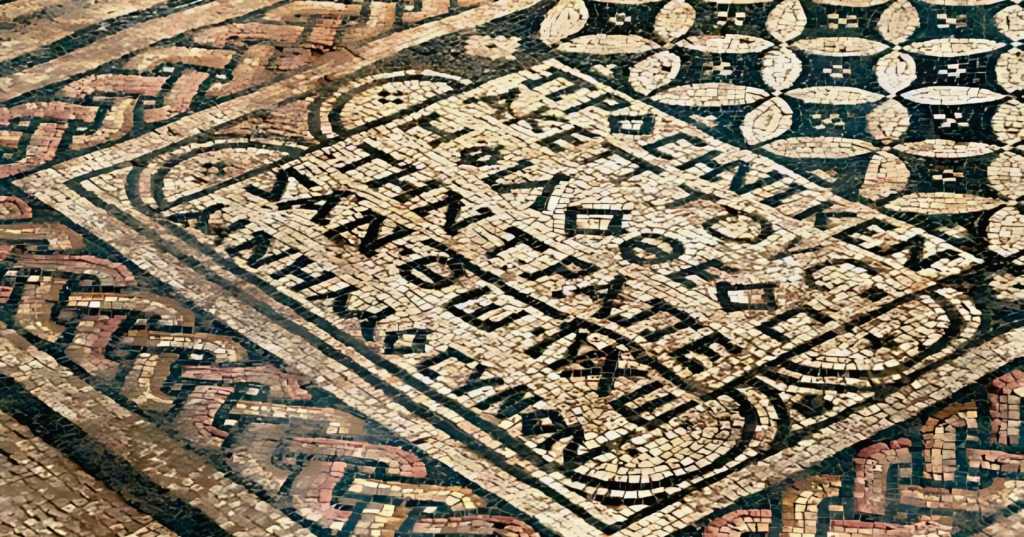
3. The Megiddo Mosaic: A Third-Century Prayer to “God Jesus Christ”
During salvage excavations beneath Megiddo Prison, archaeologists uncovered a large mosaic floor dating to the early third century CE. Its Greek inscriptions include a dedicatory line that caused a quiet stir among scholars:
“Akeptous, the God-loving, has offered the table to God Jesus Christ as a memorial.”
If authentic and correctly dated (and the evidence strongly supports this), the mosaic represents one of the earliest archaeological inscriptions explicitly referring to Jesus as God—a remarkable piece of material evidence for high Christology well before the Council of Nicaea.
The site appears to have been a domestic prayer hall or early Christian meeting place, not yet a formal church building. Its mosaic includes fish imagery and donor inscriptions typical of early Christian worship spaces emerging across the Roman world.
While popular media often overstates such discoveries, scholars note that this inscription provides rare, concrete evidence of how some Christian groups understood Jesus long before doctrinal creeds formalized such beliefs.
This small mosaic, once hidden beneath a modern prison, now adds another tessera to our picture of early Christian devotion.
4. Reconstructing Ancient Battles: Assyrian Military Camps in Judah
Recent studies combining satellite imagery, early aerial photography, surface surveys, and comparisons with Assyrian reliefs from Nineveh have helped locate what appear to be Assyrian military camps described in biblical accounts—particularly from the 701 BCE campaign of Sennacherib, king of Assyria.
Two highlights:
At Lachish, oval enclosures visible in historic aerial photos match the campsite layouts depicted on Sennacherib’s palace reliefs.
Near Jerusalem, a site long known by the Arabic name Jebel el-Mudawwara—“the camp of the foreigners”—shows ceramic remains and morphology consistent with an Assyrian field camp.
These identifications do not “prove” the events of 2 Kings 18–19, but they significantly reinforce the historical landscape behind them. Researchers use:
- morphology (oval Assyrian camps vs. rectangular Roman ones),
- pottery dating (late 8th–early 7th century BCE),
- ancient toponymy,
- and visual data from Assyrian reliefs
- to build a compelling argument for the placement of real military sites mentioned in biblical texts.
Such work reminds us that biblical history, far from being abstract storytelling, is rooted in real terrain—hills and valleys where armies marched and cities endured siege.
A Final Reflection: Between Myth and Memory
These discoveries—a painted Christ in a desert church, a mysterious bowl beneath the waves, a mosaic dedicating a gift to “God Jesus Christ,” and Assyrian camps etched into Judah’s hills—do not prove the Bible. Archaeology never works that way. It illuminates context, not creed.
But they do complicate the modern habit of dismissing Scripture as myth, fabrication, or pre-scientific fantasy.
Across Israel, Egypt, Jordan, Turkey, and beyond, tens of thousands of artifacts, inscriptions, architectural remains, and ancient texts continually align with the geographical, cultural, and historical world described in the Bible. They show that biblical stories were told by real people in real places—a tapestry woven into the archaeology of the ancient Near East.
Skepticism has its place; blind dismissal does not. These finds invite us to approach the biblical world with curiosity rather than caricature—to acknowledge that the line between faith and history is often more textured, more complex, and more fascinating than we expect.
And perhaps that is where the real discovery lies.
References
- Andrews, E. (2024, June 22) How does the discovery of an Assyrian camp support the biblical account of 2 Kings 19:35?. United ASV Bible. https://uasvbible.org/2024/06/22/how-does-the-discovery-of-an-assyrian-camp-support-the-biblical-account-of-2-kings-1935/
- Biblical Archaeology Society. (n.d.). The Megiddo mosaic. BiblicalArchaeology.org. . https://www.biblicalarchaeology.org/exhibits-events/the-megiddo-mosaic/
- Bible Archaeology Report. (2024, December 27). Top ten discoveries in biblical archaeology in 2024. BibleArchaeologyReport.com. . https://biblearchaeologyreport.com/2024/12/27/top-ten-discoveries-in-biblical-archaeology-in-2024/.
- The Berean Call. (2024, December 19). Earliest “Jesus is God” inscription found in Israel. TheBereanCall.org. . https://www.thebereancall.org/content/earliest-jesus-god-inscription-found-israel
- Borschel‑Dan, A. (2018, November 15). Jesus image hidden in plain sight at Negev church is one of earliest in Israel. The Times of Israel. https://www.timesofisrael.com/jesus-image-hidden-in-plain-sight-at-negev-church-is-one-of-earliest-in-israel/
- Colombia One. (2025, September 12). The Jesus Cup: 2,000‑Year‑Old bowl may hold earliest reference to Christ. ColombiaOne.com. . https://colombiaone.com/2025/09/12/jesus-cup-oldest-christ-reference/
- Compton, S. C. (2024, June). First‑ever discovery of ancient Assyrian military camps includes biblical site. Popular Archaeology. https://popular-archaeology.com/article/first-ever-discovery-of-ancient-assyrian-military-camps-includes-biblical-site/
- Facts and Details. (n.d.). Magic in ancient Rome: Sorcery, miracles and curses. Europe.FactsAndDetails.com. . https://europe.factsanddetails.com/article/entry-1120.html
- Franck Goddio and the European Institute for Underwater Archaeology. (n.d.). Sunken civilizations: Alexandria. FranckGoddio.org. . https://www.franckgoddio.org/projects/sunken-civilizations/alexandria/
- Goddio, F., & Fabre, D. (2008). [Finds and exhibition materials for the Alexandria underwater excavations]. In Egypt’s Sunken Treasures exhibition materials. Hilti Foundation / European Institute for Underwater Archaeology. https://www.franckgoddio.org/projects/sunken-civilizations/alexandria/
- Govier, G. (2024, December 20). Top 10 Biblical archaeology stories of 2024. Christianity Today. https://www.christianitytoday.com/2024/12/top-10-biblical-archaeology-disovery-list-2024/.
- GreekReporter. (2025, April 18). First‑Ever Greek inscription declaring Jesus as God found in Israel. GreekReporter.com. . https://greekreporter.com/2025/04/18/first-inscription-jesus-god-israel-prison/
- GreekReporter. (2025, September 11). 2,000‑Year‑Old ‘Jesus Cup’ may hold earliest known reference to Christ. GreekReporter.com. . https://greekreporter.com/2025/09/11/jesus-cup-earliest-reference-christ/
- History.com Editors. (2018, November 15). Does this 1,500‑year‑old painting show what Jesus looked like? History. https://www.history.com/articles/jesus-early-painting-discovery-israel
- MSN. (n.d.). 10 stunning archaeological discoveries that confirm biblical events. MSN. https://www.msn.com/en-us/science/anthropology/10-stunning-archaeological-discoveries-that-confirm-biblical-events/ar-AA1Qxprd.
- National Geographic. (2025, April 18). What archaeology can—and can’t—tell us about Jesus’ crucifixion. National Geographic. https://www.nationalgeographic.com/history/article/what-archaeology-can-tell-us-about-jesus-crucifixion
- Oakes, J. (2019, September 2). What is your response to the claim that a cup found in Alexandria from the early first century is the earliest written reference to Jesus Christ? Evidence for Christianity. https://evidenceforchristianity.org/14065-2/
- Radley, D. (2024, June 19). Assyrian military camp found, potentially supporting biblical account of angels killing 185,000 soldiers. Archaeology Magazine. https://archaeologymag.com/2024/06/assyrian-camp-biblical-account-of-angels-killing-soldiers/
- Rogers, J. (2018, November 13). ‘Jesus face’ uncovered at ancient church in the Israeli desert. Fox News. https://www.foxnews.com/science/jesus-face-uncovered-at-ancient-church-in-the-israeli-desert
- Viegas, J. (2008, October 1). Earliest reference describes Christ as ‘magician’. NBC News. https://www.nbcnews.com/id/wbna26972493
Excerpt
Recent archaeological discoveries—from a desert painting of Jesus to Assyrian military camps—don’t “prove” the Bible, but they vividly anchor its world in real history. These finds remind us that dismissing Scripture as pure myth overlooks a growing landscape of evidence worth thoughtful attention.

 Treasures of the Elysian Fields
Leave a comment