
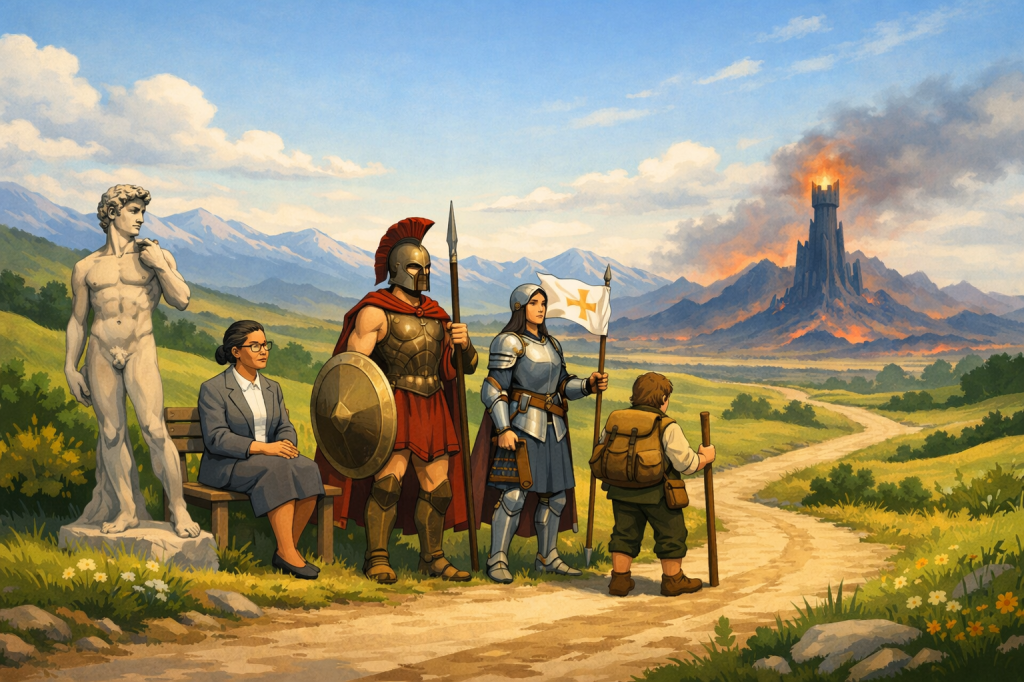
A Moment on the Road
On December 1, 1955, Rosa Parks boarded a bus in Montgomery, Alabama, and took a seat in the “colored” section, as the law required. When the bus filled, the driver ordered her to give up her seat for a white passenger. She did not shout. She did not argue. She did not resist physically. She simply said no.
That refusal was not impulsive. It was not reckless. It was deliberate, calm, and costly. Rosa Parks knew what could happen. Arrest. Job loss. Violence. Social ruin. She felt fear, but she did not let fear decide for her. In that quiet act of remaining seated, she stood for something greater than her own safety. Courage, in its purest form, often looks exactly like this: an ordinary person choosing dignity over compliance when compliance would betray the truth.
“She was powerful not because she wasn’t scared but because she went on so strongly, despite the fear.”
| Explore the full Life’s Compass series for reflections on virtue, character, and the companions who guide us toward a well-ordered life. |
Synonyms of Courage
- Bravery — the willingness to face danger or fear directly
- Fortitude — strength of mind that endures hardship or suffering
- Valor — courage shown in the face of physical danger, often in defense of others
- Resolve — firm determination to act or persist despite difficulty
- Steadfastness — unwavering commitment under pressure
Antonyms Of Courage
- Cowardice — habitual surrender to fear
- Timidity — excessive shyness or hesitation rooted in fear
- Fearfulness — being governed by anxiety or dread
- Avoidance — refusal to face difficulty or responsibility
Paralysis — inaction caused by overwhelming fear
What Courage Is (and Is Not)
Courage is commonly misunderstood as fearlessness. It is not. Courage only exists where fear exists. The Marine Corps defines courage as the mental quality that recognizes fear of danger or criticism, but enables a person to proceed in the face of it with calmness and firmness. That definition is worth lingering over. Fear is not denied. It is acknowledged, held, and disciplined. Courage is the ability to hold fear without surrendering to it.
More fully, courage is the disciplined willingness to face fear, pain, or uncertainty in order to uphold what is right, protect others, or remain true to one’s deepest values. It is the inner strength to confront danger or suffering with clarity and integrity, choosing to act—or to stand firm—in service of a higher purpose.
Stoicism speaks of courage as part of the “art of acquiescence,” the ability to accept reality without resentment and act rightly within it. This is not passive resignation, but sober strength. Courage does not thrash against every threat. It discerns which fears must be endured and which must be refused authority.
Fear is the opposite of courage not because fear disappears, but because fear ceases to rule.
Courage Across Traditions
Courage is universal because fear is universal. Every moral tradition has had to answer the same question: What do we do when doing the right thing costs us something?
In classical philosophy, courage is one of the four cardinal virtues, because without it, no other virtue survives contact with reality. Justice collapses under pressure. Compassion retreats into safety. Integrity folds when it becomes inconvenient.
In Eastern traditions, courage often appears as freedom from fear’s illusions. Lao Tzu speaks of courage as alignment with the Tao, a refusal to cling desperately to life, status, or control. Buddhism understands courage as the quiet endurance that allows wisdom to arise once fear loosens its grip.
In Indigenous traditions, courage is often inseparable from responsibility to the community. Courage protects the vulnerable, honors one’s role, and persists even when the outcome is uncertain or grim. Across traditions, courage is never the end. It is always the means.
Christian courage adds a distinct depth to this picture. Christian courage is not rooted in self-confidence, but in trust. It is not “I can do this,” but “God is with me.” It is not oriented toward glory, but toward love. It expresses itself in protection, service, forgiveness, and sacrifice. It is tied to obedience rather than self-assertion, and sustained by hope rather than optimism.
Christian courage is faithfulness under pressure. It exists so that fear cannot prevent a person from fulfilling God’s will, loving their neighbor, or living out their calling.
Scripture consistently frames courage not as bravado, but as steadfast presence:
“Be strong and courageous… for the Lord your God is with you wherever you go.”
This understanding reframes weakness itself. Courage does not require invulnerability. In fact, it often emerges most clearly where vulnerability is unavoidable.
Symbol of Courage: David
Michelangelo’s David has long resonated with me as a visual allegory of courage, particularly within a Christian imagination. David is depicted completely nude, holding only a sling. This is not incidental. It is profoundly symbolic.
There is no armor to protect him. No shield to hide behind. No sword to assert dominance. David stands exposed, vulnerable, and unguarded before an enemy who vastly outmatches him. Even the weapon he carries underscores this vulnerability. A sling can be deadly in skilled hands, but it is imprecise and unforgiving. It requires patience, practice, and above all, trust. Trust not only in one’s skill, but in God’s provision and timing.
Most people, faced with such odds, would do the opposite. They would put on as much armor as possible. They would seek protection first and trust second. Many would not step forward at all. David does both what is uncommon and what is costly. He goes out to meet Goliath without the protections that normally make courage feel safer or more respectable.
This is courage beyond what most are capable of, not because David is reckless, but because he is faithful. His courage is not self-generated confidence or bravado. It is total trust in God’s purposes, even when the outcome remains uncertain.
David’s posture reflects this. He is calm, attentive, and resolved. There is no rage in him, no desperation. This is courage as dependence on God rather than domination of the enemy. It is humility paired with conviction, strength restrained by faith. David acts not because he believes he cannot fail, but because he believes obedience matters more than safety.
That is why Michelangelo’s David is, for me, a near-perfect symbol of courage. Not because of triumph after the fact, and not because of cultural familiarity, but because it captures the moment before action, when trust must carry more weight than fear, and faith must stand without armor.
Exemplars of Courage
- Rosa Parks — Refused to surrender her seat on a segregated bus, calmly accepting arrest and personal risk in order to affirm human dignity and expose injustice.
- David — Faced Goliath without armor or conventional weapons, trusting in God’s purpose rather than strength or military advantage.
- Leonidas I — Led a small force at Thermopylae to delay a vastly larger army, accepting near-certain death in defense of his people and their freedom.
- Mahatma Gandhi — Practiced nonviolent resistance against imperial rule, enduring imprisonment and suffering while refusing to abandon moral clarity or discipline.
- Joan of Arc — Acted on a deep conviction of divine calling, leading armies and accepting martyrdom rather than recant what she believed to be true.
- Archibald Henderson — Placed himself before a loaded cannon during a mutiny, asserting authority and responsibility through personal risk rather than force.
- Lozen — Protected her people through both combat and escorting the vulnerable, acting from spiritual conviction and duty even when defeat was likely.
None of these figures were perfect. Each carried limitations, blind spots, and faults shaped by their time, temperament, and circumstances. To name someone as an exemplar is not to canonize them, excuse their failures, or claim they embodied courage in every aspect of life. It is simply to recognize that, in a particular moment or pattern of action, they revealed what courage can look like when fear is not allowed to rule. Exemplars matter because virtues are learned as much through imitation as through instruction. Abstract definitions inform the mind, but lived examples shape the imagination. They give courage a human face, helping us see how this Companion might appear in our own lives, under our own pressures, and within the imperfect conditions we actually inhabit.
Actions of Courage
- Courage is practiced, not possessed. It is expressed through concrete actions that resist fear’s authority and align behavior with truth, responsibility, and purpose.
- Acting rightly even when the consequences are uncertain or personally costly
- Speaking up when others remain silent, especially in the face of injustice or falsehood
- Naming difficult truths and addressing the “elephant in the room” with honesty and restraint
- Facing fear directly without being ruled by it
- Choosing integrity over comfort, convenience, or approval
- Standing firm in one’s convictions without resorting to aggression or contempt
- Persisting through hardship or suffering without surrendering to bitterness or despair
- Protecting the vulnerable, even when doing so places one at risk
- Accepting responsibility rather than deflecting blame or retreating into avoidance
- Acting from inner alignment and moral clarity rather than ego, pride, or bravado
- Enduring criticism, misunderstanding, or isolation when doing what is right
- Resisting coercion and refusing to participate in wrongdoing, even passively
- Exercising restraint and self-control under pressure
- Moving forward with humility, recognizing both one’s limits and one’s duty
- Accepting impermanence and loss without abandoning purpose
- Remaining faithful to commitments when enthusiasm fades or opposition rises
- Choosing reconciliation, forgiveness, or restraint when retaliation would be easier
- Doing courageous things repeatedly, even in small, unseen ways
Courage is not a single dramatic act, but a pattern of choices that steadily remove fear from its control.
The Telos of Courage
Before we go further, it helps to pause and clarify a word that may be unfamiliar to some readers: telos. Telos is a Greek term that means end, aim, or purpose. It refers not simply to what something does, but to what it is for. A knife’s telos is cutting. A compass’s telos is orientation. In the same way, virtues are not just traits we admire; they exist to move us toward something. They have a purpose.
Courage is not an end in itself. No one practices courage for the sake of courage alone. Courage exists to serve something higher. The telos of courage is to protect the pursuit of the good.
Courage is the virtue that makes all other virtues possible in a world where doing the right thing is often costly. Without courage, justice collapses under pressure, compassion retreats into safety, integrity folds when it demands sacrifice, and excellence is abandoned when the path becomes difficult. Courage is the enabling virtue, the one that allows the others to function in real life rather than remain ideals on paper.
More formally, courage aims at the fulfillment of one’s highest potential by refusing to let fear dictate one’s actions. It allows a person to pursue their deepest values, uphold their responsibilities, and remain aligned with their calling even in the presence of danger, suffering, or uncertainty.
Across traditions, this understanding is remarkably consistent. Aristotle saw courage as necessary for human flourishing (eudaimonia). Buddhism understands courage as freeing the mind from fear so wisdom can arise. Taoism views courage as alignment with the Tao, enabling authentic action rather than reactive grasping. Indigenous traditions often frame courage as responsibility to the community, protecting what must be protected even when the cost is high. In the Marine Corps ethos, courage enables duty, loyalty, and mission in the face of risk.
In every case, courage is a means, not the destination.
From a Christian perspective, the telos of courage is faithfulness. Courage exists so that fear cannot prevent a person from becoming who God created them to be, from loving their neighbor, or from living out their vocation. Christian courage is not about triumph or survival at all costs. It is about standing firm in truth and goodness, trusting that one’s life is held within a larger purpose even when outcomes remain uncertain.
Courage, then, is not the goal of the journey. It is the companion that ensures the journey can continue at all.
Other Companions at the Road’s Edge
Near the end of the road, courage often looks different than it does at the beginning.
Archibald Henderson, the fifth Commandant of the Marine Corps, served longer than any other in history. During a crisis in the 1830s, when the Corps faced dissolution and a mutinous artillery crew reportedly aimed a cannon at headquarters, Henderson stepped forward and placed himself in front of it. Versions vary, but the heart of the story remains: he was willing to put his body between chaos and the institution he believed worth defending. Courage here was not a spectacle. It was a responsibility accepted without flinching.
And then there is Lozen, a Chiricahua Apache woman known as a warrior, strategist, and protector. She escorted women and children across dangerous terrain, often alone, evading pursuit, acting from spiritual conviction rather than hatred. She fought, knowing defeat was likely. Her courage was not conquered. It was a matter of fidelity to her people’s dignity.
These stories, like Rosa Parks’, remind us that courage is not owned by any one culture or creed. It belongs to humanity because fear is a universal human experience.
The companions of courage meet us again and again on the road, asking the same question in different forms: What will you do when fear demands obedience?
The journey continues.
Quotes About Courage
“Courage is not the absence of fear, but the triumph over it. The brave man is not he who does not feel afraid, but he who conquers that fear.” – Nelson Mandela
“Courage is the greatest of all the virtues. Because if you haven’t courage, you may not have an opportunity to use any of the others.” – Samuel Johnson
Courage does not always roar. Sometimes, it is the quit voice at the end of the day saying, “I will try again tomorrow.”
“Bravery is often misunderstood. It is not the absence of fear, but the will to overcome it.” US Marine Corps Axim
“Courage is not the absence of fear, but rather the judgment that something else is more important than fear.” – James Neil Hollingworth
“If, at some point in your life, you should come across anything better than justice, truth, self-control, courage – it must be an extraordinary thing indeed.”- Marcus Aurelius
“The Stoics believed in Four Virtues: Justice. Temperance. Wisdom. Courage. Compared to these things, everything else is cheap, if not worthless. Every situation, every moment is an opportunity to exemplify these forms of human excellence. There is no challenge, no problem so big that it does not call for courage, moderation, justice or wisdom.” – Ryan Holiday
“Here I stand. I can do no other. God help me. Amen.” – Martin Luther
“When you see something that’s not right, not fair, not just, stand up, say something, and speak out.” – John Lewis
“She was powerful not because she wasn’t scared but because she went on so strongly, despite the fear.” – Atticus
“Courage is the most important of all the virtues because without courage, you can’t practice any other virtue consistently.” – Maya Angelou
“If you realize that all things change, there is nothing you will try to hold on to. If you are not afraid of dying, there is nothing you cannot achieve.” – Lao Tzu
“A man with outward courage dares to die: a man with inner courage dares to live.” – Lao Tzu
“A man must be big enough to admit his mistakes, smart enough to profit from them, and strong enough to correct them.” – John C. Maxwell
“When superior people hear of the Way, they carry it out with diligence. When middling people hear of the Way, it sometimes seems to be there, sometimes not. When lesser people hear of the Way, they ridicule it greatly. If they didn’t laugh at it, it wouldn’t be the Way.” – Lao Tzu
“If you want to change the world… don’t back down from the sharks.” – Admiral William H. McRaven
“Fear holds us back. You can step into your moral and physical courage by taking on the first commitment. Stare down fear and simultaneously fuel courage. This will propel you naturally to take on the other six commitments. Courage develops from taking a stand and risking bold action. In fact, each of the seven commitments is a call to action. Each builds upon the other. Without courage, you won’t trust. If you don’t trust, you won’t get respect and won’t respect others. If you don’t respect yourself and others, then you won’t grow. If you’re not growing, then you won’t express excellence. If you don’t commit to excellence, then you won’t be very resilient. Finally, if you’re not resilient, then your team will have difficulty aligning with your vision or mission. Staring down the wolf requires daily work to evolve your body, mind, and spirit. Embrace the suck of that work, get comfortable with discomfort, and learn to appreciate the accelerated growth that will come from it.” – Mark Divine
“In order to be courageous, you must do courageous things.” – Mark Divine
“Being deeply loved by someone gives you strength, while loving someone deeply gives you courage.” – Lao Tzu
“Courage is not the absence of fear. Courage is the decision that something else is more important than fear.” – Jordan Peterson
“Courage is the complement of fear. A man who is fearless cannot be courageous. He is also a fool.” – Robert A. Heinlein
“I have not ceased being fearful, but I have ceased to let fear control me.” – Erica Jong
“A hero is no braver than an ordinary man, but he is brave five minutes longer.” – Ralph Waldo Emerson
“Success is not final, failure is not fatal: it is the courage to continue that counts.” – Winston Churchill
“Real courage is… when you know you’re licked before you begin, but you begin anyway and see it through no matter what.” – Harper Lee
“Fall down seven times, stand up eight.” – Zen proverb
“Fearlessness is not only possible, it is the ultimate joy. When you touch nonfear, you are free.” – Thich Nhat Hanh
“Perfect courage is to do without a witness what one would do before all the world.” – Zhuangzi
“The greatest strength is gentleness.” – Lakota (Sioux) wisdom
“Bravery is being the only one who knows you’re afraid.” – Chesty Puller
“Come on, you sons of bitches — do you want to live forever?” – Dan Daly (Double Medal of Honor Recipient)
“All right, they’re on our left, they’re on our right, they’re in front of us, they’re behind us… they can’t get away this time.” – Chesty Puller
Fortes fortuna adiuvat “Fortune favors the brave.” – Roman Proverb
Virtus in arduis “Courage in difficulties.”
Virtus vincit invidiam “Courage conquers adversity.”
Animo et fide “With courage and faith.”
Fortitudo animi “Strength of spirit.”
“Be strong and courageous… for the Lord your God is with you wherever you go.” – Joshua 1:9
“Stand firm in the faith; be courageous; be strong.” – 1 Corinthians 16:13
“My grace is sufficient for you, for my power is made perfect in weakness.” – 2 Corinthians 12:9
“Through every generation of the human race, there has been a constant war. a war with fear. Those who have the courage to conquer it are made free, and those who were conquered by it are made to suffer until they have the courage to defeat it. Or death takes them.” – Alexander the Great
“Courage is being scared to death but saddling up anyway” – John Wayne
“How few there are who have courage enough to own their faults, or resolution enough to mend them” – Benjamin Franklin
“Qui si convien lasciare ogne sospetto; ogne viltà convien che qui sia morta.” (Here one must leave behind all hesitation; here every cowardice must meet its death.) – Dante’s The Inferno, Canto III, lines 14-15
“Those who lack the courage will always find a philosophy to justify it.” – Albert Camus
“Courage is almost a contradiction in terms. It means a strong desire to live taking the form of a readiness to die.” – G.K. Chesterton
Reflections for Your Journey
Courage rarely announces itself in advance. More often, it appears quietly, in moments that ask something of us before we feel ready.
- Where in my life am I allowing fear to make decisions that should be guided by conviction or love?
- What truth, responsibility, or act of faithfulness am I avoiding because it carries a cost?
- If I were less concerned with comfort or approval, what courageous step would be placed before me now?
- Whom or what do I trust when I act courageously—my own strength, or a purpose greater than myself?
Excerpt
Courage is not the absence of fear, but the refusal to let fear decide who we become. This post explores courage as a companion for the journey—through story, symbol, action, and purpose—and why every other virtue depends on it when the path grows costly.

 Treasures of the Elysian Fields
Leave a comment