
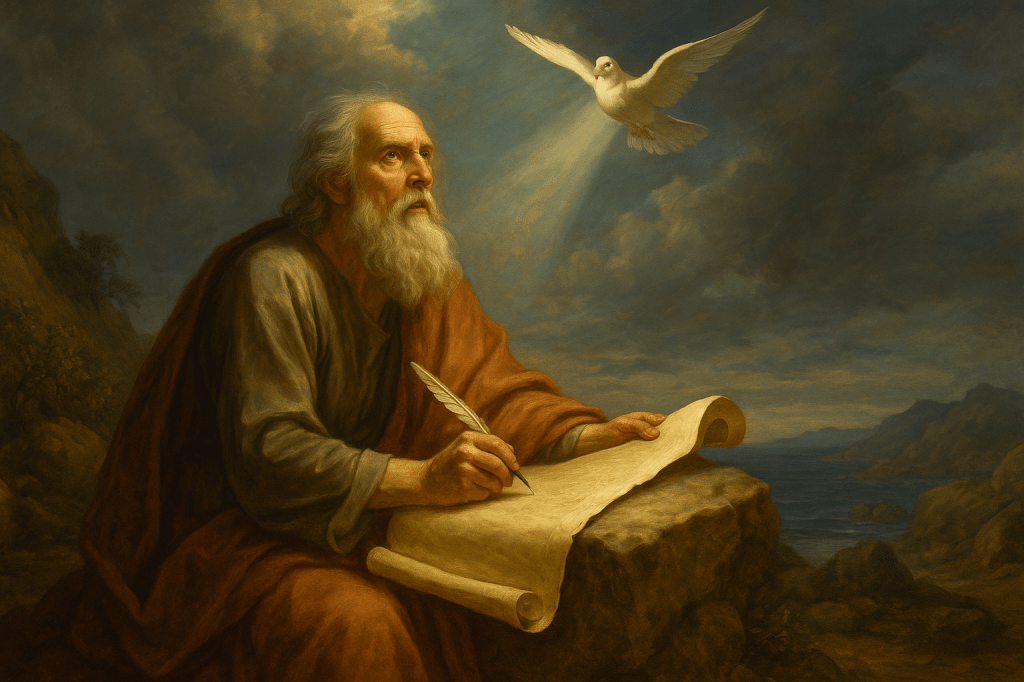
I. A Roundhouse Question and a Third Kind of Perichoresis
Over lunch with Pastor Dean we revisited our earlier conversation—“Perichoretic Salvation”—and the framework Gifford articulated: perichoresis (mutual indwelling) not only names (1) the inner-Trinitarian relation and (2) the Christological union, but also (3) a third relational pattern that extends into God’s saving economy through genuinely human participation. Dean paused and asked, “How might that third type affect our view of biblical inspiration?” The question hit me like a roundhouse kick from Chuck Norris—sudden, clarifying, impossible to ignore.
To see why it matters, recall the term at the center of the discussion. Perichoresis is the classical claim that the Father, Son, and Holy Spirit indwell one another without confusion or collapse of identity. In Christ, the divine and human natures likewise subsist without mixture or division. Gifford’s third type extends this logic into history: God truly acts as God and humans truly act as humans within one salvific reality; divine agency and human agency operate together without competition.
Here is the thesis of this essay: inspiration is either analogous to Gifford’s third type of perichoresis or a direct outworking of it. In other words, Scripture’s origin is best understood as communicative perichoresis—the Spirit’s indwelling guidance working through the authors’ real languages, genres, contexts, and intentions so that their words are, in truth, God’s communicative act. This reframes the usual debate (mechanical dictation vs. merely human literature). It elevates the doctrine of inspiration by locating it inside a relational ontology already at the heart of Christian theology: non-competitive concurrence of divine authorship and human authorship.
Pastor Dean’s question does not add a novelty; it uncovers a continuity. If Gifford’s third type already explains how God’s saving work enlists authentic human agency, then the inspiration of Scripture can be seen in the same key: God breathes without overriding; humans speak without usurping. The result is one text with two true agencies—fully human in form and history, fully divine in authority and intent. The sections that follow will trace this logic from the first two perichoretic relations (Trinitarian and Christological) to its communicative expression in Scripture, and then explore what this means for interpretation, ecclesial reception, and the shape of faithful inquiry.
II. The First Two Perichoretic Relationships
Before we can understand how inspiration might arise from Gifford’s third type of perichoresis, we must revisit the first two classical relationships: the Trinitarian and the Christological. These provide the grammar of divine and human cooperation, revealing that every act of God bears the imprint of relational life.
- Trinitarian Perichoresis — God’s Own Relational Being
The first form of perichoresis concerns the inner life of the Trinity. The term, drawn from peri (“around”) and chorein (“to make room” or “contain”), signifies mutual indwelling.
The Father is in the Son, the Son in the Father, and both in the Spirit (John 14:10–11; 17:21). Each Person is distinct yet fully participates in the life of the others; there is no isolation or rivalry within God. The Cappadocian Fathers used perichoresis to express that divine unity is relational, not solitary. God is not a monadic intellect but a communion of love whose being is fellowship.
This first type of perichoresis shows that divine action—creation, redemption, revelation—flows from God’s own relational nature. Whatever God does, He does as communion.
- Christological Perichoresis — The Union of God and Humanity in Christ
The second type occurs in the Incarnation. In Christ, divine and human natures coexist “without confusion, without change, without division, without separation” (Chalcedon). The eternal Word did not merely appear human but became truly human, entering history, language, and suffering.
In this hypostatic union, divine agency and human agency are concurrent. The Son acts as God and as man, each nature operating according to its mode, yet united in one person. Every act of Christ—His words, His obedience, His compassion—is simultaneously the act of the eternal Son and of the man Jesus.
This reveals that God’s relation to the world is not external control but internal participation. The Incarnation is the pattern of all divine-human cooperation: God working through humanity without coercing it, humanity expressing God without replacing Him.
- Gifford’s Third Type — Christ in Us and We in Christ
Here, Gifford extends the logic of perichoresis beyond ontology (who God is) and Christology (what God did) into soteriology and communion—what God continues to do in us.
This third type describes the relational union between Christ and the believer: Christ in us, and we in Christ (John 14:20; Colossians 1:27). It is the Spirit’s ongoing work by which the divine life indwells human persons, not symbolically but truly, forming the Church as Christ’s body.
In this relationship, divine and human actions again interpenetrate without confusion. God does not merely act upon us from without; He acts within us, and our faith, obedience, and proclamation become genuine expressions of His presence. We remain ourselves—thinking, choosing, creating—but those very actions become vehicles of divine grace.
When Pastor Dean and I revisited this idea over lunch, the realization struck us both with force: if Gifford’s third type of perichoresis explains how Christ lives and acts through His people, could it also explain how the Spirit spoke and still speaks through Scripture? The pattern is the same.
Just as the life of Christ continues in the believer through the Spirit’s indwelling, so the Word of God comes to us through inspired human authors whose own words carry the breath of God. Inspiration, then, is not an isolated miracle but an outworking of this third perichoretic relationship—the communicative dimension of the same divine-human cooperation that defines salvation itself.
Inspiration belongs to this relational continuum:
- The Trinitarian life shows how distinct persons act as one.
- The Christological union shows how divine and human natures cooperate.
- The Third type, Christ in us and we in Christ, shows how this cooperation extends into redeemed humanity.
And it is from within that third movement that the Spirit breathes Scripture into being—divine truth expressed through human language as part of God’s ongoing fellowship with His people.
The next section will explore this directly as Communicative Perichoresis, where the act of inspiration itself becomes an extension of the same divine-human participation that animates the Church and the believer’s life in Christ.
III. Communicative Perichoresis — The Inspiration of Scripture as Divine–Human Participation
When Gifford described his third type of perichoresis—Christ in us and we in Christ—he offered more than a description of mystical union. He outlined the relational structure of every genuine act of grace. The Spirit does not merely apply salvation to us externally; He indwells and animates us from within, transforming human words, choices, and affections into instruments of divine purpose. The question Pastor Dean asked over lunch—“How might that third type affect our view of biblical inspiration?”—was not a digression but a natural progression.
If Christ in us is the pattern of divine–human cooperation in life, then the Word of God through us must follow the same pattern in revelation. Inspiration is therefore not a separate mechanism but a communicative manifestation of the same perichoretic union that defines salvation.
- The Perichoretic Pattern of Revelation
In every sphere of divine activity, God’s relational mode remains consistent. He does not dominate or displace His creatures but works within and through them. Creation itself bears this imprint: God speaks, and the world comes to be—not by force, but by invitation into existence. Redemption follows the same pattern: the Son takes on human nature, uniting divine and human agency in one person.
Revelation, too, participates in this pattern. When prophets, psalmists, and apostles wrote, the Spirit did not suspend their individuality but inhabited it. Each writer’s culture, vocabulary, and temperament became the context through which divine meaning was communicated. The human word was not replaced by the divine; it was indwelt by it.
Thus, inspiration can be understood as a perichoretic event of communication—God’s Spirit operating within human consciousness so that the resulting text is simultaneously God’s Word and human word. The Spirit does not dictate; He participates. The author does not invent; he cooperates.
This reframes the tension that has long dominated the doctrine of inspiration—the question of whether Scripture is more divine or more human. The perichoretic model insists that such a question is misguided. The Bible is not partly divine and partly human, nor alternately one and then the other. It is wholly both, precisely because God’s mode of action allows for mutual indwelling rather than competition.
- The Incarnational Analogy
The Incarnation provides the nearest parallel. Just as in Christ the divine and human natures coexist without confusion or division, so in Scripture divine revelation and human authorship coexist in unity. The words of Moses or Paul or John are not overridden by divine control; they are embraced by divine purpose. Each retains full integrity, yet together they form a single communicative act of God.
To speak of Scripture as “God-breathed” (2 Timothy 3:16) is therefore to speak of an act of indwelling, not dictation. Breath animates without displacing; it fills the lungs but does not destroy them. In the same way, divine inspiration enlivens human speech so that its message bears the power and authority of God Himself.
The Incarnation and inspiration are not identical, but they are analogical—two expressions of the same divine condescension. In both, God does not merely reveal information; He unites Himself with creation to communicate His love and truth in a form we can receive.
- The Continuity Between Life in Christ and the Word of Christ
When believers are said to have “the mind of Christ” (1 Corinthians 2:16), it is not a poetic exaggeration but a theological reality. The same Spirit who inspired the authors of Scripture indwells the Church, forming a living continuity between revelation and response. The written Word and the indwelling Word belong to one divine economy.
In this way, inspiration is not a past event confined to the moment of writing but part of an ongoing relational process. The Spirit who once moved in the prophets now moves in readers, teachers, and hearers, not to add new revelation but to bring us into living contact with the same truth. Inspiration is the communicative dimension of the broader perichoretic relationship—an act of divine-human cooperation that bridges God’s eternal Word and humanity’s temporal language.
- A New Perspective on the Debate
Seeing inspiration through the lens of communicative perichoresis does more than reconcile opposing theories; it elevates the discussion itself.
- It preserves divine authorship without reducing Scripture to mechanical dictation.
- It honors human authorship without reducing the Bible to religious literature.
- And it situates revelation within the same relational framework that defines salvation itself.
In this model, inspiration is not simply how God produced a text—it is how God shared His life through words. The Scriptures are the communicative outworking of the same perichoretic union by which He shares His life with His people.
In the next section, we will consider how this cooperative authorship—this non-competitive sovereignty—shapes our understanding of divine truth, human language, and the authority of Scripture.
IV. Non-Competitive Sovereignty — How God and Humans Co-Author Scripture
If communicative perichoresis describes the divine–human relationship that produces Scripture, then its inner logic must be non-competitive. God’s sovereignty and human freedom do not stand on opposite sides of a scale; they interpenetrate. The Spirit’s presence in the act of inspiration does not erase the author’s intellect or individuality any more than the Incarnation erased Jesus’ humanity. Divine and human agency, far from competing, coexist in perfect concurrence.
- Two Kinds of Agency, One Act
Throughout salvation history, God’s mode of operation has always been cooperative rather than coercive. He calls Abraham, yet Abraham must answer. He gives the law through Moses, yet Moses writes and teaches it. He inspires the prophets, yet their words bear their temperament and their times. When Luke begins his Gospel by describing how he “investigated everything carefully” (Luke 1:3), he is not disclaiming inspiration but revealing its texture: careful human labor animated by divine purpose.
To say that “all Scripture is God-breathed” (2 Timothy 3:16) is to say that every word bears the Spirit’s animating breath, not that the writers became passive instruments. Breath fills the lungs; it does not replace them. In the same way, divine inspiration empowers human faculties rather than bypassing them. The writer’s grammar, imagery, and culture remain intact, yet the message accomplishes what God intends.
- Theological Grounding — A Consistent Mode of Divine Action
This concurrence of divine and human agency mirrors the larger pattern of God’s work in the world.
- In creation, God speaks, and the world participates in His command.
- In redemption, God acts in Christ, and human faith becomes the means of receiving that act.
- In revelation, God speaks through human authors whose language and lives are woven into His communicative act.
In each case, divine initiative does not suppress creaturely response; it evokes it. The Bible’s inspiration, therefore, is an extension of God’s consistent relational method: He works with what He has made, not against it.
B. B. Warfield called this “concurrence”—the divine and human operating simultaneously toward one effect. Gordon R. Lewis described it as dependence without autonomy: the writers’ individuality was real, yet their reliance on the Spirit was complete. And Kevin Vanhoozer reframed it through speech-act theory, arguing that God performs His communicative deed through the authors’ illocutions.
I am not sure any of these theologians would describe their view as a third kind of perichoresis, but what they articulate sounds remarkably analogous. Each describes divine and human agency not as competing causes but as mutually indwelling operations—precisely the pattern that Gifford’s third type reveals in the life of believers. Whether they name it or not, they gesture toward the same truth: divine sovereignty is not competitive; it is cooperative.
- Implications for Human Authorship and Freedom
Seeing inspiration as perichoretic concurrence restores dignity to the human side of Scripture. The biblical authors are not stenographers of heaven but genuine participants in revelation. Their experiences, emotions, and literary artistry are part of God’s self-disclosure. The Psalms teach us that lament can be inspired; Proverbs, that common wisdom can be holy; Paul’s letters, that theology can emerge through friendship and conflict.
This understanding also rescues human freedom from suspicion. Freedom is not the absence of divine influence but the arena in which divine purpose is most fully realized. The Spirit’s inspiration does not constrain creativity; it perfects it—aligning human expression with divine truth.
- Implications for Divine Truthfulness
If inspiration is perichoretic, then truthfulness is relational as well. The Scriptures are true not because they conform to modern notions of mechanical precision, but because they faithfully convey God’s will within the human situations they address. Their authority arises from divine intention perfectly realized through human means. What God wanted to say, He has said—fully, faithfully, and without distortion.
- The Larger Picture
Non-competitive sovereignty means that divine action need not exclude human participation. In the same way, the human voice of Scripture never diminishes its divine authority. Every psalm, proverb, and parable becomes a meeting place where heaven and earth speak together. The doctrine of inspiration, understood this way, is not a theory of control but a theology of communion: God’s Word takes shape within human words just as His life takes shape within human lives.
V. Unity and Diversity — The Canon as Perichoretic Communion
If communicative perichoresis describes how God and human authors cooperate in revelation, then the diversity of the biblical canon is not a problem to be solved but a design to be celebrated. The many voices of Scripture—poets, prophets, evangelists, and apostles—are the natural fruit of a non-competitive divine–human authorship.
- Diversity as Design
The canon’s variety of genres and perspectives does not undermine its unity; it expresses it. Law, lament, proverb, parable, gospel, and epistle each reveal a facet of divine truth refracted through human experience. These are not contradictions but harmonies—diverse instruments playing one divine theme.
Just as the Trinity is one in essence and three in person, the Scriptures manifest unity-in-plurality. The same Spirit who inspired each writer weaves their distinct voices into a coherent testimony to God’s redemptive purpose.
At this point, I cannot help but notice a deeper resonance. Jesus, the living Logos, is fully God and fully man; likewise, the written Word is authored fully by God and fully by man. The parallel is not incidental. The Incarnation and the inspiration of Scripture follow the same divine logic: God’s self-expression takes form through authentic humanity. The humanity of Christ and the humanity of the text are both sanctified vessels through which the divine speaks.
- Ecclesial Reception
If inspiration is a communicative act, then it necessarily involves both a sender and a recipient. The divine message is not complete until it is received. For this reason, canon formation was itself a perichoretic process—a cooperative act between the Spirit and the Church.
The same Spirit who “reminded [the disciples] of all that Jesus said” (John 14:26) also guided the early Church to recognize the texts that carried His voice. The Church did not bestow authority upon these writings; it discerned the authority already present in them. Inspiration, therefore, finds its completion in the Spirit’s ongoing work of reception: the Church hearing, remembering, and responding to the Word.
The Spirit continues this communicative work today, leading the people of God “into all truth” (John 16:13). The canon remains not a static archive but a living dialogue between God and His people—a communion across generations sustained by the same breath that first inspired the text.
- Theological Implications
The perichoretic nature of the canon invites humility and wonder. It teaches that diversity is not dilution but depth—that the many languages, cultures, and voices of Scripture reveal a single divine intention expressed through human plurality.
John Franke’s vision of contextual authority and Michael Bird’s emphasis on global infallibility fit naturally here. God’s relational Word speaks in many tongues and through many contexts, yet remains one truth. This is not relativism; it is universality through participation.
The Church, scattered across cultures yet bound by one Spirit, mirrors this same dynamic.
“Many parts, one body.” — 1 Corinthians 12:12
In the end, the canon is itself a perichoretic communion—diverse human testimonies interwoven by the Spirit into one divine Word. Its unity and variety are not accidents of history but reflections of the triune God whose life is communion and whose speech is love.
VI. Reading Perichoretically — Interpretation as Participation
The logic of communicative perichoresis does not end when the ink dries on the page. The same Spirit who inspired the writing of Scripture continues to work in its reading, hearing, and interpretation. The divine–human cooperation that produced the Word also animates the act of understanding it.
- The Same Spirit Who Inspired Still Indwells
This train seems to keep going. If the writing of Scripture was perichoretic, then so too is its interpretation. The New Testament authors themselves model this reality in the way they interpret the Old Testament—reading it not as a static text but as a living witness animated by the Spirit. When Peter explains Pentecost through Joel, or when Matthew sees Christ prefigured in Isaiah, they are not inventing meaning but discerning the fullness of God’s intention through Spirit-led insight.
Interpretation, then, is not merely an exercise in analysis; it is fellowship with the same Spirit who inspired the text. The Spirit illumines the mind, softens the heart, and enables the believer to discern divine truth through faithful study. Reading Scripture becomes a cooperative act—a shared work between God and reader. We do not stand over the text as detached examiners; we stand within it, participants in the same Spirit who first breathed its words.
“The Spirit searches all things, even the deep things of God.” — 1 Corinthians 2:10
- Comparative Frames
Christian tradition has recognized this cooperative dimension in different but complementary ways.
- Protestant tradition: The Spirit guides the believer directly through the text, illuminating its meaning to the individual conscience.
- Catholic and Orthodox traditions: The Spirit guides the Church corporately, ensuring that interpretation remains faithful to apostolic teaching and communal wisdom.
Both perspectives reflect the same perichoretic principle—truth discerned within communion, not isolation. The Spirit who indwells the individual also indwells the Church; the personal and communal aspects of understanding are never in competition but in cooperation.
- Hermeneutical Method
Because interpretation is both intellectual and spiritual, responsible exegesis requires two forms of faithfulness: sound study and humble dependence on the Spirit. Critical methods, linguistic tools, and historical awareness serve the goal of fidelity, not control. They help us attend more carefully to the human texture through which divine meaning shines.
When approached this way, Scripture does more than inform; it transforms.
“Do not be conformed to this world, but be transformed by the renewing of your mind.” — Romans 12:2
The Word reveals who we are before God and conforms us to Christ’s likeness:
“For the Word of God is living and active, sharper than any two-edged sword… discerning the thoughts and intentions of the heart.” — Hebrews 4:12
Perichoretic interpretation unites knowledge with transformation. The Spirit who once moved in prophets and apostles now moves in us, so that understanding becomes participation and reading becomes communion.
VII. Apologetic and Pastoral Implications
The perichoretic understanding of inspiration—divine and human agency in harmonious cooperation—does more than resolve theoretical debates. It reshapes how we engage the Bible in study, proclamation, and spiritual life.
- Apologetics
This model sustains intellectual honesty. It invites both faith and reason to the same table. Critical study and divine inspiration are not adversaries but allies; the God who inspired the Scriptures is not threatened by inquiry into them. Truth, being divine in origin, never fears examination.
Apparent contradictions or textual difficulties may arise, but they do not undermine the integrity of Scripture. Such issues often stem from differences between the original autographs and the translations or manuscript variants available today. Yet, as countless scholars have noted, no significant Christian doctrine rests on a disputed text. The central truths of the faith—God’s nature, the incarnation, the resurrection, salvation by grace—stand unshaken.
This understanding invites honest engagement rather than defensive retreat. It encourages the spirit of the Bereans, who “received the message with great eagerness and examined the Scriptures every day to see if what Paul said was true” (Acts 17:11). Their model shows that faith matures not through avoidance of questions but through testing all things by the Word of God.
- Pastoral and Missional Practice
In preaching and teaching, this perichoretic model reveals that the divine-human partnership continues. The Spirit who once inspired the biblical authors now works through the preacher’s words and the listener’s heart.
Paul reminds Timothy that “All Scripture is God-breathed and is useful for teaching, rebuking, correcting and training in righteousness” (2 Timothy 3:16). The Word’s usefulness is not static; it unfolds in the dynamic space where Spirit and human cooperation meet—where the message is proclaimed and received.
Scripture’s humanity allows empathy; its divinity gives authority. It speaks in our language and yet transcends it, addressing both intellect and conscience. The preacher becomes an instrument of the same Spirit who gave the text, echoing Isaiah’s declaration:
“So shall my word be that goes out from my mouth; it shall not return to me empty, but it shall accomplish that which I purpose.” — Isaiah 55:11
The Spirit works through the Word, not apart from it—convicting, healing, and giving life wherever it is faithfully proclaimed.
- Spiritual Formation
Finally, reading Scripture becomes a transformative act because it is participatory. The same Spirit who breathed life into the text breathes life into the reader. To engage Scripture faithfully is to participate in God’s ongoing work of sanctification.
As we hear and obey the Word, we are drawn into the very life of God. This is not absorption but transformation—what the Eastern Fathers called theosis: becoming partakers of the divine nature (2 Peter 1:4). Through the cooperative work of reading, understanding, and obeying, the Spirit conforms us to the image of Christ.
In this way, the perichoretic model of inspiration extends beyond the writing of Scripture and even beyond its interpretation—it embraces the entire life of faith. God continues to speak, teach, and transform through His Word, uniting divine truth and human response in the ongoing dance of grace and participation.
VIII. Integrative Synthesis — Who Fits This Model
For readers who wish to dig deeper, this section sketches how several contemporary theologians engage the doctrine of inspiration. These are not exhaustive summaries but touchpoints—voices that, in one way or another, resonate with or challenge the perichoretic model developed here. I have focused on those I have read most recently, aware that others might align, diverge, or refine these ideas in important ways. The point is not to claim originality but to locate this view within the wider theological conversation.
Most Aligned
B. B. Warfield — Concurrent Divine/Human Authorship, Incarnational Logic
Warfield’s concept of concurrence remains one of the most precise articulations of divine–human cooperation in inspiration. He insists that Scripture is fully divine and fully human—its words genuinely human expressions that are simultaneously God’s words. Though he does not use the language of perichoresis, his model mirrors its structure: divine and human agencies operating together toward one unified act. Warfield’s incarnational logic, seeing inspiration as analogous to the union of divine and human natures in Christ, provides a strong precedent for what I have described as communicative perichoresis.
Kevin Vanhoozer — Speech-Act and Theodramatic Communication
Vanhoozer’s theological linguistics adds depth to this vision. Through speech-act theory, he argues that God performs communicative acts—promising, commanding, revealing—through the human discourse of Scripture. Meaning arises not only from what the text says (locution) but from what God does in saying it (illocution). His “theodramatic” model portrays Scripture as the script through which God continues to communicate and invite participation in His redemptive drama. This aligns closely with the perichoretic idea of divine and human agents cooperating in one communicative act.
Complementary Voices
John Franke — Plurality Within Theological Coherence
Franke’s work on canonical diversity views the multiplicity of Scripture’s voices as a theological strength, not a liability. He emphasizes the Spirit’s guidance in preserving unity across contextual and cultural differences. His focus on the Church’s interpretive participation parallels the perichoretic idea that revelation is relational and communal. Franke’s emphasis on plurality adds nuance to the claim that the canon itself is a kind of perichoretic communion.
Michael Bird — Infallibility Serving the Church’s Faith and Mission
Bird critiques overly defensive models of inerrancy while affirming Scripture’s infallibility—its reliability for faith and practice. He reminds global Christianity that the authority of Scripture is not an end in itself but a servant of the Church’s witness to Christ. His concern for missional application complements this essay’s focus on cooperation and transformation: the same Spirit who inspired the text also empowers the Church to live it out.
Partially Aligned
Peter Enns — Incarnational Analogy Without Superintendence
Enns rightly recognizes that Scripture’s humanity is essential, not accidental, to its authority. His incarnational analogy parallels the perichoretic claim that divine revelation works through human culture and limitation. Yet, Enns tends to decouple that humanity from the Spirit’s sustaining oversight, sometimes leaving divine intentionality under-defined. His insight about diversity is valuable, but the perichoretic model insists that divine agency remains fully active within human process, not simply behind or after it.
R. Albert Mohler — Authority Guarded, Relationship Reduced
Mohler defends verbal-plenary inspiration and the full truthfulness of Scripture, a stance that rightly safeguards divine authority. However, his formulation sometimes risks portraying inspiration as a one-way transmission of propositions rather than a relational cooperation. The perichoretic model agrees with his concern for the Bible’s authority but seeks to preserve the personal, communicative dimension of revelation—the dynamic of mutual participation rather than mere assertion.
Taken together, these thinkers illustrate the range of possibilities in contemporary theology of Scripture. Warfield and Vanhoozer come closest to describing what Gifford’s third perichoresis names explicitly: divine and human agents acting concurrently without competition. Franke and Bird offer important contextual and ecclesial correctives. Enns and Mohler, though differing sharply from each other, each capture one half of the truth—the full humanity or the full divinity of Scripture—while the perichoretic model holds both together in relational harmony.
IX. Conclusion — The Word That Dwells
All of this began with an off-the-cuff question over tacos. Pastor Dean’s casual remark—“How might this affect our view of the inspiration of Scripture?”—carried keen insight. The realization hit immediately, and I found myself later that night pulling out my old seminary notes, tracing the idea back through Gifford’s writing and through Scripture itself. What began as conversation turned into revelation.
It has been a ride. Yet more than that, it has felt participatory—one of those divine appointments I have experienced throughout my life. Perhaps such moments are more than coincidences; they are perichoretic alignments, when the Spirit draws human thoughts and circumstances into harmony with divine purpose. Jesus promised that the Spirit would “guide you into all truth” (John 16:13), and I have come to see that guidance as an ongoing preparation—God readying us for what comes next.
Summary
- The inspiration of Scripture is a perichoretic act—divine and human joined in living cooperation.
- The canon’s diversity and unity mirror the relational nature of God Himself.
- Revelation, like salvation, is relational: truth incarnated, not merely dictated.
- The same Spirit who inspired the Word now illumines its readers, drawing us into faithful understanding.
The Berean Model of Discernment
The Bereans were commended because they “received the message with great eagerness and examined the Scriptures every day to see if what Paul said was true” (Acts 17:11). They model what mature faith looks like—open to truth yet anchored in revelation, testing all things by the Word of God.
This is the proper fruit of perichoretic inspiration: divine truth inviting human reason, reflection, and response in harmony with the Spirit. Faith and intellect are not adversaries but partners in the same cooperative life. To read and test Scripture faithfully is to share in the same relational dynamic by which it was first given.
Closing Reflection
When Pastor Dean asked that question, I realized that the same God who breathes life into us also breathes truth through us. Scripture is not mere information; it is communion—God’s Spirit drawing us into the story He authored.
Like the Bereans, we are called to examine, to listen, and to live in that divine rhythm where Word and Spirit meet. It is all relational and participatory—the writing of Scripture, the reading of it, and the living of it.
If the Church could recover this vision—seeing revelation and interpretation as cooperative acts rather than competitive claims—we would find fewer divisions and deeper unity. The Spirit is still inviting us into that shared life of understanding.
Come, Spirit, and guide us.
Comment
A comment from Pastor Dean concerning an email draft of this post:
I found this email to be exceptionally good – even great! It explained how inspiration, interpretation, and illumination of the Scripture all work as one between the author/believer and the Holy Spirit. I don’t know how you think thru all this and write it down so succinctly. You truly have a gift I don’t have, and I admire you for it. God has gifted and blessed you in some amazing ways. If I was grading this paper, I’d give it an A+.
Dean
References
- Catholic Answers. (n.d.). Inspiration of the Bible. Catholic Answers Encyclopedia. https://www.catholic.com/encyclopedia/inspiration-of-the-bible
- Flanagan, P., & Schihl, R. (1997, January 3). Inspiration of the Bible. Catholic Biblical Apologetics. https://www.catholicapologetics.org/ap030900.htm
- Geisler, N. L. (Ed.). (1979). Inerrancy. Zondervan Pub. House.
- Gifford, J. D., Jr. (2011). Perichoretic salvation: The believer’s union with Christ as a third type of perichoresis. Wipf & Stock.
- Lane, N. S. (n.d.). B. B. Warfield on the humanity of scripture. Retrieved from https://drmsh.com/TheNakedBible/warfieldlane.pdf
- Licona, M. R. (2014, June 2). On Chicago’s muddy waters. Risen Jesus. https://www.risenjesus.com/on-chicagos-muddy-waters
- Merrick, J. R. A., & Garrett, S. M. (Eds.). (2013). Five views on biblical inerrancy (Counterpoints: Bible and Theology). Zondervan Academic.
- Stahle, R. S. (1996). Scriptural authority in the theology of B. B. Warfield. Modern Reformation. https://www.modernreformation.org/resources/articles/scriptural-authority-in-the-theology-of-b-b-warfield
- St. Paul Center for Biblical Theology. (n.d.). Inspiration of Scripture in the Catholic tradition. St. Paul Center. https://stpaulcenter.com/posts/inspiration-of-scripture-in-the-catholic-tradition
- Warfield, B. B. (1894). The divine and human in the Bible. BiblePortal. https://www.bibleportal.com/sermon/Benjamin-B-Warfield/the-divine-and-human-in-the-bible
- Warfield, B. B. (1927). Revelation and inspiration. The Presbyterian and Reformed Publishing Company. https://archive.org
- Warfield, B. B. (1959). The inspiration and authority of the Bible. Presbyterian and Reformed Publishing Company. https://orcuttchristian.org/Benjamin%20B.%20Warfield_%20Inspiration%20and%20Authority%20of%20the%20Bible.pdf
- Wright, N. T. (2013). Scripture and the authority of God: How to read the Bible today (rev. ed.). HarperOne.
Excerpt
A lunchtime question sparks a revelation: what if biblical inspiration reflects Gifford’s third kind of perichoresis—God and humanity cooperating in revelation as in salvation? This essay explores inspiration as divine–human participation, a living communion where Word and Spirit meet.

 Treasures of the Elysian Fields
Leave a comment