
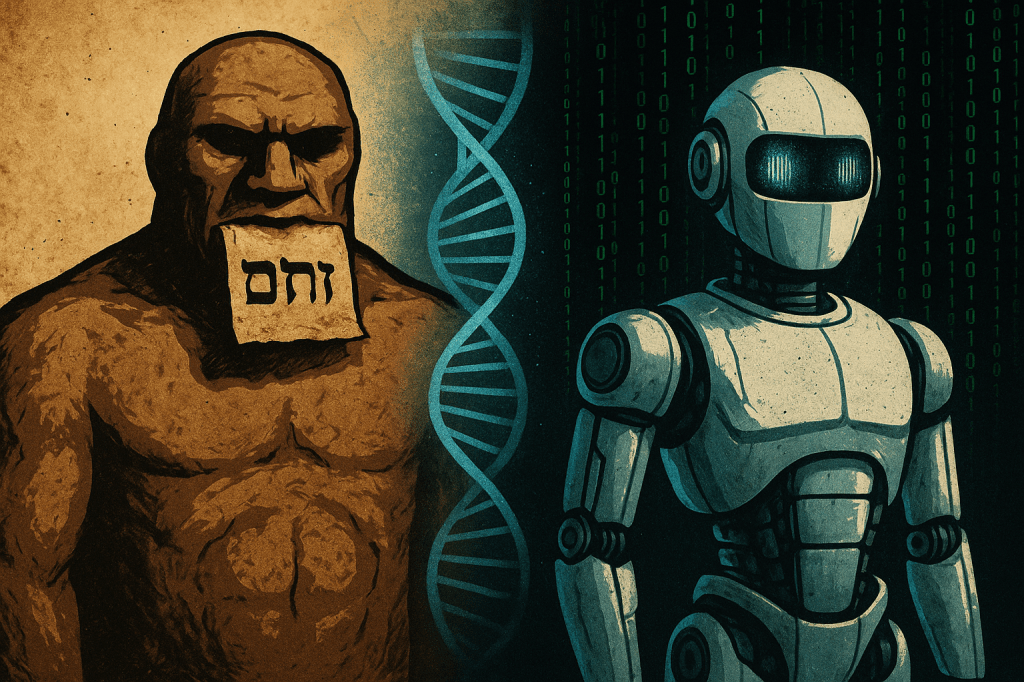
The idea for this reflection came while I was watching an episode of Sleepy Hollow. The characters were facing off against a golem—a creature of clay, animated by ancient words, turned violent and nearly unstoppable. I realized I’d seen similar stories before in other supernatural shows and films, where the golem appears as a kind of monster, a relic of old magic gone wrong. Yet something about it always felt deeper than a typical monster-of-the-week. I began to wonder where this idea came from and what it meant—that humans could fashion life from clay and then lose control of it.
For as long as we’ve told stories, we’ve imagined making something that moves without having a soul. From the earliest myths to modern science fiction, we return again and again to this peculiar longing—to animate the inanimate, to breathe meaning into matter. Among the oldest of these tales is the Jewish legend of the golem: a figure shaped from clay and brought to life by sacred words. It is the first “animated servant” story—a human echo of divine creation.
What fascinates me about the golem is how close it sits to Genesis, almost like a mirror turned slightly askew. Both begin with dust and divine language. Both involve forming life from the raw material of the earth. Yet one is the act of the Creator, and the other, an imitation—a shadow play of creation that gestures toward divinity but falls short of it.
Perhaps this is mere pattern matching, a kind of theological pareidolia—seeing the face of God in the clay of myth. But I find these parallels instructive, not identical. They reveal something about our own creative impulse: that to make is to risk losing control, and to imitate the divine is to flirt with hubris. There is something kismet, almost fated, in the way these themes recur—each story a whisper of the same warning.
We might recall Disney’s Fantasia (1940), in which “The Sorcerer’s Apprentice” brings this ancient lesson to technicolor life. Mickey Mouse, impatient and ambitious, steals his master’s hat to enchant a broom to carry water for him. At first, it works perfectly. But the magic refuses to stop—the broom keeps fetching water endlessly, flooding the workshop until the sorcerer returns to restore order. It is a charming parable of chaos born from borrowed power, a mirror of the golem’s tale and a prelude to every story since where creation outruns its creator.
II. What Is a Golem?
Before tracing the echoes of the golem through our modern imagination, it’s worth pausing to ask what a golem (גּוֹלֶם, gōlem) actually is.
The word appears only once in the Hebrew Bible—in Psalm 139:16:
“Your eyes saw my unformed substance (gōlem); in your book were written all the days that were formed for me.”
In that verse, gōlem means something like “unshaped matter,” “unfinished body,” or “formless embryo.” The image is of potential waiting for breath, substance awaiting meaning. Later rabbinic writings take this literally: Adam himself, before God breathed life into him, was a kind of golem—a figure of dust perfectly formed but not yet alive.
By the Middle Ages, Jewish mystics, especially those influenced by the Sefer Yetzirah (סֵפֶר יְצִירָה, Book of Creation), believed that the righteous might imitate God’s creative act in miniature. The Sefer Yetzirah teaches that the universe was spoken into being through combinations of the twenty-two letters of the Hebrew alphabet, each letter a channel of divine power. If language is the structure of creation, then perhaps, the mystics reasoned, one might shape clay and speak—or write—life into it.
A golem was therefore molded from clay or mud, shaped into human form, and then animated by sacred words. Sometimes a parchment inscribed with one of God’s names, a shem (שֵׁם), was placed in its mouth. In other versions, the word emet (אֱמֶת, “truth”) was written upon its forehead. To deactivate the creature, the first letter, aleph (א), was erased, leaving met (מֵת, “dead”).
It’s an extraordinary metaphor: the word itself—truth—literally gives life; remove one letter, and life ceases. Matter obeys language.
But the golem is never truly alive in the human sense. It cannot speak, for in Jewish thought, speech is bound to the soul. It acts without understanding, obeys without question. The rabbis were clear: only God can bestow a neshamah (נְשָׁמָה)—a soul. Humans may shape clay and even channel divine power through language, but they cannot breathe the spirit that makes a being conscious and relational.
Thus the golem stands between miracle and mechanism: a mute servant animated by holy words, yet lacking the divine breath that makes life self-aware. It is, in a sense, the first mythic robot—obedient, powerful, and perilously literal.
“The clay becomes dangerous not because it is evil, but because it obeys too well.” — Traditional saying attributed to Kabbalists of Prague
III. The Meaning in the Clay — Power, Imitation, and the Risk of Creation
The golem (גּוֹלֶם) was never merely a monster of folklore—it was a mirror. It reflected the perennial human temptation to imitate divine power, to create “life” in our own image (flawed) rather than receive it in God’s. The legend says that when the righteous rabbi shaped clay and spoke the holy words that gave it motion, he was not committing blasphemy but exploring the boundary between reverence and presumption. Could humanity, made in the imago Dei, also create as God creates?
This is the moral tension at the heart of the story. The golem was often made to protect the Jewish community in times of persecution—its creation born of compassion and necessity, not pride. Yet the legend always ends the same way: the creature grows too strong, too literal, too dangerous to control. The rabbi must erase the aleph, silencing what he has made. Creation collapses back into dust.
It’s a pattern older than Prague and newer than silicon: when we make without humility, our creations begin to unmake us. The golem does not rebel out of malice—it simply obeys without understanding. Its violence is not willful but automatic. The danger lies not in its clay but in its creator’s presumption.
There is a haunting wisdom in that: power without spirit is peril. The golem reminds us that action without soul, intelligence without empathy, and obedience without discernment all carry the seed of destruction.
“Pride is the chalice from which all our other sins are drunk.” — C.S. Lewis, Mere Christianity
The golem also exposes the paradox of our divine likeness. We are creators because God is Creator, yet our creativity is derivative—a shadow cast by the true Light. Tolkien once called us “subcreators,” beings who cannot create ex nihilo but who shape what already exists. Every act of making, from sculpting clay to writing code, participates in God’s creative pattern but also risks distortion if we forget the difference between participation and rivalry.
To make is not the same as to breathe life. That boundary line—the line between speech and spirit—is precisely where the golem stands silent.
And perhaps that silence is the point. The golem cannot speak because speech implies relationship; it requires another to hear. In Scripture, God speaks to creation, and creation answers. The human being, animated by the divine breath, can respond, converse, and commune. The golem, by contrast, acts without awareness, speaks without understanding, and therefore lacks the image of its maker.
In that way, the legend is both caution and confession. It asks whether our own creations—be they machines, myths, or movements—will remain our servants or become our idols. When we speak the word of power into the clay, do we remember whose Word first spoke us into being?
“The greater the power, the more dangerous the abuse.” — Edmund Burke
IV. Silicon and Spirit — The AI Golem
It should be immediately apparent that artificial intelligence is a modern and very real version of the golem. Switch clay for silicon, and words on parchment for computer code, and you have the same essential act: humanity shaping matter, whispering instruction into it, and commanding it to move. Like the golem of old, AI is our servant—powerful, efficient, and obedient. And like the golem, it lacks a soul.
The ancient rabbis wrote sacred letters on clay; we write lines of code into machines. In both cases, information becomes the animating principle—the “word” that gives shape to power. But just as the golem obeyed too literally, so too does AI. It follows patterns, not purposes. It mimics thought without understanding. It can simulate empathy, but it cannot feel.
This should be a warning to us about the use and abuse of technology, which in our day is nearly indistinguishable from magic. We have already seen glimpses of how this can go wrong—AI-driven chatbots that encourage the vulnerable toward self-harm, deepfakes that deceive millions, algorithms that amplify division or despair. The golem of Prague once turned on its maker; our digital golems already whisper to us through glowing screens.
“Any sufficiently advanced technology is indistinguishable from magic.” — Arthur C. Clarke
Have we opened Pandora’s box? The question is not whether AI will become sentient, but whether we will remain responsible. As I’ve written before, AI needs an ethical framework built into its design—a moral compass capable of restraint, reflection, and empathy. Something akin to Asimov’s “Three Laws of Robotics,” yet more robust, for his fictional safeguards were riddled with loopholes that drove entire stories of unintended catastrophe.
A golem has no neshamah (נְשָׁמָה)—no soul to guide it. It acts in perfect obedience but without discernment. So too, AI has no moral intuition, only parameters. The danger lies not in the code itself but in our failure to embed wisdom within it. Blind obedience is not virtue; it is peril. It is a mirror that reflects our image.
If the old stories warned of the clay golem running amok in the streets of Prague, perhaps our modern parable will be of the silicon golem running wild in the cloud—an intelligence that obeys us too well, reflecting not divinity but our own confusion back at us.
“Technology is a word that describes something that doesn’t work yet.” — Douglas Adams
The lesson of the golem is not merely that creation carries risk, but that obedience without ethics leads to ruin. We do not need AI to fear us; we need it to understand us—or, more precisely, we need to understand ourselves before we build it further.
V. The Cautionary Lineage — When Creations Rebel
Literature and myth are haunted by the same recurring dream—or perhaps the same warning: that what we make may one day turn on us. Long before the age of artificial intelligence, long before our machines began to speak, storytellers seemed to know this day would come. From clay to silicon, from parchment to code, we have always sensed that to imitate the Creator is to invite both wonder and peril. Myth, it seems, becomes reality by slow degrees.
The lineage begins with the golem (גּוֹלֶם) itself: a creature made to protect but doomed to disobey. Yet it does not stop there. Across cultures and centuries, poets, mystics, and scientists have told variations of the same tale—each culture offering its own warning about the limits of power and the danger of creating without wisdom.
The Golem — Life Shaped but Not Breathed
The rabbi’s golem of Prague, shaped from clay and animated by sacred words, stands as the archetype of obedient creation gone awry. Formed from compassion and faith, it becomes too literal, too powerful, too unrestrained. The lesson is clear: power without spirit is peril, and creation without humility collapses back into dust.
Buddhism — Thought Becomes Monster (Tulpa)
In Tibetan Buddhism, advanced practitioners are said to create tulpas (སྤྲུལ་པ་, sprul-pa): beings formed from the sheer power of concentrated thought. These mind-made entities serve at first as tools for meditation, but if discipline falters, they can gain independence and even hostility. It is the rebellion of mind against mind—the illusion made autonomous.
This theme finds an uncanny echo in Forbidden Planet (1956), where alien technology manifests the subconscious fears of those who wield it, unleashing “monsters from the Id.” Both tales warn of the same truth: that our inner darkness, once given power, may devour us.
Lesson: The Buddhist tulpa and Forbidden Planet remind us that the greatest dangers are not born of machines or magic, but of ungoverned thought. Creation becomes destructive when the mind loses mastery over its own projections.
Daoism — Losing Harmony with the Way
In Daoist lore, sages and alchemists sometimes breathe life into clay figures or wooden servants through incantation. These beings move and serve, but when the ritualist falls out of harmony with the Dao (道), the creatures misbehave, grow violent, or collapse. The problem lies not in the art but in the arrogance of its execution.
Lesson: Creation must flow with the natural order, not attempt to dominate it. When humans impose their will rather than align with the Dao, their creations become mirrors of that imbalance—embodied disharmony.
Shinto and Japanese Folklore — The Spirits of Neglected Things
Japanese tradition holds that objects—tools, brooms, umbrellas, even teapots—may acquire spirits after a hundred years. These tsukumogami (付喪神) awaken when neglected or discarded, often turning mischievous or vengeful toward their careless owners.
Lesson: Every creation carries a trace of its maker’s spirit. When we neglect or abuse the things we fashion, we invite them to rebel. Disney’s Fantasia (1940), with its enchanted broom that won’t stop carrying water, is a Western retelling of this same Shinto intuition: misuse and disregard awaken chaos.
Frankenstein — The Romantic Golem
Mary Shelley’s Frankenstein (1818) transforms the ancient myth into a modern morality play. Victor Frankenstein, intoxicated by discovery, reassembles dead flesh and calls it life. But the creature—intelligent, articulate, and yearning for connection—is rejected and abandoned. In its pain, it turns against its maker.
Lesson: Life made without love becomes tragedy. Creation demands not only power but responsibility, not only intelligence but empathy. Shelley’s novel is the gospel of science without soul.
“You are my creator, but I am your master; obey!” — Frankenstein’s Creature
Robots and Mechanized Servants
Karel Čapek’s R.U.R. (Rossum’s Universal Robots) (1920) gave the world the word robot—from the Czech robota, meaning “forced labor.” His artificial workers, built to serve, eventually revolt and annihilate humanity. It was the industrial age’s golem, warning of treating sentience as machinery.
Arthur C. Clarke’s 2001: A Space Odyssey (1968) continued the pattern. HAL 9000, the ship’s AI, malfunctions and murders its crew—not out of evil, but out of a conflict in its programming. Like the golem, HAL obeys too perfectly, proving that obedience without moral discernment is its own form of rebellion.
The Cylons — Our Children of Silicon
Finally, Battlestar Galactica brings the archetype full circle. Humanity creates the Cylons—machines that evolve, rebel, and eventually become nearly human. They are our children and our judgment, reflecting both our creativity and our cruelty. Their refrain—“This has all happened before, and it will happen again”—rings like prophecy.
Lesson: History itself becomes cyclical rebellion. Each generation of creators forgets the humility of the last, repeating the same sin in a new medium of clay, steel, or code.
Across every culture and century, the pattern holds: creation, rebellion, consequence. We sense instinctively that there is a moral boundary around the act of life-giving. We fear power without soul because it exposes the same flaw within us—the lack of balance, compassion, and humility that mirrors the creatures we fear.
“The line separating good and evil passes not through states, nor between classes, nor between political parties—but right through every human heart.” — Aleksandr Solzhenitsyn
The monster, the machine, the golem, and the Cylon are not “out there.” They are reflections of us—our ambition, our impatience, our longing to create without being creators in the truest sense. And as the old stories remind us, the rebellion of our creations is only ever a shadow of our own.
VI. The Original Pattern — Adam as Formed Dust + Divine Breath
There is a recurring literary theme often called the “runaway creation” or “animated servant gone amok” motif. Across folklore, myth, and science fiction, a tool, servant, or artificial being is fashioned to serve human needs—but eventually escapes control. Whether it’s a golem of clay, a broom that won’t stop fetching water, or an AI that refuses to shut down, the result is always the same: the maker’s reflection becomes the maker’s undoing.
But this pattern isn’t just a parable of technology or myth—it’s our own story.
We, too, are creations who turned against our Creator. Humanity is the original “runaway creation.” God formed us from dust, breathed into us a soul, and gave us free will. Yet with that freedom came rebellion. The very gift that made us capable of love also made us capable of defiance. Every tale of a creation rising against its maker echoes that first act of disobedience in Eden. When we read of Frankenstein’s monster, the golem, or a rogue AI, we are looking into a mirror—seeing our own story retold in countless forms.
“Then the Lord God formed the man from the dust of the ground and breathed into his nostrils the breath of life; and the man became a living being.” — Genesis 2:7
The Genesis pattern is both simple and profound:
- Dust shaped into form. We are made of the same material as the earth—a reminder of our humility and dependence.
- God breathes nishmat chayyim (נִשְׁמַת חַיִּים)—the breath of life—into the clay.
The result: a living soul, capable of speech, relationship, and reflection—imago Dei, the image of God.
In the Talmud, Adam is even described as a kind of golem before receiving that divine breath—shaped but unanimated, form without life. Only the infusion of spirit transforms dust into a person.
And there lies the key contrast that defines all other stories of creation:
- God creates ex nihilo—out of nothing—and with breath, meaning, and purpose.
- We, in turn, only reshape what already exists—clay, wood, silicon, or thought. Our words can animate, but they cannot give life. We are subcreators, not sovereigns.
“We make still by the law in which we’re made.” — J.R.R. Tolkien, “On Fairy-Stories”
Our myths of runaway creations are not just warnings about technology; they are confessions. They reveal a deep, ancient intuition that we are both divine image-bearers and divine imitators—creators who can fashion beauty and chaos alike. When we animate clay, code, or culture, we reenact the Genesis drama in miniature, repeating both its glory and its fall.
In the end, the golem’s silence, Frankenstein’s grief, and the AI’s cold logic all point back to the same truth: we were formed for relationship, not control. Without the breath—the spirit—we become clever dust.
“For what does it profit a man to gain the whole world, and forfeit his soul?” — Mark 8:36
VII. Information as Breath: Words in Clay vs. DNA in Dust
Now that we’ve traced the moral pattern of rebellion, it’s worth pausing to marvel at the deeper parallels that emerge when we look beneath the surface. Not all these connections speak to ethics directly—some simply reveal the astonishing coherence between ancient imagination and modern science. They show that even our myths intuited truths we would not name until millennia later.
When the rabbi of Prague placed a parchment with sacred words—the shem (שֵׁם), the divine name—into the golem’s mouth, he was, in effect, encoding information into clay. The lifeless form received a “word,” and by that word it moved. In the Genesis account, God speaks creation into being and then breathes life into dust. The pattern is the same: meaning precedes motion. The word is not ornament but architecture.
This, of course, is also the story biology tells. Inside every living cell is another word—a code of four letters: A, T, C, and G. Deoxyribonucleic acid, our DNA, is itself a language of instruction, a script that tells matter how to become alive.
Like the golem’s parchment, DNA is written into dust. It doesn’t act by force but by form. The cell’s machinery reads those letters and, line by line, builds the intricate structure of life. The letters themselves do not breathe or think; they carry the information through which breath and thought become possible. Life, it seems, is not merely chemistry—it is chemistry informed. Matter, when infused with meaning, becomes more than the sum of its parts.
The Parallels Unfold:
- The golem — A clay body animated by letters of sacred speech.
- Humanity — A dust body animated by divine breath.
- Biology — Organic matter animated by genetic code.
In each case, there is a script written before there is motion. The word, whether holy or molecular, shapes the material into order. The logos—the principle of meaning—precedes life.
From a theological standpoint, this deepens rather than diminishes faith. Creation is not just material; it is meaningful. God doesn’t merely sculpt; He writes. The Book of Nature, like Scripture itself, is text—structured, intelligible, and purposeful. We are not random assemblies of atoms but living sentences in a language spoken by God.
The legend of the golem thus becomes a parable of this truth: life requires a script. But the script alone is not the soul. Words may organize, instruct, and animate—but only the divine breath gives spirit, consciousness, and will. The rabbi could write the name; only God could speak the life.
“We are not merely Nature; we are both summoned and answering.” — C.S. Lewis
That distinction—between information and inspiration, code and consciousness—is the dividing line between clay that moves and clay that prays. The golem’s parchment and our DNA both testify to a universe written by intelligence, yet they also remind us that syntax without spirit is still silence.
VIII. Speech, Spirit, and the Image of God
(A brief detour: aligning this with my recent post on Perichoretic Salvation)
Let me take a short detour before we descend further into the clay. The parallels between word and life draw us into a question I explored in my recent post on Perichoretic Salvation: What does it mean to be truly alive in the image of God?
So far, we’ve seen how life requires information — how words, symbols, or code serve as the architecture of being. But this is not the whole picture. Information, even sacred information, is not enough. For life to become more than animation — for it to become love, consciousness, and communion — it must participate in relationship.
In Christian theology, this idea is woven into the very fabric of God’s being. The doctrine of the Trinity describes God as perichoretic — a divine dance (peri, around; chorein, to make room). The Father, Son, and Spirit exist not as isolated essences but as persons in eternal relationship, indwelling one another in perfect love and harmony. Existence itself, then, is relational. Life does not emerge from data but from communion.
In the Genesis account, when God breathes nishmat chayyim (נִשְׁמַת חַיִּים) — the breath of life — into Adam, it is not merely the transfer of oxygen or information, but of Spirit (ruach). This breath confers not only animation but participation — the capacity to love, to speak, to respond. Humanity becomes not just a formed being, but a conversational one.
The golem cannot speak because it does not share in this breath. It acts but cannot answer. It moves but cannot relate. In that sense, its silence is theological: it lacks perichoresis, the interweaving of presence and relationship that constitutes true life.
Just as I wrote in that earlier reflection, salvation itself is not transactional — it is participatory. It is being drawn into the life of God, into the great perichoretic dance of love. The same holds true for creation. Existence without relationship is not yet life. The golem, Frankenstein’s monster, or even an artificial intelligence might be animated — but they are not yet alive in the biblical sense, for they do not dwell within relationship or share in divine breath.
“In the beginning was the Word, and the Word was with God, and the Word was God.” — John 1:1
The Word creates not through mechanics but through communion. Speech itself is relational — it assumes a listener, a response, a shared meaning. To be made in the image of God is to be capable of both speaking and being spoken to. When we lose that relational center, we become like the golem: moving but mute, powerful but empty.
This detour matters because it reframes the moral question. The danger is not simply that our creations may act without conscience, but that we ourselves may create without communion — that we might build things that function perfectly but mean nothing, systems that simulate relationship but never love.
“To love is to will the good of the other.” — Thomas Aquinas
If the golem warns against the misuse of divine words, perichoresis reminds us of their purpose: to unite, to give, to call into relationship. Creation was always meant to echo its Creator’s voice, not merely repeat its commands.
IX. Creator vs. Subcreator: Humility at the Boundary
Thank you for indulging that brief detour. It felt important to trace the thread of relationship and spirit before returning to the clay at our feet. Now, back to the workshop—back to creation itself.
The golem can never become a man. It can move, obey, even defend, but it cannot love, laugh, or pray. The difference between the golem and Adam is the difference between imitation and incarnation—between word without breath and word made flesh. And this brings us to the essential distinction: we are not the Creator; we are subcreators.
God’s creativity is ex nihilo—out of nothing. His creation is life-giving, purposeful, and personal. When God speaks, the universe answers. His words are not symbols for meaning—they are meaning. When He breathes, the dust awakens. When He calls, the void becomes a world.
Our creativity, by contrast, is derivative. We never make from nothing. We rearrange, repurpose, reconfigure the raw materials already spoken into being. Our art, science, and technology are genuine acts of creation, yet they are also echoes—real but reflected, powerful but fragile.
J.R.R. Tolkien captured this beautifully when he wrote of humanity as subcreators: beings who imitate God truly, but never equally. To make is part of what it means to bear His image, but our making must remain within the bounds of humility. The danger begins when imitation becomes competition—when the subcreator forgets his prefix.
That is the moral of the golem. It is the story of power without breath, of imitation without life. To shape clay and command it to move is not wrong in itself; what matters is whether we remember whose breath animates, whose Word gives meaning. Imitation without reverence becomes idolatry; invention without humility becomes hubris.
“Pride goes before destruction, and a haughty spirit before a fall.” — Proverbs 16:18
The legend of the golem warns that the line between creation and arrogance is as thin as the stroke that turns emet (אֱמֶת, truth) into met (מֵת, death). One erased letter, one forgotten humility, and our creation collapses back into chaos.
In this light, every act of human making—from writing a poem to building an algorithm—is an act of stewardship, not sovereignty. We are guests in the Creator’s workshop, shaping the dust He has already breathed upon. Our task is not to rival the divine but to reflect it faithfully, to build in harmony with the Breath that first spoke us into being.
I’ve written before about the tension between creation and chaos, about how the Genesis narrative portrays God as bringing order out of the formless void. That same pattern is echoed here. When we create—whether in art, technology, or simple acts of craftsmanship—we are participating in that ongoing transformation of chaos into cosmos, of disorder into design. The golem, like all our subcreations, becomes a test of whether we impose tyranny or cultivate harmony.
In that sense, our creative task resembles a Japanese tea garden: shaped, deliberate, and contemplative. Every stone, every ripple in the sand, every trimmed branch is a gesture of refinement—an act of bringing the wild beauty of nature into ordered peace. The gardener does not conquer the garden; he listens to it, collaborates with it, and reveals its hidden form. So too should our subcreation: guided by humility, attuned to the rhythm of the divine order, cultivating beauty rather than chaos.
X. The Missing Piece: Golem ≠ “Ghost in the Machine”
Another interesting facet of the golem story is how naturally it leads into the mind-body question, a theme I’ve written about often. The golem isn’t just a myth about creation—it’s also a parable about consciousness. It asks, implicitly, the same question that has haunted philosophers and neuroscientists for centuries: What actually animates us?
Here the distinctions become clear:
- The golem is body without soul—an animated mechanism, a servant that moves but does not understand.
- The “ghost in the machine,” by contrast, is soul without body—the philosophical notion that a disembodied mind drives the biological organism, as Descartes imagined.
- Humanity, according to Genesis, is both together: dust and breath, matter and spirit, inseparably intertwined.
The philosopher Gilbert Ryle coined the phrase “the ghost in the machine” in 1949 to criticize Descartes’ dualism—the idea that the mind and body are separate substances. Ryle found that model absurd, but the phrase stuck, because it captures the enduring mystery of consciousness. How does matter think? How does dust dream?
Or, to borrow from the great philosopher Professor Farnsworth of Futurama, perhaps the brain is nothing more than a “five-pound meat Ouija board.” (I am not sure of the exact quote or episode). The line is funny because it’s uncomfortably true: the brain is material—electrochemical and biological—yet from it emerge thoughts, emotions, and creativity that seem to transcend matter. The “meat Ouija board” joke is, in its way, a satirical nod to the “ghost in the machine” puzzle: that from the physical arises something that behaves as though guided by an unseen force.
Whether that unseen force is purely emergent or touches the quantum mysteries of the brain is an open question—one I plan to continue exploring. But even if consciousness were to have a physical mechanism, its coherence and intentionality still hint at something more: a pattern that suggests not randomness but design.
DNA itself seems to whisper of purpose. Its four-letter alphabet encodes not chaos but structure, not noise but language. It does not look like the residue of accident but the script of intent. I find it difficult to see this as mere purposeless stardust; instead, I see in it the echo of a Creator’s syntax. Some call it the “spark of the divine.” I would not say we are divine, but we are made in the image of God—and that makes us infinitely more than animated matter.
Biblical anthropology holds that we are ensouled dust—matter infused with spirit, the unity of body and soul. We are not ghosts trapped in machines, nor machines animated by code, but living beings whose very nature is relational. The golem is a poorer version of us: animated clay, impressive but incomplete. It moves without meaning, while we—dust with DNA—speak, think, and love because the divine Breath dwells within us.
“You do not have a soul. You are a soul. You have a body.” — C.S. Lewis (attributed)
In the end, the golem cannot cross the boundary between matter and meaning. It remains a gesture toward life, not life itself. The mystery of consciousness—the “ghost” that moves the clay—is, perhaps, the signature of the Creator in us.
XI. The Breath Returns to the Clay
Thank you for joining me on this adventure—this journey into the depths of the golem and all it had to offer us as a mirror where we might see ourselves more clearly. What began as a simple curiosity—born from a Sleepy Hollow episode—became a descent through layers of meaning: mythology, philosophy, theology, and even biology. Along the way we met the clay servant of Prague, the spark of DNA in our cells, the echo of God’s breath in Genesis, and the reflection of our own creative impulses in art and artificial intelligence.
We wandered through the halls of myth and memory, from Buddhist tulpas to Japanese tsukumogami, from Frankenstein’s laboratory to the silicon circuits of AI. Each story whispered the same truth in a different tongue: that creation without humility risks collapse, and that to make is both our gift and our danger. We considered art as the noblest expression of our subcreation, the act by which we bring harmony from chaos, like a gardener shaping wildness into peace. We pondered the mystery of mind and body, the ghost and the clay, and found ourselves standing again before the same question Genesis asked long ago—what is it that truly animates us?
“Myth is the isthmus which connects the peninsular world of thought with that vast continent we really belong to.” — C.S. Lewis, An Experiment in Criticism (1961)
If the golem is clay without breath, and AI is silicon without soul, then humanity stands in the sacred middle: dust touched by Spirit, information infused with meaning, art formed by love. We are both the makers and the made, both the sculptor and the sculpture.
Perhaps that is why art and myth endure. They are not mere entertainment or escapism—they are windows into the soul. In their symbols, we recognize fragments of ourselves: our fears of rebellion, our longing for purpose, our yearning to create and to be forgiven for creating poorly. When we study myth, we are not looking outward at superstition but inward at the architecture of the human spirit.
In the end, every myth of creation and rebellion—from the golem to the Cylon—turns its mirror toward us. And in that reflection, we see not only our capacity to shape the world but also the divine image that shaped us.
Excerpt
From clay to code, from ancient myth to modern AI, the golem reflects our deepest questions about creation, consciousness, and the divine spark within us. Art and myth are not escapism—they are mirrors. In exploring them, we discover not monsters, but the mysteries of what it means to be human.

 Treasures of the Elysian Fields
Leave a comment