
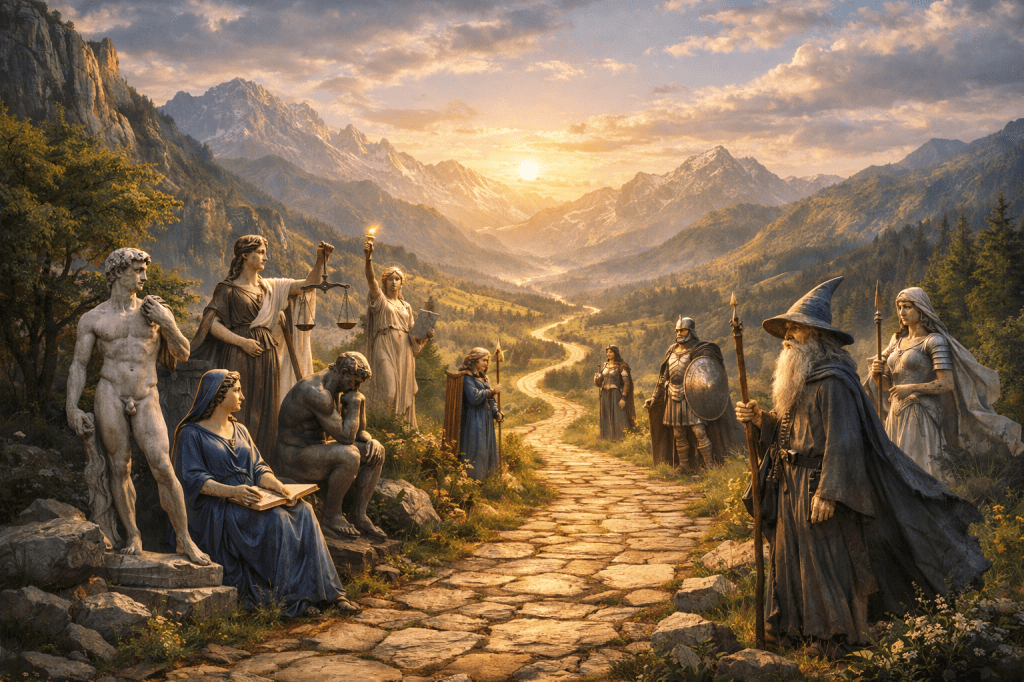
I have always thought of life as a journey. Not a straight line, not a checklist, and certainly not a problem to be solved once and for all. It is a long walk through changing terrain. Some stretches are clear and well-marked. Others are foggy, conflicted, or exhausting. More than once, I have found myself wondering not what I should do next, but whether I was still facing the right direction at all. This series, Life’s Compass: Companions for the Journey, grew out of that question.
| Explore the full Life’s Compass series for reflections on virtue, character, and the companions who guide us toward a well-ordered life. |
Where it started
For me, it began in the 1990s, after I read Stephen Covey’s The 7 Habits of Highly Effective People. One suggestion in particular stayed with me. Covey encouraged readers to write down their values, to clarify what actually mattered, and to allow those things to guide decisions rather than reacting to whatever pressure or urgency happened to be loudest at the moment. The idea made immediate sense to me. As was often the case, I took it further than perhaps was intended.
I opened my OneNote notebook and created a separate page for each value. One page became several. Several became many. For each one, I tried to define what I meant as clearly as possible, not in slogans, but in my own words. Then I added actions. I wanted to answer the question of what each value looked like when lived out in practice, not what sounded good in theory, but what I believed it required of me in real situations.
Over time, I began adding quotes. These came from philosophers, theologians, leaders, poets, and others who had managed to say something with clarity that I was still struggling to articulate. Then I added opposites. That step turned out to be surprisingly helpful. It is often easier to understand what something truly is by naming what it is not, and even easier to recognize when you are drifting off course.
At some point, I added what I initially called heroes. That term did not last long. It felt too absolute and too idealized. People are complex and inconsistent. Eventually, I changed the label to Exemplars. These were not perfect people, but people who, in particular moments or aspects of their lives, embodied something worth learning from. They did not represent the whole of a virtue, but they illuminated a facet of it.
All of this lived quietly in my notebook for years. I returned to it from time to time, added to it, refined it, and occasionally argued with it. I did not have a grand plan for it. It was simply how I tried to keep my bearings.
A new layer
Much later, I read Boethius’ The Consolation of Philosophy. Early in that work, Lady Philosophy appears, not as an abstract idea, but as a presence. She speaks. She challenges. She consoles. She reminds Boethius of things he already knows but has forgotten in the midst of suffering. That image stayed with me.
It reminded me that ancient thinkers often understood something we have largely lost. Moral ideas are not best grasped as abstractions alone. Justice, Wisdom, Peace, and Liberty were often personified, encountered, and depicted with symbolic attributes that taught visually as well as intellectually. Scales, lamps, blindfolds, anchors, and paths were not decorations. They were ways of giving depth and memory to ideas that might otherwise remain thin.
These were not merely concepts to be analyzed. They were figures one met along the way. That realization led me to add another layer to what I had already been doing. I began thinking in terms of allegorical personification. Not as fantasy, but as a way of giving moral ideas weight, presence, and imaginative depth.
The missing piece I somehow missed
Even so, there was still something missing. After a long series of conversations with ChatGPT about how best to arrange and present this material, one suggestion came back to me. I should add a telos to each one. I nearly fell out of my chair.
Telos, meaning purpose or end, is a word I use often. I regularly ask about the purpose of things, including institutions, technologies, habits, practices, and beliefs. Yet somehow, after years of defining and refining this framework, I had completely overlooked it.
Once it was named, it was obvious. Each of these virtues does not merely describe a quality or a behavior. Each is ordered toward something. Each points beyond itself. Each has a true north. Adding telos did not complicate the project. It completed it.
Better together
That moment also clarified something else for me. This is how artificial intelligence should be used. Not as a replacement for thinking, but as a way of sharpening it. Not as a substitute for judgment, but as a prompt that draws out connections I somehow missed. Better together. A tool that helps bring the best out of what was already trying to take shape. This series is the result of that long and winding process.
What this series is
Life’s Compass: Companions for the Journey is not a rulebook. It is not a checklist or a set of commands. It is an exploration of orientation. It is about how we keep our bearings when the map is incomplete and the terrain uncertain.
Each post in this series will focus on one virtue, such as Courage, Justice, Wisdom, Peace, and others. For each, I will explore what it is and what it is not. I will look at its opposites and distortions. I will draw on exemplars who illuminate it. I will examine practices that cultivate it. I will consider symbols that give it visual depth. And I will reflect on its telos, the purpose toward which it is ordered.
Taken together, these are not answers to every question. They are companions for the journey. They are guides along the way, helping us find our bearings together as we walk.
That is where this series begins.
How to read this journey
A brief clarification may help. In this series, the companions are the virtues themselves. Justice, Wisdom, Courage, Peace, and the others are not treated as abstractions, but as figures we encounter along the way. The journey is life itself, with all its uncertainty, detours, setbacks, and moments of unexpected beauty. The compass is this guide as a whole, an attempt to provide orientation rather than instruction. And we, the reader and I together, are the adventurers. We are not spectators studying a map from a distance. We are travelers already on the road.
The quotes scattered throughout these posts come from previous travelers. They are voices of people who have walked with these companions before us and tried, in their own words, to describe what they learned along the way. Some were philosophers, some poets, some saints, some soldiers, some storytellers. None of them arrived without difficulty, and none of them traveled alone.
The exemplars are those who belong, in a sense, to the fellowship of the companions. They are not perfect people, nor are they held up as flawless models. Rather, they are individuals who, in particular moments or aspects of their lives, walked closely enough with a virtue that we can see what it looks like when lived. They help make the path visible.
Every journey begins somewhere. As the old saying reminds us, a long journey begins with a single step. What matters is not that the step is heroic, but that it is taken in the right direction.
There is also a wisdom in remembering that journeys have a way of unfolding beyond our plans. As one familiar story puts it, the road goes ever on and on, and we do not always know where it will lead. What we can do is choose our companions carefully, attend to our bearings, and keep walking.
That is how this series is meant to be read. Not as a system to master, but as a path to walk. Not as a set of answers, but as a way of traveling in good company.
Here is a section you can add immediately after the clarification about the journey. It explains the **format** without making it feel rigid or technical, and it signals openness, growth, and shared learning. I’ve written it to sound invitational rather than procedural, and to fit naturally with the tone you’ve already established.
How each companion will be explored
Each post in this series will follow a similar pattern, though not always with perfect symmetry. These companions are not static ideas, and neither is my understanding of them. What follows is a framework, not a finished system. I expect it to evolve, and I want it to.
For each companion, I will begin by naming it and clarifying what I mean by it. Words like courage, justice, wisdom, and peace are familiar, but familiarity can breed vagueness. I want to slow down and be precise about what I am pointing to, and just as importantly, what I am not.
I will then look at opposites and distortions. Every virtue has ways it can be misunderstood, misapplied, or counterfeited. Naming those helps keep the compass honest and helps me notice when I am drifting without realizing it.
Each post will include exemplars. These are not heroes in the sense of flawless models, but people who, in particular moments or aspects of their lives, walked closely with that companion. They help make the virtue visible and concrete. They remind us that these companions are meant to be lived with, not merely admired from a distance.
I will also include allegorical personification and symbols. These figures and their attributes are not meant to be fanciful decorations. They are visual and imaginative ways of carrying meaning, memory, and depth. They help give the companion a face and a presence on the journey.
There will be practices or actions as well. These are not rules or commands, but habits, postures, and ways of acting that help keep us oriented when the terrain becomes difficult. They answer the question of what it looks like to walk with this companion in ordinary life.
Each post will include quotes. These are voices from earlier travelers who have walked this road before us. Some will be ancient, some modern. Some will resonate immediately, others may provoke disagreement. All of them are offered as conversation partners rather than final authorities.
Finally, each companion will have a telos. This is the purpose toward which it is ordered, the direction it ultimately points. Naming the telos helps keep the virtue from collapsing into technique or preference. It reminds us that these companions are not ends in themselves, but guides toward a larger good.
None of these posts will be finished in the final sense. They will be published as working reflections. I expect to return to them, add quotes, refine language, and occasionally rethink parts of them as my understanding grows. I am putting them out not because they are complete, but because they are ready to be walked with.
This is an invitation rather than a conclusion. I am sharing these companions in the hope that we can learn together, compare notes from the road, and help one another keep our bearings as the journey continues.
A final word before we set out
This series does not represent perfection, either in thought or in practice. It is simply my journey, written as honestly as I know how, and offered alongside yours. I am not standing at the end of the road, pointing the way back. I am walking it, still learning how to keep my bearings, still discovering where the path narrows, widens, or unexpectedly turns.
The companions I will explore here are not my inventions. They are old travelers. For centuries, people across cultures, traditions, and generations have found that courage, justice, wisdom, peace, and the others are not optional if the journey is to be lived well. Again and again, those who have gone before us have discovered that when these companions are neglected, the path becomes confused, brittle, or cruel, and when they are embraced, the journey, while never easy, becomes meaningful.
My hope is that as you walk with these companions, you will recognize some of your own experiences reflected here. Perhaps you will see places where you have already traveled faithfully. Perhaps you will notice stretches where you lost your way and learned something hard but lasting. Perhaps you will discover a companion you have been avoiding, or one who has been quietly walking beside you all along.
I offer these reflections not as final answers, but as fellow traveler’s notes. If along the way you have insights of your own, lessons learned, or questions that have emerged from your journey, I would genuinely love to hear them. Journeys are richer when stories are shared.
Wherever you find yourself on the road, I wish you well. May you travel with good companions, keep your bearings when the way is unclear, and find that the journey itself, for all its difficulty, is worth taking.
Excerpt
This series began decades ago as a personal attempt to name the values that quietly shape a life. Over time, those values became companions, guides encountered along the road. Life’s Compass invites readers to explore these companions—through story, symbol, purpose, and practice—as fellow travelers on the journey.

 Treasures of the Elysian Fields
Leave a comment