
I. The Lanterns of Summer
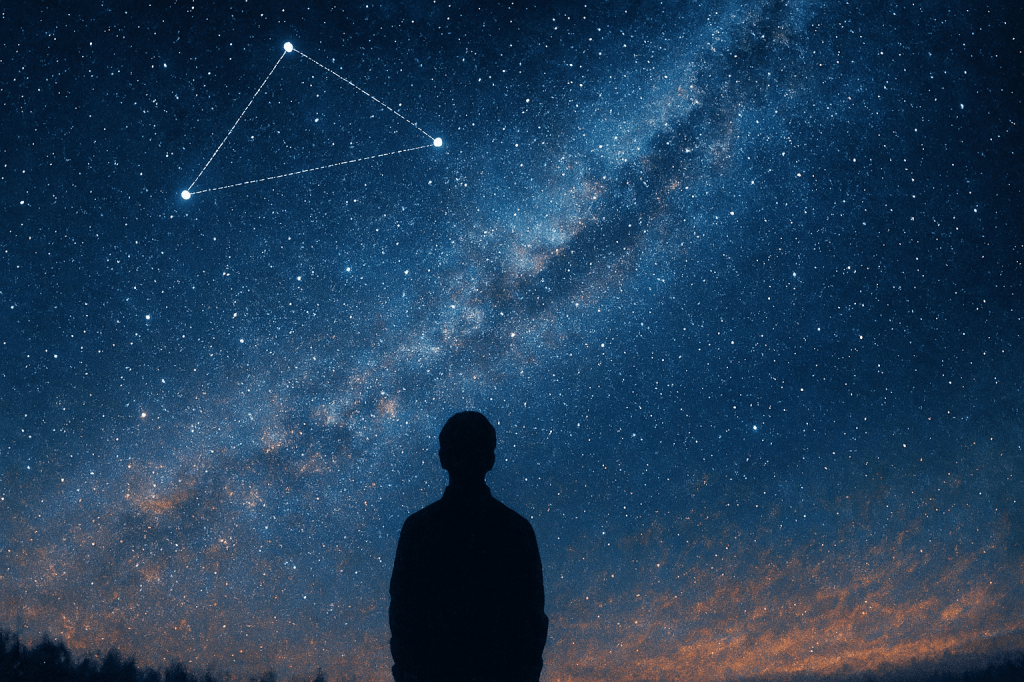
On clear summer nights, when the heat of the day finally fades and the air hums with the quiet of crickets, three bright stars rise to form a vast triangle across the heavens. Vega. Deneb. Altair. Together they create what stargazers call the Summer Triangle—a celestial signpost that has guided travelers, poets, and scientists alike.
These aren’t stars bound by the same constellation or even the same scale of distance. They are neighbors only in appearance, connected not by gravity but by the geometry of human perception. Vega burns white-blue in the small constellation Lyra, Deneb shines from the tail of Cygnus the Swan, and Altair flashes from the heart of Aquila the Eagle. Together, they span a third of the sky, a cosmic framework drawn across the Milky Way’s luminous river.
For millennia, this asterism has served as both compass and clock. To the casual observer, it marks the turning of the seasons: rising in the east on spring evenings, crowning the zenith in July and August, and slipping westward by autumn’s end. For the astronomer, it’s a gateway—its points trace constellations rich with deep-sky treasures. For the philosopher, it’s a reminder of scale and time, the heavens’ quiet invitation to humility.
The wonder begins in the simple act of noticing. To stand beneath the Summer Triangle is to participate in an ancient ritual of awareness—to align our brief lives with the long rhythms of the cosmos. These three suns, vastly different in distance and luminosity, appear to us as equals. The eye, unable to sense depth at such scales, flattens the universe into a luminous tapestry. What we see as proximity is, in truth, a projection across thousands of light-years. And yet, for that moment, they belong to each other—and to us.
“Two things fill the mind with ever new and increasing admiration and awe—the starry heavens above me and the moral law within me.” — Immanuel Kant
Every culture that looked up saw patterns in these same stars, but none could have guessed how far apart they truly were, or that their light was ancient by the time it touched human eyes. To us they seem eternal, but they too are stories in motion—one nearby and spinning fast, one radiant and balanced, one distant and vast. They are lighthouses in an ocean of time.
And so, as we trace the triangle across the summer sky, we are not merely observing the universe. We are entering into its dialogue—where geometry becomes poetry, and light becomes memory.
To truly know the Summer Triangle, however, wonder alone is not enough. Awe invites inquiry. The same instinct that made our ancestors trace myths among the stars now drives us to measure, map, and understand. Before we can grasp the deeper mysteries of time and distance—before we can realize that we are, in a sense, looking backward through history—we must first learn how to navigate this triangle of light.
II. Mapping the Summer Triangle: A Stargazer’s Compass
Once your eyes adjust to the night, the Summer Triangle reveals itself as an unmistakable beacon—three brilliant points forming a wide isosceles shape high above the horizon. To the unaided eye, it seems simple enough: three bright stars suspended in blackness. Yet within this triangle lies a roadmap of constellations, nebulae, and stories as ancient as civilization itself.
A. The Stars Themselves
At the western point glows Vega, the brightest of the three and the fifth brightest star in the entire sky. It anchors the small constellation Lyra, the Lyre—an instrument of mythic music said to have belonged to Orpheus himself. Astronomically, Vega is one of our closer stellar neighbors, only 25 light-years away. It has served as a reference point for modern astronomy—a kind of cosmic yardstick for measuring brightness. Vega’s light is so steady that for decades it defined the zero point of the magnitude scale by which we measure all other stars.
To the south burns Altair, in the constellation Aquila, the Eagle. At just 16.7 light-years distant, Altair is the closest of the three. It spins with such incredible speed—once every ten hours—that its shape bulges at the equator and flattens at the poles. Through a telescope, it’s visibly oblate, a physical reminder that stars are not perfect spheres but dynamic, living suns bound by motion and gravity.
And then there is Deneb, crowning the northern tip of the triangle, anchoring Cygnus, the Swan. Deneb is the paradox of the group: a distant blue supergiant roughly 2,600 light-years away, so luminous it outshines the Sun nearly 200,000 times. Were Deneb as close as Vega, it would cast shadows on Earth. Its light began its journey toward us when Babylon still stood, and the echoes of its brilliance carry both time and distance in a single beam.
“The most beautiful experience we can have is the mysterious. It is the fundamental emotion that stands at the cradle of true art and true science.” — Albert Einstein
B. The Astronomer’s Guide
For the stargazer, the Summer Triangle is more than an ornament—it’s a compass in the firmament. Begin with Vega, the easiest to spot. On midsummer nights it gleams near the zenith, a diamond in the dark. From there, trace southeast to Altair, then swing northward to Deneb to complete the shape. Once you’ve found these points, entire constellations unfold like petals around them.
Lyra: Within Vega’s constellation lies the Ring Nebula (M57), a faint smoke ring in small telescopes—the remnants of a dying star casting off its outer layers.
Cygnus: Follow Deneb and you trace the graceful arc of The Swan, or The Northern Cross. The Milky Way runs right through it, revealing treasures such as the North America Nebula and the delicate filaments of the Veil Nebula.
Aquila: Around Altair, the Eagle soars through star fields and dark nebulae, including the enigmatic Barnard’s E. This region is dense with the dust and gas that compose the spiral arms of our galaxy.
The Milky Way itself threads through the triangle, a river of light drawn from billions of suns. Deneb seems to float upon that river like a great white sail. When you trace this pattern across the sky, you’re not just connecting stars—you’re navigating the galactic disk itself.
By season’s end, as the triangle drifts westward and autumn’s chill returns, its disappearance becomes a subtle reminder that even the sky has a rhythm. The same three stars that guided summer evenings now yield to the long nights of Orion and winter’s constellations. The heavens have their own calendar, and the Summer Triangle marks one of its most luminous chapters.
“Equipped with his five senses, man explores the universe around him and calls the adventure Science.” — Edwin Hubble
Yet even as we trace their patterns with ease, there’s a quiet deception in their simplicity. The light from Vega, Altair, and Deneb does not arrive in the same “now.” Each is a messenger from a different era, a memory crossing unimaginable distances. The Summer Triangle, then, is not merely a map of space—it is a map of time. To look at it is to gaze into three different pasts converging in a single moment of vision.
III. Time in Starlight: Looking Backward Through Space
Every time we look up at the Summer Triangle, we are not simply looking across space—we are looking backward through time. Each point of light is a message, a single photon that has spent years or millennia crossing the darkness just to arrive here, in this moment, to touch the back of your eye.
When I look at Altair, I am seeing the star as it was 16.7 years ago. That photon left when my own world was younger, long before the moment I now stand in. The light has traveled one hundred trillion miles, and its journey ends quietly—absorbed by the cells of my retina, transformed into the faint electric whisper my brain calls sight.
From Vega, 25 light-years away, the light I see tonight began its journey a quarter century ago. That single flash set out through the void, untouched by anything, until it reached me. Every photon from Vega is a small act of endurance, a tiny ambassador of the past carrying news of what once was.
But Deneb—Deneb defies comprehension. Its light began its voyage more than 2,600 years ago. For two and a half millennia, that photon has crossed the gulf of space, its path unbent, unbroken, until this very instant when it ends in the small miracle of perception. That sliver of starlight began before our ancestors had words for galaxies, before anyone had even imagined that stars were suns.
“To confine our attention to terrestrial matters would be to limit the human spirit.” — Stephen Hawking
In the time it takes a photon to reach us, everything changes—empires, languages, lifetimes—yet the light remains steadfast. When the rays from Altair, Vega, and Deneb converge in my eye, three epochs of the universe meet within me. I am not seeing what is, but what was. The sky above is not a map of space; it is a map of time drawn in light.
For most of history, humanity believed the stars to be eternal, their glow unchanging. Only recently have we understood the truth: every glimmer is an echo from the past, a frozen image of what the cosmos once looked like. The night sky is not still—it is history in motion, written in light across the dark.
“We are all in the gutter, but some of us are looking at the stars.” — Oscar Wilde
IV. History Written in Photons: What Was Happening When the Light Left
If each photon from the Summer Triangle is a message from the past, then what was happening here on Earth when those messengers first set out? Each ray of light carries not only the story of its star but the echoes of our own history—human civilization unfolding under the same sky it would one day come to understand.
A. Deneb — The Distant Witness (~590 BCE)
The light from Deneb, the farthest of the three, began its journey around 590 BCE, a time when the ancient world was in upheaval and transformation. Babylon was rising to dominance in Mesopotamia, capturing Jerusalem and sending its people into exile. In Athens, the statesman Solon was rewriting the laws, laying the groundwork for what would one day become democracy.
Across the Nile, Pharaoh Psamtik II ruled Egypt, leading campaigns into Nubia, while in India a spiritual revolution stirred—Mahavira, the great teacher of Jainism, was preaching nonviolence and liberation from desire. In China, during the Spring and Autumn Period, the states of Jin and Chu clashed in the Battle of Bi, one episode in a centuries-long dance of power and philosophy that would give rise to Confucius only a few generations later.
The poets Sappho and Alcaeus sang on the island of Lesbos, their verses reaching across time much as Deneb’s light does now. The world they knew was smaller, its horizon bounded by myth and empire—but the same light they saw then is what strikes my eye tonight.
“The past is never dead. It’s not even past.” — William Faulkner
B. Vega — A Generation Ago (2000 CE)
When the photons from Vega began their flight, it was the autumn of 2000—the dawn of a new millennium. Humanity was wrestling with uncertainty and promise.
The U.S. presidential election was locked in dispute between George W. Bush and Al Gore, a drama that would reshape global politics.
The Sydney Olympics had just concluded, celebrating unity even as divisions simmered elsewhere.
The International Space Station received its first long-term crew, marking the start of continuous human presence in space—a fitting echo to Vega’s own distant light.
Scientists announced the near completion of the Human Genome Project, unlocking the code of life itself, while in living rooms across the world, the PlayStation 2 transformed entertainment into immersive digital worlds.
From 25 light-years away, Vega’s light watched all this unfold—our triumphs and follies, our reach for both stars and screens. It is humbling to think that the glow we see tonight left its star when we were still discovering what it means to be connected, not just by light but by information.
“The cosmos is within us. We are made of star-stuff.” — Carl Sagan
C. Altair — The Recent Past (2009 CE)
Light from Altair began its journey just 16.7 years ago, in the spring of 2009—a blink in cosmic time, yet already part of history. The world was reeling from the global financial crisis, economies trembling and trust eroding. On March 7, NASA launched the Kepler Space Telescope, destined to find thousands of exoplanets—perhaps worlds circling suns like Altair itself.
The International Criminal Court indicted a sitting head of state for the first time, while volcanoes erupted in Alaska and the first U.S. cases of H1N1 influenza appeared, foreshadowing new global vulnerabilities.
These events, so recent to us, are already sealed in light. The photon that began its voyage from Altair during that moment has only just completed its journey. In astronomical terms, that makes Altair a neighbor—its light nearly contemporary with our own lives. Yet even here, in the nearest of the three, the message is clear: we never see the present. We see the past rendered luminous.
“We shall not cease from exploration, and the end of all our exploring will be to arrive where we started and know the place for the first time.” — T. S. Eliot
The Convergence of Ages
Now, when I look up at the Summer Triangle, I am touched by photons born in three different centuries, three different worlds of human experience. The light from Altair left when modern humanity looked toward new horizons. Vega’s departed when we were crossing into a digital future. Deneb’s began when human thought was still shaped by empire and myth.
And yet, they meet here—now—in the span of my own perception. Three beams of light, three ages of Earthly history, converging in a single instant of awareness. What other act so perfectly unites time, space, and consciousness? To observe the night sky is to stand at the intersection of eternity and now.
“If there is magic on this planet, it is contained in water. If there is wonder in this universe, it is contained in light.” — Loren Eiseley
V. The Mind-Bender: Time Dilation and the Traveler’s Paradox
If I haven’t blown your mind yet, hold on—because this next part will.
Let me take you on a journey straight into an episode of The Scary Door—that cosmic corridor where reason bends, time folds, and reality itself starts to glitch.
Imagine this: You decide to visit Deneb, that brilliant blue supergiant 2,615 light-years away. You fire up your ship and somehow—through technology far beyond even our boldest sci-fi dreams—you reach the speed of light. According to our physics textbooks, at that velocity you would cover those 2,615 light-years in exactly 2,615 years from Earth’s perspective. That means if you left today, you wouldn’t “arrive” until the year 4640 CE.
But here’s where it gets weird: from your own perspective aboard that ship, no time at all would pass. Your entire journey—two and a half millennia of Earth time—would feel instantaneous. You’d leave, blink, and arrive. Meanwhile, everything you ever knew—every person, every civilization—would be long gone. You would be a traveler arriving in the far future, but you would not have aged a second.
“The distinction between past, present and future is only a stubbornly persistent illusion.” — Albert Einstein
Einstein’s theory of special relativity revealed that time is not absolute. The faster you move through space, the slower you move through time. At ordinary speeds, this effect is microscopic. But as you approach light speed, the distortion becomes staggering.
If you could travel at 99.9% the speed of light, your journey to Deneb would still take 2,615 years by Earth’s clock—but for you, the traveler, it would feel like only 37 years.
At 99.9999% light speed, your experience would shrink to less than four years.
And at the ultimate limit—100% light speed—your internal clock would stop completely. Time, for you, would cease to exist.
“What we observe is not nature itself, but nature exposed to our method of questioning.” — Werner Heisenberg
So, for a photon—the very light we’ve been following all along—no time passes at all. The instant a photon leaves Deneb, it is already, in its own frame, striking your eye. To the photon, the entire 2,615-year journey across the galaxy is a single timeless act, an eternal now.
That means when you look up at Deneb, you are, in a sense, participating in that same instantaneous connection—one end of the light’s existence meeting the other in your awareness.
It’s as if the universe itself collapses the vast gulf between star and observer into a moment of contact. The cosmos doesn’t just stretch across space; it folds through consciousness.
When I realize that, I can’t help but think: perhaps every act of perception is a form of time travel—a communion with what was, refracted through what is. Each glance at the stars is a dialogue between ancient light and living mind.
“Time is an illusion, but an extraordinarily persistent one.” — Albert Einstein
So if you ever find yourself under the summer sky, tracing the triangle of Vega, Deneb, and Altair, remember: you are not merely looking outward—you’re looking through time itself. You stand at the threshold between history and eternity, at the edge of the Scary Door, where the universe quietly whispers its greatest secret: that past and present, light and life, are all one continuous story.
VI. Conclusion — The Contemplative Sky
So what do we do with all this? Honestly, I don’t know.
“We are an impossibility in an impossible universe.” — Ray Bradbury
Maybe you’ll have an epiphany—one of those rare moments when the vastness of creation settles on you like a weight of glory. Or maybe you’ll just shrug and think, “Huh, that’s interesting.” Either response is fine. The heavens don’t demand a reaction; they simply exist, declaring what they have always declared: “The heavens proclaim the glory of God; the skies display His handiwork.”
Still, contemplating these things is worth the time. To realize that every photon you see tonight began its journey long before Christ walked the earth—or even before Athens had a democracy—is to feel the scale of God’s creation in a way words rarely convey. Light, distance, time—all of it woven together in laws so elegant that even our best science can only describe them, never explain why they are so.
“The most incomprehensible thing about the universe is that it is comprehensible.” — Albert Einstein
This adventure of the mind—the attempt to grasp such magnitude—borders on the spiritual because it brings us to the edge of our limits. We are finite creatures contemplating infinity, and that is a holy exercise. When we study the stars, we’re not gazing into a self-aware cosmos; we’re gazing upon the craftsmanship of a God whose power and imagination exceed measure.
Science reveals the how, but faith reminds us of the Who.
“Lift up your eyes on high, and see who has created these stars, The One who leads forth their host by number, He calls them all by name.” — Isaiah 40:26
So the next time you step out on a clear summer night, look up.
Three stars—Altair, Vega, Deneb—still burn across the ages, their light older than nations, older than memory. Let their quiet persistence remind you that creation itself bears witness.
And perhaps, as those ancient photons reach your eyes, you’ll feel what the psalmist felt: not the smallness of man, but the majesty of God, who made both the stars and the eyes that behold them.
“When I consider your heavens, the work of your fingers, the moon and the stars, which you have set in place—what is mankind that you are mindful of them, human beings that you care for them?” — Psalm 8:3–4
Excerpt
Every summer night, three ancient lights—Altair, Vega, and Deneb—cross vast gulfs of time to meet in your eye. One left when Jerusalem fell, another when the PlayStation 2 launched. Together, they whisper: you are standing at the intersection of eternity and now.

 Treasures of the Elysian Fields
Leave a comment