
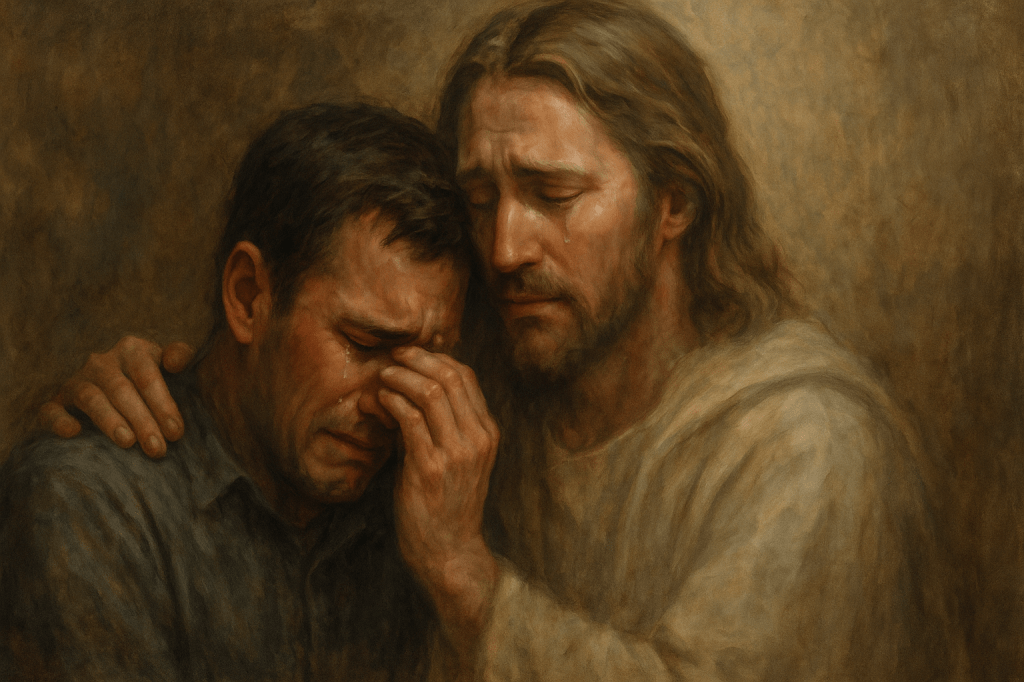
“Participating in Christ’s Suffering — A Theodicy of Mutual Love”
I. Introduction — When Theodicy Becomes Participation
Before diving in, if you haven’t read my previous post on Perichoretic Salvation, I recommend starting there. That piece lays the theological groundwork for what follows—the idea that salvation is not a transaction or a moral upgrade but a participation in the life of God. What we explore here grows out of that same vision, but now turns toward one of the hardest questions faith ever faces: why does a good God allow suffering?
For centuries, theologians and philosophers have called this the problem of evil. David Hume put it bluntly:
- “Is He willing to prevent evil, but not able? Then He is impotent.
- Is He able, but not willing? Then He is malevolent.
- Is He both able and willing? Whence then is evil?”
The technical name for any attempt to answer that challenge is theodicy—literally, “the justice of God.” Classical theodicies from Augustine to Plantinga have sought to defend God’s goodness by appealing to human freedom or to the soul-making value of suffering. Those arguments matter; they protect the coherence of belief.
But what struck me in rereading Gifford’s Perichoretic Salvation is that he quietly turns the conversation on its head. Gifford doesn’t offer a new logical solution to the problem of evil; instead, he reframes the experience of suffering within the mutual relationship between Christ and the believer. Many theologians have said that Christ participates in our suffering—that God enters our pain. Yet Gifford points to something deeper and more reciprocal: we also participate in Christ’s suffering.
That shift changes everything. The problem of evil ceases to be merely a philosophical puzzle and becomes a relational invitation. In the classical view, God stands justified before human reason; in Gifford’s participatory view, God draws us into His own redemptive empathy. Theodicy becomes less about explaining why evil exists and more about discovering how divine love meets it—how love bears it, transforms it, and ultimately overcomes it through communion.
“I want to know Christ—yes, to know the power of His resurrection and participation in His sufferings.” — Philippians 3:10
That single verse could summarize Gifford’s quiet revolution. If salvation means sharing in the divine life, then suffering cannot be outside that sharing. In what follows, I want to explore how this idea reframes the way we think about pain, the problem of evil, and God’s presence in both.
II. The Classical Foundations of Theodicy
For those who have never really looked into this question, it’s worth noting that the problem of evil has occupied theologians and philosophers for almost two thousand years. It’s one of the oldest and most enduring challenges to the Christian faith.
Atheists won’t let it go—and to be fair, their skepticism is understandable. The existence of suffering and evil does seem, at first glance, to clash with the idea of a loving, omnipotent God. They think they’ve found a fatal flaw in the armor of faith. But the truth is that this challenge has been thoroughly wrestled with, and the answers given are far more substantial than many skeptics admit. In short: asked and answered.
Still, setting apologetics aside for a moment, we need to understand the basics of how Christians have historically approached this problem. Theodicy—literally “the justice of God”—is the discipline that asks: How can God be good if evil exists? And while no theodicy can make pain pleasant, the classical approaches provide essential structure for thinking about it clearly.
Over the centuries, three dominant threads have emerged:
The Free Will Defense.
Originating with Augustine and refined by Aquinas and Alvin Plantinga, this argument holds that love requires freedom. If God is to create beings capable of genuine love, He must also allow the possibility of rebellion. Freedom opens the door to both virtue and vice. As William Lane Craig puts it, “It is logically impossible for God to create a world containing moral good without moral evil.” The problem, then, is not divine cruelty but human choice.
The Soul-Making Theodicy.
This line, developed from Irenaeus and popularized by John Hick, sees suffering not merely as a tragic side effect of freedom but as the environment in which spiritual maturity is formed. Virtues like compassion, courage, and forgiveness can only exist in a world where suffering and loss are real. As C. S. Lewis observed in The Problem of Pain, “Pain insists upon being attended to. God whispers to us in our pleasures… but shouts in our pains: it is His megaphone to rouse a deaf world.”
The Eschatological Theodicy.
Finally, there is the future-oriented hope that whatever suffering remains unresolved now will ultimately find meaning in God’s restoration of all things. Evil and pain are temporary; redemption is eternal. Revelation envisions a world where “He will wipe every tear from their eyes,” not by pretending evil never existed, but by transforming its consequences into glory.
Together, these three perspectives don’t eliminate the mystery of suffering, but they keep the faith rational, grounded, and hopeful. Each explains a different aspect of the same problem—why evil exists, what purpose it might serve, and how it will one day end.
Yet, as Gifford’s Perichoretic Salvation reminds us, even these profound answers leave something unsaid. The classical theodicies defend God’s character, but they don’t fully address the experience of pain—the lived reality of suffering and our relationship to it.
That’s where the next step begins.
III. Gifford’s Reframing — Perichoretic Participation and Mutual Suffering
James D. Gifford Jr.’s Perichoretic Salvation doesn’t try to out-argue Augustine, Plantinga, or Hick. It doesn’t propose a brand-new solution to the problem of evil. Instead, it quietly shifts the lens. Gifford changes how we see suffering by placing it within the very structure of salvation itself—within the divine life of mutual indwelling that theologians call perichoresis.
Perichoresis means “to move within” or “to make room around.” It describes the eternal dance of Father, Son, and Spirit: unity without confusion, love that gives space without separation. Gifford extends that relational pattern outward—first to the Incarnation (the union of divine and human natures in Christ) and then to the believer’s union with Christ. Salvation, he argues, is not simply pardon or positional righteousness; it is participation in the life of God.
That claim has staggering implications for how we view pain. If believers truly share in Christ’s life, then union must include every facet of His existence—glory, yes, but also suffering. In chapter 5, Gifford writes that we participate with Christ not only in His exaltation but also in His afflictions.
At first glance, that sounds familiar. Theologians from Luther to Moltmann have said that God suffers with us. But Gifford’s statement adds something more: suffering is mutual. We do not merely receive Christ’s sympathy; we enter His compassion. The relationship is not one-way. Just as the Son shares the Father’s love and the Spirit joins them in perfect giving, so the believer is drawn into that same self-giving rhythm—love that bears the pain of others.
The Apostle Paul seemed to understand this mystery long before systematic theology had a name for it.
“If we suffer with Him, we shall also be glorified with Him.” — Romans 8:17
“Now I rejoice in my sufferings for your sake, and in my flesh I complete what is lacking in Christ’s afflictions for the sake of His body, the church.” — Colossians 1:24
Paul doesn’t mean that Christ’s atonement was deficient. He means that the life of Christ continues in His people—that our pain becomes a living echo of His redemptive love. To participate in Christ’s suffering is to let His compassion flow through us into the wounds of the world.
Gifford’s reframing turns theodicy from an argument about divine justice into an invitation to divine communion. Evil and pain are still real; free will and soul-making still explain their existence. But the believer’s perspective changes: suffering is no longer an alien intrusion but a sacred place of fellowship with God.
In that light, every tear becomes relational rather than random. Pain is not evidence that God is absent; it is evidence that we are sharing in His presence—the same love that once stretched out on a cross and still refuses to let the world go.
Get this—our free will, which causes so much of the world’s pain and suffering, is bound up with our choices. And yet God, knowing this, chose to join us in full communion, taking that suffering upon Himself. That’s not abstract theology; that is the very definition of agape love—self-giving love that enters another’s pain by choice. Let that sink in for a moment.
IV. Participation as Theodicy — From Explanation to Communion
If the classical theodicies seek to explain why God allows evil, Gifford’s perichoretic view transforms that explanation into an invitation. The question changes from “Why does God permit suffering?” to “How does God meet us in it—and how do we meet Him?”
In this participatory framework, free will still stands as the foundation—love must be chosen, and real choice carries real risk. The soul-making dimension also remains: suffering shapes character, empathy, and humility. But Gifford’s insight gives these truths a new depth. Evil is not simply something we endure for eventual reward; it is the crucible in which communion is deepened. Pain becomes a meeting place.
Here, theology and experience merge into mystery. We may not understand why certain evils are permitted, but we know where God is in them: with us, and in us, and—astonishingly—through us.
C. S. Lewis captured this tension perfectly. In The Weight of Glory, he reminds us that “our desires are not too strong, but too weak,” because we settle for “making mud pies in a slum when we cannot imagine what is meant by the offer of a holiday at the sea.” We live with hearts too small to grasp what glory will be. Likewise, he wrote in The Problem of Pain that we “see through a glass darkly.” We can’t yet comprehend the purpose of every tear, but when the veil is lifted, “the terrible process will turn out to have been not a scene of horror, but the preparation of a masterpiece.”
Lewis sometimes compared it to a child who cannot yet understand why a dentist must hurt him or why his parents refuse him a second helping of ice cream. The pain and the denial make no sense until he grows into maturity and sees the love behind them. In the same way, our understanding of eternity and redemption is still childish; what feels like deprivation or punishment now may one day be revealed as the shaping of joy beyond measure.
In this light, Gifford’s participatory view does not eliminate mystery—it sanctifies it. Suffering becomes less a test of faith and more a context for intimacy. We may not know the reasons behind every instance of pain, but we know that pain has been taken up into God Himself. The cross is not only an answer; it is an invitation into relationship.
To participate in Christ’s suffering is to participate in His love—the kind of love that bears pain not as defeat but as transformation. As Lewis wrote, “The load, or weight, or burden of my neighbor’s glory should be laid on my back, a load so heavy that only humility can carry it.” Participation in suffering, then, is not passive endurance but active compassion; it is the life of Christ expanding through His people until the world is remade in love.
V. Reframing Suffering through Cognitive Behavioral Theory (CBT)
I want to take this to another level—specifically, the psychological side. The field of Cognitive Behavioral Theory (CBT) has taught us something profound about the way we process pain and meaning. CBT operates on a simple but powerful premise: our thoughts shape our emotions, and our emotions shape our actions. When we suffer, it’s often not the event itself that destroys us, but the interpretation we attach to it.
In CBT, this process is called reframing. It’s the practice of changing the way we think about a situation in order to change how we feel about it. By identifying distorted or catastrophic thoughts (“I’ll never recover,” “This always happens to me,” “I’m worthless”), a person learns to reexamine and replace them with thoughts that are more balanced, truthful, and life-giving. Over time, reframing helps the mind rebuild trust in reality and regain agency.
But this raises a critical question: doesn’t it sound as if reframing could be used to justify any interpretation of suffering—as long as it helps someone cope? What if the “new frame” is simply a comforting illusion? That’s a real danger, and one that modern psychology doesn’t always address. A purely utilitarian approach might say: If it helps you feel better, that’s all that matters.
Yet I would argue that reframing must be grounded not just in usefulness, but in truth. A false story might soothe for a season, but when reality catches up, the pain often returns twice as strong. The Christian perspective insists that genuine healing requires alignment with what is real—with what is. Jesus called this alignment truth (“You will know the truth, and the truth will set you free”). Truth and love, not wishful thinking, form the firm foundation for authentic transformation.
This is where theology and psychology converge. CBT teaches us to identify distorted thinking; theology teaches us to replace it not merely with positive affirmations but with divine perspective. Where CBT says “reframe,” Christ says “renew your mind.” The participatory model of suffering that Gifford describes functions like the ultimate reframing: it changes not just our thoughts about suffering, but the meaning of suffering itself.
In other words, the believer’s reframing is not denial—it’s reorientation toward truth. We are not alone in our pain. We are joined to a God who suffers with and through us. That realization doesn’t erase suffering, but it transforms how we inhabit it.
This shift has two outcomes. The first is comfort: we are never abandoned. Our pain has a companion in the wounds of Christ. The second is motivation: if Christ shares our suffering, then we are called to share His compassion—to do what we can to relieve the suffering of others.
So, while CBT reframes our thoughts to regulate emotions, Gifford’s participatory theology reframes our reality to reveal communion. It teaches us that the cross is not a symbol of failure, but of divine participation in the human condition. Pain becomes not a verdict, but a visitation—an encounter where God meets us in love and invites us to extend that love outward.
This is reframing at its deepest level: to look at the brokenness of the world and see not only despair, but an opportunity to embody the healing presence of Christ. It’s the moment when psychology and theology finally speak the same language—the language of renewal through truth.
VI. The Mutuality of Love — Suffering With and In Christ
The other day, I was watching a program called The Trek: A Migrant Trail to America—a multipart episode from The Whole Story with Anderson Cooper. It followed Venezuelan refugees as they crossed the treacherous jungles of Colombia and Panama: no clean water, dwindling food, miles of mud, poisonous snakes, and desperate exhaustion. I sat there with tears in my eyes, watching what these people endure just to find a place where life might be safe and just.
And then it hit me—that tear is not mine alone. That grief, that ache in the chest as you see human beings in agony, is also the tear of Christ. Let that sink in for a moment.
In full participation, my heart breaks for them, and yet it is also His heart breaking through mine. In that instant, I wasn’t just feeling sympathy; I was sharing in the compassion of the One who entered the human story, who knows every fear, hunger, and injustice from the inside. It’s easy to think of divine compassion as a distant benevolence—God watching from above. But in the perichoretic vision, compassion flows both ways. Christ suffers in us, and we suffer in Him. Our tears mingle.
This is the mystery Gifford gestures toward: love that refuses distance. The Incarnation was not God dipping His toe into humanity; it was God immersing Himself completely, body and soul, into human pain. To participate in that love is to allow our hearts to break in sync with His—and to act from that shared ache.
This is where theology becomes worship and ethics.
In prayer, we do not merely ask God to comfort the afflicted; we join Christ’s own intercession for the world’s pain.
In worship, we don’t stand apart and observe divine love; we enter into it, taking our place within the eternal giving and receiving between Father, Son, and Spirit.
In service, we become the tangible presence of that love—hands that feed, hearts that listen, feet that go where comfort is needed most.
In this sense, suffering is not glorified—it is redeemed. It becomes the channel through which divine love flows into the world. When Paul says, “I rejoice in my sufferings for your sake,” he isn’t celebrating pain itself; he’s rejoicing that pain has become a conduit of grace.
The mutuality of love means that God does not simply remove suffering from the world; He transforms it into communion. Every act of compassion—every tear for a stranger, every prayer for the broken, every burden carried for another—is participation in the suffering love of Christ. It is love incarnate, still walking through the world, still healing what is wounded.
So when your heart breaks at the news, at injustice, or at the quiet tragedies no one else sees, remember: that is not a weakness of faith—it is a mark of participation. It is God’s own love, alive and responsive within you.
VII. Potential Theological Challenges
As with any profound idea, humility demands that we hold it carefully. I want to be transparent: it’s possible that I’m misunderstanding aspects of Gifford’s argument, or perhaps extending it beyond his intent. The point here is not to declare a new doctrine but to think deeply and reverently about what it means to participate in Christ’s suffering.
The notion that believers share in the suffering of Christ is certainly biblical—Paul said it often—but exactly how that participation functions theologically is complex. There are several areas where more study and discernment are needed to ensure this understanding remains sound.
1. The completeness of Christ’s atonement.
If Christ’s sacrifice on the cross fully accomplished redemption, why does suffering continue? Some might worry that emphasizing our participation risks implying that His work was somehow incomplete. But perhaps the better way to see it is that His atonement is complete, yet the application of redemption unfolds across time. We live in the “already and not yet”—the cross is finished, but the world is still being healed. Our suffering does not add to Christ’s sacrifice; it joins in the ongoing revelation of its power.
2. The nature of participation.
Is our participation merely symbolic, or does it carry a real spiritual efficacy? The danger here is sliding into a kind of mystical fusion that blurs the line between Creator and creature. The safer—and more orthodox—reading is analogical: we participate by grace, not by essence. The indwelling is relational, not ontological. We are invited to share in Christ’s life, but we never become Him.
3. The problem of divine sufficiency.
Could mutual suffering imply that God somehow needs our pain to complete His compassion? Classical theology says no—God is already perfect in love. Yet the Incarnation shows that divine love freely chooses to include us in its expression. Participation doesn’t fill a lack in God; it reveals the abundance of a love that refuses to act alone.
4. The timeline of redemption.
If suffering is part of the redemptive process, where does it end? Revelation promises a world without tears, where sorrow and death are no more. It seems that participation in suffering belongs to the time between the cross and the new creation—a temporary vocation in a wounded world. When all is reconciled, our participation will no longer be in suffering but in joy.
Each of these questions invites further thought and prayer. I don’t claim to have them resolved. Perhaps that is part of the point—faith is not the absence of questions but the courage to ask them before God.
What matters most is that our exploration stays tethered to the core of Christian truth: that Christ’s atonement is sufficient, His divinity unthreatened, and His love still drawing us into deeper communion. If this participatory model can help us grasp that love more clearly, then it is worth studying with both reverence and caution.
“The best theology would need no advocates; it would prove itself in prayer.” — Karl Barth
For my part, I try to hold ideas like this tentatively, never as unshakable dogma but as working hypotheses open to refinement. I often assign my conclusions a kind of “likelihood percentage”—a way of saying how strongly I find them convincing given the data and understanding I have at the moment. And like all honest inquiry, those numbers can change as new insights or evidence come to light.
Today, however, I find Gifford’s perichoretic model extremely compelling—highly likely, in fact—to be an accurate and theologically rich account of the relational dimension of salvation. It offers a way of seeing divine love not as distant or abstract, but as mutual, embodied, and alive in the shared suffering and redemption of the world.
VIII. Practical Implications — Living a Participatory Theodicy
If what Gifford suggests is true—if we really participate in the life of Christ, even in His suffering—then the implications for how we live are enormous. Theodicy ceases to be an abstract defense of God and becomes an embodied practice of love. This is theology with calloused hands and tear-streaked cheeks.
The first implication is prayer. When we pray for the suffering, we aren’t shouting into the void hoping for divine intervention; we are joining Christ’s own intercession. Prayer becomes participation. We take up His compassion and let it move through us toward the world. In the quiet moments when words fail and only sighs remain, Scripture says the Spirit intercedes with us. In that union, our small prayers become part of something infinitely larger.
The second implication is worship. To worship “in spirit and in truth” (John 4:24) is to step into the Triune relationship of giving and receiving love. Worship is not merely about gratitude for what God has done but communion with who God is. When we lift our hearts, we join the ongoing song of the Son to the Father through the Spirit—the same love that once knelt to wash feet and still stoops to meet us in our pain.
The third implication is community. If Christ shares our suffering, then we are called to share one another’s. “Bear one another’s burdens, and so fulfill the law of Christ,” Paul wrote (Gal. 6:2). The church is not a club for the saved but a fellowship of co-sufferers learning how to love. Each act of empathy—each moment we stand beside the wounded, the outcast, the weary—is a small participation in the ongoing redemption of creation.
The fourth implication is service. Once we realize that divine love is participatory, indifference becomes impossible. The suffering of others is no longer “their problem”; it is ours because it is His. To feed the hungry, comfort the grieving, or speak for the voiceless is to manifest the compassion of Christ in time and space. The hands that serve are His hands still reaching into the world.
Finally, the participatory theodicy restores hope. Pain is not the end of the story. Every wound, every injustice, every tear will one day be gathered into the heart of God and transformed. In that day, our participation will no longer be in suffering but in joy. The same love that carried the cross will carry creation across the threshold into glory.
When I look at suffering now, I no longer see an argument against God. I see an invitation—a summons to enter more deeply into divine love, to participate in the healing of the world. Theodicy, at its best, is not a debate to be won but a life to be lived.
IX. Conclusion — A Theodicy of Communion
In the end, Gifford’s vision doesn’t erase the mystery of suffering; it transfigures it. Theodicy ceases to be a courtroom where God’s character is on trial and becomes a sanctuary where divine love invites participation. Evil still wounds, freedom still risks, and sorrow still burns—but within that pain, a deeper truth unfolds: we are never alone.
Paul said it best:
“I want to know Christ—yes, to know the power of His resurrection and participation in His sufferings, becoming like Him in His death.” — Philippians 3:10
That isn’t masochism or fatalism; it’s longing for union. To share in Christ’s suffering is to be drawn into His compassion, to feel what He feels, to love as He loves. Every act of empathy, every tear for another, every quiet endurance becomes a point of contact with divine mercy.
And Paul adds in another place:
“For just as we share abundantly in the sufferings of Christ, so also our comfort abounds through Christ.” — 2 Corinthians 1:5
This is the paradox of faith: suffering and comfort flow from the same source. The cross and the resurrection are not two separate events but one continuous movement of love—pain transfigured into life.
So theodicy, seen through this lens, is not an argument to win but a relationship to enter. We meet God not by standing outside the mystery demanding explanations but by stepping inside it, where He already waits.
I don’t pretend to have all the answers. As I said earlier, I hold these ideas tentatively, assigning them likelihood rather than certainty. Yet today, I find this participatory view profoundly compelling. It feels not only intellectually coherent but spiritually alive—an account of salvation that rings true to both reason and experience.
The more I reflect on it, the more I sense that this is what love does: it participates. It joins, it bears, it redeems. Perhaps the most faithful theodicy is not the one that explains suffering away, but the one that loves through it until all things are made new.
Excerpt
Gifford’s Perichoretic Salvation reframes the problem of evil. Suffering isn’t divine absence but shared participation—Christ in us and we in Him. This participatory theodicy transforms pain into communion, where love bears, redeems, and restores. The mystery of suffering isn’t solved by logic, but shared by love.
Reference List
- Adams, M. M. (1999). Horrendous evils and the goodness of God. Cornell University Press.
- Biola University Center for Christian Thought. (2014, April 15). Liberation theology: Knowing God through the poor. https://cct.biola.edu/liberation-theology-knowing-god-through-the-poor
- Browning, C. (1998). Ordinary men: Reserve Police Battalion 101 and the Final Solution in Poland. HarperPerennial.
- Craig, W. L. (2008). Reasonable faith: Christian truth and apologetics (3rd ed.). Crossway Books.
- Craig, W. L. (2004). Philosophical foundations for a Christian worldview (with J. P. Moreland). InterVarsity Press.
- Craig, W. L. (1993). The problem of evil. In M. Peterson (Ed.), Philosophy of religion: Selected readings (2nd ed., pp. 408–419). Oxford University Press.
- Craig, W. L. (1990). The problem of evil and suffering. Reasonable Faith. https://www.reasonablefaith.org/writings/popular-writings/the-problem-of-evil-and-suffering
- Craig, W. L. (2013, April 8). The problem of evil and suffering — Gracepoint Church lecture. Reasonable Faith. https://www.reasonablefaith.org/videos/lectures/the-problem-of-evil-and-suffering-gracepoint-church
- Craig, W. L. (2010). Is the problem of evil really a problem? Reasonable Faith Podcast. https://www.reasonablefaith.org/media/reasonable-faith-podcast/is-the-problem-of-evil-really-a-problem
- Craig, W. L. (2013). The coherence of theism and the problem of evil. In The Blackwell companion to natural theology (pp. 527–606). Wiley-Blackwell.
- Craig, W. L. (1998). God, time, and eternity: The coherence of theism II. Religious Studies, 34(2), 201–219. https://doi.org/10.1017/S0034412598004437
- Craig, W. L. (2006). The problem of evil. In Apologetics: Five views (pp. 93–115). InterVarsity Press.
- Feinberg, J. S. (2004). The many faces of evil: Theological systems and the problems of evil (Rev. & expanded ed.). Crossway.
- Gifford, J. D., Jr. (2011). Perichoretic salvation: The believer’s union with Christ as a third type of perichoresis. Wipf and Stock Publishers.
- Grenz, S., Guretzki, D., & Nordling, C. F. (1999). Pocket dictionary of theological terms (p. 26). IVP Academic.
- Gutiérrez, G. (1973). A theology of liberation: History, politics, and salvation (C. Inda & J. Eagleson, Trans.). Orbis Books. (Original work published 1971)
- Hall, M. (2013, February 21). Review of Perichoretic Salvation by James D. Gifford Jr. Wheaton Blog. https://wheatonblog.wordpress.com/2013/02/21/review-of-perichoretic-salvation-by-james-d-gifford-jr/
- Hauerwas, S. (1986). Suffering presence: Theological reflections on medicine, the mentally handicapped, and the church. University of Notre Dame Press.
- Hick, J. (1966). Evil and the God of love. Harper & Row.
- Holy Bible, New International Version. (2011). Zondervan. (Rom 8:17; Phil 3:10; 1 Pet 4:13; Col 1:24; John 13:35; John 17:21)
- Jones, C. (2009). We don’t hate sin so we don’t understand what happened to the Canaanites: An addendum to “Divine genocide” arguments. Philosophia Christi, 11(1), 53–68.
- Jones, C. (2012a). Evil. In G. Kurian & M. Moreland (Eds.), Encyclopedia of Christian civilization (pp. 783–785). Wiley-Blackwell.
- Jones, C. (2012b). Suffering. In G. Kurian & M. Moreland (Eds.), Encyclopedia of Christian civilization (pp. 2134–2137). Wiley-Blackwell.
- Jones, C. (2017). Why does God allow evil?: Compelling answers for life’s toughest questions. Harvest House Publishers.
- Jones, C. (2026). How does God use suffering for our good?: Living with hope while making sense of life (C. Jones & J. E. Jones). Harvest House Publishers.
- Jones, C. (n.d.). Is exhaustive determinism scriptural? Unpublished manuscript, Biola University.
- Jones, C. (n.d.). Why we suffer for Adam’s sin. Christian Research Journal.
- Lewis, C. S. (1940). The problem of pain. HarperOne.
- Lewis, C. S. (1952). Till we have faces: A myth retold. Harvest Books.
- Lewis, C. S. (2001). The weight of glory. HarperOne.
- McCord Adams, M. (2000). Horrendous evils and the goodness of God. In D. Howard-Snyder (Ed.), The evidential argument from evil (pp. 209–221). Indiana University Press.
- Moltmann, J. (1974). The crucified God: The cross of Christ as the foundation and criticism of Christian theology (R. A. Wilson & J. Bowden, Trans.). SCM Press. (Original work published 1972)
- Plantinga, A. (1974). God, freedom, and evil. Wm. B. Eerdmans Publishing.
- Plantinga, A. (2017). Knowledge and Christian belief. Wm. B. Eerdmans Publishing.
- Stump, E. (2010). Wandering in darkness: Narrative and the problem of suffering. Oxford University Press.
- Stump, E. (2018). Atonement. Oxford University Press.
- Swinburne, R. (1998). Providence and the problem of evil. Clarendon Press.
- van Inwagen, P. (2006). The problem of evil. Oxford University Press.

 Treasures of the Elysian Fields
Leave a comment