

Introduction
I don’t often write about fiction. Most of the time, I’m more interested in ideas than in stories—how philosophy, theology, and science shape the way we see the world. But every once in a while, a work of fiction demands reflection. Some stories hide their philosophy beneath humor and absurdity, inviting us to laugh first and think later.
John Scalzi’s Starter Villain is one of those stories. Beneath its super-villain parody and talking animals lies a worldview worth pausing over.
Spoiler Alert: While I’ll avoid major plot reveals, some elements of the story are discussed in enough detail to hint at key turns. If you prefer to experience Scalzi’s surprises fresh, you may want to read the book first—and then come back for the deeper dive.
Starter Villain: Ethics, Absurdity, and the Reluctant Hero
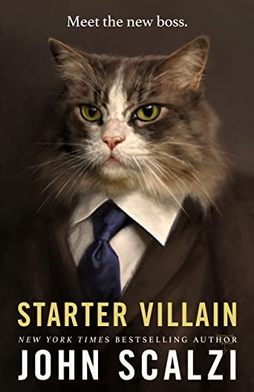
Some books entertain while quietly holding up a mirror to our moral imagination. Starter Villain by John Scalzi does this beneath its layers of parody and farce. It’s a tale of inheritance and absurd power, of a man who accidentally falls into villainy and finds, amid the ridiculousness of laser-sharks and talking dolphins, a strangely honest reflection of modern life.
The Sound of the Story
Listening to Wil Wheaton narrate Starter Villain is an experience in itself. His voice carries both the self-aware humor of a seasoned geek and the empathy of someone who has spent years navigating the frontier between earnestness and irony.
I first heard Wheaton narrate a Dungeons & Dragons-style audiobook—its title long forgotten, though the pleasure of his performance remains. He was instantly recognizable: clear, expressive, and grounded, with a knack for shifting tone and emotion without ever feeling forced. One of my favorite audiobook experiences is Ready Player One, and Wheaton was the perfect choice for that story. He gave it the heart and playfulness it needed.
Wheaton has since become one of my favorite narrators, and he seems to have found an ideal collaborator in John Scalzi. Their pairing feels natural—two voices fluent in humor, skepticism, and sincerity. Starter Villain continues that partnership beautifully. I suspect Redshirts will be my next stop on that journey.
Wheaton’s narration heightens the absurdity without losing the emotional thread. It captures Charlie’s reluctant transformation from ordinary man to accidental overlord—one who inherits a volcano lair, a union dispute among dolphins, and an army of intelligent cats who might actually be the most competent beings in the book.
A Worldview in Disguise
Beneath its comedy, Starter Villain presents a coherent worldview—secular, pragmatic, and faintly absurdist. It imagines a universe that owes us nothing, a world built from chance and stardust rather than destiny or design. In that sense, it shares more with Carl Sagan’s cosmic humility than with the triumphalism of most superhero fiction.
Scalzi’s universe is not one where grand virtue or divine purpose guides events. It is one where people—flawed, confused, and occasionally ridiculous—make the best decisions they can in systems they didn’t build. Charlie’s ethical compass is not idealistic but practical: he aims to do what’s least harmful in a world where purity is impossible. His choices resonate with the moral realism of everyday life, where ethics must coexist with entropy.
“We are made of star-stuff.” — Carl Sagan
The Reluctant Hero
Charlie’s journey follows the ancient arc of the reluctant hero, though filtered through a modern lens of economic disillusionment. At the start, he is a substitute teacher dreaming of opening a pub—a man more haunted by bills than destiny. When his estranged uncle dies and leaves him a villainous empire, Charlie steps not into greatness but into chaos.
He doesn’t crave power; he simply refuses to abdicate moral agency once power finds him. That quiet resistance—choosing conscience in the face of absurdity—is what makes him heroic. Like many of us, Charlie inherits a broken system and must decide whether to perpetuate it or transform it.
Scalzi’s satire of wealth and legacy suggests that evil, more often than not, is bureaucratic. The villains of Starter Villain aren’t dark geniuses but executives—men and women who file evil like paperwork. Their monstrosity is procedural, not passionate. Charlie’s victory lies in refusing to play the game on their terms.
Pragmatic Ethics and the Absurd
Ethics, in Starter Villain, are situational rather than absolute. The story unfolds not in a moral cosmos but in a comic one—where intent, context, and improvisation matter more than fixed codes. Charlie’s decisions reflect a pragmatism grounded in compassion rather than ideology.
This moral stance mirrors our own age: uncertain, pluralistic, and skeptical of grand narratives. Scalzi’s satire reminds us that most people aren’t villains or heroes—they’re employees. Systems corrupt not because individuals crave evil but because inertia rewards compliance. Charlie’s resistance is modest but meaningful: he treats others with decency even when surrounded by absurdity.
“The measure of a man is what he does with power.” — Plato
Parody and the Play of Power
For fans of spy thrillers and their parodies, Starter Villain reads like a mash-up of James Bond and Austin Powers—only the punchline is that everyone’s tired. Scalzi weaponizes the clichés of villainy—volcano bases, exotic pets, monologues—to reveal how hollow the glamour of domination has become.
The humor lands precisely because it feels familiar. The corporate jargon of evil empires is indistinguishable from a modern board meeting. The dolphins’ union negotiations parody labor disputes and political grandstanding alike. And the cats—aloof, cunning, almost mystical—feel like the only creatures still anchored to reality.
If the dolphins embody outrage without compassion, the cats embody poise without apology. They see through everything, as cats always do, and their quiet intelligence offers a counterpoint to the human noise. Their restraint is a reminder that wisdom rarely yells.
Flaws and Reflections
Not everything in Starter Villain works. The antagonists are broad caricatures, more outlines than people. Their simplicity makes the satire easy but limits its depth. The dolphins, meanwhile, are so abrasive they verge on parody of outrage itself—creatures defined by volume rather than conviction.
Yet even these flaws seem to serve a purpose. The villains’ flatness mirrors the emptiness of power. The dolphins’ endless shouting mirrors our culture of performative anger, where yelling replaces reasoning and division becomes identity. Scalzi exaggerates these tendencies until they become grotesque—then invites us to laugh, because laughter is often the last defense against despair.
“Humor is mankind’s greatest blessing.” — Mark Twain
Chance, Choice, and Inheritance
The novel’s philosophical heart beats in its treatment of inheritance. Charlie inherits not only an empire but a moral dilemma: what does one do with systems built by others? How does one act when every available choice is compromised?
In this, Starter Villain becomes a parable of contemporary life. Each of us inherits institutions—political, economic, familial—that precede us. We didn’t design them, yet they define our options. The moral question is not how to escape them, but how to live honorably within them.
Charlie’s answer is quiet defiance. He chooses kindness over cruelty, humor over cynicism, and collaboration over conquest. It’s a modest form of heroism, but perhaps the only kind available in a world where everything—including villainy—has been corporatized.
“In the midst of winter, I found there was, within me, an invincible summer.” — Albert Camus
Closing Reflections
Starter Villain may not pretend to profound philosophy, yet it embodies one: the absurdity of power and the possibility of conscience. It reminds us that life’s meaning rarely appears in epic form; it reveals itself in how we respond to the ridiculous.
Beneath the laughter and lava lies a meditation on responsibility. We are all, in a sense, “starter villains,” inheriting broken worlds and fumbling toward decency. The challenge is not to avoid the lair, but to humanize it—to bring empathy into the machinery of ambition.
Scalzi’s satire, filtered through Wheaton’s wry narration, invites us to do precisely that: to laugh, to think, and perhaps to remember that even in a universe of chance and star-dust, the smallest acts of integrity still matter.
“The absurd is born of this confrontation between the human need and the unreasonable silence of the world.” — Camus
What Starter Villian invites you to do
So what can we take from Starter Villain other than laughs and volcanoes? Here are three provocations for the reader willing to pause:
Ask: what have I inherited that I didn’t choose?
Whether it’s family legacy, career path, privilege or burden—Charlie’s inheritance is literal, but our inheritances may be metaphorical. How do we respond to what we inherit?
Consider: how do I act within a system I didn’t build?
Charlie lands in a villain empire not of his making. Many of us live in institutions we didn’t design. Do we replicate them, reform them, or redirect them?
Reflect: how much of my life is chance and how much is choice?
If you believe we are “products of random chance and star-dust” (to borrow your phrasing), then morality isn’t about destiny—it’s about response. It’s not “What should I be?” so much as “What will I do?”
Excerpt
A reluctant heir inherits a super-villain empire and discovers that decency can survive even in a volcano lair. Starter Villain turns satire into moral reflection—on power, chance, and conscience in an absurd world of talking dolphins, genius cats, and corporate evil gone comic.
References
- Bookwyrm’s Den. (2024, February 25). Starter Villain [Review]. The Bookwyrm’s Den. https://thebookwyrmsden.com/2024/02/25/starter-villain/
- Eric’s Binary World. (2024, February 27). Review: Starter Villain. https://www.ericsbinaryworld.com/2024/02/27/review-starter-villain/
- Kirkus Reviews. (2023, September 5). Starter Villain by John Scalzi. https://www.kirkusreviews.com/book-reviews/john-scalzi/starter-villain/
- Publishers Weekly. (2023). Starter Villain by John Scalzi. https://www.publishersweekly.com/9780765389220
- Reddit. (2024, April 3). Review: Starter Villain by John Scalzi – A fast, fun satire of villainy [Online forum post]. r/Fantasy. https://www.reddit.com/r/Fantasy/comments/1cct7xc/review_starter_villain_by_john_scalzi_a_fast/
- Scalzi, J. (2023). Starter Villain. Tor Books. https://us.macmillan.com/books/9780765389220/startervillain
- Tarvolon Books. (2024, June 23). Sci-fi novel review: Starter Villain by John Scalzi. https://www.tarvolon.com/2024/06/23/sci-fi-novel-review-starter-villain-by-john-scalzi/
- Wikipedia. (2024, March 15). Starter Villain. In Wikipedia, the free encyclopedia. https://en.wikipedia.org/wiki/Starter_Villain

 Treasures of the Elysian Fields
Leave a comment