

A Note Before We Begin
This post is not about morality, theology, or prescribing how anyone should think or behave. It is not a commentary on religious views, nor is it an argument for or against any particular moral stance. Instead, what follows is a curiosity-driven exploration—a look at how people talk about, experience, and make sense of human sexuality, especially through the lens of bisexuality.
Labels can be helpful, but they can also get in the way. They can clarify, but they can also confine. My aim here is not to say what is “right” or “true” for everyone, but to invite reflection. If anything, this is about asking better questions, not delivering definitive answers.
Introduction: When Labels Help—and Hurt
If you know me, you probably know I don’t particularly like labels. They have a tendency to reduce complex experiences to bite-sized slogans, and they often fail to keep up with the subtleties of human life. Still, labels do have their uses—they can help us navigate the social world, communicate something about ourselves, and even discover communities that resonate with our experience.
That said, sexuality is one of those areas where labels can both illuminate and obscure. Take bisexuality, for example. It’s often seen as a transitional category, a stepping stone, or even a myth. But what if that’s exactly backwards? What if bisexuality isn’t an exception, but rather the rule?
According to multiple studies, including recent data from YouGov and the Williams Institute, bisexuality may be the most common identity within the LGBTQ+ umbrella. And yet, it often feels invisible—rarely depicted, frequently misunderstood, and sometimes outright denied.
This blog post is an attempt to explore that paradox: how something so statistically common can remain so culturally elusive. We’ll look at the ways people have tried to map sexuality—through scales and grids, through stories and history—and ask whether a more fluid, more curious approach might serve us better.
So let’s start with a simple question: What if most people are, to some degree, bisexual? What if the boundaries we draw around identity are more about comfort than accuracy? And what might we see differently if we viewed sexuality not as a set of fixed categories, but as a shifting, multidimensional experience?
Section 1: The Hidden Majority?
It’s strange, isn’t it? In a time when conversations about gender and sexuality are more visible than ever, one of the largest groups within the LGBTQ+ umbrella remains largely invisible. According to a 2023 report from the Williams Institute at UCLA, over half—about 57%—of LGBT-identified adults in the U.S. describe themselves as bisexual. And yet, how often do we see bisexuality represented, discussed, or even acknowledged in public discourse?
Some of this invisibility is practical. Bisexual people often have relationships that look—at least from the outside—either heterosexual or homosexual, depending on the partner. Because of this, they may “blend in” with the majority, not out of secrecy or shame, but because their current situation fits comfortably into one of society’s more easily recognized categories. This fluidity, while natural, can paradoxically make bisexuality harder to see.
Then there’s the skepticism. Bisexuality is sometimes framed as a phase, a cover, or a kind of indecision—rather than a stable identity in its own right. This disbelief can come from all directions: from straight communities, from gay and lesbian spaces, and even from individuals questioning their own experiences. But the numbers suggest something else entirely. In fact, a 2015 YouGov UK poll found that fully 1 in 2 young people aged 18–24 did not identify as 100% heterosexual. That’s not a margin; that’s a majority.
So what’s going on here? Is this a social shift toward greater honesty and self-awareness? Is it a reaction to rigid norms that no longer fit the lived realities of younger generations? Or is it that bisexuality—far from being rare or marginal—has always been widespread, but only now are people starting to say so?
What makes bisexuality elusive might be the same thing that makes it so common: it doesn’t always announce itself. It exists in the in-betweens, in experiences that don’t demand a loud declaration. Maybe that’s why it’s been overlooked for so long—and maybe that’s why it’s worth a closer look.
Section 2: The Spectrum Lens
Is it just behavior—or is it also orientation? That’s one of the most persistent and perplexing questions when it comes to human sexuality, especially bisexuality. For some, engaging in same-sex behavior is enough to suggest a non-heterosexual identity. For others, identity is tied more deeply to internal orientation: whom you’re attracted to, what you fantasize about, or whom you’d consider forming an emotional relationship with—even if those feelings never translate into action.
Before I ever encountered formal models, I found myself wrestling with these questions and creating a mental framework to make sense of them. I imagined three separate but overlapping scales:
- Orientation – Whom are you attracted to?
- Behavior – What have you done?
- Relationship Desire – Whom would you want a relationship with?
This made intuitive sense to me. It helped explain some otherwise puzzling cases—like people who engage in same-sex experiences but insist they’re straight, or others who acknowledge attraction yet abstain for personal, cultural, or religious reasons.
One friend exemplifies this tension clearly. He describes himself as bisexual—not because he’s had same-sex relationships, but because he consistently experiences attraction to both men and women. Yet as a committed Christian, he believes acting on same-sex desires would be incompatible with his faith. He lives a life of selective abstinence. For him, bisexuality is an orientation, not a set of behaviors. That doesn’t make it any less real.
Later, I learned about the Kinsey Scale, introduced by biologist Alfred Kinsey in the late 1940s. Kinsey challenged the binary model of sexuality—heterosexual or homosexual—by proposing a seven-point continuum:
- 0 – Exclusively heterosexual
- 1–5 – Gradations of bisexuality
- 6 – Exclusively homosexual
This simple scale offered a revolutionary idea at the time: that most people do not fit neatly into two rigid categories. As Kinsey famously put it, “The world is not to be divided into sheep and goats.” Nature, he argued, rarely deals in absolutes.
But as helpful as the Kinsey Scale was, it still had limitations. It primarily measured behavior and history, not desire, fantasy, or identity. That’s where Dr. Fritz Klein’s Sexual Orientation Grid enters the picture.
Klein’s model builds on Kinsey’s spectrum but expands it dramatically. It includes seven dimensions: sexual attraction, sexual behavior, sexual fantasies, emotional preference, social preference, lifestyle preference, and sexual identity. And it charts these across three time frames: past, present, and ideal.
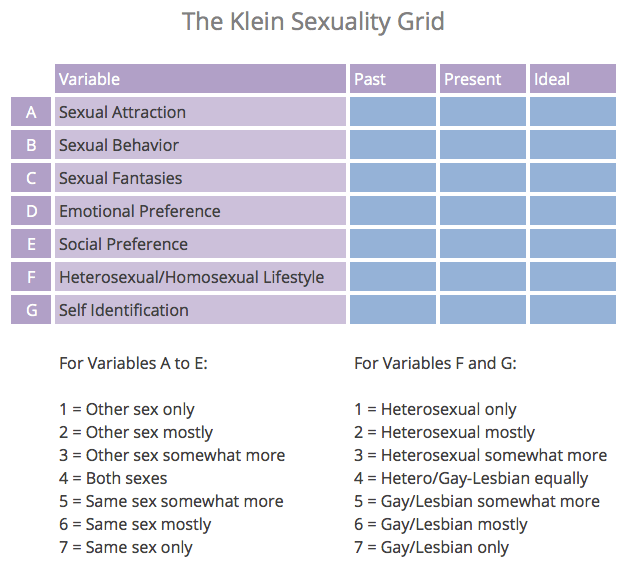
This grid captures something the earlier models missed: the richness of change over time, and the distinction between what people do, what they feel, and what they imagine. A person might have strong same-sex fantasies (present), no same-sex behavior (past), and an openness to future emotional connection (ideal). How do we label that? Maybe we don’t. Maybe we just listen and learn.
The Klein Grid doesn’t just offer more data points—it offers a more compassionate framework. It allows for nuance, for contradiction, for the ongoing evolution of self-understanding. And perhaps that’s the most honest way to talk about human sexuality: not as a fixed destination, but as an unfolding journey.
Locker Rooms, Denial, and the Hidden Currents
In high school, I remember a strange contradiction that played out daily in the boys’ locker room. The jocks—the socially dominant athletes—often strutted around naked, slapping each other on the butt, wrestling, and even engaging in what could only be described as ritualized homoerotic behavior. At the time, it felt oddly performative: proud, theatrical, but also somehow off-limits to anyone outside their circle. If you were not part of that inner group and you looked too long, or said the wrong thing, you’d be branded “gay” and punished—verbally or physically. They claimed ownership over a kind of male intimacy that was aggressively policed and fiercely denied.
Years later, I ran into a former classmate—a former jock—who shared something both surprising and illuminating. He told me that within his sports teams (lacrosse and rugby), many of the guys had engaged in full-on sexual acts with one another: oral sex, anal sex, the works. It wasn’t experimentation; it was regular. Some saw it as bonding, others as thrill-seeking, some even as dominance. But none of them considered themselves gay or even bisexual. “It was just a thing we did,” he said, shrugging. “We had girlfriends, too. Some of those guys are married now with kids. If you asked them today, they’d all say they’re straight.”
Some of them, he admitted, never stopped. They continued the behavior into college or adulthood—discreetly, on the downlow. They still identify as straight, and would deny any association with the term bisexual. To them, the acts were isolated from identity.
That disconnect—between action and identity—raises important questions. What do we make of people whose behavior suggests one thing, but whose self-description insists on another? Is identity purely internal? Is it a social construct? Or is it shaped, in part, by the narratives we’re allowed to tell without social cost?
The sports world, especially in more conservative or hyper-masculine settings, doesn’t exactly encourage nuance. A 2000s-era study titled Homophobia and Sport Experience found that athletes—particularly those from rural or conservative backgrounds—reported higher levels of homophobia than non-athletes. In such an environment, denial is not just common—it’s almost required. And yet, the behavior tells another story.
There’s a sociological term for this: situational homosexuality—same-sex behavior that emerges in all-male environments like locker rooms, prisons, or the military, often without an accompanying shift in sexual identity. It’s behavior that exists within a cultural loophole, both intensely present and officially invisible.
The takeaway here isn’t to “out” anyone or impose a label. Rather, it’s to point out that the landscape of sexuality is far more complex than most models acknowledge. Sometimes, what people do and what they say they are don’t line up—and that dissonance is worth examining, not judging.
Section 3: A Longer History Than We Realize
If we look into the past with today’s vocabulary, we might see a lot more bisexual behavior than we usually recognize. Much of what gets labeled as “homosexual” in historical retrospectives might, by current standards, more accurately be seen as bisexual. But here’s the catch: the people engaging in these behaviors didn’t think of themselves using those terms. They didn’t have “gay” or “bisexual” identities—not because they were closeted, but because such categories didn’t exist.
And that’s part of the point. Our modern language around sexuality—complete with labels, orientations, and identity politics—is a relatively recent invention. But the behaviors? Those go back as far as written history, and probably further.
Take the Greeks, for example. There’s a popular narrative that ancient Greek men were “gay.” But what the historical evidence actually shows is something far more complex. In societies like Sparta and Athens, same-sex relationships were often structured by age, status, and mentorship. Older men (the erastes) would mentor and sometimes be sexually involved with younger males (the eromenos), all while maintaining marriages and families. This wasn’t a contradiction. It was part of a culturally sanctioned life cycle.
To label these men “gay” by today’s standards overlooks the fact that most also had romantic and sexual relationships with women. In modern terms, many would be more accurately described as bisexual—but even that imposes a label they never would have used. What matters is that the behavior—attraction and relationships with more than one gender—was not uncommon.
And this isn’t limited to the Greeks. Roman soldiers, medieval knights, Renaissance poets, and even frontier cowboys have left behind traces of same-sex intimacy that coexisted with heterosexual relationships. Think of the old stereotypes: shepherds, sailors, monks, actors—occupations where men lived in close quarters, often away from women for long periods. Behaviors emerged in those environments that, while rarely discussed in moral terms at the time, suggest a broader and more fluid sexual reality than we usually acknowledge.
What we find, again and again, is that bisexual behavior—defined broadly as attraction or relationships with more than one gender—has always been with us. It may not have always had a name, but it has had a presence.
So when we talk about bisexuality today, we’re not talking about something new or trendy or confused. We may simply be rediscovering a truth that was always there—hidden not by secrecy, but by the limits of our own historical imagination.
Section 4: Nature’s Queer Kingdom
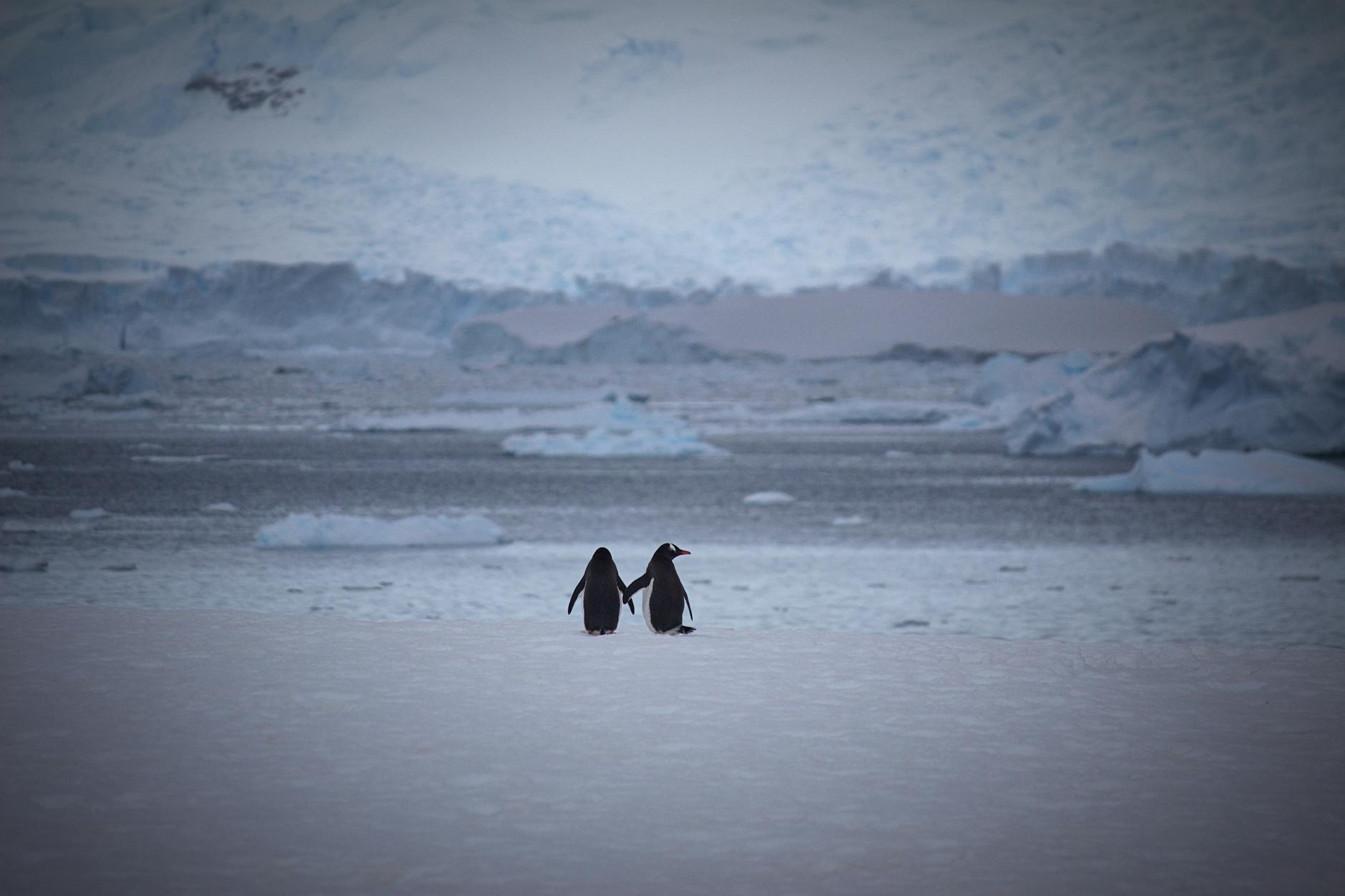
You’re probably thinking of the heartwarming story behind And Tango Makes Three, the children’s book based on real events at the Central Park Zoo. It’s often cited as evidence of “gay” behavior in animals. The story goes like this: two male chinstrap penguins, Roy and Silo, formed a pair bond. During mating season, they mimicked the nesting behaviors of other couples—even attempting to incubate a rock together. Moved by their dedication, a zookeeper gave them an actual egg that another penguin pair couldn’t care for. Roy and Silo took turns incubating the egg and, in time, hatched a chick named Tango.
It’s a beautiful story of cooperation, care, and partnership. But what exactly does it say about sexuality?
Calling Roy and Silo “gay penguins” might make for a catchy headline, but it misses something essential. First, penguins don’t have sexual identities in the way humans do—they don’t form personal or social identities around attraction. Second, the behavior here wasn’t sexual at all. It was parental. Labeling these penguins as “gay” because they raised a chick together is a bit like saying the men from Full House were gay. They weren’t in sexual relationships with each other; they were building a family for the sake of the children.
(Full House, for those who remember the late ’80s and early ’90s, featured a widowed father raising his three daughters with help from his brother-in-law and best friend. It was a story of unconventional family—not sexual identity.)
And this kind of mislabeling is not limited to penguins. Across the animal kingdom, researchers have documented countless examples of same-sex interactions—especially in species like bonobos, dolphins, and some birds. But these behaviors are typically occasional or contextual, not exclusive. In other words, they’re not instances of lifelong homosexual behavior, but of bisexual behavior by human standards.
In bonobo society, for example, sexual contact is a tool for social bonding and conflict resolution. Same-sex and opposite-sex interactions occur freely, often interchangeably. Male bottlenose dolphins engage in genital rubbing and complex social alliances with other males. Yet these same individuals also mate with females and reproduce. They’re not “gay dolphins.” They’re simply animals for whom sexuality serves more than just reproductive function.
If we step back from the need to label, what emerges is a broader pattern: nature doesn’t much care for our categories. What we see in the animal world is not evidence of rigid sexual identities, but of fluid, adaptive behaviors. Animals form bonds, seek pleasure, establish dominance, resolve conflict, and sometimes raise young—sometimes with members of the same sex, sometimes with the opposite.
So what are we really seeing? By our definitions, we’re seeing bisexual behavior—behavior that doesn’t conform to an either/or model. And maybe that’s the more useful takeaway. If the natural world is full of beings who engage in same-sex acts without needing to declare an identity, maybe our insistence on labels says more about us than it does about them.
Section 5: Maybe the Labels Are Shifting
If there’s one thing we seem to be universally wired for, it’s sex. Evolutionarily speaking, it makes sense—reproduction is the engine of natural selection, so it’s no surprise that sex tends to rank high on the list of things we’re interested in. But humans are unique in that sex isn’t just about reproduction. For many, it’s also about connection, pleasure, intimacy, status, even identity. And for some species—like bonobos and dolphins—it serves clearly social purposes, from conflict resolution to alliance-building.
Given all this, it’s worth asking: why are we so invested in labeling and categorizing something so fluid and multifaceted?
Over the last few decades, we’ve seen a cultural shift, especially among younger generations, away from fixed categories and toward more flexible, exploratory understandings of sexuality. Terms like queer, fluid, or pansexual have gained ground, and in many cases, people are opting out of labels altogether. Instead of declaring a fixed identity, some simply say, “I like who I like” or “It depends.”
Maybe this drift toward openness suggests something deeper: that the urge to label may sometimes cause more harm than good. Labels can help build community and offer language for shared experience—but they can also confine, stereotype, and create artificial boundaries. Especially when it comes to something as personal and context-dependent as sexuality.
Perhaps, rather than asking people to define themselves according to fixed categories, we might do better to just acknowledge that humans are sexual beings, shaped by biology, history, emotion, and choice. Maybe we don’t need to decide whether someone is really straight or truly bisexual or secretly gay. Maybe it’s enough to admit that most people, at some point, are drawn to others in ways that don’t always align neatly with a single label.
And maybe that’s okay.
This isn’t an argument for or against any particular kind of sexual behavior. It’s not about what is or isn’t moral, ethical, or ideal. Those are questions for a different kind of conversation. Here, the point is simpler: human sexuality is complicated. It shifts. It resists easy categorization. And maybe that’s not a flaw in our understanding—but a clue that our frameworks need to be more flexible.
If we can be honest about that—if we can let go of the need to fit everyone into neat boxes—then maybe we can have a more open, compassionate, and realistic conversation about who we are.
Conclusion: What If We Let the Questions Stay Open?
So where does this leave us?
We’ve looked at a wide range of stories and perspectives—from ancient Spartans to locker room rituals, from penguins in the Central Park Zoo to bonobos in the wild. We’ve explored different models of sexual orientation, from simple scales to multidimensional grids. And through it all, one thing keeps surfacing: human sexuality—like nature itself—is rarely binary, rarely simple, and rarely static.
Bisexuality, far from being a marginal or invented identity, appears to be deeply woven into our past and present. Whether expressed openly, quietly, situationally, or not at all, it’s there—often hidden in plain sight. And the more we examine it, the more we realize that many of our assumptions about sexual identity may be more cultural than biological, more reflective of our need for order than of the messiness of real experience.
So what if we stopped trying to force people—and ourselves—into categories that don’t always fit? What if we accepted that some people feel deeply bisexual, others less so, and still others are simply navigating desire, love, and intimacy as they arise?
What if, instead of asking What are you?, we asked How are you?
Instead of demanding definitions, we extended curiosity.
Instead of imposing identity, we made room for possibility.
Maybe the labels help. Maybe they don’t. Maybe the truest thing we can say is that most people like sex, and that how we express that—ethically, emotionally, personally—depends on far more than any label can capture.
And maybe that’s enough.
For Reflection: Questions to Sit With
As we wrap up, here are a few questions to consider—not to answer quickly, but to ponder slowly. These aren’t quiz questions; they’re invitations to look more closely at how we think about identity, desire, and the frameworks we use to understand them.
- Have you ever felt drawn to someone in a way that didn’t align with how you identify? What did you do with that feeling—and why?
- When you think about sexual orientation, do you picture behavior, feelings, relationships—or something else entirely?
- Are there moments in your past where a different cultural script might have changed how you understood yourself?
- Do you feel that the labels you’ve been given—or the ones you’ve chosen—fully capture your experience? If not, what’s missing?
- What might happen if we talked about sex more like we talk about music—something people experience differently, enjoy in varied ways, and explore over time?
Take your time with these. Let them do what good questions do: unsettle a little, illuminate a little more.
Excerpt
Bisexuality may be the most common and least acknowledged sexual identity. This post explores its complexity, historical presence, and the limits of labels—asking whether we need categories at all, or if it’s enough to simply admit: human sexuality is fluid, and maybe that’s more normal than we think.
Resources
- The Klein Sexual Orientation Grid, American Institute of Bisexuality, https://www.bisexuality.org/thekleingrid
- Andersen, M. B., Butki, B. D., & Heyman, S. R. (n.d.). Homophobia and sport experience: A survey of college students. Victoria University; University of North Carolina, Greensboro; University of Wyoming. https://krex.k-state.edu/server/api/core/bitstreams/1eb568cd-785f-4ef9-be3c-21424d631369/content
- The Bisexual Option: Second Edition 1st Edition, by Fritz Klein
- Dahlgreen, W., & Shakespeare, A.-E. (2015, August 16). 1 in 2 young people say they are not 100% heterosexual. YouGov UK. https://yougov.co.uk/society/articles/12999-half-young-not-heterosexual
- Flores, A. R., & Conron, K. J. (2023, December). Adult LGBT population in the United States. The Williams Institute, UCLA School of Law. https://williamsinstitute.law.ucla.edu/wp-content/uploads/LGBT-Adult-US-Pop-Dec-2023.pdf
- Jones, J. M. (2023, February 22). U.S. LGBT identification steady at 7.2%. Gallup. https://news.gallup.com/poll/470708/lgbt-identification-steady.aspx
- Robyn Ochs https://www.robynochs.com/
- Nimbi, F., Galizia, R., Rossi, R. et al. The Biopsychosocial Model and the Sex-Positive Approach: an Integrative Perspective for Sexology and General Health Care. Sex Res Soc Policy 19, 894–908 (2022). https://doi.org/10.1007/s13178-021-00647-x
- Kinsey scale https://en.wikipedia.org/wiki/Kinsey_scale
- Male homosexuality was not compulsory in Ancient Sparta https://exploregreeceguide.com/male-homosexuality-was-compulsory-in-ancient-sparta/
- Homosexuality https://www.pbs.org/empires/thegreeks/background/19a_p1.html
- Weekes-Shackelford, V. A., & Shackelford, T. K. (Eds.). (2014). Evolutionary perspectives on human sexual psychology and behavior (1st ed.). Springer. https://doi.org/10.1007/978-1-4939-0314-6


 Treasures of the Elysian Fields
Leave a comment