
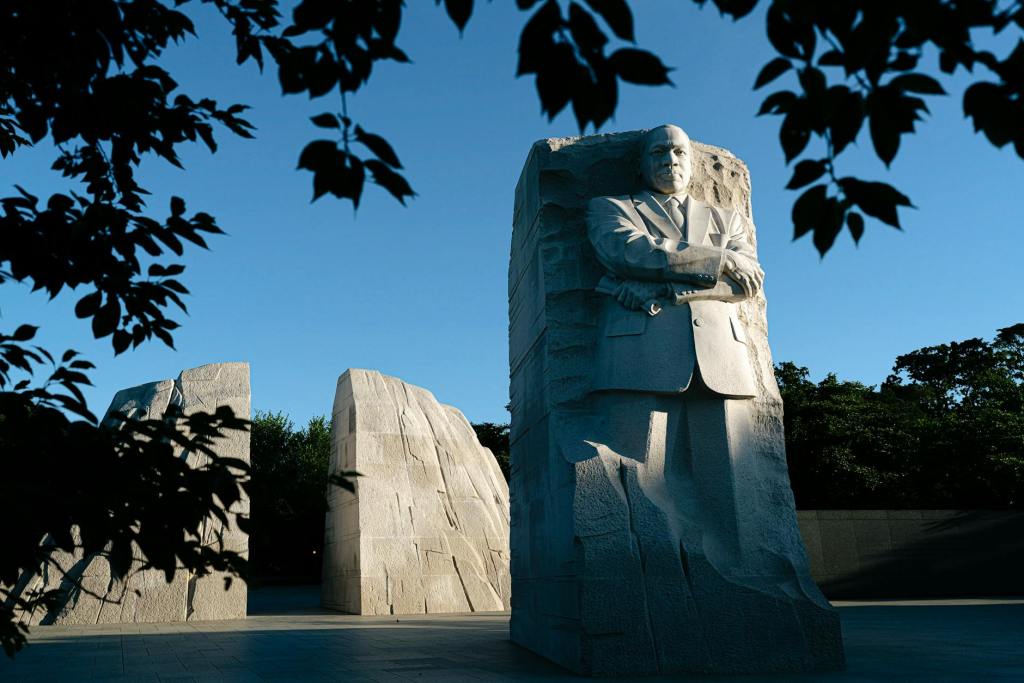
I. Introduction: A Personal Encounter with a Prophet of Love
While in college, I encountered the writings and speeches of Dr. Martin Luther King Jr. not just as a historical figure, but as something more enduring: a moral compass, a spiritual provocateur, and a revolutionary theologian of love. At a time in my life when I was grappling with what it meant to live meaningfully and faithfully, King’s voice broke through the noise—not with triumphalism, but with clarity, conviction, and compassion. His insistence on doing “the right thing, the right way, for the right reason” did not feel abstract or idealistic. It felt profoundly necessary.
There was, of course, his towering presence in the civil rights movement. But what moved me most was his unwavering commitment to Jesus Christ and to the radical implications of Christian love. His was a theology not confined to church pews or personal morality, but one that walked into the streets, sat at lunch counters, and stood on courthouse steps. King’s message was grounded in the belief that justice without love is tyranny, and that freedom without grace is hollow.
Some might argue—and they often do—that we should not overlook the flaws of our heroes. And that’s true: King, like all of us, was human, with failings and fractures. But the measure of a life is not perfection. It is faithfulness to a calling, and the fruits it bears. King bore fruit that nourished a generation—and planted seeds for many more. He made a difference, not by force or fury, but by living a principle as old as the Beatitudes and as defiant as the Cross.
In that light, King becomes more than an icon. He becomes a test. A question. A mirror. What does it mean to be free? And more deeply: What does it mean to be good?
His answer was not simplistic. It was layered—spiritual, philosophical, and practical. In what follows, I’d like to explore Dr. King’s threefold understanding of freedom:
1.) the spiritual freedom of reconciliation with God,
2.) the liberal freedom from arbitrary authority, and
3.) the disciplined freedom of nonviolent action.
These are not just political ideas. They are existential imperatives. And to truly hear them is to wrestle with them.
As King once wrote, “We are caught in an inescapable network of mutuality, tied in a single garment of destiny.” That’s not just a poetic flourish—it’s a diagnosis of our reality. If we are all bound together, then how we treat one another is not just a matter of ethics. It’s a matter of survival.
Let us begin there.
II. The Triple Meaning of Freedom in King’s Vision
Martin Luther King Jr. did not merely speak of freedom—he carefully distinguished between its dimensions, always anchoring it in both the eternal and the immediate. For King, freedom was not a singular concept but a trinity of liberations: from spiritual alienation, from political oppression, and from the cycle of violence that threatens to dehumanize both oppressor and oppressed.
A. Spiritual Freedom: Reconciliation Over Separation
Let’s begin where King began—with the soul.
Long before freedom became a political slogan, it was a spiritual condition. King, deeply rooted in Christian theology, understood sin not just as bad behavior but as separation—from God, from others, and from the self. He drew on theologians like Paul Tillich, who defined sin as separation and reconciliation as salvation. In this view, segregation wasn’t merely unjust; it was a spiritual sickness, a visible symptom of a deeper alienation.
When King said “We are all God’s children,” he wasn’t offering a sentimental bromide. He was affirming a metaphysical truth: that all human beings share a sacred origin and destiny. To divide ourselves by race, class, or creed is to reject the unity that God intended.
This view echoes through scripture—“the truth shall set you free”—but it also resonates with myth. One might recall The Lord of the Rings, where the Fellowship of the Ring, a band of unlikely companions, finds strength not in sameness but in their shared quest. Their enemy, Sauron, divides and conquers; their hope lies in fellowship. Just so, King believed, the moral arc bends only when we bend toward one another.
B. Liberal Freedom: The Enlightenment’s Promise Reclaimed
But King also spoke the language of Locke and Mill. He understood that in a democratic society, freedom must also mean liberty from arbitrary power—whether from a tyrant, a state, or a social system built on injustice.
He invoked the Declaration of Independence and the Constitution, not as outdated relics, but as “promissory notes” that had yet to be cashed for Black Americans. Civil liberties—freedom of speech, due process, equal protection—were not mere legal constructs for King. They were the secular scaffold upon which spiritual truths could stand.
This dual allegiance to divine law and natural law empowered King to practice civil disobedience with integrity. When he and his followers broke the laws of segregation, they were not lawless. They were appealing to a higher law—a law written on the heart, echoing Paul’s epistle to the Romans.
Some might object: “But isn’t breaking the law always wrong?” King anticipated this: “An unjust law is no law at all,” he wrote from the Birmingham jail, echoing Augustine and Aquinas. The measure of a law’s justice, he argued, lies in whether it uplifts or degrades the human person.
In modern myth, this moral clarity finds a curious echo in The Matrix. When Neo chooses to take the red pill, he disobeys the system—but in doing so, he aligns with a deeper reality. Like King, Neo is not a destroyer of order but a seeker of truth.
C. Discipled Freedom: Gandhi’s Swaraj and the Practice of Nonviolence
King’s third dimension of freedom came not from Europe or the Bible belt, but from India.
It was only after hearing a lecture on Gandhi that King saw how Jesus’ teachings could scale from the interpersonal to the societal. Before Gandhi, he believed love was good for individual relationships but insufficient for social change. Gandhi shattered that assumption. Through satyagraha—soul force—and swaraj—self-rule—Gandhi had turned nonviolence into a revolutionary strategy.
King took that method and baptized it in Christian love. The Montgomery Bus Boycott became the testing ground. Though not originally planned, it offered King a practical crucible for applying the nonviolent resistance he had only recently come to understand.
In this synthesis, Christ provided the ethic; Gandhi provided the strategy.
This blend of soul and strategy bears uncanny resemblance to Star Wars. In the final confrontation of Return of the Jedi, Luke Skywalker throws down his lightsaber, refusing to kill his father. It is not violence but vulnerability that breaks the Emperor’s power. Love triumphs—not by overpowering the enemy, but by transforming the relationship.
In King’s vision, then, freedom is not a monolith. It is a layered, living reality:
- A soul made whole in God,
- A citizen protected from tyranny,
- A community redeemed through peace.
Each layer enriches the others. Together, they offer not just a map of King’s philosophy—but a mirror for our own choices.
III. The Moral Architecture of King’s Activism
If Martin Luther King Jr.’s vision of freedom was the “what,” his moral architecture was the “how.” In a world tempted by the shortcuts of hatred, bitterness, and vengeance, King insisted on another way—one that was at once ancient and revolutionary: the way of Christian love, applied rigorously and consistently, even (and especially) toward those who do not deserve it.
A. Christian Love as Methodology
To love your enemies, to bless those who persecute you, to turn the other cheek—these were not metaphors or personal pieties for King. They were strategic imperatives. In the Montgomery bus boycott, King stood at the crossroads of centuries of Christian teaching and decades of racial injustice and made a choice: he would meet systemic hatred with divine love.
But this was no passive surrender. Nonviolence, for King, was not the absence of conflict—it was the presence of conscience. It demanded courage, discipline, and above all, moral clarity. One must be angry, but at the system, not the individual. One must hate injustice, not the unjust. As he put it, “Hate cannot drive out hate; only love can do that.”
This principle echoes through King’s speeches and sermons, but it also resonates with a line from Booker T. Washington: “Let no man pull you so low as to hate him.” It is a profoundly Stoic-Christian call to retain one’s dignity by refusing to mirror the methods of one’s oppressor.
A parallel can be found in Battlestar Galactica, where Admiral Adama declares, “It’s not enough to survive. One must be worthy of survival.” King’s movement sought not just political change, but moral high ground. To descend into retaliatory violence would have been to win the world and lose the soul.
B. Practical Action Rooted in Eternal Law
King’s methods were not just morally compelling—they were philosophically robust. In Letter from Birmingham Jail, he draws a careful distinction between just and unjust laws. Just laws are rooted in the moral law, what the medieval thinkers called lex aeterna—God’s eternal law, or natural law, which affirms human dignity and equality. Unjust laws, by contrast, degrade the soul and distort the image of God in the other.
By this reasoning, the civil rights movement was not lawless; it was profoundly lawful—faithful not merely to the Constitution, but to the transcendent source of all legitimate law. In King’s words: “A just law is a man-made code that squares with the moral law or the law of God. An unjust law is a code that is out of harmony with the moral law.”
This idea is not new. It echoes back to Aquinas, to Cicero, to the Stoics. But King applied it in a context where many had forgotten its implications. For him, civil disobedience was not rebellion—it was fidelity.
There’s a haunting parallel in Star Trek, particularly in the Next Generation episode “The Drumhead,” where Captain Picard defends a crew member falsely accused of sabotage. Picard warns, “With the first link, the chain is forged… the first time we deny freedom… we chain ourselves.” King understood this intuitively: to allow injustice to stand—even if not directed at you—is to enslave yourself to fear.
Martin Luther King Jr. did not choose love because it was easier. He chose it because it was the only way to heal without repeating the harm. His activism was not a rejection of anger, but a reformation of it—anger transmuted into creative, courageous love. In short, he had the high ground. His method was not just morally correct. It was spiritually transformative.

IV. King vs. Malcolm X: Two Paths Toward the Same Mountain?
Throughout the 1960s, Martin Luther King Jr. and Malcolm X were often portrayed as opposites—King, the preacher of peace; Malcolm, the prophet of power. But the contrast runs deeper than personality or rhetoric. It is a clash of moral frameworks—one grounded in eternal love, the other in historical urgency. One builds; the other strikes. And though both sought justice, only one sought it in a way that could heal the soul of a nation.
Malcolm X’s approach was rooted in a pragmatic realism. For him, nonviolence was not just ineffective; it was, in many contexts, a dangerous illusion. “Be peaceful, be courteous,” he said, “but if someone puts his hand on you, send him to the cemetery.” His model of freedom was sovereignty—not reconciliation—and his critique of America was brutal and incisive.
Some might argue that Malcolm was merely giving voice to the rage of the oppressed, and that his rhetoric was a necessary counterbalance to the slower progress of the civil rights movement. And to be fair, Malcolm exposed the hypocrisy of American ideals like few others. But here’s the danger: his method, though cathartic, threatens to enshrine retaliation as a political ethic. It risks replacing one imbalance of power with another. When victory becomes defined by who dominates, the moral compass spins wildly.
King chose another way. For King, the enemy was not the white man, but the system of dehumanization that taught people to hate across racial lines. “Darkness cannot drive out darkness; only light can do that.” This wasn’t naïve idealism. It was spiritual realism. He understood that hate, even when justified by suffering, corrodes the soul and perpetuates the cycle of violence. King’s method wasn’t just about achieving justice. It was about achieving it without becoming unjust.
In this light, King’s approach is not only more moral—it is more durable. Peace achieved through retribution is peace on a timer. Only love has the capacity to last.
Likewise, King’s goal was not to defeat white Americans but to redeem them. To awaken their conscience, not stoke their fear. To replace racial domination with what he called the beloved community—a society rooted in justice, equality, and love for even the least lovable.
King and Malcolm X stood on the same mountain of oppression, but they pointed in different directions. Malcolm’s path may have seemed more direct, more satisfying to those exhausted by injustice. But King’s was the only one that could lead not just to victory, but to peace.
V. Legacy and Echoes
When an assassin’s bullet took Martin Luther King Jr.’s life on April 4, 1968, some may have believed that they had silenced a voice. But they misunderstood the nature of a true prophet. King’s voice was never just his own—it was the echo of centuries of spiritual truth, political courage, and moral imagination. And like any true echo, it refuses to be silenced.
Consider the Montgomery Bus Boycott of 1955. It began not with a fiery manifesto but with the quiet defiance of Rosa Parks and the steady encouragement of people like Juliet Morgan—a white librarian who saw in King and Parks the fruit of Gandhi’s seeds. What followed was a disciplined, principled protest against the machinery of racial injustice. No firebombs. No mobs. Just a people, patient and resolute, refusing to stand up so long as injustice sat in power.
It was a moment that King later called “Montgomery’s finest hour.” And rightly so. For it was not just a political victory—though that came, when the Supreme Court ruled bus segregation unconstitutional on November 13, 1956. It was a spiritual turning point. A demonstration that love could move history.
One cannot reflect on King’s legacy without mentioning his Letter from Birmingham Jail, which remains one of the most important moral documents in American history. Written in the margins of newspapers, it speaks with the authority of a conscience rooted in both divine law and constitutional promise. King makes clear that disobeying an unjust law is not an act of anarchy—it is an act of fidelity. “An unjust law,” he wrote, “is a human law that is not rooted in the eternal law and the natural law.”
In this, King echoed not just Aquinas but the American Founders themselves. This was no rebellion. It was a call to return to first principles—a rebuke wrapped in reverence.
Moral Leadership in the Age of Darkness: A Star Wars Parallel
In a galaxy far, far away—where rebellion also rises against tyranny—we find an echo of this same moral struggle in Andor and Rogue One. The rebellion in Star Wars, like the civil rights movement, is not monolithic. It is fragmented, morally complex, and defined by its leaders’ competing visions of justice and victory.
Mon Mothma is, in many ways, the closest figure to King in this narrative. She works within the system as long as she can, leveraging diplomacy, truth, and moral clarity. She publicly condemns the Ghorman Massacre and the death of truth in the Senate, risking her family and her safety not through violence, but through conviction. Like King, she believes that the rebellion must stand for something, or it will fall for anything. Hers is a rebellion built on principle.
Saw Gerrera, by contrast, has discarded morality in favor of pragmatism. He has seen too much, suffered too long, and become convinced that only absolute destruction can bring justice. His methods mirror the fears King expressed when movements become consumed by rage: they risk becoming what they hate. Even Mon Mothma, no stranger to sacrifice, warns that Saw’s tactics are too extreme. He wins battles—but at the cost of his own humanity.
Luthen Rael occupies the shadowy middle ground. His haunting monologue in Andor—“I burn my life to make a sunrise I’ll never see”—reveals a soul sacrificed for the cause. He has become a manipulator, a tactician who believes the ends justify the means. While his sacrifices are real, they are also lonely and corrosive. He is effective, but not exemplary.
King would not have chosen Luthen’s path. He would have mourned Saw’s. And yet he would have understood the temptation of both.
That’s the core of his greatness: King chose the harder path—not just to win, but to win well. To hold the moral high ground when it would have been easier to trade it for results. His rebellion, like Mon Mothma’s, was not just about surviving evil. It was about defeating it without becoming it.
VI. Conclusion: What Will You Do With Your Freedom?
Martin Luther King Jr. did not offer us a formula. He offered us a question. What will you do with your freedom?
Not just political freedom, or economic freedom—but the freedom that begins at the soul-level. The freedom to love when it would be easier to hate. The freedom to stand for what is right when the world urges compromise. The freedom to suffer without becoming bitter, to lead without losing your way, and to fight without becoming the very thing you oppose.
King once said, “The time is always right to do what is right.” That is not a slogan. It is a commandment for a weary age.
We live in a world increasingly tempted by cynicism, tribalism, and despair. It is easier now than ever to believe that might makes right, that ends justify means, that moral clarity is a luxury we can no longer afford. But King reminds us—pleads with us—not to go down that road. His life is proof that there is another way.
He knew the cost. In his final speech, the night before his assassination, King said:
“I’ve seen the Promised Land. I may not get there with you. But I want you to know tonight, that we, as a people, will get to the Promised Land.”
This was not political rhetoric. It was prophetic vision. It was the voice of a man who had given everything and still believed love would have the final word.
His leadership was not defined by what he destroyed, but by what he built—hope, courage, dignity. A pathway for future generations not just to protest injustice, but to live justly.
In Star Wars: Rogue One, Jyn Erso reminds us that “rebellions are built on hope.” King knew that too. But hope is not optimism. Hope is defiant. It is a discipline. And it asks something of us.
So now the echo returns to you.
You may not lead a march or write a manifesto. But in your choices—how you speak, who you defend, what you love—you are answering King’s question. Will you sacrifice your soul to win the war, or will you save your soul and still change the world?
Let me leave you with one more quote—less famous, but no less potent:
“If I cannot do great things, I can do small things in a great way.” – Martin Luther King Jr.
May we do so.
Excerpt
Martin Luther King Jr. showed us that true freedom begins with the soul. He led not with hate, but with love—and proved that justice, pursued the right way, changes history. His legacy calls us to lead with courage, conviction, and compassion—even in the darkest times. What will you do?
Resources
- Letter from Birmingham Jail by Dr. Martin Luther King, Jr. https://letterfromjail.com/
- The Martin Luther King, Jr. Research and Education Institute, Stanford University, https://kinginstitute.stanford.edu/

 Treasures of the Elysian Fields
Leave a comment