
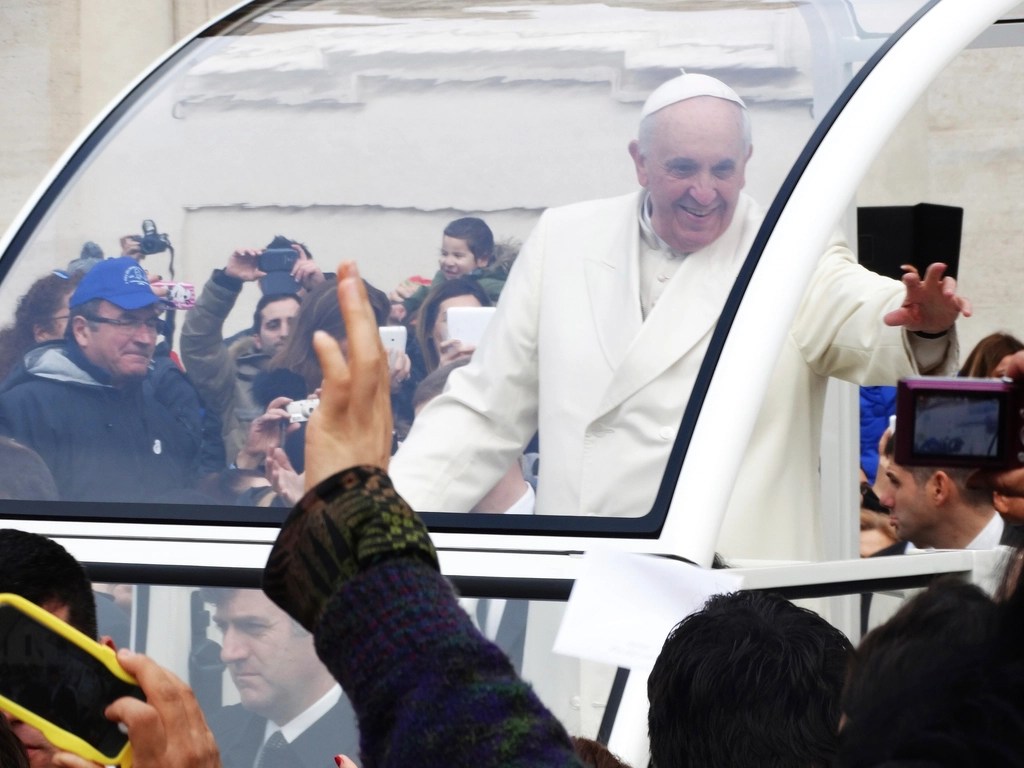
It is a curious paradox that I, a Protestant, should find myself writing a eulogy for a pope. Not just any pope, but one who—despite all the centuries of division, doctrine, and denominational distance—felt like a brother in Christ. With the death of Pope Francis on April 21, 2025, a light has gone out. But in true paradoxical form, what he stood for continues to shine—perhaps more brightly now that his earthly labor is complete.
Let’s begin with a personal note. Though I’m not Catholic, I have family who are, and over the years I’ve found myself drawn into their world through them. Catholicism’s rituals and hierarchy are not my path, but neither are they foreign to the broader Church. Francis, born Jorge Mario Bergoglio, seemed to understand this better than most. He was not only the first pope from the Americas and the first Jesuit to wear the papal white; he was the first in a long time to make many Protestants pause and say, “Yes. That sounds like Jesus.”
Francis dared to model orthopraxy—right practice—in a Church that has often been preoccupied with orthodoxy—right belief. He knelt before the poor, washed the feet of prisoners, embraced the disfigured, and never hid from the wounds of the Church. If theology is the map, he reminded us that love is the road. His encyclical Laudato Si’ called the Church to care for creation not as political action, but as spiritual responsibility. His welcoming posture toward the marginalized echoed Christ’s own openness—an echo not dulled by doctrinal disagreements.
A Protestant’s Admiration
Well, you might say, “Isn’t that a low bar? Shouldn’t every Christian leader show compassion?” Yes—and yet, we know that isn’t always the case. Francis’ distinction wasn’t in his theology (though thoughtful and pastoral), but in his steadfast commitment to living it out, even when it meant walking into the world’s messiest rooms.
He lived the Christian life like Frodo Baggins carrying the ring—not without burden or criticism, but with quiet resolve. And unlike many ring-bearers of leadership, he seemed to walk lighter the further he went, not heavier.
His decision to address issues like LGBTQ+ inclusion, clerical abuse, and even environmental degradation was not merely a progressive agenda—it was prophetic courage wrapped in humility. It reminds me of a line “Sometimes doing the right thing doesn’t mean doing the easy thing.” To his credit, Francis did not court favor, he courted Christ.
One of the moments that moved me most in Pope Francis’s final months was his unwavering participation in Holy Week and his appearance on Easter Sunday. Despite his illness—frailty visible, voice weakened—he showed up. He stood before the world not in strength, but in sacrificial love, embodying the very journey of Holy Week: suffering, perseverance, and resurrection hope. He did not allow sickness to sideline him from the Church he so dearly loved. His presence wasn’t just symbolic; it was a living testament to his devotion, a pastoral heart refusing to rest until the last Amen. To see him bless the faithful one final time on Easter, knowing what it cost him, was nothing short of Christ-like. He gave everything he had, right to the end.
And so it is deeply moving that, despite failing health, he pressed forward to deliver his final Easter address. I imagine that he must have prayed while he was in the hospital, “Lord, just one more,” like a spiritual reprise of Hacksaw Ridge’s medic Desmond Doss: “Help me get one more.” One more Easter. One more message of resurrection and hope. And he was granted that prayer.
What All Christians Can Learn
Imagine that we—Protestants, Catholics, and the Orthodox—stood side by side, not as competitors in ecclesiastical turf wars, but as co-laborers in Christ’s vineyard. Francis reminded us that unity is not uniformity. We don’t have to dissolve all differences to embrace our shared mission. In fact, perhaps some doctrinal issues—while important—do not rise to the level of schism. The ancient Church convened councils when things got tough. Why should we not do the same?
“The Kingdom of Christ is not divided.”
We are better when we give each other space to breathe, to worship, to wrestle. The apostles themselves disagreed. But the Body of Christ remained intact. Division, when not born of necessity, becomes sin—a wound in the side of the Church, a second crucifixion.
Francis, for all his titles and influence, never forgot the outcast. His example was a sermon far more persuasive than any treatise. Francis never sold illusions. He walked into pain—of abuse survivors, of war-torn refugees, of the abandoned and discarded—and tried to redeem it. For all God’s children.
“Your love for one another will prove to the world that you are my disciples.” – John 13:35 (NLT)
A Final Benediction
And now, he’s gone. A shepherd laid to rest. He leaves behind no perfect Church, no utopia. But he leaves a trail of grace. A life well-spent. And isn’t that, in the end, what we all hope for?
He was, “a candle in the darkness.” Not perfect. Not infallible. But faithful.
To my Catholic friends: I pray a blessing over you as you mourn and remember.
To all Christians: May we honor this man not by canonizing his legacy, but by imitating his kindness.
May we remember that the Church is not a fortress, but a ship—sometimes storm-tossed, sometimes listing—but still afloat. And Francis? He was no Ahab, chasing down phantoms of orthodoxy. He was more like a Jonathan, holding up the arms of a weary Church, pointing forward, and whispering: “Keep going. Love one more. Heal one more.”
And so we shall.
“Happiness in This Life” was one of Pope Francis’ more reflective books, and in it he said: “Holiness does not mean performing extraordinary things, but carrying out daily things in an extraordinary way.” That, perhaps, is his true legacy.
Excerpt
Despite illness, Pope Francis stood resolute during Holy Week, culminating in a moving Easter appearance. His love for the Church shone through weakness, embodying Christ’s passion and perseverance. Even in frailty, he served—offering one final blessing with grace, courage, and unwavering devotion. A shepherd to the very end.
Notes
A brief overview of his life.
Pope Francis, born Jorge Mario Bergoglio in Buenos Aires, Argentina, on December 17, 1936, was the son of Italian immigrants. He joined the Jesuit order in 1958 and was ordained a priest in 1969. Over the years, he rose through the ranks, becoming Archbishop of Buenos Aires in 1998 and a cardinal in 2001.
In March 2013, following the resignation of Pope Benedict XVI, Bergoglio was elected as the 266th pope, making history as the first pope from the Americas, the first Jesuit pope, and the first to take the name Francis, in honor of St. Francis of Assisi. His papacy was marked by a commitment to humility, social justice, and reform.
Pope Francis passed away on April 21, 2025, at the age of 88, after battling respiratory illness. His legacy remains one of compassion, reform, and inclusivity.
Resources
- Happiness in This Life: A Passionate Meditation on Earthly Existence by Pope Francis
- The life and times of Pope Francis https://www.straitstimes.com/world/europe/the-life-and-times-of-pope-francis
- Francis, Pope https://www.britannica.com/biography/Francis-I-pope
- Pope Francis has died. Here’s a timeline of some key events in his life. https://www.cbsnews.com/news/pope-francis-key-events-dates-in-his-life/

 Treasures of the Elysian Fields
Leave a comment