

Somewhere between Genesis and The Matrix Reloaded.
In The Matrix Reloaded, there’s a scene that is often missed or not discussed—but it’s one of the most profound in the film. Deep in the earth, in the hidden city of Zion, bodies writhe in rhythm and light. It’s not just a rave. It’s an orgy of defiance—a raw, pulsing affirmation of what it means to be human. The machines may control the world above, but down here, humanity reigns: sweating, dancing, desiring. No code, no circuitry—just flesh, friction, freedom. Not a fake imitation, a virtual world, but a world a flesh and bone.
This is not gratuitous. It’s symbolic. The last human city isn’t defended by weapons alone, but by embodiment itself. The very thing that makes us human, and not machine, is our biological essence—our capacity to feel, to unite, to desire. And, yes, to have sex.
But contrast that with the opening chapters of Genesis, where humanity is also defined by bodies—bodies created by God and found to be “good”. From the expulsion from paradise the commanded to “be fruitful and multiply.” And here, a question arises: Does this divine command reveal the telos—the purpose—of sex?
Is that all sex is for? Making babies (the procreation only view)? It’s fitting, then, to ask: What is sex for, really?
This second post in our series, “Sex, Sense, and the Sacred,” takes on the theological shorthand many of us have inherited: that sex is fundamentally, even exclusively, for procreation. We’ll explore what its implications are, and whether it holds up under the weight of logic, love, and lived reality.
Procreation Only
Some theological traditions—particularly within historic Catholic and Reformed circles—have long defined sex primarily, even exclusively, in terms of procreation. In this view, the moral and spiritual legitimacy of the act lies in its openness to creating new life. Pleasure, bonding, and emotional intimacy may be tolerated, but they are seen as secondary effects, not primary purposes. The telos—that is, the purpose—of sex is reproduction. Everything else is incidental.
But let’s test this view logically. If a sexual act cannot lead to procreation, is it still sex—or something else entirely?
Let’s walk through this idea carefully. Suppose, for the sake of argument, that the primary and defining purpose of sex is procreation. If we then define sex in terms of its intended outcome, we arrive at this: sex is any act that can potentially result in the creation of new life.
Under that definition, a number of common sexual behaviors would no longer count as “sex,” at least in a strict sense—because they cannot possibly lead to procreation.
Consider the case of a couple where one partner is sterile—either by voluntary means (like vasectomies or hysterectomies) or involuntary circumstances (like a birth defect or menopause). If procreation is impossible, then by this logic, any sexual behavior between them would not qualify as sex.
What about a married couple having sex purely for pleasure or intimacy? Surely, that’s a common and accepted part of many marriages. But if their intent isn’t procreation, then their activity—by the procreation-only definition—becomes morally questionable, or worse, not sex at all, but a self-indulgent act.
Let’s take it a step further. If procreative potential is the criterion for defining sex, then acts like oral sex, anal sex, or same-sex intimacy wouldn’t count as sex by definition. And if they aren’t sex, why are they subject to sexual moral rules? You can’t condemn something as “immoral sex” if, by your own definition, it isn’t sex at all.
Clearly, this logic leads to absurd conclusions. And that’s the point. The procreation-only view is often invoked selectively, particularly to oppose birth control or certain sexual behaviors. But when applied consistently, the logic collapses under its own weight. It becomes evident that procreation cannot be the sole defining purpose of sex.
A Broader View
Even in early Christian thought, the picture is more complex than this narrow frame allows. St. Augustine, while cautious about sexual pleasure, acknowledged within marriage that sex could serve both procreation and the “remedy of concupiscence.” Thomas Aquinas, too, in his Summa Theologica, affirmed that while procreation is a natural end, other goods—like marital fidelity and the containment of lust—are valid secondary ends. He did not treat non-procreative sex as non-sex.
From a philosophical standpoint, Aristotelian teleology helps illuminate the problem. In Aristotle’s system, the telos of something is its ultimate purpose—but that doesn’t negate multiple legitimate ends. A knife is made to cut, but it also carries aesthetic value and symbolic meaning. Likewise, sex may have a biological function, but that function does not exhaust its meaning. Human actions, unlike machine functions, are layered and multifaceted.
This richer view continues in more recent theology. In his Theology of the Body, Pope John Paul II redefined sexual intimacy in marriage as a “language of the body,” emphasizing not just the procreative, but the unitive dimension—the mutual self-gift and bonding of spouses. While he retained the Church’s commitment to openness to life, he also affirmed that physical love itself, even when not procreative, can express dignity, love, and spiritual union.
All of this points to a broader truth: if our theological frameworks cannot make space for sterile couples, aging bodies, post-surgical intimacy, or simply non-reproductive joy, then perhaps it’s not the human experience that’s failing the theology—but the theology that’s too narrow to bear the weight of human wholeness.
Defining Purpose vs. Recognizing Outcomes
To think clearly about sex, we need to make an important philosophical distinction: the purpose of something is not always the same as its effects.
Consider work. The purpose of work is to earn a living, contribute to society, and perhaps find meaning in productivity. One effect of work, however, might be stress, exhaustion, or even burnout. But no one claims that the point of work is to suffer. The effect may be real—but it is not the telos.
Sex operates in a similar way. It can lead to procreation—but that doesn’t mean procreation is its only, or even its central, purpose. To confuse consequence with purpose is to reduce a rich, multifaceted human experience to a single biological function. To be precise: procreation may be a purpose of sex, but it is not the purpose. That distinction matters—ethically, relationally, theologically.
The Trouble with Simplicity
Now, embracing a broader understanding of sex—one that includes pleasure, intimacy, union, and yes, procreation—doesn’t make the moral conversation simpler. In fact, it complicates it.
We humans tend to prefer clean categories. We crave black-and-white rules. A one-sentence theology of sex (“It’s for making babies!”) is tempting precisely because it’s easy to remember and easy to enforce. But ease does not equal truth.
When we face real situations—sterility, sexual trauma, aging, disability, emotional longing—the simple model begins to fall apart. It fails to account for the complexity of human experience. It cannot hold the weight of our real lives.
Wrestling with the Purpose
The Bible gives us a powerful image of what it means to engage with God and morality seriously—not as passive recipients of simplistic answers, but as wrestlers of truth. Jacob wrestled with God through the night, refusing to let go until he received a blessing. He walked away limping—but transformed.
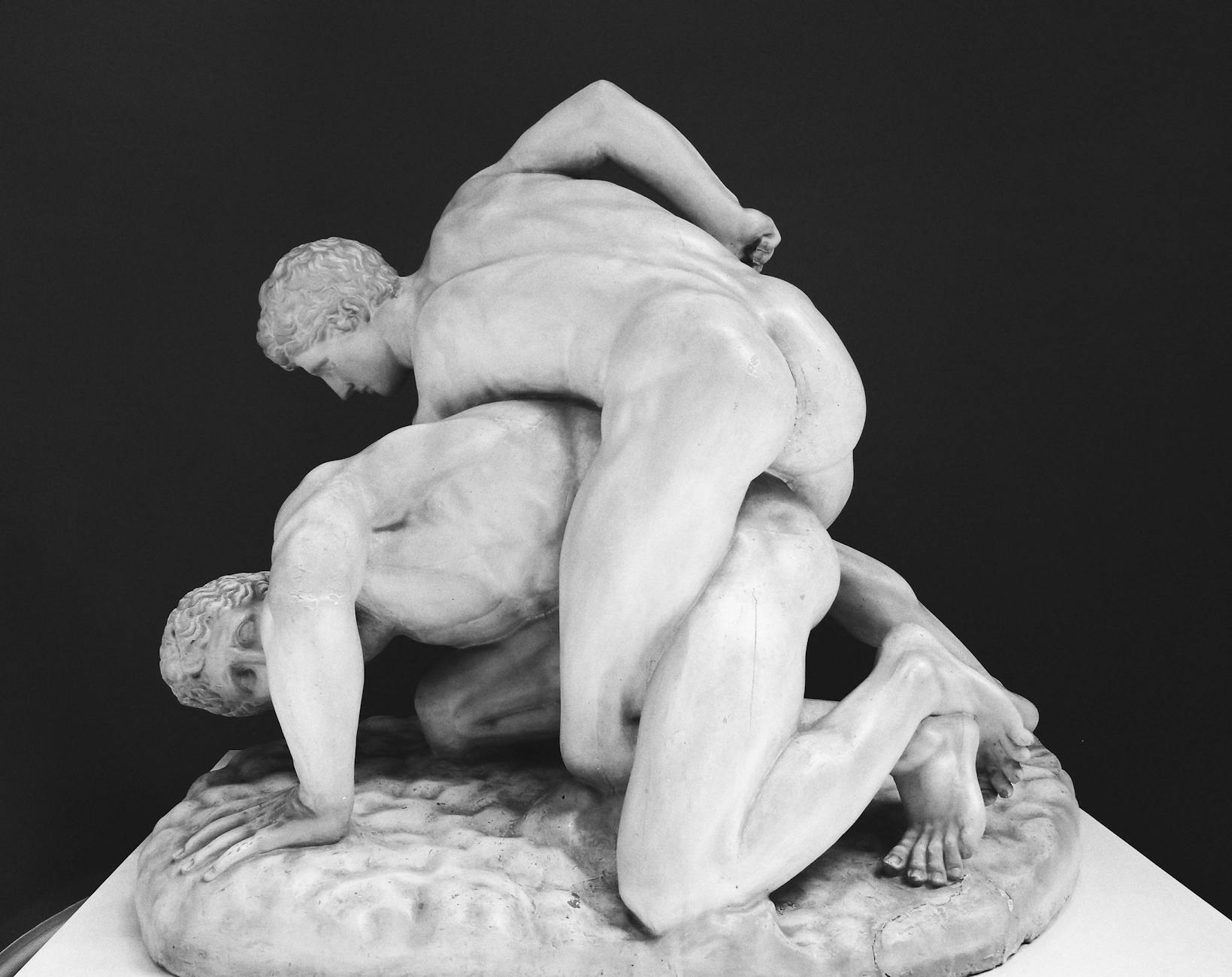
Maybe that’s what we’re meant to do with questions about sex. Wrestle. Struggle with purpose, context, and consequence. Engage with nuance. Not because it’s easy—but because truth is worth the effort. The Creator did not make us to be machines blindly following a single script. We were made to reason, to love, to inquire—and yes, to struggle. Reducing sex to a binary purpose may feel safe. But real moral growth comes not from avoiding complexity, but from entering into it.
What About the Bible?
“Well,” you might say, “Surely the Bible limits sex to procreative ends!”
Actually, it doesn’t.
Have you read the Song of Songs? It’s one of the most erotically charged texts in ancient literature—and it’s tucked right there in the middle of your Bible. This poetic celebration of physical attraction, emotional intimacy, and sensual longing is striking not just for its content, but for what it doesn’t include: there is no mention of children. The lovers are not concerned with producing heirs. They are enraptured with each other’s bodies, voices, scents, and presence. Their desire is delightfully mutual, unburdened by procreative aims.
I still remember reading it as a young boy and thinking, Is this really in the Bible? It was spicy stuff, especially for ancient poetry—though, to be fair, a few metaphors (“your hair is like a flock of goats…”) haven’t aged particularly well. Still, the Song of Songs stands as a biblical affirmation of sex that is joyful, relational, and intensely embodied, not merely reproductive.
Moreover, there is no scriptural command that every sexual act within marriage must be open to procreation. That notion arises not from biblical texts but from later theological tradition, often shaped by ascetic or monastic voices—celibate men attempting to interpret the joys and complexities of sexual union from a distance.
The Genesis Mandate: Not a One-Dimensional Command
Some appeal to Genesis 1:28—“Be fruitful and multiply”—as if it were a universal and permanent command that defines the sole purpose of sex. But a careful reading reveals a different picture.
This instruction was given specifically to Adam and Eve, the archetypal progenitors of humanity, at the beginning of the human story. It is best understood as a foundational blessing, initiating the population of the earth—not as a timeless moral prescription binding on every individual or couple for all generations.
In fact, it would be theologically irresponsible to claim that a single verse meant to launch human civilization must govern the legitimacy of every sexual act. Humanity has, quite clearly, fulfilled the task of being fruitful and multiplying. We are no longer in Eden, and the world is not underpopulated. We face ecological, social, and economic challenges today that Adam and Eve could not have imagined.
To use this verse as a blanket justification for limiting sex solely to procreative ends is to force it to do more theological work than it was ever meant to carry. It ignores the rich biblical witness that presents sex as a source of comfort, emotional intimacy, mutual delight, and covenantal bonding—especially within marriage.
Nowhere in Scripture are we told that sex loses its meaning or moral legitimacy once procreation is no longer possible. That idea is the product of theological tradition, not biblical mandate. In short, we must be cautious about building narrow moral frameworks on texts that are descriptive rather than prescriptive, and even more cautious about imposing obligations the Bible itself does not affirm.
What Other Traditions Teach: A Broader View from Hindu Thought
Consider the Kamasutra, attributed to the ancient Indian philosopher Vātsyāyana. Often misunderstood in the West as a mere erotic manual, the Kamasutra is actually part of a much broader philosophical system rooted in the purusharthas—the four legitimate aims of human life in Hindu thought: dharma (duty), artha (material prosperity), kama (pleasure), and moksha (spiritual liberation).
Within this framework, kama—sensual pleasure and emotional fulfillment—is not viewed as trivial or base, but as a valid and sacred pursuit. The Kamasutra explores sex not as mere physical gratification or reproductive utility, but as a pathway to intimacy, delight, and personal flourishing. It treats sexual union as something deeply human and richly layered—physical, emotional, and even spiritual.
Of course, the Kamasutra is more explicit than Song of Songs, its biblical counterpart in many ways. Yet both texts celebrate desire, beauty, and erotic love without framing sex solely around procreation. Where some Christian traditions have veered toward suspicion of pleasure, Hindu philosophy preserves a more holistic anthropology—affirming that the body and its desires are not corrupt by nature, but designed for joy and connection.
No, we don’t need to adopt every cultural or religious norm from other traditions to find wisdom within them. But neither should we ignore truth when it appears outside our walls. Sometimes, as with ships gathering barnacles after a long voyage, theology needs to undergo a careful cleaning. Some doctrines—especially those built more on inherited discomfort than biblical exegesis—may need to be reevaluated or cast off.
Hinduism, in this case, offers a compelling reminder: pleasure is not inherently suspect. Sex, rightly understood, is not a concession to sin, but a celebration of embodiment—a gift meant to be received with reverence, joy, and responsibility.
The Zion Rave
Let’s return for a moment to The Matrix Reloaded. That infamous Zion scene—dancing bodies, sweat-slicked skin, rhythmic motion—isn’t just about lust. It’s a visual protest against machine logic: the idea that purpose must be efficient, sterile, functional. The machines make babies in fields. The humans make love. That’s the real difference. We are not biological batteries!
Sex is not only sacred because it creates life. It is sacred because it celebrates life—intimate, embodied, complex, mysterious life.
A Fuller Vision
Let me be clear: this is not an attempt to undermine sexual ethics, but to strengthen them—by grounding them not in fear, taboo, or inherited discomfort, but in truth. However, I have no interest in sidestepping the elephant in the room or quietly nodding along when poor logic is dressed up as doctrine. When the foundations of a moral claim rest on shaky reasoning or selectively applied tradition, we do ourselves—and our faith—no favors by remaining silent.
We must engage with more than tradition. We must bring into conversation scripture, reason, experience, and honest inquiry. If that process unmasks certain rationalizations used to control behavior—so be it. Ethics that cannot survive scrutiny are not ethics worth preserving.
Let us dare to test our assumptions, to ask better and braver questions, and to follow the answers where they lead—even when they lead us out of our comfort zones.
Because truth—like love—is not afraid of examination.
And anything holy should not need to hide in the dark.
Next in the series: “Regret, Desire, and the Biology of Sex” — What do recent studies in evolutionary biology reveal about how men and women experience sex, desire, and regret differently? Drawing on biological investment theory and patterns of sexual behavior, we’ll explore why men are more likely to regret missed opportunities, while women more often regret sexual encounters they’ve had. These patterns aren’t just cultural—they’re rooted in reproductive risk, evolutionary incentives, and the age-old tension between instinct and expectation. What happens when biology meets modern morality? Let’s find out.
Excerpt
Is sex only for making babies? Many theological traditions say yes—but what happens when intimacy is no longer procreative? In this post, we examine flawed logic, sterile dogma, and the deeper purpose of embodied love. What if sex is about more than function—what if it’s about flourishing?


 Treasures of the Elysian Fields
Leave a comment