
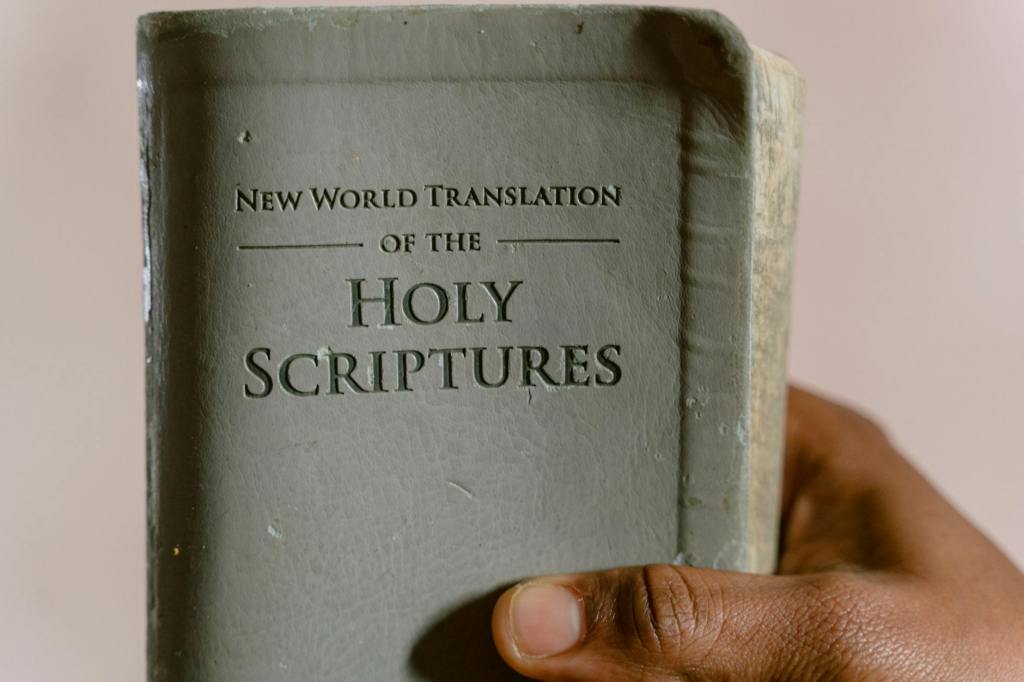
Seeking Truth or Justifying Belief? The Case of the New World Translation
We like to think of ourselves as seekers of truth—rational, objective, and open to wherever the evidence leads. But in reality, our beliefs often shape what we see, not the other way around. When faced with a challenge to our deeply held convictions, we don’t always pursue the truth with relentless honesty. Instead, we search for ways to justify what we already believe. This is especially true when those beliefs define our identity, our community, or our sense of purpose.
Religious texts have been at the center of this human tendency for millennia. The Bible, revered across many Christian traditions, has been translated and interpreted in ways that sometimes reflect more about the translators than the original texts themselves. One striking example of this is the New World Translation (NWT)—the official Bible of Jehovah’s Witnesses. Unlike mainstream translations that strive for linguistic and historical accuracy, the NWT appears to have been shaped by theological commitments first and foremost. Its unique renderings of key passages seem less like a pursuit of truth and more like an attempt to align Scripture with the beliefs of the Watch Tower Society.
Is this simply another example of doctrinal bias creeping into translation, or does it reveal something deeper about human nature? The tendency to shape reality around what we want to believe rather than letting reality shape us? In this post, we will explore how the New World Translation illustrates a fundamental challenge in the pursuit of truth—one that goes far beyond theology and into every aspect of human thought.
A Translation with a Purpose: The History of the New World Translation
The New World Translation of the Holy Scriptures (NWT) was not just another Bible translation; it was a theological project designed to align with the doctrines of Jehovah’s Witnesses. First published as a complete Bible in 1961, its development was overseen by the Watch Tower Bible and Tract Society, the governing organization of Jehovah’s Witnesses. The Society claimed that existing Bible translations were flawed—corrupted by theological bias, mistranslation, and the removal of God’s true name. To correct these issues, they sought to create a more “accurate” and “unbiased” translation, restoring what they believed had been lost or altered over centuries.
The project began in the late 1940s, and portions of the translation were released gradually. The first installment, covering Genesis to Ruth, was published in 1953, with additional sections following over the next decade. By 1961, the entire Bible had been translated and published in English. One of the primary justifications for this new translation was the belief that God’s personal name, “Jehovah,” had been systematically removed from modern Bibles. The NWT reintroduced “Jehovah” 237 times into the New Testament, despite the absence of the divine name in any known Greek manuscripts.
Over the years, the NWT has undergone significant revisions. A major update in 1984 refined the text, footnotes, and references. But the most substantial revision came in 2013, featuring modernized language and a more streamlined format. The translation has since been made available in over 200 languages, and digital editions, including audio versions, have been widely distributed. Jehovah’s Witnesses use the NWT exclusively in their worship services, evangelism, and personal study, making it central to their theological identity.
Scholarly Criticism and the Question of Theological Bias
No translation of a sacred text is immune from the influence of its translators. Whether intentional or not, the act of translating requires choices—choices about word meanings, grammatical structures, and theological implications. The New World Translation (NWT), however, has been widely criticized for taking this to an extreme, where the translation choices appear to serve doctrine first, linguistic accuracy second.
Who Translated the NWT? Anonymity or Cover-Up?
One of the most striking aspects of the NWT is that its translators have remained anonymous. The Watch Tower Bible and Tract Society claims that this was done to give glory to Jehovah God rather than to any individual translators. However, critics argue that this secrecy conceals the qualifications—or lack thereof—of the translators.
While the Watch Tower Society has never officially disclosed the names of those involved, former Jehovah’s Witnesses and researchers have identified six men who were allegedly responsible for the translation:
- Nathan H. Knorr (President of the Watch Tower Society; no formal training in biblical languages)
- Frederick W. Franz (Later President; self-taught in Hebrew and Greek but lacked formal academic credentials)
- Albert D. Schroeder (No formal training in biblical languages)
- George Gangas (No formal training)
- Milton Henschel (Later President; no formal training)
- One additional unidentified individual
Of these, only Frederick Franz had any real background in biblical languages, but even his knowledge was largely self-taught rather than acquired through formal education. This lack of scholarly training stands in sharp contrast to the teams of credentialed linguists and biblical scholars who typically produce translations such as the New International Version (NIV), English Standard Version (ESV), or New American Standard Bible (NASB).
This raises a serious question: Was the anonymity a sign of humility, or was it a way to avoid scrutiny? If the translators were truly competent, why not openly present their credentials as other translation committees do? Their lack of formal training, combined with the secrecy surrounding their identities, raises doubts about whether the NWT was produced through rigorous linguistic scholarship or simply shaped to align with Watch Tower doctrine.
Scholarly Criticism of the NWT
Many scholars have evaluated the NWT and found it deeply problematic, particularly in its rendering of key theological passages. Several respected biblical scholars have gone on record criticizing the deliberate theological bias in the translation:
Bruce M. Metzger (Princeton Theological Seminary)
- Identified explicit doctrinal bias in translation choices.
- Criticized “several quite erroneous renderings of the Greek.”
- Called certain characteristics of the NWT “indefensible.”
- Argued that key verses, such as John 1:1 (“the Word was a god”), were adjusted to support Jehovah’s Witnesses’ rejection of Christ’s divinity.
Dr. William Barclay (University of Glasgow)
- Accused the NWT translators of “deliberate distortion” and “intellectual dishonesty.”
- Stated that the translation was shaped by doctrinal commitments rather than scholarly integrity.
Robert McCoy (Andover Newton Quarterly, 1963)
- Described the NWT as “a shining example of how the Bible should not be translated.”
Dr. Harold H. Rowley (University of Manchester)
- Termed the NWT “a shocking mistranslation.”
- Published “How Not to Translate the Bible”, in which he outlined errors and theological bias in the translation process.
Dr. Julius R. Mantey (Greek scholar, co-author of A Manual Grammar of the Greek New Testament)
- Heavily criticized the grammatical and linguistic inaccuracies in the NWT.
- Strongly condemned its misrepresentation of Greek grammar to support Jehovah’s Witness theology, particularly in verses dealing with Christ’s divinity and the Holy Spirit.
The Core Issues: Bias Over Accuracy
The criticisms of the NWT largely fall into three categories:
Theological Bias
- The translation is accused of reshaping Scripture to fit Jehovah’s Witness beliefs, especially in verses concerning Jesus’ divine nature and the Trinity.
Grammatical and Linguistic Errors
- Scholars like Metzger and Mantey have pointed out that the Greek and Hebrew grammar in the NWT is sometimes twisted to support Watch Tower doctrine rather than accurately reflect the original meaning.
Lack of Scholarly Objectivity
- The secrecy surrounding the translators and their lack of formal training raise serious doubts about the credibility of the translation process.
The Name of God: Restoration or Reinvention?
One of the most distinctive and controversial features of the New World Translation (NWT) is its emphasis on using the name “Jehovah.” The Watch Tower Society claims that most Bible translations have deliberately removed God’s personal name, replacing it with generic titles like “Lord” or “God.” The NWT, in an effort to restore what was lost, inserts the name Jehovah throughout both the Old and New Testaments. However, this decision raises serious linguistic, historical, and theological concerns.
The Original Hebrew Name (YHWH)
In the Old Testament (Hebrew Bible), the most sacred name for God appears as four Hebrew letters: יהוה (YHWH)—commonly called the Tetragrammaton. Ancient Hebrew had no vowels, so the exact pronunciation of YHWH is uncertain. Many scholars believe it was likely pronounced “Yahweh.” However, due to Jewish reverence for God’s name, the practice of vocalizing YHWH faded over time. Instead, when reading Scripture aloud, Jews would substitute “Adonai” (Lord) or “Elohim” (God) in its place.
The Masoretic Tradition: Adding Vowels to YHWH
Between the 6th and 10th centuries A.D., Jewish scribes called the Masoretes developed a system of adding vowel markings to the Hebrew text to preserve pronunciation. However, instead of recording the true vowels of YHWH, they inserted the vowels from “Adonai” as a reminder to read “Adonai” aloud instead of pronouncing YHWH. This led to a misunderstanding among later Christian scholars.
The Emergence of “Jehovah”
Medieval European translators, unaware of the Jewish tradition behind the vowel markings, combined the consonants of YHWH with the vowels of Adonai, producing the hybrid term “Yehovah.” The name first appeared in Latin as “Iehovah” in the early 13th century and was later anglicized as “Jehovah” when the letter “J” came into use in English.
This means that “Jehovah” is not an authentic biblical name for God but rather a linguistic misunderstanding that emerged centuries after the biblical texts were written. Most modern scholars and translators reject the use of Jehovah, preferring “Yahweh” or simply using “LORD” in small caps to represent the divine name.
The Use of “Jehovah” in the New Testament
While inserting “Jehovah” in the Old Testament could be debated as an attempt to restore God’s name, its appearance in the New Testament is far more problematic. The Greek manuscripts of the New Testament never contain YHWH or any equivalent of “Jehovah.” Instead, the Greek word “Kyrios” (Κύριος, meaning “Lord”) is used. Despite this, the NWT inserts “Jehovah” 237 times into the New Testament—without any manuscript support.
The Watch Tower Society defends this choice by arguing that the original New Testament writers must have used “Jehovah”, but later scribes removed it. However, no Greek manuscript evidence supports this claim, making it an assumption rather than a scholarly conclusion.
More Theological Bias: Shaping Scripture to Fit Doctrine
The insertion of “Jehovah” in the New Testament is not just a linguistic choice—it reflects a broader pattern of theological bias in the NWT. By adding “Jehovah” where it does not appear in the original text, the Watch Tower Society reinforces its unique theological emphasis on God’s name and distinguishes its translation from mainstream Christianity. This practice, however, departs from established translation principles, which require fidelity to the earliest and most reliable manuscripts.
Additionally, by consistently translating “Kyrios” as “Jehovah” when it refers to God but not when it refers to Jesus, the NWT avoids passages that might imply Jesus’ divinity. This selective translation approach further undermines claims of objectivity and reinforces accusations of doctrinal manipulation.
Modern Scholarly and Linguistic Consensus
Today, biblical scholars overwhelmingly recognize that:
- “Jehovah” is not the original name of God but a later linguistic construct.
- No New Testament manuscript contains the Tetragrammaton (YHWH) or the name “Jehovah.”
- The NWT’s insertion of “Jehovah” into the New Testament is unsupported by any Greek textual evidence.
- While Jehovah’s Witnesses argue that they are restoring God’s name, scholars counter that they are actually imposing a theological preference onto the biblical text.
Implications for the New World Translation
The deliberate choice to use “Jehovah” in the New Testament despite a lack of manuscript evidence highlights a key issue with the NWT: it is not simply a translation but a theological reinterpretation. The insertion of God’s name where it does not exist in the original Greek reflects a broader pattern of doctrinal bias—one that prioritizes Watch Tower teachings over linguistic accuracy.
As we have seen with other aspects of the NWT, the goal seems less about uncovering the historical truth of Scripture and more about shaping it to fit a predetermined theological framework.
Clear Mistranslations in the New World Translation
A faithful Bible translation seeks to represent the original languages as accurately and objectively as possible. However, scholars have pointed out numerous instances in the New World Translation (NWT) where theological bias influences the rendering of key passages. These mistranslations often alter the meaning of the text to fit the doctrines of Jehovah’s Witnesses, rather than reflecting what the original Hebrew and Greek manuscripts actually say.
John 1:1 – “The Word Was a god”?
Perhaps the most famous and controversial mistranslation in the NWT is found in John 1:1, which reads:
“In the beginning was the Word, and the Word was with God, and the Word was a god.” (New World Translation, 2013 Edition)
This significantly departs from traditional translations, such as:
“In the beginning was the Word, and the Word was with God, and the Word was God.” (English Standard Version, ESV)
The difference may seem small, but the theological implications are enormous. The traditional translation affirms the divinity of Jesus, while the NWT’s rendering demotes Him to a lesser, created being.
Why Is “a god” Incorrect?
The Greek text of John 1:1 reads:
Ἐν ἀρχῇ ἦν ὁ λόγος, καὶ ὁ λόγος ἦν πρὸς τὸν Θεόν, καὶ Θεὸς ἦν ὁ λόγος.
(En archē ēn ho logos, kai ho logos ēn pros ton Theon, kai Theos ēn ho logos.)
The key issue is the phrase “καὶ Θεὸς ἦν ὁ λόγος” (kai Theos ēn ho logos), which literally translates to “and God was the Word.”
Greek Grammar Does Not Support “a god”
The NWT claims that because the word “God” (θεός, Theos) lacks a definite article (ὁ, “the”), it should be translated as “a god.”
However, Koine Greek does not require a definite article to indicate definiteness. In fact, placing “Theos” before “ho logos” (the Word) is a common grammatical structure used to emphasize the subject’s nature, not introduce an indefinite noun.
Greek Scholars Reject the NWT’s Rendering
- Dr. Julius R. Mantey (co-author of A Manual Grammar of the Greek New Testament) called the NWT’s rendering “a shocking mistranslation” and “grammatically indefensible.”
- Dr. Bruce Metzger (Princeton Theological Seminary) described it as “a deliberate distortion of the text” to fit Jehovah’s Witness doctrine.
- No Other Major Translation Uses “a god”
- Every respected Bible translation (KJV, NASB, ESV, NIV, RSV, etc.) renders John 1:1 as “the Word was God,” affirming Christ’s divinity.
- The only translations that use “a god” are those associated with Jehovah’s Witnesses or other groups that deny Christ’s full deity.
Other Key Mistranslations
While John 1:1 is the most infamous example, the NWT contains numerous other passages where translation choices reflect theological bias rather than linguistic accuracy.
Colossians 1:16-17 – Inserting “Other” to Deny Christ as Creator
NWT (2013):
“Because by means of him all other things were created in the heavens and on the earth…”
Greek Manuscripts:
“Because by means of him all things were created…” (No “other” present)
Issue: The word “other” does not appear in the original Greek but is inserted by the NWT to suggest that Jesus was created rather than the eternal Creator.
Titus 2:13 – Weakening Christ’s Divinity
NWT (2013):
“While we wait for the happy hope and glorious manifestation of the great God and of our Savior, Jesus Christ.”
Greek Manuscripts (Literal Translation):
“Waiting for the blessed hope and the appearing of the glory of our great God and Savior Jesus Christ.”
Issue: The Greek construction (“our great God and Savior Jesus Christ”) grammatically identifies Jesus as God, but the NWT alters the wording to separate “God” and “Savior” into two persons.
Luke 23:43 – Moving the Comma to Alter Meaning
NWT (2013):
“Truly I tell you today, you will be with me in Paradise.”
Traditional Translations:
“Truly I tell you, today you will be with me in Paradise.”
Issue: The placement of the comma shifts the meaning. In the Greek manuscripts, the natural reading affirms that Jesus promised immediate entry into paradise. The NWT moves the comma to delay the promise, aligning with their teaching that souls enter a state of unconscious sleep after death.
A Translation Shaped by Doctrine
These examples demonstrate that the New World Translation is not merely a Bible translation but a theological tool shaped to fit Watch Tower doctrine. By altering the text in key places, the NWT systematically downplays the deity of Christ, modifies key doctrines, and reinforces Jehovah’s Witness beliefs, often at the cost of grammatical accuracy and textual integrity.
Scholars widely reject these mistranslations, and the overwhelming consensus is that the NWT is a doctrinally-driven reinterpretation rather than a faithful translation of the biblical text.

How to Talk with Jehovah’s Witnesses at Your Door
When Jehovah’s Witnesses come to your door, they are not just stopping by for a friendly discussion—they are trained evangelists, well-rehearsed in Watch Tower doctrine and prepared to counter objections. However, what many people fail to realize is that Jehovah’s Witnesses are not accustomed to listening—they are conditioned to teach. Because of this, traditional debate tactics or confrontational arguments rarely work.
Jehovah’s Witnesses operate under a powerful confirmation bias. They are taught that those who oppose their beliefs are either deceived by Satan or actively persecuting them. This means that aggressive arguments, strong emotional appeals, or even well-reasoned logic may only reinforce their belief that they are on the right path.
If you want to have a meaningful conversation, it is crucial to understand their mindset and the control mechanisms of the Watch Tower Society.
Understanding the Cult-Like Influence of the Watch Tower Society
Jehovah’s Witnesses live within an intellectually insulated system, where the Watch Tower Bible and Tract Society maintains strict control over what they can read, think, and believe. A few key elements of this control include:
Avoiding Outside Information
- Members are strongly discouraged from reading non-Watch Tower material, including other religious literature, critical perspectives, or historical analyses of their movement.
- Questioning Watch Tower doctrine is seen as spiritually dangerous, even sinful.
- Any negative information about the organization is labeled as “apostate lies,” and Witnesses are told to avoid it at all costs.
Authority of the Watch Tower Society
- The Watch Tower explicitly teaches that individual members should not come to their own interpretations of the Bible but should instead accept the Society’s teachings without question:
- “Questions From Readers,” The Watchtower (April 1, 1986, pp. 30–31) instructs members that they should not interpret Scripture independently.
- “Make Your Advancement Manifest,” The Watchtower (August 1, 2001, p. 14) reinforces that trust in the organization is equivalent to trusting God.
- Question Box, Our Kingdom Ministry (September 2007) reiterates that Jehovah’s Witnesses should avoid independent thinking and stick to the Society’s explanations.
Emotional and Psychological Barriers
- Jehovah’s Witnesses are conditioned to believe that any doubts they experience are Satanic attacks.
- If they begin to question the organization, they may experience intense fear, guilt, or anxiety—what cult experts call “phobia indoctrination.”
- Because they have been trained to see the outside world as spiritually dangerous, any attempt to persuade them will be met with resistance.
How to Effectively Engage with Jehovah’s Witnesses
Because Jehovah’s Witnesses are trained to teach, not listen, the best way to have a productive conversation is to ask them thoughtful questions rather than making direct statements. Your goal is not to “win” an argument but to plant seeds of doubt that might later lead them to question the Watch Tower Society.
1. Ask Thought-Provoking Questions
Rather than telling them they are wrong, ask them questions that make them think critically. For example:
- “Can you show me one Greek manuscript where ‘Jehovah’ appears in the New Testament?”
- “Why does the Watch Tower teach that Jesus is not God, when Colossians 2:9 says, ‘For in him the whole fullness of deity dwells bodily’?”
- “If the Watch Tower Society has made errors in past teachings (such as predicting the end of the world multiple times), why should I trust them today?”
These types of questions force them to search for answers, and in doing so, they may begin to recognize the inconsistencies in Watch Tower doctrine.
2. Don’t Argue—Stay Calm and Respectful
Jehovah’s Witnesses are conditioned to expect hostility. If you become argumentative or aggressive, it will reinforce their belief that they are being persecuted. Instead:
- Keep the conversation friendly and respectful.
- Express genuine curiosity rather than an intent to debate.
- Let them speak, but gently challenge inconsistencies.
3. Challenge Their Trust in the Watch Tower Society
Since Jehovah’s Witnesses are taught to trust the organization above all else, one of the most effective strategies is to point out discrepancies in their own literature.
- Show them contradictions between older Watch Tower publications and current teachings.
- Ask them why the Watch Tower Society has made failed predictions (such as 1914, 1925, and 1975) and yet still claims to be God’s sole channel of truth.
- Bring up changes in doctrine and ask, “If the Watch Tower Society was wrong before, how do you know they are right now?”
Since Jehovah’s Witnesses are not allowed to read external sources, using their own literature can be an effective way to challenge their beliefs.
4. Recommend Books That Address Cult Mind Control
If a Jehovah’s Witness begins to express doubts, one of the best resources you can recommend is Steven Hassan’s “Combating Cult Mind Control.” Hassan is an expert on high-control groups, and his work helps individuals recognize manipulative techniques used by organizations like the Watch Tower Society.
You May Not See Immediate Results
Jehovah’s Witnesses rarely change their minds in a single conversation. However, if you plant a seed of doubt, it may grow over time. Many former Jehovah’s Witnesses say that their journey out of the organization began with a single question that they couldn’t answer.
The key is to engage with patience, kindness, and wisdom—not to win an argument, but to help them begin their own path toward truth.
Conclusion: The Danger of Letting Belief Shape Truth
Anyone who has ever worked on translating a text knows that language is not a simple one-to-one equation. The source language and receptor language often have different grammatical structures, idioms, and cultural contexts, making translation a complex task. Certain nuances may be lost in translation, and some words or phrases don’t have direct equivalents. This is why multiple legitimate translations of a text can exist—each attempting to faithfully convey the intended meaning while accounting for linguistic and cultural differences. However, while interpretation may vary, the duty of a translator is to remain as faithful as possible to the original intent of the text. When doctrinal bias influences the translation process, meaning can be deliberately distorted rather than simply lost, creating not just a bad translation, but a misleading one. This challenge is not just grammatical but cultural, as different worldviews can further shape and obscure how a text is understood. This is why honest translation requires discipline, scholarship, and integrity—something that critics argue is lacking in the NWT.
The New World Translation (NWT) stands as a cautionary example of what happens when theology dictates translation rather than the other way around. From its anonymous translators with questionable credentials to its deliberate mistranslations of key passages, the NWT reflects a process driven not by linguistic accuracy, but by the need to reinforce doctrinal beliefs. The insertion of Jehovah into the New Testament, the grammatical distortions in verses about Christ’s divinity, and the selective modifications to fit Watch Tower teachings all point to the same underlying issue: truth is being molded to fit a belief system, rather than beliefs being shaped by the pursuit of truth.
But this problem isn’t just about one religious group or one translation—it’s a universal human tendency. We are all susceptible to confirmation bias, seeking out information that supports what we already believe while ignoring or rejecting what challenges us. The question is: Are we brave enough to challenge our own assumptions? Are we willing to pursue truth, even when it takes us in uncomfortable directions?
Jehovah’s Witnesses are conditioned to trust the Watch Tower Society unquestioningly—not unlike how the citizens of The Matrix were trapped in an illusion, believing they were free while actually being controlled. Morpheus offered Neo a choice: stay in comfortable ignorance, or wake up to reality, no matter how difficult it is to accept. In the same way, when engaging with Jehovah’s Witnesses, the goal is not to force them to see the truth—only to offer them the red pill and let them decide whether they are willing to see where it leads.
At the end of the day, the pursuit of truth requires humility—the willingness to admit when we’ve been wrong, to re-examine our beliefs, and to follow the evidence wherever it leads. Whether we are examining a Bible translation, a religious doctrine, or even our own worldviews, we should always be asking ourselves: Am I seeking truth, or am I just seeking to justify what I already believe?
Excerpt
The New World Translation (NWT) is more than a Bible translation—it’s a theological reconstruction. From anonymous translators to doctrinally driven mistranslations, it reshapes Scripture to fit Watch Tower beliefs. True translation requires integrity, but when belief dictates the text, are we pursuing truth—or just justifying what we want to believe?
Resources
- New World Translation (Wikipedia) https://en.wikipedia.org/wiki/New_World_Translation
- New World Translation History 9 https://divine-name.org/new-world-translation-history/
- Penton, M.J. (1997). Apocalypse Delayed. University of Toronto Press. p. 372
- “Keep Your Distance When Danger Threatens”. The Watchtower: 23. February 15, 1994
- Questions From Readers”, The Watchtower April 1, 1986 pp. 30–31
- “Make Your Advancement Manifest”, The Watchtower, August 1, 2001, page 14
- Question Box, Our Kingdom Ministry, September 2007
- Walter Martin, Kingdom of the Cults, Expanded Anniversary Edition, October 1997, Bethany House Publishers, p. 123.
- R. Rhodes, The Challenge of the Cults and New Religions, The Essential Guide to Their History, Their Doctrine, and Our Response, Zondervan, 2001, p. 94
- Robert McCoy, “Jehovah’s Witnesses and their New Testament.” Andover Newton Quarterly. 3.3 (1963): 31.
- Dr. Julius R. Mantey, A Manual Grammar of the Greek New Testament
- Dr. Julius R. Mantey, A Hellenistic Greek Reader
- H.H. Rowley, How Not To Translate the Bible, The Expository Times, 1953; 65; 41
- Steven Hassan, Combating Cult Mind Control: The Guide to Protection, Rescue and Recovery from Destructive Cults
- Steven Hassan, Freedom of Mind: Helping Loved Ones Leave Controlling People, Cults, and Beliefs
Websites
- Watch Tower Bible and Tract Society of Pennsylvania https://www.jw.org/
- Freedom of Mind https://freedomofmind.com/
- Always Be Ready: A Christian Response to Jehovah’s Witnesses https://alwaysbeready.com/jehovahs-witnesses/
- Alpha & Omega Ministries https://www.aomin.org/aoblog/
- Christian Apologetics Alliance https://christianapologeticsalliance.com/
- Christian Apologetics and Research Ministry (CARM) https://carm.org/
- The Christian Research Institute https://www.equip.org/
- Christian Ministries International https://www.christianministriesintl.org/

 Treasures of the Elysian Fields
Leave a comment