
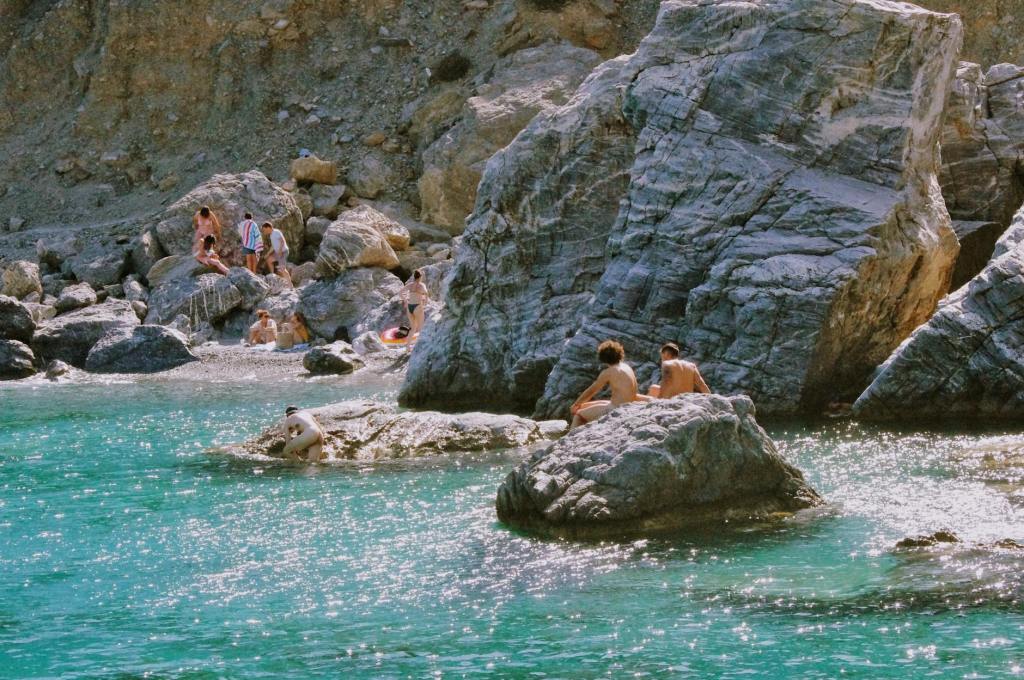
The True Nudist
Recently, I had a stimulating conversation with a fellow blogger about what it means to be a “nudist.” While we didn’t fully agree, the discussion left me pondering some important questions about labels and identity. Rather than filling up their comment section with a long response, I thought I’d bring my expanded reflections here, where we can take a deeper dive into the nuances of the label “nudist.”
Self-identifying labels, like “nudist,” often serve as a way to express values and find common ground with others. But they can also simplify complex, deeply personal journeys. Just as labels like “introvert” or “extrovert” might miss the full spectrum of someone’s social tendencies, “nudist” may leave out the diverse ways people connect with nudity, whether privately or socially. This post will explore the possibility that nudism exists on a spectrum, encompassing both private comfort and social engagement.
At the end of this post, I’ll share our original conversation and a link to my friend’s blog, where this exchange began. I hope this expanded reflection on nudism and self-labels encourages us all to think more broadly about how we identify ourselves and connect with others in community.
In my previous post Defining Nudism and Naturism, I explore how to define nudism in a way that reflects its diverse expressions, from private to social practices. While some see nudism as inherently social, requiring communal nudity to qualify, others believe it includes solitary experiences of comfort and freedom in being nude. I argue that rigid definitions may exclude valid forms of nudism and suggest instead viewing nudism on a spectrum, where both individual and social expressions are embraced. This approach fosters inclusivity, allowing individuals to identify as nudists in ways that align with their comfort, lifestyle, and values, without being restricted by narrow criteria.
The Story of Joe: A Journey Into Nudism
To kick off this conversation, let me tell you a story about a new friend, Joe, whom I met at a conference. During one of the after-hours gatherings, we got to talking about the perks of working from home, and somehow, the conversation veered toward the topic of nudism. Joe confided that he loved being naked around the house—it was freeing for him, a way to unwind and feel at ease. Every day, the first thing he did when he walked through his front door was shed his clothes and settle into a natural, unfiltered version of himself.
While Joe was enthusiastic about home nudity, he hadn’t yet tried being naked in a social setting. He was curious about it, even excited, but hadn’t found any local nudist resorts or gatherings to take that next step. The nearest resort was a considerable drive away, and Joe felt uncertain about venturing into a new community alone. He shared how reassuring it was to meet someone who understood his interests, and he was glad to hear that non-sexual nudity, even in a solo context, was more common than he’d realized. Joe also felt encouraged by the idea that nudism could exist on a spectrum—he didn’t need to go “all in” by immediately visiting a nudist resort to be considered a nudist.
My definition of nudism as a spectrum seemed to give Joe the assurance that his private experience was valid and that he could be part of the nudist community without fitting a rigid mold. I think he left that conversation with a bit more confidence, inspired to explore social nudity at his own pace. Who knows? Maybe someday I’ll bump into him at a resort or beach, taking that next step toward embracing social nudity. For now, I’m just glad my encouragement seemed to resonate with him, validating his journey as a budding nudist and reminding him that there’s no “one way” to be a part of this community.
Defining Nudism: The Social Element
In exploring what defines a “nudist,” my fellow blogger Jerry offered a perspective that nudism is, at its core, a social experience. For Jerry, true nudism extends beyond simply enjoying nakedness at home; it involves embracing nudity in the presence of others, such as at beaches, resorts, or other social spaces. He explained, “being among other nudists at a beach or a resort is the foundation of what nudism is” and questioned whether one can truly call themselves a nudist if they avoid all social nudity. To Jerry, nudism is not just a private preference but a communal practice.
This view raises an interesting question: does nudism inherently require social participation, or can it be a broader preference that includes both social and private expressions? If we were to adopt Jerry’s social-based definition, this could potentially exclude the millions of people worldwide who consider themselves nudists yet rarely, if ever, practice nudity in a social setting. Where does this leave those who may be passionate about nudism but only experience it privately, perhaps because of limited opportunities, privacy preferences, or geographic challenges?
Jerry’s approach offers a specific, community-oriented standard for nudism, emphasizing shared experiences over solitary ones. However, many nudists around the world find value and comfort in private nudity alone. These individuals might experience nudity as a form of self-liberation and body acceptance without necessarily engaging in social nudity. This more private practice could also reflect a different path within the larger nudist movement—one that might eventually lead to social nudity but doesn’t hinge on it as a defining characteristic.
In this light, perhaps nudism could encompass a range of experiences, from private to public, each reflecting a valid way of embracing nudity as a lifestyle. Adopting a more inclusive definition might allow for greater accessibility, encouraging those who identify as nudists but may not yet have ventured into social settings. At the same time, Jerry’s perspective on the essential role of community in nudism is a valuable reminder that, for many, the true heart of nudism lies in connection and shared experience.
The Demarcation Problem in Defining Nudism, The Challenge of Defining Nudist Identity
The challenge of defining “nudism” brings us face-to-face with what philosophers call the demarcation problem—the question of where to draw boundaries around a term or concept. Often, our everyday definitions feel adequate until we put them to the test, discovering that they may inadvertently include those we think don’t belong or exclude those we think do. A well-crafted definition should ideally determine who is in and who is out with clarity, encompassing all who identify with the concept while leaving out those who don’t. However, this precision can be elusive; as we refine the definition, we often find ourselves reopening loopholes or facing edge cases that defy easy categorization.
Disclaimer: In philosophy of science and epistemology, the demarcation problem specifically addresses the question of how to distinguish between science and non-science. In this article, however, I am using the concept and term “demarcation problem” in a broader sense, referring to the challenge of defining and distinguishing between different concepts or categories more generally.
With nudism, there is the added complication of self-identification and external labeling. People label themselves as nudists or naturists in ways that may not align with another’s standards or the group’s “official” definition. This raises difficult questions: should the nudist community “police” the term, enforcing criteria to protect the identity’s integrity, or should it embrace a broader, more inclusive definition that reflects diverse experiences and approaches to nudity?
Similar to the famous demarcation problem in science—where even experts struggle to define what qualifies as “scientific”—defining nudism with precision is challenging. Any attempt to codify the boundaries of nudism leaves room for debate and disagreement. As we attempt to set these boundaries, we must ask ourselves what truly matters: is it the community’s coherence, the inclusivity of the term, or the sense of belonging it offers to those who resonate with its principles? The answer, much like the definition, is complex and perhaps will always include an element of gray area.
The Dangers of Gatekeeping in Defining Nudism, Does Being a Nudist Require an Audience?
In discussing what defines a “nudist,” we encounter a psychological phenomenon known as gatekeeping. Gatekeeping involves restricting access to an identity or community by imposing rigid standards that one believes others must meet to be seen as a “true” member. In the context of nudism, a gatekeeper may argue that only those who embrace social nudity, attend nudist resorts, or regularly practice nudism in public spaces qualify as “real” nudists, excluding anyone who doesn’t meet these specific criteria. Gatekeepers often see themselves as custodians of a community’s purity, using their personal experiences and definitions as the yardstick for authenticity.
This restrictive approach is far from unique to nudism; gatekeeping can be found in many communities, whether centered around lifestyle choices, hobbies, or beliefs. In these cases, the gatekeeper views identity as a kind of purity test, where only the most extreme or committed adherents pass muster as genuine. But this exclusivity has its downsides. Gatekeeping can fragment communities and deter newcomers who feel intimidated or unworthy, limiting their opportunity to explore and connect with the group.
In nudism, gatekeeping might prevent those who primarily practice nudity in private or are new to the lifestyle from feeling welcome. It also risks creating a hierarchy within the community, where only the most “dedicated” are considered authentic, while others are dismissed as less genuine. In a movement aimed at body acceptance and personal freedom, gatekeeping undermines inclusivity by narrowing what it means to belong. By recognizing the value of diverse expressions within nudism, we foster a more open and supportive community, encouraging people to connect with the lifestyle in ways that feel right to them.
Another issue with gatekeeping is its inherent subjectivity. When one person sets rigid standards for what qualifies as “true” nudism, there’s always a risk that someone else will come along with an even narrower definition. This can lead to a chain reaction of escalating exclusivity, where each successive gatekeeper imposes stricter criteria, potentially excluding those who were previously deemed authentic. Ironically, even the original gatekeeper might find themselves suddenly “not nudist enough” in the eyes of the new standard. This cycle of ever-tightening definitions can fracture the community, turning what should be an inclusive, supportive space into one defined by competition and judgment. Ultimately, this undermines the essence of nudism, which is often about freedom, body acceptance, and personal comfort. Instead of fostering belonging, gatekeeping risks leaving everyone isolated by subjective standards that few can consistently meet.
Gatekeeping often comes with an undercurrent of superiority, where individuals establish a hierarchy of authenticity within the community—“I am a higher level nudist than you.” This mindset creates layers of worthiness and undermines the egalitarian spirit that many nudist groups cherish. Nudism is frequently celebrated as a movement rooted in body acceptance and mutual respect, yet a hierarchy of “true” versus “lesser” nudists contradicts these values. When newcomers or less “experienced” nudists are told they don’t measure up, it can erode their confidence and even hamper their journey toward body acceptance. Instead of feeling encouraged to embrace their own nudist path, they may feel inadequate, as if they need to meet an arbitrary standard of nudity to be fully accepted. This hierarchy of authenticity ultimately works against the core goals of nudism, fostering self-doubt rather than self-acceptance.
Testing the Definition of Social Nudism
The definition of nudism that requires social nudity—being nude in the presence of others—poses a number of issues when tested in various scenarios. Let’s examine a few examples that illustrate the limitations of this definition.
Imagine a person who enjoys hiking and camping alone in the wilderness, entirely naked. By a strict definition of social nudism, this person wouldn’t qualify as a “nudist” because they aren’t engaging in nudity within a social setting. Yet, they spend extended time outdoors, fully embracing nudity in a non-sexual and natural way. Now, what if this same hiker takes photos or videos of themselves to share later? Despite having documentation to share, they still aren’t in a social setting in the moment. Or consider that another hiker comes into their visual range, unaware of the nude hiker’s presence and vice versa—still, no social interaction occurs. Even if the hiker happens to meet someone on the trail, exchanges a quick hello, or stops to chat, would this brief social interaction now qualify them as a nudist?
In each of these cases, the hiker’s experience of nudity remains fundamentally the same. However, by requiring a “social” aspect to nudism, we end up with contradictory results: they wouldn’t be a nudist when hiking alone, but if another person happens to wander by, they suddenly are. The act of being nude in nature alone, which many might argue aligns well with the values of nudism, is rendered insufficient by a strictly social definition. This suggests that our definition may be overly rigid, excluding individuals who embrace nudism in solitary yet meaningful ways.
Conversely, let’s consider someone in a gym locker room, where nudity is a common, socially acceptable state. In this setting, individuals are nude in the presence of others—meeting the criteria of social nudism in its most technical sense. However, these individuals may not identify as nudists and may even reject the label if applied to them. To them, locker room nudity isn’t an expression of nudist values; it’s simply part of a routine. I’ve personally encountered someone in this situation who enjoyed walking around nude in the locker room, and engaging in conversation, but who bristled at the suggestion they were a nudist. For them, it was simply situational nudity, unrelated to the philosophy or lifestyle of nudism.
Fun Fact: The term Gym originates from the Greek word “gymnós” (γυμνός), which means naked. In ancient Greece, the word “gymnasion” (γυμνάσιον) referred to a place where people would exercise, often nude, as physical fitness was highly valued and nudity was seen as natural and even ideal in the context of athletic training.
These examples reveal that a strict social definition of nudism may not capture the full diversity of nudist experiences. A solitary nude hiker might align more closely with the values of nudism than a gym-goer comfortable with locker room nudity. In fact, the definition may need to be nuanced to acknowledge both social and individual expressions of nudism, recognizing that nudism may be less about the presence of others and more about the intent, comfort, and philosophy behind the act of being nude.
I hope these thought experiments encourage us to think more deeply about how we define nudism. You don’t have to agree with my perspective on it, and if you feel I’m overlooking something, please share your thoughts. Open dialogue is crucial here; it’s only through respectful discussion and exploring varied perspectives that we can move toward a definition that feels fair, inclusive, and representative of nudist values. Definitions evolve with conversation, and by considering multiple viewpoints, we can work toward a more thoughtful and widely accepted understanding of what it means to be a nudist.
Linguistic Hints: Nudism Beyond Social Settings
Interestingly, the language we use provides subtle clues that nudism may not be limited to social settings. The very fact that we need to specify social nudism by adding an adjective implies that nudism as a concept is broader than nudity in social contexts alone. Grammatically, adjectives like “social” modify nouns by adding specificity, which suggests that nudism in its broader sense encompasses more than just the social aspect. If nudism were inherently social, the modifier “social” would be unnecessary.
By specifying social nudism, we acknowledge that there are forms of nudism practiced outside communal or group settings. This opens up room for interpretations of nudism that include both solitary and social expressions of comfort with being unclothed. While social nudism emphasizes community interaction—being nude around others who share the same values—nudism without the “social” qualifier could equally apply to those who find peace, freedom, or self-acceptance in private nudity.
Therefore, while social nudism refers to the communal or shared aspect of nudism, the broader term nudism might simply describe a lifestyle or comfort with nudity in various contexts, whether alone or with others. This linguistic nuance invites us to consider nudism as a spectrum, where social engagement is one expression but not a defining necessity, thus creating space for diverse experiences and forms of self-identity within the nudist community.
The Role of “Being Seen” and Seeing Others in Nudism
An intriguing element of social nudism that my fellow blogger brought up is the importance many place on “being seen” by others and, conversely, seeing others nude. While nudism for me is the simple preference for being unclothed in non-sexual settings, the experience of social nudity appears to involve additional layers. At its core, being nude in social situations could appeal to a non-sexual form of voyeurism or exhibitionism—concepts that have historically been associated with sexuality but can exist outside of sexual contexts.
The term voyeurism, from the French noun meaning “one who sees,” typically refers to gaining enjoyment from observing others. In a non-sexual context, social nudism may satisfy an innocent form of voyeurism by providing a natural curiosity to see others without clothes, which may enhance feelings of community or shared experience. Similarly, exhibitionism generally refers to exposing oneself, often with a desire to be seen. Though exhibitionism is traditionally defined as an impulse with sexual undertones, in a non-sexual context, it can simply mean a comfort or preference for displaying one’s body openly, as in communal locker rooms or public nudist spaces. For some, this non-sexual exhibitionism may express pride, body acceptance, or even a desire to challenge social norms.
Jerry’s perspective on nudism echoes these ideas when he says, “if your nudity is secluded from others to the level that nobody ever sees you in the nude… you are not a nudist.” This definition implies that social nudism is not just about being nude but also about “being seen” in a public or communal setting. For example, take the case of a person who enjoys nude gardening in their private backyard. They may be seen by a neighbor without realizing it, but this doesn’t necessarily make the act of nude gardening a social one. Yet, the broader nudist community celebrates activities like World Naked Gardening Day, encouraging people to be nude outdoors without requiring a social aspect to the gardening. For some the potential to be seen in these situations could be part of the appeal lies in the potential for exposure, even in non-sexualized forms, which aligns more closely with non-sexual exhibitionism than with a strict nudist definition.
In some cases, non-sexual voyeurism and exhibitionism may partially explain why people enjoy social nudity—they provide opportunities for natural, non-judgmental observation and self-display. However, while these elements may enhance the experience of social nudism, they are not necessarily sufficient to define someone as a nudist. They area reason why someone may wish to be nude. Back to my friend at the gym who proudly walks nude through the locker room may enjoy being seen but may reject the label of “nudist” because the nudity is situational, not a lifestyle. Thus, the desire to see and be seen can be part of nudism, but it may not fully encapsulate the broader, lifestyle-oriented principles that true nudists embrace.
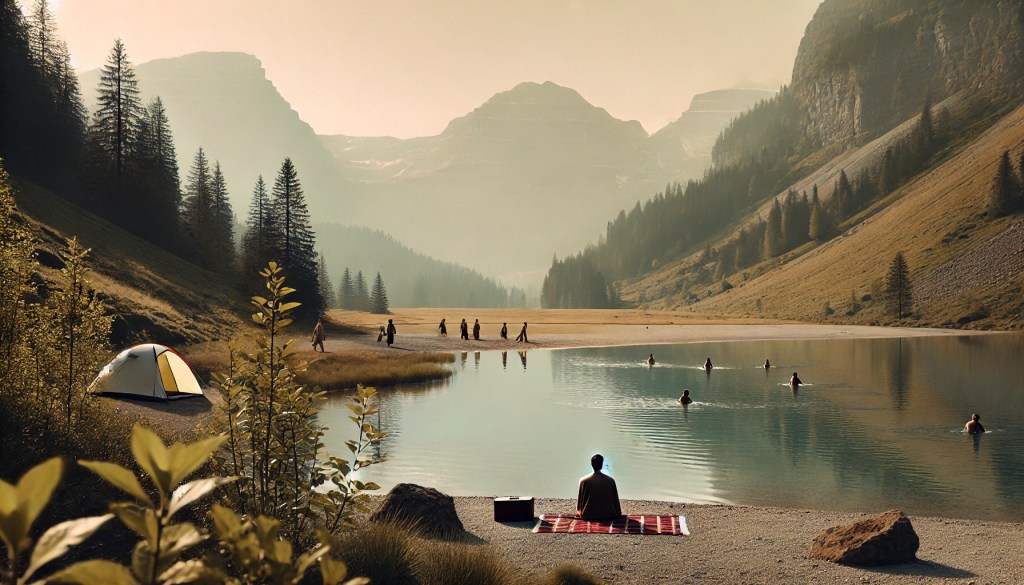
When I first visited a nudist beach, it was a stunning alpine lake nestled in the mountains, a place where nature felt as vast and liberating as the experience itself. Upon arriving, I was surprised to see nearly a hundred people scattered along the shore. I picked out a spot, laid down my things, and settled in to enjoy the sun, the breeze, and the cool waters. It was exhilarating to be nude in nature, surrounded by so many others who shared this openness. Yet, interestingly, despite being seen and seeing others, there was little social interaction. Most people had come in groups, chatting and laughing among themselves, while I found myself alone, without the boldness to introduce myself to others. As an introvert, I preferred to simply enjoy the peaceful solitude amid this natural gathering.
This experience underscored an important point for me: being seen or seeing others nude doesn’t necessarily mean the setting is “social” in the interactive sense. Even in a space where nudity is shared, interaction isn’t guaranteed. Without interaction, it can feel less like a social experience and more like parallel co-existence.
At that time and place, was I a nudist? The answer depends entirely on how one defines nudism, and that is precisely my point: definitions matter. How we choose to define nudism shapes our understanding of who qualifies and who doesn’t, and often, when we test our definitions in real-life situations, they can fall short or create inconsistencies. My experience at the lake exemplifies this. By some definitions, being seen nude around others would make me a nudist; by others, the lack of social interaction might mean I was simply someone enjoying solitude while nude. This raises an essential question about the flexibility and boundaries of our labels. Definitions can provide clarity, but if they are too rigid, they risk excluding valid experiences. Sometimes, to truly capture a concept like nudism, we may need to recognize a broader spectrum that allows for both social and solitary expressions.
Conclusion
In defining nudism along a spectrum, we open the door to individuals who may one day expand their comfort zones or find contentment in their current expression of nudity. This perspective, while broader, honors the diversity within the community and strengthens the potential for acceptance and normalization in society.
For me my nudist story began with sleeping in the nude when I was a child. Later it expanded to be nude when I was home alone. Later it progressed to being nude outside in nature and then finally, many years later I moved into social nudity. The spectrum easily accounts for the progression and for others who are just now dipping their toes into the waters of nudism it allows them the space to explore without the requirement that they take the big pledge all at once.
This progression seems to be important for normalizing and desexualizing the naked body. For people with body acceptance issues the big plunge may be too much for them to bear. Allowing apace for them to get comfortable in their own skin but dipping their toes in may be the path they need.
Look I don’t have a horse in this race, I practice social nudity so I can be a “true nudist” but for me I think strictly requiring a social aspect to be a nudist is not welcoming or giving many a sense of belonging to a larger community.
Reflection, Is Social Interaction Essential or Optional?
- If you feel most comfortable being nude only in private, does that make you any less of a nudist than someone who regularly attends nudist events?
- Should nudism require a social element to be considered “authentic,” or can it be a solitary practice? What might be gained or lost by including or excluding social interaction?
- Is it important for nudists to “be seen” by others, or is nudism more about the individual experience of being in one’s natural state?
- How might defining nudism as a spectrum of experiences—from private comfort to social engagement—affect perceptions of what it means to be a nudist?
- Do you think gatekeeping within the nudist community helps preserve its identity, or does it risk excluding people who may genuinely resonate with nudist values?
- If someone practices nudity without identifying as a nudist, does that challenge or expand your definition of nudism?
- How do you think definitions of nudism might change if they were rooted in intent and comfort rather than specific actions or settings?
Original Conversation
Jerry
“I think that I feel at times that there is some kind of bar you have to meet to be called an actual nudist…Is there an actual like marker to get to in terms of how many hours a year you go nude to reach the level of being a nudist. Not just home nude hours but at social areas, beaches, resorts. I will never really call anyone a nudist if they refuse to be nude around other people.”
Nomen
Thank you for sharing this thought-provoking post! I appreciate your honesty and exploration of what it means to be a nudist. Personally, I think of nudism as more of a spectrum rather than an all-or-nothing label. For some, nudism might mean a preference for simply being nude at home or while sleeping, while for others, it includes being nude in social settings or spending extended time at resorts or beaches. By thinking of it as a spectrum, with a range from a bit of private nudity to being nude in more public and social settings, it might open up a more inclusive perspective on what nudism can be.
I think this approach can make the idea of nudism feel more accessible and valid for those who may only have opportunities to practice it occasionally or in private. Embracing this spectrum might help more people feel comfortable exploring nudism at their own pace without feeling like they need to meet a specific benchmark to “qualify” as a nudist. Looking forward to seeing where your journey takes you!
Here are some of my thoughts on naturism https://nlirien.wordpress.com/tag/naturism/
Jerry
I do feel at least for me that a nudist is not one that is say simply nude alone at home, nudism at it’s core is a social avenue. I feel yes you can sit at home in the nude if you prefer to do it in that manner, but for me if your nudity is secluded from others to the level that nobody ever sees you in the nude. For me you are not a nudist, just someone who enjoys being naked at times in your own home. I would never call myself a nudist personally if my nudity was never around others or never seen by others.
Nomen
Thank you for sharing your perspective! I really appreciate the depth of thought you’ve put into what it means to be a nudist and how you view the social aspect of nudism as essential. I completely understand where you’re coming from—there’s a unique freedom and community that comes with being nude around others, and that connection can indeed feel like the heart of nudism. At the same time, I think viewing nudism as a spectrum can be helpful in bringing greater awareness and support to those curious about it but who may only be comfortable with private nudity for now.
For some, starting with private nudity can be a stepping stone that eventually leads to social experiences, while for others, it may be all they’re comfortable with or have access to at the moment. By recognizing this as part of a spectrum, we might encourage more people to explore nudism in a way that feels right for them, helping them ease into the community and possibly find their own path to social nudity. Thank you again for helping bring such thoughtful insight to the conversation—it’s a valuable perspective that helps deepen our understanding of nudism.
Jerry
So for example if your own daughter was only ever nude in the shower, would you call her a nudist?
Nomen
Good question. I think it is an extreme example and not really what we are going for but if they identify as a nudist, even if it’s in a way that might not align with our definitions, who are we to dismiss that? Embracing nudism as a preference for nudity along a spectrum allows more people to connect with it in a way that feels natural and authentic for them, whether that’s limited to private moments like sleeping or extends to social experiences. A spectrum definition creates more nudist and helps to normalize nudism. We could limit the definition of nudism to only social situations and that would by definition decrees the number of “true nudists” and exclude many who currently identify as nudists. Let’s say we do that and now we have to tell people sorry you are not one of us because you are only nude at home. It seems to me to work against normalizing nudity.
Normalizing nudity will help reduce the stigma around it and encourage people to become more comfortable with their own bodies. Ultimately, this broader understanding could create a more inclusive and accepting society where nudity isn’t automatically tied to shame or judgment. There’s definitely wisdom in opening the conversation like this for all of us.
Jerry
But you have to see it like this too, if I watched a show on medicine and I read medical books. Does it make me accepted as a Dr? Simply put just being nude does not make one a nudist, regardless of what they think. Nudism in itself is an actual social construct. I would never label myself a nudist if I was never nude with other people. You can be a home nudist yes, but if your nudity is never visual to others then you are no different than someone changing clothes who was nude for a few seconds.
Nomen
Thanks for sharing your thoughts, Jerry! I just want to make sure I fully understand your definition of nudism. From what I gather, would you say that, to you, a nudist is defined as someone who is not only comfortable being naked but also chooses to be nude in the presence of others? In other words, is the visibility to others a key factor in your view of what makes someone a nudist? Just trying to clarify, as I think it’s an interesting point that highlights the social dimension of nudism!
Jerry
Yes for me and others nudism is a social thing, being among other nudists at a beach or a resort is the foundation of what nudism is. As I said for me if I am never nude around others I am not a nudist. Nudism/Naturism-Naturism is a lifestyle of practicing non-sexual social nudity in private and in public; the word also refers to the cultural movement which advocates and defends that lifestyle. Both may alternatively be called nudism.
Nomen
Thanks so much, Jerry, for taking the time to engage in this discussion. I really appreciate hearing your perspective on nudism as a social experience. It’s inspired me to think more deeply about how we define nudism, especially around the social versus private aspects. This conversation has given me a lot to consider, and I think I’ll write a blog post on the topic, reflecting on our discussion. Thank you again for sharing your insights—it’s a meaningful contribution to an important topic!
References
- Gatekeeping Behavior: Causes, Consequences, and Strategies for Overcoming It https://neurolaunch.com/gatekeeping-behavior/
- Our Common Strive for Originality: Why Do We Gatekeep? https://www.theteenmagazine.com/our-common-strive-for-originality-why-do-we-gatekeep
- Katherine Dormandy & Bruce Grimley (2024) Gatekeeping in Science: Lessons from the Case of Psychology and Neuro-Linguistic Programming, Social Epistemology, 38:3, 392-412, DOI: 10.1080/02691728.2024.2326828 https://doi.org/10.1080/02691728.2024.2326828
- Pseudoscience and the Demarcation Problem by Massimo Pigliucci, Internet Encyclopedia of Philosophy, https://iep.utm.edu/pseudoscience-demarcation/
Excerpt
Nudism is often defined by shared experiences, yet personal nudity holds its own significance. Exploring nudism as a spectrum—from solitary moments to social gatherings—broadens its inclusivity, allowing people to connect with it authentically. This post questions rigid definitions and invites reflection on what it means to be a “true” nudist.


 Treasures of the Elysian Fields
Leave a comment