
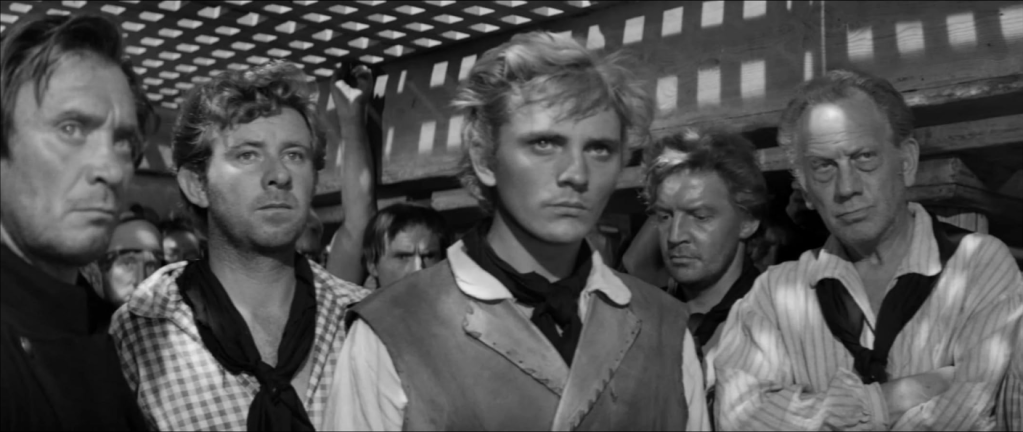
Exploring the Complexities of Justice in Billy Budd, Sailor
A friend recently asked me if I had seen the movie Billy Budd, and though I hadn’t, I was intrigued by his enthusiasm for it as an illustration of something profound—though I wasn’t sure what exactly. This sparked my curiosity, and rather than watch the movie, I decided to read Herman Melville’s novella instead. After all, the book is almost always better than the movie, right? Having now delved into and digested the book, I feel ready to revisit this conversation.
Billy Budd, Sailor is a fascinating and multifaceted exploration of good and evil, justice and injustice, and the often harsh realities of authority and duty. Melville’s tale is set on a British warship during a time of naval mutinies, where discipline and order were paramount, and any disruption to the chain of command was considered a grave threat. The protagonist, Billy Budd, is an embodiment of innocence and goodness. His natural charm and popularity make him a favorite among the crew, but also a target of envy and malice, particularly from the master-at-arms, Claggart.
The Clash of Good and Evil
The central conflict between Billy and Claggart is a stark portrayal of good versus evil. Billy’s innocence and naïveté stand in sharp contrast to Claggart’s malevolence. Claggart’s irrational hatred of Billy is fueled by envy and a deep-seated need to destroy what he cannot be—pure and beloved. When Claggart falsely accuses Billy of mutiny, Billy, unable to articulate his defense due to a speech impediment, reacts impulsively and strikes Claggart dead.
This act sets the stage for a tragic examination of justice. Captain Vere, the ship’s commander, is faced with an agonizing dilemma. He knows that Billy is fundamentally good and acted without malice, yet the law is clear: striking a superior officer, especially resulting in death, is punishable by death.
The Imperfect Application of Justice
One of the main themes of the novella is the imperfection of justice. Captain Vere’s decision to uphold martial law, despite his personal belief in Billy’s innocence, illustrates the conflict between legal duty and moral justice. His choice to execute Billy is a tragic one, and it raises a profound question: How can justice be served when the law itself is rigid and unyielding, incapable of accounting for the nuances of human behavior and intention?
“Struck dead by an angel of God! Yet the angel must hang!”
This dilemma is compounded by the novel’s ending, where a newspaper account of the incident completely distorts the truth. Billy is portrayed as a dangerous mutineer, while Claggart is depicted as an innocent victim. This manipulation of the narrative to serve nationalistic purposes adds insult to injury, illustrating how those in power can shape perceptions of justice and truth to suit their own ends.
The Catch-22 of Justice
One takeaway from the novel is the perilous nature of pursuing justice in an unjust system. If your superior is corrupt and you seek justice, you might succeed in removing them, but the consequences for yourself can be equally dire. This is the tragic reality Billy faces: by defending himself against a malicious accusation, he unwittingly condemns himself to death.
This raises a fundamental question: If justice is imperfect, how can we pursue it? Is it better to seek imperfect justice than to accept injustice? Melville seems to suggest that, while justice as applied by human beings is flawed and often cruel, it is still a necessary part of maintaining order in society. The alternative—chaos, anarchy, or unchecked personal retribution—might be even worse.
The Death of Captain Vere: A Just Consequence?
Captain Vere’s death in Billy Budd, Sailor is a moment laden with irony and poetic justice. As he is fatally wounded in battle, Vere’s demise can be seen as a form of cosmic retribution or divine justice for his role in Billy’s execution. Despite his adherence to duty and the law, Vere’s actions lead to an outcome that is both morally and emotionally devastating, and his death leaves us grappling with complex feelings about justice and responsibility.
For me, Vere’s death evoked no sympathy. It felt like an unfortunate but fitting consequence for a man who, despite his internal conflict, chose the rigidity of law over the compassion of justice. He was, after all, the one who insisted on Billy’s execution, even while recognizing Billy’s innocence and the mitigating circumstances of the case. Vere prioritized the maintenance of authority and order above all else, and in doing so, he became an instrument of injustice.
His fate seems to suggest that even those who operate within the bounds of law and duty are not free from the repercussions of their actions. Vere’s death serves as a reminder that there is a personal cost to moral compromise, and that upholding the letter of the law, while neglecting its spirit, can lead to ruin. His decision to condemn Billy, though legally justified, feels like a betrayal of his own conscience and a failure to protect the very values he sought to uphold.
“Farewell to the Rights of Man!” Billy Budd (movie)
It’s difficult to muster sympathy for a character who, in the end, is a tragic figure not because of his noble sacrifice, but because he became ensnared by his own rigid adherence to duty. His final words, “Billy Budd, Billy Budd,” reveal the haunting regret that lingers with him until his last breath. Yet, this regret does not absolve him of responsibility; it merely underscores the human tragedy of a man who, in trying to do what he believed was right, ended up causing irreparable harm.
Captain Vere’s death is unfortunate, not because of the loss of his life, but because it symbolizes the ultimate failure of a man who chose the law over justice, and authority over humanity. His end reflects the novel’s broader critique of rigid systems that prioritize order over compassion and serve as a stark reminder of the potential consequences when we allow rules to eclipse our moral instincts.
The Distorted Newspaper Account: Another Injustice
One of the most striking aspects of Billy Budd, Sailor is the distorted newspaper account that appears at the end of the novella. The article completely misrepresents the events on the ship, portraying Billy Budd as a dangerous mutineer and Claggart as an innocent martyr. This manipulation of facts serves a propagandistic purpose, reinforcing the narrative that the British navy—and by extension, British authority—is always just and above reproach, while anyone who opposes it is inherently suspect and dangerous.
This theme resonates powerfully with contemporary issues in media. Just as the newspaper in the story molds the truth to fit a certain agenda, modern media often shapes narratives to influence public perception, sometimes at the expense of accuracy and fairness. Whether through selective reporting, biased framing, or outright misinformation, the media has a profound impact on how we understand events and people.
Today, we frequently see how the portrayal of events can be twisted to serve political, ideological, or corporate interests. For instance, complex situations are often reduced to simplistic “good versus evil” narratives that do not reflect the nuances of reality. This can polarize public opinion and hinder a deeper understanding of the issues at hand. The rise of social media and the 24-hour news cycle has only intensified this phenomenon, making it easier for misinformation to spread quickly and widely.
The Tragic Seed of Envy: How a Simple Emotion Led to Three Deaths
The entire tragedy of Billy Budd, Sailor can be traced back to a single, powerful emotion: envy. Claggart’s jealousy of Billy Budd’s natural charisma, good looks, and the respect he garnered from both his peers and superiors set the stage for a catastrophic chain of events. What begins as a seemingly petty resentment grows into a poisonous force, ultimately leading to the downfall of not just one, but three men.
Billy Budd embodies an ideal that many admire but few possess. His innocence and charm make him a beacon of positivity on the warship, earning him the admiration of his fellow sailors and the trust of his superiors. But this very same goodness that endears him to others sows the seeds of envy in Claggart’s heart. Unable to tolerate Billy’s effortless popularity and the purity of his spirit, Claggart becomes consumed by a desire to destroy what he cannot be. This internal struggle manifests in his false accusation of mutiny, an act born not out of concern for the ship’s safety but from a deep-seated need to see Billy brought low.
“There are many ways to lie, Mr. Claggert, but there is only one way to tell the truth.” Billy Budd (movie)
What Claggart may not have anticipated is the profound impact his envy would have, not only on Billy but on Captain Vere as well. This single act of malice forces Vere into an impossible situation, testing his commitment to duty and the moral laws he claims to uphold. Ultimately, his decision to condemn Billy to death—despite knowing that he is innocent of any malicious intent—reveals the destructive power that envy can unleash, spreading beyond its original target to ensnare others in its grasp.
In the end, three men are irrevocably changed and, eventually, lost. Billy, the innocent, faces an unjust execution. Claggart, the instigator, dies at the hands of his own scheming, and Captain Vere, the arbiter of justice, is left to confront the crushing weight of his decision until his own tragic death in battle. Each man is tested, and each man falls—either to envy, to duty, or to the consequences of choices they were compelled to make.
The story of Billy Budd serves as a cautionary tale about the insidious nature of envy. What begins as a seemingly harmless emotion festers into a force capable of wrecking lives and destroying even the most virtuous of men. It reminds us of the profound impact that our inner states can have on the world around us. The envy in Claggart’s heart is not just a personal failing; it is a destructive energy that ripples outward, implicating and dooming those who become caught in its wake.
“With no power to annul the elemental evil in himself, though readily enough he could hide it, apprehending the good, but powerless to be it, a nature like Claggart’s surcharged with energy as such natures almost invariably are, what recourse is left to it but to recoil upon itself and like the scorpion for which the Creator alone is responsible, act out to the end the part allotted it.”
This tale invites us to reflect on how we handle our own feelings of envy and resentment. Left unchecked, these emotions can grow into something far more dangerous, distorting our perception of others and leading to decisions that have far-reaching consequences. In the case of Billy Budd, envy becomes the seed of a tragedy that costs three men their lives, illustrating the devastating potential of unchecked jealousy and the dark paths it can lead us down.
Reflections and Questions
Having read the book, I find myself more prepared to discuss its complexities with my friend. I’m curious to know what aspects of the movie he found so illustrative. Was it the portrayal of Billy as a Christ-like martyr? The moral quandary faced by Captain Vere? Or perhaps the depiction of a rigid and unfeeling system that crushes individual goodness in the name of order?
Ultimately, Billy Budd leaves us with more questions than answers, which is perhaps why it resonates so deeply. It challenges us to think about the nature of justice, the role of authority, and the tragic costs that can arise when good and evil clash within the confines of human institutions. It’s a story that reminds us that while justice may be imperfect, the pursuit of it—and the reflection on its shortcomings—is a vital part of the human condition.
In a world where moral clarity is often elusive and authority can be both protective and oppressive, Billy Budd remains a poignant and timely reminder of the complexities we face in our search for justice.
Considerations
- Do you agree that the strict application of the law is sometimes necessary, even if it leads to morally unjust outcomes? Why or why not?
- The distorted newspaper account in the novel serves as a critique of media manipulation. Do you think this kind of misrepresentation is still a problem in today’s world? How do you navigate the truth in media narratives?
- How do you think the themes of Billy Budd resonate with contemporary issues of justice and authority? Are there any parallels you see in today’s world?
- How would you define “justice” in a situation where following the rules results in an outcome that feels morally wrong? Is there a balance between adhering to the law and acting ethically?
References
- Herman Melville, Billy Budd, Sailor https://amzn.to/3XXyeIG
- Billy Budd, Movie, 1968 https://www.imdb.com/title/tt0055796/

 Treasures of the Elysian Fields
Leave a comment